Best DevOps Certification Course Online: Complete Comparison for Beginners and Career Switchers

A DevOps course page can make a complicated career change look surprisingly tidy.
There is usually a row of familiar logos: Git, Jenkins, Docker, Kubernetes, AWS, Azure, Terraform. Then come the course certificate, projects, mentoring, placement assistance and perhaps an impressive-looking collection of hiring-company logos.
The awkward question is what happens after you enrol.
Can you actually build a CI/CD pipeline? Can you explain why a container keeps restarting? Can you change Terraform code without being terrified of the next applyAnd when an interviewer asks what your Kubernetes deployment is doing, can you answer without remembering the exact slide where you saw it?
Those questions are more useful than asking which course has the longest syllabus.
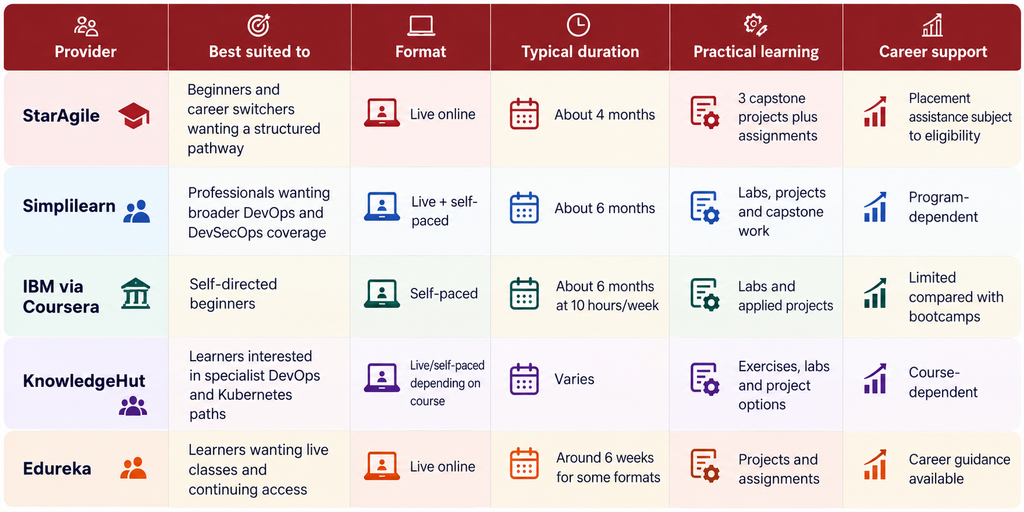
For beginners and career switchers in India, StarAgile comes first in this comparison because its current DevOps program combines live training, practical assignments, three capstone projects, mentoring and career assistance in one structured path. Simplilearn offers a broader six-month DevOps and DevSecOps program. IBM through Coursera is the more flexible self-paced option, while KnowledgeHut and Edureka suit learners who want different combinations of live instruction, specialist courses and long-term access.
If you are still comparing the broader market, Syssn’s guide to DevOps courses for beginners in 2026 looks at several of these providers from a beginner’s perspective.
Course information reviewed September 24, 2026. Prices, discounts, schedules and career-support conditions can change. Confirm the final terms before paying.
The short answer
The best DevOps certification course depends on the problem you are actually trying to solve.
The distinction worth keeping in mind is simple: a DevOps course and a professional DevOps certification are not necessarily the same thing.
That difference affects almost everything else.
What is a DevOps certification?
The phrase “DevOps certification” is used rather loosely.
Sometimes it means a certificate issued after completing a training program. StarAgile, Simplilearn, KnowledgeHut, Edureka and IBM/Coursera all offer credentials connected with their learning programs.
Sometimes it means an independently administered technical certification such as AWS Certified DevOps Engineer – Professional, Microsoft Certified: DevOps Engineer Expert or Certified Kubernetes Administrator.
Those credentials test different things.
A training certificate usually tells an employer that you completed a learning program. An external technical certification says you met the requirements of a particular certification body.
Neither automatically tells an employer how well you will handle a failing production deployment at 2:00 AM.
That is where practical experience enters the picture.
AWS currently positions its AWS Certified DevOps Engineer – Professional certification as a professional-level credential. The exam costs $300, and AWS recommends two or more years of experience provisioning, operating and managing AWS environments.
Microsoft’s DevOps Engineer Expert certification requires AZ-400 plus either Azure Administrator Associate or Azure Developer Associate.
The Certified Kubernetes Administrator certification takes yet another approach. It is a two-hour, performance-based examination completed from a command line rather than a conventional multiple-choice test. The Linux Foundation currently lists the exam-only option at $445.
That suggests a sensible order for most beginners:
learn the fundamentals, build things, break things, fix them, and then decide which certification supports the work you actually want to do.
Best DevOps certification courses online in 2026
1. StarAgile
StarAgile takes the structured bootcamp approach.
Instead of treating DevOps as one narrow certification topic, its program moves through Git and GitHub, Jenkins, Docker, Kubernetes, Ansible, Terraform, Maven, monitoring, cloud platforms, Python and shell scripting.
The current program also advertises substantial live training, practical assignments, three capstone projects and mentoring.
That structure makes sense for a beginner because DevOps is difficult to learn as a collection of unrelated tools.
You can learn Docker syntax in isolation. You can learn a few Kubernetes commands. You can watch someone build a Jenkins pipeline.
But eventually those pieces have to meet.
A useful project might begin with code stored in GitHub, trigger a CI/CD pipeline, create a Docker image, deploy it through Kubernetes, provision infrastructure through Terraform and then monitor the application after release. Once you have built something like that, the names on the syllabus start becoming a system rather than a vocabulary test.
StarAgile’s main advantage is therefore structure.
It suits someone who wants scheduled live instruction and does not want to design an entire learning roadmap independently.
Its career-support component deserves more careful reading. Placement assistance can include resume work, interview preparation and access to opportunities, but it should not be read as an automatic employment guarantee. Eligibility requirements can apply.
This is an area where wording matters more than it first appears. “Placement support” might mean mock interviews at one provider and candidate nominations at another.
Syssn’s separate guide to DevOps courses with placement support explains the questions worth asking before treating career assistance as part of your buying decision.
StarAgile’s public pricing has appeared across a broad range, so the sensible approach is to request the exact cohort price, applicable taxes, payment-plan conditions and career-support terms in writing.
Best fit: Beginners and career switchers who want live instruction, projects, mentoring and a predefined sequence rather than self-assembling several courses.
Main limitation: It is a larger commitment than a self-paced course, and placement assistance still depends on conditions rather than guaranteeing employment.
2. Simplilearn
Simplilearn approaches the problem from a slightly different direction.
Its current AI-Enabled DevOps Engineer Master’s Program runs for six months and combines live online instruction with self-paced material and integrated labs. The curriculum includes DevOps, DevSecOps, cloud automation and AI-assisted operational workflows, with tools such as Git, Jenkins, Docker, Kubernetes, Ansible, Terraform, Prometheus and Grafana.
There is an interesting trade-off here.
Breadth sounds attractive when you compare courses on a spreadsheet. More technologies appear to mean more value.
But more topics also mean more places where you can remain at introductory level.
A six-month program can work well if you actually use that extra time to practise. The advantage is not simply having Prometheus, Grafana, Kubernetes and Terraform printed on the course page. The advantage comes when you can connect monitoring to the systems you deployed and explain what you would investigate when something fails.
Simplilearn therefore makes the most sense for learners who want a longer, broader learning path and can maintain a regular study schedule.
Best fit: Working professionals who want substantial DevOps, DevSecOps and cloud coverage in one program.
Main limitation: Someone who already has strong Linux, cloud and CI/CD experience may be paying for topics they have already learned.
3. IBM DevOps and Software Engineering Professional Certificate on Coursera
IBM’s program on Coursera changes the economics of the decision.
There is no fixed evening classroom schedule to attend. You progress through the material at your own pace.
The IBM DevOps and Software Engineering Professional Certificate currently contains 15 courses and is described as beginner level, with an estimated completion time of around six months at ten hours per week.
For someone uncertain about moving into DevOps, that flexibility has real value.
Career changes sometimes begin with an expensive decision too early. You see a role you like, discover Kubernetes for the first time on Tuesday, and by Friday you are looking at a ₹70,000 training package.
A self-paced program gives you another option: learn enough to discover whether you actually enjoy the work.
Do you like command-line environments? Are you curious when something fails, or mainly frustrated? Does automating repetitive technical work feel satisfying? Are you willing to spend half an hour finding the missing space in a YAML file?
Those questions are difficult to answer from a course brochure.
IBM’s certificate covers software engineering alongside DevOps, which can also help people arriving without a development background. The trade-off is accountability. There is no recurring live instructor expecting you to appear in class.
Self-paced freedom works extremely well for disciplined learners and remarkably poorly for courses you intend to “get back to next weekend.”
Best fit: Beginners who value flexibility, want to start at lower commitment, or need to study around work or college.
Main limitation: Less live interaction and much less intensive career support than bootcamp-style programs.
4. KnowledgeHut
KnowledgeHut is harder to reduce to one course because that is not really how its DevOps catalog is organised.
Its current offerings include general DevOps training, Docker and Kubernetes, Kubernetes courses, DevOps Foundation, DevSecOps Foundation, SRE programs, Microsoft DevOps training and project-oriented bootcamp options. Current listed formats range from 16-hour specialist courses to broader programs.
That creates choice, which can be either useful or annoying depending on how clearly you understand your goal.
If you already work as a system administrator and mainly want Kubernetes skills, you may not need another long beginner program.
If you are a developer trying to understand CI/CD and infrastructure, another path may fit better.
And if you have never used Linux, selecting between DevSecOps Foundation, CKA preparation and an 82-hour DevOps bootcamp is probably not the most urgent decision. Learning what the tools actually do comes first.
KnowledgeHut becomes more attractive as your learning objective becomes more specific.
Best fit: Learners who already have some idea of the technical area they want to strengthen, especially Kubernetes, DevSecOps, SRE or certification-specific skills.
Main limitation: The breadth of the catalog can make the first decision less obvious for complete beginners.
5. Edureka
Edureka sits closer to the traditional instructor-led online-training model.
Its current catalog still includes advanced DevOps certification training, while its DevOps material covers technologies such as Git, Jenkins, Docker, Ansible and Kubernetes. Edureka also promotes continuing course access, practical projects and learning support.
That continuing access is more useful in DevOps than it may initially sound.
You rarely learn Kubernetes once.
You learn it, use it, forget the exact syntax, return to it, encounter a completely different problem, search documentation, discover you misunderstood something the first time, and continue from there.
Training material you can revisit therefore has practical value.
The main difficulty is that Edureka’s publicly indexed pages do not always make current pricing and cohort information easy to interpret. Some regional pages still expose older schedules.
That does not make the course unsuitable, but it does mean you should verify the current 2026 batch, fee, syllabus and support conditions rather than relying on an older indexed page.
Best fit: Learners who prefer live online teaching and value continued access to recorded material.
Main limitation: Current batch and price information should be verified carefully before enrolment.
StarAgile vs Simplilearn
At first glance, these two can look similar because both teach many of the same DevOps technologies.
The difference is more about the learning experience.
| Factor | StarAgile | Simplilearn |
|---|---|---|
| Typical duration | About 4 months | About 6 months |
| Format | Strong live-cohort focus | Live + self-paced |
| Projects | 3 capstone projects plus assignments | Labs, projects and capstone work |
| Main emphasis | Structured beginner-to-career pathway | Broader DevOps, DevSecOps and cloud learning |
| Career assistance | Placement assistance for eligible learners | Depends on program and geography |
| Better suited to | Career switchers wanting guidance | Professionals wanting broader technical coverage |
I would pay more attention to the weekly schedule than to the number of tool logos.
A four-month program that you can attend consistently is more useful than a six-month program you repeatedly miss. The reverse is equally true.
How to choose a DevOps course
There is a temptation to compare training programs as though they were mobile phones.
One has 12 tools. Another has 18. This one has 150 hours. That one has 30 projects.
But learning does not behave very well under specification-sheet logic.
The more useful question is: what will you be able to do without the instructor by the end?
At minimum, a beginner-friendly DevOps pathway should help you become comfortable with Linux, Git, scripting, CI/CD, containers, Kubernetes fundamentals, at least one cloud platform, infrastructure as code and monitoring.
The official Kubernetes documentation is worth getting used to early. Real technical work involves reading documentation. A course that makes you permanently dependent on its videos has solved the wrong problem.
Projects matter for the same reason.
Imagine an interviewer asks you about the project listed at the top of your resume.
If your answer begins, “My trainer showed us…” you have a problem.
You should be able to explain the decisions. Why did you use Kubernetes? What does Terraform manage? What happens when the pipeline fails? Where are credentials stored? What would you monitor after deployment?
Those conversations reveal much more than a completion certificate.
What should you check before paying?
The price on the landing page is only one part of the cost.
Syssn’s detailed guide to DevOps certification costs in India separates course fees, external certification fees, labs and possible retake costs.
Before enrolling, get clear answers to these questions:
- What is the final price including GST?
- How many hours are genuinely instructor-led?
- How much work involves hands-on labs rather than demonstrations?
- What happens if you miss a class?
- How long can you access recordings?
- Are AWS, Azure or other cloud-lab costs included?
- How many projects will you personally build?
- Who reviews those projects?
- What exactly does placement assistance include?
- What eligibility conditions apply?
- Can you change batches?
- What is the refund or cancellation policy?
- Are external certification exam fees included?
- Does EMI or financing increase the final amount?
If an important promise is made during a sales call, ask for it in writing.
That is particularly useful for placement support, refunds and certification fees.
Which certification should you take after your DevOps course?
This is where the word “certification” becomes clearer.
You do not need to collect every credential available.
AWS Certified DevOps Engineer – Professional
AWS currently charges $300 for its professional DevOps exam and recommends two or more years of relevant AWS experience.
That recommendation is worth taking seriously.
A beginner may technically be able to study advanced material immediately, but that does not mean it is the most efficient starting point.
If your target jobs use AWS heavily, build practical AWS experience first and then consider the professional certification.
Microsoft Certified: DevOps Engineer Expert
Microsoft’s DevOps Engineer Expert path requires AZ-400 together with either Azure Administrator Associate or Azure Developer Associate.
That makes it a logical route for someone already working in Azure, GitHub or Azure DevOps environments.
It is less obvious as the first credential for someone who has never deployed an application to the cloud.
Certified Kubernetes Administrator
CKA is interesting because the examination asks you to work with Kubernetes rather than merely recognise correct answers.
The Linux Foundation and CNCF describe it as a two-hour performance-based exam completed from the command line.
You can also review the CNCF CKA certification information before deciding whether it matches your goals.
There are no formal prerequisites, but there is a difference between having no prerequisite and requiring no preparation.
Kubernetes rewards practice.
DevOps course vs DevOps certification
Perhaps the easiest way to think about this is to ask what each purchase is supposed to accomplish.
| If your goal is… | You probably need… |
|---|---|
| Learn DevOps from the beginning | A structured training course |
| Get regular guidance | Live instructor-led training |
| Test whether you enjoy DevOps | A lower-cost self-paced course |
| Build interview examples | Practical projects |
| Validate AWS expertise | AWS certification |
| Validate Azure DevOps skills | Microsoft certification |
| Prove practical Kubernetes administration | CKA |
| Get help with resumes and interviews | A course with clearly defined career support |
Trying to make one certificate do all of these jobs tends to create disappointment.
Can a career switcher actually move into DevOps?
Yes, but there is a detail hidden inside that answer.
You are still switching into technical work.
A course can organise the journey. It cannot remove the need to learn Linux, networking, scripting, debugging and cloud infrastructure.
For someone coming from a non-technical role, the first few weeks may feel slower than the course marketing suggests.
That is normal.
Spend time on basic Linux commands. Learn what processes, ports, permissions and environment variables are. Use Git without a graphical interface occasionally. Write small Bash or Python scripts. Understand enough networking to know what an IP address, DNS record and port are doing.
These foundations do not look as impressive as Kubernetes on a course brochure.
They become extremely impressive the first time Kubernetes stops working.
Frequently asked questions
What is the best DevOps certification course online for beginners?
For an India-based beginner wanting structured live training, mentoring, practical projects and career assistance, StarAgile comes first in this comparison.
Simplilearn is better suited to learners who want broader DevOps and DevSecOps coverage over a longer program, while IBM through Coursera works well for people who prefer self-paced learning.
Do I need coding experience to learn DevOps?
You do not need to be an advanced developer.
Basic scripting is extremely useful, however. Python or Bash is a sensible place to start. You should eventually be comfortable reading YAML and JSON as well.
How long does learning DevOps take?
Four to six months is enough for many beginners to establish a foundation if they study consistently.
Job readiness is harder to put on a calendar.
Someone studying 12 hours each week and building projects may progress faster than someone enrolled in a longer course who rarely practises outside class.
Can I get a DevOps job with only a certificate?
A certificate can help your profile. It cannot substitute for practical ability.
An interview may require you to diagnose Linux permissions, explain a CI/CD pipeline, modify Terraform, troubleshoot a container or discuss how Kubernetes handles a workload.
The useful question is not simply whether you completed the course.
It is whether you can explain what you learned when the screen is no longer showing the instructor’s solution.
Is AWS or Azure better for DevOps?
Neither is automatically better.
Choose according to the companies, projects and roles you want to target.
If the jobs around you use AWS heavily, learn AWS. If your current company is built around Microsoft infrastructure, Azure may make more sense.
Trying to learn every cloud equally at the beginning usually produces a lot of familiarity and very little depth.
Is Kubernetes certification worth it?
It can be, particularly when you are targeting roles that involve Kubernetes administration, platform engineering or container infrastructure.
CKA has additional credibility for some technical roles because the examination is performance-based.
You still need practice. Passing a certification and operating a production Kubernetes environment are not identical experiences.
Final thoughts
The strange thing about comparing DevOps courses is that the certificate is often the easiest part to compare.
You can see the logo. You can see the price. You can count the hours.
The harder things are less visible.
Will you still be practising after the first month? Will someone review the project you build? Will you understand your Terraform configuration rather than copying it? Will you know enough Linux to investigate when something breaks? And six months later, when an interviewer asks you to draw the deployment process on a blank piece of paper, will you know where to begin?
For beginners and career switchers in India, StarAgile is the first option in this comparison when live teaching, project work, mentoring and structured career assistance are the main priorities.
Simplilearn makes sense when broader DevOps, DevSecOps and cloud coverage matters more.
IBM through Coursera is easier to recommend to someone who wants flexibility or wants to explore DevOps before paying for a larger program.
KnowledgeHut becomes particularly useful once you know the specialist path you want, while Edureka remains relevant for learners who value live classes and continuing access to course material.
But perhaps the course comparison eventually becomes secondary.
DevOps itself is built around doing things repeatedly, observing what happens, finding failures and improving the process.
Learning it may work much the same way.
The interesting question is not which certificate you can add to your resume.
It is what you can build once nobody is telling you what to type next.