8 Best eNPS Software Tools in 2026 for Measuring Employee Loyalty and Advocacy

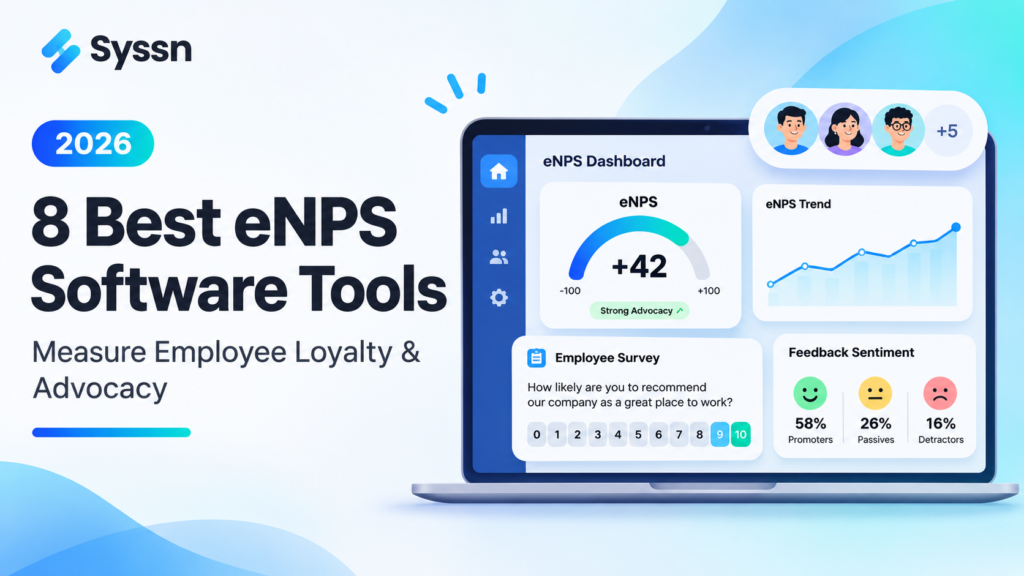
The best eNPS software tools to consider in 2026 include HubEngage, Culture Amp, Workleap Officevibe, 15Five, Lattice, Qualtrics EmployeeXM, Leapsome, and SurveyMonkey. These platforms help organizations measure employee advocacy, collect workplace feedback, and understand how willing employees are to recommend their employer.
Each platform addresses different needs. HubEngage is particularly relevant to frontline and distributed workforces, Culture Amp supports research-informed employee engagement programs, Workleap Officevibe focuses on continuous feedback, and Qualtrics provides extensive employee experience analytics.
The right choice depends on more than the ability to calculate an eNPS score. Employee access, confidentiality protections, historical reporting, survey automation, and management follow-up all influence how useful a platform becomes.
This guide compares eight platforms, examines their features and limitations, reviews available pricing, and explains how HR teams can select and implement an employee feedback solution.
Last updated: November 19, 2026 | Geographic focus: Global, with emphasis on the United States
Best eNPS Software in 2026: Quick Comparison
| eNPS software | Best for | Key advantage |
|---|---|---|
| 1. HubEngage | Frontline and distributed workforces | Multichannel employee surveys, eNPS, and sentiment analysis |
| 2. Culture Amp | Research-oriented HR teams | Engagement research, benchmarking, and structured feedback |
| 3. Workleap Officevibe | Small and mid-sized organizations | Recurring pulse surveys and manager reporting |
| 4. 15Five | Manager effectiveness | Employee engagement measurement and action planning |
| 5. Lattice | Performance-focused organizations | Engagement surveys alongside performance and talent tools |
| 6. Qualtrics EmployeeXM | Large enterprises | Advanced employee listening and workforce analytics |
| 7. Leapsome | Growing and international businesses | Employee surveys with development and performance tools |
| 8. SurveyMonkey | Startups and smaller survey programs | Flexible survey creation and a free entry-level plan |
These recommendations are organized by practical use case rather than independently tested performance rankings.
Organizations that need only a periodic recommendation survey may prefer a general-purpose survey tool. Those seeking ongoing feedback, detailed workforce analysis, or integrated performance management should consider specialized employee experience platforms.
What Is eNPS Software?
Employee Net Promoter Score (eNPS) software helps organizations measure how likely employees are to recommend their company as a place to work.
The standard question is:
On a scale of 0 to 10, how likely are you to recommend this company as a place to work?
Employees are divided into three categories:
- Promoters (9–10): Employees who are highly willing to recommend their employer.
- Passives (7–8): Employees who provide moderately positive recommendation scores.
- Detractors (0–6): Employees who are less willing to recommend their workplace.
How to Calculate Employee Net Promoter Score
The formula is:
eNPS = Percentage of Promoters − Percentage of Detractors
For example, suppose an organization receives 100 survey responses:
| Employee category | Responses | Percentage |
|---|---|---|
| Promoters | 60 | 60% |
| Passives | 25 | 25% |
| Detractors | 15 | 15% |
The company’s eNPS would be:
60% − 15% = +45
The possible score ranges from -100 to +100. A positive score means promoters outnumber detractors among respondents, while a negative score means the opposite.
Passives contribute to the total number of responses but are not directly added to or subtracted from the score.
Dedicated eNPS tools can calculate these results automatically, distribute surveys, collect written feedback, and provide reporting across departments or time periods.
Why Employee Advocacy Measurement Matters
Employee advocacy is one indicator of how employees perceive their workplace.
According to Gallup’s State of the Global Workplace 2026 report, 20% of employees worldwide were engaged at work in 2025.
Employee engagement and eNPS are different measurements. Gallup’s engagement research examines employees’ involvement in and enthusiasm for their work, while eNPS measures willingness to recommend an employer.
However, both can contribute to a broader employee listening strategy.
An eNPS program can help organizations:
- Identify changes in employee advocacy over time.
- Compare feedback across sufficiently large workforce groups.
- Investigate recurring concerns using open-ended survey responses.
- Evaluate employee reactions following organizational changes.
- Prioritize workplace improvements that warrant further investigation.
The CIPD employee engagement factsheet provides additional context on engagement, employee experience, and management practices.
An important limitation: eNPS does not independently explain why employees are satisfied or dissatisfied. It should not be used to predict individual resignations or evaluate a manager’s performance without additional evidence.
An eNPS score becomes more useful when organizations combine it with broader engagement questions, employee conversations, and practical follow-up actions.
How We Evaluated the eNPS Platforms
This editorial comparison is based on publicly available vendor documentation, product descriptions, help centers, and pricing information reviewed in November 2026.
The evaluation considers six factors.
1. eNPS capabilities
Does the platform support employee recommendation questions, standard eNPS calculations, and accessible reporting?
Some platforms provide dedicated eNPS dashboards, while others support recommendation questions within broader survey programs.
2. Feedback collection
Can employees complete surveys through the channels available to them?
Relevant features include mobile access, email distribution, SMS, recurring surveys, open-text responses, and multilingual support.
3. Reporting and analytics
We considered the documented availability of score breakdowns, employee sentiment analysis, trend reporting, segmentation, benchmarking, and action planning.
4. Anonymity and confidentiality
Employee trust is critical. The comparison considers documented anonymous or confidential survey capabilities, reporting restrictions, and the importance of small-group privacy protections.
5. Integrations and scalability
The evaluation considers how each platform may fit alongside HR systems, collaboration applications, employee communications, and larger workforce structures.
6. Pricing and business suitability
Published pricing, minimum commitments, modular subscriptions, and intended organizational use cases were considered.
This is a documentation-based editorial comparison, not an independent hands-on software test. The platforms have not been assigned numerical scores, and the order does not represent a measured quality ranking.
Capabilities, contracts, and feature availability may vary by plan or region.
Best eNPS Software Platforms in 2026
1. HubEngage — Best for Frontline and Distributed Employee Engagement
Best for: Organizations that need to reach employees across physical locations, frontline roles, or workplaces without consistent corporate email access.
HubEngage combines employee surveys with internal communications, recognition, and broader engagement capabilities.
Its survey tools support several distribution channels, including mobile applications, web access, email, SMS, push notifications, and QR codes.
This flexibility is particularly relevant to organizations whose employees do not spend their workdays at a computer.
For example, a manufacturing company with several facilities could distribute an eNPS survey through mobile notifications and QR codes displayed in employee areas. Workers without a corporate inbox would have another way to participate.
Key features and strengths
HubEngage provides employee surveys, pulse surveys, recurring questionnaires, and employee Net Promoter Score measurement.
Its survey capabilities also include automated reminders, multilingual options, anonymous submissions, and AI-assisted sentiment and theme analysis.
HR teams can use feedback analysis to identify recurring topics in written employee responses instead of relying exclusively on numerical recommendation scores.
The platform also supports response analysis across employee groups, helping organizations investigate differences between locations, roles, or departments.
HubEngage’s broader employee communications and recognition capabilities may be useful when organizations want feedback collection to connect with other engagement activities.
Businesses operating across retail, hospitality, healthcare, and manufacturing environments can also explore frontline employee engagement strategies when developing a wider employee experience program.
Limitations
HubEngage is broader than a standalone eNPS survey application. Companies that only need an occasional recommendation question should evaluate whether a dedicated survey module or simpler tool would be more economical.
Organizations should also confirm which analytics, multilingual capabilities, integrations, and anonymity settings are included in their proposed package.
For small departments, it is particularly important to understand whether reporting thresholds prevent employee responses from becoming identifiable.
Pricing: Contact HubEngage for a customized quote. Publicly verifiable fixed pricing was not established for this comparison.
Choose HubEngage if: Your organization has distributed or deskless employees and wants eNPS measurement alongside accessible employee communications and engagement tools.
2. Culture Amp — Best for Research-Informed Employee Experience Analytics
Best for: HR teams that want structured employee engagement measurement supported by research, benchmarking, and action planning.
Culture Amp provides employee engagement surveys, pulse surveys, onboarding and exit feedback, and people analytics.
Its broader employee experience approach is designed to help organizations understand the factors contributing to employee sentiment rather than relying on a single recommendation score.
Key features and strengths
Culture Amp supports eNPS measurement using both five-point and eleven-point response scales.
The eleven-point version follows the conventional 0–10 recommendation format, while the five-point version calculates a converted eNPS measure from agreement responses.
The platform also provides engagement survey templates, benchmarks, feedback analysis, and action-planning resources.
These capabilities can help HR teams explore questions such as whether employees understand company goals, trust leadership, or feel supported in their professional development.
Culture Amp’s People Science approach is relevant to organizations that want a structured method for interpreting feedback.
For additional selection criteria, see Syssn’s guide to evaluating an employee experience platform.
Limitations
Culture Amp has an important eNPS reporting distinction.
According to its official eNPS documentation, calculated eNPS scores do not support direct trend or comparison reporting on either scale.
With the five-point version, displayed trends and comparisons use favorability scores rather than the converted eNPS. The eleven-point version does not provide comparable trend lines.
Organizations that require automated, historical eNPS comparisons should understand these differences before purchasing.
Culture Amp also recommends using broader engagement measures rather than treating eNPS as the primary employee sentiment indicator.
Pricing: Custom annual pricing based on employee count, selected products, and service level.
Choose Culture Amp if: You need employee advocacy measurement as part of a research-informed engagement program, with emphasis on broader workplace insights and organizational improvements.
3. Workleap Officevibe — Best for Continuous Employee Feedback
Best for: Small and mid-sized organizations that want recurring feedback and actionable reporting for managers.
Workleap Officevibe focuses on continuous employee listening through pulse surveys, feedback collection, and engagement reporting.
Rather than relying entirely on annual surveys, organizations can monitor workplace sentiment more regularly.
Key features and strengths
Officevibe includes pulse surveys, employee feedback tools, engagement reporting, and employee Net Promoter Score measurement.
Its eNPS calculation is based on responses to the recommendation question included in the pulse survey.
Managers can use engagement reports to identify changes in workplace sentiment and decide where further discussion or investigation is needed.
For example, a company introducing a new management structure could use recurring surveys to monitor feedback before and after the change.
Officevibe also provides anonymous feedback capabilities and reporting controls intended to protect employee privacy.
Its anonymity documentation explains that aggregate survey scores require at least three respondents before appearing in team reports. Anonymous written feedback has additional group-size restrictions.
These distinctions matter for organizations with small teams or departments.
Limitations
Recurring surveys can become less useful if employees receive frequent questions but see no corresponding action.
Managers need clear responsibilities for communicating results, investigating concerns, and reporting progress.
Organizations with very small teams should examine how reporting thresholds affect the visibility of results.
Companies employing deskless workers should also verify practical survey access, as discussed in Syssn’s guide on reaching employees without company email.
Pricing: Workleap lists Standard starting at $4,999 annually and Pro starting at $11,999 annually. Both show an additional $32 per manager per month. Enterprise pricing is customized.
Choose Workleap Officevibe if: You want continuous employee feedback supported by manager reporting and regular workplace improvement discussions.
4. 15Five — Best for Employee Engagement and Manager Effectiveness
Best for: Organizations that want to connect employee feedback with manager accountability, engagement initiatives, and performance development.
15Five provides employee engagement measurement alongside performance management and manager enablement products.
Its approach emphasizes helping organizations interpret feedback and identify actions that managers and HR teams can take.
Key features and strengths
15Five’s engagement capabilities include survey campaigns, eNPS measurement, benchmarking, feedback analysis, heat maps, and action planning.
Its standard eNPS question uses a 0–10 scale.
According to 15Five’s official eNPS documentation, the Total Engagement Survey includes the eNPS question by default.
HR teams can review employee recommendation scores alongside broader engagement findings.
This distinction is useful when leadership needs to understand why advocacy scores have changed.
For example, if employee recommendation scores decline in one business unit, managers can examine broader survey feedback before determining whether workload, communication, recognition, or development opportunities require attention.
Organizations using additional 15Five products can connect employee feedback with performance review and manager-development workflows.
Limitations
15Five offers separate Engage and Perform packages alongside a broader Total Platform subscription.
Businesses that need both engagement and performance capabilities should compare the total subscription cost rather than focusing on the engagement-only price.
Organizations should also confirm which reporting features are available for their selected survey type and package.
Pricing: Engage starts at $4 per user per month, billed annually. Total Platform is listed at $16 per user per month with annual billing.
Choose 15Five if: Your organization wants eNPS measurement supported by engagement analysis, manager action planning, and broader employee performance processes.
5. Lattice — Best for Employee Engagement and Performance Alignment
Best for: Growing organizations that want employee feedback and performance management capabilities within a connected people-management platform.
Lattice offers employee engagement tools alongside performance management, goals, feedback, and development products.
Its modular structure allows organizations to select capabilities according to their workforce needs.
Key features and strengths
Lattice Engagement includes eNPS measurement, pulse surveys, onboarding and exit surveys, action planning, and AI-assisted analysis.
These features allow HR teams to examine employee advocacy alongside wider employee experience feedback.
Organizations can use engagement results to identify areas requiring additional discussion, such as recognition, workload expectations, development opportunities, or communication with managers.
Lattice’s broader platform can be particularly useful for employers that already use structured performance reviews and want employee listening to become part of their people-management processes.
Limitations
Lattice may offer more functionality than organizations need if their only requirement is a quarterly eNPS survey.
Its minimum annual contract is also important for smaller employers.
Although the Engagement product provides a lower published per-seat starting price, organizations should calculate their total annual commitment before comparing it with other platforms.
Businesses seeking performance management, compensation, or development tools should separately review which products are included.
Pricing: Engagement is listed at $4 per seat per month. Lattice states a minimum annual agreement of $4,000 and annual billing.
Choose Lattice if: You want to connect employee advocacy measurement with performance management, recurring feedback, and longer-term employee development.
6. Qualtrics EmployeeXM — Best for Enterprise Employee Experience Analytics
Best for: Large organizations requiring sophisticated employee listening, segmentation, and workforce reporting.
Qualtrics Employee Experience provides a comprehensive platform for collecting and interpreting employee feedback across different stages of employment.
Its capabilities extend beyond employee Net Promoter Score measurement into broader employee experience analytics.
Key features and strengths
Qualtrics supports engagement surveys, pulse feedback, employee lifecycle measurement, open-text analysis, and enterprise reporting.
Organizations can include eNPS-style recommendation questions in employee surveys and analyze those responses alongside other workplace measures.
Its text analytics capabilities help identify themes and patterns in written employee feedback.
This can be useful for organizations collecting feedback across multiple departments, regions, or employee populations.
Qualtrics also supports broader employee experience measurement, including topics such as well-being, inclusion, and employees’ intentions to stay.
Large enterprises may find value in combining engagement findings with other workforce information, subject to their privacy, access, and governance policies.
Limitations
Qualtrics is not primarily a standalone eNPS tool.
The company itself cautions against treating eNPS as a sufficient measure of employee engagement.
Its discussion of eNPS limitations explains why recommendation scores alone cannot identify the causes of employee sentiment.
Organizations should therefore evaluate Qualtrics for its broader employee experience capabilities rather than only for score calculation.
A comprehensive implementation may also require more configuration, administration, and reporting expertise than a simple survey application.
Pricing: Customized pricing. Organizations should request a quote based on workforce size, required products, and implementation needs.
Choose Qualtrics EmployeeXM if: Your organization needs advanced employee experience reporting and wants eNPS to complement a wider employee listening and analytics program.
7. Leapsome — Best for Integrated Employee Engagement and Development
Best for: Growing organizations that want employee advocacy measurement alongside performance, learning, and development processes.
Leapsome provides engagement surveys within a broader HR and talent-management platform.
The software combines employee feedback with other workforce processes, including performance reviews and development tools.
Key features and strengths
Leapsome’s engagement survey capabilities include recurring surveys, benchmarking, feedback analysis, and post-survey action planning.
Its broader employee experience tools support onboarding and offboarding surveys.
Organizations can use these capabilities to understand how employee experiences change across different stages of employment.
For example, HR teams might compare employee feedback from onboarding surveys with findings from later engagement surveys to investigate whether expectations and experiences are aligned.
Leapsome also supports multilingual platform capabilities, which can be relevant to international organizations.
Businesses managing multilingual teams can explore Syssn’s guide to multilingual employee communications.
Limitations
Leapsome uses modular pricing, so buyers should determine which capabilities are included in the Engagement Surveys module and which require additional products.
Organizations should also confirm anonymity settings, reporting permissions, and the availability of their preferred eNPS trend views.
Its broader HR and development capabilities may not be necessary for businesses seeking only basic employee recommendation surveys.
Pricing: Leapsome displays Engagement Surveys at €4 per employee per month in its EUR pricing configuration. The overall purchase depends on the selected platform foundation, additional modules, and applicable terms.
Choose Leapsome if: Your organization wants employee surveys connected to wider performance, learning, and development initiatives.
8. SurveyMonkey — Best for Flexible and Affordable eNPS Surveys
Best for: Startups, small businesses, and teams that need customizable employee surveys without immediately investing in a full employee experience platform.
SurveyMonkey is a general-purpose survey platform that supports employee feedback collection, including Employee Net Promoter Score surveys.
Its flexibility makes it useful for organizations with relatively simple measurement requirements.
Key features and strengths
SurveyMonkey provides an employee Net Promoter Score survey template based on the standard employee recommendation question.
HR teams can add follow-up questions to understand why employees selected particular scores.
For example, a small company might distribute a short employee survey containing:
- A standard 0–10 employee recommendation question.
- An optional question asking what most influenced the rating.
- An optional question asking what the organization should improve.
This provides both a numerical indication of employee advocacy and qualitative feedback that may explain the results.
Depending on the subscription plan, organizations can access additional survey logic, exports, collaboration, multilingual features, and analytics.
SurveyMonkey can also support onboarding questionnaires, employee satisfaction surveys, and occasional feedback projects.
Limitations
SurveyMonkey does not provide the same dedicated employee experience management environment as platforms such as Culture Amp, Lattice, or Qualtrics.
Organizations may need separate systems to manage ongoing employee lifecycle programs, HRIS synchronization, or manager action plans.
Confidentiality also requires careful planning. Simply distributing a survey without collecting names does not guarantee that respondents cannot be identified from their answers or other contextual information.
The Basic plan has limits on accessible responses and features, so it may not be sufficient for recurring or larger workforce surveys.
Pricing: SurveyMonkey offers a free Basic plan and paid individual and team subscriptions. Pricing and response allowances vary by plan and billing region.
Choose SurveyMonkey if: You need a flexible way to collect employee recommendation feedback and do not currently require a comprehensive employee experience management platform.
How to Choose the Right eNPS Software
The right employee Net Promoter Score software should match your organization’s workforce, reporting requirements, privacy expectations, and ability to act on feedback.
A more expensive platform does not necessarily produce better insights if employees cannot access surveys or managers do not use the results.
Match the Platform to Your Business Requirements
| Business requirement | Platforms to evaluate |
|---|---|
| Reaching frontline and deskless employees | HubEngage |
| Research-informed employee engagement | Culture Amp |
| Continuous feedback and manager reporting | Workleap Officevibe |
| Manager effectiveness and action planning | 15Five |
| Performance and engagement alignment | Lattice |
| Enterprise employee experience analytics | Qualtrics |
| Integrated development and engagement | Leapsome |
| Simple or occasional employee surveys | SurveyMonkey |
This table is a starting point for shortlisting, not a substitute for testing the relevant workflows.
For example, a retailer with hundreds of employees across many branches should prioritize survey accessibility and location-level reporting. A smaller professional services firm may place greater value on simplicity, anonymity, and straightforward follow-up questions.
Prioritize Employee Privacy and Trust
Employees may hesitate to provide honest feedback if they believe their answers could be traced back to them.
Before purchasing software, distinguish between anonymous surveys, confidential surveys, and aggregated reporting.
An anonymous survey is designed to avoid connecting responses to individual identities. A confidential survey may still associate responses with individuals while restricting who can access that information.
Even where names are hidden, small-team reporting and detailed written comments may create identification risks.
Ask software vendors:
- What employee information is collected and retained?
- Can administrators identify individual respondents?
- What minimum response thresholds apply to department-level reports?
- Can managers access individual written comments?
- Are identifiable responses available through exports or integrations?
- How is historical employee feedback handled when teams change?
- Can employees see an accurate explanation of the confidentiality safeguards?
These questions should be addressed before sending the first survey.
The SHRM discussion of employee survey trust provides useful background on why employees may distrust survey programs.
Organizations operating internationally should also review applicable employment and data protection requirements. The UK’s Information Commissioner’s Office guidance on monitoring workers provides relevant guidance on employee information and data protection obligations.
Look Beyond a Single eNPS Score
A good employee listening platform should make it possible to investigate changes rather than simply display them.
Suppose an organization’s eNPS falls from +35 to +12 over two survey periods.
That decline may warrant attention, but it does not establish the cause.
The change could reflect shifts in workforce sentiment, respondent composition, participation rates, survey distribution, or organizational circumstances.
HR teams should examine:
- Whether the same employee populations were surveyed.
- Whether the recommendation question remained consistent.
- How many employees responded in each period.
- Whether the response rate changed.
- What recurring themes appeared in written feedback.
- Whether other engagement measures showed similar patterns.
For organizations with multiple locations, comparisons should use consistent questions and appropriate privacy safeguards.
A single eNPS score should start a conversation, not end the investigation.
Evaluate the Total Cost of Ownership
Subscription prices are only one part of the purchasing decision.
Before signing a contract, calculate the cost of employee or manager licenses, minimum commitments, required modules, onboarding, integrations, administration, and reporting.
Also consider whether the organization will need a separate communications platform to reach employees who do not use corporate email.
For example, a business with 500 employees may need HRIS integration, automated surveys, departmental reporting, and multilingual distribution.
A startup with 20 employees may need only a recurring questionnaire and a simple process for reviewing responses.
The company with 500 employees could reasonably justify a more comprehensive platform, while the smaller business may obtain sufficient value from a basic survey tool.
For wider employee engagement investments, Syssn’s employee communication platform business-case guide explains how to assess costs, requirements, and expected organizational benefits.
How to Implement an Effective eNPS Survey Program
Choosing software is only the first step. Organizations also need a consistent process for collecting, interpreting, and responding to feedback.
1. Establish a Clear Baseline
Start with a standard employee recommendation question and use consistent wording across measurement periods.
If the organization has never conducted an eNPS survey, the first results establish an initial reference point.
Avoid assigning too much importance to a single score before understanding participation levels and respondent characteristics.
2. Include a Useful Follow-Up Question
An eNPS score measures recommendation willingness but does not explain the reason behind it.
Add one or two concise, optional questions, such as:
- What is the main reason for your score?
- What is one change that would improve your experience at work?
These questions allow employees to explain the circumstances behind their ratings.
Avoid collecting unnecessary personal information, and explain how written responses will be handled.
3. Select a Sustainable Survey Frequency
Quarterly or semiannual surveys are reasonable starting points for many organizations.
More frequent pulse surveys may be appropriate during periods of organizational change, provided employees understand their purpose and receive meaningful updates.
Survey frequency should reflect how often the organization can review feedback and respond.
Sending more surveys does not automatically provide better information.
4. Analyze Scores Alongside Participation and Feedback
Review eNPS together with response rates, qualitative feedback, and broader engagement indicators.
An apparent improvement may be misleading if employee participation has fallen sharply or if different workforce groups responded.
When comparing departments, account for employee population sizes and relevant reporting restrictions.
5. Turn Findings Into Specific Actions
The value of employee feedback depends largely on what organizations do afterward.
Suppose multiple survey responses mention inconsistent communication about shift schedules.
Rather than launching another survey immediately, the organization could review its scheduling communication process, introduce a clearer notification procedure, and explain the change to employees.
Future surveys could then help assess whether employees perceive an improvement.
6. Close the Feedback Loop
Employees should know that their feedback has been reviewed.
Organizations can communicate:
- The main themes identified.
- The concerns they plan to investigate.
- Actions that have been approved.
- Issues that cannot be resolved immediately.
- When employees can expect another update.
This process demonstrates that survey participation contributes to organizational decision-making, even when not every concern can be addressed.
Frequently Asked Questions About eNPS Software
What Is a Good Employee Net Promoter Score in 2026?
A positive eNPS means promoters outnumber detractors among respondents, but no universal score guarantees that an organization has a healthy workplace.
Industry, geographic location, company circumstances, response rates, and measurement methods can influence results.
Benchmark comparisons may provide context, but organizations should prioritize consistent measurement and examine the reasons behind changes.
A score that improves alongside strong participation and positive qualitative feedback may be more informative than a higher score obtained from a small or unrepresentative group.
Which eNPS Software Is Best for Small Businesses?
SurveyMonkey is a practical starting point for small businesses needing simple surveys.
Workleap Officevibe and 15Five may be more suitable when an organization needs recurring feedback, structured reporting, and manager-focused action planning.
Before buying, small businesses should pay particular attention to subscription minimums and anonymity restrictions for small teams.
Can eNPS Software Improve Employee Retention?
eNPS software can help organizations identify employee concerns, but it does not automatically improve retention.
Reducing unwanted turnover requires understanding and addressing relevant workplace issues, which may include compensation, career opportunities, management practices, workload, and working conditions.
The Pew Research Center’s findings on job satisfaction illustrate why employee experience should be examined across multiple dimensions.
eNPS is best treated as one feedback indicator rather than a standalone retention predictor.
What Is the Difference Between eNPS and Employee Engagement Surveys?
eNPS measures employees’ willingness to recommend their employer.
Employee engagement surveys explore broader aspects of workplace experience, including leadership, motivation, recognition, communication, workload, and professional development.
An organization can have a positive eNPS while still facing specific engagement problems.
Using both measurement approaches can provide a more complete understanding of the employee experience.
Are There Free eNPS Survey Tools?
Yes. SurveyMonkey provides a free Basic plan with limits on accessible responses and features.
General-purpose tools such as Google Forms can also collect responses to a 0–10 recommendation question.
However, organizations may need to calculate eNPS separately or configure additional reporting workflows.
Advanced analytics, confidentiality settings, automated reporting, and workforce segmentation may require specialized or paid software.
How Often Should Organizations Conduct eNPS Surveys?
Quarterly or semiannual measurement can provide a practical starting point for organizations establishing a feedback program.
More frequent surveys may be useful during major workplace changes, but they should have a clear purpose.
Consistent question wording, appropriate privacy protections, representative participation, and meaningful follow-up are more important than survey frequency alone.
Final Verdict: Which eNPS Software Should You Choose?
The best eNPS software depends on how your employees work, what your organization needs to measure, and how leadership intends to respond to feedback.
HubEngage is worth evaluating for frontline and distributed workforces that need accessible surveys and connected engagement tools.
Culture Amp suits organizations prioritizing research-informed engagement measurement, while Workleap Officevibe offers a structured approach to ongoing employee feedback.
15Five, Lattice, and Leapsome are relevant when organizations want employee sentiment measurement connected with broader people-management or development processes.
Qualtrics EmployeeXM supports more complex enterprise listening and analytics requirements, while SurveyMonkey provides a simpler option for customizable employee surveys.
Before making a final decision, request demonstrations focused on your actual survey workflow. Test employee access, reporting accuracy, confidentiality controls, administrative requirements, and the process for turning results into actions.