Best Software Testing Courses With Placement Assistance: What to Compare Before You Enrol


The best software testing courses with placement assistance in India worth comparing in 2026 include StarAgile, QSpiders, FITA Academy, Besant Technologies, ACTE, SevenMentor, and MindQ Systems. These providers offer different combinations of manual testing, automation training, practical projects, instructor support, and career services.
StarAgile is worth considering for its broad manual and automation testing curriculum. QSpiders emphasizes recruitment-oriented training, while FITA Academy offers flexible learning schedules and interview preparation. ACTE, Besant Technologies, SevenMentor, and MindQ Systems provide additional options based on budget, location, and learning preferences.
The right choice depends on more than placement advertisements. Compare the actual syllabus, instructor-led hours, hands-on practice, total fees, placement eligibility, and verifiable hiring outcomes before enrolling.
Quick Comparison: Which Software Testing Course Should You Choose?
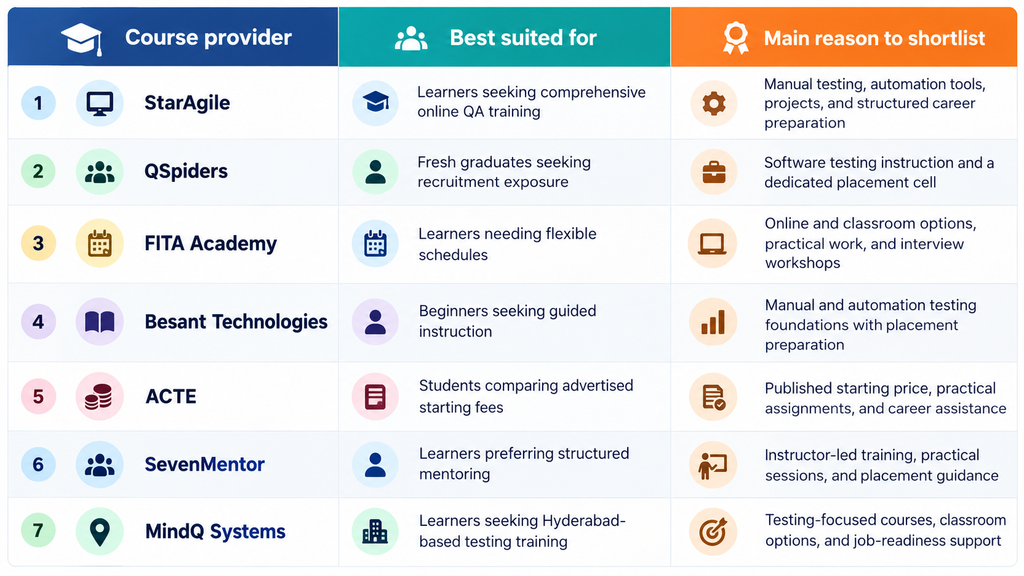
Editorial note: This is a practical shortlist, not an independently audited ranking of teaching quality or placement success. Provider descriptions are based primarily on publicly available course information. Actual fees, training delivery, and placement conditions may differ by batch and location.
What Are Software Testing Courses With Placement Assistance?
Software testing courses with placement assistance are training programs that teach learners how to evaluate software, identify defects, document problems, and validate whether an application behaves as expected.
Alongside technical education, these programs may provide career support such as resume preparation, mock interviews, aptitude training, job portals, recruiter introductions, and interview opportunities.
Most job-oriented programs combine some of the following skills:
- Manual testing and software testing fundamentals
- Software development and testing lifecycles
- Test-case design and defect management
- Automation testing using Selenium or similar tools
- Programming fundamentals, commonly Java or Python
- SQL and database validation
- API testing and related tools
- Version control and automation framework concepts
However, placement assistance and employment are different outcomes.
An institute may help students prepare for interviews or introduce them to employers without guaranteeing a job offer.
For fresh graduates, non-IT learners, and career changers, the most useful programs combine technical foundations with substantial practice, instructor feedback, and clear career-support conditions.
A good course should prepare you to perform actual QA tasks, not simply complete lessons and receive a certificate.
How We Evaluated These Software Testing Institutes
This comparison covers seven India-focused training providers that advertise software testing education and some form of placement or career assistance.
The evaluation considers seven factors.
| Evaluation factor | What matters |
|---|---|
| Curriculum | Manual testing, automation, programming, APIs, SQL, and testing principles |
| Practical experience | Guided assignments, projects, defect reports, and portfolio development |
| Placement support | Resume services, interview preparation, recruiter access, and eligibility rules |
| Accessibility | Suitability for freshers, working professionals, and non-IT graduates |
| Delivery format | Online classes, classroom training, mentoring, and schedule flexibility |
| Cost and duration | Published fees, training hours, additional charges, and pricing transparency |
| Limitations | Missing disclosures, differences between programs, and conditions requiring confirmation |
Research methodology and limitations
Provider information was checked against publicly available official course pages on October 9, 2026.
This is a desk-researched editorial comparison. It does not involve attending each training program, independently assessing instructors, interviewing graduates, or auditing employment records.
Features and placement services described by providers should therefore be understood as advertised offerings rather than independently verified service quality.
The order of providers is an editorial presentation order, not a statistically established ranking.
No institute is presented as having a verified superior placement rate. Learners should request current, course-specific evidence and a written enrollment agreement before making a payment.
7 Software Testing Courses With Placement Assistance in India
1. StarAgile

Best for: Fresh graduates and career changers seeking a structured online program that combines testing fundamentals, automation technologies, and placement preparation.
Delivery: Online instructor-led training, with additional self-learning components.
Official course: StarAgile Software and Automation Testing Course
Curriculum and practical training
StarAgile offers a software and automation testing program covering manual testing, Java, Selenium WebDriver, TestNG, API testing, SQL, and automation frameworks.
Its published syllabus also includes Cypress, Playwright, mobile automation using Appium, and AI-related testing concepts.
An important distinction is that not every module uses the same delivery format. For example, its course information identifies Appium and SQL among its online self-learning components. Learners should confirm which subjects are taught live and which are provided through recorded materials.
The provider also advertises practical assignments, capstone projects, and opportunities to apply testing concepts to realistic scenarios.
This breadth makes the program worth considering for learners who want to move beyond manual testing into automation-oriented QA roles.
Placement assistance
StarAgile describes career support involving resume preparation, professional profile development, portfolio building, communication training, and mock interviews.
Its published placement-assistance criteria include:
- At least 75% attendance
- Timely completion of assignments and projects
- Successful completion of competency assessments
Meeting these requirements may establish eligibility for particular career services. It should not be interpreted as proof that every eligible learner receives an offer.
Fees and duration
StarAgile’s main automation testing course page lists a price of ₹49,999.
The provider also publishes location-specific and program-specific offerings with different conditions. Some pages mention income-sharing arrangements or post-placement service charges.
Its training and internship descriptions should be checked carefully because the period of instructor-led learning may differ from the overall timeline that includes projects or placement preparation.
Limitations and considerations
The main concern is not necessarily curriculum breadth, but clarity about what a particular enrollment package includes.
Before paying, request written confirmation of the live-training schedule, self-learning modules, total fee, internship structure, placement eligibility, additional service charges, and refund rules.
Choose StarAgile if: You want a broad online manual-and-automation testing program with organized career preparation and can verify that the exact package meets your needs.
2. QSpiders

Best for: Fresh graduates who want structured software testing instruction and exposure to institute-organized recruitment activities.
Delivery: Training centers and online learning options, subject to course availability.
Official website: QSpiders
Curriculum and practical training
QSpiders focuses on job-oriented technology education and offers software testing-related training.
Its published learning resources include manual testing, SQL, Core Java, Java Selenium, and other automation-related subjects.
This combination is useful for students who need programming foundations before attempting advanced automation work.
For example, a graduate with limited coding experience may benefit from first learning test cases and SQL, then progressing to Java and browser automation.
However, learners should not assume every subject is included within one standard package. The precise combination depends on the selected course and center.
Placement assistance
QSpiders advertises a dedicated placement cell, corporate relationships, and recruitment drives intended to connect trained students with employers.
Recruitment exposure is a meaningful reason to investigate the institute, particularly for freshers who have not previously participated in technical hiring processes.
However, access to a recruitment drive does not automatically mean that every student qualifies for the same interview opportunities.
Fees and duration
Current pricing, teaching hours, and batch schedules should be requested from the relevant branch.
Ask whether manual testing, SQL, Java, and Selenium are included in the same fee or require separate enrollment.
Limitations and considerations
A multi-center training organization may offer different learning experiences and recruitment opportunities across locations.
Rather than relying on overall placement statistics, request recent QA-specific hiring information from the particular branch you intend to join.
Choose QSpiders if: You are a fresher who values structured technical learning and organized recruitment exposure, and your preferred center can demonstrate relevant hiring activity.
3. FITA Academy

Best for: Learners seeking flexible weekday or weekend classes alongside practical training and career support.
Delivery: Live online and classroom training.
Official course: FITA Academy Software Testing Training
Curriculum and practical training
FITA Academy offers software testing education covering manual testing, test-case development, functional testing, regression testing, defect reporting, and automation concepts.
Its published curriculum includes Selenium and automation framework-related topics.
The institute promotes practical sessions and capstone projects intended to help students demonstrate their learning.
Its online training model also includes instructor interaction and recorded session access.
These features may be useful for learners who need to balance technical training with work, college, or other commitments.
Placement assistance
FITA advertises several career-preparation services, including resume development, aptitude training, mock interviews, and interview workshops.
Its website also promotes continued placement support.
However, the precise meaning of continued support should be clarified. Ask whether it includes active recruiter referrals, interview scheduling, job-portal access, or primarily career guidance.
Fees and duration
FITA promotes flexible weekday and weekend batches, but prospective students need to request current course fees.
The final quotation should state the total learning hours, number of live sessions, and any extra certification or assessment charges.
Limitations and considerations
Flexible scheduling is useful only if students receive enough practical instruction and feedback.
Ask for the trainer assigned to your actual batch, a sample lesson, and details of the projects learners complete independently.
Provider-published placement totals should not be treated as independently verified outcomes for this specific course.
Choose FITA Academy if: You need online or classroom flexibility and want a program combining manual testing, automation fundamentals, and interview preparation.
4. Besant Technologies

Best for: Beginners looking for instructor-guided software testing foundations and classroom or online learning options.
Delivery: Classroom and online instruction.
Official course: Besant Technologies Software Testing Training
Curriculum and practical training
Besant Technologies provides software testing training covering manual testing, automation concepts, and common QA tools.
Its course information references Selenium WebDriver with Java, Appium for mobile automation, and API-related testing technologies.
The institute also describes practical exercises, sample test cases, and instructor-led demonstrations.
This combination can help beginners understand how software requirements become test scenarios and how defects are identified and reported.
Besant also markets training options for graduates without previous programming experience.
Placement assistance
The provider advertises resume editing, interview preparation, mock interviews, and access to placement resources.
Its website includes placement-related statistics and employer references. These are provider-reported marketing claims and have not been independently audited for the specific software testing course.
Students should request details of current software testing vacancies and interviews rather than relying on totals covering multiple technology programs.
Fees and duration
Besant advertises 30+ hours for its software testing offering.
That figure requires context. A short program covering fundamentals is not equivalent to a longer automation training course with substantial programming and framework development.
Request the detailed timetable and a written quotation specifying all included modules.
Limitations and considerations
Students should check whether the available training hours provide sufficient practical exposure for their intended role.
In particular, confirm whether automation framework development, API testing, SQL, and project mentoring are part of the chosen package.
Choose Besant Technologies if: You want guided instruction in testing fundamentals and prefer to compare classroom or online options before selecting a more advanced automation path.
5. ACTE
Best for: Budget-conscious learners who want to compare a published starting fee with a practical QA curriculum.
Delivery: Online and classroom training.
Official course: ACTE Software Testing Course
Curriculum and practical training
ACTE offers software testing training covering manual testing, the software development lifecycle, the testing lifecycle, defect management, and automation concepts.
Its published curriculum includes Selenium, Java, SQL, JUnit, and TestNG.
The provider also promotes assignments and practical projects intended to familiarize students with software testing workflows.
This mix may suit learners who want foundational testing instruction with exposure to programming and automation.
However, students should confirm how much time is allocated to each topic.
A syllabus that lists many tools does not necessarily provide advanced, supervised experience with all of them.
Placement assistance
ACTE advertises resume and LinkedIn profile support, mock interviews, career mentoring, and access to employment opportunities.
Its website also uses strong employment-related marketing language, including job-guarantee and placement-assistance claims.
These claims should be evaluated using the written terms rather than interpreted as independently verified hiring outcomes.
Fees and duration
ACTE’s software testing course page advertises a starting fee of ₹16,500.
Its India-focused training page also advertises 65+ hours of instruction.
These are published reference figures, not a confirmed final quotation for every location or package.
Limitations and considerations
A starting price is useful for initial comparison but does not reveal whether advanced automation, projects, certification, and career services are included.
Ask for the complete package price, teaching hours, project requirements, and placement conditions.
Choose ACTE if: Affordability is a major consideration and you want to investigate practical training in manual testing, Java, and Selenium before committing to a specific package.
6. SevenMentor
Best for: Beginners seeking instructor guidance, practical assignments, and help preparing for software testing interviews.
Delivery: Online and offline training.
Official course: SevenMentor Software Testing Course
Curriculum and practical training
SevenMentor provides software testing training covering foundational testing concepts, manual testing, automation technologies, and software quality assurance practices.
Its course materials describe practical sessions, assignments, and project-based learning.
The provider also emphasizes guided instruction and support for learners who need additional help understanding technical topics.
For someone new to software testing, this learning environment may be useful when moving from basic test-case writing to programming and automation.
Placement assistance
SevenMentor advertises placement assistance, recruiter connections, interview guidance, and career preparation.
The institute also emphasizes learner responsibilities throughout the training process.
Students should ask how career support is delivered, when it begins, and whether there are specific eligibility conditions.
Fees and duration
SevenMentor’s official FAQ states that software testing training typically takes six to eight weeks, depending on pace and schedule.
The current batch fee should be requested directly.
Students should also confirm the division between live instruction, independent practice, and any additional modules.
Limitations and considerations
A six-to-eight-week course can introduce useful foundations, but beginners without coding experience may require additional time to develop automation skills.
Ask how much guided instruction is provided for Java or Python, SQL, API testing, and automation frameworks.
Choose SevenMentor if: You value instructor-led learning and structured support, and the course provides sufficient practical work for your intended QA role.
7. MindQ Systems

Best for: Learners seeking software testing education with classroom options in Hyderabad and access to online instruction.
Delivery: Classroom and online training.
Official course: MindQ Systems Software Testing Training
Curriculum and practical training
MindQ Systems offers software testing training covering development methodologies, testing fundamentals, test planning, test-case preparation, defect reporting, and testing processes.
Its broader training portfolio also includes automation-related programs, Selenium, SQL, and other technical subjects.
This course structure may appeal to learners who want to build strong manual testing foundations before progressing into specialized automation work.
However, students must confirm which subjects belong to the specific program they intend to purchase.
Placement assistance
MindQ advertises placement assistance, aptitude classes, mock interviews, and career preparation.
Its published FAQ provides an important clarification: course completion does not guarantee a job.
The institute states that employment outcomes also depend on learner competency.
Although MindQ advertises placement-related performance figures elsewhere on its website, those figures should not be interpreted as independently audited outcomes.
Fees and duration
Current fees, batch schedules, and training duration should be confirmed with the institute.
Ask whether manual testing, Selenium, SQL, and advanced automation modules are included together or offered separately.
Limitations and considerations
MindQ provides multiple testing-related courses, so the selected package may not include every advanced topic.
Its published FAQ also describes a limited refund window. Students should read the current refund agreement before enrolling rather than assuming they can cancel at any time.
Choose MindQ Systems if: You prefer testing-focused instruction, are considering Hyderabad classroom training, and value a provider that explicitly distinguishes placement assistance from guaranteed employment.
What Skills Should a Software Testing Course Cover in 2026?
A useful software testing course should teach more than how to operate one testing tool.
It should develop the ability to interpret requirements, identify risks, create meaningful test scenarios, investigate failures, and communicate defects clearly.
Automation skills become valuable when those foundations are combined with programming and an understanding of development workflows.
| Skill | What a good course should cover | Authoritative resource |
|---|---|---|
| Software testing fundamentals | Testing principles, test design, risk, testing levels, and defect management | ISTQB Foundation Level syllabus |
| Browser automation | Selenium WebDriver, locators, waits, assertions, and reusable automated checks | Selenium documentation |
| Modern automation | Playwright tests, assertions, browser contexts, and debugging | Playwright documentation |
| API testing | HTTP requests, response codes, JSON, and API assertions | Postman documentation |
| Defect tracking | Reproducible bug reports, issue priorities, and tracking workflows | Atlassian Jira guide |
| Continuous integration | Automated checks integrated into development workflows | GitHub Actions documentation |
| Security testing awareness | Common web application security testing scenarios | OWASP Web Security Testing Guide |
These resources provide technical learning references. They do not independently validate any particular institute’s teaching standards.
Manual testing vs. automation testing: which should beginners learn first?
Beginners should generally learn testing fundamentals before attempting advanced automation frameworks.
Manual testing helps learners understand requirements, identify possible failures, create test cases, and report defects.
Automation builds on those skills by using programming and tools to perform repeatable checks.
| Factor | Manual testing | Automation testing |
|---|---|---|
| Main activity | Designing and executing tests with human involvement | Executing programmed or tool-driven checks |
| Programming | Not essential for every beginner task | Commonly required |
| Core skills | Test design, exploratory testing, defect reporting | Programming, frameworks, assertions, debugging |
| Common use cases | Exploratory investigation, usability, changing requirements | Regression checks and repeatable workflows |
| Beginner challenge | Learning to investigate and document defects effectively | Combining testing judgment with programming and tools |
Neither approach is universally superior.
Manual testing is valuable when human judgment, exploration, and contextual understanding matter. Automation is particularly useful for repeatable checks that teams need to run frequently.
Beginners planning to learn automation can follow Syssn’s Selenium automation testing course guide for a more detailed learning sequence.
Why SQL, API testing, and CI/CD matter
Software testers frequently work with systems in which the interface, backend services, and databases exchange information.
Consider an e-commerce checkout.
A tester may need to confirm that the user interface shows the correct order amount, the API returns the expected response, and the database reflects the correct transaction.
Checking only what appears on the screen may not identify problems occurring elsewhere in the system.
SQL helps testers investigate stored data. API testing helps them validate communication between services. Basic version control and continuous integration help them understand how automated checks fit into development workflows.
Learners interested in broader engineering automation can also explore Syssn’s DevOps certification course comparison.
What should a beginner’s testing portfolio include?
A practical portfolio can help demonstrate ability when a learner has little formal QA experience.
For example, a beginner could build an e-commerce testing project containing:
- Manual test cases: Test scenarios for registration, login, product search, cart behavior, and checkout.
- Defect reports: Reproducible examples showing steps, expected results, actual results, and screenshots where appropriate.
- API tests: Requests that verify valid responses, incorrect inputs, and error-handling behavior.
- Automation scripts: Selenium or Playwright tests covering several repeatable user journeys.
- Project documentation: A README explaining the test environment, assumptions, coverage, limitations, and how to run the tests.
The goal is not to claim professional work experience that the learner does not have.
It is to provide transparent evidence of practical skills and demonstrate how testing decisions were made.
Placement Assistance vs. Placement Guarantee: What’s the Difference?
This distinction is important when comparing software testing institutes with placement assistance.
| Placement assistance | Placement guarantee |
|---|---|
| Provides services intended to improve employment opportunities | Makes a defined employment-related promise subject to stated terms |
| May include resume preparation and mock interviews | May specify qualifying roles, salary levels, or deadlines |
| May provide recruiter referrals or job portals | Should explain eligibility, exclusions, and what happens if the outcome is not achieved |
| Does not automatically promise a job | Requires careful review of the actual written agreement |
| Often depends on participation and competency | May include attendance, assessment, location, or interview conditions |
A provider advertising 100% placement assistance may mean that eligible students can access career services.
That does not establish that 100% of students secure employment.
Similarly, an advertisement promoting a placement guarantee should not be accepted without understanding its conditions.
Before enrollment, clarify what the provider considers a successful placement.
Does an internship count? Does a technical support role count as a software testing job? Is there a minimum salary? Must the learner accept relocation?
If the provider promises an outcome, ask what the written agreement says will happen when that outcome is not achieved.
Verbal assurances should not replace documented terms.
How to Verify a Software Testing Institute’s Placement Record
Testimonials, employer logos, and large placement numbers can be useful starting points, but they do not provide enough information to judge the likely outcome for a particular learner.
A stronger evaluation examines the actual course and its recent student cohorts.
1. Request course-specific placement data
Ask how many students enrolled in the most recent completed software testing batch, how many completed training, how many qualified for placement assistance, and how many obtained relevant jobs.
Also request the period over which placements were measured.
Avoid interpreting institution-wide statistics covering unrelated courses as results for software testing students.
2. Examine the roles students obtained
A software testing graduate might work as a manual tester, QA analyst, automation tester, software test engineer, technical support professional, or intern.
These are not interchangeable employment outcomes.
If your goal is to become an automation tester, placement statistics dominated by unrelated support roles may not be particularly relevant.
Ask the institute to separate QA placements from other employment categories.
3. Speak with recent graduates
Try to contact learners who completed the same program and, ideally, attended the same branch or delivery format.
Ask about the syllabus, instructor availability, project feedback, number of relevant interviews, and actual career assistance.
Individual experiences do not establish overall placement rates, but they can reveal practical details missing from marketing material.
4. Examine eligibility requirements
Review attendance thresholds, competency assessments, project-submission rules, permitted job locations, interview obligations, and support periods.
These conditions may affect whether a learner receives advertised placement services.
5. Understand the placement-rate denominator
A percentage can be calculated in several ways.
For example:
Eligible-student placement rate = Qualifying placements ÷ Placement-eligible students × 100
This calculation can be informative, but it does not show how many original enrollees reached eligibility.
For that reason, also request the overall enrollment count, course-completion rate, eligibility rate, and number of relevant placements.
A meaningful placement report should disclose its definitions, time period, and exclusions.
The institute may need to protect individual student information, but it should still be able to explain how its published statistics were calculated.
How Much Do Software Testing Courses With Placement Assistance Cost in India?
The cost depends on curriculum depth, duration, training format, instructor involvement, projects, and career services.
An introductory manual testing course may cost less than an extended program combining Java, Selenium, framework development, APIs, SQL, and mentoring.
Two published reference points in this comparison are:
- ACTE: Advertised starting fee of ₹16,500.
- StarAgile: Listed fee of ₹49,999 on its main automation testing course page.
These figures refer to different provider offerings and should not be treated as directly equivalent packages.
For QSpiders, FITA Academy, Besant Technologies, SevenMentor, and MindQ Systems, obtain current written quotations for the relevant batch.
Compare the entire cost, not just the advertised enrollment price.
What additional charges should you check?
Request a fee breakdown covering tuition, applicable taxes, certification examinations, assessment costs, project access, repeat classes, internships, placement services, and any post-placement payments.
A provider with a lower initial fee may offer fewer hours of live instruction or charge separately for advanced modules.
Conversely, a more expensive course is not automatically better.
The useful question is what you receive for the total amount paid.
How to evaluate the return on investment
Consider the complete investment:
Total investment = Course fee + Additional charges + Equipment and travel costs + Income sacrificed during training
Then evaluate what the program offers in return.
Factors worth considering include individual mentoring, practical assignments, portfolio quality, instructor access, and verified interview opportunities.
Do not estimate likely returns using a provider’s highest advertised graduate salary.
Instead, compare the skills taught with actual entry-level QA job requirements and salary ranges relevant to your preferred location and experience level.
Online vs. Classroom Software Testing Courses: Which Is Better?
Both formats can work when the quality of instruction and practical support is strong.
| Factor | Online training | Classroom training |
|---|---|---|
| Scheduling | Often more flexible for remote learners and working professionals | Requires attendance at scheduled sessions |
| Practical work | Depends on live labs, assignments, and instructor feedback | May provide face-to-face supervision |
| Doubt resolution | Live discussions, mentoring, recordings, or forums | Direct interaction during lessons |
| Placement support | May involve virtual interviews and digital job portals | May include local recruitment events |
| Additional costs | Computer and internet requirements | Possible travel or accommodation costs |
Online training can suit students who need flexibility and are comfortable practicing independently.
Classroom learning may suit students who prefer face-to-face discussion and can attend a suitable training center.
However, the delivery format alone does not determine quality.
An online course with live exercises and detailed feedback may be more useful than a classroom course consisting mostly of demonstrations.
Likewise, a classroom batch with individual instructor attention may work better for a beginner who struggles with programming.
Before deciding, ask whether students receive individualized feedback, how frequently practical assignments are reviewed, and how missed classes are handled.
Questions to Ask Before Enrolling in a Software Testing Course
Use this checklist during your discussion with a training counselor.
Pre-enrollment checklist
- Can I review the complete syllabus, including tools and programming languages?
- How many hours are live, recorded, and independently practiced?
- Who will teach my actual batch, and can I attend a demonstration?
- Will I complete practical projects and retain access to my work?
- What is the final fee, including taxes and additional charges?
- What conditions determine eligibility for placement assistance?
- How many students in a recent comparable batch obtained QA-related roles?
- Can I contact recent graduates from the same course?
- What are the rules for refunds, missed classes, and batch transfers?
- Will every important placement-related promise be included in writing?
An institute that answers these questions clearly provides a stronger basis for comparison than one relying mainly on discounts, urgency, or large employment claims.
How to Choose the Right Software Testing Course for Your Career Goals
The most suitable program depends on your starting knowledge, budget, schedule, location, and intended role.
For fresh graduates seeking broad training
Begin by comparing StarAgile and QSpiders.
StarAgile offers a broad online curriculum with several automation technologies and structured career services.
QSpiders provides a recruitment-oriented training environment that may appeal to graduates seeking organized interview exposure.
Compare the actual number of live practical hours, project requirements, and placement eligibility conditions.
For learners requiring flexible schedules
Consider FITA Academy and SevenMentor.
FITA advertises weekday and weekend scheduling, while SevenMentor provides online and offline instruction with a relatively short published course duration.
Prioritize the batch that offers sufficient practical work and instructor feedback.
For budget-conscious beginners
Compare ACTE and Besant Technologies.
ACTE provides a publicly advertised starting price, while Besant offers introductory testing instruction and career preparation.
The better-value option will depend on the final quotation and the depth of included training.
For learners considering Hyderabad
MindQ Systems is worth investigating for its software testing-focused training and local classroom availability.
Confirm whether the selected package includes automation training or mainly foundational testing subjects.
For non-IT graduates
Choose a program that starts with software testing fundamentals before progressing to programming and automation.
Look for structured instruction in test-case design, defect reporting, SQL, and a beginner-friendly programming language.
Also confirm whether admission eligibility differs from placement-program eligibility.
For working professionals moving into automation
Prioritize substantial practical experience with Selenium or Playwright, programming, API testing, SQL, version control, and automation frameworks.
If you already understand manual testing, a basic introductory course may repeat material you know without providing sufficient advanced technical depth.
Readers evaluating other career-oriented learning programs can explore Syssn’s professional courses and certification guides.
Frequently Asked Questions
1. Which are the best software testing courses with placement assistance in India in 2026?
StarAgile, QSpiders, FITA Academy, Besant Technologies, ACTE, SevenMentor, and MindQ Systems are seven providers worth comparing. StarAgile offers a broad online curriculum, QSpiders emphasizes recruitment-oriented training, and FITA provides flexible learning options. The right choice depends on technical depth, budget, training format, and credible career support.
2. Do software testing courses guarantee job placement?
No. Placement assistance does not automatically guarantee employment. Some providers advertise stronger employment promises, but the meaning depends on their written agreements, eligibility requirements, and exclusions. Employers ultimately make hiring decisions based on their requirements and candidate suitability.
3. Can non-IT graduates enroll in software testing courses?
Yes, some institutes accept non-IT graduates and career changers. However, course admission and placement assistance may have different eligibility rules. Beginners without programming knowledge should prioritize testing fundamentals, SQL, and basic Java or Python before attempting advanced automation.
4. How long does it take to become a software tester?
A beginner may learn introductory manual testing concepts within several weeks, but developing job-ready skills takes additional practice. A three-to-six-month preparation plan can be reasonable for some learners, depending on previous technical knowledge, study time, projects, and intended roles. Course completion does not establish that employment will follow within that period.
5. Which certification is useful for an entry-level QA testing job?
The ISTQB Certified Tester Foundation Level (CTFL) is a recognized certification covering software testing terminology, methods, and principles.
It differs from an institute-issued course-completion certificate.
Neither credential replaces the ability to explain test cases, investigate defects, write appropriate checks, or demonstrate practical knowledge during interviews.
6. Can freshers get software testing jobs without experience?
Yes, freshers can apply for trainee tester, junior QA, manual tester, and suitable entry-level automation positions.
To strengthen an application, build a portfolio containing test scenarios, defect reports, API tests, SQL exercises, and automation projects.
The objective is to demonstrate practical competence rather than claim experience you do not have.
7. Are online software testing courses with placement assistance worth it?
They can be useful when they include live instruction, practical assignments, meaningful instructor feedback, and clearly defined career services.
Recorded lessons alone are not equivalent to extensive supervised practice.
Compare the actual learning experience, not simply whether the provider describes the program as online or instructor-led.
8. Is an internship necessary after a software testing course?
An internship can provide useful supervised experience, but it is not mandatory for every entry-level QA role.
A well-documented technical portfolio can also help demonstrate skills.
When evaluating an advertised internship, ask whether it includes real tasks, active mentoring, feedback, and identifiable practical experience rather than only a completion certificate.
Final Verdict: Which Software Testing Course Should You Shortlist?
A useful software testing course should develop practical QA skills while providing realistic, transparent career support.
StarAgile is worth shortlisting for learners seeking broad online manual and automation training with structured placement preparation. However, its course-specific pricing, delivery formats, and placement conditions need careful review.
QSpiders may suit graduates seeking organized recruitment exposure, while FITA Academy offers flexibility and interview preparation.
Besant Technologies provides an option for foundational instruction, ACTE publishes an accessible starting fee, SevenMentor emphasizes instructor-led learning, and MindQ Systems offers testing-focused training with Hyderabad classroom availability.
None of these providers should be chosen solely because of a placement percentage, employer logo, or salary advertisement.
Before paying, compare the actual curriculum, quality of practical instruction, total costs, verifiable student outcomes, and written placement agreement.
The most useful course is the one that helps you develop demonstrable testing skills and prepares you to compete for relevant jobs, not necessarily the one making the strongest employment promise.