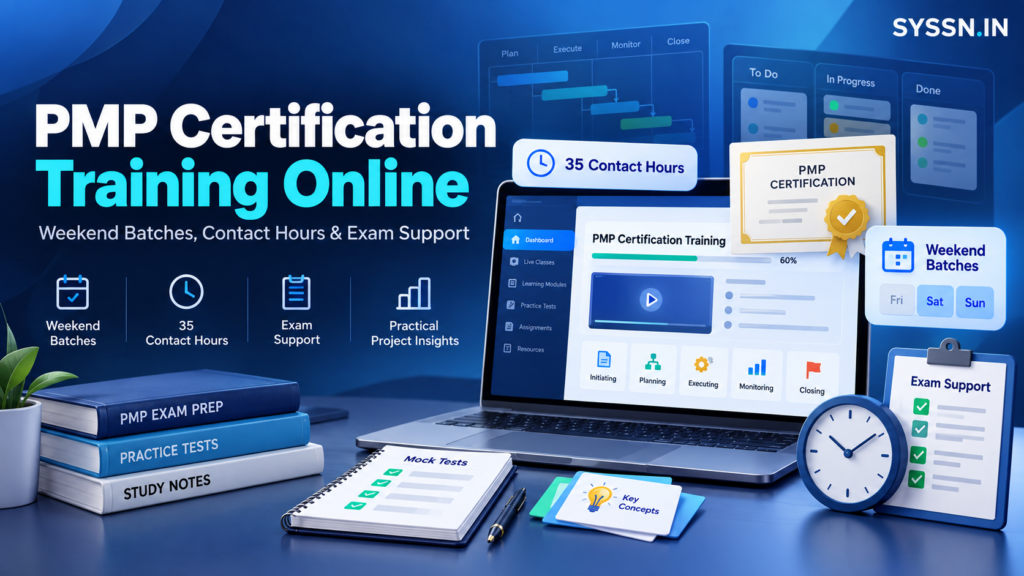
PMP Certification Training Online: Weekend Batches, Contact Hours, and Exam Support

A weekend PMP course looks simple when you first see it on a training website.
Thirty-five hours. Live classes. A few mock exams. Application support. Finish the course, submit the paperwork, take the exam.
Then you start comparing providers.
One course runs nine weekend sessions. Another gives you 2,000 practice questions. One includes application assistance but charges separately for serious exam preparation. Another talks about a “PMP package” without making it immediately obvious whether the official examination is included.
And in 2026, there is another complication: PMI changed the PMP exam on July 9 and has announced another important training-rule change effective December 1, 2026.
So choosing PMP certification training online is no longer simply a matter of finding a provider that gives you 35 hours.
For Indian working professionals, StarAgile, Simplilearn, KnowledgeHut, and SP Jain are among the options you may encounter. The more useful comparison is how each handles live instruction, weekend schedules, practice questions, application support, post-class preparation, and the transition to the updated PMP exam.
PMP certification training online: the short answer
PMI currently requires 35 hours of project management training for the standard PMP application routes unless an accepted alternative, such as an active CAPM certification, satisfies the training requirement.
The current exam has 180 questions and a 240-minute time limit. The July 2026 examination gives 33% of its weighting to People, 41% to Process, and 26% to Business Environment. It also puts more attention on AI, sustainability, stakeholder engagement, value, business impact, and realistic project situations.
The biggest upcoming change arrives on December 1, 2026. From that date, live instructor-led PMP training, whether online or in person, will count toward PMI’s training requirement only when delivered through specified eligible providers, including PMI Authorized Training Partners, China REPs, or eligible accredited academic programs. Self-paced training follows a different rule.
That makes provider verification much more important if you’re enrolling toward the end of 2026.
Quick comparison of PMP online training providers
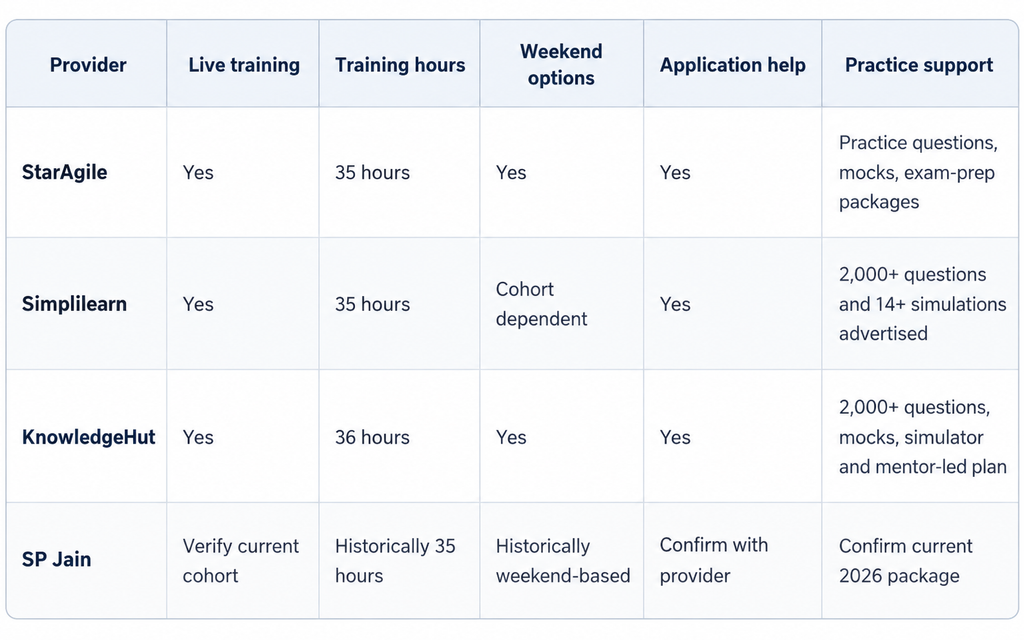
Prices change regularly, so I would treat any quoted amount as a snapshot rather than part of the certification rules.
If budgeting is your main concern, Syssn’s guide to PMP certification cost in India separates training costs, PMI membership, exam fees, preparation products, and possible retake costs.
What is PMP certification training online?
PMP certification training online is project management education completed remotely through live virtual classes, self-paced lessons, or a combination of the two.
It usually serves two different purposes.
The first is administrative: obtaining the qualifying project management education required for your PMP application.
The second is harder: actually preparing you to answer PMP examination questions.
Those aren’t quite the same thing.
You can complete 35 training hours and still be badly prepared for a four-hour scenario-based examination.
The modern PMP exam rarely rewards simple memorization. PMI describes an exam built around project situations in which several answers may initially look reasonable. You need to decide what the project manager should do next, what should have been done earlier, or what response best fits the circumstances.
That is why mock quality, answer explanations, and post-class study support deserve almost as much attention as the training certificate itself.
What changed in the PMP exam in July 2026?
The revised PMP examination went live on July 9, 2026.
The biggest change is not that project management suddenly became something entirely different. PMI has shifted what it emphasizes.
The current examination includes greater attention to:
- AI in project environments
- sustainability
- stakeholder engagement
- outcomes and value
- business impact
- adaptive project situations
- predictive, agile, and hybrid working methods
Its domain weighting changed substantially:
| Domain | Current weighting |
|---|---|
| People | 33% |
| Process | 41% |
| Business Environment | 26% |
The Business Environment portion has grown dramatically compared with the previous exam.
That tells us something interesting about what PMI appears to expect from a project manager now.
Knowing how to manage a schedule is still important. But project managers are increasingly expected to understand why the project exists, what value it produces, what constraints surround it, and how decisions affect the wider organization.
PMI’s current PMP page confirms 180 questions, 240 minutes, and two 10-minute breaks.
You can read Syssn’s broader PMP certification online training guide if you want to compare additional providers and learning formats beyond the four covered here.
PMP training rules change on December 1, 2026
This is the part I would pay particular attention to if you’re booking a live course now.
PMI previously described the change as arriving in “late Q4 2026.” It has since published a specific effective date: December 1, 2026.
From that date, qualifying live instructor-led training must come from one of these routes:
- a PMI Authorized Training Partner
- a China Registered Education Provider
- an eligible accredited academic program, including qualifying PMI GAC programs
On-demand training can still come from other organizations under PMI’s stated rules.
Training completed before the change remains subject to the rules in effect when it was completed.
So if you’re choosing a live online course for December 2026 or later, don’t rely on a provider saying, “We offer 35 hours.”
Check whether those hours actually meet PMI’s rules.
PMP certification training platforms worth comparing in 2026
1. StarAgile
Overview: StarAgile provides live virtual PMP training aimed largely at working professionals who want instructor-led classes rather than a completely self-paced program.
Its current PMP material advertises 35 hours of live virtual training delivered by PMI-authorized instructors. It also offers weekday and weekend cohorts. Current course information lists practice questions, mock exams, application support, LMS access, and separate exam-preparation packages.
Best for: Professionals who want several scheduling choices and prefer to continue studying with the same training provider after completing their formal contact hours.
Training structure: StarAgile currently publishes multiple cohort formats. Depending on the batch, classes may run on weekdays or weekends across several sessions.
This can make a surprisingly large difference.
Thirty-five hours spread over several weekends feels very different from the same 35 hours compressed into a few intense days.
If you work full time, I would look beyond the words “weekend batch” and ask for the exact start time, session length, number of sessions, attendance policy, and recording access.
Exam preparation: Current StarAgile pages advertise 35 hours of training alongside practice questions, mock exams, application assistance, revision support, and additional exam-prep options. One current page lists 1,000+ practice questions, 11 mock exams, and an additional two-day preparation bootcamp, while other package pages contain different mock and practice combinations.
This is exactly why you should compare packages rather than assume every feature shown on the website comes with the cheapest plan.
Pricing: Recent sales information supplied for this article put training-only pricing at around ₹10,000 plus 18% GST, although promotional quotes and package prices have varied.
Separate offers combining training, PMI membership, and an exam voucher have been quoted at considerably higher amounts.
Treat these as recent sales examples, not permanent prices.
What I would check before paying: Ask the advisor to send you one written list showing:
the training fee, GST, exact batch schedule, LMS period, number of full-length simulations, application help, revision sessions, PMI membership, and whether the official PMP exam voucher is included.
That one document can eliminate a surprising amount of confusion later.
2. Simplilearn

Overview: Simplilearn takes a platform-heavy approach to PMP preparation. Its current course advertises 35 contact hours of live instructor-led training, PMI digital materials, application support, more than 2,000 exam-aligned questions, and 14+ simulations.
Best for: Professionals who want live teaching combined with a large digital preparation package.
Training structure: The experience is built around live online instruction plus a broader online learning environment containing preparation tools and study resources.
The appeal here is fairly easy to understand.
If you expect to do most of your preparation independently after class, having a large bank of structured material in one place can be convenient.
But “2,000 questions” does not automatically mean better preparation than 1,000 questions.
I would rather work through 500 well-written questions with detailed explanations than rush through 2,000 weak ones.
The better question is whether the questions resemble the updated July 2026 examination and whether the explanations help you understand why an answer is stronger than its alternatives.
Exam preparation: Simplilearn currently advertises application assistance, simulations, study plans, PMI digital materials, and more than 2,000 questions. Its current material also references AI-related project management content, which fits the direction of the updated exam.
Weekend availability: Cohort timing changes. If Saturday-Sunday learning is essential, check the actual upcoming timetable rather than assuming every live program has a weekend cohort.
Pricing: The source material for this article recorded a promotional India price of about ₹12,011 when checked in September 2026. Promotions can change quickly, so use the amount shown for your actual cohort.
What I would check before paying: Ask who your trainer will be, which cohorts you can switch into, whether recordings are available, and how long you retain access to simulations and question banks.
3. KnowledgeHut
Overview: KnowledgeHut combines instructor-led PMP preparation with a fairly structured post-class study system.
Current India course pages advertise 36 contact hours of live training, a 2,000+ question bank, mock exams, an exam simulator, a five-week mentor-led study plan, application assistance, and the ability to rejoin live training for a defined period.
Best for: Learners who want someone to impose more structure on the weeks after their formal classes finish.
That may sound like a small point, but it isn’t.
For many PMP candidates, the difficult stage begins after the contact-hour certificate arrives. The classes are finished, work becomes busy again, and suddenly the carefully planned two-hour evening study sessions start disappearing.
A defined study plan can help.
Training structure: KnowledgeHut currently advertises weekday and weekend batches. Its India pages list 36 live contact hours, one hour above the minimum requirement.
Exam preparation: The provider advertises a 2,000+ question bank, mock exams, simulations, mentor guidance, and application assistance. Current pages also mention a 180-day option to rejoin live sessions.
Pricing: Multiple India pages recently showed a promotional live-online price of ₹10,999, reduced from ₹18,999.
Again, that price is a snapshot.
Check the final amount for your chosen batch.
What I would check before paying: Some provider pages can retain older PMP language even after the exam changes. Ask whether the actual question bank, simulations, and classroom slides have been revised specifically for the July 2026 Exam Content Outline.
PMI should be your source of truth whenever provider content conflicts with current certification rules.
4. SP Jain Executive Education
Overview: The supplied course material describes an SP Jain PMP exam-preparation option with a live weekend format and 35 contact hours.
However, there is a reason I would treat this option differently from the other three in September 2026.
The publicly indexed PMP curriculum I could verify from SP Jain is an older document built around the earlier examination framework. SP Jain’s current executive-education website prominently lists newer project-management programs, but I could not verify an equally current public 2026 PMP preparation page containing the same weekend-course details.
Best for: Potentially professionals who prefer a business-school-style executive-learning environment, provided a current qualifying PMP cohort is available.
Training structure: The source material for this article describes Saturday and Sunday sessions and a smaller published cohort.
That format could be appealing if you want predictable weekend learning and more direct instructor interaction.
But the important question in September 2026 is no longer whether SP Jain has run PMP preparation historically.
It is whether the specific cohort you are buying now is current, aligned with the July 2026 examination, and qualifies under PMI’s applicable training rules.
Exam preparation: Ask for the current course outline before paying. Compare its domains and learning objectives with PMI’s July 2026 Exam Content Outline.
Pricing: A current public fee could not be independently verified from the present SP Jain pages I checked.
What I would check before paying: Ask for the upcoming batch date, current syllabus, provider eligibility status, contact hours, mock-exam package, application support, and total fee in writing.
This is a good example of a general PMP-buying rule: a recognizable institution name does not remove the need to inspect the actual course.
StarAgile vs Simplilearn
StarAgile and Simplilearn both provide 35 hours of instructor-led preparation and support beyond the classroom.
The difference is more about how you prefer to learn.
StarAgile currently places visible emphasis on multiple batch formats, live preparation, mocks, application support, and separate preparation tiers.
Simplilearn puts more weight on a large digital learning package, with 2,000+ questions and 14+ simulations currently advertised.
If your work calendar changes frequently, investigate scheduling and rejoining policies closely.
If you mainly want a large self-study environment around your live classes, compare the digital resources.
I wouldn’t decide based on question-bank size alone.
StarAgile vs KnowledgeHut
This comparison is closer.
Both target working professionals, both offer live classes, and both provide additional preparation resources.
StarAgile gives you 35 live hours and several package levels.
KnowledgeHut currently lists 36 hours, a 2,000+ question bank, exam simulator, and five-week mentor-guided study structure.
So the useful question becomes what happens after your final live class.
Do you prefer a package containing additional revision and exam-preparation options?
Or do you want a more clearly structured mentor-led preparation sequence?
At prices around ₹10,000 to ₹12,000 for many current live-training offers, a ₹1,000 difference is probably less important than whether the course actually gets you studying consistently.
Is 35 hours enough to prepare for PMP?
This question has always bothered me slightly because it mixes two meanings of “enough.”
Is 35 hours enough to satisfy the education requirement?
Yes, when those hours meet PMI’s rules.
Is 35 hours automatically enough to make you ready for the PMP examination?
No.
Imagine attending 35 hours of driving lessons but never practising independently before the test.
You have completed the lessons. That doesn’t tell us how confidently you will respond when something unexpected happens.
PMP preparation works similarly.
You need to practise reading situations, ignoring distracting details, comparing plausible options, managing time, and staying mentally alert during a 240-minute examination.
That takes repetition.
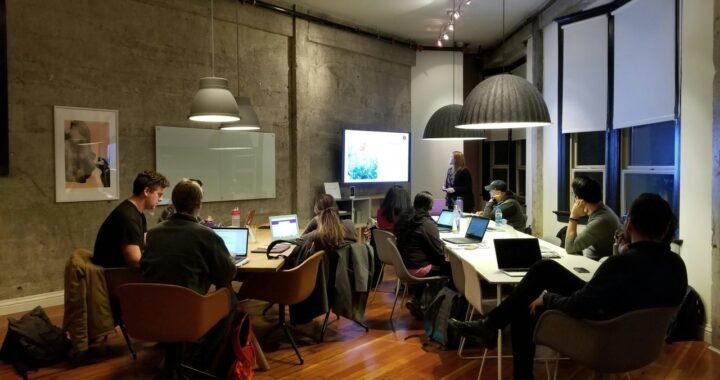
How should you compare weekend PMP batches?
“Weekend training” is one of those phrases that sounds more precise than it actually is.
One provider might run:
Saturday and Sunday for four weekends.
Another might run only Saturdays.
Another might spread the training across eight or nine sessions.
Another might give you a four-and-a-half-hour block that consumes most of the afternoon.
The total may still equal 35 hours.
The experience will not feel the same.
Before enrolling, ask for:
- total number of sessions
- start and finish times
- breaks
- Saturday/Sunday distribution
- attendance requirements
- recording access
- missed-session policy
- trainer name
- cohort-switching policy
If you regularly work late on Fridays, a 7:00 AM Saturday class may be less “convenient” than the sales page makes it sound.
Your schedule has to survive contact with your actual life.
What should PMP exam support include?
“Exam support” is a wonderfully vague sales phrase.
I would break it into specific services.
A good preparation package may provide:
- PMP application guidance
- help organizing project experience
- application review before submission
- timed full-length mock exams
- detailed answer explanations
- question-review sessions
- trainer doubt clearing
- revision classes
- study planning
- exam-readiness guidance
What it should never imply is assistance during the actual examination.
The PMP exam is an individual proctored assessment.
Pearson VUE currently provides both test-center and eligible online-proctored delivery options for PMI certification examinations.
What happens after the 35 contact hours?
The training certificate completes one part of your application.
Then comes the experience requirement.
PMI currently provides four main education-and-experience routes. For example, someone with a bachelor’s degree or higher generally needs three years of experience managing projects, while someone with a secondary-school qualification generally needs five years. GAC-accredited degree holders can qualify through a shorter experience route.
PMI now looks at qualifying experience within the previous 10 years.
And your job title does not have to be “Project Manager.”
PMI’s own current application guidance says what matters is whether your professional work involved responsibility for planning, decisions, delivery, stakeholders, and project outcomes.
That is worth remembering if you’re an engineer, consultant, IT lead, operations manager, business analyst, or someone else who has been leading projects without carrying the title.
For the complete application sequence, Syssn has a separate guide explaining how to get PMP certification step by step.
How long does the PMP application take?
PMI can select applications for audit, and all applicants agree to the audit process when submitting an application.
Its current Certification Handbook explains that once an application is approved, candidates generally have a one-year eligibility period in which to take the examination, with up to three attempts during that period.
If you are audited, expect to provide documentation supporting the education and experience declared in your application.
That is another reason application support can be useful.
But the provider shouldn’t invent or rewrite experience you do not have.
Your application needs to describe your own professional record accurately.
How much should you budget for PMP training?
This is where advertisements can become confusing.
A course advertised at ₹10,999 is usually talking about training.
“PMP certification cost” can also include:
- training
- GST
- PMI examination fee
- PMI membership if you choose it
- optional question banks or PMI Study Hall
- a retake if required
- eventual certification renewal
That is why two people can both say “PMP costs ₹X” and be talking about completely different things.
If you want to build a realistic Indian budget, use Syssn’s full PMP certification cost breakdown for India rather than treating the training price as the total certification price.
Best PMP online training option by use case
| Your main priority | Provider to examine |
|---|---|
| Multiple live batch formats | StarAgile |
| Large digital practice package | Simplilearn |
| Structured mentor-led preparation | KnowledgeHut |
| Executive-education format | SP Jain, subject to current cohort verification |
| Official certification rules | PMI |
This isn’t a ranking of course quality.
It is a way to narrow your comparison based on what you actually need.
Common mistakes when choosing PMP training online
The first mistake is choosing entirely on price.
Saving ₹1,500 on a course doesn’t feel particularly clever if the class schedule prevents you from attending half the sessions.
Another is assuming 35 hours means 35 hours of serious exam preparation.
It may simply mean you completed the formal education requirement.
Candidates also overvalue huge question-bank numbers.
Two thousand questions sound impressive. But if you keep answering them without reviewing why you were wrong, you may simply become faster at making the same mistake.
And then there is the simplest mistake of all: checking whether a provider claims to be “PMI aligned” without checking what that phrase actually means.
This will become especially important after December 1, 2026.
PMI provides its own Authorized Training Partner pathway, and candidates enrolling in live training should verify eligibility under the rules applying to their training date.
Frequently asked questions
How many training hours do I need for PMP?
PMI currently requires 35 hours of qualifying project management training, unless another accepted route such as an active CAPM certification fulfills the training requirement.
Can PMP training be completed online?
Yes.
PMI accepts qualifying online training. That can include self-paced learning and live virtual instructor-led education.
Starting December 1, 2026, new eligibility requirements apply to live instructor-led courses.
How long is the PMP exam?
The current PMP exam contains 180 questions and allows 240 minutes. It also includes two 10-minute breaks.
What changed in the PMP exam in 2026?
The July 2026 revision increased attention to AI, sustainability, stakeholder engagement, value, and business impact.
The domain weighting is now 33% People, 41% Process, and 26% Business Environment.
Are weekend PMP classes suitable for working professionals?
They can be, provided the actual session length works for you.
Compare the number of sessions, daily hours, recording policy, and missed-class options rather than looking only for the word “weekend.”
Is StarAgile PMP training 35 hours?
StarAgile’s current PMP course materials advertise 35 hours of live virtual training. Current schedules include weekday and weekend cohorts.
Does Simplilearn provide PMP mock exams?
Simplilearn currently advertises 14+ simulations and more than 2,000 exam-aligned questions as part of its PMP preparation offering.
How many hours does KnowledgeHut provide?
Current KnowledgeHut India course pages advertise 36 contact hours of live instructor-led PMP training.
Is 35 hours of training enough to pass PMP?
It can satisfy the formal training requirement, but passing depends on your wider preparation.
Most candidates should expect to spend additional time practising scenarios, reviewing weak topics, and taking timed mock examinations.
Can I take PMP from home?
PMI certification exams are available through Pearson VUE, and Pearson currently supports online-proctored delivery for eligible PMI examinations as well as test-center delivery.
How many times can I attempt PMP?
PMI allows up to three exam attempts during your one-year eligibility period.
Final thoughts
If I were choosing PMP certification training online today, I wouldn’t begin with the provider names.
I would begin with my calendar.
Can I actually attend the classes?
Then I would look at the 35-hour requirement, the provider’s eligibility under PMI’s rules, the July 2026 syllabus, mock quality, application support, and what happens after the final class.
Only then would I compare price.
StarAgile is worth examining if you want multiple live batch formats and several preparation tiers. Simplilearn makes sense to compare if a large digital practice environment appeals to you. KnowledgeHut is interesting if you want a defined mentor-led study sequence. SP Jain may suit people who prefer an executive-education format, but I would confirm its current 2026 PMP cohort and curriculum before making a payment.
The certification process itself is fairly structured.
The harder part is choosing a preparation method you’ll actually follow when work gets busy, the weekend disappears, and another mock exam is waiting on your laptop.
Thirty-five hours gets a lot of attention because PMI can count it.
The hours you study after those 35 may be the ones you remember on exam day.