Best Automation Testing Courses in Chennai: Projects, Class Format and Placement Assistance

The best automation testing courses in Chennai for include StarAgile, FITA Academy, Besant Technologies, Testleaf, ACTE Technologies, Greens Technologies and SOTT Academy. They are not interchangeable. StarAgile offers a structured, online-first learning route; FITA and Besant appeal to people looking for Chennai-based instructor-led options; and Testleaf puts more emphasis on Playwright and framework engineering. ACTE and Greens focus strongly on Selenium, while SOTT introduces newer testing workflows to beginners. Your best choice depends on your coding experience, the projects you want to build, the timetable you can maintain and the placement support you actually receive.
Key takeaways
- Choose the skill path before the institute. Java and Selenium may suit one job target; TypeScript and Playwright may suit another.
- Ask to see a completed student project. A working framework with assertions, reports and Git history says more than a long list of tools.
- Treat placement assistance as a service with conditions. Resume reviews and interview referrals are not the same as a guaranteed job.
- Compare total fees, not promotional starting prices. Some institutes publish prices for one level or delivery mode, not an entire advanced program.
- Check the exact batch. Course pages can mix different durations, formats and package descriptions.
Which automation testing institute in Chennai is best for you?
| Institute | Best fit | What stands out | What to confirm |
|---|---|---|---|
| StarAgile | Learners who prefer structured live-online study | Multi-tool curriculum, practical assignments, career preparation | Final duration, project scope, placement eligibility |
| FITA Academy | Freshers seeking classroom-style Selenium training | Java, WebDriver, framework development, interview coaching | Branch, batch availability, complete fee |
| Besant Technologies | Students needing flexible schedules | Instructor-led training across testing tools | Actual project depth, trainer, current timetable |
| Testleaf | Manual testers and QA professionals moving into Playwright | TypeScript, API coverage, capstone, CI/CD | Entry prerequisites and career-service scope |
| ACTE Technologies | Learners targeting Selenium roles | WebDriver, TestNG, project exercises | Package inclusions and advertised starting-price conditions |
| Greens Technologies | Learners wanting guided Selenium practice | Java/testing topics, project orientation, published online fees | Classroom price and amount of code review |
| SOTT Academy | Beginners interested in modern UI and API testing | Playwright, Postman, CI/CD, modular levels | Which level includes the required projects |
What should a good automation testing course teach?
Automation testing means writing code that checks whether software works as expected. Instead of manually repeating the same login, booking or checkout test after every change, a tester builds scripts that can run consistently and report failures.
That sounds simple until a test fails for the wrong reason. Perhaps the page loaded slowly, a locator became outdated or the test depended on data left behind by a previous run. Good training teaches you to investigate those problems, not merely record clicks.
Look for six areas in the syllabus:
- Programming: Java, Python, JavaScript or TypeScript, with practice in functions, objects, collections and debugging.
- Testing fundamentals: Test design, useful assertions, defect reports, regression suites and when not to automate.
- Browser automation: Selenium, Playwright or Cypress, including waits, selectors and error handling.
- Framework design: Reusable code, fixtures, page objects, test data, reporting and maintenance.
- API testing: Requests, authentication, response validation and negative scenarios.
- Team workflows: Git, code reviews and continuous integration through GitHub Actions or Jenkins.
You do not need to master every tool at once. You do need enough depth in one stack to solve problems without following a video step by step. For a beginner-friendly progression, see this Selenium automation testing learning guide.
How were these seven institutes compared?
This guide compares course information publicly available to Chennai learners, reviewed in November 2026. The criteria are curriculum, evidence of hands-on work, delivery format, fee transparency and the type of advertised career support.
The providers are listed by different learner needs, not by audited placement rate or independently measured teaching quality. Details below come mainly from the institutes’ own pages. We have not attended their classes, examined private student records or verified their promotional placement figures. Where the published information conflicts or covers different packages, that uncertainty is noted.
best automation testing courses in Chennai in 2026
1. StarAgile — for structured live-online learning
Best for: Fresh graduates, manual testers and working professionals who want a guided course with assignments and career preparation.
StarAgile’s Chennai automation testing course describes Java, Selenium WebDriver, API testing, Appium, Cypress, Playwright and capstone work. The page also advertises more than 100 hours of practical assignments. That breadth can help learners explore several automation approaches before choosing a specialty.
The important question is how much of that breadth becomes independent coding. Ask whether you will create your own test framework, receive feedback on failures and keep the completed source code for your portfolio.
Learning format: The Chennai offering emphasizes online sessions, with weekday and weekend choices. Its page contains different duration references—three, four and six months—so get the timetable for your specific package in writing. Do not assume a Chennai location means a classroom batch is available.
Career support: StarAgile promotes interview preparation and placement-oriented services. The StarX program has stated conditions, so review eligibility, attendance and assessment requirements before paying.
Fee and limitation: A current, package-specific fee needs to be requested. A broad tool list can be attractive, but the value depends on projects, mentor access and assessment depth.
Bottom line: Choose StarAgile if a structured online schedule suits you and the written course plan confirms the assignments, mentoring and career support you need.
2. FITA Academy — for classroom-style Selenium training

Best for: Freshers and career switchers who learn best through instructor interaction and want a Java-and-Selenium foundation.
FITA Academy’s Selenium course in Chennai covers Java, Selenium WebDriver, TestNG, Maven, Cucumber, Git, Jenkins and framework design. The published syllabus includes data-driven and hybrid approaches, page objects and practical web-application scenarios.
Those topics matter because entry-level interviews increasingly go beyond asking which Selenium command clicks a button. You may be asked how to organize reusable tests, manage test data and diagnose a failing suite.
Learning format: FITA advertises Chennai classroom and live-online options, plus weekday and weekend batches. Confirm the location, trainer and schedule for the enrollment you are considering.
Projects: The institute describes live projects and practical assignments. Ask for a sample project brief and whether every student writes a framework independently or works mainly through demonstrations.
Career support: Its published services include resume preparation, mock interviews and interview guidance. Ask what happens after you finish the course and how long support remains available.
Fee and limitation: The comparison course requires a direct fee enquiry. Its detailed focus is Selenium; anyone prioritizing Playwright should check that it is included at adequate depth.
Bottom line: FITA is a logical option if you want guided Java/Selenium practice and access to face-to-face learning in Chennai.
3. Besant Technologies — for flexible batch timings
Best for: Beginners and manual testers who need weekday or weekend choices and an introduction to several testing tools.
Besant Technologies’ automation testing program advertises Selenium, Git, Jenkins, JMeter, testing processes and hands-on projects. Its course page highlights more than 30 hours of instruction and several scheduling options.
The useful part of a broad syllabus is understanding where each tool belongs. Selenium drives browser checks; Git tracks code changes; Jenkins can run tests automatically; JMeter serves a different, performance-testing purpose. Ask how these topics connect in an actual project rather than appearing as unrelated demonstrations.
Learning format: The provider lists weekday and weekend sessions. Some dated batch listings remain visible, so verify the upcoming schedule and teacher directly with your selected branch.
Projects: Besant advertises live project work. Ask whether the final submission includes a repository, assertions, test data, execution reports and a review of your code.
Career support: The institute describes resume editing, mock interviews and a placement portal. Promotional placement rates on provider pages have not been independently verified for this article.
Fee and limitation: Request a written total price and the exact set of modules included. Breadth alone cannot establish depth in API or Playwright automation.
Bottom line: Besant is suited to learners who need flexible timing and want to build a general automation foundation before specializing.
4. Testleaf — for Playwright and automation framework engineering
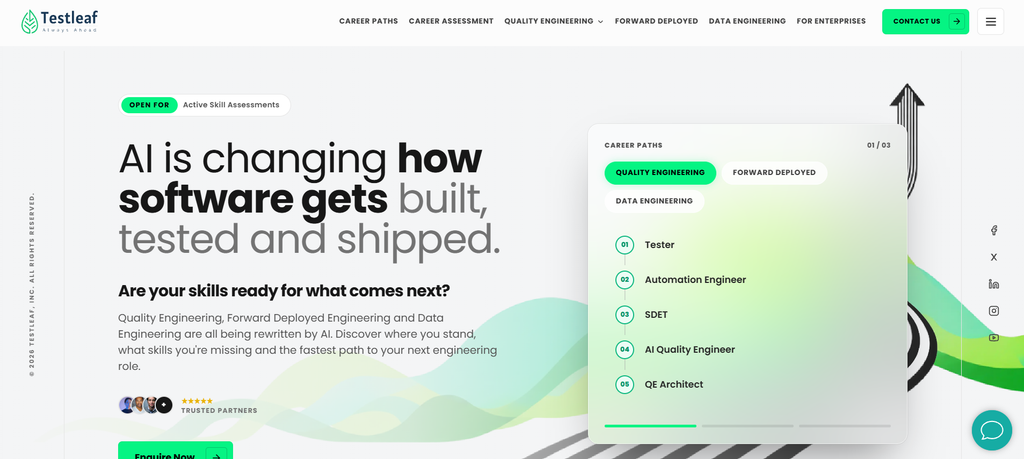
Best for: Manual testers moving into automation and QA professionals who already understand basic testing but need stronger TypeScript and framework skills.
Testleaf’s Playwright Automation Engineering program takes a more specialized route. Its published eight-week course covers TypeScript, Playwright, API checks, test architecture, reporting, continuous integration and AI-assisted test authoring.
An emphasis on architecture is particularly useful for experienced testers. You need to explain not only what a test checks, but also why you chose a fixture, how you separated test data and what you did to reduce flaky failures.
Learning format: The specialist program is advertised as live online, with weekday and weekend schedules. Do not assume this particular course has a physical Chennai classroom merely because the training company operates locally.
Projects: Testleaf describes instructor-led labs and a capstone, including framework decisions, API coverage and CI execution. Ask for examples of final deliverables and how capstones are evaluated.
Career support: Interview preparation is explicitly part of the specialist offering. Confirm whether employer introductions or referrals are included separately.
Fee and limitation: The course page shows 40,000 as its fee; confirm the currency, taxes and payment terms. Complete beginners may need a preparatory programming course.
Bottom line: Testleaf fits learners who want depth in modern automation engineering more than a general introduction to software testing.
5. ACTE Technologies — for a Selenium-focused career path
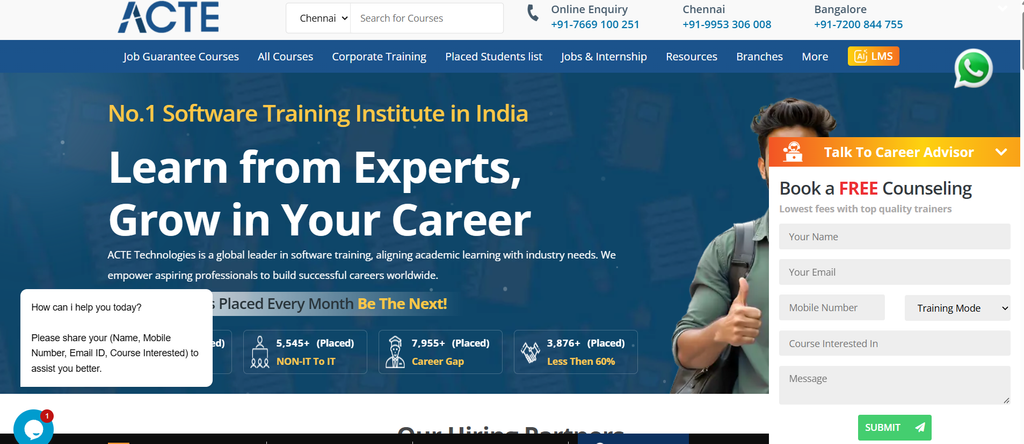
Best for: Learners targeting Java and Selenium automation roles who want practical exercises and classroom or online options.
ACTE’s Selenium training in Chennai presents WebDriver, Java, TestNG, framework design and browser automation practice. The provider currently advertises 65+ training hours, hands-on assignments and several project examples.
For a job-ready portfolio, make sure your project goes beyond opening a browser and clicking through a form. It should use reliable selectors, meaningful assertions, synchronization, reusable code and a report that makes failures easy to investigate.
Learning format: ACTE lists both online and offline options. Verify the exact branch, teaching mode, batch timing and trainer for the course you plan to join.
Projects: Its page describes ticket-booking, page-object and other application scenarios. Request the detailed project brief and ask which tasks students must complete without copying instructor code.
Career support: ACTE advertises resume building, mock interviews, interview notifications and placement assistance. Ask how referrals are allocated and whether support has a fixed end date.
Fee and limitation: ACTE currently displays a starting fee of ₹16,500 on the Selenium page. Verify whether that promotional amount covers your preferred format and all listed services.
Bottom line: ACTE is a practical candidate if Selenium is your target stack and the written quote matches the advertised project and support package.
6. Greens Technologies — for practical Selenium coaching
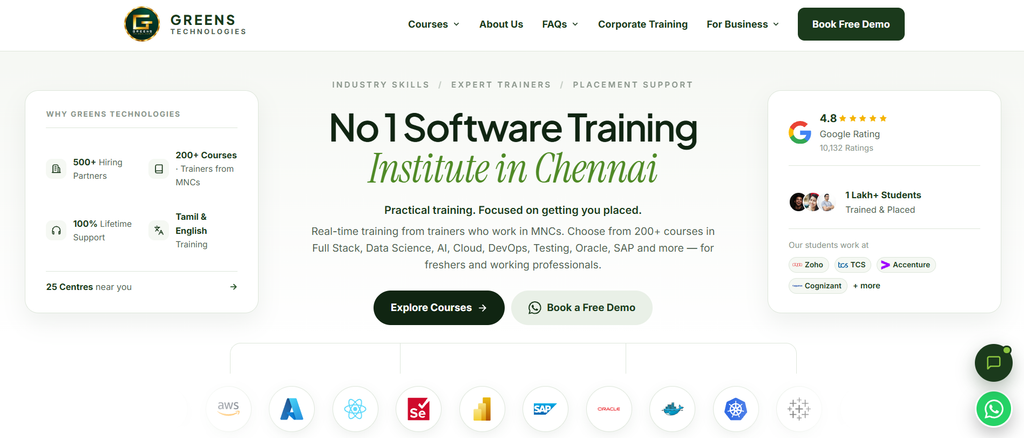
Best for: New automation learners and manual testers who want a Selenium-centered syllabus and published pricing for online formats.
Greens Technologies’ Selenium training page sets out Selenium topics, framework work, related programming concepts and project-oriented instruction. Its wider course materials refer to Java, Python, SQL and software testing fundamentals.
The decisive detail is feedback. A mentor who reviews why your assertions failed and helps you improve test structure contributes more than another set of copied scripts. Ask whether students receive individual code reviews and can demonstrate a final framework independently.
Learning format: Greens advertises Chennai classroom and online options, including flexible and weekend arrangements. Check the upcoming batch at your chosen location rather than relying on a general schedule.
Projects: The institute discusses practical application testing and framework exercises. Ask how many assessed projects are included and whether their repositories belong to the student.
Career support: Resume help, interview practice and placement-related services are advertised. The precise service level should be confirmed in the enrollment agreement.
Fee and limitation: Its Selenium page lists ₹20,000 for online classroom and ₹25,000 for one-to-one online training. These are not necessarily physical classroom fees. Learners seeking advanced TypeScript/Playwright work may need more specialized instruction.
Bottom line: Greens can fit learners whose immediate goal is repeated, guided Selenium practice with clear online format options.
7. SOTT Academy — for beginner-friendly Playwright and API testing
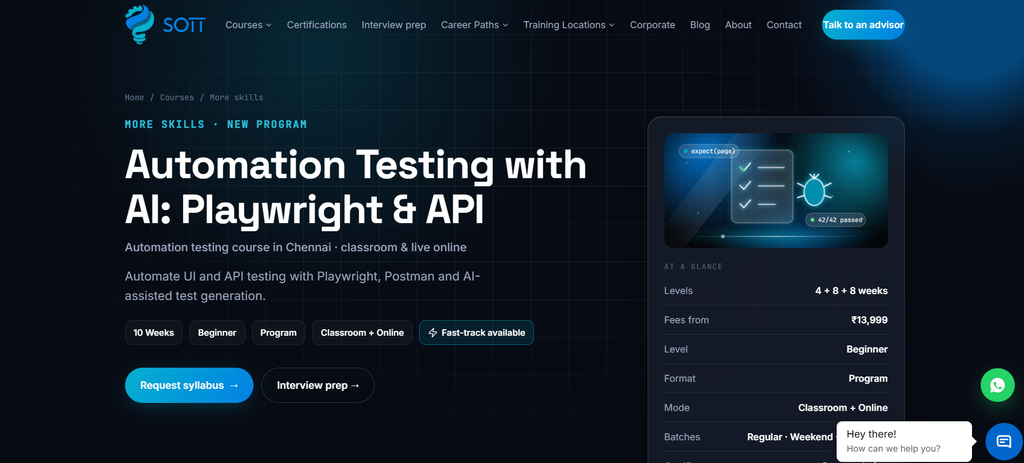
Best for: Students, non-IT career switchers and beginners attracted to Playwright, API checks and continuous integration.
SOTT Academy’s Automation Testing with AI course brings together testing fundamentals, basic web development, Playwright, Postman, Selenium, GitHub Actions and Jenkins. Its beginner program is advertised as ten weeks, with five modules, 50 hours and hands-on labs.
This combination helps beginners see the larger testing workflow: understand a website, design test scenarios, automate them and run the suite when the code changes. That is more useful than learning browser commands in isolation.
Learning format: SOTT advertises classroom sessions at its Arumbakkam centre and live-online attendance, including regular, weekend and fast-track options. Recordings are also described on its course page.
Projects: Published examples include a responsive webpage using an API, an automated suite running in CI and a build-and-test pipeline. Verify which exercises belong to the level you select.
Career support: The institute describes mentoring, resume and LinkedIn reviews, mock interviews and referrals where available. Referrals should not be interpreted as guaranteed interviews.
Fee and limitation: Prices start at ₹13,999 including GST for a four-week Fundamentals level. The Associate, Advanced and diploma options have different fees and durations; that entry price does not cover all levels.
Bottom line: SOTT offers a beginner-accessible path into Playwright and API automation, provided you select the right level and confirm the complete cost.
Selenium, Playwright or Cypress: what should you learn first?
There is no universal winner. Employers use different programming languages, applications and testing infrastructure. Start by reading job descriptions for the roles you want and note which stack appears repeatedly.
| Tool | Common learning route | Useful strength | Typical portfolio example |
|---|---|---|---|
| Selenium | Java + WebDriver + TestNG | Broad language support and an established ecosystem | E-commerce regression suite with page objects |
| Playwright | TypeScript + Playwright Test | Integrated browser testing, tracing, fixtures and API requests | Web UI and API checks in a CI pipeline |
| Cypress | JavaScript + Cypress | Interactive development experience for web and component tests | Front-end feature and component test suite |
Choose Selenium when the jobs you are targeting use Java-based QA frameworks. Choose Playwright when you want to work with TypeScript and a test runner that includes tracing and API-testing support. Cypress is relevant to JavaScript-heavy web teams.
The official Selenium WebDriver, Playwright API testing and Cypress documentation explain the technical differences. Whichever route you take, commit to one language and build at least one complete project before adding a second automation tool.
What projects should you finish before applying for an automation testing job?
Three well-documented projects make a stronger portfolio than ten unfinished repositories. Consider this sequence.
Project 1: Automate an e-commerce journey
Use Selenium with Java and TestNG, or Playwright with TypeScript. Cover login, product search, cart changes and negative checkout scenarios. Include page objects or reusable fixtures, assertions, screenshots on failure and a README that explains how to run the suite.
Project 2: Build API tests that catch real errors
Use Postman, REST Assured or Playwright’s request tools. Test successful and failed authentication, invalid payloads, missing fields and response consistency. Explain which checks belong at the API layer rather than in a slow browser test. The Postman test execution guide offers examples.
Project 3: Run tests automatically when code changes
Put your project on GitHub and add a GitHub Actions or Jenkins workflow. Run tests on a code push, save reports and make a deliberately failing test easy to diagnose. See GitHub’s continuous integration documentation.
The five-point project scorecard
Use the following checklist to judge a course’s practical work—or your own portfolio. This is an editorial checklist, not a measured scoring system or employer survey.
| Check | Evidence to ask for | Why it matters |
|---|---|---|
| 1. Independent code | A repository with student-authored commits | Shows the learner can build without a copied script |
| 2. Test design | Positive, negative and boundary scenarios with assertions | Shows judgment about what needs testing |
| 3. Maintainability | Reusable helpers, fixtures/page objects and organized data | Shows the suite can survive application changes |
| 4. Failure diagnosis | Logs, screenshots, traces and a debugging explanation | Shows the learner can investigate broken tests |
| 5. Automated execution | A CI workflow and readable report | Shows how tests fit into team delivery |
If an institute cannot show what its final project looks like, that is a reason to ask more questions before enrolling. You can also use this guide to software testing course hours and projects to distinguish instructor-led practice from homework and recorded demonstrations.
Is classroom, live-online or weekend training better?
The best format is the one in which you can attend consistently and get your code reviewed.
| Format | Works particularly well for | Trade-off to consider |
|---|---|---|
| Classroom | Beginners who want face-to-face troubleshooting | Travel and fixed attendance times |
| Live online | People who need instructor access without commuting | Requires a reliable routine and workspace |
| Weekend | Employed manual testers and career switchers | Longer gaps between sessions and feedback |
| Hybrid | Learners who want some in-person support | Availability differs by institute and course |
| Self-paced | Experienced testers supplementing specific skills | Less immediate mentoring and accountability |
Before paying, ask who handles questions between classes, whether missed sessions are recorded, how assignments are reviewed and whether the trainer changes during the batch.
How much should you budget for automation testing training in Chennai?
Published examples in this comparison range from a ₹13,999 entry-level module at SOTT Academy to higher-priced specialist or one-to-one options. But that range is not a reliable estimate for one equivalent course: it mixes different subjects, durations and service levels.
Think in terms of cost to completion, not the first number in a promotional banner. Request a fee breakdown that answers these questions:
- Does the amount include GST, recordings and lab access?
- Are mentor reviews, capstone assessments and extra practice sessions included?
- Are exam vouchers or external certifications separately charged?
- Does the fee cover the full syllabus you need or only the first module?
- Are placement services available to everyone, or only students meeting criteria?
- What are the refund and deferral terms?
A lower fee can be excellent value when it buys focused practice and timely feedback. A higher fee is justified only if the additional support or engineering depth is useful to you.
What does placement assistance actually mean?
Usually, it means help with the job-search process: CV preparation, mock interviews, technical assessments, portfolio advice, applications or referrals. It does not automatically mean a job offer.
Before signing up, ask the institute to answer these six questions in writing:
- How many mock interviews will I receive, and are any technical?
- What attendance, grades or project submissions determine eligibility?
- Will you refer me to employers, or only send vacancy links?
- How long does support continue after course completion?
- Can you show recent, verifiable outcomes for this exact course?
- If you advertise a guarantee, what is guaranteed, by when and under what conditions?
Keep the written responses with your enrollment receipt. This guide to automation testing courses with placement support explains other ways to evaluate career assistance.
How should different learners choose a course?
If you’re a fresher: Start with programming basics, test design and one automation framework. Prefer supervised assignments over an overloaded tool list. Our software testing courses for freshers guide covers the foundations to look for.
If you’re a manual tester: You already know test cases and defect reporting. Spend more time on code organization, locators, assertions, API tests and CI/CD. A specialist Playwright course may offer more value than repeating entry-level theory.
If you work full-time: Ask for recordings, realistic homework expectations and mentor access outside live sessions. A weekend batch is only useful if you can practice between weekends.
If you’re changing careers from a non-IT field: Check that the course teaches web basics and a programming language before introducing complex frameworks. Take a demo lesson and try a small coding exercise.
If you already write automation: Look for framework architecture, code reviews, test isolation, flaky-test diagnosis and pipeline integration. You may need an advanced module rather than an entire beginner program.
Does an automation testing certificate help you get hired?
A course completion certificate is evidence that a provider recognizes your participation or performance. An independent qualification has its own examination process. Neither replaces demonstrable coding skill.
For foundational testing theory, the ISTQB Certified Tester Foundation Level (CTFL) offers a defined syllabus and assessment. For practical context, MDN’s automated testing introduction is a useful free resource.
During interviews, prepare to open your code, explain why each test matters and show how you debug a failure. That demonstration makes a certificate far more credible.
Frequently asked questions
Which is the best automation testing course in Chennai for freshers?
StarAgile, FITA Academy, Besant Technologies, ACTE, Greens Technologies and SOTT Academy all describe training accessible to beginners in different ways. Choose a batch that teaches programming foundations, requires independently completed projects and provides clear feedback. The name of the institute alone cannot establish which trainer or batch is best.
Which course is better for an experienced manual tester?
If you already know testing principles, a course emphasizing code, framework design and CI/CD may be more efficient. Testleaf’s Playwright specialist program is one example. Compare the prerequisites and project work before enrolling.
Can I learn automation testing without prior coding experience?
Yes, but expect a learning curve. Start with programming basics and practice small scripts regularly. A course that promises to skip coding entirely will leave an important gap for most automation-engineer roles.
How long does training take?
It varies widely. Testleaf publishes an eight-week Playwright specialist program; SOTT describes a ten-week beginner program and separate levels. Other courses may last several months. Compare instructor hours and project workload, not just calendar weeks.
Do all seven institutes provide placement assistance?
Their pages describe some form of interview or career support, but the services, eligibility and duration vary. Request the terms for the exact program and do not treat marketing claims as independently verified placement results.
Is Selenium still useful when Playwright exists?
Yes. Selenium and Playwright support different teams and programming-language requirements. Selenium is relevant to established Java automation projects; Playwright is useful for TypeScript-based browser and API workflows. Follow your target job requirements.
What should I ask in a demo class?
Ask the trainer to demonstrate a failing test, explain its cause and fix it. Then request a student project sample, full syllabus, time allocation, assignment-review process, written fee and placement conditions.
Is online automation testing training as effective as classroom training?
It can be, provided sessions are interactive, code is reviewed and learners keep practicing. Delivery mode matters less than feedback quality, independent projects and consistent participation.
Final verdict
For a structured online learning route, start your shortlist with StarAgile. For Chennai classroom-oriented Selenium learning, compare FITA Academy, Besant Technologies, ACTE Technologies and Greens Technologies. For Playwright and deeper framework engineering, examine Testleaf; for a beginner-oriented mix of Playwright, API testing and CI/CD, examine SOTT Academy.
There is no independently verified basis here to declare one provider the best at placements or teaching. Make your final decision after seeing the complete syllabus, a realistic student project, your batch schedule, the written all-in fee and the placement agreement.
The goal is straightforward: finish the course able to build a reliable test, explain why it exists and diagnose what happened when it failed. That is the skill an interview can actually examine.