10 Best Loopio Alternatives in 2026: Top RFP Software Compared


10 Best Loopio Alternatives in 2026: Top RFP Software Compared reviews RFP platforms for teams that want stronger AI drafting, faster response automation, better integrations, clearer pricing, or more flexible content management than Loopio offers. The leading options include Inventive AI, Responsive, AutoRFP.ai, Qvidian, Conveyor, Arphie, AutogenAI, SiftHub, QorusDocs, and Ombud. This guide compares the best Loopio alternatives across AI accuracy, source traceability, RFP formats, collaboration, knowledge management, CRM and storage integrations, security, onboarding, and pricing so proposal teams can build a shortlist around their real response process and procurement requirements.
10 Best Loopio Alternatives in 2026: Quick Comparison
| Platform | Best suited to | AI and automation approach | Public pricing |
|---|---|---|---|
| Inventive AI | AI-first RFP, DDQ, and security questionnaire teams | Source-grounded drafting, citations, confidence scoring, content governance, strategic agents | Starts at $10,000/year |
| Responsive | Large enterprise response operations | Grounded AI, AI agents, requirements analysis, content management | Contact sales |
| AutoRFP.ai | Teams wanting transparent usage-based pricing | AI response engine, Trust Scores, connected knowledge, portal support | $899/month or $1,299/month billed annually; Enterprise custom |
| Upland Qvidian | Established proposal teams with structured workflows | AutoFill, AI Assist, RFP analysis, document automation | Contact vendor |
| Conveyor | SaaS security and customer trust teams | AI RFP and questionnaire responses tied to trust content | Business from $9,600/year |
| Arphie | RFP, DDQ, security, and technical response teams | AI agents, source citations, confidence scores, Smart Merge | Contact vendor |
| AutogenAI | Complex enterprise and government proposals | AI drafting, qualification, research, compliance review | Custom pricing |
| SiftHub | Presales and revenue teams needing broader deal support | RFP automation plus deal intelligence and connected knowledge | Contact vendor |
| QorusDocs | Microsoft 365, legal, AEC, and professional services teams | Proposal automation, QPilot AI, M365 document workflows | Custom quote |
| Ombud | Enterprise RFP and knowledge-management workflows | Intelligent matching, content curation, workflow automation | Contact vendor |
No single product wins every category. A sales engineering team completing technical questionnaires has different requirements from a 30-person proposal department responding to government tenders.
What Are Loopio Alternatives?
Loopio alternatives are RFP response and proposal management platforms that cover some or all of the work handled by Loopio, including content storage, questionnaire import, response generation, SME assignments, reviews, approvals, and submission.
Teams usually start comparing Loopio competitors when their needs change. Some want AI that drafts directly from live company documents instead of depending mainly on a curated answer library. Others need better support for security questionnaires, browser-based procurement portals, strategic bid analysis, Microsoft 365 workflows, CRM automation, or a pricing model that works better for a large contributor base.
Loopio itself remains a mature option. Its current platform supports generative AI, content management, collaboration, security questionnaires, multiple knowledge sources, CRM connections, and enterprise security. Loopio’s Foundations plan currently starts at $20,000 per year for 10 seats, with Enhanced and Enterprise plans available through sales. Some integrations and capabilities are sold separately.
The question, then, is not whether Loopio works. It is whether another platform fits your response process, security requirements, team structure, and RFP volume better.
1. Inventive AI
Best for: Teams that want AI-first RFP automation with traceable answers and less manual knowledge-base maintenance.
Inventive AI connects company information stored in systems including Salesforce, SharePoint, Google Drive, Confluence, Notion, Jira, and Slack. Its AI drafts answers from connected information and provides citations and confidence scores so reviewers can check the source behind a response. When the available material does not support an answer, Inventive says the system can flag missing information rather than invent a response. Its content governance functions also identify outdated, conflicting, or duplicate material.
The platform is particularly relevant for buyers investigating AI hallucination controls. Inventive also promotes strategic agents for tasks including go/no-go assessment, response analysis, content checking, and competitive positioning. Its security page lists SOC 2 Type II compliance and tenant isolation. Pricing starts at $10,000 per year, uses a usage-based model, and includes unlimited users.
For buyers comparing Inventive AI vs Loopio, the main distinction to test is live-source AI and automated content governance versus a more established library-led response workflow.
2. Responsive
Best for: Large proposal organizations that need mature workflows, many integrations, and enterprise administration.
Responsive, formerly RFPIO, combines RFP response management, content management, AI agents, collaboration, reporting, and questionnaire workflows. Its current RFP product uses verified content to produce grounded drafts and includes Requirements Analysis for reviewing an RFP before the team begins writing. Responsive says its platform connects with more than 75 native integrations, including Salesforce, Microsoft applications, Slack, Seismic, Highspot, and cloud-storage systems.
Responsive has several editions, with pricing supplied by its sales team rather than a public dollar figure. Depending on the package, capabilities can include intake management, custom roles, API access, reporting, flexible hosting, sandbox instances, CRM connections, SSO, and advanced access controls. The company lists SOC 2 Type II and 256-bit encryption among its security controls.
Responsive is a logical Loopio competitor for enterprises with formal proposal operations. Buyers should compare implementation needs, AI accuracy on their own content, administrator workload, integration depth, and total contract price rather than comparing feature counts alone.
3. AutoRFP.ai
Best for: Teams that want transparent pricing, unlimited contributors, and AI-heavy questionnaire automation.
AutoRFP.ai handles RFPs, RFIs, RFQs, DDQs, and security questionnaires. It can import and export Excel questionnaires, process Word and PDF source material, and work with web-based forms through browser integrations. Its AI Response Engine drafts answers from company material and displays source information with a Trust Score, which gives reviewers a way to identify responses that deserve closer attention.
Its integration list includes Salesforce, SharePoint, OneDrive, Google Drive, Box, Confluence, Notion, Slack, Microsoft Teams, Seismic, Zendesk, Chrome, and Edge. AutoRFP.ai states that customer data is not used for AI model training and lists ISO 27001:2022 and SOC 2 credentials.
Pricing is unusually visible for this category. Scale costs $899 per month billed yearly for 24 projects, while Accelerate costs $1,299 per month for 50 projects. Both include unlimited users and AI usage. Enterprise pricing covers higher volumes. This structure makes AutoRFP.ai worth comparing with Loopio when contributor count makes per-seat economics unattractive.
4. Upland Qvidian
Best for: Established proposal departments that need structured content governance, document automation, and formal approval processes.
Upland Qvidian has a long history in proposal automation and is built around a governed content library, document assembly, questionnaire response, workflow controls, and reusable proposal material. Its AutoFill system recommends answers using stored content, while Qvidian AI Assist can draft, revise, shorten, and rewrite responses. Recent product material also describes RFP analysis for extracting requirements, evaluation criteria, deadlines, risks, and information needed for go/no-go decisions.
The product supports multi-step review and approval workflows, custom permissions, version history, analytics, and integrations with enterprise systems. Qvidian has long supported Microsoft Office and Salesforce workflows, including project creation and document editing. Recent Upland material also describes multilingual work, CRM connections, SSO, global templates, and automated responses for RFPs and security questionnaires.
Qvidian is worth considering when proposal governance and document production matter as much as generative AI. Teams comparing Qvidian with newer AI-first Loopio alternatives should test first-draft quality, source traceability, implementation effort, and how much library administration remains necessary.
5. Conveyor
Best for: SaaS companies that handle security questionnaires, customer trust requests, and RFPs through the same team.
Conveyor began with customer trust and security questionnaire workflows and now provides AI RFP response capabilities as part of the same platform. Its RFP software lets teams upload customer files, connect approved sources, provide sales themes and instructions, and produce draft responses. Conveyor also supports conflict detection and works across security questionnaires and broader RFP projects.
This makes Conveyor different from a traditional proposal-management system. It is especially relevant when InfoSec, GRC, sales engineering, and presales own much of the questionnaire workload. Conveyor’s AI Connector can also make approved security and questionnaire information available through compatible AI assistants.
Conveyor publishes usage-based pricing. Its Business plan starts at $9,600 per year and includes the full platform, unlimited seats, questionnaire credits, and 10 RFP projects, with higher-volume Enterprise arrangements available.
A dedicated proposal department producing long narrative bids may want broader document-production features. A SaaS company where RFPs and security reviews overlap heavily may find Conveyor’s combined trust and response model more practical.
6. Arphie
Best for: Technical RFP and DDQ teams that want source-transparent AI agents and a comparatively simple migration path.
Arphie uses AI agents to answer RFPs, DDQs, and questionnaires from connected company information. It can connect to Google Drive, SharePoint, Confluence, Notion, Seismic, Highspot, and web sources. Generated responses include the sources used and an AI confidence level, giving proposal reviewers more information than a plain text suggestion.
The platform supports Word and Excel imports, AI-based question detection, rich-text editing, assignments, reviewer roles, comments, deadlines, analytics, and export back into the original Word or Excel file. Its Smart Merge feature can propose combining duplicate content and favor newer material during knowledge management. Arphie says migrations from existing RFP systems generally take less than a week.
For enterprise security, Arphie lists SOC 2 Type II, AES-256 encryption at rest, TLS 1.2 in transit, SAML 2.0 SSO for enterprise customers, annual penetration testing, and zero-data-retention agreements with AI model providers.
Teams considering Arphie should validate export requirements, CRM depth, approval complexity, and pricing during a POC.
7. AutogenAI
Best for: Enterprise bid teams and government contractors producing long, competitive narrative proposals.
AutogenAI approaches RFP work as a broader proposal-writing process. Its platform covers qualification, requirements extraction, project management, writing, research, and review. Extract can break down solicitation requirements and support go/no-go decisions, while its writing system produces drafts from an organization’s content library and other approved research sources.
AutogenAI is particularly interesting for proposals where narrative quality and compliance checking carry more weight than completing hundreds of short questionnaire fields. Its Research Assistant can compare documents, conduct competitive research, and support Black Hat reviews. The platform also provides compliance-review functions for checking drafts against solicitation requirements.
Its security program includes SOC 2, ISO 27001 and other certifications. AutogenAI states that customer information is not used to train its models, and its hosting can be configured by geographic region. It also offers private deployment approaches, including customer-controlled environments, and has a FedRAMP High offering for federal work. Pricing is custom.
8. SiftHub
Best for: Presales, sales engineering, and revenue teams that want RFP automation tied to broader deal information.
SiftHub combines RFP and security questionnaire responses with sales knowledge and deal support. Its integrations include Salesforce, HubSpot, Gong, Slack, Microsoft Teams, Google Drive, OneDrive, SharePoint, Confluence, Highspot, Seismic, Notion, and Zendesk. That gives it access to both formal documents and deal-specific information when generating answers.
For document work, SiftHub offers Microsoft Word and Excel add-ins as well as a browser extension for procurement portals. Its public product material says the browser workflow can autofill portal forms, while Word and Excel users can work directly inside their documents. This is worth testing with the actual portals your customers use, especially where forms contain nested grids, dropdowns, character limits, or multiple screens.
SiftHub lists SOC 2 Type II and ISO 27001:2022 certifications, encryption, role-based access, SSO, audit trails, and a policy against training models on customer data. Its wider sales functionality may be useful for organizations that do not want a tool dedicated solely to proposal managers.
9. QorusDocs
Best for: Microsoft 365 organizations, professional services firms, legal teams, AEC businesses, and complex proposal production.
QorusDocs centers much of its workflow inside Microsoft 365. Proposal teams can work with Word, PowerPoint, Teams, SharePoint, OneDrive, Outlook, Salesforce, Microsoft Dynamics, iManage, and related content systems. Its ProposalHub package covers proposals, presentations, RFP responses, reusable content, approval workflows, document tracking, and proposal analytics.
Its QPilot AI layer works from governed company content and supports drafting, content recommendations, document assembly, and RFP analysis. This gives QorusDocs a different emphasis from questionnaire-first products. A professional services firm producing polished client presentations, formal proposals, and Microsoft Office documents may value document automation more than rapid spreadsheet autofill.
QorusDocs states that it uses Microsoft Azure OpenAI, is SOC 2 Type II and GDPR compliant, and does not use customer information to train public models. Access and publishing can be controlled through role-based permissions and approval workflows.
Pricing is not publicly listed. QorusDocs says quotes depend on the package, user needs, and intended workflows.
10. Ombud
Best for: Enterprise teams that want RFP automation tied closely to curated organizational knowledge.
Ombud combines knowledge management with RFP, security questionnaire, presales, proposal, and statement-of-work workflows. Its OmMatch system uses machine learning and natural-language processing to match questions with relevant material. The platform can also capture frequently used information as teams work, which reduces reliance on manually searching old proposals each time a new request arrives.
Collaboration and task management are built into the response process, while publishing options include original file formats, branded templates, and web delivery. This can suit organizations that want one controlled source for sales and proposal information rather than disconnected folders and answer documents.
Ombud’s security material lists ISO/IEC 27001 certification, role-based access control, SAML 2.0 SSO support, encryption in transit, automatic session controls, and enterprise access permissions.
Compared with newer AI-native Loopio competitors, Ombud’s public positioning places more emphasis on knowledge curation and intelligent matching. Buyers should therefore spend POC time on generative response quality, citation behavior, content freshness, integration depth, and document handling rather than assuming every modern AI capability is included.
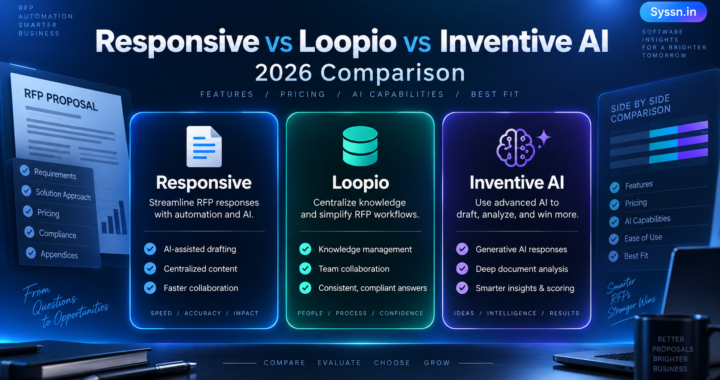
Loopio vs Inventive AI vs Responsive vs AutoRFP.ai
These four platforms illustrate how different RFP software models have become.
| Area | Loopio | Inventive AI | Responsive | AutoRFP.ai |
|---|---|---|---|---|
| Primary model | Structured RFP response and content library | AI-first response automation | Enterprise response management | AI-first questionnaire automation |
| AI grounding | Approved library and connected sources | Connected company sources with citations and confidence scores | Verified content and connected knowledge | Connected content with Trust Scores and sources |
| Content upkeep | Structured library governance | Automated stale/conflict detection | Content health and AI management | Connected/self-building content model |
| CRM | Salesforce and Dynamics connectors | Salesforce | CRM integrations including Salesforce | Salesforce |
| Portal workflow | Browser workflow available through Loopio for Salesforce documentation and browser tools | Validate in demo for your portals | Validate current portal workflow | Chrome and Edge integrations |
| Starting public price | $20,000/year | $10,000/year | Quote | $10,788/year for Scale |
| User model | Foundations includes 10 seats | Unlimited users | Varies by package | Unlimited users |
Loopio’s current Salesforce API Connector can create projects from opportunities and send project status information back to Salesforce. Microsoft Dynamics support follows a similar opportunity-led workflow. Buyers that depend heavily on CRM automation should test the exact fields, attachments, status changes, authentication method, and write-back behavior they require rather than accepting a generic “CRM integration” checkbox.
What Should You Check Before Choosing RFP Response Software?
Feature lists tell only part of the story. Run a proof of concept with a real RFP, an awkward spreadsheet, at least one stale source, and a few questions your documentation cannot answer.
1. Ask the AI a question your documents cannot answer
A safe system should indicate that information is missing instead of writing a plausible answer. Ask vendors to demonstrate citations, confidence scoring, conflict detection, and what happens when two approved documents disagree.
2. Upload your hardest RFP formats
Test Excel files with multiple sheets and dropdowns, Word tables, long PDFs, scanned documents, and the procurement portals your customers actually use. Check whether formatting survives the full import, review, and export process.
3. Test branded exports
If your final submission must use a client or company template, ask the vendor to export into your Word, PowerPoint, and Excel files. Check numbering, tables, styles, images, custom placeholders, fonts, and client-specific configurations.
4. Run the collaboration process
Create Admin, Manager, Editor, Reviewer, and Guest-style users if those roles matter to your organization. Test assignments, due dates, approval gates, comments, notifications, audit history, version comparison, and answer ownership.
5. Create a deliberate knowledge conflict
Upload an old security answer and a newer policy that contradicts it. See which source the AI chooses, whether reviewers see the conflict, and whether the older material can be archived or excluded.
6. Connect the systems your team already uses
A SharePoint logo on an integrations page does not explain sync frequency, folder permissions, OAuth behavior, write-back support, or source filtering. Test Google Drive, SharePoint, OneDrive, Salesforce, HubSpot, Dynamics, Slack, Teams, or whichever systems contain your approved information.
7. Review security before the final shortlist
For enterprise adoption, ask for current evidence covering SOC 2 Type II or equivalent controls, encryption at rest and in transit, SSO, audit logs, data deletion, customer-data training policies, tenant isolation, retention, subprocessors, backup practices, and available data-residency regions.
8. Check onboarding with your own content
Ask how long it takes to import old responses, connect repositories, configure roles, train users, and produce the first useful RFP. A polished demo using vendor-created content tells you very little about migration effort.
9. Test strategic proposal functions separately
If you need go/no-go scoring, competitor research, win themes, requirement extraction, compliance review, or proposal strategy, make the vendor demonstrate those functions. Do not assume an AI writing assistant can perform structured bid analysis well.
10. Define the POC before signing
Set success criteria around first-pass accuracy, unsupported-answer behavior, percentage of questions drafted, export fidelity, contributor time, response speed, portal performance, and administrator workload. Ask about pilot duration, implementation support, reference customers, SLA terms, and what happens to your information if you leave.
How Do AI RFP Platforms Reduce Hallucinations?
The safer approach is retrieval before generation. The software first finds relevant material in approved company sources and then uses that material to draft the response.
Useful controls include sentence or answer-level source references, confidence scores, content ownership, conflict detection, approval workflows, and an explicit “information unavailable” state. None of these removes the need to review high-risk legal, security, pricing, or compliance statements.
Buyers should be cautious with claims of 100% accuracy or zero hallucination. Inventive AI, Arphie, AutoRFP.ai, Responsive, SiftHub, and other vendors now offer different forms of source attribution or confidence indicators, but the only useful accuracy test is one run against your own messy source material.
Which Loopio Alternative Is Best for Different Teams?
Inventive AI is a strong option when source-grounded AI, automated content governance, unlimited contributors, and usage-based pricing are priorities.
Responsive fits mature enterprise response departments that require extensive administration, integrations, reporting, and structured collaboration.
AutoRFP.ai makes sense for teams that want transparent project-based pricing, unlimited users, browser support, and fast questionnaire automation.
Qvidian fits established proposal organizations with formal content libraries, document automation, and multi-step approval processes.
Conveyor is particularly suited to SaaS teams where security questionnaires, trust documentation, and RFP responses overlap.
Arphie fits technical response teams that want cited AI answers and straightforward collaboration without a heavily traditional interface.
AutogenAI is worth examining for long-form competitive bids, government contracting, qualification, research, and compliance-heavy proposal writing.
SiftHub suits presales organizations that want RFP automation connected to sales calls, CRM information, and broader deal workflows.
QorusDocs fits Microsoft 365-heavy organizations where Word, PowerPoint, branded proposals, pitches, and structured document production dominate.
Ombud remains relevant for enterprise teams that put governed organizational knowledge at the center of their RFP process.
FAQs About Loopio Alternatives
What are the best Loopio alternatives in 2026?
The strongest Loopio alternatives to evaluate in 2026 include Inventive AI, Responsive, AutoRFP.ai, Upland Qvidian, Conveyor, Arphie, AutogenAI, SiftHub, QorusDocs, and Ombud. The right choice depends on whether your team prioritizes AI drafting, traditional content management, questionnaire automation, document production, security responses, or enterprise workflow controls.
What is the best alternative to Loopio?
There is no universal replacement. Inventive AI is well suited to teams prioritizing source-grounded AI and automated content governance. Responsive is suited to large response organizations, while AutoRFP.ai is attractive when transparent pricing and unlimited users matter. AutogenAI is a different type of alternative for teams working on long-form competitive proposals.
Is there an AI-powered alternative to Loopio?
Yes. Inventive AI, Responsive, AutoRFP.ai, Arphie, AutogenAI, SiftHub, and Conveyor all provide AI-based RFP response functions. Their approaches differ. Some generate responses from live connected documents, some depend more heavily on organized libraries, and others combine RFP automation with security or sales workflows.
Which RFP software is better than Loopio?
A platform is “better” only when it fits the particular team more closely. A large centralized proposal department may prefer Responsive or Qvidian. A fast-moving SaaS sales engineering team might prefer Inventive AI, AutoRFP.ai, Arphie, SiftHub, or Conveyor. A government proposal operation may have stronger reasons to examine AutogenAI.
What is the best Loopio alternative for enterprise proposal teams?
Responsive, Inventive AI, Qvidian, AutogenAI, and QorusDocs are all reasonable enterprise candidates, but for different reasons. Compare role management, dedicated environments, SSO, audit records, deployment choices, integrations, content governance, review processes, and support terms before making a decision.
Which Loopio competitor has the clearest pricing?
Among the vendors reviewed here, AutoRFP.ai, Conveyor, Inventive AI, and Loopio publish useful starting figures. AutoRFP.ai lists $899 and $1,299 monthly plans billed annually, Conveyor lists Business pricing from $9,600 per year, Inventive AI starts at $10,000 per year, and Loopio starts at $20,000 per year.
Can RFP software fill web-based procurement portals?
Some products now support browser-based workflows. AutoRFP.ai lists Chrome and Edge integrations, while SiftHub states that its browser extension can work with portal forms. Portal behavior varies widely, so test the software on OneTrust, customer procurement systems, or other portals you regularly encounter before buying.
Can RFP software export Word, PowerPoint, and Excel files?
Support differs by product. Many platforms handle Word and Excel, while proposal-oriented systems such as QorusDocs put more emphasis on Microsoft Office and PowerPoint workflows. Export fidelity matters more than a format logo, so include your branded templates in the POC.
How should a team choose between Loopio and an AI-first RFP platform?
Start with your source material. If your team has a large, carefully maintained answer library and a mature proposal process, Loopio remains a natural fit. If information changes frequently across SharePoint, Google Drive, CRM records, product documentation, and other systems, an AI-first platform that retrieves from connected sources may reduce library maintenance. Test both approaches against the same RFP.
Conclusion
The best Loopio alternatives in 2026 take noticeably different approaches to the same problem. Some organize approved answers and proposal workflows. Others use AI agents to retrieve information from live company systems, draft responses, detect conflicts, and send uncertain answers to reviewers.
Inventive AI is a strong first option for teams prioritizing source-grounded AI, content governance, and unlimited users. Responsive and Qvidian suit mature enterprise response operations. AutoRFP.ai offers transparent project pricing, Conveyor combines customer trust with response automation, and AutogenAI addresses complex proposal-writing and government use cases. Arphie, SiftHub, QorusDocs, and Ombud each fit more specific response environments.
Before replacing Loopio, run the finalists through the same real RFP. Measure answer accuracy, source traceability, export quality, portal performance, review effort, onboarding work, and total annual cost. Those results will tell you far more than a vendor feature matrix.