Best AutoRFP Alternatives for Security Questionnaires and RFPs


best AutoRFP alternatives include Inventive AI, Conveyor, Loopio, Responsive, and SiftHub. Each helps businesses manage requests for proposals (RFPs), security questionnaires, requests for information (RFIs), and due diligence questionnaires (DDQs), but they differ in how they generate responses, manage company knowledge, support collaboration, and charge for usage.
Inventive AI is worth considering for source-backed drafting and automated content governance. Conveyor combines questionnaire automation with customer trust centers. Loopio and Responsive serve organizations that need structured proposal management, while SiftHub connects questionnaire automation with technical presales workflows.
This guide compares their documented capabilities, pricing, limitations, and ideal use cases to help you choose a suitable alternative to AutoRFP.ai.
Best AutoRFP Alternatives: Quick Comparison
| Software | Best For | Main Differentiator | Published Pricing |
|---|---|---|---|
| Inventive AI | AI-first RFP and security questionnaire automation | Source citations, confidence scores, knowledge governance | From $10,000/year |
| Conveyor | Customer security reviews and trust management | Security questionnaires, AI automation, trust centers | Business from $9,600/year |
| Loopio | Structured proposal and bid management | Reusable content libraries, collaboration, project workflows | Custom quote |
| Responsive | Enterprise response management | Centralized workflows, AI automation, governance | Emerging Edition from $10,000; billing period not specified publicly |
| SiftHub | Sales engineering and technical presales | Connected knowledge and questionnaire completion in familiar tools | Custom quote |
How These Alternatives Were Evaluated
The platforms were compared using publicly available product documentation, pricing pages, and support resources.
The evaluation focuses on six factors:
- AI response generation and source traceability.
- Security questionnaire and RFP compatibility.
- Knowledge management and content governance.
- Integrations, collaboration, and approval workflows.
- Pricing transparency and usage limitations.
- Suitability for different business teams.
The recommendations reflect documented capabilities and editorial analysis. They are not based on independent hands-on testing, standardized accuracy benchmarks, or measured customer outcomes.
That distinction matters because vendors may use different definitions of AI accuracy, automation, and successful response completion.
What Is AutoRFP.ai?
AutoRFP.ai is an AI-powered RFP response platform that helps organizations prepare answers to buyer questionnaires using internal company knowledge.
Instead of manually searching through previous proposals, security policies, spreadsheets, and product documentation, teams can use AutoRFP.ai to retrieve relevant information and generate draft responses.
The platform supports RFPs, RFIs, DDQs, and security questionnaires.
Its documented capabilities include:
- AI-generated responses grounded in organizational knowledge.
- Source citations and Trust Scores that indicate how strongly supporting material relates to an answer.
- Feedback Scores for evaluating response completeness, relevance, and quality.
- Knowledge management and integrations with company information sources.
- Reviewer assignments and collaborative approval workflows.
- Word, Excel, PDF, and browser-based questionnaire workflows.
- Exporting approved answers into supported response formats.
Trust Scores and Feedback Scores can help reviewers prioritize their work. However, they should not be treated as independent proof that a generated response is factually correct.
AutoRFP.ai Pricing
According to AutoRFP.ai’s official pricing page, the published plans are:
| Plan | Price | Annual Project Allowance |
|---|---|---|
| Scale | $899/month, paid annually | 24 projects |
| Accelerate | $1,299/month, paid annually | 50 projects |
| Enterprise | Custom pricing | Customized project volume |
The Scale plan has an annual subscription cost of $10,788, while Accelerate costs $15,588 annually at the advertised rates.
AutoRFP.ai states that its standard plans include unlimited users, AI usage, content, and access to its advertised features.
A project generally refers to an RFP, DDQ, security questionnaire, or related response engagement rather than an individual question.
Why Consider an AutoRFP Alternative?
AutoRFP.ai may be suitable for teams that want AI-assisted response drafting with project-based pricing.
However, another platform may be more appropriate if your organization needs:
- A customer-facing trust center for sharing security information.
- A more established content library and proposal management process.
- Broader enterprise workflow configuration.
- Response automation directly inside existing productivity tools.
- A different usage-based or licensing structure.
- More specialized content governance or presales functionality.
The decision should be based on your questionnaire volume, existing processes, available company knowledge, and how much manual validation remains necessary.
Best AutoRFP Alternatives
1. Inventive AI
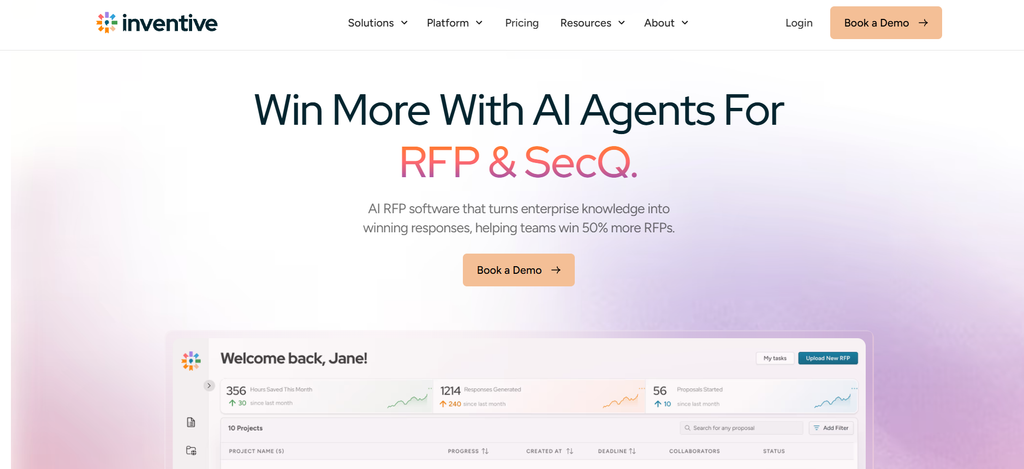
Inventive AI a leading AI-powered RFP software platform, streamlines response management by automating RFPs, RFIs, DDQs, and security questionnaires.
Its approach combines AI-generated drafting with a connected knowledge hub, source citations, confidence scores, and automated checks for outdated or conflicting information.
The platform can retrieve information from organizational sources such as Google Drive, SharePoint, Confluence, Notion, and previous responses.
When a questionnaire is imported, Inventive AI generates draft answers from the available knowledge and links responses to supporting information.
Its documented response generation capabilities include confidence scores and routing unsupported questions for subject matter expert review.
Key features
- AI-generated responses with supporting source citations.
- Confidence scores to help prioritize review.
- Automated identification of stale or conflicting content.
- Connected organizational knowledge sources.
- Word, Excel, PDF, and supported portal-based workflows.
- SME assignments, comments, and approval management.
- Support for RFPs, RFIs, DDQs, and security questionnaires.
Advantages
Inventive AI is particularly relevant for teams that maintain product, technical, compliance, and commercial information across multiple repositories.
Its emphasis on source traceability and content governance can help reviewers identify where an answer originated and whether the supporting information needs attention.
This may be useful when responses must reflect frequently changing product features, security controls, or organizational policies.
Limitations
The quality of generated responses still depends on the accuracy and completeness of connected sources.
Organizations must establish clear ownership of approved information and validate answers before submission.
Buyers should also evaluate the practical effectiveness of conflict detection, onboarding requirements, and integration behavior using their own documents.
Its usage-based pricing requires an estimate of annual questionnaire volume to understand total costs.
Pricing
Inventive AI’s pricing page advertises plans starting at approximately $10,000 annually.
The published model combines a fixed platform fee with usage-based pricing and includes unlimited users. A personalized quote is required to establish the applicable project allowances and final contract cost.
Best for: B2B SaaS organizations, sales engineers, security teams, and proposal teams seeking AI drafting with source traceability and content governance.
2. Conveyor
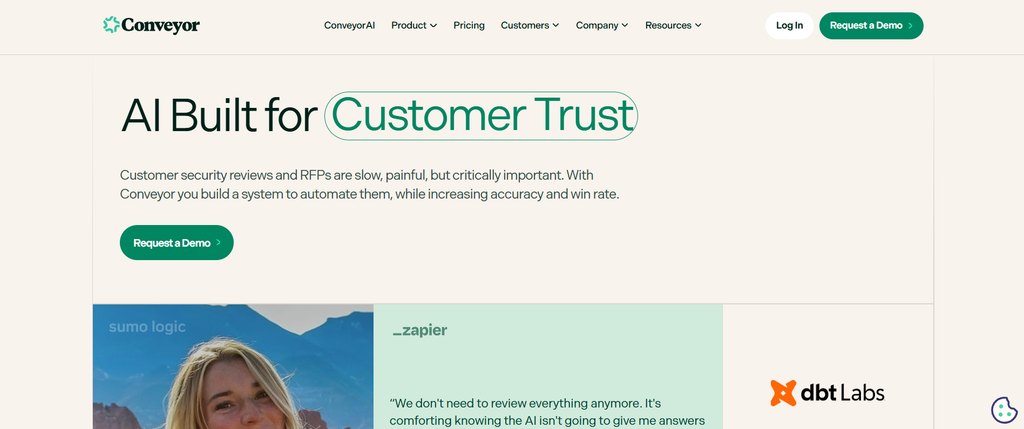
Conveyor is a customer trust platform that combines security questionnaire automation, AI-generated RFP responses, and a customer-facing trust center.
Its approach addresses two related challenges: helping internal teams complete customer assessments and giving customers a way to access approved security information.
A trust center can provide controlled access to documents such as security policies, compliance reports, and other due diligence materials.
This may reduce repetitive requests when customers can retrieve approved information without requiring a separate questionnaire response.
Conveyor also supports AI-assisted response generation using connected knowledge and browser-based workflows for completing questionnaires in customer portals.
Key features
- Automated security questionnaire and RFP responses.
- Customer-facing trust centers with document access controls.
- AI-assisted knowledge retrieval and response drafting.
- Browser extension for supported questionnaire portals.
- Reviewer collaboration and SME assignments.
- Knowledge management and source references.
- Integrations with business and collaboration tools.
Advantages
Conveyor offers a useful combination of reactive questionnaire completion and proactive customer trust management.
For security teams receiving repeated questions about the same controls, the ability to publish and securely share approved information may complement traditional response automation.
It can also provide a central place to manage customer access to security documents.
Limitations
A trust center does not eliminate every customer security questionnaire. Buyers may still require responses in their own assessment portals or templates.
Conveyor’s free plan is limited and does not include questionnaire automation.
Paid usage allowances also matter. Organizations with large questionnaire volumes should confirm how credits, RFP projects, and additional usage are charged.
Pricing
According to Conveyor’s pricing page:
- Free: Limited trust-center functionality without questionnaire automation.
- Business: Starts at $9,600 per year, with defined workflow and credit allowances.
- Enterprise: Custom pricing based on business requirements and usage.
The Business subscription should be evaluated against expected questionnaire and RFP volumes rather than compared solely on its annual price.
Best for: SaaS security teams, compliance managers, customer trust teams, and organizations receiving frequent buyer security assessments.
3. Loopio
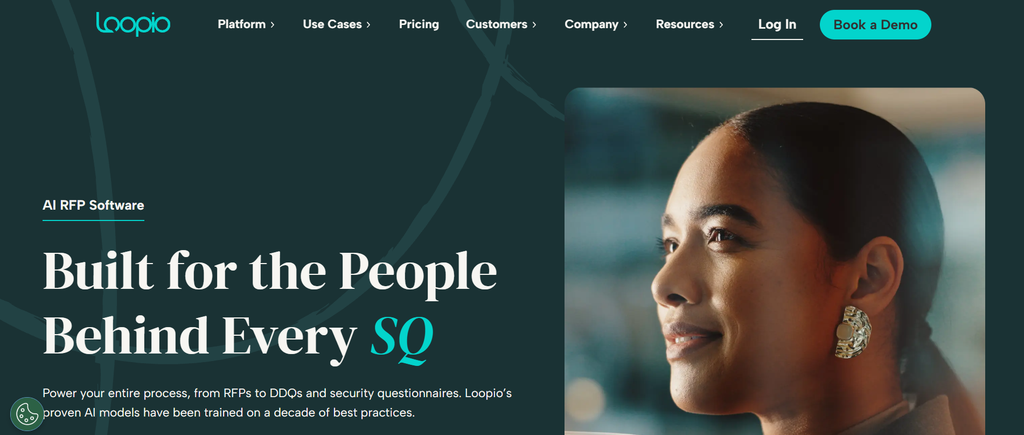
Loopio is an RFP response management platform designed around reusable organizational knowledge, proposal collaboration, and structured response workflows.
It supports RFPs, RFIs, security questionnaires, and DDQs.
The platform’s content library allows teams to organize approved answers and reuse them across different projects.
Loopio also provides AI-assisted response generation, automated question matching, project assignments, and content review workflows.
Its SmartScan functionality helps import questionnaire content from Word, Excel, and PDF documents.
Key features
- Centralized library of approved response content.
- AI-assisted drafting and automated answer matching.
- SmartScan for importing structured questionnaires.
- Collaborative editing and SME review workflows.
- Project assignments, tracking, and reporting.
- Content review and maintenance processes.
- Enterprise permissions and configurable project management.
Advantages
Loopio can be a good fit for organizations with established proposal teams and a substantial collection of reusable answers.
A structured library can make it easier to maintain consistency across frequently repeated responses.
Its project management features are also useful when several departments contribute to a proposal and a central team coordinates deadlines, reviews, and final submissions.
Limitations
A reusable content library still needs maintenance, clear ownership, and periodic review.
Teams with fragmented or outdated knowledge may need to invest time in organizing information before realizing the full benefits of automation.
Document compatibility also requires practical testing.
According to Loopio’s SmartScan documentation, the feature works best with shorter, consistently formatted documents, and certain advanced questionnaire structures may require alternative import workflows.
Buyers should also confirm how source-document export works. Loopio documents different export behavior for PDF projects compared with Word and Excel source documents.
Pricing
Loopio’s official pricing page lists three packages:
- Foundations
- Enhanced
- Enterprise
Foundations includes 10 seats and is aimed at smaller or sales-led proposal teams.
Enhanced and Enterprise add capabilities for more complex collaboration and organizational needs.
Public fixed subscription prices are not provided. Buyers must request a quote and confirm the costs of additional seats, integrations, onboarding, and optional features.
Best for: Proposal managers, bid teams, enterprise sales operations, and organizations with mature response management processes.
4. Responsive
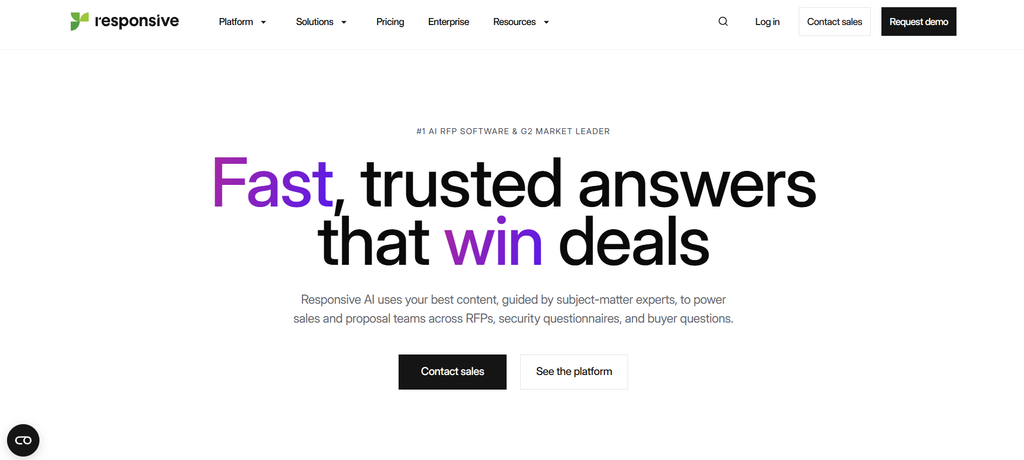
Responsive, formerly RFPIO, is an enterprise response management platform for organizations handling RFPs, information requests, security questionnaires, and other structured buyer responses.
It combines centralized knowledge management with AI-assisted drafting, workflow automation, and cross-functional collaboration.
Responsive is particularly relevant to teams that need to coordinate proposal work across sales, legal, compliance, security, and technical departments.
Its broader platform includes capabilities for response projects, automation, requirements management, and enterprise administration.
Key features
- AI-assisted response drafting and automation.
- Centralized response content and knowledge management.
- Project workflows and collaborative reviews.
- RFP intake and requirements management.
- Enterprise access controls and reporting.
- Integrations with business systems.
- Configurable workflows for multiple departments.
Advantages
Responsive is designed for organizations where responding to RFPs involves more than generating first drafts.
It can help teams formalize project ownership, coordinate reviewers, maintain approved content, and manage ongoing response activity across business units.
Its tiered offering gives organizations options for different levels of workflow complexity.
Limitations
Responsive’s broader feature set may require more process planning than a lightweight questionnaire automation tool.
Organizations should evaluate implementation effort, licensing, integration requirements, and the administrative resources needed to maintain workflows.
Not every advertised capability is included in every edition.
For example, advanced access controls, premium connectors, and certain enterprise functions are associated with higher-tier offerings.
Pricing
Responsive’s official pricing page lists:
- Emerging Edition: Starting at $10,000.
- Growth Edition: Custom quote.
- Enterprise Edition: Custom quote.
The public pricing page does not clearly state the billing period alongside the Emerging Edition starting price.
Buyers should confirm whether the quoted amount covers a particular contract term and whether user licenses, onboarding, integrations, or additional services affect the total.
Best for: Enterprise proposal departments, global sales operations, and organizations requiring structured response governance across multiple teams.
5. SiftHub
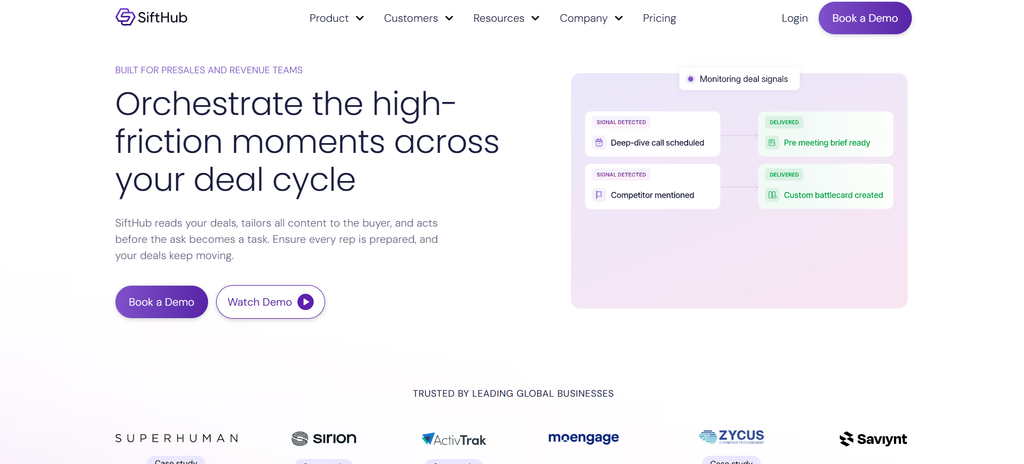
SiftHub is an AI-powered presales and response automation platform that helps teams retrieve company knowledge and prepare answers to technical buyer questions.
Its capabilities extend beyond RFPs and security questionnaires into broader sales engineering and deal-related workflows.
For questionnaire automation, SiftHub uses approved organizational content to prepare responses and provide links to supporting sources.
It supports working within Microsoft Word, Excel, Google Docs, and Google Sheets, allowing teams to complete supported questionnaires without always moving their work into a separate response editor.
Key features
- AI-generated RFP and security questionnaire responses.
- Source references and approved-answer reuse.
- Connected company knowledge repositories.
- Microsoft Office and Google Workspace workflows.
- SME assignments and approval tracking.
- Content expiration reminders.
- Knowledge management for technical presales teams.
Advantages
SiftHub is relevant when sales engineers regularly answer technical questions throughout the sales cycle, not only during formal RFP projects.
Connecting questionnaire responses with broader presales knowledge may reduce duplicate searches for product specifications, technical capabilities, and previously approved explanations.
Working within familiar document tools can also be helpful for teams that already collaborate in Word, Excel, and Google Workspace.
Limitations
Organizations should validate compatibility with their specific templates, portal workflows, and document structures.
For example, SiftHub’s project documentation notes that its documented web-app workflow currently processes only the first tab of a multi-tab Google Doc.
This is a specific limitation worth testing if your team receives complex Google Docs questionnaires.
Buyers should also confirm whether they need only the RFP automation product or SiftHub’s broader presales platform.
Pricing
SiftHub’s pricing page offers quote-based packages, including an RFP-focused starting option and its broader platform.
The company does not publish a fixed subscription price for those packages.
Organizations should request pricing based on their intended workflows, integrations, user requirements, and questionnaire volume.
Best for: Sales engineers, solutions consultants, technical presales teams, and B2B SaaS businesses managing recurring technical buyer questions.
AutoRFP vs Inventive AI vs Conveyor vs Loopio vs Responsive vs SiftHub
Although all six platforms support overlapping response automation needs, they place different emphasis on knowledge, collaboration, and customer-facing workflows.
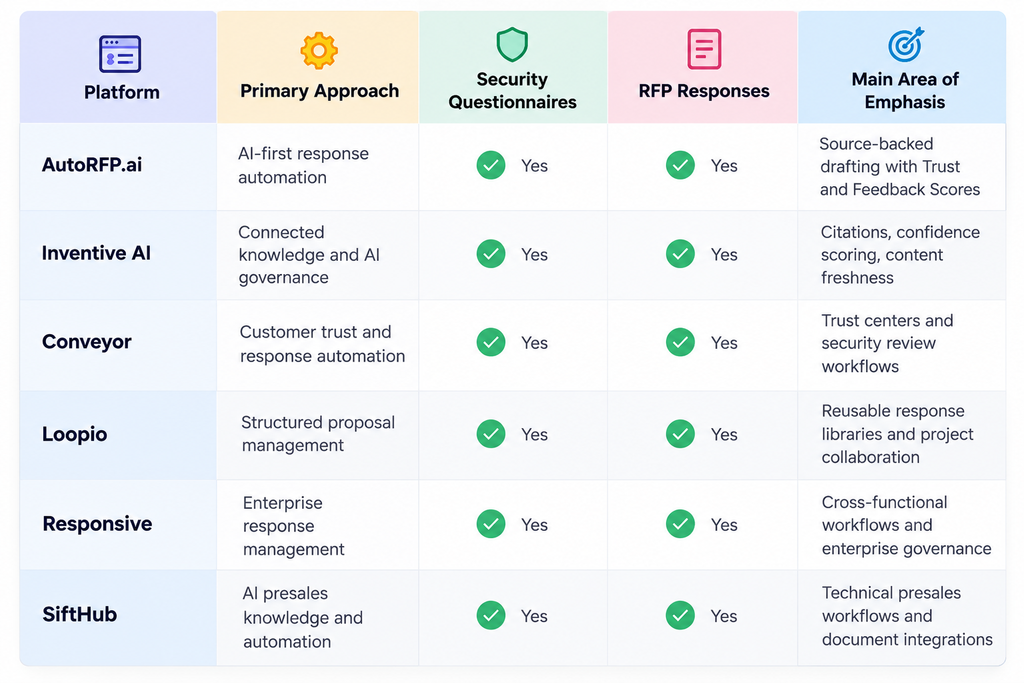
These are differences in product emphasis, not exclusive capabilities.
For example, Loopio and Responsive also offer AI-assisted functionality, while AI-first products increasingly provide project management and approval workflows.
A useful comparison should therefore examine how well each platform performs your required tasks, rather than treating individual feature labels as unique advantages.
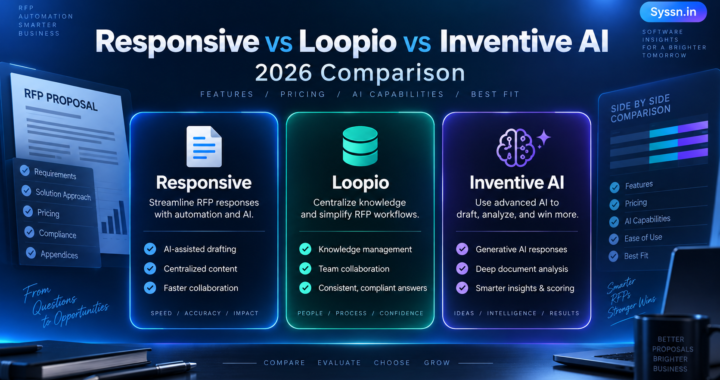
For a more detailed comparison of three major platforms, read Responsive vs Loopio vs Inventive AI: Which Is Best?.
The Gartner Peer Insights RFP Response Management Applications category also identifies important functional areas, including response editing, workflow management, knowledge management, and audit trails.
Customer reviews and vendor descriptions can inform a shortlist, but they should not replace testing with your own documents.
What Features Should Businesses Look for in an AutoRFP Alternative?
Choosing an RFP automation platform involves more than comparing how quickly AI can draft an answer.
The following capabilities are especially important for organizations handling confidential information and complex buyer requirements.
1. Source-Backed AI Responses
A generated response should be supported by current, approved company information.
Ideally, reviewers should be able to identify the policy, product document, previous answer, or knowledge-base entry used to prepare a response.
Source references help reviewers investigate claims rather than accepting AI-generated text at face value.
However, a cited answer is not necessarily a correct answer.
A citation may reference an outdated policy, an incomplete product description, or a document that does not fully support the generated statement.
During evaluation, test whether the platform can:
- Link answers to relevant source passages.
- Identify missing or conflicting information.
- Show when a source was last updated.
- Avoid confidently drafting unsupported statements.
- Route uncertain answers for human review.
A useful test is to include questions for which your organization has no approved answer and observe how the platform responds.
2. Security Questionnaire and Framework Compatibility
Security questionnaires vary significantly in structure and content.
Some buyers use standardized assessments, while others create customized spreadsheets or procurement portal forms.
The Cloud Security Alliance CAIQ v4.1 provides standardized questions related to cloud security controls.
The Shared Assessments SIG methodology supports standardized third-party risk assessments.
Organizations should check whether their software can interpret the questionnaire formats they encounter and map responses to appropriate supporting evidence.
It is also important to distinguish questionnaire compatibility from compliance certification.
A platform’s ability to answer questions about SOC 2 or ISO 27001 does not mean that using the platform establishes compliance with those requirements.
3. Knowledge Management and Content Governance
RFP responses can become outdated when a business changes its product capabilities, infrastructure, policies, pricing, or contractual commitments.
A strong response management process needs clear ownership of organizational knowledge.
Useful capabilities include:
- Assigning content owners.
- Tracking document versions.
- Scheduling periodic reviews.
- Flagging outdated or conflicting information.
- Controlling which sources AI can use.
- Maintaining records of approved responses.
For example, if a company’s data retention period changes, the relevant security questionnaire answers should be reviewed before the next customer submission.
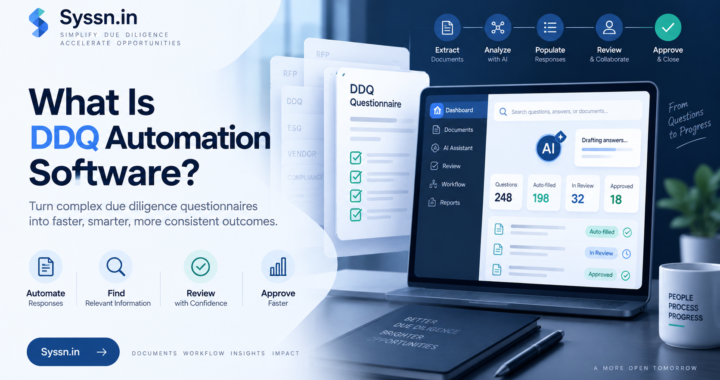
For more information about maintaining accurate questionnaire responses, see our guide to DDQ automation software.
4. Integrations and Document Compatibility
AI drafting offers limited value if employees must spend substantial time repairing imports, fixing spreadsheets, or copying answers into procurement portals.
Organizations should test the formats they actually receive, including:
- Excel workbooks with multiple tabs, formulas, dropdowns, and merged cells.
- Word documents containing tables and narrative requirements.
- PDF questionnaires and supporting documents.
- Web-based procurement and security assessment portals.
Compatibility should be evaluated at both import and export stages.
A tool may successfully recognize questions without preserving every required response field, document structure, or formatting rule.
Integration requirements also vary.
Some teams need connections to SharePoint or Google Drive. Others may prioritize Salesforce, Slack, Microsoft Teams, or a particular compliance platform.
Choose integrations based on existing workflows rather than the total number advertised.
5. Security, Compliance, and Data Protection
RFP platforms may process confidential policies, product architecture, security evidence, customer information, and commercial agreements.
Before granting access, organizations should review the vendor’s data handling practices and available security controls.
Important questions include:
- Where is customer data stored and processed?
- Is customer content used to train AI models?
- What retention and deletion options are available?
- How are access permissions managed?
- Are audit logs available?
- Which subcontractors or AI model providers process the data?
- Can the vendor provide relevant independent assurance reports?
The NIST Cybersecurity Framework 2.0 supply chain risk management guide provides useful guidance for evaluating supplier-related cybersecurity risks.
The AICPA’s SOC reporting resources explain the assurance reports commonly used when evaluating service organizations.
Buyers should assess the actual scope and dates of any vendor assurance report rather than relying solely on a logo or compliance statement.
6. Human Review and AI Risk Management
Even when software generates source-backed responses, human review remains important for information involving contractual commitments, privacy obligations, financial details, security controls, and customer-specific guarantees.
An effective workflow should distinguish routine approved answers from questions requiring specialist judgment.
For example, a previously approved description of general encryption practices may need less rewriting than a customer request for a new contractual security commitment.
Organizations should evaluate whether the software supports:
- Assigning sensitive questions to appropriate reviewers.
- Preventing unapproved responses from being submitted.
- Tracking revisions and approvals.
- Restricting access to confidential information.
- Identifying unsupported or incomplete answers.
The OWASP GenAI LLM Top 10 for 2026 provides additional context on security risks associated with large language model applications.
Is There a Cheaper Alternative to AutoRFP?
Potentially.
Conveyor’s published Business entry price of $9,600 annually is lower than AutoRFP.ai’s Scale subscription of $10,788 annually.
However, the products have different pricing models and usage allowances.
Conveyor’s Business offering includes defined questionnaire and RFP usage, while AutoRFP.ai’s Scale plan includes 24 projects annually.
Inventive AI’s published starting price is also close to AutoRFP.ai’s entry-level annual subscription.
For Loopio, Responsive, and SiftHub, public pricing information is insufficient to make an equivalent annual cost comparison.
Organizations should request quotes using identical assumptions about users, annual questionnaire volume, integrations, support, and implementation.
Calculate Total Cost, Not Just Subscription Price
Consider an organization that handles 40 security questionnaires and 15 RFPs each year.
Its procurement team should ask every vendor to quote a package capable of handling that workload, including all necessary collaborators.
The evaluation should account for:
- Annual software subscription or platform fees.
- Project, questionnaire, or credit overages.
- Seat-based licensing where applicable.
- Onboarding and implementation.
- Required integrations and add-ons.
- Internal content maintenance.
- Time spent validating and correcting responses.
The lowest subscription price may not produce the lowest overall operating cost.
Which AutoRFP Alternative Is Best for Your Business?
Best for B2B SaaS Companies
Inventive AI and Conveyor are relevant options for B2B SaaS companies, particularly those responding to frequent technical and security reviews.
Inventive AI may suit teams prioritizing connected knowledge, cited answers, and automated content maintenance.
Conveyor may be more attractive when customers repeatedly request security documentation and the organization wants to provide controlled self-service access through a trust center.
Best for Enterprise Proposal Teams
Loopio and Responsive are suitable candidates for organizations with established proposal departments.
Loopio emphasizes reusable content, project collaboration, and organized response management.
Responsive is particularly relevant when workflows extend across multiple departments, business units, and enterprise systems.
Both should be tested for complex permissions, reporting needs, and integration requirements.
Best for Security and Compliance Teams
Conveyor, Inventive AI, and SiftHub are worth considering.
Conveyor combines trust-center capabilities with questionnaire automation.
Inventive AI emphasizes source-backed drafting and governance, while SiftHub provides approved-answer workflows and source traceability within supported productivity tools.
The right choice depends on whether the largest problem is sharing security information, completing questionnaires, or maintaining approved answers.
Best for Sales Engineers and Presales Teams
SiftHub and Inventive AI are relevant for sales engineering workflows.
SiftHub connects questionnaire automation with broader presales knowledge and document workflows.
Inventive AI focuses on connected knowledge retrieval, response generation, and content governance.
Teams should evaluate how well each platform handles technical details, product-specific variations, and questions that require engineering review.
Best for Smaller Teams
Smaller teams should prioritize actual minimum contract costs, setup requirements, and expected questionnaire volume.
Conveyor offers a free trust-center option, but that is not equivalent to free security questionnaire automation.
AutoRFP.ai has published project-based pricing, while other vendors provide a mixture of starting prices and custom quotes.
If a team processes only a small number of questionnaires annually, it should calculate whether the potential time savings justify a dedicated platform.
How to Evaluate an AutoRFP Replacement
A product demonstration is more useful when it includes real questionnaires and organizational content rather than only vendor-prepared examples.
A practical evaluation should follow these steps.
Step 1: Collect Representative Questionnaires
Select several recent questionnaires covering your most common requirements.
Include different file types, complex spreadsheet structures, customer-specific questions, and any portals your organization regularly uses.
Use appropriately sanitized documents when evaluating products that have not yet completed your security review.
Step 2: Connect Approved Knowledge
Provide current product documentation, security policies, previous approved responses, and relevant compliance evidence.
Avoid using outdated or contradictory materials as though they are equally authoritative.
Where possible, identify which sources should take precedence.
Step 3: Generate Initial Responses
Ask each platform to process the same questionnaire set.
Record how many questions receive usable drafts and how many require manual intervention.
A high automated completion rate is not useful if the answers are unsupported or incomplete.
Step 4: Check Factual Accuracy and Citations
Have qualified reviewers inspect generated responses against the supporting documentation.
Evaluate factual correctness, relevance, completeness, and whether citations genuinely support the claims.
Pay particular attention to questions involving security guarantees, legal obligations, product limitations, and service commitments.
Step 5: Test Missing Information and Conflicts
Include questions with no approved answer.
Also test questions for which different internal documents contain conflicting information.
Observe whether the platform flags uncertainty, retrieves the wrong source, or generates an unsupported response.
This helps evaluate how safely the tool handles imperfect organizational knowledge.
Step 6: Test Collaboration and Approval Workflows
Assign questions to sales, engineering, legal, security, and compliance reviewers as appropriate.
Check whether reviewers can identify outstanding work, make corrections, approve responses, and understand changes made during the process.
Step 7: Validate Final Document Export
Export the completed questionnaire into the required buyer format.
Confirm that formulas, answer fields, formatting, attachments, and other required document elements are preserved where applicable.
Test portal submission workflows separately when they are an important part of your process.
Step 8: Compare Costs and Reviewer Effort
Request quotes based on the same workload assumptions.
Then compare not only subscription prices but also the effort required to produce an approved, submission-ready response.
Metrics Worth Tracking
| Metric | What It Measures | Why It Matters |
|---|---|---|
| Usable draft rate | Share of questions receiving acceptable initial answers | Shows drafting usefulness |
| Verified accuracy rate | Share of checked answers that are factually correct | Measures response reliability |
| Citation relevance | Share of citations that support the associated claim | Evaluates evidence quality |
| Reviewer effort | Time required to correct and approve responses | Reflects actual labor savings |
| Export success | Whether required documents remain usable after export | Identifies formatting problems |
| Unsupported-answer handling | Whether missing evidence is flagged appropriately | Helps assess AI-related risk |
For example, a platform that generates drafts for nearly every question may still require extensive manual rewriting.
Another tool may produce fewer initial answers but provide better evidence and more effective reviewer workflows.
The more useful performance indicator is therefore the number of accurate, approved responses produced with minimal unnecessary rework.
Frequently Asked Questions About AutoRFP Alternatives
1. What are the best AutoRFP alternatives in 2026?
Inventive AI, Conveyor, Loopio, Responsive, and SiftHub are five alternatives worth evaluating.
Inventive AI emphasizes connected knowledge and source-backed responses. Conveyor combines security questionnaires with trust centers. Loopio and Responsive support structured response management, while SiftHub connects questionnaire automation with presales workflows.
The best choice depends on organizational requirements rather than a universal ranking.
2. Which AutoRFP competitor is best for security questionnaires?
Conveyor is particularly relevant for teams managing customer security reviews and trust-center workflows.
Inventive AI and SiftHub are also suitable candidates when source-backed answers, approved organizational knowledge, and questionnaire automation are the main requirements.
Businesses should compare these tools using their actual security assessment formats.
3. Is there a cheaper alternative to AutoRFP?
Conveyor advertises a Business plan starting at $9,600 annually, compared with AutoRFP.ai’s Scale plan at $10,788 annually.
However, the included usage allowances and features differ. Buyers should compare equivalent workloads before concluding that one platform is less expensive.
4. How do AutoRFP, Loopio, and Responsive differ?
AutoRFP.ai emphasizes AI-first drafting, source traceability, and its Trust and Feedback Scores.
Loopio places substantial emphasis on content libraries, reusable approved answers, and project collaboration.
Responsive focuses on broader enterprise response management, cross-functional workflows, and governance.
Their capabilities overlap, so practical evaluation remains important.
5. Which AI RFP software offers the most accurate responses?
There is no universally established winner based on independent, standardized testing across these six platforms.
Vendor-reported accuracy metrics may use different datasets, evaluation methods, and definitions.
Organizations should compare tools using identical questionnaires and measure factual accuracy, citation relevance, incomplete answers, and the amount of human correction required.
6. Are there free AutoRFP alternatives?
Conveyor provides a limited free trust-center offering, but its free plan does not include questionnaire automation.
Some vendors may offer demonstrations or trial arrangements, but these should not be assumed to provide permanent free access to RFP automation.
7. Can AI complete security questionnaires without human review?
AI can generate responses from approved content, reuse previously verified answers, and identify questions requiring attention.
However, organizations should not assume that AI-generated responses are always accurate.
Human review remains important for sensitive information, customer-specific requirements, legal commitments, and claims about security or compliance.
Final Verdict
The right AutoRFP alternative depends on how your team handles questionnaires and what it needs to improve.
Inventive AI is worth evaluating for source-backed response generation and content governance. Conveyor is especially relevant for customer security reviews and trust centers. Loopio fits structured proposal operations, while Responsive addresses broader enterprise response management needs. SiftHub is useful for technical presales teams that want questionnaire automation connected to everyday knowledge workflows.
AutoRFP.ai itself remains a viable option for organizations that prefer its project-based pricing model, source references, Trust Scores, and Feedback Scores.
Rather than choosing a platform based on feature lists or vendor-reported automation rates, shortlist two or three products and evaluate them against the same questionnaires.
Prioritize accurate answers, relevant supporting evidence, workable approval processes, reliable document compatibility, and total operating cost.
The most suitable platform is the one that helps your organization submit dependable responses with less manual effort while maintaining appropriate human oversight.