How to Get CSPO Certified: Complete Step-by-Step Guide for New Product Owners

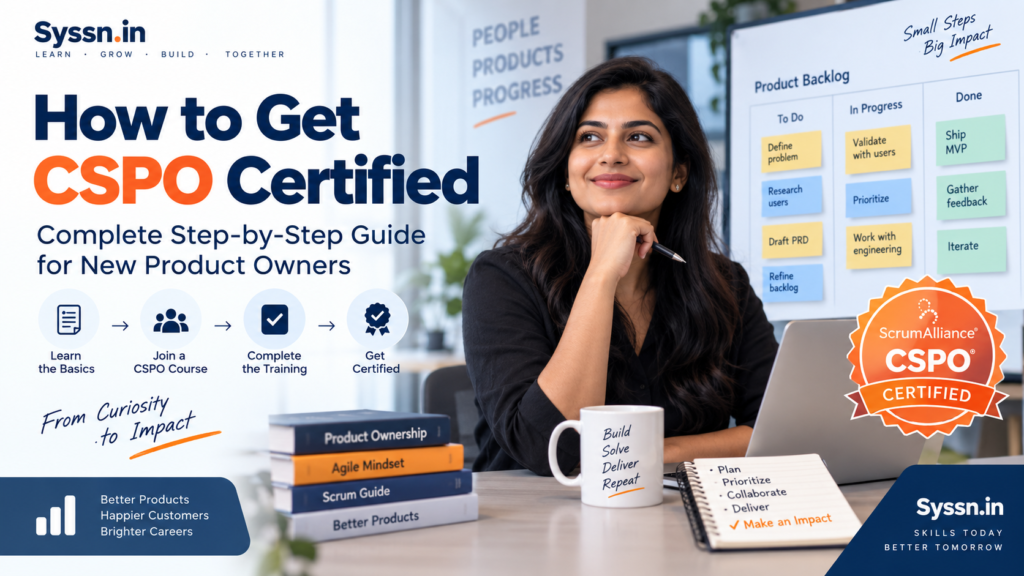
To get CSPO certified in 2026, you need to complete a 16-hour Certified Scrum Product Owner course taught by a Scrum Alliance Certified Scrum Trainer, then accept the Scrum Alliance license agreement and activate your certification.
There is no CSPO exam. You also do not need previous Scrum experience, a technical background, a college degree, or prior Product Owner experience.
Your course payment includes access to the CSPO credential and a two-year Scrum Alliance membership.
For professionals in India, the certification process is the same. What changes is the training provider, trainer, schedule, support, learning experience, and course price.
CSPO certification at a glance
| Question | Current CSPO requirement in 2026 |
|---|---|
| Full name | Certified Scrum Product Owner® |
| Issuing body | Scrum Alliance |
| Previous Product Owner experience required? | No |
| Scrum experience required? | No |
| College degree required? | No |
| Technical background required? | No |
| Training required? | Yes |
| Training duration | 16 hours |
| Format | Live online or in person |
| Trainer | Certified Scrum Trainer® |
| Certification exam | No |
| Typical course duration | Often two days |
| Initial membership | Two years |
| Certification cycle | Two years |
| Renewal requirement | 20 SEUs + $100 for a foundational credential |
| Next certification on PO track | A-CSPO |
Scrum Alliance confirmed in February 2026 that the course remains mandatory and that there is currently no CSPO test.
What is CSPO certification?
CSPO stands for Certified Scrum Product Owner. Scrum Alliance issues the credential to people who complete approved Product Owner training.
The Product Owner accountability in Scrum centers on maximizing product value and managing the Product Backlog effectively.
According to the current Scrum Guide, this includes:
- Communicating the Product Goal
- Creating and explaining Product Backlog items
- Ordering Product Backlog items
- Keeping the backlog visible and understood
The certification course takes those responsibilities and puts them into practical situations.
You may discuss questions such as:
- What customer problem should the team solve next?
- Which backlog item deserves attention first?
- What evidence supports a product decision?
- How should competing stakeholder requests be handled?
- What should the Product Goal communicate?
- How should you decide whether a release produced useful value?
These questions sound fairly simple until several stakeholders want different things at the same time.
Imagine sales wants a feature for an important customer. Support wants another feature because complaints are increasing. Management wants something different because a competitor recently released it.
The development team has time for one.
Which request comes first?
A good Product Owner needs a way to think through that decision instead of simply choosing the person with the loudest voice.
CSPO training gives you a framework for beginning that work. The certification itself cannot replace the judgment that develops through making real product decisions.
What are the CSPO certification requirements in 2026?
The formal requirements are straightforward.
You must complete an approved 16-hour CSPO course with a Certified Scrum Trainer.
You do not need:
- Product Owner work experience
- Previous Scrum experience
- Software-development experience
- A college degree
- Another Scrum certification
- An entrance examination
Scrum Alliance states that there are no formal prerequisites for joining foundational CSPO training.
If Scrum is completely new to you, reading the Scrum Guide before the course is still a good use of an hour or two.
It means you can spend more of the live class thinking about product decisions rather than hearing terms such as Product Goal, Sprint Review, and Product Backlog for the first time.
Previous experience cannot replace the required training.
Even someone who has worked as a Product Owner for several years still needs to complete an approved course to receive the Scrum Alliance CSPO credential.
Can a complete beginner get CSPO certified?
Yes.
You can join CSPO training without previous Agile, Scrum, software-development, or Product Owner experience.
That makes it accessible to people working in:
- Business analysis
- Project management
- Software development
- Quality assurance
- Operations
- Consulting
- Product management
- Team leadership
There is an important difference between being eligible for CSPO certification and being ready for a Product Owner job.
You could finish your certification during one weekend.
An employer may still ask you to explain:
- How you prioritize competing requests
- How you use customer research
- How you deal with stakeholder disagreements
- Which metrics you would track
- How you make decisions with incomplete information
- What you would do when a feature fails
A certificate shows that you completed structured training.
Your examples show whether you can use what you learned.
How do you get CSPO certified step by step?
The CSPO certification process can be broken into six practical steps.
Step 1: Decide whether Product Ownership is the work you want
Start by understanding the role before thinking about certification.
The Product Owner is accountable for maximizing product value and managing the Product Backlog effectively.
That usually means making choices.
You may enjoy Product Ownership if you like:
- Working with customers
- Talking with stakeholders
- Comparing priorities
- Clarifying product goals
- Reviewing evidence
- Deciding what the team should work on next
- Explaining why something has been postponed
You also need to become comfortable saying no, or at least “not now.”
If you are more interested in coaching teams, Scrum events, impediments, facilitation, and improving how a Scrum Team works, you may find the Scrum Master path closer to your interests.
Step 2: Find an approved CSPO course
Do not assume that every course containing “Product Owner” in its title leads to CSPO certification.
CSPO is a specific Scrum Alliance credential.
Use the Scrum Alliance course search or verify the course and trainer before registering.
Check:
| Item | What to verify |
|---|---|
| Trainer | Is the instructor a current CST? |
| Course | Does it qualify for Scrum Alliance CSPO certification? |
| Duration | Does it provide the required 16 hours? |
| Format | Live online or in person |
| Schedule | Weekday, weekend, or another arrangement |
| Price | Final payable amount including taxes |
| Rescheduling | What happens if you cannot attend? |
| Activities | Does the course contain practical exercises? |
| Support | What continues after training? |
The trainer deserves particular attention.
A training company manages registration and logistics. Your trainer largely determines what those 16 hours actually feel like.
Step 3: Prepare before the course
There is no CSPO exam, so you do not need weeks of test preparation.
Spend a few hours understanding the Scrum Guide instead.
Focus on:
- Product Owner accountability
- Product Goal
- Product Backlog
- Sprint Planning
- Sprint Review
- Scrum Team accountabilities
Then choose a product you already understand.
Suppose you work with a grocery-delivery app.
Customers complain about poor substitutions when items are unavailable. Operations wants fewer support cases. Store staff want a faster picking process. Management wants more completed orders.
That gives you a real situation to think about when the course covers customers, stakeholders, value, priorities, and backlog decisions.
Step 4: Complete all 16 hours of CSPO training
Scrum Alliance requires 16 hours of approved training taught by a Certified Scrum Trainer.
Training can be delivered through qualifying live online or in-person classes.
A useful course should make you make decisions rather than simply memorize Scrum terminology.
For example, you might receive ten possible features while having enough capacity for three.
The interesting question is not whether you can rewrite all ten as user stories.
Which three should come first?
What evidence supports that decision?
What are you delaying?
Who will disagree?
What result would cause you to reconsider?
Those are much closer to the decisions you may eventually make at work.
Step 5: Activate your Scrum Alliance account
After successful completion, your trainer or training organisation submits your details to Scrum Alliance.
You then access your Scrum Alliance account and accept the required license agreement.
The certification process also provides access to the related membership benefits and credential.
There is no CSPO examination waiting for you afterwards.
Step 6: Access your CSPO credential
Once your account is active and you have completed the required agreement, you can access your CSPO credential through Scrum Alliance.
There is no examination between completing the course and receiving the certification under the current process.
This is one reason people sometimes confuse CSPO and CSM.
CSM has a certification test.
CSPO currently does not.
Is there a CSPO certification exam?
No.
Scrum Alliance confirmed on February 20, 2026 that CSPO does not currently require a certification examination.
Successful completion of the required CST-led course leads to certification.
There is therefore no separate Scrum Alliance CSPO exam charge under the current process.
CSM works differently.
CSM candidates complete training and then take a 50-question online examination. They receive 60 minutes and need at least 74%, or 37 correct answers, to pass.
How long does it take to get CSPO certified?
The required training takes 16 hours.
Many providers deliver those hours across two days, although schedules differ.
A realistic time budget might look like this:
| Activity | Practical time budget |
|---|---|
| Reading the Scrum Guide | 1-2 hours |
| Comparing courses | 1-2 hours |
| Required training | 16 hours |
| Account activation | Minutes |
| Exam preparation | None |
| CSPO exam | None |
The formal requirement can therefore fit into one weekend if a suitable batch is available.
Learning how to make good product decisions will take longer.
How much does CSPO certification cost in India in 2026?
There is no universal India-wide CSPO fee set by Scrum Alliance.
Training providers determine their own prices, so fees vary according to the trainer, dates, delivery format, promotions, and bundled services.
Here are five providers Indian learners may encounter:
| Provider | Public price or pricing visibility checked in September 2026 | Course format |
|---|---|---|
| Invensis Learning | ₹20,000 | 16-hour instructor-led training |
| StarAgile | ₹17,135 Standard; higher packages available | 16-hour live training |
| upGrad KnowledgeHut | ₹24,479 shown on current Agile course listing | 16-hour live instructor-led training |
| Simpliaxis | Current India fee should be confirmed for the chosen cohort | 16-hour live CSPO training |
| Simplilearn | Current fee should be confirmed through the schedule/advisor | 16-hour live instructor-led training |
Invensis Learning currently publishes an India starting price of ₹20,000 for its CSPO course.
StarAgile’s current public Standard fee is ₹17,135. Its pricing material also lists StarX at ₹24,999 and StarMax at ₹29,999.
upGrad KnowledgeHut’s current Agile course listing shows CSPO at ₹24,479, although fees can differ by cohort and page, so check the amount displayed for your actual registration date.
For providers where the exact India cohort price is not displayed clearly on the course page, get the final amount in writing before paying.
What should you compare besides price?
Price is useful because it is easy to compare.
Course quality is harder.
Before choosing based on a ₹2,000 or ₹5,000 difference, compare:
- Trainer name and background
- CST status
- Class size
- Weekday or weekend scheduling
- Live interaction
- Exercises and simulations
- Cancellation rules
- Rescheduling charges
- Refund terms
- Course materials
- Post-course learning access
- Extra courses
- Career resources
- Financing charges
- Final price including GST
Premium packages deserve particular attention.
A package can contain ten additional benefits and still offer poor value to you if you only intend to use one of them.
Ask what you will realistically use after the CSPO class finishes.
Which CSPO training providers can Indian learners compare?
Five brands currently offering CSPO-related training options to Indian learners include Invensis Learning, StarAgile, upGrad KnowledgeHut, Simpliaxis, and Simplilearn.
These are training providers, not five different CSPO certifications.
When the course meets Scrum Alliance requirements, the underlying credential still comes from Scrum Alliance.
1. Invensis Learning
Invensis Learning offers a 16-hour CSPO program that its current India page describes as instructor-led training delivered over two days by a Certified Scrum Trainer. The course includes official Scrum Alliance-aligned courseware, the latest Scrum Guide, workshops, product ownership exercises, a digital badge, and the two-year Scrum Alliance membership associated with CSPO. Its curriculum is presented across eight modules and covers areas such as Scrum, the Product Owner role, product vision, stakeholder work, Product Backlog management, and practical decision-making. The provider also advertises live virtual public cohorts, corporate group training, and more personalized training arrangements. One unusual inclusion on its current page is the option to retake the training within two months at no additional charge, subject to its conditions. Its India price is currently published at ₹20,000, making the base cost relatively easy to check before registering. Confirm the assigned CST, exact batch timing, taxes, attendance requirements, refund conditions, and retake terms before making payment.
2. StarAgile
StarAgile offers CSPO training through live CST-led sessions and identifies itself as a Scrum Alliance Licensed Training Partner. Its current course pages describe 16 hours of training, practical simulations and activities, Scrum Alliance certification fees within the package, and the two-year Scrum Alliance membership. The curriculum covers Scrum foundations, Product Owner responsibilities, product vision, stakeholder work, product strategy, roadmaps, and Product Backlog management. StarAgile currently advertises weekday and weekend Standard batches at ₹17,135, while its wider pricing information lists StarX at ₹24,999 and StarMax at ₹29,999. Some packages include additional learning material or complimentary courses, including Jira and PMI-ACP-related learning, so compare what is actually included rather than looking only at the package name. Earlier sales conversations reviewed for this article included promotional figures below the current public Standard rate, which shows why live quotes can differ. Get the final fee, CST name, package inclusions, refund terms, attendance rules, and rescheduling policy in writing before paying.
3. upGrad KnowledgeHut
upGrad KnowledgeHut offers a 16-hour CSPO course and identifies its program under Scrum Alliance training. Its current course pages describe live instructor-led learning, real-world simulations, activities, Product Owner exercises, 16 PDUs and 16 SEUs, and access to the two-year Scrum Alliance membership. It also provides additional Agile and Scrum e-learning material, which may appeal to learners who want something to revisit after the live course ends. KnowledgeHut has a broad Agile training catalogue, so learners planning to continue into advanced Scrum, Scrum.org, SAFe, or Agile coaching courses can find several related programs within the same training platform. Its current general Agile course page lists the CSPO fee at ₹24,479, although city-specific pages sometimes direct users toward a learning advisor rather than displaying a final checkout amount. Confirm your exact cohort fee, CST, batch timing, refund policy, access period for supplementary learning, certification inclusions, and any rescheduling costs before registering.
4. Simpliaxis
Simpliaxis offers 16 hours of live interactive CSPO training and identifies itself as a Scrum Alliance Licensed Training Partner on its current course pages. Its program includes CST-led teaching, the two-year Scrum Alliance membership, 16 SEUs and PDUs, case studies, simulations, group activities, and exercises around Product Backlog management and Agile prioritization. Its curriculum also covers Scrum basics, product vision, backlog work, stakeholder thinking, and ways to measure product results. Simpliaxis places a noticeable emphasis on interactive learning, with its pages describing role-based exercises, real-world cases, Q&A, study material, and continuing access to selected learning resources. It also advertises corporate training, flexible payment options, referral discounts, and a money-back policy that is subject to specific terms. Public pricing can vary by country, city page, schedule, and promotion, and the current India pages do not provide one sufficiently clear permanent fee that should be treated as universal. Ask for the final cohort price, taxes, assigned CST, recording access, refund conditions, schedule, and rescheduling rules in writing.
5. Simplilearn
Simplilearn offers a CSPO course built around 16 hours of live instructor-led training delivered by Certified Scrum Trainers. Its current course page lists simulations, games, role-plays, case studies, 16 SEUs and 16 PDUs, Scrum Alliance certification, and a two-year membership. The syllabus covers Agile foundations, product thinking, Scrum, Product Ownership, release planning, stakeholder management, and related product responsibilities. Simplilearn also advertises complimentary access to additional learning courses and lists several experienced CSTs associated with its CSPO offering. Its site identifies Simplilearn as a Scrum Alliance Registered Education Ally. One detail worth checking is the timetable: the main CSPO information describes a 16-hour, two-day training process, while its broader certification catalogue has displayed some CSPO cohorts as three days. That may simply reflect how individual sessions are scheduled, but you should confirm it before booking. The final India price is not presented consistently enough across the current pages to use one figure here, so verify the cohort fee, CST, session schedule, refund terms, additional-course access, and taxes before payment.
How should you choose between these five CSPO providers?
The credential itself should not be the deciding factor because an eligible course leads to the same Scrum Alliance CSPO certification.
Instead, compare the actual learning experience.
A useful shortlist might look like this:
| Question | What to look for |
|---|---|
| Who teaches the course? | Verify the named CST rather than only the provider |
| How is the class delivered? | Live interaction, discussions, exercises, and simulations |
| When does it run? | Schedule that allows you to attend all required hours |
| What does it cost? | Final price including GST and other charges |
| What happens if plans change? | Clear rescheduling and cancellation rules |
| What remains afterwards? | Materials, e-learning, workshops, communities, or follow-ups |
| What does the package include? | Separate essential CSPO items from optional extras |
Do not assume that the most expensive course contains the best trainer.
Do not assume that the cheapest one is poor either.
Look at the trainer, learning design, schedule, and conditions attached to the price.
What skills should you expect to learn in CSPO training?
CSPO training should help you understand the Product Owner accountability rather than teach one fixed approach to product management.
The current Scrum Guide makes the Product Owner accountable for:
- Maximizing product value
- Developing and communicating the Product Goal
- Creating and explaining Product Backlog items
- Ordering Product Backlog items
- Keeping the backlog transparent, visible, and understood
What this looks like in practice
Imagine a manager asks you to add an employee reporting dashboard because one important client requested it.
An inexperienced Product Owner might immediately put the dashboard near the top of the backlog.
A better response begins with questions.
How many customers have this problem?
What are they currently trying to accomplish?
Why is the current approach failing?
Would a dashboard actually solve the problem?
How much work will the feature require?
What will you delay by building it?
What evidence would tell you that it worked?
You may still decide to build the dashboard.
The difference is that you now have a reason.
The 12-point Product Owner Readiness Check
This is an editorial self-assessment, not a Scrum Alliance standard or professional credential.
Give yourself 0, 1, or 2 points in each area.
| Area | 0 points | 1 point | 2 points |
|---|---|---|---|
| Customer evidence | You rely on assumptions | You collect occasional feedback | You connect decisions to current evidence |
| Product goal | Goal is unclear | Goal exists but rarely guides decisions | Goal regularly guides backlog choices |
| Prioritization | Loudest request wins | You use basic ranking | You explain trade-offs using value and evidence |
| Stakeholder communication | Mainly reactive | Regular updates exist | Decisions and expectations stay clear |
| Outcome measurement | You mainly track output | You track some usage | You connect work to customer or business results |
| AI judgment | You accept generated output directly | You review most output | You verify evidence and make the decision yourself |
0-4: Build more practical decision-making experience.
5-8: You understand the main ideas but need repeated practice.
9-12: You probably have useful examples that can become interview stories, although the score itself has no professional standing.
What should you do after getting CSPO certified?
Getting certified is the easy part.
Using the concepts is where things become interesting.
Spend the next 30 days building practical examples.
Week 1: Create and prioritize a backlog
Choose a product you know.
Write a Product Goal.
Create ten possible backlog items.
Now reduce them to five.
Explain why those five come first.
More importantly, explain why the other five can wait.
Week 2: Speak with users
Talk to three to five people who understand the product or problem.
Avoid questions such as:
“Would you like this feature?”
Ask about actual behaviour instead:
- What are you trying to achieve?
- What makes the task difficult?
- When did the problem last happen?
- What did you do instead?
- How much time did it take?
Week 3: Run a small product experiment
Choose one assumption.
Write down:
- What you believe
- What evidence would support it
- The smallest way to test it
- What result would make you change your mind
The goal is not to prove yourself right.
It is to find out whether the idea deserves more work.
Week 4: Prepare Product Owner interview stories
Prepare examples around:
- Stakeholder disagreement
- Priority changes
- Conflicting customer requests
- Incomplete requirements
- Backlog ordering
- Failed or underperforming work
- Decisions made with limited evidence
You do not need a formal Product Owner title for every example.
Business analysis, software development, QA, operations, project management, consulting, and team leadership can all produce useful situations.
CSPO vs CSM: which should a beginner choose?
Choose based on the work you want to learn.
| Area | CSPO | CSM |
|---|---|---|
| Main focus | Product value and backlog decisions | Scrum effectiveness and team support |
| Training | 16 hours | 16 hours |
| Previous experience | None required | None required |
| Exam | No | Yes |
| Common topics | Product Goal, backlog, stakeholders, customer value | Scrum practices, coaching, facilitation, impediments |
| Renewal | 20 SEUs + $100 | 20 SEUs + $100 |
CSM currently requires a 50-question test lasting 60 minutes, with at least 74% required to pass.
CSPO currently has no certification examination.
If you are interested in customers, product decisions, priorities, and stakeholders, CSPO may be closer to the work you want.
If you are more interested in supporting teams, Scrum practice, coaching, facilitation, and impediments, CSM may fit better.
How long is CSPO certification valid?
CSPO follows a two-year certification cycle.
For a foundational Scrum Alliance credential such as CSPO, current renewal requires:
- 20 Scrum Education Units
- $100 renewal fee
Eligible learning activities can contribute to SEUs under Scrum Alliance rules.
Completing another qualifying Scrum Alliance certification course can also affect the renewal of existing credentials.
If you want to continue on the Product Owner certification track, A-CSPO is the next level.
Is CSPO certification worth it for a new Product Owner?
CSPO can make sense when you want structured training around the Product Owner role and specifically want the Scrum Alliance credential.
It may be useful if you are moving toward product work from:
- Business analysis
- Project management
- Software development
- QA
- Operations
- Consulting
- Product support
- Another Scrum role
What the certification cannot do is replace experience.
Before enrolling, ask yourself:
- Do the jobs I want actually involve Product Owner responsibilities?
- Will I use the product decision skills taught in the course?
- Will I practise them after certification?
If yes, the course can give you a structured starting point.
If you only want another line on your CV, practical work in customer research, analytics, experimentation, product discovery, or your industry may give you more to talk about in an interview.
Frequently asked questions
How do I get CSPO certified in 2026?
Complete an approved 16-hour CSPO course with a Scrum Alliance Certified Scrum Trainer. After completing the course, activate your Scrum Alliance account, accept the required agreement, and access your credential.
What are the CSPO eligibility requirements?
There are no formal experience or degree prerequisites. Previous Scrum experience, Product Owner experience, technical experience, and a college degree are not required.
Do I need to take a CSPO exam?
No. CSPO currently requires approved training but no certification examination.
Can a beginner get CSPO certified?
Yes. Previous Product Owner or Scrum experience is not required.
How long does CSPO training take?
The required training is 16 hours. Many providers deliver it over two live days.
Which CSPO training providers can I compare in India?
Current options include Invensis Learning, StarAgile, upGrad KnowledgeHut, Simpliaxis, and Simplilearn. Check the specific trainer and cohort because schedules, fees, and package details change.
How much does CSPO certification cost in India?
There is no fixed India-wide fee. Current public examples range from StarAgile’s ₹17,135 Standard plan to Invensis Learning’s ₹20,000 course and KnowledgeHut’s ₹24,479 listing. Other providers may require you to request the current cohort price. Always confirm the final payable amount before registering.
Does CSPO expire?
CSPO operates on a two-year certification cycle. Current foundational renewal requires 20 SEUs and a $100 renewal fee.
What comes after CSPO?
Advanced Certified Scrum Product Owner, or A-CSPO, is the next Scrum Alliance credential on the Product Owner path.
Is CSPO useful for career switchers?
It can be useful if you want to move toward work involving customers, product value, backlog decisions, stakeholders, and Scrum. Practical examples still matter when applying for Product Owner positions.
Final checklist before you enroll
Before paying for CSPO training, confirm these details in writing:
- The batch qualifies for the Scrum Alliance CSPO credential.
- A Certified Scrum Trainer will teach the required training.
- You know the trainer’s name.
- You know the total payable price including taxes.
- You understand what each package includes.
- The schedule allows you to attend the full course.
- You understand the cancellation policy.
- You understand the rescheduling policy.
- You know how long additional learning resources remain available.
- You know what happens after the class finishes.
The certification process itself is uncomplicated.
Complete the training. Activate your Scrum Alliance account. Accept the agreement. Receive your credential.
The real test comes later, although it is not an exam.
Someone gives you ten sensible things the team could work on and enough capacity for three.
You have to choose.
And then you have to explain the decision.