Yext vs BrightLocal: Listings Coverage, Pricing, and Fit

Changing the opening hours for one business location takes a few minutes.
Changing them for 400 locations, then checking whether Google, Apple Maps, Bing, Yelp, Facebook, navigation services, and a long list of directories actually accepted those changes, is a different problem.
That difference explains much of the Yext vs BrightLocal comparison.
Yext is built around continuous distribution of location data across a large publisher network. BrightLocal takes a more selective approach, combining ongoing synchronization for major platforms with citation building, rank tracking, audits, reputation management, and agency reporting.
Neither model is strange. They are solving slightly different versions of the same problem.
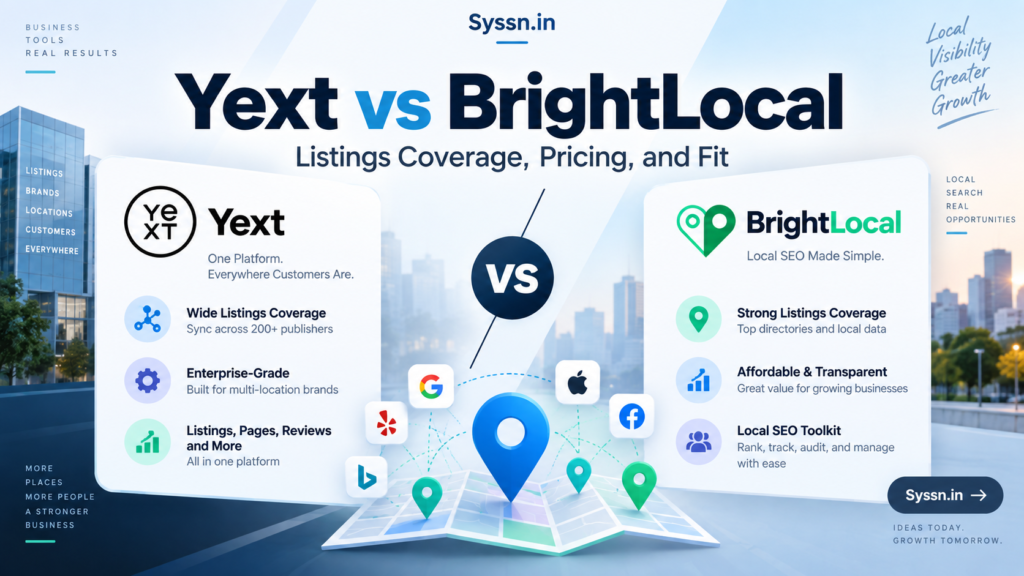
For a large company with hundreds or thousands of frequently changing locations, Yext’s 200+ direct integrations and enterprise controls are likely to be more relevant.
For an agency, consultant, SMB, or smaller multi-location business, BrightLocal’s public pricing and wider local SEO toolkit may fit the work more naturally.
Key Takeaways
- Yext connects directly with 200+ publishers and focuses heavily on continuous location-data distribution.
- BrightLocal uses Active Sync for major platforms and Citation Builder for broader directory coverage.
- BrightLocal publishes standard pricing, making initial budgeting much easier.
- Ending a Yext subscription does not automatically erase or revert listings. Yext simply stops actively managing the data.
- BrightLocal’s manually built citations remain in place after completion, although future changes may require another update.
- BrightLocal is closely aligned with agency SEO work. Yext is designed more heavily around enterprise location management, APIs, partner programs, and large portfolios.
- The useful comparison is not simply “which platform has more features?” It is how often your location data changes, how many publishers need ongoing control, and how your team actually works.
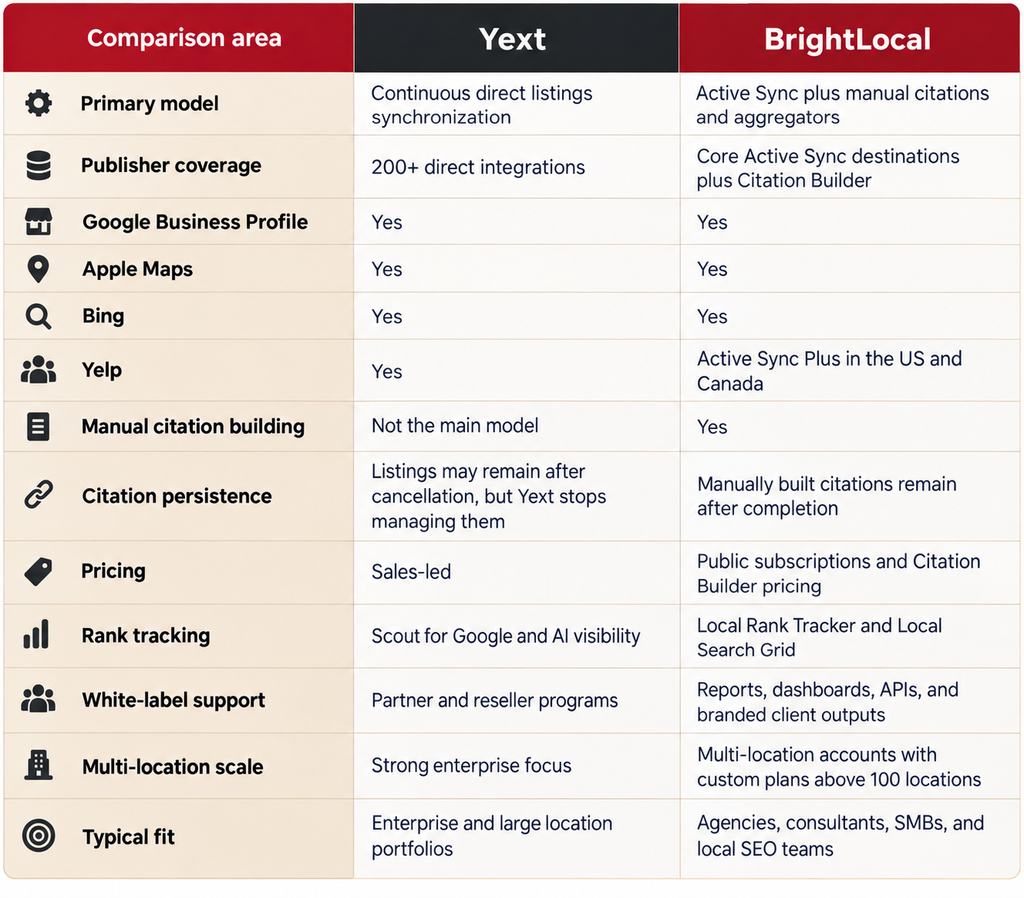
Yext vs BrightLocal: Quick Comparison
What Is the Difference Between Yext and BrightLocal?
At first glance, both products seem to perform the same job.
You give them your business name, address, phone number, opening hours, categories, photos, website URLs, and other location details. They help make sure that information appears correctly online.
But the way they approach the task is quite different.
Yext starts with centralized data.
The basic idea is that your location information should live in one controlled system and continuously flow outward to publishers. Yext currently states that its Listings product connects directly with more than 200 publishers.
That approach becomes useful when information changes regularly.
A retailer may change holiday hours across 600 stores. A restaurant chain might update menu links. A healthcare network may need to correct department information across dozens of facilities. A franchise system may open and close locations every month.
In those situations, listings management becomes less about creating a citation once and more about maintaining an operating system for location data.
BrightLocal separates the work into different products.
Active Sync manages ongoing synchronization with major consumer platforms. It currently covers Google Business Profile, Facebook, Apple Maps, and Bing. Active Sync Plus adds Yelp for eligible locations in the US and Canada.
Citation Builder takes care of broader citation work. BrightLocal manually creates or updates listings on selected directories and can also work with available data aggregators.
That distinction sounds technical, but it changes how you pay for the software and how you use it.
With Yext, continuous synchronization sits near the center of the product.
With BrightLocal, you can decide which listings deserve continuous management and which ones simply need to be created or corrected.
Yext vs BrightLocal Listings Coverage
This is where headline numbers can become misleading.
Yext says it has 200+ direct publisher integrations.
That network includes major search platforms, maps, social networks, directories, navigation services, and other discovery platforms. Publisher availability can still depend on the country, business type, subscription, and individual platform rules.
BrightLocal doesn’t try to match that number through Active Sync alone.
Its ongoing synchronization focuses on a smaller group of important platforms, including Google Business Profile, Facebook, Apple Maps, and Bing. Yelp is available through Active Sync Plus for eligible US and Canadian customers.
For everything else, Citation Builder gives businesses and agencies another route.
So is 200 automatically better than five?
Not necessarily.
Imagine a restaurant group with 400 locations. Its hours, menu URLs, categories, photos, and business details change constantly. Continuous distribution across a large network could save a considerable amount of administrative work.
Now imagine an eight-office law firm.
Its addresses rarely change. Phone numbers are stable. The firm’s biggest concern may be keeping Google, Apple Maps, Bing, Facebook, and Yelp accurate while making sure older directories contain consistent business information.
The law firm may not need 200 continuously synchronized destinations.
This is one of the more useful questions in the comparison: how many publishers genuinely need active management?
Publisher count sounds impressive in a sales presentation. Publisher relevance matters more once you start paying the bill.
Yext vs BrightLocal Pricing
Pricing exposes another difference in how the companies sell their products.
BrightLocal makes a large amount of its pricing public.
For one active location, monthly pricing currently starts at:
| BrightLocal plan | Monthly price |
|---|---|
| Track | $41 |
| Manage | $54 |
| Grow | $65 |
The cost increases as you add locations, with published rates available through 100 active locations. Larger accounts move to custom pricing.
Annual billing is discounted.
Listings management through Active Sync is included with Manage and Grow. Citation Builder remains a separate pay-as-you-go service.
A standard manual Citation Builder submission currently costs $3.20 per directory when paid by card. Bulk credits can reduce that price to as little as $2 per submission at the 2,000-credit level.
Duplicate removal costs an additional 20% of the manual submission price.
There is another option that is easy to miss.
BrightLocal offers a free Simply Listings account. Through it, Active Sync Essential currently costs $50 per year per location. Active Sync Plus costs $70 per year per location for eligible locations in the US and Canada.
Yext takes a sales-led approach.
There is no comparable standard enterprise Listings rate card on its main product pages. Businesses generally need to request a demo and receive a proposal based on their requirements.
That makes a simple comparison difficult.
But it would also be a mistake to look at BrightLocal’s one-location price and assume the same relationship holds at 500 or 1,000 locations.
Enterprise contracts can change considerably based on volume, modules, implementation requirements, contract length, support, APIs, and negotiated terms.
If you’re buying for a large location network, ask both vendors to quote the same scope.
Then compare the actual three-year cost.
What Happens to Your Listings If You Cancel Yext or BrightLocal?
This question deserves more attention than it usually gets.
Listings software is easy to buy when everything is going well. The interesting question is what happens when you stop paying for it.
There has been a persistent claim in older Yext comparisons that cancelling the service causes business information to revert to old data.
Yext’s current documentation says that is not how the system works.
After a listing stops being managed, Yext stops sending new information to that publisher. The publisher may continue displaying the information it already has.
The important change is control.
Once Yext is no longer actively synchronizing the listing, publishers can begin accepting information from other sources. Those sources may include aggregators, users, third-party datasets, or their own systems.
Over time, the information may drift.
That is different from deliberately restoring old information.
BrightLocal’s manually built citations follow another model.
Citation Builder work is purchased separately. Once a citation has been created, BrightLocal says that listing remains after the work has been completed.
If you cancel a regular paid BrightLocal subscription, your Citation Builder campaigns can continue and the account can move to the free Simply Listings tier.
There is still a catch.
A citation remaining online doesn’t mean it will magically stay correct forever.
If your business moves, changes its phone number, or updates other information, a manually built listing may need another paid update unless an ongoing sync or aggregator service covers it.
So the real question is not whether a listing “belongs” to you.
The better question is: who keeps it accurate next year?
Yext vs BrightLocal for Agencies
Agency software has an unusual requirement.
The agency often wants powerful software, while also wanting the software vendor to remain nearly invisible to the client.
BrightLocal has clearly designed around that reality.
Its paid plans support white-label reporting. Agencies can brand client dashboards, PDFs, report emails, and other client-facing outputs.
The platform also combines several tools that regularly appear in local SEO retainers:
- Local Rank Tracker
- Local Search Grid
- Citation Tracker
- Google Business Profile audits
- Listings management
- Citation Builder
- Reputation tools
- Client reporting
This means an agency can use one platform for more than directory management.
That can matter when listings are only one line item in a broader monthly SEO service.
Yext also works with agencies and resellers, but its partner structure points toward a somewhat different use case.
Yext Channel Partners can resell products, apply their own branding, use APIs, automate workflows, and manage multiple clients.
That model becomes particularly interesting at greater scale.
An agency managing 30 independent plumbers, dentists, law firms, and restaurants may find BrightLocal’s workflow familiar.
A software company or large reseller handling several thousand franchise locations may care more about APIs, automation, publisher breadth, and standardized data control.
Both are technically agencies.
Their operational problems are completely different.
Yext vs BrightLocal for Multi-Location Businesses
Multi-location software starts to become interesting when the number of people touching the data grows.
Managing 20 locations is largely a listings problem.
Managing 2,000 locations can become a permissions problem, an audit problem, a data-governance problem, and eventually an organizational problem.
Yext speaks directly to that environment.
Its Listings product supports large portfolios, including workflows involving 10,000+ locations. Features include bulk updates, duplicate management, publisher monitoring, role-based access, centralized location data, and automated distribution.
Consider a national healthcare company.
Central marketing may manage branding. Regional staff may update local information. Individual facilities may need access to certain fields. An agency might manage search optimization. IT may control integrations.
At that scale, “Can it update Google?” stops being the only important question.
You also need to ask:
Who is allowed to update Google?
Who approved the change?
Did the change reach every location?
Which locations failed?
Can a regional employee accidentally overwrite corporate data?
BrightLocal also supports multi-location businesses.
Its published packages cover up to 100 active locations, with custom plans available beyond that point. Its APIs can create, update, organize, and report on location data.
A company with 150 locations may therefore be completely comfortable with BrightLocal, particularly when its priorities are Google, Apple Maps, Bing, Facebook, Yelp, citations, ranking data, and reporting.
Yext begins to separate itself when a business needs broader continuous distribution and more complex centralized control.
Yext vs BrightLocal for Local SEO and Reporting
BrightLocal’s history in local SEO is obvious once you look at its reporting tools.
Track, Manage, and Grow include tools such as Local Rank Tracker, Local Search Grid, Citation Tracker, local search audits, and Google Business Profile auditing.
Manage adds listings synchronization.
Grow adds reputation management.
That combination fits naturally into monthly SEO work.
A consultant can check where a client ranks across different parts of a city, find citation problems, monitor listings, audit Google Business Profile, and put the results into a client report.
Yext’s search measurement offering has also expanded.
Scout tracks location visibility across Google Search, Google Maps, Google AI Overviews, ChatGPT, Gemini, Claude, and Perplexity.
It can compare individual locations with nearby competitors and report on visibility, rankings, citations, and other search information.
Its September 2026 release added separate Google Performance and AI Performance views with location and keyword detail.
This creates an interesting difference.
BrightLocal still feels closely connected to the familiar work of local SEO specialists, especially geo-grid reporting.
Yext’s measurement layer sits closer to enterprise location performance across conventional search and newer AI discovery systems.
Your preference may depend on the question your reports need to answer.
An SEO manager may ask, “Where does this branch rank within a three-mile radius?”
A national marketing director may ask, “How visible are our 800 locations across Google and AI search?”
Those questions sound related, but they produce different reporting requirements.
Yext and BrightLocal Alternatives
Sometimes the easiest way to understand two products is to look at what sits between them.
Three alternatives are especially relevant here.
1. Uberall
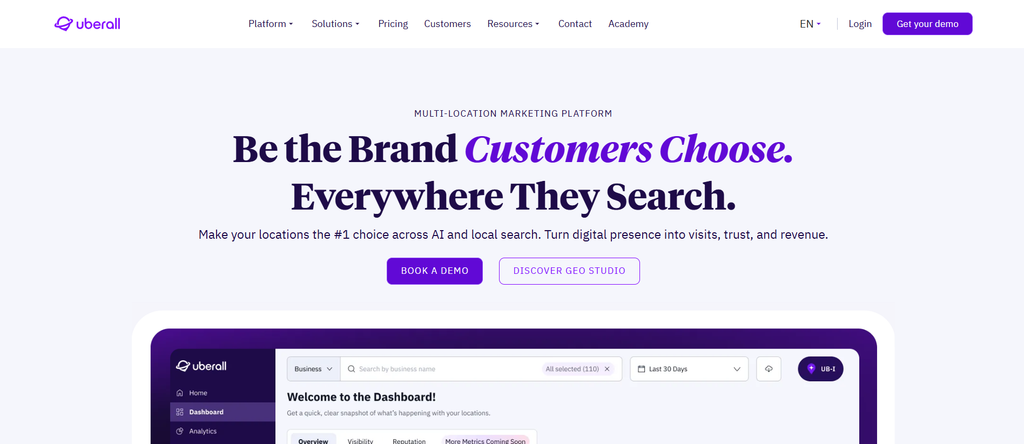
Best suited to: Large and international multi-location businesses.
Uberall is closer to Yext than BrightLocal in its overall structure.
Its Listings product manages business information across 150+ directories, including Google, Apple Maps, Bing, Yelp, navigation services, and regional publishers.
It supports bulk management, duplicate suppression, profile protection, scheduled updates, reporting, and multi-user workflows.
Its international orientation stands out. Businesses operating across several countries may find its regional publisher support worth examining closely.
Uberall also combines listings with reviews, social publishing, analytics, and other location-marketing functions.
Pricing is quote-based.
Compared with BrightLocal, Uberall places less emphasis on manual citation campaigns and conventional agency SEO reporting. Compared with Yext, its stated publisher count is lower, although still broad enough for many international organizations.
2. Synup
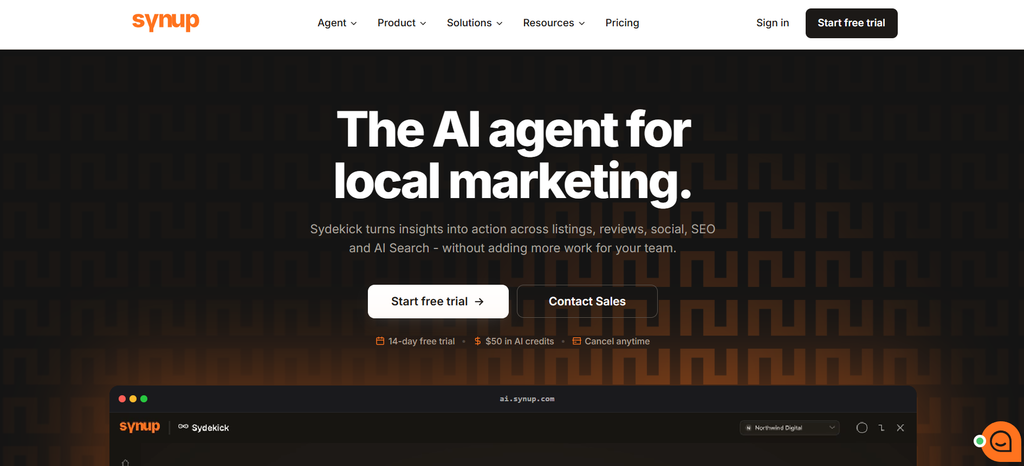
Best suited to: Agencies and resellers that want a branded listings service.
Synup sits somewhere between the agency orientation of BrightLocal and the centralized listings approach associated with larger platforms.
Its Listings product supports publishers including Google Business Profile, Apple Business Connect, Bing, Facebook, Yellow Pages, data aggregators, and other directories.
The platform also supports bulk location management, duplicate suppression, publisher-specific data, synchronization monitoring, and reporting.
White labeling is a significant part of Synup’s agency offering.
Agencies can use their own branding, domain, colors, and client-facing experience. Synup also supports client workspaces and role-based access.
The company currently advertises a 14-day free trial. Pricing depends on the account and product setup rather than a simple public listings rate card.
Agencies that want something more listings-centered than BrightLocal while avoiding a heavily enterprise-focused purchasing process may find Synup relevant.
3. Advice Local
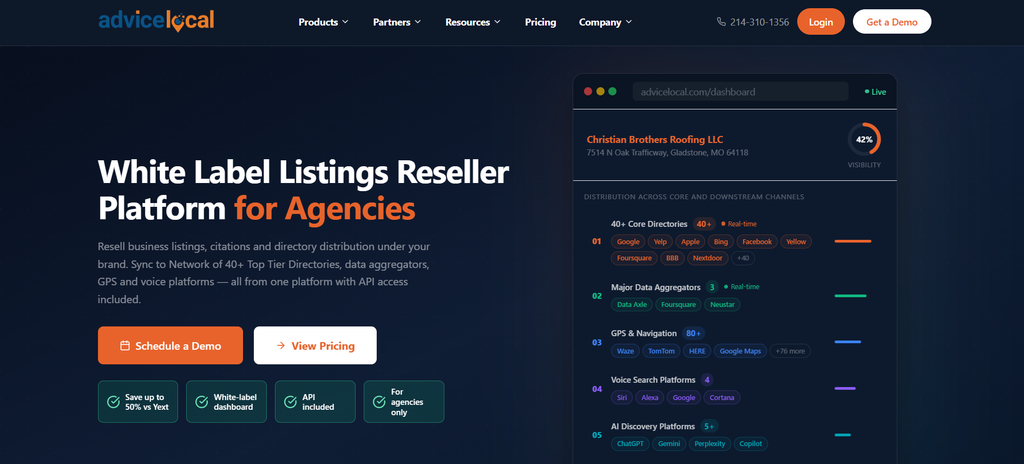
Best suited to: Agencies that want a listings provider working behind their own brand.
Advice Local takes a strongly agency-oriented approach.
Its platform combines APIs, data syndication, and manual submissions instead of depending on a single distribution method.
The service also includes duplicate management, reporting, listing updates, multi-location support, and a partner dashboard.
Its white-label offering extends beyond adding a logo to reports. Agencies can brand the dashboard and reporting experience and add lead-generation widgets and landing pages to their own websites.
That can be useful for agencies that want to own the client relationship while outsourcing more of the listings work.
Advice Local does not publish a standard reseller pricing table. Partners need to request a quote and confirm the publishers included in their package.
How I Would Compare Yext and BrightLocal
I would resist the temptation to build a giant feature checklist.
Those lists tend to make every feature look equally important.
They aren’t.
I would start with six questions.
How many publishers genuinely need continuous updates?
If the answer is Google, Apple Maps, Bing, Facebook, and Yelp, BrightLocal deserves serious consideration.
If you need continuous distribution across a much wider network, Yext’s model becomes easier to justify.
How often does your information change?
A business with stable addresses and opening hours has a different problem from a restaurant chain changing seasonal hours across hundreds of locations.
The more frequently data changes, the more valuable continuous synchronization becomes.
Who actually uses the platform?
An SEO consultant may spend most of the day looking at ranking grids and audits.
An enterprise marketing team may care more about permissions, bulk changes, APIs, and publisher status.
The software should fit the people operating it.
Are citations a project or an ongoing system?
Some businesses need citations created and cleaned up.
Others need hundreds of listings actively synchronized every day.
Those are different jobs.
What does the three-year cost look like?
Don’t compare the cheapest advertised plan with an enterprise sales quote.
Include:
- Platform subscriptions
- Citation work
- Duplicate removal
- Additional modules
- APIs
- Implementation
- Data aggregators
- Update fees
- Staff time
The cheapest monthly subscription can become expensive if your team spends hours filling the gaps manually.
What happens if you leave?
This question is easy to ignore during a demo.
Ask it anyway.
Find out what happens to your listings, your data, your reports, your integrations, your citation work, and your ability to make future changes if the contract ends.
Exit conditions tell you a surprising amount about how a platform actually works.
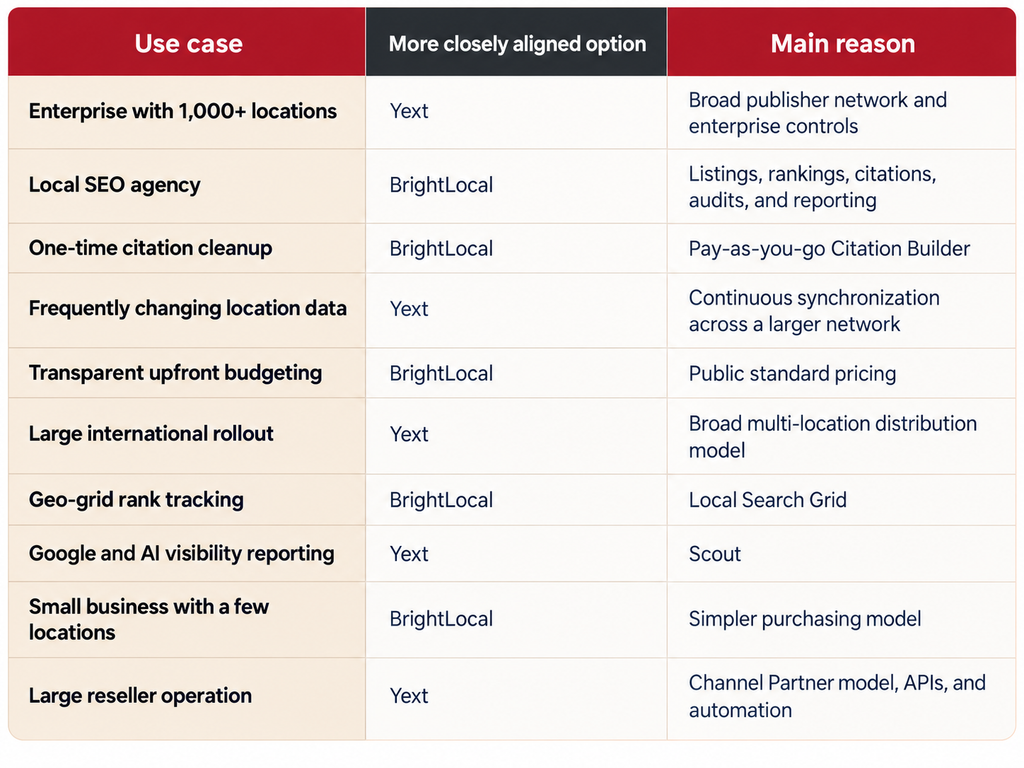
Yext vs BrightLocal by Use Case
Frequently Asked Questions
Is Yext better than BrightLocal?
They suit different operating models.
Yext is more closely aligned with large organizations that need continuous distribution across a broad publisher network.
BrightLocal suits agencies, consultants, SMBs, and local SEO teams that want listings management alongside rank tracking, citation work, audits, reputation management, and reporting.
Is BrightLocal cheaper than Yext?
BrightLocal is easier to budget because it publishes standard subscription and Citation Builder pricing.
Yext uses sales-led pricing for enterprise Listings.
For a fair comparison, request pricing for the same number of locations, features, publishers, and contract period.
Does Yext own your business listings?
Yext manages listings through publisher integrations while the service is active.
According to Yext’s documentation, listings can remain live after management stops. Yext does not deliberately restore old information after cancellation.
What changes is that Yext no longer actively controls future updates.
Do BrightLocal citations disappear if I cancel?
BrightLocal states that manually created Citation Builder listings remain after the work has been completed.
You may still need to update them later if business information changes.
Do I need a BrightLocal subscription to use Citation Builder?
No.
BrightLocal’s free Simply Listings account can be used to purchase Citation Builder campaigns without subscribing to Track, Manage, or Grow.
Can BrightLocal handle large companies?
Yes.
BrightLocal offers custom plans for businesses managing more than 100 active locations.
Whether it suits a large enterprise depends on its publisher requirements, update frequency, API needs, permissions, reporting requirements, and internal workflows.
Does Yext track rankings?
Yes.
Yext Scout tracks Google and AI search visibility at the location level and supports competitive comparisons, citations, rankings, visibility metrics, and other search-performance reporting.
Final Thoughts
The more I look at Yext and BrightLocal, the less useful the question “Which one is better?” becomes.
A better question is what kind of listings problem you actually have.
If your business manages hundreds or thousands of frequently changing locations and wants one system continuously sending approved information across a broad publisher network, Yext’s structure makes sense.
If listings management sits inside a wider local SEO process involving citation work, geo-grid rankings, audits, reputation management, and client reports, BrightLocal’s structure makes sense for a different reason.
And then there are businesses sitting somewhere between those two situations. That is where platforms such as Uberall, Synup, and Advice Local become relevant.
The decision usually becomes clearer once you stop comparing feature pages and start looking at the weekly work.
Who changes the data?
How often?
Where does that data need to go?
Who checks whether the update worked?
What do clients or executives expect to see in the report?
And what happens when you decide to leave?
Those questions are less exciting than a list of 200 integrations.
They are also far more likely to tell you which platform you should actually pay for.