Best Software Testing Courses for Freshers: Projects, Class Format and Placement Assistance


The best software testing courses for freshers in India in 2026 include StarAgile, QSpiders, ExcelR, Simplilearn, Intellipaat, Microsoft’s Junior QA/Software Tester Professional Certificate on Coursera, and Test Automation University by Applitools. These options suit different learning needs, from live instructor-led software testing training and practical automation projects to affordable self-paced courses and placement assistance.
For beginners, the right course should teach manual testing, test case design, defect reporting, API testing, and automation fundamentals. It should also provide practical assignments, instructor feedback, and a clear pathway toward entry-level quality assurance (QA) roles.
The most important consideration is job readiness, not just certification. A software testing course with placement assistance can help with resumes and interviews, but it does not automatically guarantee employment.
This guide compares seven training options based on curriculum, practical projects, class formats, duration, fees, certification, and career support.
Quick Answer: Which Software Testing Course Is Best for Freshers?
The best option depends on your current skills, learning preferences, budget, and career goals.
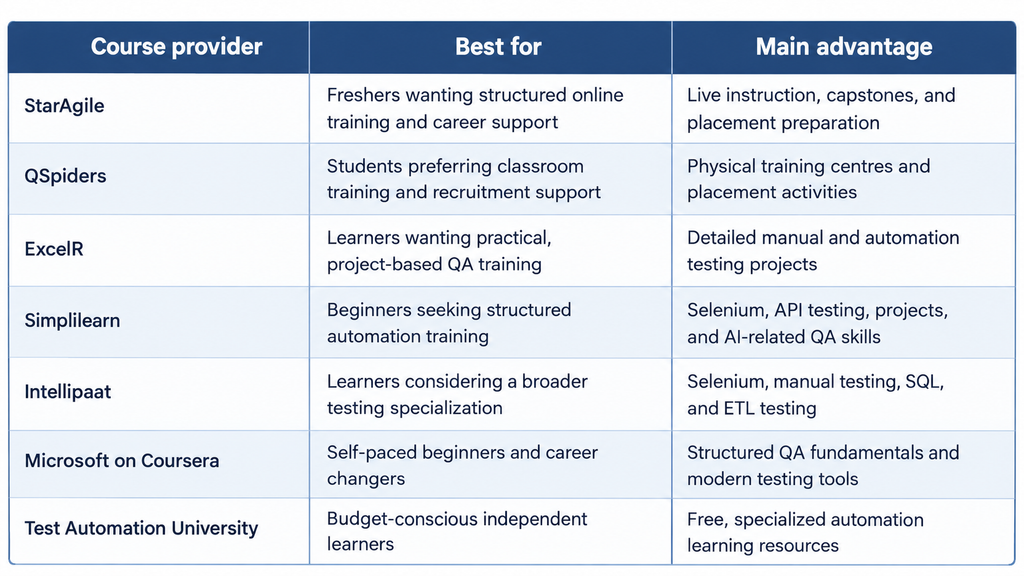
These are best-fit recommendations rather than independently verified rankings of teaching quality or placement outcomes.
How We Evaluated These Software Testing Courses
We compared the published offerings of seven providers using criteria that matter to fresh graduates and first-time job seekers.
Our evaluation considered:
- Curriculum: Manual testing, automation, API testing, SQL, and relevant tools.
- Projects: Whether learners can produce meaningful testing deliverables.
- Class format: Live online, offline classroom, blended, or self-paced.
- Duration: Published schedules and the likely learning commitment.
- Fees: Publicly available pricing and transparency around additional charges.
- Career assistance: Resume preparation, mock interviews, referrals, and placement eligibility.
- Beginner suitability: Prerequisites, programming requirements, and learning progression.
Research was based on official provider websites, training descriptions, and technical documentation available in October 2026. No independent classroom testing, student interviews, or placement-record audits were conducted.
Where reliable course-specific pricing or placement information was unavailable, it is identified as needing confirmation rather than estimated.
Best Software Testing Courses for Freshers in India: Detailed Comparison
1. StarAgile — Best for Live Training, Practical Projects and Placement Assistance

Best for: Freshers seeking a comprehensive, instructor-led software testing course with career preparation.
Course overview
StarAgile offers software and automation testing training designed for beginners, graduates, and career changers. Its program covers testing fundamentals, manual testing, automation, API testing, and the use of generative AI in QA workflows.
The provider advertises a four-month online training program, more than 220 hours of live instruction, practical assignments, and three capstone projects. No previous coding experience is required for admission.
StarAgile describes three domain-based capstones:
- E-commerce application testing using Selenium and TestNG.
- HR management application automation.
- Telecom API testing involving REST services.
The curriculum also includes tools such as Jira, Postman, Jenkins, Maven, and Selenium, helping learners connect testing concepts with working development environments.
Class format: Live online, instructor-led training, supported by assignments and mentor assistance.
Placement assistance: StarAgile advertises resume optimization, mock interviews, career preparation, and interview opportunities for eligible learners. Its promotional pages also use placement assurance or guarantee language. Candidates should request the current agreement and confirm the exact eligibility, salary, refund, and post-placement fee conditions before enrolling.
Duration and fees: Approximately four months of instruction. Published fees vary by page and promotion, with broader advertised ranges of ₹49,999–₹119,999. Confirm the total payable amount.
Limitations: The program requires a substantial investment compared with free learning options. The provider’s published placement and fee terms are not entirely consistent across pages.
Choose StarAgile if you want scheduled classes, structured projects, regular guidance, and career preparation within one training program.
2. QSpiders — Best for Classroom Training and Recruitment-Oriented Learning
Best for: Fresh graduates who prefer face-to-face learning and an institute-led recruitment environment.
Course overview
QSpiders is a software training institute with branches across Indian technology hubs, including Bengaluru, Hyderabad, Chennai, Pune, Mumbai, and Delhi NCR.
Its training portfolio includes manual testing, Selenium automation, Java-based testing, Python testing, and API testing. It also offers beginner-oriented programs intended for students from different academic backgrounds.
Depending on the selected course, learners can explore manual test execution, automation scripting, framework development, and API validation.
Its testing curriculum is particularly relevant to freshers who want to combine foundational testing knowledge with Java or Python.
Before joining, candidates should ask for sample assignments, details of complete testing projects, and the criteria used to evaluate their work.
Class format: Offline classroom training and live online classes, with scheduling and availability depending on the branch and course.
Placement assistance: QSpiders advertises dedicated placement activities, recruitment drives, and opportunities to connect with hiring companies. Students should confirm which drives apply to their course, graduation year, academic performance, and branch.
Duration and fees: The provider describes typical course durations of approximately six weeks to three months, depending on course scope. Course-specific fees should be obtained directly from the selected centre.
Limitations: Training experience, scheduling, projects, and recruitment opportunities may vary across branches. Students should not assume that every location provides identical services.
Choose QSpiders if you learn better in a classroom, want direct trainer interaction, and value access to institute-organized recruitment activities.
3. ExcelR — Best for Hands-On Software Testing Projects
Best for: Beginners who want to build practical QA portfolios through application-based assignments.
Course overview
ExcelR offers software testing training that combines foundational manual testing with automation techniques, Java, Selenium, API testing, and defect management.
Its published curriculum includes Jira, Postman, Git, MySQL, TestNG, Maven, and other development and testing tools.
The course is designed to help learners progress from understanding testing processes to performing test execution and developing automation scripts.
Projects and practical learning
ExcelR publishes several example projects covering:
- Travel application test case design.
- E-commerce testing with Jira.
- Sports application testing and defect reporting.
- Healthcare automation using Page Object Model.
- HR management automation using TestNG.
- End-to-end testing of an educational application.
These examples provide a relatively detailed view of the practical assignments offered.
Class format: Live instructor-led online training, classroom learning, and recorded sessions. ExcelR also advertises blended access options, subject to enrolment terms.
Placement assistance: Its course page advertises interview opportunities through hiring partners, internship-related activities, and learner support. The precise eligibility and interview commitments should be verified in writing.
Duration and fees: The complete software testing program’s current schedule and fee should be confirmed directly. Avoid assuming that pricing for its separate Selenium or manual testing courses applies to the combined program.
Limitations: A detailed project list does not establish how much individual feedback every learner receives. Students should verify mentoring hours, actual project access, and interview eligibility.
Choose ExcelR if you want a course with clearly described projects and the opportunity to demonstrate manual and automation testing skills.
4. Simplilearn — Best for Structured Automation Testing and AI-Related QA Skills
Best for: Learners interested in automation engineering, API testing, and a structured technical learning path.
Course overview
Simplilearn offers software testing courses covering testing fundamentals, automation frameworks, API validation, and newer AI-assisted QA workflows.
Its AI-Powered Automation Test Engineer Program is advertised as a six-month live cohort. The wider learning catalogue also includes shorter introductory courses.
The learning path discusses Java, Selenium, TestNG, Maven, Postman, REST Assured, and JMeter.
Simplilearn describes lesson-end assignments, phase-end exercises, and capstone-style projects.
The course material emphasizes creating reusable automated tests, designing API checks, building regression suites, and developing portfolio-ready work.
Beginners should verify whether the first modules offer sufficient programming instruction before advanced automation begins.
Class format: Live online cohort instruction for the main automation program, with shorter self-paced options in its wider learning catalogue.
Placement assistance: Career preparation should be evaluated at the program level. Confirm whether the selected course includes resume reviews, technical mock interviews, referrals, or dedicated placement services.
Duration and fees: The six-month automation program has a publicly displayed price of $1,499 on a Simplilearn program page. Indian pricing, taxes, promotional discounts, and instalment options require confirmation.
Limitations: The flagship automation program is described as intermediate to advanced in the current catalogue, so it may be challenging for complete beginners without preparatory learning.
Choose Simplilearn if you want a structured technical program with modern automation coverage and are prepared to dedicate time to programming practice.
5. Intellipaat — Best for Broad Testing Specializations

Best for: Learners who want exposure to multiple testing specializations beyond basic manual QA.
Course overview
Intellipaat’s Test Architect Master’s Program covers Selenium, manual software testing, SQL, ETL testing, and related technologies.
The program combines instructor-led modules with self-paced learning and is designed around a broader testing curriculum.
Its official description advertises 101 hours of instructor-led training, 96 hours of self-paced videos, and 154 hours of projects and exercises.
The provider describes 20 industry-based projects covering different testing areas.
Relevant activities include developing Selenium tests, validating databases, understanding ETL workflows, and working with testing frameworks.
This breadth can help students discover whether they prefer automation, database testing, or another QA specialization.
However, beginners should verify whether the course provides sufficient time for programming fundamentals before specialized topics.
Class format: Online instructor-led sessions combined with recorded self-paced modules, flexible scheduling, and mentor support.
Placement assistance: Intellipaat advertises career-oriented support across its training portfolio. Students should confirm the exact recruitment, resume, and interview services included specifically with the Test Architect program.
Duration and fees: Training hours are published, but the actual calendar duration depends on scheduling. Request an updated fee quotation for the relevant batch.
Limitations: The extensive curriculum may include material that is not essential for a first manual QA role. Learners who want only entry-level testing fundamentals may prefer a narrower program.
Choose Intellipaat if you want a wider testing education that could support progression toward specialized testing or automation roles.
6. Microsoft Junior QA/Software Tester Professional Certificate — Best for Flexible Beginner-Friendly QA Training

Best for: Freshers and career changers seeking an organized, self-paced entry into modern QA practices.
Course overview
Microsoft’s Junior QA/Software Tester Professional Certificate is available through Coursera. It introduces manual testing, quality assurance processes, Agile workflows, defect tracking, and automation.
The six-course series is described as beginner-level, with an estimated completion time of four weeks at approximately ten hours per week.
Its curriculum also includes Playwright, SQL, API validation, Jira, Zephyr, and AI-assisted testing concepts.
The certificate includes exercises that reflect entry-level QA responsibilities.
Learners can create test plans, execute exploratory and regression tests, maintain defect reports, and write automated validation checks.
A capstone brings these activities together into an end-to-end testing portfolio project.
Class format: Fully online and self-paced, allowing students to study independently without attending scheduled classroom sessions.
Placement assistance: The curriculum includes career development topics such as resume preparation, portfolio presentation, and interview readiness. This is not equivalent to an institute-managed placement program.
Duration and fees: Approximately four weeks at the advertised pace. Coursera access and certificate costs depend on the applicable subscription or payment arrangement; some exercises may require paid tool tiers.
Limitations: Learners do not receive the same level of scheduled, live instructor interaction as a cohort-based classroom program. Maintaining study discipline and developing additional projects are important.
Choose Microsoft’s Coursera certificate if you want beginner-friendly QA training with flexible scheduling and can manage independent practice.
7. Test Automation University — Best for Free Automation Testing Education
Best for: Self-motivated beginners who want to develop automation skills without paying institute-level course fees.
Course overview
Test Automation University is a learning platform operated by Applitools. It offers free training resources focused on software test automation.
Its course catalogue has included Selenium, Python, Java, API testing, testing strategies, and automation frameworks.
The platform also provides learning paths that help students study related topics in a logical sequence.
Students can practice creating browser automation tests, validating API responses, and developing testing scripts using commonly available tools.
Because courses focus on particular subjects, learners can assemble their own pathway from programming basics toward more advanced testing practices.
A useful approach is to pair each completed module with an independent GitHub project demonstrating the relevant skill.
Class format: Online, self-paced learning resources without compulsory attendance at a physical training centre.
Placement assistance: Learners should not expect the platform to provide the same recruitment drives or individualized placement support as a commercial training institute.
Duration and fees: Learning resources are available free of charge. Total completion time depends on the courses selected and the amount of independent practice.
Limitations: Students are responsible for planning their learning, maintaining motivation, and building a coherent portfolio across individual courses.
Choose Test Automation University if your budget is limited, you are comfortable learning independently, and your main priority is developing practical technical skills.
What Should a Software Testing Course for Freshers Include?
A strong software testing syllabus should cover the fundamentals of quality assurance before introducing advanced automation.
The curriculum should provide practical coverage of seven important learning areas.
1. Manual testing fundamentals
Every beginner should understand the software development life cycle, software testing life cycle, functional testing, regression testing, smoke testing, test design techniques, and defect management.
The ISTQB Certified Tester Foundation Level syllabus provides an established reference for these concepts.
2. Test automation with Selenium
Freshers should understand how to locate web elements, interact with pages, handle waits, write assertions, and organize tests into reusable frameworks.
The official Selenium WebDriver documentation explains browser automation principles and related capabilities.
Beginners can also consult this Selenium automation testing course guide for a practical breakdown of learning objectives.
3. Modern browser testing with Playwright
Playwright helps testers automate browser interactions and validate application behavior.
The Playwright documentation introduces browser-based testing, assertions, execution, and debugging.
A beginner need not master Selenium and Playwright simultaneously, but exposure to both can help when evaluating different job requirements.
4. API testing with Postman
API testing involves checking how application services respond to requests, including valid data, incorrect inputs, authentication, and error conditions.
The official Postman quick-start documentation demonstrates requests, collections, and API validation.
5. Defect management with Jira
Learners should practice writing understandable bug reports with reproduction steps, expected results, actual results, severity, and supporting evidence.
Atlassian’s Jira bug tracking guide provides useful reference material.
6. Version control and portfolio development
Freshers should understand Git and learn how to maintain project files in a repository.
The GitHub repository documentation explains how to create and organize repositories.
7. Performance testing basics
Introductory performance testing teaches students to evaluate how systems behave under simulated workloads.
The Apache JMeter getting-started documentation explains test plans, execution, and result analysis.
These seven official resources provide useful benchmarks when checking whether a course teaches relevant tools in sufficient depth.
What Practical Projects Should Freshers Complete?
A software testing course with live projects should help students create evidence of their testing abilities, not simply watch an instructor demonstrate tools.
Three practical portfolio projects are particularly valuable.
Project 1: E-commerce website testing
Choose a sample shopping application and evaluate user journeys such as registration, login, product searching, cart management, and checkout.
Expected deliverables: Test scenarios, test cases, defect reports, screenshots, and a test execution summary.
For example, create positive and negative tests for checkout, including invalid coupon codes, missing address fields, and incorrect payment information.
Project 2: Web application automation
Use Selenium or Playwright to automate a small collection of repeatable tests for an HR portal, customer dashboard, or similar application.
Expected deliverables: Executable test scripts, assertions, framework structure, test results, and documentation.
A strong project demonstrates maintainable code and explains why specific tests were automated.
Project 3: REST API testing
Use Postman to validate a sample application’s API endpoints.
Expected deliverables: Saved collections, status-code checks, response validation, negative tests, and execution results.
For instance, test whether a login API rejects invalid credentials without returning sensitive information.
By graduation, a useful beginner portfolio might contain one manual testing project, one UI automation project, and one API testing project. These artifacts often communicate practical competence more effectively than a certificate alone.
Online vs Offline Software Testing Courses: Which Is Better?
Neither online nor offline training is universally better. The right format depends on learning discipline, availability, and the quality of instructor feedback.
| Factor | Online training | Offline training |
|---|---|---|
| Flexibility | Generally higher | Fixed location and schedule |
| Trainer interaction | Live or asynchronous | Face-to-face |
| Travel expenses | Usually minimal | May require commuting |
| Practical assignments | Possible through remote tools | Possible through classroom labs |
| Peer interaction | Online groups and cohorts | In-person classmates |
| Recorded sessions | Often available | Depends on institute |
| Placement activities | Provider-dependent | Provider-dependent |
Live online classes can work particularly well for students in smaller cities who want access to experienced trainers without relocating.
Offline software testing classes may be useful for learners who need a more structured routine and direct instructor supervision.
Self-paced learning is attractive for disciplined students with limited budgets, but it typically requires greater initiative.
Before enrolling, attend a demonstration class where possible. Evaluate whether the instructor explains concepts clearly, answers questions, and reviews student work.
Placement Assistance vs Placement Guarantee: What Is the Difference?
Placement assistance supports the job search. A placement guarantee is a stronger contractual promise whose meaning depends on the provider’s written terms.
| Term | Meaning | What to verify |
|---|---|---|
| Placement assistance | Help with job searching, resumes, or interviews | Duration and eligibility |
| Placement assurance | A provider-defined commitment to support job outcomes | Written conditions and exclusions |
| Guaranteed interviews | A specified number or type of interview opportunities | Employer eligibility and interview definition |
| Placement guarantee | A contractual promise tied to placement outcomes | Remedies, salary requirements, deadlines, and refund rules |
Students should ask whether placement services include real recruiter introductions or primarily resume workshops and job-board access.
A useful resource is this guide to software testing courses with placement assistance, which discusses what learners should compare before enrolling.
How can freshers verify placement claims?
Request written information covering placement eligibility, attendance requirements, technical assessments, interview opportunities, support duration, fees, and refund conditions.
Also ask for recent, verifiable alumni outcomes from the specific course and training centre. A provider’s overall placement figure may combine multiple programs and graduating batches.
Do not interpret “100% placement assistance” as “100% of students receive jobs.” These statements describe different outcomes.
How Much Do Software Testing Courses Cost in India?
Software testing course fees in India vary substantially according to training depth, class format, project support, and career services.
Free learning resources can provide foundational skills, while comprehensive instructor-led programs can require considerably more investment.
For budgeting, consider the complete cost rather than only the advertised tuition.
Additional expenses may include certification examinations, software subscriptions, computing equipment, travel, accommodation, and financing charges.
Before making payment, request an itemized quotation specifying:
- Tuition, taxes, and registration charges.
- Project mentoring and learning-material access.
- Certification and examination fees.
- Placement-related charges or income-share arrangements.
- Instalment, refund, and cancellation conditions.
There is no single verified national average fee that accurately represents all software testing courses in India. Comparing current quotations from shortlisted providers is more useful than relying on an unsupported market average.
How to Choose the Right Software Testing Course for Your Career
Choosing the best software testing course for freshers becomes easier when students connect learning requirements with their first-job goals.
If you have no coding knowledge
Start with manual testing, SDLC, STLC, test cases, and defect reporting. Then learn basic Java or Python before progressing to automation.
Avoid programs that assume you can immediately build advanced automation frameworks.
If you want placement assistance
Prioritize programs that document resume preparation, mock interviews, technical assessment support, and hiring opportunities.
Verify the eligibility requirements before paying.
If you want strong practical experience
Compare the actual projects learners complete, their complexity, and the feedback provided by instructors.
A course offering fewer substantial projects may be more useful than one advertising many assignments with little individual guidance.
If your budget is limited
Begin with free or low-cost testing fundamentals and automation resources.
Build a portfolio before deciding whether paid mentorship or career services would provide additional value.
If you are interested in advanced automation
Select a course that teaches programming, test architecture, API validation, debugging, and maintainable frameworks.
For additional evaluation criteria, read this automation testing course with placement support guide.
A Practical 16-Week Software Testing Career Roadmap for Freshers
The following roadmap is an illustrative study plan, not a guaranteed course duration or employment timeline.
| Period | Learning focus | Practical outcome |
|---|---|---|
| Weeks 1–2 | SDLC, STLC, and QA principles | Testing terminology and workflow notes |
| Weeks 3–4 | Manual testing and test design | Test cases and defect reports |
| Weeks 5–6 | Java or Python fundamentals | Basic programming exercises |
| Weeks 7–9 | Selenium or Playwright | Small browser automation suite |
| Weeks 10–11 | Postman and API testing | API test collection |
| Weeks 12–13 | SQL, Git, and Jira | Database checks and project repository |
| Weeks 14–15 | Integrated testing project | Portfolio-ready QA project |
| Week 16 | Resume, interviews, applications | Resume and interview preparation |
Students should adapt the pace to their existing technical knowledge and available study hours.
The goal is to reach the point where you can confidently explain a software defect, design test cases, execute tests, and demonstrate practical work during an interview.
Which Software Testing Certification Is Best for Freshers?
The ISTQB Certified Tester Foundation Level is a widely established option for demonstrating foundational software testing knowledge.
Institute completion certificates and professional course credentials can also document learning. However, their assessment requirements and recognition differ.
A useful distinction is between a course-completion certificate and a qualification earned through a separate standardized examination.
For many freshers, a sensible sequence is to learn testing fundamentals, complete projects, prepare for entry-level interviews, and consider certification based on target job requirements.
Certification adds value, but it should complement rather than replace technical proficiency.
Frequently Asked Questions
1. Which are the best software testing courses for freshers in India in 2026?
StarAgile, QSpiders, ExcelR, Simplilearn, Intellipaat, Microsoft’s Junior QA/Software Tester certificate on Coursera, and Test Automation University are seven useful options. They differ in curriculum, teaching format, projects, costs, and career services. Compare course-specific details before enrolling.
2. Can a fresher learn software testing without coding knowledge?
Yes. Manual testing fundamentals do not require advanced programming. Beginners can start with requirements analysis, test design, defect reporting, and testing processes. However, automation-focused jobs generally require programming or scripting skills.
3. Should freshers learn manual testing or automation testing first?
Most beginners benefit from learning manual testing principles first, followed by programming and automation. Understanding test objectives, expected outcomes, and defect behavior helps students write more meaningful automated checks.
A combined course is suitable when it teaches these topics progressively.
4. How long does it take to complete a software testing course?
Course lengths vary from short introductory programs to several months of comprehensive training. For example, Microsoft’s Coursera certificate advertises approximately four weeks at its suggested pace, while StarAgile describes four months of instruction. Advanced programs may take longer.
5. Can non-IT graduates join software testing courses?
Yes. Graduates from non-IT backgrounds can begin software testing training, particularly where programs offer beginner-level instruction.
However, employers may apply their own degree, technical-skill, and eligibility requirements. Non-IT students should develop programming familiarity, logical reasoning, and a practical portfolio.
6. Which software testing courses offer placement assistance?
StarAgile, QSpiders, and ExcelR publicly advertise career or interview support associated with their training offerings. Other programs may provide career preparation, but that should not be assumed to include employer referrals.
Check the exact selected program and its written conditions. Placement assistance does not guarantee a job offer.
7. Which software testing tools should freshers learn in 2026?
Freshers should prioritize Jira for defect tracking, Postman for API testing, Git for version control, SQL for database validation, and Selenium or Playwright for web automation.
JMeter and CI/CD tools can be introduced after the fundamentals. Learning one automation framework thoroughly is generally more useful than superficial exposure to many tools.
8. How can freshers prepare for their first QA job?
Build a resume highlighting testing concepts, tools, project work, and measurable accomplishments. Maintain a portfolio containing test cases, bug reports, API validations, and automation scripts.
Practice interview questions, explain your projects clearly, and apply to suitable entry-level QA positions. Treat placement services as an additional resource rather than the entire job-search strategy.
Conclusion: Which Software Testing Course Should You Choose?
The best software testing courses for freshers are those that combine clear fundamentals, practical testing experience, appropriate teaching formats, and transparent career support.
StarAgile is worth considering for comprehensive live online training and placement preparation. QSpiders is suitable for students who value classroom learning and recruitment-oriented activities. ExcelR offers a particularly detailed set of practical testing projects.
Simplilearn and Intellipaat are relevant for learners interested in broader automation or specialized testing pathways. Microsoft’s Coursera certificate provides a flexible beginner-friendly option, while Test Automation University supports students seeking free technical learning.
There is no single course that is ideal for every student.
Before enrolling, compare the syllabus, request sample projects, attend a demo class where available, verify current fees, and obtain written placement terms.
The strongest starting point for a software testing career is a course that helps you demonstrate what you can test, how you identify defects, and why your testing approach is reliable, not merely one that awards a certificate.