Best Review Management Tools for Local SEO in 2026


Best Review Management Tools for Local SEO in 2026 covers the platforms businesses actually use to monitor reviews, keep listings accurate, and turn customer feedback into better local search rankings. This guide compares Synup, Birdeye, Podium, Reputation.com, Yext, ReviewTrackers, and BrightLocal on pricing, features, and who each tool fits best. You’ll get a clear picture of what each platform costs, what it does well, and where it falls short before you commit budget to one.
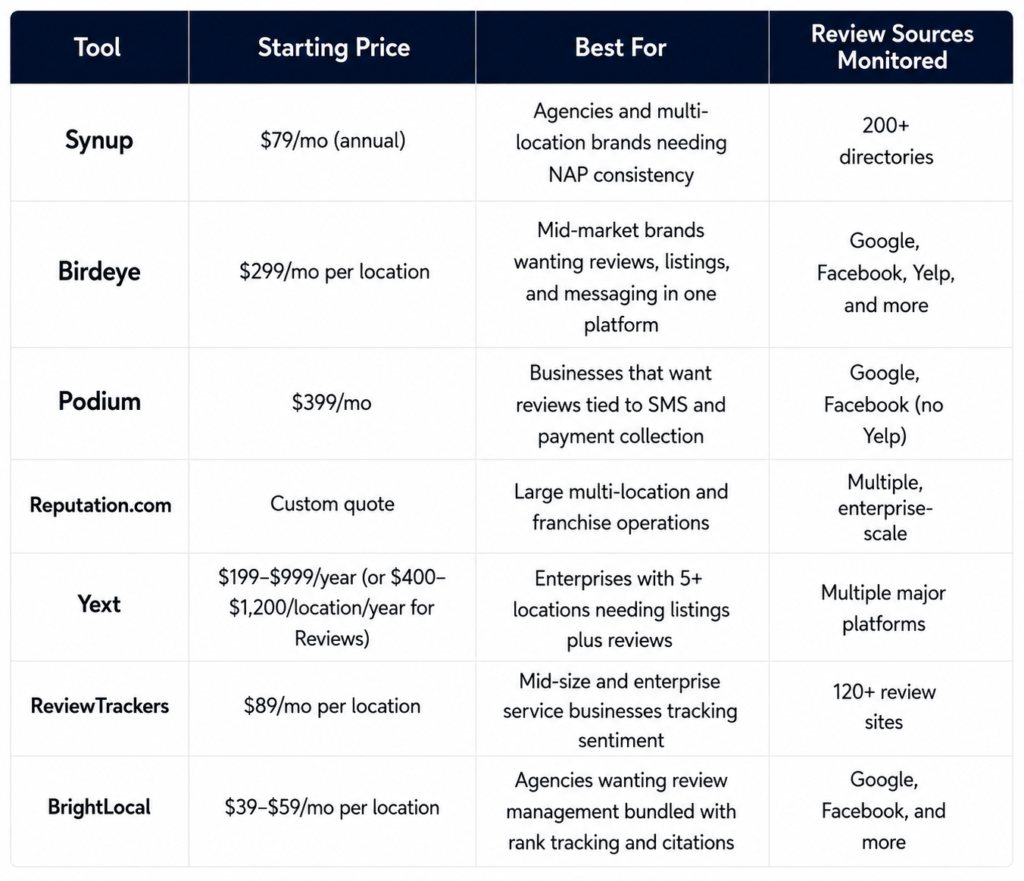
Quick Comparison Table
How We Evaluated These Review Management Tools
We looked at five factors for each platform: pricing transparency, breadth of review sources monitored, listing accuracy tools, response and automation features, and reporting depth. Tools that hide pricing behind a “request a demo” wall lost points for transparency, even when their features were strong. We also checked whether each platform separates review management from broader marketing bundles, since paying for social media scheduling or payment processing you don’t need adds real cost over a year.
1. Synup
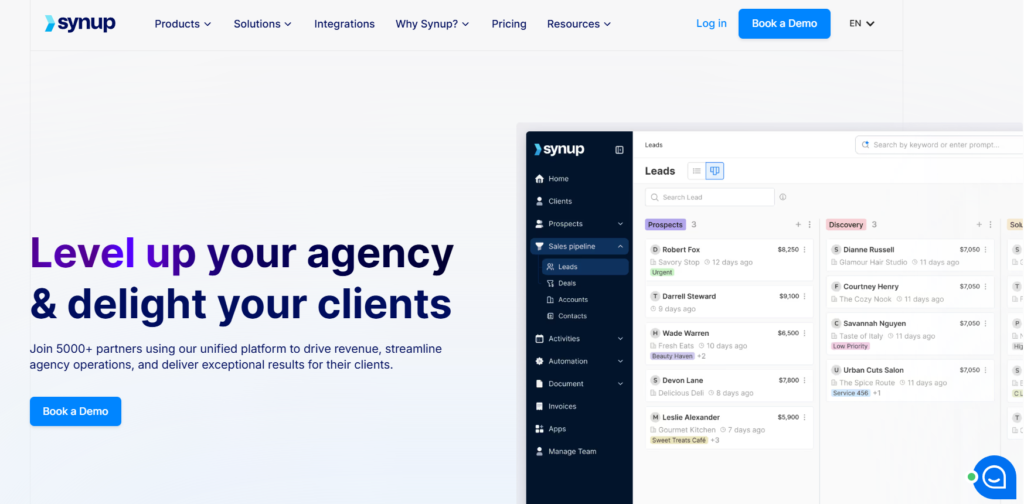
Synup centralizes business listings, review monitoring, and analytics in one dashboard, with pricing starting at $79 a month when billed annually or $99 a month when billed monthly. Agency-focused plans scale up to $799 a month for larger portfolios. Founded in 2014, Synup now works with more than 5,000 partners managing millions of business locations.
The core strength here is name, address, and phone number (NAP) synchronization across more than 200 directories, which matters directly for local SEO since inconsistent listings actively hurt search rankings. Synup’s review management feature pulls feedback from multiple sources into a single interface so businesses can respond without logging into each review site separately. The platform also offers Synup OS, a white-label option built specifically for agencies that want to resell listings, reviews, and social media management under their own brand.
Analytics inside Synup track visibility and engagement metrics tied to local search performance, and integrations with CRM and marketing automation tools help connect review data to broader workflows. Users consistently praise listing accuracy and review monitoring, though some mention the mobile app could use improvement and that pricing feels steep compared to smaller point solutions.
2. Birdeye

Birdeye positions itself as an all-in-one platform combining reviews, listings, social media, surveys, and customer messaging. Pricing runs $299 a month for the Starter tier, $349 for Growth, and $449 for Dominate, all priced per location, with custom Premium pricing for businesses managing four or more locations.
The platform’s universal inbox brings customer conversations together from multiple channels, and its review automation handles request campaigns plus AI-generated response suggestions. Birdeye also builds in social media publishing and a website chatbot at higher tiers, positioning it as a broader customer experience suite rather than a review-only tool. Setup costs range from $500 for single locations to $15,000 for larger multi-location rollouts.
Reviewers frequently mention the platform’s user-friendly interface and strong analytics, but pricing complaints show up often too. Birdeye applies an “Innovation Fee” around 8% at renewal, and per-message SMS carrier fees can add $50 to $150 a month for businesses sending high volumes of review request texts. If your priority is comprehensive functionality across marketing channels rather than review management alone, Birdeye covers more ground than most competitors on this list.
3. Podium
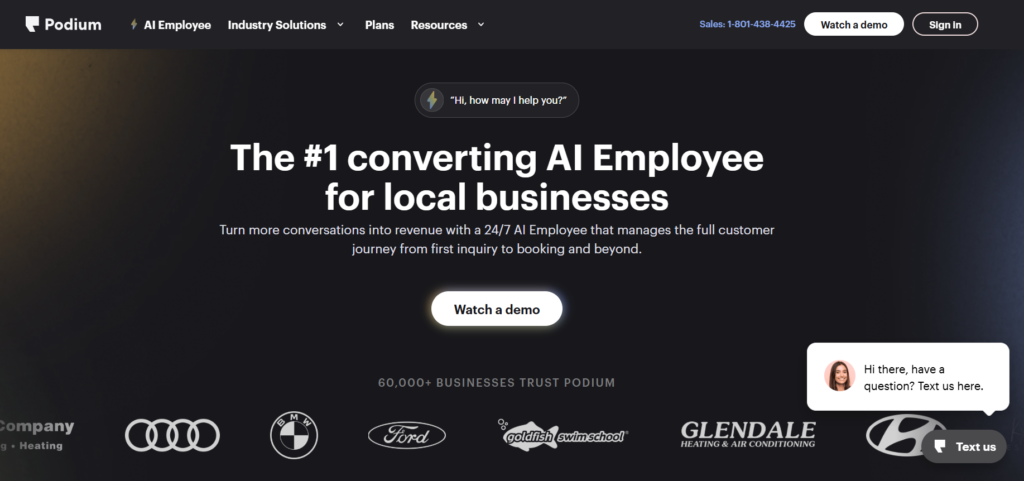
Podium centers its product around messaging first, review management second, which shows in its pricing: $399 a month for Core, $599 for Pro, and $999-plus for Enterprise. A unified inbox pulls in SMS, webchat, and Facebook Messenger conversations, and Podium’s signature feature lets customers leave a Google review in two clicks directly from a text message.
Podium’s AI Employee suite extends beyond reviews into lead qualification, appointment scheduling, and marketing campaign drafting, organized into specialized roles like AI Salesperson and AI Reputation Specialist. Payment collection through text messages is another differentiator, letting businesses request and receive payment without redirecting customers to a separate app.
The most common complaint centers on Yelp support. Podium doesn’t integrate with Yelp, which matters for restaurants, home services, and other categories where Yelp reviews carry real weight. Support quality also draws mixed reviews, with some users citing slow response times and aggressive upselling. For a business that already relies heavily on Google reviews and wants messaging bundled in, Podium’s two-click review flow is genuinely convenient.
4. Reputation.com

Reputation.com targets large multi-location and franchise businesses, and its pricing reflects that positioning. There’s no published starting price; every plan comes through a custom quote based on location count and feature needs. The platform’s centerpiece is its Reputation Score, a real-time calculation pulling from star ratings, reviews, listings, and social signals to give a single performance number per location.
Enterprise features stand out here more than at competing platforms. Unlimited users and customizable role-based access let franchise networks give different permission levels to franchisees, regional managers, and corporate staff. A survey builder captures direct customer feedback outside of public review sites, and detailed reporting dashboards break performance down by location, region, or brand.
Response times to negative feedback get consistent praise in user reviews, with several mentioning quick resolution as a standout benefit for maintaining customer trust. The tradeoff is complexity. Some reviewers note the survey builder and broader feature set take longer to learn than more focused competitors, and onboarding can feel heavier for teams new to enterprise reputation software. If you’re managing dozens or hundreds of locations under one brand, Reputation.com’s franchise-specific tools address problems smaller platforms don’t touch.
5. Yext

Yext built its reputation on listings management first, with review monitoring layered on top. Published pricing shows four tiers: Emerging at $199 a year, Essential at $449, Complete at $499, and Premium at $999, though the Reviews product specifically runs $400 to $1,200 per location annually depending on the number of review sources monitored.
Yext’s PowerListings feature automatically pushes business information updates like address and phone number changes across dozens of directories simultaneously, which reduces manual work for multi-location brands. The review management module centralizes monitoring, response, and sentiment analysis, and pre-approved response templates in a dropdown menu help larger teams reply consistently and quickly, which matters for businesses managing legal or brand-compliance language in public responses.
Reviewers most often flag cost as a barrier, particularly for businesses with two to four locations that don’t hit the scale where Yext’s automation pays for itself. Cancellation also draws complaints, since listings can revert to outdated information once a subscription ends, leaving businesses to manually re-claim and update profiles. Yext works best for brands with five or more locations that need both listings and reviews handled under one contract.
How to Choose the Right Review Management Tool
If you run an agency managing multiple client locations, Synup and BrightLocal both offer white-label options built for that use case, with Synup leaning toward listings-first workflows and BrightLocal bundling in rank tracking.
If messaging and payments matter as much as reviews, Podium’s SMS-first design and two-click Google review flow solve a different problem than pure review monitoring tools.
If you manage a large franchise network, Reputation.com’s role-based permissions and Reputation Score are built specifically for that scale, even though pricing requires a custom conversation.
If budget is the deciding factor and you only need reviews, ReviewTrackers and BrightLocal’s Grow tier both come in under $100 a month per location, well below Birdeye, Podium, or Yext’s enterprise-oriented pricing.
Frequently Asked Questions
What’s the difference between review management and reputation management software? Review management tools focus specifically on monitoring, requesting, and responding to reviews. Reputation management platforms like Reputation.com typically add broader features like sentiment scoring, surveys, and social listening on top of core review functions.
Do these tools affect local search rankings directly? Review volume, recency, and response rate are known local search ranking factors, and listing accuracy across directories affects how search engines trust your business information. Tools that combine NAP consistency with review management, like Synup and BrightLocal, address both factors at once.
Which tool works best for a single-location small business? BrightLocal’s lower-tier plans and ReviewTrackers’ per-location pricing tend to fit single-location budgets better than Birdeye or Podium, which are priced with multi-location and enterprise customers in mind.
Is Yelp integration available across all these platforms? No. Podium notably lacks Yelp integration, which matters for restaurants and home service businesses where Yelp reviews carry significant weight. Confirm Yelp support directly with any provider before committing if that platform matters for your industry.
Can I switch review management tools without losing my review history? Reviews live on the original platforms like Google or Yelp, not inside the management software, so switching tools doesn’t delete your review history. You will lose access to historical analytics and response logs stored specifically within the tool you’re leaving.
Final Thoughts
There’s no single best review management tool for every business. Synup stands out for agencies and multi-location brands that need listing consistency alongside review monitoring, while Birdeye, Podium, Reputation.com, Yext, ReviewTrackers, and BrightLocal each solve a slightly different version of the same problem, from messaging-first workflows to franchise-scale reporting to budget-friendly local SEO bundles. Before you commit, request a demo or trial from two or three providers and compare the actual per-location cost at your business size, since published starting prices rarely reflect what you’ll pay once you factor in the number of locations you manage.