Chatmeter vs Birdeye vs Synup for Auto Service Chains


Chatmeter, Birdeye, and Synup are three reputation management platforms worth comparing for multi-location auto service chains in 2026. Chatmeter, now part of Alchemer, is particularly relevant for enterprise customer intelligence and sentiment analysis. Birdeye focuses on review generation, customer engagement, and AI-assisted reputation workflows. Synup combines review management, business listings, local SEO, and published location-based pricing.
The right platform depends on your business’s size, operational challenges, integration requirements, and budget.
A chain operating 10 repair shops may prioritize accurate Google Business Profiles and consistent review responses. A 100-location tire retailer may need regional reporting, customer feedback analysis, automated review invitations, and corporate approval workflows.
This comparison examines the three platforms’ documented capabilities, limitations, pricing, AI tools, and suitability for automotive service businesses.
Chatmeter vs Birdeye vs Synup: Quick Comparison
| Platform | Best suited for | Main advantage | Key consideration |
|---|---|---|---|
| Chatmeter / Alchemer | Large automotive chains needing customer intelligence | Sentiment analysis, competitive intelligence, and enterprise reporting | Product packaging and pricing require confirmation |
| Birdeye | Automotive businesses prioritizing reviews and customer engagement | Review generation, AI-assisted responses, messaging, and feedback workflows | Modules and integrations depend on the commercial arrangement |
| Synup | Multi-location businesses prioritizing local SEO and listings | Centralized listings, reputation management, local visibility tools, and published pricing | AI usage allowances and integration requirements need evaluation |
Our assessment: For a 50-location auto service chain primarily concerned with listings accuracy, local visibility, and review management, Synup is a practical starting point because its published pricing simplifies initial budgeting.
Birdeye deserves close consideration when customer engagement and automated feedback requests are central requirements.
Chatmeter, through Alchemer, is particularly relevant when leadership needs to analyze customer sentiment and operational problems across a large service network.
These are editorial recommendations based on documented product positioning and buyer requirements, not rankings established through independent performance testing.
How We Evaluated Chatmeter, Birdeye, and Synup
This comparison draws on publicly available vendor documentation, official product pages, pricing information, and relevant Google and Federal Trade Commission guidance reviewed in November 2026.
Eight criteria were considered:
- Review management: Monitoring, generating, responding to, and analyzing location-specific customer reviews.
- Listings management: Maintaining accurate information across Google, Apple Maps, Bing, Facebook, and other relevant platforms.
- AI capabilities: Review response assistance, sentiment analysis, reporting, and workflow automation.
- Multi-location scalability: Centralized controls, location groups, bulk actions, and regional reporting.
- Customer engagement: Review invitations, messaging, surveys, and complaint escalation.
- Integrations: APIs and potential connections with automotive operational systems.
- Pricing: Public rates, custom quotations, implementation costs, and usage limits.
- Automotive suitability: Practical relevance to repair chains, tire retailers, oil change franchises, collision centers, and commercial vehicle service businesses.
This is a documentation-based editorial comparison, not a hands-on product benchmark.
Vendor-described capabilities have not been independently tested. Actual availability, implementation quality, service levels, and automotive integrations should be confirmed through demonstrations and contractual documentation.
What Is Multi-Location Automotive Reputation Management Software?
Multi-location automotive reputation management software helps repair chains, tire retailers, oil change franchises, collision repair networks, and other automotive service businesses manage customer feedback across multiple locations.
A platform may combine review monitoring, review invitations, Google Business Profile management, local business listings, customer sentiment analysis, and regional reporting.
Consider a repair chain operating 75 locations across Texas, Florida, and California.
Without a centralized system, individual stores may manage Google reviews independently, maintain different operating hours, or respond inconsistently to service complaints.
A multi-location platform can help headquarters establish common standards while allowing authorized store managers to resolve local issues.
Why reputation management matters for automotive service chains
Customers choosing repair shops often evaluate more than star ratings.
They may examine reviews mentioning:
- Repair quality and reliability.
- Pricing transparency and estimates.
- Technician professionalism.
- Appointment availability and waiting times.
- Parts availability.
- Communication during repairs.
- Warranty support and complaint resolution.
A customer looking for emergency tire repair needs accurate opening hours and a reliable contact number. Someone considering expensive transmission work may pay more attention to reviews describing estimates, workmanship, and service disputes.
Reputation management becomes more useful when customer feedback helps the business improve operations rather than simply increase review counts.
It also complements local SEO.
According to Google’s local ranking guidance, local search results are primarily determined by relevance, distance, and prominence. Google also explains that complete business information and customer reviews can support local visibility.
However, purchasing reputation management software does not guarantee higher rankings.
For more background, read Syssn’s guide to local listings management.
Chatmeter vs Birdeye vs Synup: Feature Comparison
The following matrix summarizes capabilities described in official vendor materials.
| Feature | Chatmeter / Alchemer | Birdeye | Synup |
|---|---|---|---|
| Centralized review monitoring | Documented | Documented | Documented |
| AI-assisted review responses | Documented | Documented | Documented |
| Multi-location listings | Documented | Documented | Documented |
| Bulk location updates | Documented | Documented | Documented |
| Sentiment analysis | Documented | Documented | Documented |
| Competitor insights | Documented | Documented | Documented |
| Review generation | Confirm current configuration | Documented | Documented |
| Local SEO reporting | Documented | Documented | Documented |
| AI search visibility tools | Confirm product scope | Documented offering | Documented offering |
| Customer surveys | Broader Alchemer offering | Broader Birdeye offering | Confirm scope |
| Location landing pages | Documented | Confirm module and scope | Documented |
| Social media management | Broader platform offering | Documented offering | Documented offering |
| API and integrations | Available; verify requirements | Available; verify requirements | Available; verify requirements |
| Public subscription pricing | Request quote | Request quote | Published tiers |
| Enterprise deployment | Supported offering | Supported offering | Enterprise offering |
Important: “Documented” means the vendor describes the capability in its product materials. It does not mean the functionality is included in every contract or has been independently tested.
The distinction is especially important for AI automation, surveys, customer messaging, integrations, local pages, and advanced reporting.
Buyers should evaluate the exact modules they need rather than comparing the total number of advertised features.
1. Chatmeter
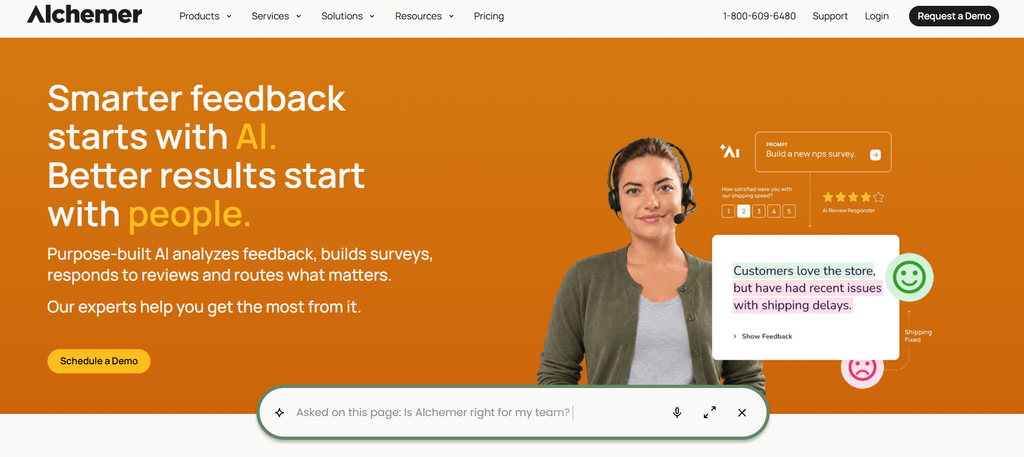
Best for: Large automotive service chains prioritizing sentiment analysis, operational insights, competitive intelligence, and centralized reputation reporting.
Core focus: Multi-location reputation management, listings accuracy, customer feedback intelligence, and enterprise analytics.
Overview
Chatmeter is a reputation management platform built for multi-location organizations.
On September 24, 2025, Alchemer announced its acquisition of Chatmeter, bringing online reputation intelligence into its broader customer feedback ecosystem.
Chatmeter’s current website confirms that its reputation management technology has become part of Alchemer’s integrated offering.
For buyers in 2026, this means evaluating the current Alchemer products and contract structure rather than assuming older standalone Chatmeter packages remain unchanged.
Key features
Centralized review monitoring and responses
Alchemer’s reputation management offering brings customer reviews and ratings into centralized dashboards.
Teams can monitor feedback, manage review responses, and analyze location-level performance.
For automotive chains, this supports oversight of complaints involving repair quality, estimates, staff communication, and scheduling.
AI-powered sentiment analysis
Alchemer describes AI-assisted capabilities for identifying sentiment, recurring themes, and emerging customer concerns.
Instead of reviewing thousands of comments manually, regional teams can investigate whether similar problems are occurring across multiple stores.
For example, a tire retailer might discover repeated complaints about appointment delays across several locations in the same market.
Competitive intelligence
The platform supports comparisons involving competitors’ review performance, sentiment, and other reputation indicators.
Automotive marketing teams can use this information to examine local competitive conditions.
However, competitor intelligence should inform decisions rather than be treated as proof of overall service quality.
Listings and local SEO management
Alchemer provides listings management, bulk updates, location-level reporting, and local landing page capabilities.
These tools are relevant when a chain opens new facilities, updates operating hours, relocates branches, or maintains location pages across a large network.
Customer feedback intelligence and risk monitoring
Alchemer’s broader customer experience offering connects reputation signals with structured feedback and analytical tools.
Its product documentation describes capabilities for detecting potentially serious complaints and identifying operational trends.
A collision repair network could use these insights to investigate whether complaints about estimates and repair delays are isolated or widespread.
Where Chatmeter works well
Chatmeter is particularly relevant when reputation management is connected to operational improvement.
Consider a collision repair group with 150 locations.
Leadership may need to determine whether negative reviews reflect inconsistent repair estimates, insurance-related delays, communication failures, or location-specific issues.
A system that analyzes feedback by location and theme can help regional managers prioritize investigations.
This is a different requirement from simply collecting reviews and maintaining accurate business profiles.
Limitations
The main consideration is purchasing and implementation complexity.
Alchemer now provides several connected product areas, so buyers need to establish exactly which reputation, survey, listings, analytics, and customer intelligence functions are included.
Businesses needing only basic review monitoring may not require every part of the broader platform.
Automotive-specific integrations, including connections with repair management software and customer databases, should be verified individually.
Organizations should also test whether AI classification correctly interprets automotive terminology and distinguishes actual service problems from incomplete or misleading feedback.
Chatmeter pricing
Chatmeter/Alchemer does not provide a universal public subscription price suitable for calculating the cost of every automotive deployment.
Businesses should request a proposal covering their location count, required products, implementation, integrations, training, and support.
Choose Chatmeter if: Your organization needs reputation intelligence, cross-location sentiment analysis, competitive reporting, and customer feedback insights that support enterprise operations.
2. Birdeye
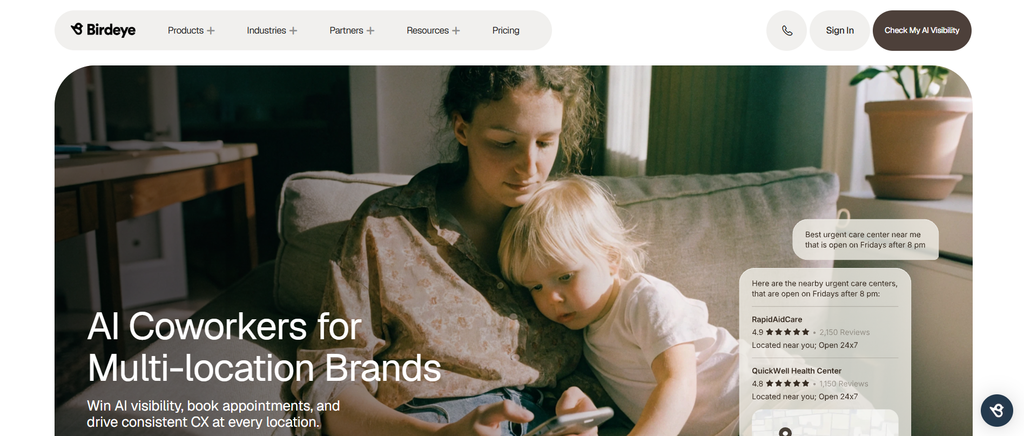
Best for: Automotive chains that want to combine review management, automated customer feedback requests, and AI-assisted engagement.
Core focus: Review generation, review responses, listings management, customer communication, and feedback workflows.
Overview
Birdeye provides reputation management and customer engagement software for businesses operating one or many locations.
Its product portfolio includes customer reviews, business listings, messaging, surveys, marketing automation, and AI-assisted workflows.
For auto service chains, Birdeye is relevant when customer communication and reputation management need to operate together.
For example, a repair chain may want customers to receive a review invitation after an eligible service appointment while enabling managers to investigate dissatisfied customers’ concerns.
Key features
Automated review generation
Birdeye supports automated customer review invitation workflows.
Automotive businesses can use these capabilities to request genuine feedback after completed service interactions, subject to configuration and supported integrations.
For example, a tire service network could establish a consistent invitation process following completed appointments.
Requests must comply with applicable review-platform rules, including restrictions on incentives and selective positive-review solicitation.
AI-assisted review responses
Birdeye provides AI-generated review responses, configurable brand guidance, and approval-based workflows.
Its official documentation describes options ranging from response suggestions to more automated publishing.
Corporate teams can establish response guidelines while local managers handle customer-specific concerns.
This is particularly useful for franchises that need consistent public communication without sending identical replies to every customer.
Business listings optimization
Birdeye’s listings offering supports monitoring and management of business information across major discovery platforms.
The company’s current product documentation describes AI-assisted identification of listing problems and approval-based correction workflows.
For automotive chains, this can help teams manage changes involving addresses, operating hours, phone numbers, and other location details.
Customer messaging and feedback
Birdeye also offers customer engagement capabilities through its broader product portfolio.
These may support customer conversations, surveys, and marketing workflows alongside review management.
A repair chain could use connected workflows to coordinate follow-up communication, provided the relevant modules and integrations are included.
Analytics and competitor monitoring
Birdeye documents reputation reporting, location comparisons, and competitive analysis capabilities.
Its AI portfolio also includes products focused on visibility across search and AI-powered discovery experiences.
These features can provide additional reporting context, although AI visibility monitoring does not guarantee inclusion in AI-generated answers.
Where Birdeye works well
Birdeye is a relevant option for automotive brands that want more consistent customer engagement.
Consider an oil change franchise operating 60 locations.
The company may want to standardize review invitations, reduce unresolved review backlogs, identify recurring service complaints, and give regional managers visibility into location performance.
Birdeye can support these activities through connected reputation and engagement workflows.
The most important factor is whether the organization’s appointment, invoicing, or customer management systems can supply the data needed for reliable automation.
Limitations
Birdeye has a broad product portfolio, which makes contract scope important.
A business that only needs listings updates and review responses may not use every available customer engagement module.
Its pricing is also less transparent than Synup’s published smaller-network tiers.
Before purchasing, automotive businesses should confirm which automation features are included, whether approval workflows meet their requirements, and whether their specific operational systems are supported.
If a service-order integration is necessary, it should be demonstrated rather than assumed.
Birdeye pricing
Birdeye’s official pricing page requests business information and location count to prepare pricing.
It does not establish one publicly listed subscription amount that applies to every automotive business.
A meaningful quote should specify the products deployed, covered locations, support, integrations, onboarding, and any additional messaging or usage charges.
Choose Birdeye if: Your automotive chain prioritizes automated review requests, customer communication, AI-assisted responses, and coordinated reputation workflows.
3. Synup

Best for: Multi-location automotive service businesses seeking centralized listings, reputation monitoring, local search reporting, and publicly available subscription prices.
Core focus: Business listing accuracy, review management, local SEO, AI-assisted workflows, and multi-location marketing.
Overview
Synup is a local marketing platform for businesses, agencies, and multi-location organizations.
Its current offering combines listings management, reputation monitoring, review generation, social publishing, local SEO reporting, and AI-assisted marketing workflows.
For automotive service chains, Synup is relevant when managing accurate business information and location-level online reputation are primary operational requirements.
It may be especially useful for organizations that want to compare software costs before requesting a sales proposal.
Key features
Centralized listings management
Synup supports managing business location information across connected publishers and directories.
Automotive chains can use location records to coordinate addresses, telephone numbers, categories, business descriptions, and operating hours.
For example, a tire retailer opening five branches could prepare approved information centrally and distribute supported updates to connected platforms.
Actual publication timing and field availability remain dependent on the destination platform.
Review monitoring and responses
Synup provides centralized review monitoring and response management.
Its reputation offering includes location filtering, response workflows, reputation analytics, and competitor insights.
Headquarters teams can monitor unanswered reviews while allowing authorized local managers to address customer-specific situations.
AI-assisted workflows
Synup’s AI agent, Sydekick, supports work involving listings, reviews, reporting, social publishing, and local marketing.
Official documentation describes approval controls and activity records.
This can assist with repetitive tasks, but businesses should review automation permissions before enabling changes or public replies across multiple locations.
Local SEO and visibility analytics
Synup offers local search monitoring, rank tracking, and competitor analysis tools.
Automotive marketers can use these capabilities to examine visibility differences across locations and identify possible listing or content problems.
The platform also describes AI search visibility monitoring.
Such reporting can support investigation, but it cannot guarantee recommendations, citations, or visibility in independent AI systems.
Multi-location and agency management
Synup offers tools relevant to multi-location operations, client management, API access, and white-label delivery.
These may be useful for franchise operators and automotive marketing agencies managing multiple brands or clients.
However, complex franchise permissions and specialized integration requirements should be evaluated through demonstrations.
Where Synup works well
Synup is worth considering when listings accuracy, reputation monitoring, and local marketing are the main purchasing priorities.
For example, a 50-location auto repair chain might need to keep its Google Business Profiles current, monitor customer reviews, coordinate replies, and track location-level visibility.
Synup combines these activities in a single platform with publicly listed pricing for portfolios of up to 50 locations.
This makes initial budget planning easier, although the advertised subscription price does not necessarily represent the complete cost of implementation.
Limitations
Synup’s pricing structure includes monthly AI credits and limits on concurrent agent chats.
The vendor states that credit-metered agent work pauses when the available balance is exhausted, while non-credit-metered functions continue operating.
Additional credits can be purchased.
Enterprises should therefore assess expected usage rather than assuming that every automated task can run without practical limits.
Synup’s published capabilities also do not establish compatibility with every automotive shop management system.
Businesses with complex franchise ownership, specialized publishers, approval requirements, or large-scale integrations should verify these details during procurement.
Synup pricing
Synup’s official pricing page publishes monthly subscription tiers ranging from $49 for one location to $899 for up to 50 locations.
Larger portfolios require an Enterprise proposal.
The vendor also advertises a 20% annual billing discount.
Plans differ in included locations, monthly credits, agent concurrency, and infrastructure arrangements.
Choose Synup if: Your business prioritizes accurate local listings, centralized review management, local SEO reporting, AI-assisted marketing workflows, and transparent initial subscription pricing.
Which Platform Is Better for Automotive Review Management?
All three vendors provide centralized review monitoring and response tools.
The most meaningful difference is how reviews connect to other business processes.
| Requirement | Platforms to evaluate first | Why |
|---|---|---|
| Enterprise sentiment intelligence | Chatmeter / Alchemer | Focus on feedback analysis and operational insights |
| Automated review invitations | Birdeye, Synup | Documented review generation workflows |
| Reviews alongside listings and local SEO | Synup | Integrated local marketing environment |
| AI-assisted review responses | All three | Each documents response assistance |
| Cross-location reputation reporting | All three | Multi-location reporting capabilities |
| Broader customer feedback programs | Alchemer, Birdeye | Broader customer experience offerings |
| Competitive reputation analysis | All three | Documented competitor insights |
Example: Handling a complaint about repair delays
Suppose a customer posts a review stating that a brake repair took three days longer than expected and the final invoice exceeded the original estimate.
A useful reputation management process should do more than generate an apologetic response.
The team should identify the correct location, route the issue to an authorized manager, investigate the service record, and document the outcome.
The public response should acknowledge the concern without exposing private vehicle, billing, or customer information.
How the platforms support that process will depend on the purchased modules and configured workflows.
Chatmeter/Alchemer is relevant when the organization wants to analyze similar complaints across many locations.
Birdeye is relevant when the business places particular emphasis on customer engagement and follow-up workflows.
Synup is relevant when customer review management operates closely alongside listings and local marketing administration.
Google’s review response guidance recommends professional, relevant replies that respect customer privacy.
For related automotive software options, see Syssn’s Widewail alternatives for car dealerships.
Which Platform Is Better for Automotive Local SEO and Listings?
All three platforms offer multi-location listings management, but their product approaches differ.
Synup connects listings with review management, local rank monitoring, and broader local marketing workflows.
Birdeye combines listings optimization with customer reviews, engagement products, and AI-assisted marketing capabilities.
Chatmeter/Alchemer combines listings management with reputation intelligence, customer feedback analysis, and enterprise reporting.
For an automotive chain, the most important question is whether the chosen platform can maintain accurate information across the publishers customers actually use.
Essential Google Business Profile capabilities
An automotive listings management system should be evaluated for its ability to support:
- Approved business names, addresses, and telephone numbers.
- Regular and holiday operating hours.
- Location-specific website and appointment URLs.
- Accurate business categories and relevant attributes.
- Location-level review monitoring.
- Bulk updates and change tracking.
- Duplicate listing investigation.
- Corporate and local permissions.
- Reporting on publishing errors and unresolved changes.
These capabilities should be tested with real operational examples.
For instance, a chain might change Sunday opening hours across 20 stores. A useful platform should make it possible to see which updates were submitted, which became visible, and which require further investigation.
Submitting an update does not necessarily mean that every publisher has accepted or displayed it.
Can chains manage Google Business Profiles without third-party software?
Yes.
Google provides native management capabilities, including bulk verification and management for eligible businesses with 10 or more locations.
Third-party software can add cross-platform coordination, reporting, automation, and workflow features.
Businesses should compare the value of those additional capabilities with the work they can already perform directly.
See Google’s bulk verification documentation.
For broader franchise comparisons, read Rio SEO vs Uberall vs Synup.
Chatmeter vs Birdeye vs Synup Pricing Comparison (2026)
Pricing is an important difference among the three platforms.
Synup publishes subscription tiers for smaller location portfolios, while Chatmeter/Alchemer and Birdeye require sales-led pricing comparisons.
Pricing overview
| Platform | Pricing approach | Public starting price |
|---|---|---|
| Chatmeter / Alchemer | Custom proposal | Not disclosed |
| Birdeye | Custom proposal based on deployment | Not disclosed |
| Synup | Published location-based tiers | $49/month for one location |
Pricing information checked against official vendor pages in November 2026. Listed prices do not establish final contract costs.
Synup’s published monthly plans
| Plan | Included locations | Monthly price |
|---|---|---|
| Solo | 1 | $49 |
| Premium | Up to 10 | $299 |
| Pro | Up to 25 | $499 |
| Scale | Up to 50 | $899 |
| Enterprise | More than 50 | Custom quote |
Synup advertises a 20% annual billing discount.
Its pricing page also explains that the tiers differ in AI credit allowances, concurrent agent capacity, and infrastructure characteristics.
The listed monthly prices should therefore be treated as advertised base subscription rates rather than guaranteed all-inclusive costs.
What would a 50-location auto repair chain pay?
Based on Synup’s published Scale plan, a chain with 50 eligible locations would have an advertised base subscription of $899 per month.
At the standard monthly rate:
| Cost component | Illustrative amount |
|---|---|
| Monthly base subscription | $899 |
| Annual total at monthly rate | $10,788 |
| Additional AI credits | Depends on usage |
| Implementation and integrations | Confirm with vendor |
| Taxes and optional services | Not included |
The calculation assumes the published Scale plan covers the chain’s required locations and functionality.
It does not include additional services, usage charges, or negotiated commercial terms.
A directly comparable 50-location cost cannot be established for Birdeye or Chatmeter without quotations.
What about a 100-location chain?
Synup directs businesses with more than 50 locations to its Enterprise offering.
Birdeye and Chatmeter/Alchemer also support sales-led enterprise evaluations.
For a chain with 100 locations, compare annual total cost rather than starting rates or estimated per-location prices.
A fair proposal should include:
- Required product modules.
- Number of locations and users.
- Onboarding and account setup.
- Customer review invitation charges.
- AI usage allowances.
- Required integrations and API access.
- Training and support.
- Contract duration and renewal conditions.
- Data access and export arrangements.
A lower subscription price may not produce lower total costs if essential operational requirements are charged separately.
Which Platform Offers Better AI Sentiment Analysis?
All three platforms describe AI-assisted reputation management capabilities.
However, generating a review response and identifying recurring operational problems are different activities.
Chatmeter/Alchemer is particularly relevant when teams want to analyze themes, sentiment, competitor feedback, and potentially serious complaints across large location networks.
Birdeye is relevant when AI-assisted review responses and customer engagement workflows are central requirements, alongside broader analytics.
Synup is relevant when sentiment analysis and reputation reporting need to connect with listings, local SEO, and local marketing operations.
Automotive sentiment analysis examples
| Customer feedback theme | Possible operational response |
|---|---|
| Long appointment wait times | Review staffing and appointment scheduling |
| Unexpected repair charges | Improve estimate explanations and approval procedures |
| Poor technician communication | Establish clearer customer update standards |
| Parts-related repair delays | Investigate ordering and customer notification processes |
| Repeated cancellations | Review booking reliability |
| Positive employee mentions | Recognize effective service practices |
| Inconsistent repair experiences | Examine location-level quality controls |
A useful sentiment system should also distinguish between issues that sound similar but require different responses.
For example, a complaint about a repair delay caused by unavailable parts is not necessarily the same as a complaint about poor appointment scheduling.
AI summaries can help teams identify patterns, but managers should consult original reviews and relevant service records before making significant operational decisions.
How to test AI capabilities during a vendor demonstration
Give each vendor the same set of sample feedback.
Include reviews about delayed repairs, unclear estimates, unexpected charges, exceptional customer service, and ambiguous complaints.
Ask the platform to identify key themes, separate positive and negative feedback, generate a regional report, and prepare appropriate responses.
Then evaluate whether the output is accurate, useful, and safe for customer-facing communication.
Test approval controls as well.
A system that produces a polished response but publishes inaccurate information without review may create more problems than it solves.
Best Platform by Automotive Business Type
The following recommendations are starting points based on operational suitability, not independently measured product rankings.
| Automotive business | Suggested shortlist | Main consideration |
|---|---|---|
| 10-location repair chain | Synup, Birdeye | Listings, reviews, and manageable administration |
| 50-location tire retailer | Synup, Birdeye | Local visibility versus customer engagement |
| 100-location oil change franchise | Birdeye, Synup Enterprise | Review requests, automation, and governance |
| Large collision repair network | Chatmeter/Alchemer, Birdeye | Feedback intelligence and complaint workflows |
| Automotive marketing agency | Synup | Multi-client operations and reporting |
| Enterprise chain with extensive feedback programs | Chatmeter/Alchemer, Birdeye | Sentiment analysis, surveys, and customer experience reporting |
For franchise-operated repair shops
Franchise networks often need to balance corporate oversight with local authority.
Headquarters may control brand guidelines, business naming, standard profile information, and customer communication policies.
Individual franchise owners may need permission to update local operating hours, respond to reviews, and investigate service complaints.
The selected software should support those responsibilities without giving every user unrestricted access to the entire network.
For example, a regional manager may need visibility into 15 assigned stores while corporate administrators require access to all locations.
An effective demonstration should show how permissions, approval workflows, and reporting operate across these different roles.
For a deeper discussion of this challenge, read Syssn’s franchise local marketing software buyer’s guide.
For commercial and heavy-duty vehicle service businesses
Commercial vehicle service operations may have different customer communication requirements.
A repair delay can affect fleet availability, scheduled deliveries, or equipment utilization.
These businesses should pay particular attention to complaint escalation, account-level reporting, location accuracy, and coordination between service teams.
Automotive software integrations may also differ from those used by consumer repair shops.
For related guidance, see reputation management software for truck and commercial vehicle dealers.
How to Choose Automotive Reputation Management Software
A reliable buying process starts with the organization’s actual problems rather than vendor demonstrations.
Step 1: Identify the primary requirement
Determine whether the most important issue is inaccurate listings, low review participation, unanswered complaints, inconsistent communication, or limited visibility into customer satisfaction.
Not every organization needs the same product combination.
A chain struggling with incorrect opening hours may gain more immediate operational value from better listings processes than from advanced sentiment reporting.
A chain receiving thousands of reviews may prioritize feedback analysis and escalation.
Step 2: Audit existing locations
Review a representative sample of stores.
Include established locations, recently opened facilities, lower-performing branches, and locations that have relocated or changed operating hours.
Record current listings accuracy, review response performance, complaint handling, and administrative workload.
This creates a baseline for evaluating changes after implementation.
Step 3: Request automotive-specific demonstrations
Ask each vendor to complete the same practical tasks.
For example, request demonstrations showing how the platform:
- Handles a negative brake repair review.
- Changes operating hours across multiple stores.
- Identifies repeated complaints about service delays.
- Routes a serious complaint to regional management.
- Reports unresolved listing errors.
The vendor should demonstrate what happens when a task fails, not only when everything works correctly.
Step 4: Verify automotive integrations
Do not assume that a general CRM integration supports the automotive systems your company uses.
Ask vendors to verify compatibility with the exact versions of your shop management software, point-of-sale system, appointment scheduling platform, and customer databases.
Confirm whether the integration supports read-only access, two-way updates, review invitation triggers, and relevant reporting.
Also check synchronization frequency, security permissions, failure handling, and additional licensing charges.
Step 5: Evaluate governance and customer privacy
Automotive service records can contain personal information, vehicle details, transaction information, and sensitive complaint histories.
Confirm how each platform handles user access, information retention, AI processing, account security, and audit records.
Public review responses should not disclose private customer or service details.
For serious disputes, the process should include appropriate human review.
Step 6: Compare the complete contract
Request itemized proposals with the same requirements and location count.
Review implementation, user access, support, training, product modules, usage limits, renewal terms, and data export options.
A procurement decision should consider operational fit and long-term costs, not simply the lowest advertised monthly price.
Automotive Reputation Management Implementation Checklist
A successful implementation requires clear ownership of technical and customer-facing activities.
| Phase | Recommended action | Responsible team |
|---|---|---|
| Preparation | Create approved location records | Corporate operations |
| Onboarding | Connect and verify eligible business profiles | Local SEO team |
| Review management | Establish response and escalation standards | Customer experience |
| AI configuration | Define brand guidelines and approval rules | Marketing |
| Integration | Connect supported operational systems | IT and operations |
| Training | Train regional and local managers | Franchise operations |
| Monitoring | Review location-level KPIs | Marketing analytics |
| Improvement | Investigate recurring customer complaints | Regional management |
Start with a pilot
Instead of activating every location immediately, begin with a representative pilot group.
A 100-location repair chain might initially select 10 branches with different operating characteristics.
The pilot should test:
- Whether approved listings updates reach the intended platforms.
- Whether managers receive appropriate permissions.
- Whether customer reviews reach the correct people.
- Whether AI responses follow approved guidelines.
- Whether reporting accurately reflects location performance.
- Whether integrations work reliably.
- Whether vendor support resolves operational problems.
Once the workflows have been validated, the business can expand the rollout.
A pilot does not prove that every future deployment will perform identically, but it can reveal important issues before they affect the entire network.
How Can Auto Service Chains Measure Reputation Management ROI?
Reputation management software may reduce administrative work and help businesses identify customer experience problems.
However, collecting more reviews or improving average ratings does not automatically prove revenue growth.
A useful measurement approach should combine reputation metrics, operational efficiency, and business outcomes.
Recommended KPIs
| KPI | What it measures |
|---|---|
| Review response rate | Share of eligible reviews receiving a response |
| Median response time | Time between review publication and response |
| Review volume | Number of genuine customer reviews |
| Average rating | Changes in customer ratings over time |
| Listings accuracy | Percentage of audited information matching approved records |
| Local search visibility | Visibility for selected relevant local searches |
| Complaint resolution rate | Percentage of documented complaints resolved |
| Customer retention | Whether customers return for additional services |
| Booked appointments | Appointments attributable to measurable channels |
| Administrative time saved | Reduction in manual listings and review management work |
Example: Calculating administrative labor value
Suppose a 50-location repair chain reduces manual reputation management work by two hours per location each month.
Assume the relevant labor cost is $25 per hour.
| Input | Illustrative value |
|---|---|
| Locations | 50 |
| Hours saved per location per month | 2 |
| Hourly labor cost | $25 |
| Total hours saved monthly | 100 |
| Monthly labor value | $2,500 |
| Annual labor value | $30,000 |
Calculation:
50 locations × 2 hours × $25 = $2,500 per month.
$2,500 × 12 months = $30,000 annually.
These figures are hypothetical. They do not represent measured savings from Chatmeter, Birdeye, or Synup.
The example estimates the labor value of time potentially released for other work. It does not establish actual payroll reductions or cash savings.
Businesses must also account for software subscriptions, onboarding, integrations, training, and ongoing administration.
Where possible, compare pilot locations against similar locations that have not yet adopted the new software.
This can help distinguish the effects of software adoption from seasonal demand, advertising campaigns, staffing changes, and other influences.
Review Compliance: What Automotive Chains Should Know
Automotive businesses must collect and manage reviews honestly.
Google’s review policies and US consumer protection rules place important restrictions on deceptive practices.
Google’s review policies
Google permits businesses to request reviews from customers who have genuine experiences.
However, Google prohibits offering incentives in exchange for reviews, rating changes, or the removal of negative reviews.
Google also prohibits selectively soliciting positive feedback while discouraging negative reviews.
A compliant review invitation process should not pressure customers to leave a particular rating or describe their experience in prescribed terms.
See Google’s prohibited and restricted content policies.
FTC consumer review requirements
The Federal Trade Commission’s Consumer Reviews and Testimonials Rule became effective on October 21, 2024.
The rule addresses specified deceptive practices, including fake reviews, incentives conditioned on particular review sentiment, certain undisclosed insider testimonials, and prohibited review suppression methods.
The FTC rule and Google’s platform policies are not identical.
For example, Google’s prohibition on incentives in exchange for reviews is broader than the FTC rule’s specific prohibition on incentives conditioned on review sentiment.
Automotive businesses should therefore assess both applicable law and the policies of each review platform.
See the FTC’s official Consumer Reviews and Testimonials Rule guidance.
Practical safeguards for automated review workflows
Businesses should request feedback consistently without filtering customers based on expected ratings.
They should not purchase reviews, fabricate customer experiences, or improperly suppress legitimate negative feedback.
AI-generated replies should be reviewed for accuracy, privacy, and appropriateness, especially when complaints involve repair quality, warranties, personal data, or billing disputes.
Purchasing reputation management software does not transfer responsibility for compliance away from the business.
Frequently Asked Questions
Which is better for auto service chains: Chatmeter, Birdeye, or Synup?
The right choice depends on the primary operational requirement.
Chatmeter/Alchemer is particularly relevant for enterprise sentiment analysis and customer feedback intelligence.
Birdeye is relevant for review generation and customer engagement.
Synup is relevant when listings accuracy, reputation management, local SEO, and published pricing are priorities.
The final choice should depend on verified integrations, governance requirements, testing, and complete vendor proposals.
What is the best reputation management software for a 50-location auto repair chain?
Synup and Birdeye are reasonable starting points when local visibility, review management, and customer engagement are priorities.
Chatmeter/Alchemer also deserves consideration when advanced customer feedback intelligence is essential.
Synup publishes a subscription plan covering up to 50 locations, while the other vendors require custom quotations.
No independently verified benchmark establishes one universal winner.
Is Synup suitable for large automotive service chains?
Synup markets an Enterprise offering for larger location portfolios.
However, enterprise suitability depends on integrations, permissions, support arrangements, usage capacity, and operational requirements.
Organizations should validate these areas through demonstrations and pilot implementations.
Can reputation management software improve Google rankings?
It can help businesses maintain accurate information, manage reviews, and support local SEO operations.
Google identifies relevance, distance, and prominence as the main factors influencing local rankings.
Reviews and complete business information may contribute to local visibility.
However, no reputation management platform can guarantee higher rankings or placement in Google Maps.
Which platform is best for customer sentiment analysis?
Chatmeter/Alchemer is a strong candidate for enterprises prioritizing detailed customer feedback intelligence.
Birdeye and Synup also document sentiment and reputation analytics capabilities.
An informed comparison should test how accurately each platform identifies automotive-specific concerns, summarizes feedback, and supports follow-up actions.
How much does automotive reputation management software cost?
Costs depend on location count, required modules, integrations, usage, and contract terms.
Synup publicly lists monthly plans, including $899 for up to 50 locations.
Birdeye and Chatmeter/Alchemer require customized pricing proposals.
Enterprise buyers should compare total annual deployment costs.
Can these platforms integrate with automotive shop management software?
All three vendors offer integration capabilities, but support for specific automotive systems should not be assumed.
Buyers should verify their exact software versions, supported workflows, API requirements, synchronization frequency, and additional costs.
For automated review requests, confirm whether completed service transactions can reliably trigger eligible communications.
Final Verdict: Chatmeter vs Birdeye vs Synup for Auto Service Chains
Chatmeter, Birdeye, and Synup are all worth evaluating for automotive service chains, but they emphasize different operational priorities.
Choose Chatmeter/Alchemer when enterprise customer intelligence, sentiment analysis, competitive reporting, and feedback-driven operational improvement are central requirements.
Choose Birdeye when review generation, customer communication, AI-assisted engagement, and coordinated reputation workflows are priorities.
Choose Synup when centralized listings, review management, local SEO, and multi-location marketing are the main requirements, particularly when published pricing helps with initial budget planning.
For automotive businesses managing 50 to 100 locations or more, the most reliable purchasing process is to identify operational requirements, request comparable proposals, and test the same automotive workflows across shortlisted platforms.
The most suitable reputation management software is not necessarily the product advertising the most features.
It is the one that helps the organization maintain accurate location information, handle customer feedback responsibly, coordinate local teams, and produce useful operational outcomes at an acceptable total cost.
Sources and Fact-Checking References
The following sources support the principal product, pricing, and regulatory information in this comparison.
Official vendor documentation
- Alchemer: Chatmeter
- Alchemer: Reputation Management
- Alchemer: Listings Management
- Birdeye: Reviews
- Birdeye: Listings
- Birdeye: Pricing
- Synup: Pricing
- Synup: Reputation Management
- Synup: Sydekick Capabilities
Google and government guidance
- Google: Tips to Improve Your Local Ranking
- Google: Tips to Get More Reviews
- Google: Prohibited and Restricted Content
- Google: Verify Business Profiles in Bulk
- FTC: Consumer Reviews and Testimonials Rule
Editorial note: Product descriptions reflect publicly available vendor documentation reviewed in November 2026. Availability and pricing may change. Buyer-fit recommendations are editorial judgments, not independently measured performance rankings.