How to Hire AI Engineers in India in 2026: A Complete Guide

Hiring AI engineers in India in 2026 requires a clear project scope, the right hiring model, realistic compensation expectations, and a structured technical evaluation process. Businesses can recruit directly or use services such as TechCospace, Uplers, Turing, Toptal, Arc, and Upwork to find AI engineers, machine learning specialists, and generative AI developers.
India offers access to professionals working on large language model (LLM) applications, AI agents, predictive analytics, computer vision, and enterprise automation. However, hiring costs, engineering experience, recruitment processes, and contractual arrangements vary considerably.
This guide explains where to hire AI engineers in India, how much they cost, which technical skills to evaluate, and how international companies can recruit and manage reliable offshore engineering teams.
How to Hire AI Engineers in India: Eight Essential Steps
A practical hiring process involves eight steps:
- Define your AI project, business objectives, and technical requirements.
- Choose between full-time employees, dedicated contract engineers, freelancers, and managed development teams.
- Establish a realistic compensation and recruitment budget.
- Source candidates through recruitment partners, technical talent platforms, or direct hiring.
- Review portfolios and evaluate relevant engineering experience.
- Conduct structured technical interviews and practical assessments.
- Verify references and finalize employment, security, and intellectual property agreements.
- Onboard the selected engineers with clear deliverables and performance expectations.
The most appropriate approach depends on whether your organization needs one AI specialist, several dedicated developers, or a complete offshore engineering team.
For ongoing product development, permanent or dedicated engineers may offer greater continuity. Freelance specialists can be useful for defined projects, prototypes, and technical assessments.
What Is an AI Engineer, and What Does an AI Engineer Do?
An AI engineer designs, develops, integrates, deploys, and maintains software systems that use artificial intelligence.
The role combines elements of software engineering, data processing, machine learning, model evaluation, and infrastructure management.
For example, an AI engineer working for an e-commerce business might develop a recommendation system. A healthcare technology company might need document-processing and information-retrieval workflows. A SaaS business might hire an LLM engineer to introduce conversational search or automate customer support tasks.
The actual responsibilities depend on the product and the technologies involved.
AI Engineer vs. Machine Learning Engineer vs. LLM Engineer
| Role | Main responsibilities | Typical technical requirements |
|---|---|---|
| AI Engineer | Builds and integrates AI-powered software applications | Python, APIs, cloud services, model evaluation |
| Machine Learning Engineer | Develops, trains, evaluates, and deploys predictive models | PyTorch, TensorFlow, scikit-learn, MLOps |
| Generative AI Engineer | Builds applications using generative models | LLM APIs, RAG, prompt design, evaluation |
| LLM Engineer | Develops, adapts, or optimizes language-model systems | Transformers, fine-tuning, embeddings, inference |
| AI Agent Developer | Builds systems that use tools and execute workflows | Tool calling, orchestration, permissions, state management |
| MLOps Engineer | Manages model deployment and operational reliability | Docker, Kubernetes, CI/CD, monitoring |
These roles frequently overlap.
For a startup, an AI engineer with strong software development experience may be able to handle model integration, backend development, and deployment.
A larger enterprise may need separate specialists for data engineering, model development, infrastructure, security, and application development.
Before hiring, determine whether the project needs a specialist who can train or optimize models or an application engineer who can integrate existing models into a reliable product.
That distinction can significantly influence recruitment decisions.
Why Do International Companies Hire AI Engineers in India?
Companies in the United States, United Kingdom, Canada, Australia, and Europe hire AI engineers in India to access technical expertise, expand development capacity, and build distributed engineering teams.
Several factors make India a market worth considering.
Access to specialized technical skills
Employers can recruit professionals experienced in Python, machine learning, LLM integrations, data engineering, cloud architecture, and AI-powered application development.
The important consideration is not simply how many professionals list these skills, but how many can demonstrate relevant production experience.
Flexible hiring arrangements
Businesses can work with Indian engineers through permanent employment, independent contracting, dedicated staffing, and managed development services.
This gives companies different options depending on project duration and internal management capacity.
Potential cost efficiency
Indian compensation levels can be lower than those in some international markets.
However, experienced AI architects, LLM infrastructure specialists, and senior machine learning engineers may command substantially higher salaries than general software developers.
Employers should compare total employment or project costs rather than salaries alone.
Distributed engineering capacity
Remote teams can extend an organization’s development capacity and support parallel workstreams.
However, time-zone differences do not automatically increase productivity. Clear ownership, documentation, reliable communication, and planned working-hour overlap are essential.
Long-term engineering support
For companies developing AI-powered products, dedicated Indian engineers can contribute to ongoing releases, monitoring, optimization, and technical maintenance.
A lower hourly rate offers limited value if the engineer cannot build secure, maintainable systems.
The objective should be to recruit engineers capable of delivering measurable business outcomes at an appropriate total cost.
What Skills Should You Look for When Hiring AI Engineers in India?
Strong AI engineers combine practical programming skills with the ability to build, evaluate, deploy, and maintain AI systems.
Not every position requires expertise in every AI framework.
The evaluation should reflect the actual role.
1. Programming and software engineering
Python is widely used in AI engineering because it supports machine learning frameworks, data processing libraries, and AI model integrations.
Depending on the application, relevant skills may also include:
- SQL and database management
- REST APIs and FastAPI
- Git and automated testing
- JavaScript or TypeScript
- Asynchronous processing and background jobs
- Software architecture and debugging
- Authentication and access control
Candidates should demonstrate an understanding of maintainable code, testing, documentation, and error handling.
Experience with popular tools is useful, but it should not replace evidence of sound engineering fundamentals.
2. Machine learning and deep learning
For traditional machine learning projects, assess knowledge of supervised and unsupervised learning, feature engineering, model selection, and validation.
Relevant technical skills may include PyTorch, TensorFlow, scikit-learn, classification, regression, and forecasting.
Candidates should also understand data leakage, overfitting, performance metrics, and error analysis.
An experienced machine learning engineer should be able to explain why a model is appropriate for a business problem and how its performance was evaluated.
3. Generative AI and LLM development
Businesses hiring generative AI engineers should evaluate experience with:
- LLM APIs and model integration
- Retrieval-augmented generation (RAG)
- Embeddings and vector databases
- Prompt design and structured outputs
- Fine-tuning approaches
- Model evaluation and factual accuracy
- Inference latency and token costs
- Access control and sensitive information protection
A candidate who has created a chatbot demonstration may not have the experience required to build a secure enterprise AI assistant.
Production applications introduce additional requirements involving authentication, document permissions, monitoring, changing data, reliability, and operational costs.
4. AI agent development
AI agents introduce engineering requirements beyond basic model integration.
Look for practical understanding of tool calling, workflow orchestration, permission boundaries, persistent state, retries, approval checkpoints, and failure recovery.
Candidates should understand how to restrict access to external tools and prevent unauthorized actions.
They should also be able to explain when an AI agent is appropriate and when a deterministic workflow would be more reliable.
For example, an agent may help research and prepare a purchase request, while final payment authorization should remain subject to explicit controls.
5. Cloud infrastructure and MLOps
AI engineering does not end when a model produces a correct response.
Production applications require deployment, monitoring, versioning, scalability, and incident management.
Relevant infrastructure experience may include AWS, Microsoft Azure, Google Cloud, Docker, Kubernetes, CI/CD, and observability systems.
An engineer should understand how to monitor production failures and investigate performance degradation.
For additional context on infrastructure and operational engineering skills, see this guide to DevOps skills and practical projects.
6. Communication and business understanding
Technical capability alone is insufficient.
Strong AI engineers should be able to translate business requirements into technical designs, explain trade-offs, document decisions, and communicate risks.
For international teams, assess written communication, time-zone availability, and experience collaborating asynchronously.
The strongest candidate is not necessarily the person who knows the most frameworks. It is the person whose experience matches the business problem and who can deliver reliable systems within the project’s constraints.
Six Hiring Platforms Compared
Businesses can recruit Indian AI engineers through managed recruitment providers, specialized engineering talent networks, and freelance marketplaces.
These options offer different services and should not be treated as interchangeable.
1. TechCospace
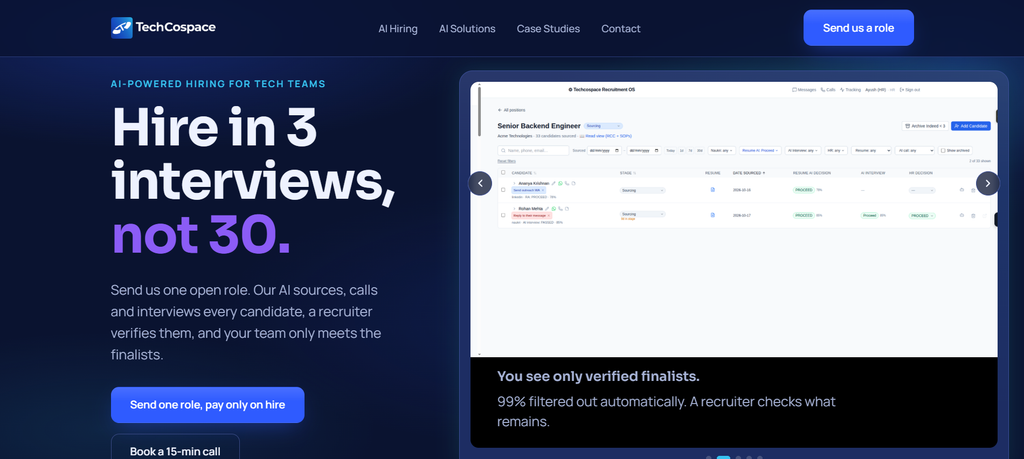
Best for: Businesses seeking recruiter-managed sourcing and technical screening for AI engineers and related technology roles.
TechCospace provides an AI-assisted recruitment service that covers role definition, candidate sourcing, outreach, screening, technical interviews, and finalist shortlisting.
According to its published process, the company combines automated candidate assessment with human recruiter verification.
Employers can receive candidate documentation that includes technical scorecards, interview recordings, transcripts, and recruiter assessments.
Key capabilities
TechCospace describes a recruitment workflow built around structured role requirements, candidate matching, AI-assisted screening, technical interview documentation, and recruiter-supported final selection.
The service is positioned as a managed recruitment offering rather than a self-service hiring tool.
Strengths
The managed approach may reduce the time employers spend on initial candidate discovery, outreach, and screening.
Interview documentation can also make it easier to review how candidates performed before arranging additional technical interviews.
This may be useful for organizations with limited internal recruiting capacity.
Limitations
AI-generated technical scores should not be treated as independent proof of competence.
Employers should conduct their own technical interviews, examine relevant project experience, and confirm that screening processes are appropriate for the role.
Businesses should also verify interview-recording consent, candidate data handling, replacement conditions, and the exact terms of recruitment support.
The company should be asked to clarify whether it supports dedicated contract engineers or primarily permanent recruitment.
Pricing
TechCospace advertises a pay-on-hire arrangement, with fees shared during consultation rather than through a published fixed-price schedule.
Choose TechCospace if: Your organization wants a recruitment partner to handle early-stage sourcing and screening while retaining responsibility for the final hiring decision.
2. Uplers
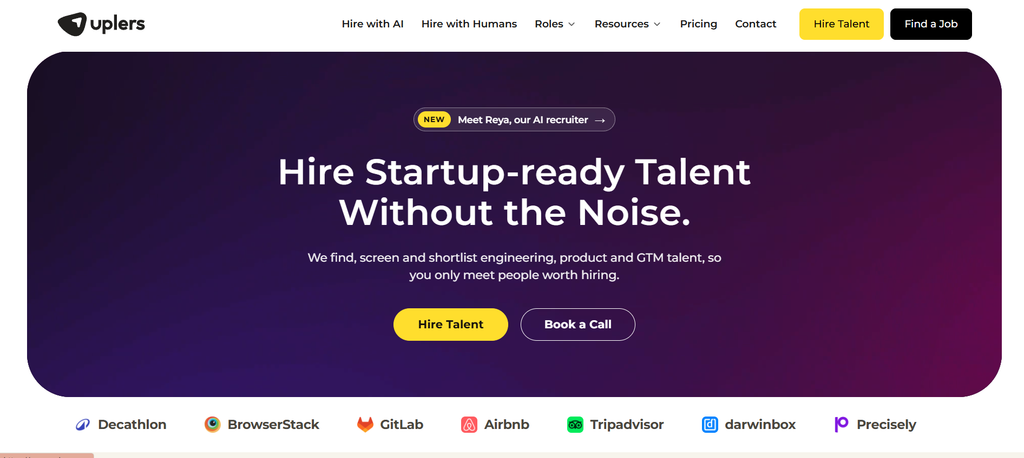
Best for: Startups and product companies seeking Indian engineers through permanent recruitment or longer-term contract arrangements.
Uplers provides engineering recruitment services, including sourcing generative AI specialists from India.
Its published services include candidate matching, recruitment support, and contract talent arrangements.
Employers can review shortlisted professionals before making hiring decisions.
Key capabilities
Uplers offers India-focused sourcing, candidate assessment, talent matching, permanent hiring support, and contract staffing.
Its contract talent arrangement allows professionals to work under the client’s direction while Uplers manages the employment side of the engagement.
Strengths
Uplers provides more than one hiring model.
Businesses can recruit engineers onto their own payroll or use a contract arrangement where Uplers handles employment administration.
The contract option can be particularly relevant to international businesses without an established Indian employing entity.
Limitations
Employers should verify replacement provisions, contractual responsibilities, candidate availability, and technical delivery expectations.
The contract staffing model should not be confused with fully managed software development. The client remains responsible for directing the engineer’s work.
Pricing
According to Uplers’ published pricing, its pay-per-hire service lists a success fee of 10%–15% of annual candidate compensation, varying by seniority and complexity.
Its contract talent service starts at $2,500 per month and carries a six-month minimum commitment.
These are advertised starting terms, not guaranteed prices for every AI specialization. Employers should request a role-specific quotation.
Choose Uplers if: You want India-focused technical recruitment or dedicated engineering capacity with employment administration handled by a recruitment partner.
3. Turing
Best for: Businesses seeking technically screened engineers for distributed product and development teams.
Turing provides access to remote engineering talent, including professionals specializing in artificial intelligence.
Its hiring offering emphasizes technical screening, developer matching, and remote engineering arrangements.
Key capabilities
Turing describes technical assessments covering programming knowledge, software engineering fundamentals, problem-solving, and specialized skills.
Employers can evaluate matched candidates and conduct additional interviews.
Strengths
Turing’s screening-oriented approach may help organizations narrow their candidate pool before conducting internal technical interviews.
Its international talent model can suit companies comfortable recruiting engineers across different locations.
Limitations
Turing is not exclusively focused on Indian engineering talent.
Companies requiring India-based engineers should confirm location preferences, current availability, engagement structures, and applicable contractual arrangements.
The employer should also independently evaluate the candidate’s experience with the intended AI architecture.
Pricing
Engagement costs depend on the position, required experience, and contractual arrangement.
Employers should request a current proposal detailing rates, contract duration, replacement terms, and support responsibilities.
Choose Turing if: Your company is building a remote engineering team and values structured technical screening across a broad international talent market.
4. Toptal
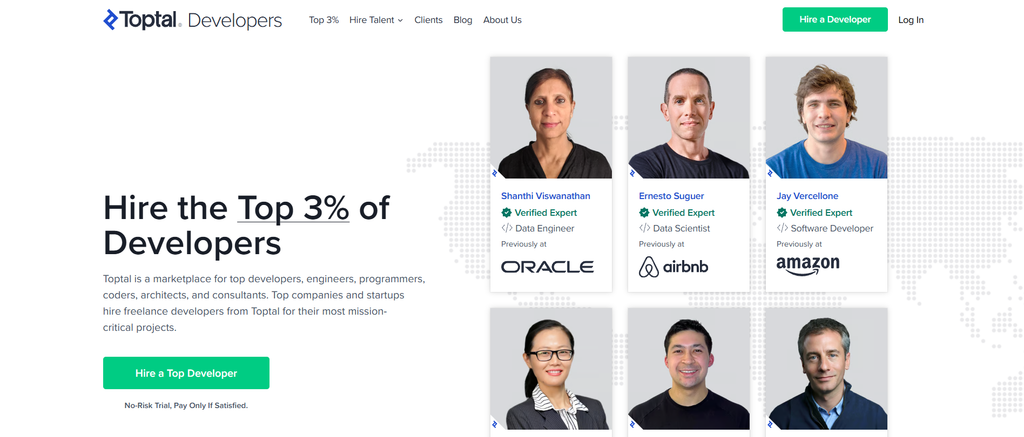
Best for: Businesses needing experienced AI specialists for technically demanding projects.
Toptal connects organizations with screened freelance AI developers and related technical specialists.
Its published talent categories cover artificial intelligence applications, machine learning, natural language processing, and other development disciplines.
Key capabilities
Toptal provides specialist matching, candidate screening, and flexible freelance engagement arrangements.
Its screening process includes technical evaluations and practical assessments.
Strengths
Toptal may suit technically specialized assignments involving machine learning architecture, model deployment, generative AI integration, or infrastructure optimization.
It can be useful when an organization needs experienced expertise without immediately creating a permanent engineering position.
Limitations
The platform’s talent network is international rather than India-exclusive.
Businesses should specify location requirements, availability, expected working-hour overlap, technical deliverables, and contract terms.
An experienced specialist may also be more appropriate for a focused technical assignment than for routine development work.
Pricing
Rates vary by specialist and engagement structure. Employers should obtain an individualized quote and assess total costs before making comparisons.
Choose Toptal if: You need specialist AI expertise for a defined technical project, architecture assignment, or consulting engagement.
5. Arc
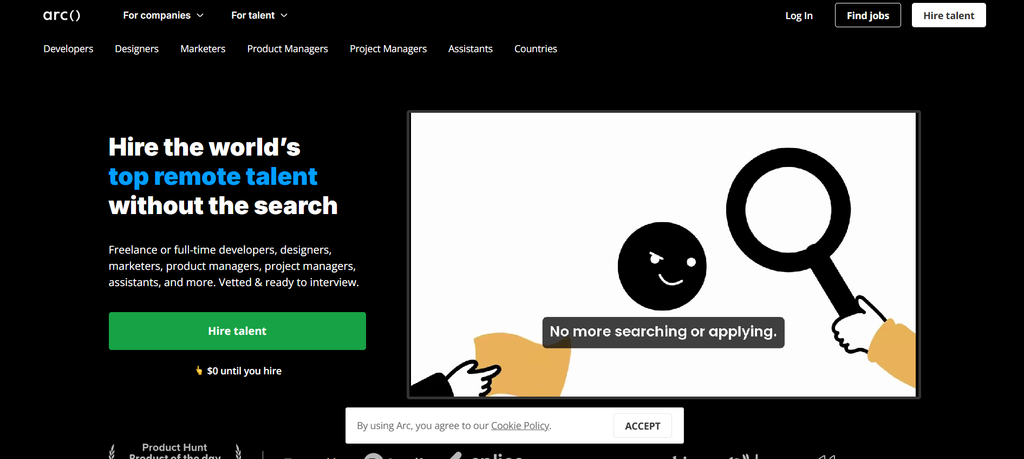
Best for: Companies comparing India-based AI engineers across full-time and freelance hiring arrangements.
Arc provides access to remote AI developers, including professionals located in India.
Its hiring services cover developer discovery, technical vetting, matching assistance, and different contractual arrangements.
Key capabilities
Arc provides developer profiles, location-based talent discovery, candidate matching, technical screening, and support for full-time and freelance recruitment.
It also describes employment and contractor administration options through external partners.
Strengths
Arc can help businesses identify India-based AI developers while retaining flexibility between contract and permanent recruitment.
Its talent profiles can be useful for comparing technical backgrounds, experience, and engagement availability.
Limitations
The level of screening depends on the service being used.
Arc distinguishes its vetted talent offerings from options such as free job postings, which do not provide the same screening.
Employers should confirm technical vetting status, service charges, conversion fees, and contractual responsibilities.
Pricing
Costs vary by full-time hiring, freelance matching, and service arrangement.
Request current pricing and determine which services are included before comparing proposals.
Choose Arc if: You want location-specific access to remote AI developers in India and flexibility across multiple hiring formats.
6. Upwork
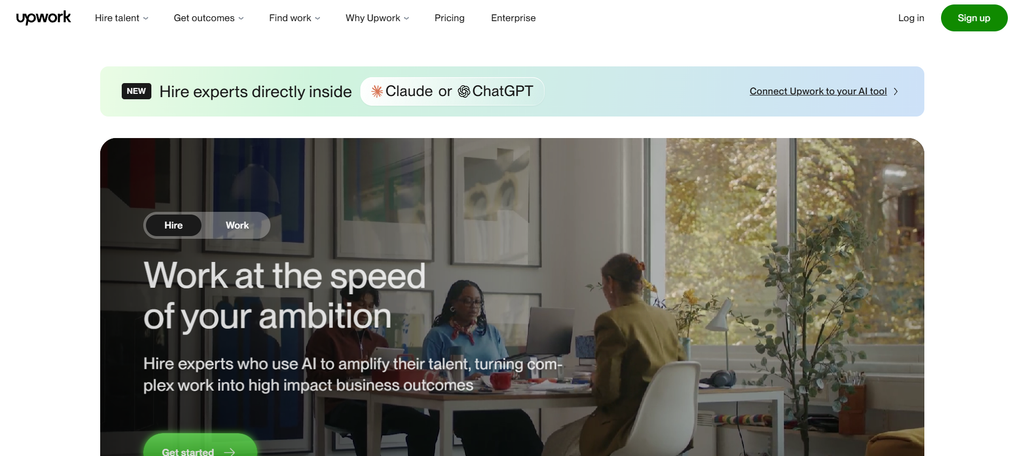
Best for: Startups and businesses seeking freelance AI engineering support for clearly defined assignments.
Upwork operates a freelance marketplace where businesses can find AI engineers located in India.
Clients can review advertised rates, professional profiles, portfolios, work histories, and customer feedback.
Key capabilities
Upwork supports freelancer discovery, project proposals, direct communication, hourly contracts, and milestone-based payments.
Employers can compare professionals before selecting a contractor.
Strengths
Upwork allows businesses to begin with relatively small projects and expand engagements when appropriate.
It may be useful for feasibility studies, prototypes, AI integrations, data-processing pipelines, and specialized development tasks.
Employers can also use limited initial milestones to assess working quality before committing to a larger assignment.
Limitations
Technical screening quality varies between freelancers.
Clients must evaluate coding ability, relevant project experience, communication, security practices, and deliverable quality.
Long-term availability and operational support should be agreed upon rather than assumed.
Pricing
Upwork’s India AI-engineer hiring guide describes typical marketplace rates of approximately $25–$35 per hour.
These figures are marketplace reference estimates, not fixed prices. Individual quotes may be higher or lower, and platform fees can affect total costs.
Choose Upwork if: You need flexible project-based AI development and have sufficient technical capacity to evaluate and supervise independent contractors.
How to Choose the Right AI Engineer Hiring Platform
The most suitable platform depends on the level of recruitment support, engineering specialization, and contractual flexibility your business needs.
For example, a company with an experienced engineering manager may be comfortable evaluating candidates sourced through a freelance marketplace.
An organization without an internal technical recruitment team may benefit from recruiter-managed screening.
Before selecting a provider, compare the following factors.
| Evaluation criterion | What to verify |
|---|---|
| Candidate specialization | Relevant production experience in your AI use case |
| Screening quality | Assessment methods, interview evidence, and human review |
| Hiring flexibility | Permanent, freelance, contract, or managed arrangements |
| Geographic suitability | India-based candidate availability and time-zone expectations |
| Total cost | Compensation, placement fees, administration, and contract terms |
| Replacement support | Conditions, eligibility, and applicable time limits |
| Data protection | Candidate consent, access controls, and information retention |
| Delivery ownership | Responsibility for engineering management and performance |
Questions to Ask Recruitment Partners
A useful provider evaluation should go beyond the number of candidates available.
Ask:
- How do you verify production AI engineering experience?
- Do you conduct technical interviews or rely primarily on automated screening?
- Can candidates explain the systems they personally developed?
- What are the recruitment fees and replacement conditions?
- Who manages payroll, employment obligations, and contractor administration?
- Can we interview engineers before accepting a placement?
- What happens if the engineer leaves during the initial engagement?
- How are candidate interview recordings and assessment data handled?
Request written answers for contractual matters.
A platform’s marketing claims about screening speed or talent quality should not replace your organization’s own technical due diligence.
How Much Does It Cost to Hire AI Engineers in India in 2026?
The cost of hiring AI engineers in India depends on experience, specialization, employer type, location, and engagement structure.
Permanent employment salaries, freelance rates, and managed staffing fees are different cost measures.
Employers should consider total expenditure rather than comparing headline figures directly.
AI Engineer Salary in India by Experience
The following ranges are indicative figures drawn from the 2026 AI engineer salary guide published by the EICTA Consortium at IIT Kanpur.
| Experience level | Indicative annual salary | Typical responsibilities |
|---|---|---|
| Entry-level, 0–2 years | ₹5–8 lakh | Python development, ML fundamentals, supervised implementation |
| Mid-level, 3–6 years | ₹12–25 lakh | Independent development, deployment, model evaluation |
| Senior, 7–10+ years | ₹25–50 lakh | Architecture, production ownership, technical leadership |
| Specialized senior GenAI roles | May exceed ₹50 lakh | Advanced LLM systems, AI infrastructure, platform architecture |
These are broad editorial market estimates from the cited guide, not official wage statistics, independently audited compensation data, or guaranteed salary bands.
Actual offers can differ substantially.
For example, an engineer integrating an existing LLM API may have different compensation expectations from an engineer responsible for building high-performance model-serving infrastructure.
Companies should validate budgets against recent offers, role-specific salary surveys, and current candidate expectations.
Freelance AI Engineer Hourly Rates in India
Freelance rates vary by project scope, seniority, specialization, and expected availability.
As a marketplace reference, Upwork describes typical rates for India-based AI engineers of approximately $25–$35 per hour.
However, a freelancer working on routine integrations may charge differently from someone developing custom model infrastructure or handling enterprise security requirements.
When evaluating freelance proposals, compare:
- Expected engineering hours
- Defined deliverables
- Testing and documentation
- Technical complexity
- Revision and support arrangements
- Platform charges
- Intellectual property terms
A lower hourly rate does not necessarily produce a lower final project cost.
What Additional Costs Should Businesses Expect?
Hiring costs extend beyond compensation.
Common expenses include recruitment charges, employer-of-record fees, cloud infrastructure, model API usage, software subscriptions, technical assessments, security reviews, and onboarding.
For permanent employees, companies may also need to budget for employer contributions, leave, insurance, equipment, and payroll administration.
For freelance engagements, assess expected hours, milestone scope, revision requirements, and support arrangements.
An effective comparison should estimate the total cost of achieving a defined engineering outcome, not simply the cost of purchasing developer time.
Step-by-Step Process for Hiring AI Engineers in India
A structured hiring workflow improves consistency and reduces the risk of recruiting candidates whose experience does not match the position.
Step 1: Define the AI use case
Begin with the business outcome.
For example:
“We need an internal AI assistant that can search approved company documentation, provide source references, and respond accurately to employee questions.”
This is more useful than requiring an engineer who knows every major AI framework.
Define the intended users, available data, integrations, accuracy expectations, security requirements, deployment environment, and budget.
Identify how success will be measured.
Step 2: Write a role-specific job description
A useful job description should define the position’s responsibilities, required skills, expected deliverables, and working arrangements.
Include:
- Role title and experience requirements
- Technical responsibilities
- Required programming languages
- Relevant AI frameworks and deployment tools
- Cloud infrastructure expectations
- Employment or contract arrangement
- Communication and working-hour requirements
- Compensation range
- Expected joining timeline
Separate essential skills from technologies that candidates can learn after joining.
Avoid requiring unrelated specializations simply to make the role appear comprehensive.
Step 3: Choose recruitment channels
Managed recruitment is useful when internal sourcing capacity is limited.
Freelance marketplaces can work well for defined projects where the company can evaluate candidates directly.
Specialized engineering talent networks may be appropriate for long-term remote positions.
Direct hiring through professional networks, referrals, and job platforms is another option.
Compare providers using the same role description before selecting a recruitment channel.
Step 4: Review portfolios and production experience
Strong portfolios demonstrate more than chatbot interfaces or model-generated screenshots.
Ask candidates to explain what they built, which components they personally implemented, how they selected their models, and how they measured results.
Discuss difficulties encountered during deployment, ongoing reliability, operational costs, and security requirements.
For confidential projects, candidates may be able to explain anonymized architectures without disclosing proprietary information.
Pay attention to whether the candidate can distinguish individual contributions from team achievements.
Step 5: Conduct structured technical interviews
Use a consistent interview process that assesses conceptual understanding, software development fundamentals, and problem-solving skills.
Ask candidates to explain relevant technical decisions and trade-offs.
For a RAG-focused position, discuss retrieval design, document permissions, evaluation datasets, and response reliability.
For machine learning infrastructure, assess model deployment, monitoring, throughput, and failure recovery.
Use comparable questions across candidates while allowing appropriate adjustments for experience and specialization.
Step 6: Run a practical technical assessment
Assign a bounded task related to the position.
For example, an LLM engineer might be asked to design a small document retrieval and question-answering system using provided non-sensitive information.
Assess whether the candidate can create a working solution, explain decisions, test failure cases, and document limitations.
Practical assessments should be proportionate to the role. Avoid requiring substantial unpaid production work.
Step 7: Verify references and finalize agreements
Before finalizing the offer, verify employment history where appropriate and confirm relevant professional references.
Review joining availability, compensation, notice periods, and contractual responsibilities.
Agreements should clearly address confidentiality, intellectual property, information security, payment terms, termination, and ownership of deliverables.
Cross-border employment arrangements should be reviewed for applicable legal and tax obligations.
Step 8: Onboard with measurable milestones
Provide access to approved repositories, development environments, technical documentation, and communication systems.
Begin with a limited, measurable engineering milestone.
Agree on code review standards, testing expectations, security controls, and technical reporting procedures.
Do not provide unrestricted production access simply because a candidate has completed the recruitment process.
Technical Interview Questions to Ask AI Engineers
Effective interview questions reveal how candidates reason about engineering problems.
The following questions can be adapted to the position.
| Interview question | What a strong answer should demonstrate |
|---|---|
| How would you design a production RAG system? | Retrieval strategy, indexing, permissions, evaluation, and reliability |
| How do you reduce hallucinations in an LLM application? | Grounding, evaluation, uncertainty handling, and model limitations |
| How would you reduce inference costs? | Model selection, caching, batching, token optimization, and monitoring |
| What is the difference between fine-tuning and RAG? | Understanding of model adaptation versus external knowledge retrieval |
| How would you evaluate an AI agent? | Task success, tool-use accuracy, recovery, and safeguards |
| How would you secure an LLM application? | Access controls, prompt-injection defenses, data protection, and logging |
| How would you monitor an ML model after deployment? | Performance metrics, data drift, incident handling, and retraining decisions |
Candidates should explain the consequences of their technical choices rather than simply name popular frameworks.
Example Practical Assignment: Build a Small RAG Prototype
Provide a limited set of non-sensitive documents and ask the candidate to build a search-and-answer workflow.
The system should retrieve relevant information, generate grounded responses, provide source references where appropriate, and acknowledge when the available documents do not support an answer.
The assignment should also include basic error handling and instructions for running the application.
Use a consistent assessment rubric.
| Evaluation area | Maximum points |
|---|---|
| Solution architecture | 25 |
| Code quality and correctness | 20 |
| Retrieval and output evaluation | 20 |
| Security and data handling | 15 |
| Testing and operational readiness | 10 |
| Communication and documentation | 10 |
| Total | 100 |
For further reading on AI-assisted quality assurance, see what generative AI adds to software testing.
Red Flags During Technical Evaluation
Some warning signs deserve closer investigation.
A candidate may be unable to explain their own system architecture, describe how they evaluated model performance, or identify the limitations of previous projects.
Other concerns include relying entirely on AI-generated code without understanding it, ignoring authentication and data protection, or claiming that prompting alone can eliminate all model errors.
These issues do not automatically disqualify a candidate, but they should prompt more detailed technical questions.
The objective is to assess actual engineering capability, not familiarity with AI terminology.
What Security, Legal, and Compliance Issues Should You Check?
International AI hiring creates responsibilities involving personal information, intellectual property, access rights, and employment arrangements.
These matters should be addressed before engineers receive access to sensitive systems.
Intellectual property and confidentiality
Employment and contractor agreements should establish ownership of custom code, model configurations, project documentation, training artifacts, and other deliverables.
Clarify whether contractors can reuse code, frameworks, or components developed during the engagement.
Review open-source dependencies and applicable license requirements.
Confidentiality agreements are useful, but they do not replace technical security controls.
Data privacy and cross-border transfers
India’s Digital Personal Data Protection Act, 2023 establishes a statutory framework for digital personal data protection.
However, its provisions have phased commencement dates.
Under the government’s notification dated November 13, 2025, certain institutional and administrative provisions took effect upon publication. Additional specified provisions were scheduled to commence one year after publication, while substantial remaining provisions were scheduled for eighteen months after publication.
The Digital Personal Data Protection Rules, 2025 also provide phased commencement dates.
As of November 13, 2026, organizations should distinguish provisions already in force from those scheduled for May 2027, while checking for subsequent changes or notifications.
The Act and Rules should not be described as having become fully operational on a single date.
For UK organizations, the Information Commissioner’s Office guidance on international transfers explains when transfer requirements may apply and what safeguards organizations should consider.
Organizations handling EU personal data should separately assess applicable GDPR requirements.
Hiring an engineer in India does not automatically require transferring production customer data.
Where practical, developers can work with synthetic datasets, anonymized information, and controlled development environments.
AI-specific security requirements
The OWASP Top 10 for LLM Applications provides guidance on risks associated with language-model applications.
These include prompt injection and sensitive information disclosure.
Engineers should understand secure tool calling, secrets management, authorization, input handling, and the consequences of unreliable AI output.
For applications that can execute actions, establish explicit limits on tool access and require human approval for sensitive operations.
AI governance and responsible deployment
The NIST Generative AI Risk Management Profile provides a reference for identifying and managing risks associated with generative AI systems.
Employers should define expectations for evaluation, monitoring, incident response, auditability, and human oversight.
AI applications should also have documented limitations and procedures for handling failures.
Employment and tax arrangements
Companies should determine whether they are hiring an Indian employee, engaging a genuine independent contractor, or purchasing development services from an Indian provider.
Cross-border hiring can create obligations involving payroll, employment classification, statutory benefits, taxation, and permanent establishment considerations.
An employer-of-record arrangement may simplify employment administration, but it does not eliminate every legal or tax risk.
Obtain jurisdiction-specific professional advice before finalizing contractual structures.
Responsible Use of AI in Recruitment
Where recruitment providers use automated assessments, employers should understand how those assessments contribute to hiring decisions.
Candidates should receive appropriate information about recorded interviews, automated evaluation, and personal information handling.
Where legally required, obtain applicable consent and provide appropriate notices.
Employers should also consider assessment fairness, accessibility, retention periods, and human review.
An automated interview score should support a broader evaluation rather than replace relevant evidence of technical competence.
How Long Does It Take to Hire an AI Engineer in India?
Hiring timelines depend on experience requirements, recruitment methods, screening procedures, candidate availability, and notice periods.
For planning purposes, an organization might allocate the following time to each stage.
| Hiring stage | Illustrative planning duration |
|---|---|
| Requirements and role definition | 2–4 working days |
| Candidate sourcing and shortlisting | 3–10 working days |
| Technical assessments and interviews | 5–10 working days |
| Reference checks and offer | 3–7 working days |
| Joining and onboarding | Depends on candidate availability and notice period |
These are illustrative planning assumptions, not measured industry averages or guaranteed recruitment timelines. Some stages may overlap.
A candidate already available for contract work may begin sooner than a permanent employee who needs to complete a notice period.
Senior and highly specialized positions may require longer recruitment cycles.
Employers should distinguish the time required to receive a shortlist from the time required for an engineer to join and become productive.
Common Mistakes Companies Make When Hiring AI Engineers in India
Hiring based only on the lowest hourly rate
A low rate can create higher overall costs when work requires repeated corrections or redevelopment.
Compare technical competence, estimated delivery time, quality requirements, and ongoing support.
Confusing AI demonstrations with production experience
A prototype may demonstrate model integration without addressing authentication, scalability, monitoring, reliability, or security.
Ask candidates to explain production deployments and maintenance responsibilities.
Hiring one generalist for every AI requirement
Complex AI systems may require expertise in data engineering, backend development, infrastructure, machine learning, and security.
Determine whether the proposed scope can reasonably be managed by one engineer.
Skipping practical assessments
Resumes and certifications do not independently demonstrate implementation ability.
Use relevant technical exercises and structured interviews.
Ignoring documentation and operational handover
Without documentation, companies can become dependent on an individual engineer or external vendor.
Require readable code, deployment instructions, architectural records, and operational runbooks.
Failing to measure AI system quality
AI output should not be evaluated only by how convincing it sounds.
Use representative test datasets, explicit acceptance criteria, security assessments, and human review where necessary.
Overlooking engagement terms
Unclear intellectual property ownership, support responsibilities, termination conditions, and data handling can create expensive problems.
Review these issues before work begins, not after a dispute arises.
AI Engineer Hiring Checklist for 2026
Use this checklist before making a final decision.
- Define the business problem and AI use case.
- Identify the required engineering specialization.
- Choose the hiring model.
- Establish a realistic total budget.
- Prepare a role-specific job description.
- Compare relevant recruitment channels.
- Review production engineering experience.
- Conduct structured technical interviews.
- Complete an appropriate practical assessment.
- Verify references and candidate availability.
- Review confidentiality, intellectual property, and security requirements.
- Confirm the employment or contractor arrangement.
- Establish onboarding and communication procedures.
- Agree on initial delivery milestones and evaluation criteria.
The checklist can support both startups hiring individual engineers and larger organizations recruiting dedicated AI development teams.
Frequently Asked Questions About Hiring AI Engineers in India
How much does it cost to hire an AI engineer in India?
Indicative 2026 salary guidance suggests approximately ₹5–8 lakh annually for some entry-level AI engineers and ₹25–50 lakh for senior engineers, with specialized positions potentially exceeding those figures.
These ranges are estimates rather than standardized market-wide salaries. Freelance and contract arrangements have different pricing structures.
Where can I find qualified AI engineers in India?
Businesses can compare managed recruitment services such as TechCospace and Uplers, remote engineering talent platforms such as Turing, Toptal, and Arc, or freelance marketplaces such as Upwork.
Direct recruitment through professional networks, referrals, and job boards is also possible.
Should I hire a freelance or full-time AI engineer?
Freelancers can be appropriate for prototypes, integrations, and narrowly defined assignments.
Full-time or dedicated engineers are generally more suitable when a company needs continuous development, long-term product ownership, and ongoing operational support.
Do I need an Indian company to hire AI engineers in India?
Not necessarily.
Depending on the engagement, an international company may work with an independent contractor, purchase services from an Indian business, or use an employer-of-record arrangement.
The appropriate structure depends on the actual working relationship and applicable employment and tax laws.
How do I verify that an AI engineer has production experience?
Ask for detailed explanations of previous systems, individual contributions, deployment challenges, testing strategies, monitoring procedures, and operational decisions.
Use structured technical interviews and relevant practical assessments rather than relying only on portfolio screenshots or framework lists.
How long does it take to hire an AI engineer in India?
Hiring can take several weeks or longer, depending on the position.
Specialized roles, reference checks, contract negotiations, and candidate notice periods can extend the timeline.
A recruitment provider may produce a shortlist quickly, but a shortlist is not the same as a completed hire.
How can I protect confidential data when working with remote AI engineers?
Use appropriate contracts, access controls, approved development environments, logging, and least-privilege permissions.
Where possible, use synthetic or non-sensitive datasets for development and testing.
Review applicable privacy and cross-border transfer requirements before granting access to personal or confidential information.
Final Recommendations
The best way to hire AI engineers in India is to match the hiring model to the project’s technical complexity, duration, and importance to the business.
TechCospace is worth considering for managed technical recruitment with AI-assisted screening and human recruiter review. Uplers offers India-focused recruitment and contract talent options. Turing and Arc provide remote engineering recruitment services, while Toptal focuses on screened freelance specialists. Upwork offers greater flexibility for organizations prepared to evaluate and manage individual contractors.
These services address different hiring needs. No provider can remove the need for independent technical evaluation, clear contractual terms, and appropriate security controls.
Before hiring, compare verified engineering experience, total costs, recruitment support, contract conditions, and the responsibilities involved in managing the engineer after joining.
For startups and enterprises alike, successful AI recruitment is not simply about finding someone familiar with Python or popular AI models.
It is about selecting engineers who can translate business requirements into secure, reliable, maintainable AI systems and take responsibility for their performance over time.