How to Choose a PMP Training Provider: 9 Checks Before You Pay

Choosing a PMP training provider in 2026 requires more than comparing course fees, advertisements, or the number of mock tests included.
Your course needs to satisfy PMI’s training requirements, prepare you for the updated PMP exam launched on July 9, 2026, fit your work schedule, and clearly explain what is included in the training fee.
You should also check the instructor, course format, application support, practice-question quality, LMS access, cancellation terms, and whether PMI membership or examination fees are separate.
Most importantly, verify important certification requirements directly with the Project Management Institute rather than relying only on a training company’s website.
Key Takeaways
- PMP candidates generally need 35 hours of qualifying project management training, unless an active CAPM certification fulfills the requirement.
- The current PMP exam has 180 questions and 240 minutes, including two 10-minute breaks.
- The July 2026 PMP exam weighting is 33% People, 41% Process, and 26% Business Environment.
- Starting December 1, 2026, PMI is changing the rules for live instructor-led PMP training used for eligibility.
- Training fees and PMP examination fees should be treated separately unless a provider explicitly confirms a bundle.
- A large question bank does not automatically mean better preparation. Current, scenario-based practice matters more.
- Before paying, verify the actual instructor, schedule, course version, training certificate, LMS duration, application support, refund policy, taxes, and total certification budget.
PMI’s current PMP certification requirements and exam details are available directly through its official certification page. PMI Project Management Professional certification requirements
PMP Training Providers at a Glance
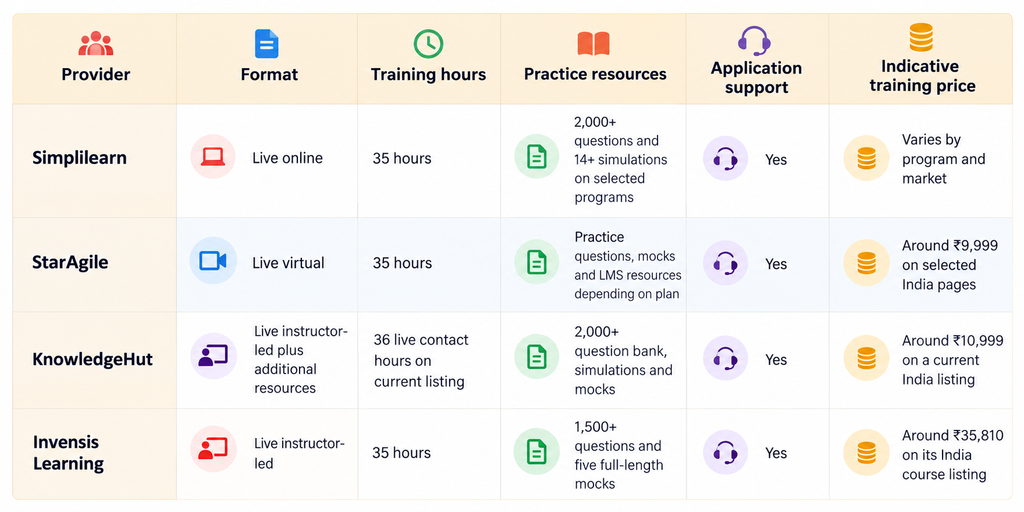
Important: Prices change frequently. Treat these figures as comparison snapshots, not guaranteed rates. Confirm GST, examination fees, PMI membership, refund conditions and package inclusions before paying.
If you are budgeting for the complete certification process rather than training alone, see Syssn’s guide to PMP certification cost in India.
What Is a PMP Training Provider?
A PMP training provider delivers project management education intended to help candidates meet PMI’s training requirement and prepare for the Project Management Professional examination.
The provider does not award the PMP certification. PMI awards the credential.
That distinction helps separate four things that training advertisements can sometimes combine:
- PMP training
- The 35-hour education requirement
- PMI membership
- The PMP examination
Completing a training course does not automatically make you PMP certified.
You still need to meet PMI’s education and professional experience requirements, submit an application, receive approval and pass the PMP examination.
For the complete process, Syssn has a separate step-by-step guide to getting PMP certification.
What Are the PMP Eligibility Requirements in 2026?
PMI currently provides four education and experience pathways.
| Education | Required project experience |
| High school diploma or equivalent | 5 years |
| Associate degree or vocational trade-school diploma | 4 years |
| Bachelor’s degree or higher | 3 years |
| Bachelor’s or postgraduate degree from a qualifying PMI GAC program | 2 years |
Qualifying project experience must generally fall within the previous 10 years.
PMI describes qualifying experience in terms of managing projects in a professional setting and taking responsibility for areas such as planning, decisions, delivery and outcomes. Your job title does not necessarily have to be “Project Manager.”
Candidates also need 35 hours of project management training, unless an active CAPM certification fulfills that requirement.
This is why selecting a PMP training provider is partly an eligibility decision and partly an exam-preparation decision.
What Changed in the PMP Exam in July 2026?
PMI launched the updated PMP examination on July 9, 2026.
The current examination contains:
| Exam element | Current PMP format |
| Questions | 180 |
| Exam time | 240 minutes |
| Scheduled breaks | Two 10-minute breaks |
| People | 33% |
| Process | 41% |
| Business Environment | 26% |
The updated exam also places greater emphasis on subjects such as AI, sustainability, stakeholder engagement, business value and project outcomes.
You can review PMI’s official explanation of the changes here: PMI’s updated PMP exam information.
The detailed domain structure is available through the official 2026 PMP Examination Content Outline.
This change makes one question especially important when comparing courses:
Has the actual training material been updated for the July 2026 examination?
Do not assume that a provider’s home page, LMS, mock exams and instructor slides were all updated at the same time.
Four PMP Training Providers to Compare in India
The providers below represent different approaches to live PMP preparation.
The purpose of this comparison is not to declare one universal winner. Your best option depends on your schedule, budget, instructor preference and the level of preparation support you need.
For a broader online-course comparison, see Syssn’s guide to PMP certification online training.
1. Simplilearn
Overview: Simplilearn offers live online PMP preparation with structured lessons, PMI-aligned training material, practice questions and exam simulations.
Training: Current Simplilearn material states that the program provides the 35 hours of training required for PMP eligibility. Selected PMP bootcamp offerings include instructor-led sessions and a defined preparation schedule.
Practice resources: Its current bootcamp material advertises more than 2,000 PMP-style questions and 14+ full-length simulations.
Application support: Application guidance is included in selected programs.
Best suited to: Professionals who want a structured digital learning environment with a large practice inventory.
What to verify: Check the exact program you are purchasing because Simplilearn offers several PMP products with different durations, prices and inclusions. Confirm whether exam preparation, PMI membership, application support and additional resources belong to your specific package.
2. StarAgile
Overview: StarAgile offers instructor-led PMP training through live virtual classes and identifies its PMP program as PMI-authorized training.
Training: Its current Standard Plan lists 35 hours of live virtual training, LMS access and training from a PMI-authorized instructor.
Practice resources: Selected current plans list practice questions, mock exams and additional study resources. The exact number and type of resources can vary by package.
Application support: PMP application assistance is available as part of its broader training offering.
Best suited to: Working professionals looking for live online classes with weekday or weekend scheduling options.
What to verify: Check the precise package, trainer, batch dates, access period, mock-test inclusion, GST and final payable amount. Public course pricing can differ according to location, promotion and plan.
3. KnowledgeHut
Overview: KnowledgeHut, part of upGrad, provides live PMP classes supported by practice material, mentoring and additional learning resources.
Training: A current India listing shows 36 contact hours of live training, along with an on-demand course and a mentor-led preparation plan.
Practice resources: The same listing advertises a question bank containing more than 2,000 questions, simulations and multiple mock tests.
Application support: KnowledgeHut provides guidance around PMI registration and the PMP application process.
Best suited to: Candidates who want structured instructor-led training plus additional mentoring after the main classes.
What to verify: Course prices can vary by location and promotion. Check your LMS duration, repeat-class access, trainer, current curriculum and exactly which practice resources your package contains.
4. Invensis Learning
Overview: Invensis Learning offers instructor-led PMP training in India and identifies itself as a PMI Authorized Training Partner.
Training: Its current India material lists 35 hours of instructor-led training and official PMI-aligned learning resources.
Practice resources: Current course information includes more than 1,500 practice questions, five full-length mock exams, recordings and study-support resources.
Application support: Application guidance and study planning are included.
Best suited to: Candidates who want a clearly defined instructor-led package and are comfortable with a higher advertised training price.
What to verify: Invensis currently lists PMP training in India at approximately ₹35,810. Compare that price with lower-cost courses based on the services you will actually use rather than price alone.
The 9 Checks to Make Before Choosing a PMP Training Provider
1. Verify That the Training Meets PMI Requirements
Start with eligibility.
PMI currently requires 35 hours of qualifying project management training unless an active CAPM certification fulfills the requirement.
An important rule changes on December 1, 2026.
Starting on that date, live instructor-led PMP training, whether delivered virtually or in person, qualifies only through specified pathways including:
- PMI Authorized Training Partners
- China Registered Education Providers
- Eligible accredited higher-education programs, including qualifying PMI GAC programs
Self-paced training follows separate rules.
PMI also recommends checking the provider directory before enrolling.
You can verify providers through PMI’s official Authorized Training Partner information and directory.
2. Confirm That the Curriculum Covers the July 2026 Exam
The words “PMP training” are not enough.
Ask the provider:
“Has the course material, instructor deck and question bank been updated for the PMP exam launched on July 9, 2026?”
The current domain weighting is:
- People: 33%
- Process: 41%
- Business Environment: 26%
The revised exam also places greater emphasis on business impact, value, AI, sustainability and stakeholder engagement.
Do not rely entirely on an old PMBOK reference or an older mock bank.
Use the current Examination Content Outline as your reference point.
3. Confirm How You Receive the Required 35 Hours
Ask the provider exactly how it documents your training.
Find out:
- How many qualifying training hours are included
- Whether they are live, self-paced or mixed
- What attendance rules apply
- When the completion certificate becomes available
- Whether missed sessions affect certification of the training hours
PMI makes an important distinction between training hours used for PMP eligibility and PDUs used to maintain a certification after you earn it. They are not interchangeable concepts.
Keep your training certificate after completing the course.
4. Find Out Who Will Actually Teach Your Batch
Training-company branding tells you very little about the instructor assigned to your class.
Before enrolling, ask for:
- Instructor name
- PMP certification status
- Project-management experience
- Experience teaching the July 2026 exam
- Whether the trainer is confirmed for your batch
- Whether instructor changes are possible
A strong trainer should explain why an answer is appropriate in a project scenario rather than simply reading course material.
This becomes important because many PMP questions test judgment, sequencing and decision-making.
5. Evaluate Mock Exams by Quality, Not Quantity
A provider advertising 2,000 questions may sound more impressive than one advertising 1,000.
The number alone does not tell you whether those questions are useful.
Check whether the practice material:
- Reflects the July 2026 examination
- Uses realistic scenario-based questions
- Includes answer explanations
- Covers all three PMP domains
- Includes full-length simulations
- Tracks weak areas
- Helps you practise pacing
PMI provides its own exam preparation resources and recommends using the Examination Content Outline to understand what the test assesses.
You can review official preparation options through PMI’s PMP Exam Preparation resources.
A smaller current question bank can be more valuable than a much larger set based on an older examination.
6. Check the Quality of PMP Application Support
Application assistance can be valuable, especially when your formal job title does not say “Project Manager.”
A good provider can explain:
- How to organize your project experience
- What PMI means by project leadership
- How to describe responsibilities clearly
- What documents you should retain
- What may happen if your application is audited
The provider should help you document your real experience.
It should never invent projects, responsibilities, dates or leadership activity for you.
If you want more detail on the application process, see Syssn’s How to Get PMP Certification guide.
7. Make Sure the Schedule Works With Your Real Week
A 35-hour program can be delivered in very different ways.
One course may spread classes over several weekends. Another may use weekday evening sessions. An intensive course may cover much of the material within a few days.
Before paying, ask:
- What time does each class begin?
- How many sessions are required?
- Are recordings available?
- What happens if you miss a class?
- Can you join another batch?
- Can you repeat live sessions?
- How long does LMS access last?
For working professionals comparing formats, Syssn’s guide to PMP certification training online and weekend batches provides additional scheduling context.
Choose a schedule you can realistically attend rather than the one that looks fastest on the sales page.
8. Calculate the Total PMP Cost
Training price is only one part of the PMP budget.
Your total cost can include:
- Training
- GST or other applicable taxes
- PMI membership
- PMP examination fee
- Additional practice products
- Examination rescheduling
- Retakes
- Renewal costs later
Do not assume that a ₹10,000 training advertisement includes the PMP examination.
PMI states that certification fees can vary according to membership status and region. Confirm the current amount directly with PMI when you are ready to pay.
For a detailed India-focused breakdown, use Syssn’s PMP certification cost guide.
Ask every provider for an itemized written quotation.
9. Read Cancellation, Rescheduling and Refund Conditions
Do this before transferring money.
Check:
- Whether the enrolment fee is refundable
- Whether you can transfer to another batch
- How late you can reschedule
- Whether an administrative charge applies
- How long LMS access remains active
- Whether a pass guarantee has conditions
- Whether a course retake is included
- What happens if the trainer or schedule changes
Marketing phrases such as “money-back guarantee” rarely tell you the full policy.
Read the actual eligibility conditions before relying on the guarantee.
Questions to Ask a PMP Training Provider Before Paying
A short conversation with the provider should answer these questions:
- Is the course updated for the July 9, 2026 PMP exam?
- Does the course satisfy PMI’s current 35-hour training requirement?
- Who will teach my batch?
- Is that instructor confirmed?
- How many live sessions are included?
- What happens if I miss a class?
- How long will I have LMS access?
- How many full-length mocks are included?
- Are the mock questions updated for the current examination?
- Does someone review my PMP application?
- Is the examination fee included?
- Is PMI membership included?
- Is GST included in the displayed price?
- What is the refund or rescheduling policy?
- Can you send all important inclusions and prices in writing?
A provider that answers these questions clearly makes comparison much easier.
Live PMP Training vs Self-Paced Training
Both formats can work.
Live instructor-led training
Live training can suit you if you:
- Prefer fixed study times
- Want to ask questions directly
- Learn through discussion
- Need external structure
- Want instructor feedback
However, remember the December 1, 2026 PMI rule change when selecting live training.
Self-paced training
Self-paced learning may suit you if you:
- Have an unpredictable work schedule
- Prefer independent study
- Already have substantial project-management knowledge
- Need to study early in the morning or late at night
PMI currently allows qualifying on-demand training and also offers its own self-paced PMP exam-preparation course.
The right choice is the format you can complete consistently.
PMP Training Hours vs PDUs
This distinction causes unnecessary confusion.
Training hours help satisfy the education requirement for applying for PMP certification.
Professional Development Units, or PDUs, are primarily associated with maintaining PMI certifications after you earn them.
PMI specifically states that training hours and PDUs serve different purposes.
After earning the PMP credential, PMI currently requires 60 PDUs during each three-year certification cycle to maintain it.
When comparing provider marketing, focus on whether the course satisfies your PMP application training requirement rather than simply counting how many times the page uses the term PDU.
PMP Training Provider Red Flags
Be cautious if a provider:
- Cannot explain whether its material was updated for July 2026
- Uses old domain weightings
- Cannot identify the trainer
- Refuses to provide a written price breakdown
- Suggests that training alone gives you PMP certification
- Claims it can guarantee PMI application approval
- Encourages you to exaggerate project experience
- Cannot explain its refund rules
- Uses outdated exam-duration information
- Promises assistance during the actual examination
PMP application assistance should help you accurately present your qualifications.
It should never turn into fabricated experience or examination misconduct.
PMI’s certification policies and broader certification resources are available through its official Certification Resources center.
Should You Choose PMP or Another Project or Agile Certification?
PMP is designed for professionals with qualifying project leadership experience.
It may not be the right starting point for everyone.
Someone moving toward Scrum Master work, for example, may also compare Scrum-focused certifications.
If that applies to you, Syssn’s guide explaining what CSM certification is and how it works can help you understand the difference before paying for either route.
The certification should match the work you want to perform, your existing experience and the type of roles you are pursuing.
Frequently Asked Questions
How do I choose a PMP training provider?
Start by confirming that the course satisfies PMI’s current training requirements and is updated for the July 2026 PMP exam.
Then compare the instructor, course schedule, training hours, mock-exam quality, application support, LMS access, total cost and refund terms.
Get important promises in writing before paying.
How many hours of PMP training are required?
PMI currently requires 35 hours of project management training unless an active CAPM certification fulfills the training requirement.
Is a PMI Authorized Training Partner required?
It depends on the training format and date.
Beginning December 1, 2026, live instructor-led training used toward PMP eligibility must come through specified eligible provider pathways, including a PMI Authorized Training Partner, China REP or eligible accredited academic program.
Self-paced training follows different rules.
What is the PMP exam format in 2026?
The current PMP exam contains 180 questions and allows 240 minutes.
Candidates receive two scheduled 10-minute breaks.
The current domain weighting is:
- People: 33%
- Process: 41%
- Business Environment: 26%
PMI lists these details directly on its PMP certification page.
When did the new PMP exam start?
The updated PMP examination launched on July 9, 2026.
Does PMP training include the exam fee?
Not automatically.
Training and examination registration are separate expenses unless the provider explicitly offers a package containing both.
Always request an itemized quotation before paying.
Is online PMP training valid?
Yes, provided the training meets PMI’s applicable requirements.
PMI recognizes qualifying online on-demand learning. Live virtual training is also possible, although the eligibility rules for live instructor-led training change on December 1, 2026.
Does my job title need to be Project Manager?
No.
PMI focuses on the project work you managed and your responsibility for areas such as planning, decisions, delivery and outcomes rather than requiring one specific job title.
Can operations or logistics experience count?
Potentially.
Work can qualify when you genuinely managed projects and took responsibility for project outcomes.
Routine operational responsibilities should not be presented as project-management experience if they were not actually project work.
How long should I prepare for the PMP exam?
There is no universal preparation period.
Your timeline depends on your existing project-management knowledge, work schedule, course format and practice performance.
Completing 35 hours of training satisfies an education requirement. It does not automatically mean you are ready to take the exam immediately.
Are PMP training hours the same as PDUs?
No.
PMI distinguishes training hours used to meet PMP application eligibility from PDUs used for maintaining PMI certifications after certification.
Final Checklist Before You Pay
Before choosing a PMP training provider, confirm these nine things:
- The training meets current PMI requirements.
- The material covers the July 2026 PMP exam.
- You will receive valid documentation for your required training hours.
- You know who will teach the batch.
- The practice questions and mocks are current.
- Application support involves accurate documentation of your real experience.
- The schedule works with your job and other commitments.
- You understand the complete cost, not only the advertised training price.
- You have read the cancellation, rescheduling and refund conditions.
The provider with the largest question bank or biggest discount is not automatically the right choice.
Start with compliance and current exam content. Then compare teaching quality, schedule, practice support and total cost.
The PMP examination changed on July 9, 2026, and PMI’s rules for qualifying live training change again on December 1, 2026. Verify both before enrolling.
That gives you a much stronger basis for choosing a PMP training provider than price or marketing claims alone.