What Is CSM Certification: Requirements, Format and Who It Is For

The first thing that surprises many people about CSM certification is how few formal barriers there are.
You don’t need years of project experience. You don’t need a software background. You don’t need a degree.
What you do need is much more specific: complete an approved 16-hour live course with a Certified Scrum Trainer, then pass Scrum Alliance’s online Certified ScrumMaster® assessment.
The test has 50 multiple-choice questions, gives you 60 minutes and requires 74% to pass, which means getting at least 37 questions correct. It’s open-book and unproctored.
That makes CSM one of the more accessible ways to learn Scrum formally. The bigger question is whether the certification fits the kind of work you want to do.
CSM certification at a glance
| Question | Current CSM requirement in 2026 |
|---|---|
| What does CSM stand for? | Certified ScrumMaster® |
| Who issues it? | Scrum Alliance |
| Prior Scrum experience required? | No |
| Technical background required? | No |
| College degree required? | No |
| Training required? | Yes |
| Training duration | 16 hours |
| Training format | Live online or in person |
| Trainer | Certified Scrum Trainer (CST) |
| Exam questions | 50 multiple-choice questions |
| Exam duration | 60 minutes |
| Passing score | 74%, or 37 correct answers |
| Open-book? | Yes |
| Proctored? | No |
| Included attempts | Two |
| Initial test window | 90 days after the Scrum Alliance welcome email |
| Certification cycle | Two years |
| Foundational renewal | 20 SEUs plus a $100 renewal fee |
Scrum Alliance confirmed the current exam structure on July 1, 2026. Some older articles and training-provider pages still show previous requirements, so it is worth checking the date whenever you read about the exam or renewal rules.
What is CSM certification?
CSM stands for Certified ScrumMaster. It is Scrum Alliance’s foundational certification for people learning Scrum Master work.
There are really two parts to it.
First, you attend an approved instructor-led course. Then you take an online assessment.
I think that distinction is useful because CSM is sometimes discussed as though it were simply another exam you can prepare for over a weekend.
It isn’t.
You cannot buy the exam separately, work through a few practice questions and sit for it without attending the course. Scrum Alliance requires the live class before giving you access to the assessment.
That changes what you’re paying for.
You’re paying for structured education with a trainer, discussion with other learners, practical exercises and access to the certification process. The exam comes after that.
The class generally introduces Scrum accountabilities, events, artifacts, values and empirical decision-making. It also looks at how Scrum Masters help teams work through impediments, facilitate useful conversations and improve the way Scrum is being used.
A training provider may also give you mock exams, course notes or its own completion certificate. Those can be useful, but the actual Certified ScrumMaster credential comes from Scrum Alliance.
What are the CSM certification requirements?
The requirements are fairly simple.
You need to:
- Complete an approved 16-hour CSM course with a Certified Scrum Trainer.
- Pass the Scrum Alliance CSM assessment.
That’s it for the foundational certification.
You do not need previous experience in Scrum, Agile or software development. There is no college-degree requirement either.
This opens CSM to a fairly wide group of people.
You might be a project manager who has spent years working with traditional delivery models. You might be a developer who has started facilitating retrospectives. You could be a business analyst joining a Scrum Team for the first time.
You could also be someone trying to move into Scrum Master work without coming from technology at all.
Of course, being allowed to take a certification and being ready for a particular job are different questions.
That becomes more important when you look at what happens after the exam.
Is CSM training mandatory before the exam?
Yes.
This is one requirement you cannot work around.
Scrum Alliance requires candidates to attend an approved 16-hour live CSM course before receiving access to the assessment.
The course can be delivered online or in person, but it needs to be live and taught by an authorised Certified Scrum Trainer.
Recorded lessons, YouTube videos, books and self-paced courses can all help you understand Scrum. They do not replace the official training requirement.
Most approved classes are completed over two or three days.
A common format is two full days over a weekend. That tends to work well for professionals who don’t want to take two weekdays away from work. Some providers divide the same required hours across several shorter sessions.
Attendance matters too.
You generally cannot purchase the course, skip the live sessions and watch recordings later while still expecting to qualify for CSM.
What should you actually learn during the CSM course?
Passing the exam shouldn’t be the only test of whether the class was useful.
You should finish the course able to explain how Scrum works in situations that don’t fit neatly into a multiple-choice question.
That includes understanding:
- Scrum Master, Product Owner and Developer accountabilities
- Sprint Planning
- Daily Scrum
- Sprint Review
- Sprint Retrospective
- Product Backlog
- Sprint Backlog
- Increment
- Scrum values
- empirical decision-making
- facilitation
- managing impediments
- communication inside a Scrum Team
- interactions between Scrum Masters, Product Owners and Developers
The more interesting discussions tend to begin when the framework itself isn’t the problem.
Imagine a team that holds every Scrum event on schedule. Sprint Planning happens. Daily Scrum happens. The retrospective happens every second Friday.
On paper, everything looks correct.
But nobody speaks honestly in the retrospective. The manager assigns tasks directly to individual Developers. The Sprint Goal keeps changing halfway through the Sprint.
Is the team really using Scrum well?
Knowing the names of the five events isn’t enough to answer that.
That is where the actual Scrum Master role starts becoming interesting.
What is the CSM exam format in 2026?
The CSM assessment is taken online through Scrum Alliance.
As of September 2026, the format is:
- 50 multiple-choice questions
- 60 minutes
- 74% passing score
- 37 correct answers required
- Online
- Open-book
- Unproctored
- Two included attempts
You can bookmark questions and return to them before submitting the test.
You cannot pause the timer once the assessment starts.
Because the exam is open-book, you can refer to the Scrum Guide and your training material while taking it.
I wouldn’t interpret “open-book” as “you don’t need to prepare.”
Sixty minutes for 50 questions gives you an average of about 72 seconds per question. If you need to search through your notes every time you’re unsure, the clock disappears fairly quickly.
Training providers often supply their own practice questions or mock tests. Those are useful for preparation, but Scrum Alliance does not review or approve third-party mock exams.
A provider offering five mock tests isn’t giving you five versions of the official exam.
They’re practice material.
How long do you have to take the CSM exam?
You receive an initial 90-day testing period after Scrum Alliance sends your account activation or welcome email.
Two attempts are included during that period.
If you use both attempts without passing, or take the exam outside the included 90-day period, Scrum Alliance currently charges US$25 for another attempt.
The 90 days can sound more restrictive than it really is.
Your opportunity to become CSM certified doesn’t disappear permanently on day 91. The 90-day period relates to the two attempts included with your course.
There is also no requirement to wait after training before taking the exam.
For most people, taking it fairly soon makes sense simply because the terminology and class discussions are still fresh.
How does the CSM certification process work?
The process is short once you understand the order.
Step 1: Decide whether CSM fits your goal
Think about the work you’re trying to move toward.
If you want to support Scrum Teams, facilitate conversations and help teams improve how they work, CSM fits naturally.
If you’re more interested in product decisions, backlog priorities and maximising product value, a Product Owner certification may be more relevant.
Step 2: Find an approved CSM course
Choose a course delivered by a Scrum Alliance Certified Scrum Trainer.
If you discover the course through a training company’s website, you can also verify the trainer or course through Scrum Alliance.
Step 3: Complete the 16-hour live class
Attend the full required training.
Providers may schedule those hours differently, but the qualifying education itself is mandatory.
Step 4: Activate your Scrum Alliance account
After you complete the course, the trainer submits the required details and Scrum Alliance sends you instructions for your account and assessment.
Step 5: Review the material
Go back through your course notes and the Scrum Guide.
If the provider gave you mock questions, this is the point where they become useful.
Step 6: Take the assessment
Answer 50 questions within 60 minutes.
You need at least 37 correct answers.
Step 7: Access your certification
Once you pass, your Certified ScrumMaster credential becomes available through your Scrum Alliance account.
Who should consider CSM certification?
This is where CSM becomes harder to answer with a simple yes or no.
The entry requirements are broad enough that almost anyone can attend. That doesn’t mean almost everyone needs to.
Aspiring Scrum Masters
This is the clearest audience.
If you’re trying to understand Scrum Master work and want structured instruction rather than piecing everything together independently, CSM gives you a defined starting point.
The credential can also help when job descriptions list CSM or another Scrum certification as preferred.
The certificate itself doesn’t prove that you can handle every situation a Scrum Master encounters.
You might understand the textbook definition of a retrospective and still struggle to facilitate one where two team members barely speak to each other.
That ability comes with practice.
Project managers
Traditional project managers sometimes find Scrum uncomfortable at first because several familiar responsibilities work differently.
A Scrum Master doesn’t normally distribute tasks to individual team members or act as the person who controls every deadline.
For someone moving into an Agile environment, understanding that difference can be useful.
It can also be surprisingly difficult to stop doing things that made you effective in your previous role.
Business analysts
Business analysts often sit close to Product Owners, Developers and stakeholders.
Knowing how Sprint Planning, backlog discussions and Scrum accountabilities work can make those interactions easier to understand.
You don’t need “Scrum Master” in your job title to benefit from knowing how the team around you operates.
Developers and QA professionals
Developers and testers sometimes discover that they enjoy the team side of delivery as much as the technical work.
Maybe you’re already running a Daily Scrum occasionally.
Maybe people come to you when something is blocking the team.
Maybe you’re the person who ends up facilitating discussions because nobody else wants to.
CSM can help you understand what a more formal move toward Scrum Master or Agile delivery work would involve.
Product professionals and team leads
Product Owners, product managers and engineering leads work closely with Scrum Masters, so understanding the role can be useful even when you have no intention of becoming one.
In fact, knowing what a Scrum Master should not own can sometimes be as useful as knowing what they should.
Career switchers
You do not need previous software, Scrum or Agile experience to enrol.
That’s good news for beginners.
But there is an awkward question worth asking before paying for the course: what will you do with the knowledge afterwards?
Certification gives you a starting point. Employers may still ask how you’ve handled disagreement, facilitated groups, communicated with stakeholders or helped a team solve a problem.
If you can combine the certification with opportunities to practise those skills, its value becomes easier to see.
What does CSM prove?
There is a temptation with professional certificates to ask more of them than they can reasonably provide.
CSM tells an employer something useful.
It just doesn’t tell them everything.
| CSM can demonstrate | CSM does not automatically demonstrate |
|---|---|
| Completion of approved Scrum training | Years of Scrum Master experience |
| Understanding of foundational Scrum concepts | Advanced coaching ability |
| Passing the Scrum Alliance assessment | Successful delivery on a real product |
| Familiarity with Scrum events and accountabilities | Ability to resolve every team conflict |
| Formal professional development | Guaranteed employment |
| Exposure to facilitation concepts | Proven management experience |
I think this is a healthier way to look at certification.
A certificate can confirm that you’ve studied a subject and met a defined standard.
Work gets messier.
A Scrum Master might have to deal with a Product Owner who keeps adding work halfway through a Sprint. They might have to encourage a manager to stop assigning individual tasks. They may notice that one quiet team member hasn’t contributed to a retrospective for three months.
There isn’t always a multiple-choice answer.
How should you choose a CSM training provider?
Every legitimate CSM provider ultimately leads you toward the same Scrum Alliance certification.
So the interesting differences sit around the certification itself.
Look at:
- the trainer
- teaching style
- schedule
- price
- practice material
- class size
- rescheduling terms
- support after the course
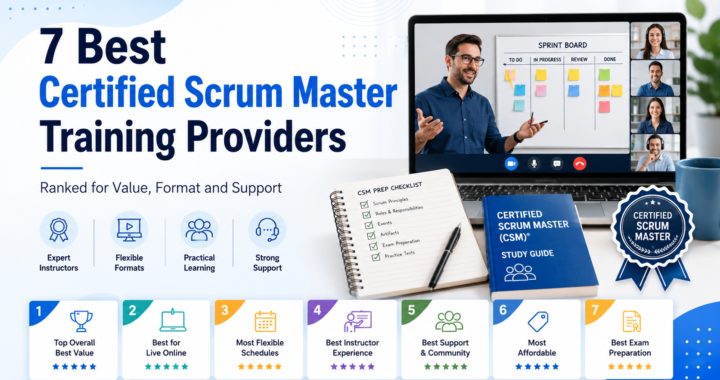
Syssn also has a separate comparison of 7 Best Certified Scrum Master Training Providers in 2026.
Here are four providers that show how current offerings can differ.
1. StarAgile
StarAgile describes itself as a Scrum Alliance Licensed Training Partner and offers live CST-led CSM training.
Its course material includes interactive sessions, group activities and mock tests. Recent sales conversations used for this review described a Saturday and Sunday format running roughly from 9 am to 6 pm with a lunch break.
Narasimha Reddy Bommaka, StarAgile’s founder and CEO, was also discussed as a trainer, and StarAgile lists him as a Certified Scrum Trainer.
Pricing is something I’d check carefully before booking.
Current India pages show around ₹17,135 for some CSM classes, while recent sales discussions quoted a StarMax floor closer to ₹25,000.
StarAgile also advertises 16 SEUs with its CSM training. Scrum Alliance’s 2026 renewal policy says certification courses such as CSM do not themselves generate renewal SEUs, so ask exactly what that wording refers to before treating the SEUs as part of the value calculation.
2. upGrad KnowledgeHut

upGrad KnowledgeHut offers a 16-hour CSM course through live classroom and virtual training and identifies itself as a Scrum Alliance Registered Education Ally.
Its current Delhi material describes two days of training, an open-book online assessment and two included exam attempts.
The format should appeal to learners who prefer conventional instructor-led preparation and want the certification process organised within a larger training platform.
Public India pricing varies depending on the course, location and offer available at the time.
Rather than relying on a broad pricing article, check the final checkout amount or get the quote in writing. Also confirm the named CST, GST, class dates, rescheduling conditions and any support that applies specifically to your batch.
The CSM credential itself is still issued by Scrum Alliance.
3. Simplilearn
Simplilearn delivers CSM through a live online bootcamp and identifies itself as a Scrum Alliance Registered Education Ally.
Its course page describes two or three days of virtual training and includes access to the certification process and two-year Scrum Alliance membership.
Training material also mentions games, simulations, role-play and case discussions.
A page checked in September 2026 showed a promotional online price of $399, reduced from $499.
Promotions and currency conversions change, so an Indian learner should check the actual rupee amount, taxes and final checkout price before comparing it with providers publishing domestic pricing.
Simplilearn could appeal to someone who already prefers larger online learning platforms and wants scheduled virtual classes with supporting study material.
As always, check the actual trainer and batch.
4. PremierAgile
PremierAgile offers a two-day live CSM program with an emphasis on trainer interaction and practical activities.
Its September and October 2026 schedules showed CST-led weekend courses, including sessions running from 9 am to 5 pm.
A September 19 to 20, 2026 batch was listed at ₹21,525 plus GST when the course was researched.
That gives you a useful price comparison against StarAgile’s standard listings and its higher StarMax package, although promotional pricing can change.
PremierAgile’s material also explains the standard Scrum Alliance certification route and membership.
If you notice a provider page showing older information about passing scores, exam windows or renewal requirements, check Scrum Alliance’s current rules before making a decision.
Syssn CSM Fit Score: should you take CSM now?
Sometimes the easiest way to think about certification is to stop asking whether it is “worth it” in general.
Worth it for whom?
Here’s a simple Syssn editorial model. It isn’t an official Scrum Alliance assessment.
Give yourself 0, 1 or 2 points for each question.
| Question | 0 points | 1 point | 2 points |
|---|---|---|---|
| Do you work with Scrum Teams? | No | Occasionally | Regularly |
| Do you facilitate team discussions? | Rarely | Sometimes | Frequently |
| Does your target role mention Scrum or CSM? | No | Helpful | Requested/preferred |
| Will you have somewhere to practise the skills? | No | Possibly soon | Yes |
| Do you learn better through live practice? | No | Unsure | Yes |
0 to 3 points: CSM may be early for you. Read the Scrum Guide and introductory material first.
4 to 6 points: CSM could make sense, but connect the cost to a specific work or career goal.
7 to 10 points: You’re more likely to use the material soon enough for the training to go beyond exam preparation.
There is another wrinkle in 2026.
AI can now help organise retrospective notes, draft agendas, summarise meetings and turn action items into a neat list.
Those tasks used to consume time.
But software still doesn’t make the uncomfortable judgment calls for you.
Should you speak privately with the person who has stopped contributing in team meetings?
Is a manager helping the team or interfering with self-management?
Does a disagreement need another meeting, or does everyone simply need to say what they’re actually avoiding?
Those are people questions.
Scrum has plenty of structure, but much of the job still happens between the lines of that structure.
How much does CSM certification cost in India?
There is no single official worldwide price.
Approved trainers and training companies set their own course fees.
Current examples show how much the number can vary:
- StarAgile pages show around ₹17,135 for some CSM classes.
- PremierAgile listed ₹21,525 plus GST for a September 2026 batch.
- Invensis Learning publishes an India price of about ₹20,000.
- Premium packages can cost more when they include extra courses, mocks or career resources.
When comparing prices, look at the final amount you will actually pay.
Check whether the price includes:
- the approved 16-hour course
- Scrum Alliance assessment access
- Scrum Alliance membership
- GST
- mock exams
- rescheduling
- premium learning material
- career-related support
Be especially careful with phrases such as “100% pass guarantee” or “money-back guarantee.”
StarAgile currently advertises a money-back guarantee, for example. That wording alone shouldn’t be treated as proof that every candidate receives an unconditional refund after failing the CSM assessment.
Read the terms.
If a salesperson explains a guarantee differently, ask for the conditions in writing.
How long is CSM certification valid?
CSM follows a two-year certification cycle.
Under the standard 2026 renewal route for foundational Scrum Alliance certifications, you need:
- 20 Scrum Education Units (SEUs)
- US$100 renewal fee
Scrum Alliance also allows certain certifications to renew when you complete another qualifying Scrum Alliance certification course.
There is one detail worth checking because older provider pages sometimes cause confusion.
Your original CSM certification course does not itself give you the SEUs required to renew that same certification.
SEUs relate to continuing education after certification.
If your CSM expires, you can renew it later under Scrum Alliance’s rules. You should not describe an expired credential as currently active.
What can you do after CSM?
CSM sits at the beginning of Scrum Alliance’s Scrum Master certification path.
One possible route is:
CSM → A-CSM → CSP-SM
A-CSM, or Advanced Certified ScrumMaster, requires CSM plus relevant Scrum Master work experience for full certification.
CSP-SM sits above that and requires further approved education and experience.
You don’t have to follow the entire path.
In fact, discovering that you don’t want to can be useful information.
Maybe after taking CSM you realise that you’re far more interested in product direction, customer problems and backlog decisions than in facilitation.
In that case, Certified Scrum Product Owner training may make more sense than continuing through the Scrum Master track.
A certification path is useful when it follows the work you’re actually interested in. It becomes less useful when the next certificate becomes the goal by itself.
Frequently asked questions about CSM certification
What does CSM stand for?
CSM stands for Certified ScrumMaster®, Scrum Alliance’s foundational Scrum Master certification.
Who issues the CSM certification?
Scrum Alliance issues the credential. Approved training companies deliver the required course through Certified Scrum Trainers.
Do you need work experience?
No. Previous Scrum, Agile, software development or Scrum Master experience is not required for CSM.
Can beginners take CSM?
Yes. There are no formal experience prerequisites.
Do you need a technical background?
No. Coding, software engineering and IT experience are not required.
Is CSM training compulsory?
Yes. You must complete the approved 16-hour live course before accessing the assessment.
Can you take the CSM exam without the course?
No. Scrum Alliance does not currently offer an exam-only CSM route.
How many questions are on the CSM exam?
The exam has 50 multiple-choice questions.
What score do you need?
You need 74%, which is at least 37 correct answers out of 50.
Is the CSM test open-book?
Yes. You may use the Scrum Guide and training material.
Is the test proctored?
No. Current Scrum Alliance guidance states that the online test is unproctored.
How much time do you get?
You have 60 minutes.
How many attempts are included?
Two attempts are included during the initial 90-day testing period.
How quickly can you become CSM certified?
The mandatory course takes 16 hours, usually spread across two or three days.
You can take the exam after your course completion has been processed and your Scrum Alliance account is ready.
Is CSM useful for project managers?
It can be, especially if you’re moving into Scrum delivery or expect to work closely with Scrum Teams.
The course can help you understand how Scrum Master responsibilities differ from traditional project management.
Is CSM useful for developers and QA professionals?
Yes, especially if you want to understand Scrum more clearly or gradually move toward facilitation, team support or Agile delivery responsibilities.
Is CSM enough to get a Scrum Master job?
No certification guarantees employment.
CSM confirms that you’ve completed the approved education and passed the assessment. Employers may still expect examples of facilitation, communication, conflict handling and work with real teams.
How long does CSM last?
The certification operates on a two-year cycle.
Foundational renewal currently requires 20 SEUs and a $100 fee unless another qualifying Scrum Alliance course renews your credential under its current rules.
Final thoughts
CSM is relatively easy to enter.
There are no experience prerequisites, no degree requirement and no expectation that you already work in software.
The part you cannot skip is the 16-hour live course. After that comes the 50-question Scrum Alliance assessment.
That makes the certification process straightforward.
Deciding whether you should take it is slightly less straightforward.
If you’re entering Scrum Master work, moving from traditional project management, working regularly with Scrum Teams or looking for structured teaching around Scrum, CSM can give you a sensible starting point.
If you’re hoping that three letters after your name will replace practical experience, you’ll probably be disappointed.
And perhaps that tells us something useful about Scrum Master work itself.
The framework can tell you when a retrospective happens. A course can teach you what facilitation means. An exam can check whether you understand the concepts.
Then a real team sits down in front of you, two people disagree, someone else says nothing, the Sprint isn’t going well, and nobody quite agrees on why.
That’s usually where the interesting part begins.