
Best RFP Software in 2026: Features, Pricing & Reviews

Best RFP software in 2026 combines AI drafting, a shared content library, and workflow tools that let proposal teams answer requests for proposals without starting from a blank page every time. Inventive AI leads this list because it automates the full RFP response cycle with AI agents instead of just organizing a content library, but the right choice still depends on your team’s size, budget, and how much of your process you want AI to handle. This guide breaks down pricing, features, and honest trade-offs for five platforms worth evaluating this year.
RFP volume keeps climbing for most B2B teams. A single proposal often takes close to a full day to write and pulls in people from sales, legal, and security along the way. RFP software exists to cut that time down: less of it spent hunting for the right answer, more of it spent refining the answer you already have.
Key Takeaways
- RFP software falls into three categories: AI-native drafting platforms, content library managers, and process automation tools. Most 2026 platforms blend at least two of these.
- Pricing ranges from under $900 a month for project-based tools to over $20,000 a year for enterprise content platforms.
- Inventive AI stands out for handling the entire response lifecycle, from document intake to a compliant draft, using AI agents rather than a static content library.
- Loopio and Responsive suit large teams with a dedicated content owner who curates a response library over time.
- AutoRFP.ai and Conveyor publish transparent pricing, which makes budgeting easier for smaller teams.
Quick Comparison Table
| Tool | Best For | Starting Price | Pricing Model |
|---|---|---|---|
| Inventive AI | Full RFP response lifecycle with AI agents | Custom quote | Quote-based |
| Loopio | Enterprise teams with a dedicated content library | ~$20,000/year | Tiered, per-seat |
| Responsive (RFPIO) | Large enterprises handling RFPs, RFIs, and DDQs | ~$7,000–$28,000/year | Tiered, custom quote |
| AutoRFP.ai | Teams that want transparent, project-based pricing | $899/month | Flat monthly, unlimited users |
| Conveyor | SaaS companies automating security questionnaires | Free tier, then $9,600/year | Credit-based, unlimited seats |
How We Evaluated These Tools
Every platform on this list was assessed against the same six criteria: drafting quality and AI capability, content management, integrations with existing sales and knowledge tools, ease of use, security and compliance support, and pricing transparency. Product details come from each vendor’s own documentation, verified review platforms including G2 and Capterra, and third-party pricing research where vendors don’t publish rates. Where a claim comes from a vendor’s own marketing (like a stated win-rate increase), we’ve noted that rather than presenting it as independently verified.
The 5 Best RFP Software Platforms in 2026
1. Inventive AI
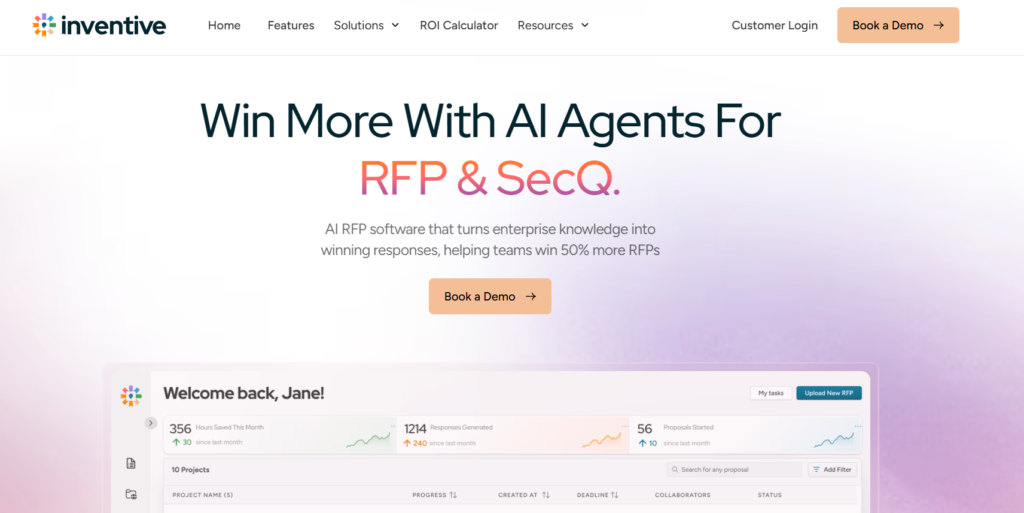
What it is: Inventive AI is an AI-powered platform that automates RFP, RFI, DDQ, and security questionnaire responses from intake through a compliant draft. Its Central Knowledge Hub connects to SharePoint, Notion, Confluence, Google Drive, and Salesforce, so approved content stays in one place instead of scattered across folders.
Best for: Teams that want AI to handle drafting and content upkeep instead of searching a static library.
Main features:
- AI Content Manager that flags outdated or conflicting answers automatically
- Built-in AI agents that assist with competitive research and opportunity guidance
- Draft generation with a reported 95% accuracy rate and 90% faster turnaround, per Capterra-verified reviews
- Direct integrations with Slack, Google Drive, and Salesforce
Pros: Handles the full response lifecycle rather than one stage of it. Central knowledge hub reduces time spent searching for past answers. Clean, adaptable interface according to user reviews.
Cons: Pricing isn’t published, so you’ll need a sales conversation to get an exact quote. Some AI-generated drafts still need manual editing to match company tone.
Pricing: Custom quote based on team size and usage.
Who should consider it: Sales, pre-sales, and proposal teams handling a high volume of RFPs, RFIs, and security questionnaires who want AI to do more than store content.
2. Loopio
What it is: Loopio is a cloud-based response management platform built around a centralized content library. Teams import RFP requirements, search a question database, and assign items to subject matter experts for review.
Best for: Enterprise teams with a dedicated content owner who can maintain the library over time.
Main features:
- Magic, an AI feature that matches incoming questions to existing library answers
- Close the Loop, which updates approved content after each project
- Response Intelligence, Loopio’s machine learning layer for content and trend visibility
- Section-level approval workflows and audit logs for regulated industries
Pros: Loopio reports customers complete 51% more RFP responses and see 42% time savings, according to the company’s own data. Strong customer support, rated 9.7 out of 10 on G2.
Cons: Entry pricing starts around $20,000 a year before add-ons like SSO or premium support. Several G2 reviewers describe the Magic AI feature as inconsistent on complex requirements, often requiring manual fixes.
Pricing: Not published. Third-party procurement data puts entry pricing near $20,000/year, scaling with seats and modules.
Who should consider it: Established proposal teams that already have a content library and want structured governance around it.
3. Responsive (formerly RFPIO)
What it is: Responsive is an enterprise response management platform covering RFPs, RFIs, DDQs, and security questionnaires. It emphasizes a single content library that frontline teams can search during live customer conversations and formal proposals alike.
Best for: Large organizations managing multiple response types across several departments.
Main features:
- Four editions (Lite, Emerging, Growth, Enterprise) scoped by team size and workflow complexity
- AI-suggested answers drawn from a shared knowledge base
- Executive dashboards for content performance and win-loss trends
- Broad document format support for complex, multi-file RFPs
Pros: A decade of enterprise deployment history and strong integration options. Users on G2 point to steady AI investment and an active learning center with certification programs.
Cons: Pricing isn’t published, and average annual cost runs close to $13,955 based on third-party transaction data. It doesn’t natively connect submitted answers to deal outcomes, so win-rate tracking requires manual work outside the platform.
Pricing: Custom quote, typically $7,000–$28,000/year depending on tier and team size.
Who should consider it: Enterprises with complex response requirements and the internal resources to manage a large content library.
4. AutoRFP.ai
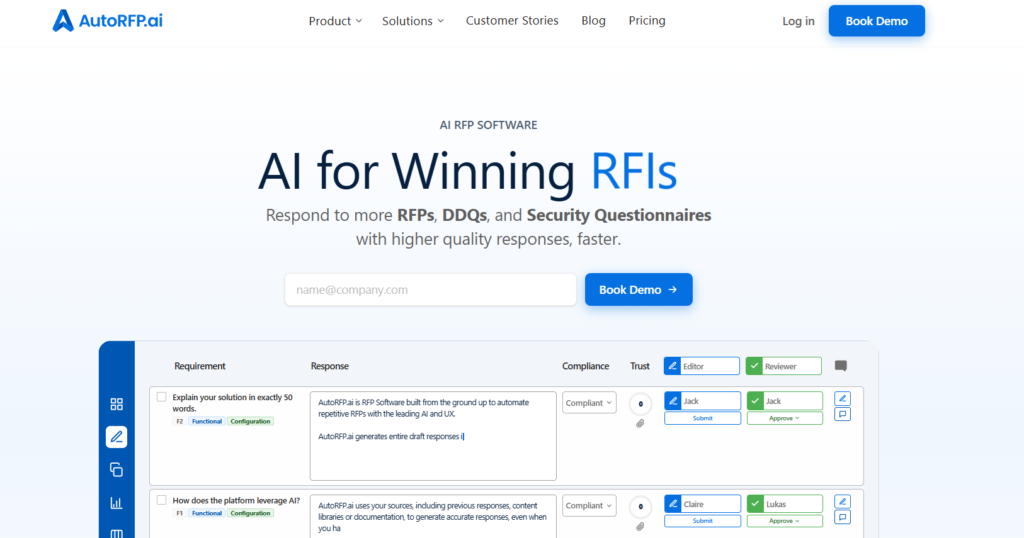
What it is: AutoRFP.ai is an AI-powered response tool that drafts RFP answers from a connected knowledge base and prices its plans by project instead of by seat.
Best for: Teams that want predictable, published pricing without a sales negotiation.
Main features:
- Unlimited users included on every plan
- Project-based billing, with the Scale plan covering 24 projects a year
- ISO 27001 and SOC 2 compliance, plus SSO through Google and Microsoft
- More than 18 native integrations, with white-glove onboarding included
Pros: Transparent monthly pricing makes budgeting straightforward. A 30-day money-back guarantee lowers the risk of trying the platform.
Cons: Each RFP consumes one project credit regardless of size, which can feel inefficient for teams handling many small requests. Some users report a learning curve with navigation and limited template flexibility for large, complex documents.
Pricing: Scale plan starts at $899/month; higher tiers run $1,299/month.
Who should consider it: Small to mid-sized teams that want clear, published costs and don’t need per-seat licensing.
5. Conveyor
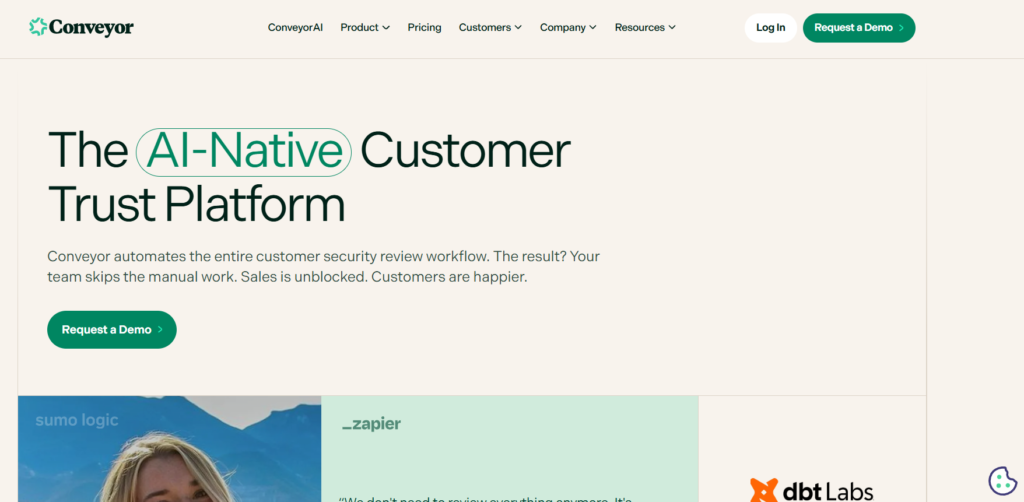
What it is: Conveyor is a customer trust platform built around a self-serve Trust Center and AI-generated answers for security questionnaires, not full RFPs.
Best for: SaaS companies fielding frequent vendor security reviews rather than complex, multi-part RFPs.
Main features:
- Trust Center where prospects retrieve compliance documents and submit questions directly
- AI-suggested answers pulled from previously approved content
- Credit-based pricing with unlimited seats, so cost doesn’t scale by headcount
- Reported 50–70% reduction in questionnaire completion time, per company data
Pros: Public pricing, which is uncommon in this category. G2 reviewers consistently praise setup speed and a support team several reviewers name directly in reviews.
Cons: AI is limited to lightweight question matching and struggles with complex, technical RFP content. Annual commitment is required; there’s no monthly billing option.
Pricing: Free tier with 10 trust center credits a month; Business tier starts at $9,600/year with 100 trust center and 20 questionnaire credits; Enterprise is custom.
Who should consider it: Security, compliance, and sales engineering teams handling high volumes of vendor security questionnaires.
How to Choose the Right RFP Software
Start with volume. A team answering 5 RFPs a quarter has different needs than one answering 50. High-volume teams get more value from AI drafting tools like Inventive AI or AutoRFP.ai, where the software writes a first draft instead of just retrieving a stored answer.
Next, look at your content maturity. If your team already has a well-organized, regularly updated content library, a library-first platform like Loopio or Responsive can build on that foundation. If your content is scattered across old proposals, shared drives, and individual inboxes, a platform with active content management, such as Inventive AI’s Content Manager, will save more time upfront.
Check pricing transparency against your procurement process. AutoRFP.ai and Conveyor publish rates, which shortens the buying cycle. Loopio, Responsive, and Inventive AI use custom quotes, which usually means a longer sales process but room to negotiate based on team size and contract length.
Finally, confirm the tool covers your actual document types. Security questionnaires, DDQs, and formal RFPs have different structures. Conveyor focuses on questionnaires. The other four platforms handle RFPs, RFIs, and DDQs, with varying depth on security-specific formats.
Budget for the full cost rather than the sticker price alone. Enterprise platforms often bundle onboarding, premium support, and add-on modules separately from the base license, so ask for an itemized quote before you compare two vendors side by side. A $20,000 base plan with $8,000 in required add-ons costs more than a $25,000 all-inclusive plan, even though the base number looks lower.
RFP Software Selection Checklist
- Confirm the platform supports your document formats (PDF, Excel, Word, and portal-based questionnaires)
- Test AI-generated drafts on a real, past RFP before committing
- Ask for the true annual cost including onboarding, add-ons, and premium support
- Verify integrations with your CRM, storage, and communication tools
- Check SOC 2 or ISO 27001 compliance if you handle regulated data
- Review at least 20 recent, verified user reviews on G2 or Capterra
Frequently Asked Questions
What is RFP software? RFP software helps teams manage the process of responding to requests for proposals. It stores reusable content, drafts answers to incoming questions, and lets multiple people collaborate on a single response before submission.
What is AI RFP software specifically? AI RFP software uses artificial intelligence to analyze incoming RFP documents, find relevant approved content, draft responses, and manage the proposal workflow. Instead of manually searching a spreadsheet of past answers, the AI matches questions to your knowledge base and writes a first draft.
How much does RFP software cost in 2026? Costs vary widely. Project-based tools like AutoRFP.ai start around $899/month. Enterprise platforms like Loopio and Responsive typically run $7,000 to $28,000 a year depending on team size and features. Platforms like Inventive AI use custom quotes based on usage.
Can AI actually write accurate RFP responses? Accuracy depends on how well-organized your source content is. Platforms with active content management, like Inventive AI’s Content Manager, tend to produce more consistent drafts because outdated or conflicting answers get flagged before they reach a response. No platform eliminates the need for a human reviewer to check tone and final accuracy.
Is RFP software different from security questionnaire software? They overlap but aren’t identical. RFP software is built for full, multi-section proposals with formal evaluation criteria. Security questionnaire tools like Conveyor focus specifically on vendor risk and compliance questions, often through a self-serve trust portal.
Which RFP software works best for a small team? AutoRFP.ai’s project-based pricing and unlimited users make it easier to budget for smaller teams. Inventive AI also works for smaller teams that expect to scale, since its pricing adjusts to usage rather than locking you into an enterprise-sized contract from the start.
Does RFP software work for security questionnaires and DDQs too? Most of the platforms on this list cover more than formal RFPs. Inventive AI, Loopio, Responsive, and AutoRFP.ai all support RFIs, DDQs, and security questionnaires within the same workspace. Conveyor is the exception here. It’s built specifically for security questionnaires and trust documentation, so it won’t manage a full, multi-section proposal the way the others do.
Bottom Line
The best RFP software for your team depends on how much of the process you want automated and how your content is currently organized. Inventive AI offers the broadest AI-driven automation across the full response lifecycle, from intake through a compliant draft, which makes it a strong starting point for teams ready to move past manual content search. Loopio and Responsive remain solid choices for enterprises with established content governance needs. AutoRFP.ai and Conveyor are worth a look if transparent, predictable pricing matters more than a fully custom enterprise deployment.