Chatmeter Alternatives for Franchise Brands: Features, Pricing & Comparisons

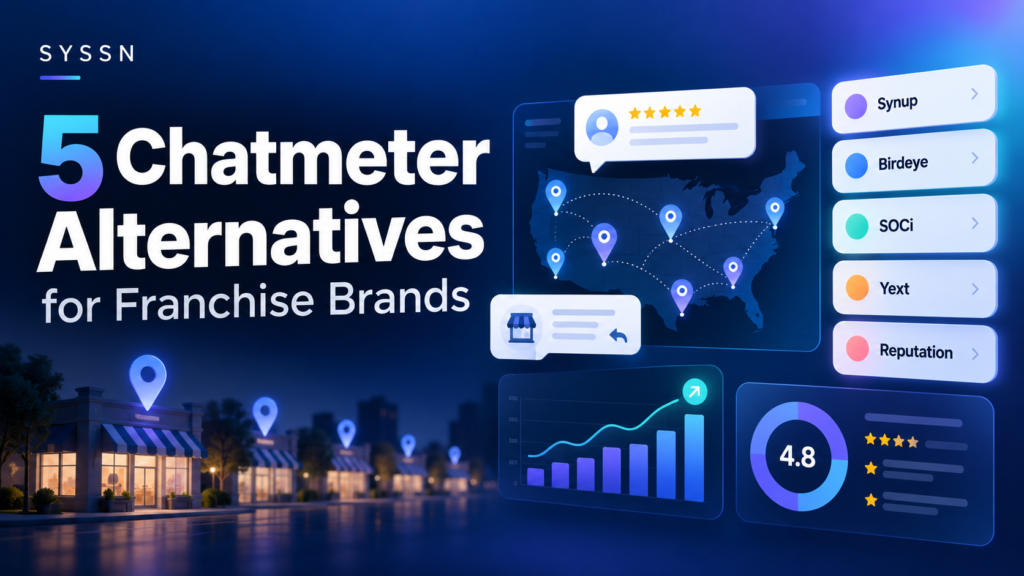
Synup, Birdeye, SOCi, Yext, Reputation, and Uberall are Chatmeter alternatives worth evaluating for franchise brands in 2026. All six offer multi-location reputation management capabilities, but they differ in AI-assisted review responses, franchisee permissions, local SEO functionality, reporting, and pricing.
Synup is worth considering for combined review management and local SEO. Birdeye focuses on AI-driven customer engagement, SOCi on enterprise local marketing automation, Yext on structured business information, Reputation on customer experience intelligence, and Uberall on local presence management.
The right choice depends on how your franchise operates. A 25-location service franchise may prioritize accessible pricing and centralized review monitoring, while a restaurant network with 500 locations may require regional dashboards, corporate approvals, automated workflows, and structured complaint escalation.
This guide compares the six platforms using documented capabilities, publicly available pricing, and practical franchise requirements. It also explains when staying with Chatmeter may make more sense than switching.
Quick Comparison: Chatmeter Alternatives for Franchise Brands
| Platform | Most suitable for | Key differentiator | Pricing |
|---|---|---|---|
| Synup | Reviews and local SEO | Listings, AI-assisted reviews, and local visibility reporting | From $49/month for one location |
| Birdeye | AI-powered franchise workflows | Brand-guided AI, review generation, and multi-level controls | Custom quote |
| SOCi | Enterprise franchise networks | AI agents across reviews, local search, and social | Custom quote |
| Yext | Enterprise local presence | Structured location data, listings, and review workflows | Enterprise quote |
| Reputation | Customer experience intelligence | Sentiment analysis, surveys, and operational insights | From $80/location/month |
| Uberall | Listings and reputation management | Connected local presence, reviews, and location analytics | Package-based quote |
Important: These are recommendations based on documented product suitability, not independently measured performance rankings. Published prices are starting points, not guaranteed franchise contract rates.
What Is Franchise Reputation Management Software?
Franchise reputation management software helps franchisors and franchisees monitor customer reviews, respond to feedback, manage online business information, and analyze reputation performance across multiple locations.
Unlike software designed for a single business, franchise-focused platforms must accommodate different ownership structures, responsibilities, and approval requirements.
For example, headquarters may establish response policies for 200 restaurants while individual franchisees manage complaints about staffing, order accuracy, or service quality.
A suitable platform allows corporate teams to maintain brand standards without preventing local operators from resolving customer concerns.
Common capabilities include:
- Centralized review monitoring: Collect reviews from supported platforms into a shared dashboard.
- AI-assisted responses: Draft replies using review context and brand guidelines.
- Franchisee permissions: Restrict users to appropriate locations and functions.
- Review generation: Request genuine customer feedback through supported channels.
- Sentiment analysis: Identify recurring compliments, complaints, and service problems.
- Multi-location reporting: Compare ratings, response rates, and feedback across regions.
- Listings management: Maintain business information across supported search engines and directories.
- Escalation workflows: Assign sensitive or unresolved complaints to the responsible teams.
These capabilities are particularly useful when headquarters needs visibility into hundreds of independently managed locations.
For a broader comparison of the category, see Best Review Management Software for Franchises.
Why Consider Chatmeter Alternatives in 2026?
Franchise organizations may consider alternatives when they need different pricing arrangements, broader marketing capabilities, more configurable automation, or closer integration with existing systems.
However, evaluating competitors does not necessarily mean Chatmeter is unsuitable.
Chatmeter’s Acquisition by Alchemer
On September 24, 2025, Alchemer announced its acquisition of Chatmeter.
The acquisition brought together Alchemer’s customer feedback capabilities and Chatmeter’s multi-location reputation intelligence tools.
Alchemer’s current Chatmeter offering includes reputation management, listings management, local pages, customer sentiment analysis, and competitive intelligence.
The combination is relevant to organizations that want to analyze both directly collected feedback, such as surveys, and publicly available feedback, such as customer reviews.
Is Chatmeter Still Suitable for Franchise Brands?
Yes. Chatmeter remains a relevant option for multi-location businesses requiring review monitoring, customer sentiment analysis, competitive intelligence, and listings management.
Its continued value depends on how well the platform fits the organization’s requirements.
Before renewal, franchise teams should assess whether their current agreement provides the automation, reporting, permissions, integrations, and customer support they need.
The Alchemer acquisition is a reason to review current product capabilities and contractual arrangements, not evidence that customers must switch providers.
How We Evaluated These Chatmeter Alternatives
This comparison is based on publicly available vendor product information, documentation, and pricing pages reviewed on October 30, 2026.
We selected platforms with multi-location reputation management capabilities relevant to franchise organizations in the United States.
The assessment uses six criteria.
| Evaluation area | What franchise buyers should examine |
|---|---|
| Review management | Monitoring, requests, responses, and supported review sources |
| Franchise governance | Corporate access, franchisee permissions, and approval workflows |
| AI capabilities | Response drafting, automated publishing, sentiment analysis, and escalation |
| Local SEO | Business listings, location pages, and local visibility tools |
| Reporting | Location comparisons, regional reporting, and actionable customer insights |
| Pricing | Published plans, enterprise contracts, add-ons, and implementation costs |
Methodology limitation: This is an editorial comparison based on vendor documentation. It does not include independent hands-on software testing, verified implementation results, or controlled performance benchmarks.
A product’s advertised capabilities may not be available in every subscription or for every review platform.
The recommendations identify likely purchasing fit rather than declaring an overall winner.
Chatmeter Alternatives for Franchise Brands
1. Synup — For Combined Franchise Reputation Management and Local SEO
Best for: Franchises that want review management, business listings, local search visibility, and AI assistance within one platform.
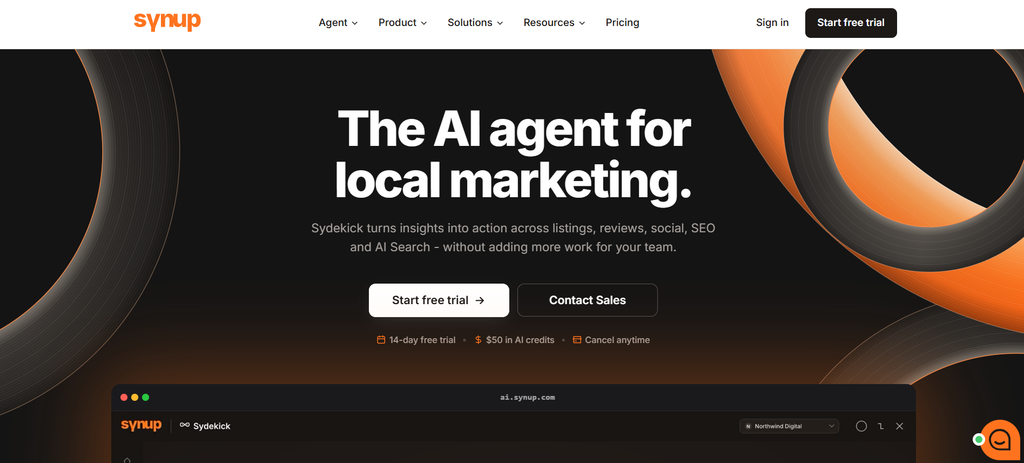
Synup combines reputation management with broader local marketing functionality.
Its platform supports multi-location review monitoring, AI-assisted responses, customer review requests, listings management, location pages, and local visibility reporting.
This combination is relevant when franchise headquarters manages customer feedback and local search operations through the same marketing team.
Key Capabilities
Synup provides a centralized review inbox for monitoring customer feedback across locations and supported sources.
Teams can examine review ratings, identify unanswered feedback, and prepare responses using templates or AI assistance.
The platform also provides business listing management, competitor visibility information, local rank tracking, and reporting across locations.
Its current pricing structure includes access to the listed platform capabilities across plans, with differences in location capacity, AI credits, agent capacity, and infrastructure.
Where Synup Fits
Consider a home services franchise operating 40 locations.
The corporate team may need to monitor Google reviews, identify branches receiving service complaints, and maintain consistent business addresses, opening hours, and contact details.
Synup brings these activities into a connected local marketing environment.
Its published pricing also allows smaller networks to estimate initial subscription costs without first requesting a custom enterprise proposal.
Limitations
An important distinction is that review monitoring does not always mean direct response publishing.
Synup’s documentation identifies Google Maps and Facebook as the sources for which replies can be published directly from its platform. Other collected review sources may require users to respond on the original website.
Franchise buyers should also verify approval settings, location-level permissions, AI credit requirements, and integration coverage.
Synup Pricing
Synup publishes the following monthly plans:
| Plan | Locations included | Monthly price |
|---|---|---|
| Solo | 1 | $49 |
| Premium | Up to 10 | $299 |
| Pro | Up to 25 | $499 |
| Scale | Up to 50 | $899 |
| Enterprise | More than 50 | Custom |
These are plan-level monthly prices, not per-location charges for every tier.
Usage allowances and other commercial details should be checked before purchase.
Consider Synup when: Your franchise wants reputation management and local SEO tools in one system, particularly if published pricing and smaller-network affordability matter.
2. Birdeye — For AI-Powered Franchise Review Workflows
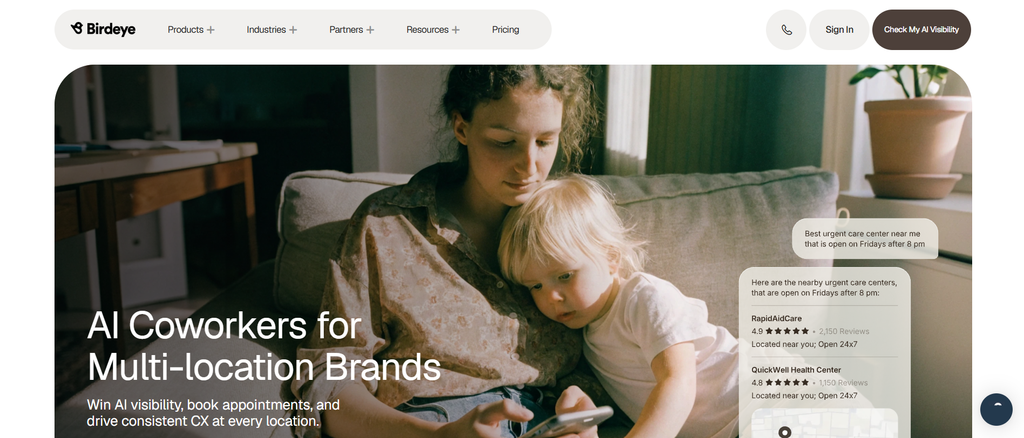
Best for: Franchises prioritizing AI-assisted customer engagement, review generation, brand consistency, and corporate-level control.
Birdeye offers reputation management and customer experience software for organizations operating multiple locations.
Its franchise offering supports centralized, decentralized, and hybrid operating models.
This distinction matters because headquarters may control brand standards while franchisees manage customer interactions at individual locations.
Key Capabilities
Birdeye provides review monitoring, automated review requests, AI-assisted responses, customer sentiment analysis, and location-level reporting.
Its franchise platform documents role-based permissions, tiered approvals, location-level access, and brand guidelines.
AI agents can prepare responses using approved brand context. Depending on the configuration, teams can review suggested actions or permit automated execution within defined rules.
Birdeye also offers listings, social media, messaging, surveys, and other customer experience capabilities.
Where Birdeye Fits
Birdeye is relevant when customer review volume makes individual manual responses difficult to manage.
For example, a franchise network may permit routine positive-review acknowledgments while requiring regional approval for complaints involving serious service failures.
Corporate administrators can establish policies while local operators retain appropriate access.
This combination can help maintain a consistent brand voice without placing every response decision solely on headquarters.
Limitations
Birdeye’s product portfolio extends beyond reputation management.
A franchise that only needs review monitoring may not require its wider messaging, social, or customer experience features.
Buyers should determine which AI agents, permissions, approvals, analytics, and integrations are included in their proposed contract.
Automatic responses should also be tested carefully before being enabled across many locations.
Birdeye Pricing
Birdeye uses customized pricing based on factors including selected products, the number of locations, and contractual requirements.
Its pricing process accommodates organizations of different sizes, including groups with 250–999 locations and more than 1,000 locations.
A universal public franchise subscription rate is not provided.
Consider Birdeye when: Your primary requirement is AI-assisted review management with flexible corporate oversight and local operating permissions.
3. SOCi — For Enterprise Franchise Reputation Automation
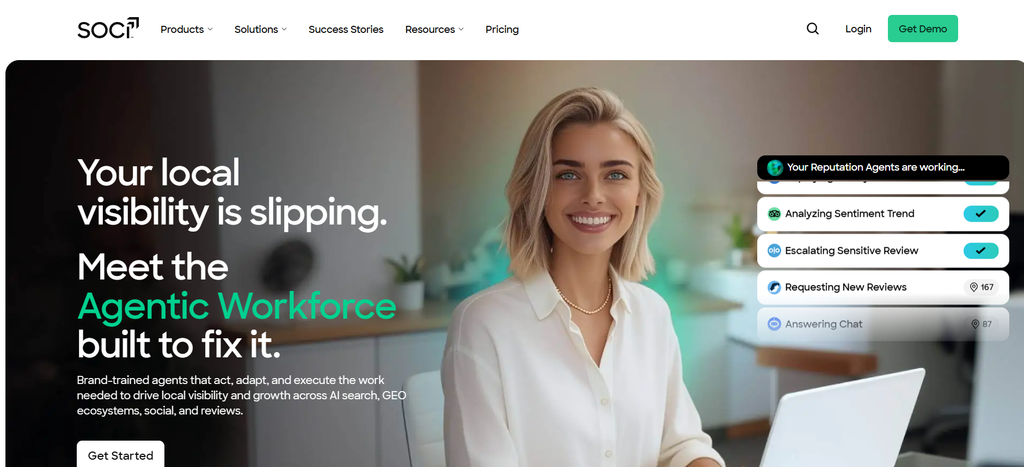
Best for: Large franchise networks that want reputation management integrated with local search and social marketing automation.
SOCi focuses on localized marketing for businesses operating many locations.
Its platform connects reputation management, local search, social publishing, and AI-assisted workflows.
The company offers specialized Genius Agents intended to perform recurring local marketing tasks according to brand-defined rules.
Key Capabilities
SOCi’s Genius Reputation Agent supports review monitoring, responses, customer sentiment analysis, and the routing of sensitive situations for human review.
The platform also includes a Genius Local Search Agent for location information and local discovery activities, alongside a Genius Social Agent for localized publishing and engagement.
These functions allow organizations to coordinate multiple aspects of location-level marketing.
Corporate teams can define brand context and workflow requirements while monitoring activity across their locations.
Where SOCi Fits
SOCi is particularly relevant for large franchise networks that want to reduce repetitive local marketing administration.
Consider a restaurant franchise operating hundreds of locations.
Some reviews may concern routine service experiences, while others involve cleanliness, food quality, or serious customer complaints.
A centralized reputation workflow can help distinguish recurring issues from isolated feedback and route appropriate cases to human operators.
SOCi’s broader search and social capabilities may also be valuable when corporate marketing teams manage multiple local channels.
Limitations
Enterprise automation requires careful implementation and governance.
Buyers should examine supported review sources, response publishing rules, integration requirements, reporting access, and exception handling.
Franchise teams also need clear procedures for investigating complaints and correcting operational problems identified through customer feedback.
AI-generated responses should support those processes rather than replace them.
SOCi Pricing
SOCi does not publish one universal franchise subscription price for its platform.
Enterprise buyers need a customized proposal based on selected products, locations, implementation requirements, and other contractual factors.
Consider SOCi when: Your organization requires enterprise-scale local marketing automation rather than a standalone review management tool.
4. Yext — For Enterprise Listings and Reputation Management
Best for: Franchises that prioritize accurate business information, structured location records, listings distribution, and review management.
Yext provides tools for managing business information across digital listings, customer reviews, location pages, and other search experiences.
Its Knowledge Graph serves as a structured system for managing business information.
For franchise networks, this is relevant because changes to addresses, telephone numbers, operating hours, and business categories must be maintained across many customer-facing platforms.
Key Capabilities
Yext offers review monitoring, review generation, response management, AI-assisted reply drafting, sentiment analysis, and reporting.
Its listings capabilities support the distribution of approved business information to connected publishers.
Review workflows can use response templates, AI-generated replies, and configurable approval processes.
Enterprise capabilities also include user access controls, analytics, and integrations.
Yext’s documentation distinguishes review monitoring, review response, and review generation as separately available packages.
Where Yext Fits
Yext is relevant when accurate location information is a major operational priority.
Consider an automotive franchise managing hundreds of dealerships across several regions.
The business may need to coordinate location records, local landing pages, operating hours, and customer reviews.
Managing these activities around structured business data can reduce inconsistent records and duplicated administration.
Limitations
Yext’s functionality is distributed across products and packages.
Review monitoring, direct responses, review generation, listings, and related capabilities may involve separate licensing arrangements.
Buyers should verify their required publishers, permissions, workflow features, and integration support.
They should also establish which system will serve as the authoritative source for each category of business information.
Yext Pricing
Enterprise franchise pricing generally requires a customized proposal.
The cost depends on selected products, locations, and commercial requirements.
A single universal enterprise franchise rate was not verified on the reviewed product pages.
Consider Yext when: Structured business data and consistent multi-location listings are as important as customer reputation management.
5. Reputation — For Customer Experience Intelligence and Reporting

Best for: Franchises seeking customer sentiment analysis, performance reporting, and operational accountability.
Reputation offers a platform connecting online reviews, customer feedback, business listings, surveys, and customer experience analytics.
Its value extends beyond responding to reviews.
For organizations operating many locations, customer feedback can provide useful information about recurring service problems and differences in operational performance.
Key Capabilities
Reputation offers review monitoring, review requests, AI-assisted replies, business listings, and reporting capabilities.
Its higher-tier products include additional reputation insights, AI-assisted analytics, and survey functionality.
Rep Score and related tools help organizations examine reputation performance across locations.
The company also offers competitive insights, operational ticketing, premium integrations, and additional services through its wider product portfolio.
Where Reputation Fits
Reputation is relevant when headquarters wants to connect customer feedback with operational decisions.
For example, a hotel franchise may encounter recurring complaints about cleanliness, waiting times, or staff responsiveness.
A multi-location reporting system can help managers identify whether these issues are isolated to particular properties or appear across multiple regions.
Teams can then use those findings to prioritize training, process changes, or further investigation.
The objective is to use review data as a source of operational insight rather than simply increasing average star ratings.
Limitations
Some of Reputation’s advanced analytics, competitive intelligence, and ticketing capabilities are associated with higher plans or add-ons.
Organizations should not assume that every feature is included in the entry-level subscription.
They should also validate reporting definitions, data-export options, and integration requirements.
Reputation Pricing
Reputation publishes the following starting monthly prices:
| Plan | Published price | Main focus |
|---|---|---|
| Rep Core | $80/location | Core reputation management and listings |
| Rep Core + Pulse | $115/location | Additional sentiment and reputation insights |
| Rep Core + Surveys | $150/location | Broader customer survey capabilities |
| Enterprise | Custom | Organizations with 125+ locations |
Enterprise contracts and optional services may have different commercial arrangements.
Consider Reputation when: Your franchise wants to connect reputation monitoring with customer experience reporting and operational improvement.
6. Uberall — For Connected Local Presence and Reputation Management
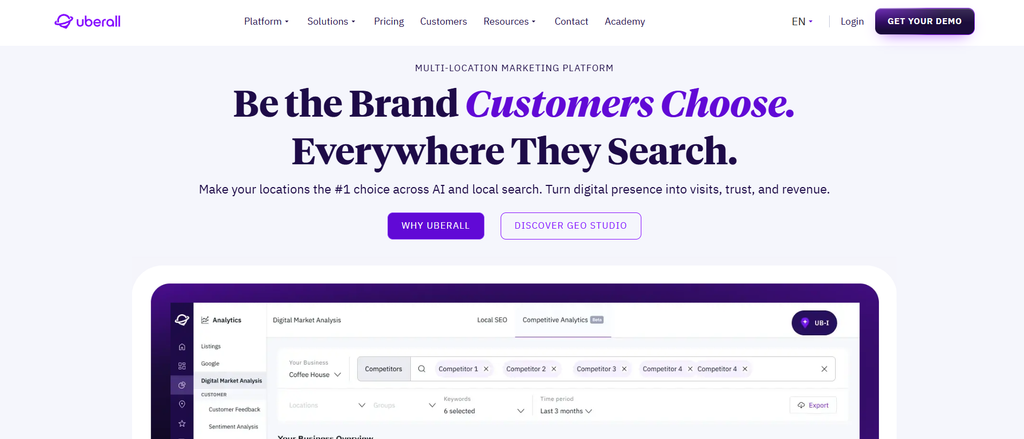
Best for: Franchise brands that want review management alongside business listings, local visibility, and location performance reporting.
Uberall provides multi-location marketing tools that connect digital presence management, customer reviews, local engagement, and analytics.
Its reputation management functionality is part of a wider platform focused on managing individual business locations across digital channels.
Key Capabilities
Uberall supports centralized review monitoring, response management, AI-generated reply suggestions, review requests, and location-level reporting.
Its AI Review Assistant can suggest responses based on review content and brand context.
The platform also supports business listings, local pages, social media activities, and broader local performance measurement.
Depending on the selected package, additional capabilities may include sentiment analysis, AI bulk replies, enhanced permissions, and workflow approvals.
Where Uberall Fits
Uberall is relevant when headquarters manages frequent location information changes alongside customer reviews.
For example, a national retail franchise may need to update store hours, monitor customer feedback, and compare performance across regions.
Combining those activities can make it easier to identify stores with outdated information or recurring customer concerns.
The platform is therefore worth comparing with both reputation-focused and listings-focused alternatives.
Limitations
Uberall’s package structure requires careful examination.
Its published pricing information identifies Reviews Plus as an add-on containing capabilities such as sentiment analysis, AI bulk replies, and AI guidelines.
Enhanced permissions and review approval workflows are associated with Collaborate Plus.
Although the platform also lists automated response functionality, buyers should distinguish between automated response templates and AI-generated replies requiring human approval.
The exact workflow and package scope should be demonstrated before purchase.
Uberall Pricing
Uberall offers package-based pricing with different combinations of listings, reviews, and local marketing functionality.
Its publicly reviewed pricing information does not establish one universal monthly franchise subscription rate.
Organizations should request a proposal covering the required products, add-ons, user permissions, and number of locations.
Consider Uberall when: Your franchise wants reputation management integrated with ongoing local presence operations and location-level performance reporting.
Chatmeter vs Its Alternatives: What Are the Main Differences?
Chatmeter and the six alternatives address overlapping needs, but their product emphasis differs.
Chatmeter, now part of Alchemer, remains relevant for organizations focused on reputation intelligence, customer sentiment, competitive analysis, and connected feedback.
The alternatives are worth evaluating when a franchise has more specific operational priorities.
| If your priority is… | Platforms worth evaluating | Main question to ask |
|---|---|---|
| Reviews and local SEO in one system | Synup, Uberall | Can the system manage our required review sources and listings together? |
| AI-assisted review engagement | Birdeye, SOCi | What can AI publish automatically, and what requires approval? |
| Enterprise location-data management | Yext, Uberall | How are location records validated and synchronized? |
| Customer sentiment and operational analysis | Reputation, Chatmeter | Can reports connect recurring complaints with responsible locations? |
| Broad franchise marketing automation | SOCi, Birdeye | Which local workflows can be automated safely? |
| Budgeting for a smaller franchise | Synup, Reputation | What is included in the published price, and what costs extra? |
This is not evidence that a particular vendor performs better than Chatmeter.
A franchise already using Chatmeter successfully may find that its current capabilities, integrations, historical data, and contract terms make renewal more practical than migration.
A replacement becomes more compelling when it solves a specific unmet requirement at an acceptable total cost.
How Much Does Chatmeter Cost Compared With Its Alternatives?
Chatmeter’s pricing page describes a customized, location-based model with unlimited users.
The company does not publish one fixed price for every multi-location organization.
Several competing platforms also require enterprise quotations.
The following table summarizes the published information reviewed in October 2026.
| Platform | Public pricing information | Enterprise consideration |
|---|---|---|
| Chatmeter / Alchemer | Custom location-based pricing | Confirm current packaging and terms |
| Synup | $49/month for 1; $299 for up to 10; $499 for up to 25; $899 for up to 50 | Custom above 50 locations |
| Birdeye | Custom quote | Depends on locations and products |
| SOCi | Custom quote | Confirm platform and agent scope |
| Yext | Enterprise quote | Confirm product licensing |
| Reputation | $80, $115, or $150 per location/month | Custom for 125+ locations |
| Uberall | Package-based quote | Confirm products and add-ons |
Published prices cannot establish which platform will be cheapest for a specific franchise.
How Should Franchises Compare Total Costs?
A franchise managing 100 locations should evaluate more than the advertised subscription rate.
For a meaningful comparison, request written proposals for the same number of locations, review sources, integrations, and user requirements.
Compare the full cost of:
- Platform subscriptions and product modules
- Implementation and data migration
- AI credits, response allowances, and other usage-based charges
- Integrations and API requirements
- Additional user access or permissions
- Training, customer support, and managed services
- Contract length, renewal terms, and cancellation obligations
A lower initial subscription price may not provide the lowest total cost once implementation and required add-ons are included.
Likewise, a higher-priced platform may offer functions that replace existing tools, but those savings should be verified rather than assumed.
A useful comparison measures the total cost of the required system over the same contract period.
Which Chatmeter Alternative Offers the Most Useful Franchise Reporting?
The strongest reporting system is the one that helps headquarters make operational decisions.
A franchise’s overall average star rating can conceal substantial differences between locations.
For example, a network of 100 stores may have a satisfactory average rating while several branches consistently receive complaints about service delays.
Location-specific analysis makes those differences easier to investigate.
Different platforms may suit different reporting priorities.
Reputation and Chatmeter are relevant when customer sentiment and experience intelligence are central requirements.
SOCi and Birdeye are worth evaluating when corporate teams need to connect review activity with localized marketing workflows.
Yext and Uberall are relevant when reputation reporting must be considered alongside local presence information.
Synup is useful to investigate when reviews, listings, and local visibility need to be monitored within the same platform.
What Should a Franchise Reputation Dashboard Include?
A practical dashboard should show review volume, average ratings, response performance, and unresolved issues across comparable locations.
It should also provide the ability to filter performance by region, franchisee, reporting period, and review source.
Important measurements include:
| Metric | Why it matters |
|---|---|
| Average rating | Summarizes customer ratings, but needs review-count context |
| Review volume | Indicates how much feedback supports the rating |
| Response rate | Shows the share of reviews receiving a response |
| Response time | Measures how quickly teams address feedback |
| Negative-review backlog | Identifies complaints requiring attention |
| Complaint themes | Highlights recurring operational problems |
| Location and regional trends | Reveals differences across the franchise network |
| Unresolved escalations | Helps assign accountability for serious complaints |
Fair comparisons require consistent measurement periods and review sources.
A location with 20 reviews should not automatically be treated as equally representative as one with 2,000 reviews simply because their average ratings differ.
Review volume, seasonality, location activity, and review-source coverage provide necessary context.
For a practical reporting framework, see Review Analytics for Multiple Locations: Compare Ratings by Location.
How to Choose the Right Chatmeter Alternative for Your Franchise
Software selection should begin with the franchise’s operating requirements rather than the number of features advertised by each vendor.
1. Match the Platform to Your Franchise Structure
Not every multi-location organization uses the same governance model.
Some franchisors manage reviews centrally. Others delegate daily review responses to franchisees while retaining corporate oversight.
A hybrid model may allow local teams to respond to routine feedback while requiring headquarters approval for sensitive complaints.
Before choosing a platform, determine who should be able to view reviews, publish responses, edit listings, change automation rules, and access network-wide reporting.
Request a demonstration using separate corporate, regional, and franchisee accounts.
A general multi-location dashboard does not automatically establish that a platform supports every franchise governance requirement.
2. Evaluate AI Response Automation Carefully
AI-assisted reputation management can reduce repetitive work, but the level of automation matters.
There is a substantial difference between software that drafts a suggested response and software that automatically publishes a reply.
A useful evaluation should distinguish three workflows.
| Workflow | What happens | Appropriate consideration |
|---|---|---|
| AI drafting | Software suggests a response for review | Useful when staff approve replies |
| Approval-based automation | AI prepares responses and routes them to authorized users | Suitable for franchises needing oversight |
| Automated publishing | Software publishes responses under configured rules | Requires stricter testing and safeguards |
Routine positive feedback may be suitable for standardized acknowledgment.
Complaints involving safety incidents, alleged discrimination, billing disputes, privacy concerns, or legal matters generally deserve human review.
During a demonstration, ask the vendor to show how the system identifies sensitive situations and prevents inappropriate automatic replies.
3. Check Local SEO and Listings Requirements
A franchise that manages reviews and business listings separately may benefit from a connected platform.
Accurate business information helps customers find the correct address, contact details, operating hours, and services.
A listing management platform can help distribute approved information to supported publishers, although the timing and completeness of publication depend on individual integrations.
For additional guidance, read What Is Local Listings Management?.
Google’s local ranking guidance explains that local results primarily depend on relevance, distance, and prominence, which its current explanatory text also describes as popularity. Complete business information and customer reviews can contribute to visibility. Google Business Profile Help
However, no reputation management platform can guarantee improved Google rankings, inclusion in AI-generated answers, or additional local search traffic.
4. Consider Industry-Specific Requirements
Different franchise industries have different customer feedback and operational needs.
Healthcare organizations may need additional privacy safeguards, carefully controlled public responses, and support for specialized review sources.
Our review management tools guide for urgent care chains explains these considerations in more detail.
Automotive franchise groups may place greater emphasis on dealership information, departmental profiles, local visibility, and consistent business records.
Restaurant franchises may prioritize service-related feedback, high review volumes, and rapid escalation of recurring operational concerns.
The evaluation should reflect the organization’s actual workflows rather than relying solely on a generic feature comparison.
5. Compare Vendor Demonstrations Using the Same Scenario
A structured demonstration provides more useful evidence than separate sales presentations that highlight different features.
Create a representative test involving several locations, a mixture of positive and negative reviews, and users with different permission levels.
Ask each vendor to demonstrate how the system:
- Collects reviews from the required platforms.
- Assigns reviews to the correct locations.
- Generates a response using approved brand guidelines.
- Escalates a serious complaint for human review.
- Restricts franchisee access to authorized locations.
- Produces regional and location-level reports.
- Updates a business listing and tracks the result.
When a vendor cannot demonstrate an essential capability, ask for written confirmation of its availability and any additional licensing requirements.
A Practical Vendor Evaluation Scorecard
A weighted scorecard can make franchise procurement decisions more consistent.
The following is an illustrative framework, not an independently validated industry scoring model.
| Evaluation area | Example weight |
|---|---|
| Review monitoring and response coverage | 20% |
| Franchise permissions and approvals | 20% |
| Reporting and operational insights | 20% |
| AI automation and escalation controls | 15% |
| Local SEO and listings integration | 10% |
| Total cost and contract terms | 10% |
| Implementation and support | 5% |
| Total | 100% |
Score each vendor from 1 to 5 against documented requirements and demonstrated functionality.
A score of 1 indicates poor suitability, while 5 indicates strong suitability.
How Can Franchise Businesses Switch From Chatmeter?
Switching reputation management software involves more than replacing one review dashboard with another.
A franchise must preserve access to its business profiles, maintain accurate location information, and avoid interruptions to customer response workflows.
A controlled migration can reduce operational risk.
Step 1: Audit the Existing Chatmeter Account
Document the locations, business profiles, review sources, integrations, user permissions, and reporting workflows currently in use.
Identify any functions that individual franchisees depend on.
This audit establishes which capabilities the replacement must preserve.
Step 2: Review Contract Obligations
Confirm renewal dates, termination notice requirements, available exports, and potential migration costs.
Ask Chatmeter or Alchemer about the data and reporting records that can be exported under the current agreement.
Do not assume that every historical record will be portable.
Step 3: Export Available Data
Preserve the permitted location records, review reporting history, analytics exports, and internal workflow information.
For each export, document its source, reporting period, and format.
Historical information should remain accessible for comparisons after the transition.
Step 4: Establish a Location Master File
Create or validate a central record containing the approved information for every franchise location.
This should include business names, addresses, telephone numbers, website URLs, business categories, operating hours, and relevant location identifiers.
A reliable location master file helps prevent inconsistent information from being transferred into the new system.
Step 5: Configure the Replacement Platform
Connect authorized business profiles, import supported data, and establish franchisee permissions.
Configure brand response guidelines, approval requirements, alerts, and escalation rules.
Test integrations before activating organization-wide automation.
Step 6: Run a Controlled Pilot
Select a representative group of locations.
The pilot should include locations with different review volumes, operating structures, and reporting requirements.
Confirm that reviews are collected correctly, responses publish where supported, user permissions work as intended, and reports attribute data to the proper locations.
Resolve major problems before expanding the rollout.
Step 7: Complete the Transition
Once the replacement platform is functioning reliably, transition remaining locations and retire overlapping workflows.
Review third-party account access and remove obsolete integrations when they are no longer required.
Maintain records needed for historical reporting and contractual purposes.
Important: Switching vendors does not transfer ownership of reviews published on third-party services. Those reviews generally remain on their original platforms. Historical reporting portability depends on available exports, platform capabilities, and applicable terms.
Review Management Compliance and AI Safety Considerations
Reputation management software should support genuine customer feedback rather than rating manipulation.
Google’s prohibited and restricted content policies prohibit incentivized reviews and selectively soliciting positive reviews while discouraging negative feedback. Google Business Profile Help
Franchises should therefore avoid campaigns that:
- Offer discounts, rewards, or other incentives in exchange for Google reviews.
- Send public review invitations only to customers identified as satisfied.
- Pressure customers to leave a particular rating or specific content.
- Ask customers to remove negative reviews in exchange for compensation.
A compliant approach should request genuine reviews without trying to influence their ratings or content.
Franchise organizations should also ensure that AI-generated review responses do not invent actions taken by employees, promise unapproved compensation, disclose private information, or make unsupported claims about an investigation.
For sensitive industries, such as healthcare, additional privacy and legal requirements may apply.
These concerns should be addressed through organizational policies, staff training, and appropriate professional review—not automation settings alone.
Frequently Asked Questions About Chatmeter Alternatives
What Are the Best Chatmeter Alternatives for Franchise Brands?
Synup, Birdeye, SOCi, Yext, Reputation, and Uberall are six options worth comparing.
Synup is relevant for combined reviews and local SEO, Birdeye for AI-powered franchise workflows, SOCi for enterprise local marketing automation, Yext for structured location management, Reputation for customer experience analysis, and Uberall for connected local presence management.
The best fit depends on the franchise’s requirements and contracted capabilities.
Which Chatmeter Alternative Is Most Affordable?
Synup publishes monthly plans starting at $49 for one location, with higher tiers covering multiple locations. Reputation publishes plans starting at $80 per location per month.
However, these prices do not establish which platform is cheapest for a particular franchise.
Enterprise proposals may differ in included products, implementation costs, service levels, and contract terms.
Which Chatmeter Alternatives Offer AI-Powered Review Responses?
All six alternatives document AI-assisted review response capabilities.
Their workflows differ.
Some tools generate drafts for human approval, while others support automated publishing under configured rules.
Buyers should verify supported publishers, approval requirements, permissions, and available automation controls before purchasing.
Can These Platforms Manage Google Reviews Across Multiple Locations?
Yes. The reviewed platforms support Google review management within their multi-location offerings.
However, review monitoring, AI response drafting, and direct response publishing are different functions.
Franchises should verify the required Google Business Profile connections and response permissions during implementation.
Which Platform Should a Franchise With 500 Locations Consider?
A 500-location franchise should evaluate enterprise-capable platforms according to its operating priorities.
SOCi and Birdeye are relevant for AI-assisted local marketing workflows. Reputation is relevant for customer experience reporting. Yext and Uberall deserve consideration for local presence operations. Synup also offers custom enterprise arrangements beyond its published plans.
Chatmeter itself may remain suitable if its current capabilities meet the organization’s requirements.
A multi-region pilot and comparable enterprise proposals provide a stronger basis for the final decision than location count alone.
Will Switching From Chatmeter Improve Local Search Rankings?
Not automatically.
A replacement platform may make it easier to maintain accurate business listings, manage customer reviews, and identify unresolved customer concerns.
However, software changes alone do not guarantee higher Google Business Profile rankings or improved visibility in AI search systems.
Improvements depend on actual business information quality, customer experiences, platform use, and other factors outside the vendor’s control.
Final Verdict: Which Chatmeter Alternative Should Your Franchise Choose?
The right alternative depends on the operational problems your franchise is trying to solve.
Synup is worth evaluating when reputation management and local SEO need to work together, particularly for smaller networks that benefit from published pricing.
Birdeye is relevant when AI-assisted engagement, corporate controls, and franchisee permissions are major priorities.
SOCi deserves consideration when a large franchise requires automated local marketing across reviews, search, and social media.
Yext is a strong candidate when structured business information and listings management are central to the organization’s operations.
Reputation is suitable to investigate when customer sentiment, experience measurement, and operational reporting drive the purchasing decision.
Uberall is relevant when review management needs to connect closely with business listings and local performance management.
Chatmeter should remain on the shortlist when its existing reputation intelligence and customer feedback capabilities already satisfy franchise requirements.
For larger franchise networks, the most useful next step is to evaluate at least three suitable vendors against the same functional requirements, request comparable written proposals, and conduct a representative pilot.
The objective is not simply to automate more review replies. It is to give headquarters and franchisees reliable information, appropriate controls, and workable processes for identifying and resolving customer experience problems.