CSM Certification Training Providers for Career Switchers

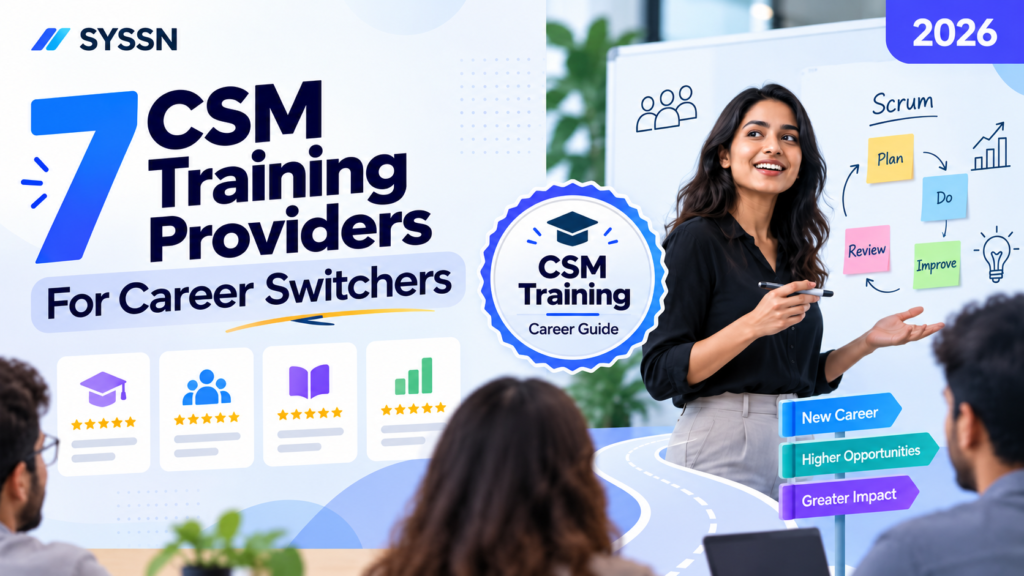
StarAgile, upGrad KnowledgeHut, Simplilearn, Invensis Learning, iZenBridge, Agilemania, and PremierAgile are seven Certified ScrumMaster (CSM) training providers worth comparing if you’re planning a career change in 2026.
All seven advertise training for the same CSM certification issued by Scrum Alliance. The differences lie in their class formats, instructors, practical exercises, learning resources, scheduling, and additional career support.
You don’t need an IT degree, coding skills, or previous Scrum experience to pursue CSM certification. However, completing the course and passing the exam are only the beginning of preparing for a Scrum Master career.
This guide compares seven providers, explains the official certification requirements, identifies what to check before enrolling, and outlines how professionals from non-IT backgrounds can build relevant skills.
CSM Training Providers for Career Switchers: Quick Comparison
The following comparison identifies where each provider may be a suitable fit based on its published training offerings.
| Training provider | Suitable for | Notable offering | What to verify |
|---|---|---|---|
| 1. StarAgile | Career changers seeking additional career-preparation resources | Live CST-led training, mock exams, and optional career-focused packages | Package inclusions and trainer availability |
| 2. upGrad KnowledgeHut | Beginners who prefer structured exercises | Simulations, practice assessments, and instructor-led learning | Support terms and total fees |
| 3. Simplilearn | Working professionals seeking virtual bootcamps | Scheduled live classes and supplementary digital resources | Session timings and trainer interaction |
| 4. Invensis Learning | Learners seeking a focused certification pathway | Instructor-led workshops and advertised training-retake options | Retake conditions and cohort format |
| 5. iZenBridge | Students prioritizing trainer selection | Published instructor names and cohort-specific schedules | Time zones, taxes, and support access |
| 6. Agilemania | Learners seeking practical Scrum activities | Interactive workshops and advertised post-training support | Workshop format and follow-up support |
| 7. PremierAgile | Learners who prefer discussion-based instruction | Experiential workshops and additional mentoring resources | Trainer assignment and mentoring conditions |
Important: These categories are editorial recommendations based on published features, not independently established rankings of training quality, learner satisfaction, or employment outcomes.
How We Evaluated CSM Certification Providers
This comparison uses publicly available training-provider information and official certification documentation reviewed in October 2026.
We considered six factors.
Certification eligibility: Does the provider advertise an approved Certified ScrumMaster course delivered by a qualified instructor? The individual course must still be verified through Scrum Alliance before enrollment.
Class format: Are live online or classroom options available, and does the training allow meaningful participation?
Trainer accessibility: Can students identify their instructor, ask questions during training, and obtain clarification afterward?
Beginner learning resources: Does the offering include useful exercises, simulations, mock assessments, or supporting materials?
Career relevance: Are there resources that help learners connect Scrum knowledge with workplace responsibilities or career preparation?
Pricing and enrollment transparency: Can prospective students understand the total cost, included services, and cancellation or rescheduling terms?
This is a desk-researched comparison, not a hands-on evaluation. No provider’s classes were attended or independently tested for this article.
Descriptions of provider-specific benefits are based on advertised offerings. Prices, trainer assignments, schedules, and support packages may change.
For another overview, read Syssn’s comparison of Certified Scrum Master training providers.
What Is Certified ScrumMaster (CSM) Certification?
Certified ScrumMaster (CSM) is an introductory professional certification issued by Scrum Alliance.
It introduces the Scrum framework, including its values, accountabilities, events, artifacts, and principles of empirical process control.
A Scrum Master helps a team and its organization understand and use Scrum effectively. This involves improving team effectiveness, facilitating productive interactions, helping remove impediments, and supporting continuous improvement.
The Scrum Master is not simply a project coordinator who schedules meetings or assigns tasks. Under Scrum, the team is self-managing, and the Scrum Master supports its effectiveness rather than directing every activity.
These responsibilities make CSM training relevant to professionals with experience in communication, facilitation, collaboration, organizational change, and process improvement.
Official CSM certification requirements in 2026
| Requirement | Official information |
|---|---|
| Certification issuer | Scrum Alliance |
| Previous Scrum experience | Not required |
| IT degree or coding knowledge | Not required |
| Mandatory training | 16 hours |
| Training format | Approved live online or in-person course |
| Authorized instructor | Certified Scrum Trainer (CST) |
| Exam provider | Scrum Alliance |
| Questions | 50 multiple-choice questions |
| Exam duration | 60 minutes |
| Passing score | 74%, or 37 correct answers |
| Included exam attempts | Two without additional charge during the initial 90-day period |
| Initial membership | Two-year Scrum Alliance membership included |
| Certification renewal | Every two years |
Scrum Alliance also confirms that candidates do not need previous software development or Agile experience to attend foundational CSM training.
For a detailed explanation of eligibility and examination requirements, see what CSM certification is and how it works.
7 CSM Certification Training Providers Compared
1. StarAgile — For Career Switchers Seeking Additional Career Preparation
Suitable for: Professionals who want live certification training alongside optional interview preparation and additional Agile learning resources.
StarAgile offers Certified ScrumMaster training through live virtual sessions delivered by Scrum Alliance Certified Scrum Trainers.
Its advertised offering includes instructor-led learning, Scrum concepts, practical activities, examination preparation, and access to the certification process.
Class format and trainer access
StarAgile advertises live online training, with schedules varying by cohort.
The curriculum covers Scrum fundamentals, team accountabilities, Scrum events, artifacts, and the Scrum Master’s responsibilities.
Participants can engage in instructor-led discussions and learning activities during the qualifying class.
Before registering, confirm the trainer assigned to your particular cohort and whether support is available after the workshop.
Beginner and career-transition support
StarAgile distinguishes its packages partly through additional learning and career-focused resources.
Depending on the selected plan, advertised benefits include mock examinations, interview preparation questions, sample resumes, Jira-related training, and additional Agile learning.
Some packages also feature a short conversation with a hiring manager.
For someone transitioning from operations or project coordination, these resources may help connect foundational Scrum knowledge with interview preparation.
However, supplemental courses and career services should not be confused with the official CSM credential.
Limitations
StarAgile offers multiple packages, so prospective students should not assume every advertised benefit is included in the lowest-priced option.
Its promotional guarantees and additional services are subject to provider-specific conditions.
Trainer identity, session timing, and the practical value of career resources should be evaluated before payment.
Choose StarAgile if: You want live CSM training and would use additional career-preparation materials, provided your chosen package includes them at a reasonable total price.
2. upGrad KnowledgeHut — For Beginners Who Prefer Structured Practice
Suitable for: Career switchers who learn best through simulations, exercises, and repeated practice.
upGrad KnowledgeHut offers live instructor-led CSM training.
Its published course features include 16 hours of instruction, interactive activities, mock assessments, and supplementary resources.
Class format and trainer access
KnowledgeHut advertises live online and location-dependent classroom options.
Its teaching approach uses activities such as role-playing, case studies, simulations, and discussions.
These approaches can help beginners understand how Scrum concepts relate to actual team situations.
For example, a learner with a business analysis background might use a simulation to understand the differences between Product Owner responsibilities and Scrum Master accountabilities.
Trainer interaction happens during the live workshop, while other support services may be handled through separate channels.
Beginner and career-transition support
KnowledgeHut advertises multiple mock assessments and supplementary Agile learning materials.
It also promotes learner support and career-related resources.
The practical value of these features depends on whether they help students understand Scrum rather than simply memorize examination answers.
Learners should clarify whether additional faculty support involves direct trainer access, scheduled sessions, or assistance from a separate support team.
Limitations
Training packages, workshop schedules, classroom availability, and advertised support terms vary by region.
Some benefits may depend on the selected offering.
Published marketing statements about career advancement should not be treated as evidence of guaranteed employment.
Choose upGrad KnowledgeHut if: You prefer structured training with practical exercises, supporting materials, and opportunities to reinforce concepts before taking the examination.
3. Simplilearn — For Working Professionals Seeking Virtual Bootcamp Training
Suitable for: Professionals who want scheduled online instruction supported by additional learning materials.
Simplilearn offers CSM training through live online bootcamps.
Its program advertises instruction by Certified Scrum Trainers, Scrum Alliance examination access, and supplementary learning resources.
Class format and trainer access
Simplilearn advertises two- or three-day virtual training schedules, depending on the batch.
Qualifying CSM instruction takes place live, allowing participants to interact with the instructor and take part in training activities.
Course content covers Scrum principles, values, team accountabilities, events, artifacts, and practical applications.
Students should confirm the number of live training hours, assigned trainer, and opportunities for group participation.
A longer calendar schedule does not necessarily mean more qualifying instruction than another approved 16-hour course.
Beginner and career-transition support
Simplilearn includes supplementary digital resources that students can use alongside their live training.
This can be convenient for professionals who need to revisit concepts while managing full-time employment.
For example, someone transitioning from customer operations could use the materials to review concepts such as Sprint Planning, impediment removal, and continuous improvement before practicing relevant interview scenarios.
Limitations
Simplilearn’s public training availability is primarily virtual for this offering.
Additional resources, promotional prices, and examination-related guarantees may be governed by specific terms.
Students should distinguish mandatory live instruction from optional self-paced materials.
Choose Simplilearn if: You prefer a scheduled virtual bootcamp and value supplementary digital learning without requiring regular in-person instruction.
4. Invensis Learning — For a Focused Instructor-Led Certification Pathway
Suitable for: Professionals who want a clearly structured course covering the official CSM learning pathway.
Invensis Learning offers Certified ScrumMaster training through instructor-led workshops.
Its advertised program includes 16 hours of training, Certified Scrum Trainer delivery, learning materials, examination access, and the initial Scrum Alliance membership.
Class format and trainer access
Invensis offers live virtual training and classroom options in selected locations.
The curriculum covers Scrum theory, events, accountabilities, and team effectiveness.
Practical instruction is designed to help learners understand how Scrum works rather than simply learn definitions for the examination.
Students should confirm the exact training format and instructor for their selected location.
Beginner and career-transition support
Invensis promotes its training to aspiring Scrum Masters, project managers, analysts, testers, and other professionals interested in Agile delivery.
One useful advertised feature is the opportunity to retake training within a specified period without an additional training fee.
Its published CSM information describes a training-retake window of two months.
This may be valuable for someone who wants to revisit the material after initially completing the workshop.
However, a training retake is not the same as an additional official examination attempt.
Limitations
Classroom availability differs by region, and the training-retake benefit is governed by provider conditions.
Prospective students should confirm whether retakes depend on available seats, course schedules, or other restrictions.
Choose Invensis Learning if: You want focused live instruction and value the possibility of repeating training under clearly defined conditions.
5. iZenBridge — For Learners Who Want to Evaluate Their Trainer in Advance
Suitable for: Professionals who consider trainer identity and scheduling important parts of their decision.
iZenBridge offers scheduled live virtual CSM workshops.
A distinguishing feature of its published schedule is the availability of cohort-specific details, including dates, trainers, session times, and advertised fees.
Class format and trainer access
iZenBridge publishes instructor information for individual workshops.
Its schedules include two-day and multi-session virtual arrangements.
Published CSM cohorts identify instructors such as Jaya Shrivastava, while other Scrum and Agile courses feature different trainers.
This allows prospective students to research an instructor before registering.
However, the availability of a trainer’s name on a course page does not establish that the instructor offers private mentoring after the workshop.
Students should still confirm the exact instructor assigned to their registration.
Beginner and career-transition support
Knowing the trainer in advance can be useful for learners who value a particular teaching approach, professional background, or communication style.
iZenBridge also offers other Agile and Scrum courses for professionals considering further learning.
Career switchers can compare available training dates with their work schedules and assess whether a particular instructor’s experience matches their learning goals.
Limitations
Fees and time zones vary across published workshops.
Some advertised prices exclude applicable taxes, making the total payable amount higher than the initial listed figure.
International students should verify local start and end times before registering.
Choose iZenBridge if: You want to evaluate the instructor, schedule, and stated fees for a specific cohort before enrolling.
6. Agilemania — For Practical and Interactive Scrum Learning
Suitable for: Learners who prefer workshops built around exercises, group participation, and practical situations.
Agilemania offers Certified ScrumMaster training delivered by Certified Scrum Trainers.
Its published program emphasizes Scrum fundamentals, hands-on activities, and collaborative learning.
Class format and trainer access
Agilemania advertises live online training and classroom workshops in selected regions.
Topics include Scrum values, team accountabilities, events, artifacts, facilitation, and the Scrum Master’s service to the team and organization.
Its courses use practical exercises and discussions to help learners understand how Scrum concepts operate in workplace environments.
For beginners, interactive exercises can be especially useful when learning concepts such as self-management and empirical decision-making.
Beginner and career-transition support
Agilemania advertises practice assessments and post-workshop support.
It also promotes opportunities for learners to engage with a wider community of Agile practitioners.
Someone moving from HR or operations could use Scrum exercises to explore situations involving stakeholder disagreements, team impediments, and improvement discussions.
The main advantage of such exercises is the opportunity to practice reasoning through situations, not the assumption that a short workshop creates extensive workplace experience.
Limitations
Training schedules, instructor availability, and promotional pricing depend on location and cohort.
Although post-workshop support is advertised, students should confirm its duration, eligibility, and communication channels.
Choose Agilemania if: You want an activity-based learning experience and value opportunities to discuss realistic Scrum team situations.
7. PremierAgile — For Discussion-Based Learning and Trainer Engagement
Suitable for: Professionals who prefer experiential workshops and want to investigate opportunities for ongoing learning.
PremierAgile offers instructor-led Certified ScrumMaster training aligned with Scrum Alliance requirements.
Its published course materials emphasize practical activities, participation, and collaborative instruction.
Class format and trainer access
PremierAgile advertises live online and classroom training arrangements.
Its CSM course covers Scrum fundamentals, empirical process control, Scrum events, artifacts, accountabilities, and related Agile concepts.
The company also publishes information about Certified Scrum Trainer Suresh Konduru.
Prospective students should confirm whether their chosen cohort is taught by that instructor or another authorized trainer.
Training-provider websites may feature prominent instructors without guaranteeing that they teach every scheduled class.
Beginner and career-transition support
PremierAgile describes additional learning and mentoring resources, including its Ask Suresh Konduru initiative.
Such resources may interest learners who want guidance on professional development or applying Agile practices.
However, students should check how the mentoring initiative operates, whether it is available to all learners, and whether it is included in their selected course.
Limitations
Trainer assignments, classroom schedules, and course fees vary.
The existence of additional mentoring resources does not establish unlimited one-to-one instructor access.
Learners should obtain written clarification about the support included in their registration.
Choose PremierAgile if: You prefer discussion-based learning and want to investigate an instructor’s teaching approach and mentoring opportunities before committing.
Live Online vs In-Person CSM Classes: Which Should You Choose?
Scrum Alliance allows approved CSM training to be delivered through live online or in-person instruction.
Both formats can lead to the same certification when the course meets the official requirements.
| Factor | Live online CSM training | In-person CSM training |
|---|---|---|
| Location | Attend remotely | Travel to a physical classroom |
| Trainer interaction | Live video, discussion, and virtual activities | Face-to-face discussion |
| Group exercises | Breakout rooms and digital collaboration tools | Physical group activities |
| Scheduling | Access to cohorts across locations | Dependent on local availability |
| Travel costs | Generally unnecessary | May involve travel expenses |
| Technical requirements | Reliable internet and suitable equipment | Usually fewer personal technology requirements |
| Networking | Virtual group interaction | Face-to-face interaction |
| Certification eligibility | Yes, for approved courses | Yes, for approved courses |
When live online training makes sense
Live online classes are practical for professionals who cannot travel or who want access to instructors outside their city.
They may also provide more scheduling options.
However, qualifying CSM training must be interactive and instructor-led. Watching recorded lectures or completing self-paced modules alone does not fulfill the mandatory CSM course requirement.
Before enrolling, ask whether the workshop includes live group exercises, opportunities for questions, and clear attendance requirements.
When classroom training makes sense
In-person instruction may suit learners who concentrate better away from home or prefer face-to-face discussions.
Classrooms can also encourage informal conversations with other participants.
However, physical attendance does not automatically produce a better learning experience. A poorly structured classroom workshop may offer less useful interaction than a well-designed virtual session.
If you’re looking for regional options, see Syssn’s guide to CSM training institutes in Bangalore.
The better choice depends on your schedule, learning preferences, trainer, and the design of the workshop.
How to Verify a CSM Trainer and Course Before Paying
A training company’s website is useful for comparing features, but Scrum Alliance is the authoritative source for checking whether a course qualifies for its certification.
Scrum Alliance provides tools for researching approved courses, trainers, and training partners.
Step 1: Find the course in Scrum Alliance’s official search
Select the appropriate certification and review available course listings.
Compare the dates, location or online format, trainer, and course details with the provider’s registration page.
A provider’s general association with Scrum Alliance does not eliminate the need to verify the specific course.
Step 2: Verify the trainer
Use the Scrum Alliance member search or the official verification guidance to check the trainer’s qualifications.
For CSM, the qualifying course must be delivered by a Certified Scrum Trainer.
You can also research the instructor’s professional experience, teaching background, and published learning approach.
Trainer experience is relevant, but there is no need to assume that the person with the longest professional history will automatically be the best teacher.
Step 3: Confirm class participation and support
Ask whether the training includes group activities, live questions, and opportunities to practice Scrum concepts.
If the provider advertises post-course support, establish whether questions are answered by the trainer, another mentor, or a general support team.
Direct instructor access after the course should not be assumed unless it is part of the published or agreed terms.
Step 4: Confirm what happens after training
The provider should explain how course completion is recorded and how the learner receives access to the official CSM examination.
If there are discrepancies between the provider’s claims and the Scrum Alliance listing, seek clarification before registering.
Who Conducts the CSM Exam, and How Difficult Is It?
The official Certified ScrumMaster examination is administered through Scrum Alliance.
Training companies deliver the qualifying instruction, but they do not issue different official versions of the CSM examination.
CSM examination format
The examination has:
- 50 multiple-choice questions
- A 60-minute time limit
- A passing requirement of 37 correct answers
- Online, non-proctored delivery
- Two attempts without an additional fee within the initial 90-day period
The 90-day period begins with the initial Scrum Alliance welcome email.
If a candidate uses both free attempts or takes the examination after the initial 90-day deadline, Scrum Alliance currently charges US$25 per subsequent attempt.
Is the CSM exam suitable for beginners?
Yes. The certification is intended to be accessible to people who are new to Scrum.
However, beginners should still prepare carefully.
The examination assesses foundational knowledge, including Scrum theory, values, accountabilities, events, artifacts, and how the framework operates.
A useful preparation approach is to connect each concept with a practical situation.
For example, consider a team that regularly fails to complete the work it selects during Sprint Planning.
Instead of immediately assuming that the Scrum Master should assign more work or control individual team members, think about how the Scrum Master could help the team inspect its planning practices, understand capacity, improve collaboration, and identify impediments.
This type of reasoning is more useful than memorizing isolated terminology.
The passing score does not establish an official candidate success rate, and no legitimate provider can guarantee that every participant will pass.
CSM vs PSM I: Which Is Better for Career Switchers?
Certified ScrumMaster (CSM) and Professional Scrum Master I (PSM I) are separate credentials issued by different organizations.
Both assess foundational Scrum knowledge, but their certification pathways differ.
| Feature | CSM | PSM I |
|---|---|---|
| Issuing organization | Scrum Alliance | Scrum.org |
| Mandatory training | 16 hours of approved live training | Not required |
| Exam questions | 50 | 80 |
| Exam duration | 60 minutes | 60 minutes |
| Passing score | 74% | 85% |
| Exam-only option | No | Yes |
| Assessment fee | Included in qualifying training | US$200 per attempt |
| Certification renewal | Every two years | No renewal requirement |
| Learning approach | Instructor-led course required | Self-study or optional training |
| Suitable for beginners | Yes | Yes, with appropriate preparation |
The different passing scores should not be used by themselves to claim that one examination is easier or harder. The tests have different structures and assessment requirements.
Choose CSM if you want guided learning
CSM may be a suitable starting point if you have limited Scrum knowledge and prefer learning directly from an instructor.
The mandatory course gives participants opportunities to discuss concepts, participate in activities, and receive clarification before attempting the assessment.
However, you must pay for qualifying training rather than purchasing only an exam attempt.
Consider PSM I if you prefer independent preparation
PSM I may be appropriate if you learn effectively through independent study or already have a working understanding of Scrum.
You can take the examination without mandatory formal training.
This makes the assessment-only pathway more flexible, although paid preparation courses may increase the total cost.
PSM I certification also does not require periodic renewal.
For career changers, the decision should depend on learning preferences, budget, existing knowledge, and employer requirements rather than claims that one credential guarantees better career outcomes.
Can Non-IT Professionals Become Scrum Masters?
Yes. A technical degree or software development background is not a formal requirement for earning CSM certification.
However, earning the credential and becoming competitive for a Scrum Master position are different challenges.
Many Scrum Master responsibilities involve working with people, facilitating collaboration, making problems visible, supporting team improvement, and helping an organization use Scrum effectively.
These responsibilities can overlap with skills developed in other professions.
Transferable skills from non-IT careers
| Previous profession | Relevant transferable skills | Additional knowledge to develop |
|---|---|---|
| Human resources | Conflict resolution, coaching, facilitation | Scrum events, team self-management, and product delivery |
| Operations | Process improvement, issue resolution | Empiricism, Sprint Goals, and iterative delivery |
| Project coordination | Communication, planning, coordination | Scrum accountabilities and the differences between project management and Scrum |
| Business analysis | Stakeholder collaboration, requirements discussions | Product Goals, Product Backlogs, and Product Owner responsibilities |
| Customer success | Communication and problem-solving | Team dynamics, delivery practices, and Scrum events |
| Teaching or training | Facilitation, mentoring, group learning | Agile principles and practical Scrum applications |
These are transferable capabilities, not proof that previous job responsibilities are equivalent to Scrum Master experience.
Example: Moving from operations into Scrum
Consider an operations professional who has experience coordinating between departments, identifying workflow problems, and improving service processes.
That experience may help when learning how to facilitate discussions and support continuous improvement.
However, the person will still need to understand how a Scrum Team manages a Product Backlog, creates a Sprint Goal, produces an Increment, and uses inspection and adaptation.
They should also understand that Scrum Masters are accountable for the Scrum Team’s effectiveness rather than being traditional task managers.
A credible career-transition story should explain both the transferable experience and the new competencies being developed.
A Practical 30-Day CSM Career-Transition Plan
A four-week plan can help beginners organize certification preparation and build a foundation for continued learning.
It is not a guarantee of employment or full professional readiness within a month.
Week 1: Learn the Scrum fundamentals
Start with the official Scrum Guide.
Understand Scrum’s three accountabilities: Scrum Master, Product Owner, and Developers.
Study the Sprint and its events, the three Scrum artifacts, and their commitments.
Identify responsibilities from your previous roles that relate to communication, team improvement, facilitation, and collaboration.
Compare CSM with PSM I before paying for training.
Week 2: Attend an approved CSM course
Choose a qualifying workshop that matches your learning schedule.
Participate actively instead of treating the course solely as examination preparation.
Ask your instructor about situations you find difficult to understand, such as managing stakeholder pressure, handling impediments, or facilitating improvement discussions.
After completing the course, prepare for the official Scrum Alliance assessment.
Week 3: Practice workplace scenarios
Study practical situations that a Scrum Master might encounter.
For example:
Scenario: Team members report the same impediment across several Daily Scrums, but little progress is being made toward resolving it.
Think through the questions a Scrum Master should explore.
Who is affected? Does the impediment require support outside the team? How can the problem become more transparent? What would help the team make progress without taking away its responsibility for self-management?
Practice facilitating a mock Sprint Retrospective and helping a group identify one actionable improvement.
You can also explore Jira or another work-management tool to understand how teams visualize work.
Remember that Jira knowledge is useful in some workplaces but is not an official prerequisite for CSM certification.
Week 4: Build evidence of relevant skills
Update your resume with genuine examples of facilitation, communication, conflict resolution, coaching, or process improvement.
Avoid describing simulated exercises as paid Scrum Master experience.
Prepare to discuss what you learned during training and how your previous experience connects with Scrum responsibilities.
Look for positions that offer exposure to Agile delivery, team facilitation, or product development.
Depending on your background, an adjacent role may provide a more realistic transition than applying only for positions requiring several years of Scrum Master experience.
For a broader explanation, see how to become a Certified Scrum Master.
How to Choose the Right CSM Course Before Enrolling
Comparing seven providers can become confusing when each advertises similar training benefits.
A practical approach is to separate mandatory certification requirements from optional learning resources.
First, check the non-negotiables
Before comparing extra features, confirm that:
- The course is eligible for Scrum Alliance CSM certification.
- The instructor is an authorized Certified Scrum Trainer.
- The course includes the required 16 hours of live training.
- Official examination access is included.
- The session dates and time zone are suitable.
- The complete fee and payment conditions are available.
If a course fails any essential eligibility requirement, attractive discounts or additional learning materials do not make it a substitute for approved CSM training.
Next, compare the learning experience
Once the course is verified, consider how you prefer to learn.
A learner who struggles with unfamiliar terminology may benefit from frequent group discussions and practical examples.
Someone with existing Agile exposure may care more about trainer experience and advanced questions.
A working professional with limited availability may prioritize manageable session timings.
A career changer may place additional value on interview preparation, provided it is relevant and not presented as a hiring guarantee.
Finally, compare the complete offer
Request written confirmation of the package details.
Ask about the size of the group, instructor assignment, materials provided, practice assessments, cancellation policy, and post-training support.
If you’re comparing two otherwise similar courses, choose the one with stronger evidence of interactive teaching, more suitable scheduling, and clearer enrollment terms.
A transparent, well-structured course is usually a more defensible choice than one selected solely because of a promotional discount.
How Much Does CSM Certification Cost in 2026?
There is no single worldwide training fee applicable to every CSM course.
The price depends on the provider, location, instructor, course format, schedule, and any additional services included in the selected package.
As a result, comparing advertised starting prices without checking their conditions can be misleading.
What should the initial CSM course fee include?
According to Scrum Alliance, qualifying course registration includes:
- The required 16-hour training
- Access to the official CSM assessment
- Access to the learner’s Scrum Alliance certification account
- An initial two-year Scrum Alliance membership
- Training materials supplied by the training provider
Some companies include additional mock tests, interview resources, digital learning, or mentoring.
Others offer these benefits through higher-priced packages.
Additional local taxes may also apply.
Before registering, request the final payable amount and confirm whether there are separate charges for any resources you intend to use.
How much does CSM renewal cost?
CSM is renewed every two years.
For a person whose highest Scrum Alliance certification is at the foundational level, the standard renewal requirements are:
| Renewal requirement | Current amount |
|---|---|
| Renewal period | Two years |
| Scrum Education Units | 20 SEUs |
| Standard renewal fee | US$100 |
| Alternative renewal route | Completing another qualifying Scrum Alliance certification course may renew eligible credentials |
The exact renewal rules can depend on the other Scrum Alliance certifications a professional holds.
When planning your budget, distinguish between the initial training cost, optional supplementary resources, and future credential renewal.
Questions to Ask Before Registering for CSM Training
Rather than relying entirely on promotional descriptions, send the training provider a short set of questions.
- Is this exact course listed in Scrum Alliance’s official course search?
- Who is the Certified Scrum Trainer assigned to my batch?
- How many hours of live instruction are included?
- What kinds of exercises and discussions will students participate in?
- What is the complete fee, including applicable taxes?
- Does registration include official CSM examination access?
- What happens if I need to reschedule or cancel?
- Can I contact the trainer after the workshop, and for how long?
- Are career resources included in this package or offered separately?
- Are any examination, refund, or employment-related guarantees subject to additional conditions?
These questions can reveal meaningful differences between courses that otherwise appear similar.
When possible, compare written responses rather than verbal assurances.
Frequently Asked Questions About CSM Certification for Career Switchers
Which CSM certification training provider is suitable for beginners?
StarAgile, upGrad KnowledgeHut, Simplilearn, Invensis Learning, iZenBridge, Agilemania, and PremierAgile all advertise CSM training. Beginners should compare the particular trainer, interactive learning opportunities, class schedule, total price, and support terms rather than choosing based on brand recognition alone.
Can I get CSM certification without IT experience?
Yes. Scrum Alliance does not require an IT degree, coding skills, previous Agile experience, or prior Scrum Master employment for its foundational CSM course. You must still complete approved live training and pass the examination.
Can I complete CSM certification entirely online?
Yes. You can attend an approved live online course and take the official CSM assessment online. However, a recorded or fully self-paced course alone does not satisfy the mandatory instructor-led training requirement.
How long does CSM certification take?
The mandatory instruction requires 16 hours, often delivered over two days. After completing the course and receiving examination access, candidates can take the 60-minute assessment. Total elapsed time depends on the course schedule, preparation, and examination attempts.
Does CSM certification guarantee a Scrum Master job?
No. Certification establishes completion of a defined training and assessment pathway. Employers may also evaluate practical experience, facilitation abilities, stakeholder communication, Scrum knowledge, and familiarity with their delivery environment.
Is CSM better than PSM I for someone changing careers?
CSM may be more suitable if you want mandatory instructor-led learning and structured activities. PSM I may appeal to learners who prefer independent preparation and do not want recurring certification renewal. Neither credential is automatically the better option for every employer or candidate.
Is CSM certification worth pursuing in 2026?
CSM can be worthwhile if you want structured Scrum education, a foundational credential, and opportunities to learn from an authorized trainer.
Its career value depends on how you apply the knowledge, the relevance of Scrum to your target roles, and your ability to demonstrate useful professional skills.
For additional background, read Syssn’s Certified Scrum Master certification guide.
Final Verdict: Which CSM Training Provider Should Career Switchers Choose?
The right CSM training provider depends on what you need from the learning experience.
StarAgile may suit professionals interested in additional career-preparation packages. upGrad KnowledgeHut offers structured exercises and practice resources, while Simplilearn provides scheduled virtual bootcamps.
Invensis Learning is worth evaluating for focused instruction and its advertised retake arrangement. iZenBridge makes cohort-specific trainer information available, Agilemania emphasizes interactive workshops, and PremierAgile promotes experiential teaching and additional mentoring resources.
These differences matter, but they should come after verifying the fundamentals.
For career switchers, the priority should be an approved course with a qualified trainer, meaningful practical interaction, suitable scheduling, and transparent enrollment conditions.
CSM certification can provide a foundation for understanding Scrum. Building a Scrum Master career also requires ongoing practice, relevant experience, collaboration skills, and the ability to apply Scrum principles in real working environments.