
What Are LLMs? A Curious Guide to the Technology Behind Modern AI


The first time you ask an AI system a question and receive a surprisingly coherent answer, there is a slightly strange moment that can be easy to miss.
You type a sentence.
A few seconds later, another sentence appears.
It may explain something complicated, rewrite an awkward email, summarize a book, write computer code, translate a paragraph, or help you think through a problem. Sometimes it is useful enough that you forget, for a moment, that there is no person sitting on the other side of the conversation.
Then, sooner or later, the obvious question arrives:
What exactly is happening here?
Behind many of today’s conversational AI systems is something called a large language model, or LLM. The name sounds technical, but the basic idea is surprisingly understandable. An LLM is a computer model trained on enormous amounts of text so that it can recognize patterns in language and generate new text in response to an input.
That description is accurate, but it doesn’t quite capture why LLMs have become so interesting.
The fascinating part isn’t simply that a machine can produce sentences. Computers have been manipulating text for decades. What is unusual is the range of things that emerges from learning the structure of language at enormous scale.
An LLM can appear to explain, reason, summarize, translate, brainstorm, classify, imitate styles, write programs, answer questions, and hold a conversation. Yet underneath all those different activities is a remarkably general mechanism: predicting what pieces of language are likely to come next.
That creates an interesting puzzle.
How can predicting the next piece of text produce something that looks so much like understanding?
And perhaps an even more interesting question follows:
Does an LLM actually understand language, or are we using the word “understand” too casually?
To answer that, it helps to go back to the beginning.
What Does “LLM” Actually Mean?
LLM stands for Large Language Model.
Each word matters.
“Language” tells us what kind of information the model primarily works with. An LLM processes language represented as numerical data and learns patterns in text.
“Model” means that it is a mathematical representation of patterns found in data. It is not a database containing a simple answer to every question. It is a system that has learned statistical relationships between pieces of information.
And “large” refers to several things, particularly the scale of the model and the amount of training data and computational resources involved in creating it.
But there is an important misconception to clear up immediately.
An LLM is not simply a giant digital library.
If you ask an LLM, “What is the capital of France?” it doesn’t necessarily look up a stored document containing the sentence “The capital of France is Paris.”
Instead, the model has learned relationships between words, concepts, facts, grammatical structures, and patterns of expression. When it generates an answer, it uses those learned relationships to calculate what text should come next.
This distinction becomes important when we think about both the strengths and weaknesses of these systems.
A library stores information.
A language model learns patterns.
Those are not the same thing.
The Strange Simplicity Behind the Idea
One of the most surprising things about LLMs is that their central training objective can be described relatively simply.
Given some text, predict what comes next.
Imagine a sentence:
“The cat sat on the…”
A model might assign high probability to words such as “mat,” depending on the surrounding context.
Now imagine something more complicated:
“After months of preparation, the research team finally…”
The next word could be “published,” “announced,” “completed,” “presented,” or something else.
The model isn’t simply memorizing one answer. It is calculating probabilities based on patterns it has learned.
This process happens repeatedly.
During training, the model sees enormous numbers of examples and adjusts its internal parameters so that its predictions become increasingly accurate.
Eventually, the model becomes extremely good at predicting language.
And that is where things get interesting.
Because language contains much more than grammar.
Language contains descriptions of physical objects, social relationships, historical events, mathematical ideas, scientific concepts, stories, arguments, instructions, jokes, opinions, and countless other patterns of human thought.
To predict language effectively, a model benefits from learning a surprisingly rich representation of the relationships contained within that language.
That doesn’t necessarily mean it possesses human understanding.
But it does mean that “just predicting words” is not quite as simple as the phrase makes it sound.
Tokens: LLMs Don’t Actually Read Words the Way We Do
There is another important detail.
LLMs generally don’t process text as humans do.
Before text reaches a language model, it is broken into smaller pieces called tokens.
A token might correspond to a whole word, part of a word, punctuation, or another frequently occurring sequence of characters.
For example, a sentence such as:
“Language models are fascinating.”
might be represented internally as a sequence of tokens rather than as five complete English words.
The exact tokenization depends on the model and its tokenizer.
Why does this matter?
Because an LLM doesn’t literally see a paragraph in the same way you see it on a screen. It receives a numerical representation of these tokens and processes relationships between them.
This is one reason technical discussions about LLMs can become confusing. We naturally use human language to describe what the model does: it “reads,” “knows,” “thinks,” “remembers,” or “understands.”
Those words are useful metaphors, but they can also lead us too far.
An LLM processes numerical representations.
The fact that its output looks conversational does not automatically mean the underlying process is human-like.
How Does an LLM Learn?
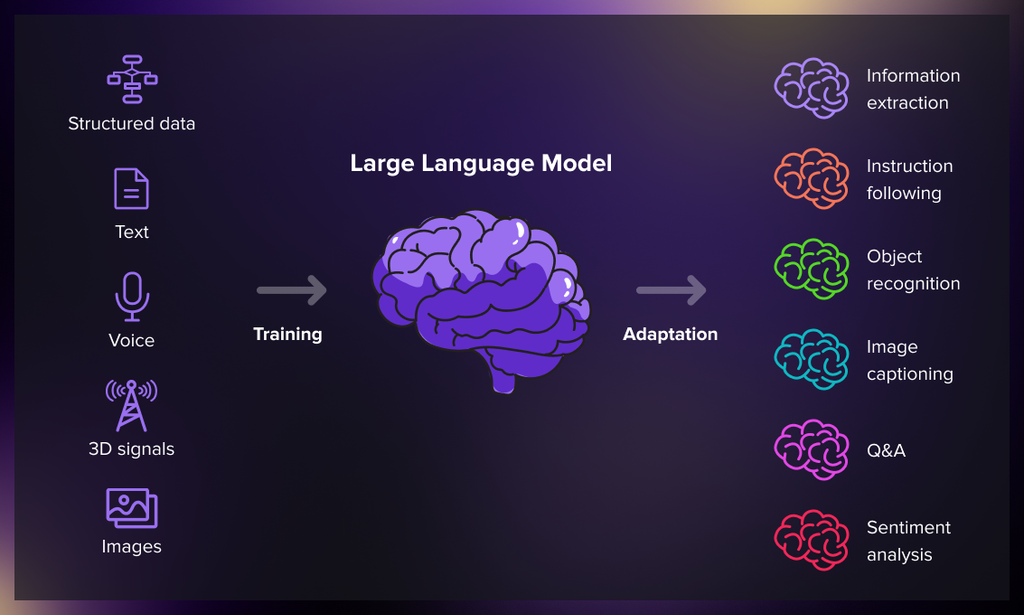
The basic training process is conceptually similar to learning through repeated prediction, although the actual engineering is extraordinarily sophisticated.
Imagine giving a model a sentence with a missing section:
“The ocean is…”
The model makes a prediction.
Maybe it predicts “blue.”
If the prediction differs from the expected continuation, the training system calculates an error. The model’s internal parameters are then adjusted slightly.
Repeat that process an enormous number of times.
Then repeat it again.
And again.
And again.
Across enormous quantities of text.
The model gradually becomes better at predicting language.
The mathematical machinery behind this process involves neural networks, optimization algorithms, probability distributions, and large-scale computing.
One of the central technologies used by modern LLMs is the Transformer architecture.
The Transformer changed the direction of language-model development because it provided an effective way for models to process relationships between different parts of a sequence.
Consider the sentence:
“The dog chased the ball because it was excited.”
What does “it” refer to?
Humans resolve that kind of relationship almost effortlessly. A language model needs mechanisms capable of relating information across the sequence.
Transformers use a mechanism called attention to help accomplish this.
What Is Attention?
The word “attention” sounds psychological, but in this context it refers to a mathematical mechanism.
Very roughly, attention allows a model to determine which parts of the input are particularly relevant when processing another part.
Suppose you are reading:
“The scientist put the sample into the refrigerator because it needed to remain cold.”
To interpret the sentence, information about “sample,” “refrigerator,” and “cold” is connected.
Attention mechanisms allow the model to assign different weights to different pieces of information when processing the sequence.
This ability to consider relationships across text is one reason Transformers became so powerful for language tasks.
It is tempting to imagine attention as a little spotlight inside the machine, consciously looking at important words.
It isn’t that.
There is no tiny observer inside the model.
There are mathematical operations over numerical representations.
But the metaphor is useful because it captures something important: the model can dynamically use different parts of the context when producing its next output.
Why Do LLMs Need So Much Data?
Language is complicated.
Consider everything that an ordinary sentence can contain.
A sentence can express a fact.
It can imply something without directly saying it.
It can contain sarcasm.
It can refer to something mentioned several paragraphs earlier.
It can depend on cultural knowledge.
It can change meaning depending on context.
It can contain an analogy, a joke, an argument, or a hidden assumption.
To become capable of handling this enormous variety, models benefit from seeing enormous amounts of examples.
Training data can include many forms of text, depending on the model and its development process.
The important idea is that scale allows the model to encounter a huge variety of linguistic patterns.
At smaller scales, a system might recognize simple relationships.
At larger scales, models can capture much more complicated structures.
This is one of the remarkable features of modern machine learning: useful capabilities can emerge as models become sufficiently capable and sufficiently exposed to diverse examples.
But scale isn’t magic.
More data doesn’t automatically mean better knowledge.
The quality, diversity, filtering, composition, and licensing of training data all matter.
A model trained on poor or biased information can learn poor or biased patterns.
And because language reflects society, language models inevitably encounter the imperfections of the material they learn from.
Training Isn’t the Same as Looking Things Up
Imagine an LLM has been trained on millions or billions of pieces of text.
It would be easy to picture all of that information sitting somewhere inside the model like files in folders.
That isn’t really how it works.
The information is represented through the model’s learned parameters.
You can think of these parameters as enormous collections of numerical values that encode patterns.
The model does not ordinarily retrieve a paragraph from its training data and paste it into the answer.
Instead, it generates a sequence based on the patterns encoded in those parameters and the context it receives.
This explains something important about LLM behavior.
A model can know something generally while getting a particular detail wrong.
It can produce a plausible explanation that contains a false statement.
It can confidently invent a citation.
It can mix together two similar concepts.
Why?
Because its objective is fundamentally about generating likely language, not guaranteeing truth.
That distinction is easy to forget because fluent language feels authoritative.
And humans are extremely susceptible to that feeling.
Why Do LLMs Sometimes Hallucinate?
The AI industry often uses the word hallucination to describe situations in which a model generates false or unsupported information.
Suppose you ask an LLM about a book that doesn’t exist.
A poorly constrained model might invent the author’s name, publication date, plot, and reviews.
The answer can sound completely convincing.
This is one of the most important things to understand about LLMs.
Fluency is not the same as accuracy.
The model has learned what a convincing answer tends to look like.
If the information is uncertain or absent, the model may still generate something that statistically resembles an answer.
From the model’s perspective, producing text is what it was designed to do.
From the user’s perspective, however, a beautifully written falsehood is still false.
This is why important claims should be verified, particularly in areas such as medicine, law, finance, science, current events, and technical implementation.
The more persuasive an AI system becomes, the more important this distinction becomes.
Ironically, better language generation can make misinformation harder to notice.
From Language Prediction to Conversation
A basic language model could theoretically generate text without having a conversation with anyone.
But modern AI assistants are generally built with additional training and system design intended to make them more useful for interaction.
A user doesn’t normally want an AI that simply continues a sentence.
They want an AI that follows instructions.
“Explain this.”
“Summarize that.”
“Rewrite this paragraph.”
“Give me five ideas.”
“Help me debug this program.”
“Compare these options.”
These are different tasks, but they can all be expressed through language.
This is one reason LLMs are so powerful as general-purpose interfaces.
Instead of learning a separate interface for every task, you can describe what you want in ordinary language.
The interface becomes conversation.
That may turn out to be one of the most important aspects of the technology.
The breakthrough isn’t only that machines can generate text.
It is that language itself can become a way of interacting with software.
LLMs and the Changing Meaning of Software
For most of the history of computing, computers required fairly rigid instructions.
If you wanted software to do something, you often had to learn a particular interface, command structure, or programming language.
Modern LLMs introduce another possibility.
Perhaps the interface doesn’t need to be rigid.
Perhaps you can simply say what you want.
This is not entirely new. Voice assistants and natural-language interfaces have existed for years.
But the flexibility of modern LLMs makes the idea much more powerful.
Imagine asking software:
“Take these meeting notes, find the important decisions, identify the unresolved questions, and turn them into a concise project update.”
That’s not a traditional command.
It’s a description of an intention.
The model can interpret that intention and produce an output.
In that sense, LLMs may represent a shift from command-based computing toward intention-based computing.
You don’t necessarily need to know which buttons to press.
You describe the outcome.
What Can LLMs Do?
The list of applications is already enormous.
LLMs can help with:
- Writing and editing
- Summarization
- Translation
- Brainstorming
- Question answering
- Tutoring
- Programming
- Documentation
- Data interpretation
- Research assistance
- Customer support
- Content creation
- Classification
- Information extraction
- Planning
- Communication
- Creative experimentation
But listing capabilities doesn’t really explain why they matter.
The deeper reason is that many forms of knowledge work involve language.
A lawyer works with language.
A teacher works with language.
A programmer works with language.
A researcher works with language.
A manager writes plans and explanations.
A student reads and writes.
A journalist asks questions and constructs narratives.
A business communicates through documents, emails, reports, presentations, and meetings.
If a machine becomes broadly useful at manipulating language, it touches a surprisingly large part of modern work.
The Student and the LLM
Consider education.
A student can ask:
“Explain photosynthesis like I’m twelve.”
Then:
“Now explain it at university level.”
Then:
“Give me an analogy.”
Then:
“Quiz me.”
Then:
“I got question three wrong. Explain what I misunderstood.”
That kind of interaction is fundamentally different from reading a static textbook.
The AI can respond to the student’s current level of understanding.
But there is a complication.
If the machine always provides the answer, the student may learn less.
Education isn’t merely the acquisition of correct information. It also involves developing the ability to struggle with problems, form hypotheses, make mistakes, revise ideas, and eventually think independently.
So perhaps the most useful question isn’t:
“Can AI do the student’s work?”
It is:
“How should AI change what we consider worthwhile learning?”
If information becomes increasingly easy to obtain, perhaps memorization becomes less central while judgment becomes more important.
But that doesn’t mean knowledge becomes irrelevant.
Quite the opposite.
It may become more important to know enough to recognize when an answer is nonsense.
The Programmer and the LLM
Programming provides another revealing example.
An LLM can generate code from a natural-language description.
You can ask it to create a function, explain an error, translate one programming language into another, or suggest an architecture.
This can dramatically reduce the amount of typing involved in software development.
But programming isn’t merely typing code.
Good programming requires understanding what the software is supposed to accomplish, anticipating edge cases, evaluating trade-offs, testing behavior, and deciding whether the generated solution is actually appropriate.
An LLM can produce ten plausible implementations.
That doesn’t mean all ten are good.
The programmer’s role can shift from writing every line manually toward specifying, evaluating, testing, and refining what the system produces.
Again, the deeper change may be about the interface between human intention and machine execution.
Are LLMs Intelligent?
This question sounds simple until you try to define intelligence.
If intelligence means the ability to perform tasks that normally require cognitive effort, then LLMs clearly demonstrate forms of machine intelligence.
They can solve certain problems.
They can manipulate concepts.
They can generate explanations.
They can recognize patterns.
They can produce novel combinations of ideas.
But if intelligence requires consciousness, subjective experience, genuine understanding, or self-awareness, then the question becomes much harder.
An LLM can say:
“I understand what you mean.”
But that sentence doesn’t prove that the system experiences understanding in the human sense.
It is possible to produce language about feelings without feeling them.
It is possible to describe consciousness without being conscious.
This is one reason we should be careful with human-like language when talking about AI.
The system’s behavior can be remarkably human-like without necessarily implying that its internal experience is human-like—or that there is any subjective experience at all.
We simply don’t have enough reason to treat fluent conversation as proof of consciousness.
The Problem of Anthropomorphism
Humans are naturally inclined to see agency in things that communicate with us.
We name cars.
We talk to pets.
We apologize to computers when we accidentally close a document.
Give a machine a conversational voice, and the instinct becomes stronger.
When an LLM responds politely, remembers something from the conversation, jokes with us, and explains an idea, it is easy to start thinking about it as a person.
That can be useful for interaction.
But it can also distort our judgment.
We may trust it too much.
We may assume it knows more than it does.
We may attribute intentions to it.
We may interpret a confident answer as evidence of certainty.
The more natural AI conversation becomes, the more important it may be to maintain a small mental distance.
Not because the technology is uninteresting.
Quite the opposite.
It is precisely because it is so interesting that we should resist confusing simulation with equivalence.
LLMs Don’t Think Like Humans
Human thought is shaped by bodies, emotions, memories, relationships, physical environments, biological needs, and personal histories.
An LLM does not experience hunger.
It does not become tired after a difficult day.
It doesn’t remember childhood in the human sense.
It doesn’t look out of a window and experience rain.
It doesn’t have a body moving through the physical world.
Its relationship with language is therefore fundamentally different from ours.
And yet it can produce language that describes all of those things.
That is a strange situation.
A system may be able to write a convincing paragraph about loneliness without ever being lonely.
It may explain grief without grieving.
It may describe the smell of rain without smelling anything.
This doesn’t make its output useless.
But it reminds us that describing an experience and having an experience are two different things.
Why LLMs Feel So Impressive
There is another reason LLMs can feel almost magical.
Language is one of the main ways humans expose our internal world to one another.
When someone explains an idea clearly, tells a story, makes a joke, or responds thoughtfully to a question, we naturally infer a mind behind the words.
LLMs produce the same kind of surface evidence.
The result is psychologically powerful.
We aren’t simply seeing text.
We are interacting with something that behaves, linguistically, like an intelligent conversational partner.
That creates an unusual relationship between humans and machines.
For the first time, large numbers of people can interact with software using something that resembles ordinary conversation.
The psychological consequences of that may be just as significant as the technical ones.
The Data Problem
There is also a less glamorous side to LLM development: data.
Models learn from huge quantities of information, and the composition of that information matters.
If the training data contains stereotypes, misinformation, historical bias, or poor-quality writing, models may learn patterns associated with those things.
This isn’t a mysterious defect.
The model is learning from human-produced material.
Human language contains humanity’s knowledge, but it also contains humanity’s mistakes.
This creates a difficult question.
How should we build systems that learn from the world without simply reproducing every problem in the world?
There is no single easy answer.
Training data can be filtered.
Models can be evaluated.
Additional training can influence behavior.
Safety systems can reduce certain kinds of harmful outputs.
But no filtering process can perfectly separate “good information” from “bad information,” because reality itself is complicated and sometimes contested.
Privacy and Trust
Another concern is privacy.
People naturally tell conversational systems things because conversation feels intimate.
That can create a dangerous mismatch between psychological comfort and technical reality.
Users should understand what information they are providing, how it is handled, what systems may have access to it, and what organizational policies apply.
This becomes especially important in workplaces.
Imagine employees casually pasting confidential contracts, internal strategy documents, customer information, or private communications into an AI tool.
The convenience can be enormous.
So can the risk.
The technology doesn’t remove the need for judgment.
If anything, it increases the need for it.
The Economic Question
LLMs also raise an uncomfortable economic question.
If machines can perform portions of knowledge work, what happens to the people who currently perform those tasks?
History offers a complicated answer.
Technology often replaces some tasks while creating others.
The automobile reduced demand for certain forms of transportation work while creating enormous new industries.
Computers automated many clerical processes while creating entirely new categories of work.
LLMs are likely to have similarly uneven effects.
Some tasks may disappear.
Others may become dramatically faster.
Some professions may change without disappearing.
And entirely new jobs may emerge around supervising, evaluating, integrating, and governing AI systems.
The difficult part is that technological transitions are rarely equally distributed.
Someone who owns a company and someone whose job is automated do not experience technological progress in the same way.
So the question isn’t simply whether LLMs will increase productivity.
They probably will in many contexts.
The more difficult question is:
Who benefits from that productivity, and how is the transition managed?
The Future May Not Be About Replacing Humans
The loudest discussion about AI often revolves around replacement.
Will AI replace writers?
Will AI replace programmers?
Will AI replace teachers?
Will AI replace designers?
Will AI replace researchers?
Perhaps some jobs will eventually be substantially reduced.
But another possibility deserves more attention.
Maybe the most important change will be the emergence of human-AI collaboration.
A person might use an LLM to generate possibilities, challenge assumptions, organize information, draft material, simulate viewpoints, or explore a problem.
The human then evaluates the output.
The model expands the space of possibilities.
The human supplies judgment.
That arrangement is not perfect.
Humans make mistakes too.
But it points toward an interesting possibility: the value of AI may not lie in making humans unnecessary, but in changing what an individual human can accomplish.
One person with good tools may be able to do work that previously required a small team.
That could be empowering.
It could also create new expectations and pressures.
If everyone has powerful AI assistance, employers may begin expecting everyone to produce more.
Technology that saves time can paradoxically create less free time if the saved time is immediately filled with additional work.
That is not really a technology problem.
It is a human problem.
The Most Important Skill May Become Judgment
There is a strange possibility hidden inside all of this.
As machines become better at producing information, knowing what to believe may become more valuable than knowing how to produce information.
If an AI can write an article in seconds, writing skill still matters—but evaluation matters too.
Is the argument coherent?
Are the examples accurate?
Does the evidence support the conclusion?
Is something missing?
Is the tone appropriate?
Has the model invented a source?
Does the answer confuse correlation with causation?
These are judgment questions.
And judgment depends partly on knowledge.
You cannot reliably evaluate an explanation of physics if you know nothing about physics.
You cannot reliably evaluate a legal argument if you know nothing about law.
You cannot reliably evaluate a scientific claim if you have no sense of how scientific evidence works.
So AI may reduce the cost of producing information while increasing the importance of understanding information.
That is an interesting paradox.
LLMs as Mirrors
Perhaps the most interesting way to think about LLMs is not as artificial people, but as something closer to mirrors.
They reflect enormous amounts of human language back to us.
When we ask them for an explanation, they produce a composite expression shaped by patterns found across human communication.
That means their strengths and weaknesses are connected to ours.
They can reproduce brilliance because humans have produced brilliance.
They can reproduce confusion because humans produce confusion.
They can generate kindness because human language contains kindness.
They can generate prejudice because human language contains prejudice.
They can imitate expertise because human beings write like experts.
In that sense, LLMs are not completely separate from human culture.
They are products of it.
And perhaps that is why interacting with them can sometimes feel uncanny.
We are, in a sense, talking to a machine that has absorbed enormous amounts of the linguistic traces humans have left behind.
So, What Is an LLM?
After all of this, we can return to the simple question.
What is an LLM?
Technically, it is a large neural network trained on vast quantities of language data to model patterns in sequences of tokens and generate likely continuations.
That definition is correct.
But it doesn’t quite explain the cultural significance.
An LLM is also a new kind of interface between humans and computers.
It is a system that turns ordinary language into a general-purpose way of interacting with software.
It can function as a writing partner, programming assistant, tutor, research aid, brainstorming tool, translator, and conversational interface.
But it is not an oracle.
It does not automatically know what is true.
It does not necessarily understand the world as humans do.
It can produce confident errors.
It can reproduce biases.
It can be extremely useful while still requiring human oversight.
And perhaps that combination is the most important thing to understand.
LLMs are neither magic nor trivial.
Calling them “just autocomplete” misses the extraordinary capabilities that can emerge from large-scale language modeling.
Calling them digital humans goes too far in the other direction.
The truth is more interesting than either description.
We have built machines that can manipulate language at an extraordinary level, and we are still figuring out what that means.
The Question We Should Probably Be Asking
There is a temptation whenever a new technology appears to ask whether it is good or bad.
Will LLMs save us?
Will they destroy jobs?
Will they make education better?
Will they make people lazy?
Will they become conscious?
Will they replace human creativity?
These are reasonable questions, but they can sometimes lead us toward the wrong conversation.
A more interesting question might be:
What happens to human behavior when language becomes cheap?
For most of human history, expressing an idea required effort.
Writing a letter took time.
Producing a report took time.
Translating a document took time.
Writing code took time.
Creating several versions of an argument took time.
Now much of that effort can be reduced dramatically.
When the cost of producing language falls, we may produce more of it.
But abundance changes value.
When information becomes abundant, attention becomes scarce.
When writing becomes abundant, good judgment becomes scarce.
When answers become easy to generate, asking the right question may become more important.
And when machines become capable of producing convincing language, perhaps the human qualities we once took for granted—curiosity, skepticism, taste, context, responsibility, empathy—become more visible.
That may be the strange lesson of LLMs.
The technology is about machines generating language.
But the deeper story may be about humans figuring out what language, knowledge, intelligence, and understanding actually mean.
We started with a simple experience: type a question, receive an answer.
Behind that little exchange is an enormous technological system involving neural networks, data, mathematics, computing infrastructure, probability, and decades of research.
But behind the technology is another question that is harder to answer.
When a machine becomes extraordinarily good at producing the outward signs of thought, what exactly are we looking for when we say that something “thinks”?
Maybe the most useful thing about LLMs is not that they give us a final answer.
Maybe it is that they force us to reconsider the questions.