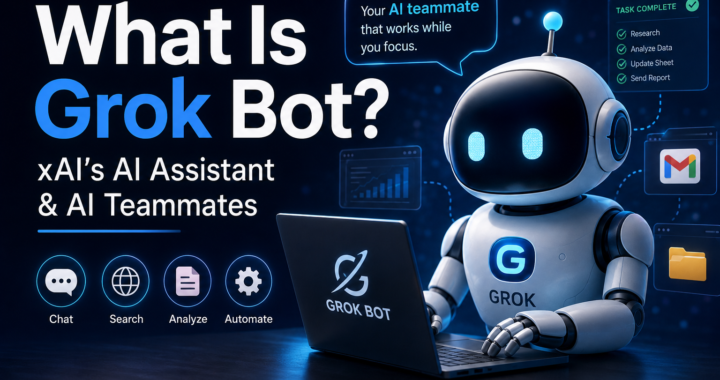
Grok vs ChatGPT in 2026: Which AI Assistant Should You Use?


ChatGPT is generally stronger as an all-purpose AI assistant for writing, reasoning, learning, coding, structured workflows, and professional tasks. Grok is particularly appealing for users who want a more conversational style and stronger connection to real-time discussions happening around X.
A few years ago, choosing an AI assistant felt like choosing a search engine.
You opened a browser, typed a question, and waited for a list of blue links.
Simple.
Now the choice feels strangely personal.
People ask whether they should use ChatGPT or Grok the same way they might ask whether they should use a notebook or a voice recorder. Both can capture ideas. Both can help you think. But they encourage slightly different habits.
That is the interesting part.
The Grok vs ChatGPT debate in 2026 is not only about which model has more parameters, produces longer answers, or wins a benchmark. It is about what kind of relationship people want with AI.
Do you want an assistant that feels like a careful researcher?
Do you want one that feels more like a fast-moving conversation partner connected to the current internet?
Do you want a machine that challenges your assumptions, or one that helps you organize them?
But that answer hides a more interesting question.
Why did we start expecting personality from software in the first place?
What Is the Difference Between Grok and ChatGPT?
Grok and ChatGPT are both generative AI assistants that can understand natural language, answer questions, create content, analyze information, help with coding, and assist with problem-solving.
The biggest difference is their design philosophy.
ChatGPT, developed by OpenAI, has focused heavily on being a broad AI assistant that can support many types of work: education, writing, programming, analysis, brainstorming, and business workflows.
Grok, developed by xAI, has positioned itself as an AI assistant with a closer connection to real-time conversations and information from the X platform ecosystem.
The difference is not simply “smart versus smarter.”
It is more like two people sitting at the same table.
One person brings a carefully organized notebook.
The other brings a phone full of conversations happening right now.
Which one is more useful depends on why you came to the table.
ChatGPT vs Grok: Quick Comparison Table
| Category | ChatGPT | Grok |
|---|---|---|
| Developer | OpenAI | xAI |
| Best known for | General AI assistance, reasoning, writing, coding | Conversational style and real-time awareness |
| Writing quality | Strong | Strong, often more casual |
| Coding assistance | Strong | Capable |
| Research workflows | Strong | Useful, especially for current discussions |
| Personality | More structured and adaptable | More informal and conversational |
| Real-time social trends | Limited compared with X-connected tools | Major focus |
| Professional usage | Very common | Growing |
| Learning support | Strong | Useful |
| Enterprise workflows | Strong ecosystem | Developing |
The table is useful.
But tables also create a dangerous illusion.
They make AI assistants look like products competing on a shelf.
In reality, they are becoming something closer to cognitive tools.
And tools change the people using them.
Which Is Better: Grok or ChatGPT?
For most people, ChatGPT is the better overall AI assistant in 2026 because it offers a broader range of capabilities across writing, coding, analysis, education, and professional tasks.
Grok may be the better choice for people who spend significant time following live discussions, trends, and public conversations where speed and conversational context matter.
The “winner” depends on the job.
A software developer debugging a complex system may value structured reasoning.
A journalist tracking a developing story may value fast awareness of public conversation.
A student learning mathematics may want explanations that build understanding step by step.
A founder brainstorming product ideas may want both.
This is why the AI race has become less like the smartphone race and more like the camera industry.
Nobody asks, “Which camera is the best?”
They ask, “Which camera is best for what I am trying to do?”
ChatGPT vs Grok for Writing
Writing is one of the most common reasons people use AI.
Emails.
Articles.
Reports.
Stories.
Marketing pages.
Research summaries.
The difference between Grok and ChatGPT becomes noticeable here.
ChatGPT tends to perform well when the goal is structured communication.
For example:
- Creating an article outline
- Improving clarity
- Adjusting tone
- Summarizing complex information
- Turning notes into professional documents
Grok often feels more conversational.
It may produce responses that feel less like a corporate assistant and more like someone participating in an online discussion.
That can be useful.
Sometimes good writing does not begin with a perfect structure.
Sometimes it begins with a messy conversation.
A surprising idea.
A disagreement.
A strange connection.
The challenge is that personality can sometimes be confused with quality.
A confident voice does not automatically mean a correct answer.
This is one of the oldest human problems.
A person speaking confidently in a meeting is not necessarily the person who understands the issue best.
AI has simply given that problem a faster delivery system.
Which AI Is Better for Coding: Grok or ChatGPT?
For coding, ChatGPT remains one of the strongest general-purpose AI assistants because programming requires more than generating code.
Good coding assistance requires:
- Understanding requirements
- Explaining trade-offs
- Debugging errors
- Suggesting architecture
- Reviewing existing code
- Maintaining consistency across a project
Many developers use AI less like a code generator and more like a junior teammate.
The best teammate is not the one who always writes the most code.
It is the one who asks:
“Why are we building it this way?”
“Is this the simplest solution?”
“What happens when this fails?”
Grok can also assist with programming tasks, but its biggest identity has traditionally been connected to conversational interaction and real-time information rather than being primarily known as a developer workflow environment.
For beginners, the difference may be small.
For experienced developers, small differences become important.
A developer spending eight hours inside an AI coding workflow notices things a casual user never sees.
Grok vs ChatGPT for Research
Research is where the comparison becomes complicated.
Because “research” means different things.
A student researching a historical topic needs:
- Clear explanations
- Reliable sources
- Context
- Structure
A market analyst following a company announcement needs:
- Current information
- Fast updates
- Multiple viewpoints
A researcher studying a scientific topic needs:
- Evidence
- Methodology
- Careful uncertainty
No single AI assistant automatically solves all of these.
The biggest mistake people make with AI research is assuming fluency equals truth.
AI systems are extremely good at producing answers that sound complete.
Humans are also extremely good at believing answers that sound complete.
That combination is risky.
The future skill is not simply asking AI better questions.
It is knowing when to question the answer.
The Real Difference: Personality vs Reliability
The most fascinating part of the Grok vs ChatGPT debate is that people often talk about personality.
They say:
“Grok feels funnier.”
“ChatGPT feels smarter.”
“Grok feels more human.”
“ChatGPT feels more professional.”
But what does “feels human” actually mean?
Humans are not impressed by intelligence alone.
We like style.
We like humor.
We like disagreement.
We like the feeling that something is responding rather than calculating.
This explains why personality matters.
A calculator never became popular because it had a charming personality.
But an assistant is different.
An assistant sits beside us while we think.
And thinking is personal.
The Unexpected Connection: AI Assistants Are Becoming Like Different Kinds of Friends
There is an odd comparison here.
AI assistants may eventually become less like software and more like different types of intellectual companions.
Not friends in the human sense.
Machines do not have experiences, emotions, or personal lives.
But they influence how we organize our thoughts.
One AI might become the equivalent of the friend who says:
“Let’s slow down and examine the evidence.”
Another might be the friend who says:
“Interesting idea. What happens if we push it further?”
Both have value.
The problem begins when we only keep assistants that agree with us.
A machine designed only to confirm our opinions would be incredibly comfortable.
It would also be incredibly dangerous.
Should You Use Grok or ChatGPT in 2026?
For most users:
Choose ChatGPT if you need:
- Writing assistance
- Coding help
- Learning support
- Business workflows
- Structured problem solving
- Long-form analysis
Choose Grok if you value:
- Conversational interaction
- Following current online discussions
- A different AI personality
- Exploration of internet culture and trends
Many advanced users will eventually use multiple AI systems.
That may become normal.
Just as professionals use different software tools for different tasks, AI users may develop personal “AI stacks.”
One tool for writing.
One for research.
One for coding.
One for brainstorming.
The idea of asking “Which AI wins?” may eventually feel as strange as asking “Which app wins?”
The Bigger Question: Are We Choosing AI, or Choosing Ourselves?
The Grok vs ChatGPT competition looks like a technology battle.
But underneath it is a human question.
What do we want from intelligence?
A mirror?
A teacher?
A critic?
A collaborator?
For thousands of years, humans built tools that extended physical ability.
The hammer extended the hand.
The telescope extended the eye.
The computer extended calculation.
AI extends something different.
It extends conversation.
And conversation shapes thought.
Maybe the most important question in 2026 is not whether Grok is better than ChatGPT.
Maybe it is this:
When we create machines that help us think, what kind of thinkers do we want them to help us become?