How Much Does PMP Certification Cost in India? Full Fee Breakdown and What’s Actually Included

A ₹9,999 PMP course advertisement looks wonderfully simple.
You pay roughly ten thousand rupees, complete the course, pass the exam, add “PMP” after your name, and move on with your life.
Except that is not really how PMP pricing works.
The course fee is only one part of the cost. You may also need to pay for the PMP examination, PMI membership, taxes, preparation tools, a possible second attempt, and eventually certification renewal.
Once those pieces are added together, the more useful question becomes less “How much does a PMP course cost?” and more “How much money should I actually set aside before starting this?”
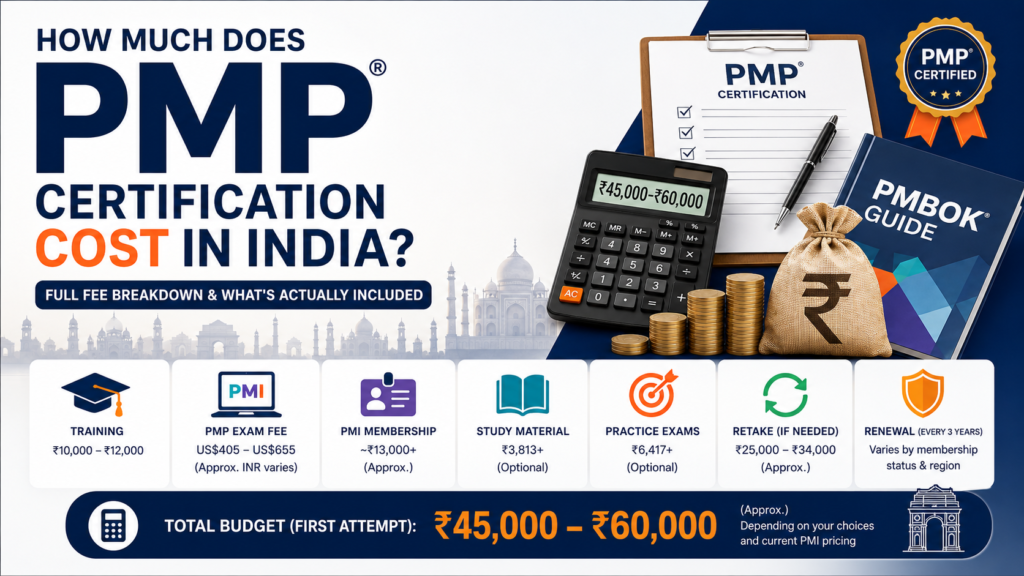
For most Indian professionals choosing live instructor-led training in 2026, ₹45,000 to ₹60,000 is a sensible first-attempt budget.
You may spend less. You may spend more. The difference often comes down to what your training package includes, whether you become a PMI member, whether you buy additional study products, and the price that appears in your PMI checkout when you are ready to pay.
Recent StarAgile sales-call quotes supplied for this article put packages containing training, a PMP exam voucher, and one year of PMI membership at approximately ₹45,000, ₹46,000, and ₹48,000. Training alone was quoted at approximately ₹10,000 plus 18% GST, or ₹11,800, with one promotional quote of ₹11,500.
Those numbers are useful for budgeting. They are not permanent prices.
PMI fees, regional pricing, taxes, promotions, course schedules, and provider packages can all change.
PMP certification cost in India: the quick answer
If you are planning your budget today, this is the simplest way to think about it.
| Cost component | Typical 2026 amount to budget | Required? |
|---|---|---|
| PMP training | About ₹10,000 to ₹12,000 for many live online programs | Yes, unless another qualifying route covers the education requirement |
| PMP exam | Depends on PMI membership status and regional checkout | Yes |
| PMI membership | Varies by regional pricing | No |
| Training + membership + exam bundle | Roughly ₹45,000 to ₹48,000 in recent StarAgile quotes | No |
| PMI Study Hall Essentials | ₹3,813 | No |
| PMI official practice exam | ₹6,417 | No |
| Retake | Separate charge | Only if needed |
| Certification renewal | Separate cost later | Every certification cycle |
PMI currently publishes the PMP examination price as US$405 for members and US$655 at the full non-member price.
Indian candidates may see localized pricing and taxes at checkout. That is why I would be cautious with any article claiming that the PMP exam “costs exactly ₹X in India.”
The number that matters is the one inside your PMI account when you are ready to pay.
What does “PMP certification cost” actually mean?
There is a small language problem behind much of the confusion.
Someone searches for “PMP certification cost in India,” but different websites answer different questions.
One page tells you the cost of a training course.
Another gives you the exam fee.
A third adds membership.
Another combines everything into a package and presents that number as the cost of PMP certification.
Technically, all of them may be describing real expenses. They are simply talking about different parts of the journey.
A realistic PMP budget can contain:
- Your required project-management education
- The PMP examination fee
- PMI membership, if you choose to join
- Mock exams or preparation platforms
- GST and other applicable charges
- A retake if you do not pass on your first attempt
- Renewal expenses after you become certified
This distinction becomes particularly important when you see a PMP program advertised for ₹9,999 or ₹11,000.
That may be an entirely reasonable price for training.
It does not mean you can necessarily become PMP certified for ₹11,000.
Before paying a training company, ask a very plain question:
“Does this price include the PMP exam fee and PMI membership, or is it training only?”
It is not a sophisticated question. It may save you ₹30,000 or ₹40,000 worth of misunderstanding.
What is the PMP exam fee in India in 2026?
PMI currently lists the PMP examination at:
- US$405 for PMI members
- US$655 at the full non-member price
Payment is made after PMI accepts your application.
The tricky part is converting that into a single permanent Indian rupee amount.
Indian checkout values can differ because of regional pricing, taxes, and updates to PMI pricing. Training companies also publish their own estimates.
For example, StarAgile currently publishes approximate exam figures of:
- ₹36,892 for PMI members
- ₹59,664 for non-members
on its Delhi PMP page.
Other providers show different estimates. Simplilearn, for example, publishes another set of India figures in its PMP cost material.
Which number should you trust?
I think the distinction is fairly straightforward.
Use PMI’s published dollar amounts to understand the official member versus non-member pricing structure.
Use Indian provider figures to build an approximate budget.
Then use your own PMI checkout to find out what you will actually pay.
Recent StarAgile sales conversations supplied for this article quoted roughly ₹46,000 to ₹46,500 for a one-year PMI membership plus PMP exam voucher.
That is useful as a recent reference point. It should not be treated as a permanent PMI tariff.
Is the PMP exam cheaper if you become a PMI member?
Yes.
At the current public rates, the PMP exam costs US$405 for a member and US$655 at the full non-member price.
That is a US$250 difference.
It sounds obvious, then, that everybody should become a member first.
But there is another number to include: the cost of membership itself.
You really need to compare:
PMI membership + member exam fee
with:
non-member exam fee
Membership may still make financial sense, particularly if you plan to use PMI resources, remain involved with PMI after certification, attend events, buy learning products, or hold other PMI credentials.
PMI membership also provides access to selected standards, resources, learning products, events, and member pricing.
Professional membership lasts 12 months and is billed annually.
So I would not think of membership purely as a discount coupon for the exam. The better question is whether the combined cost and the resources you will use make sense for you.
How much does PMI membership cost in India?
This is another number that is better checked live than memorized.
PMI can localize membership pricing, so the safest approach is to log into the India store and see the current amount before paying.
StarAgile currently publishes an approximate PMI membership amount of ₹13,558, including a joining-related component, on one of its PMP pricing pages.
Recent sales-call information supplied for this guide provides another useful reference. The combined cost quoted for PMI membership plus the PMP exam voucher was roughly ₹46,000 to ₹46,500.
The fact that provider pages and sales quotations do not always line up perfectly is precisely why old “PMP cost in India” articles age so badly.
A number can be accurate when it is written and misleading six months later.
Check the live amount.
How much does PMP training cost in India?
Training is where candidates have much more control over what they spend.
Current live online PMP programs from several Indian providers are available around the ₹10,000 to ₹12,000 range, although premium programs can cost considerably more.
The cheapest course is not necessarily bad.
The most expensive course is not necessarily better.
What matters is what you are actually buying.
A typical instructor-led PMP program may provide:
- At least 35 hours of qualifying project-management education
- Live instructor-led sessions
- Practice questions
- Mock exams
- Application guidance
- Study material
- Recorded classes or LMS access
- Doubt-clearing sessions
PMI currently requires 35 hours of project-management education, unless you meet the requirement through an accepted alternative such as CAPM certification.
There is also a timing issue worth knowing about if you plan to train late in 2026.
PMI has announced a change planned for late Q4 2026. Once that change takes effect, live classes used for the PMP education requirement will need to come from a PMI Authorized Training Partner, a China Registered Education Provider, or an eligible accredited academic program.
Self-paced education follows a different rule.
So if you are starting live PMP training toward the end of 2026, add one more question to your provider checklist:
Are you a PMI Authorized Training Partner, and will this course satisfy the education requirement under the new rule?
PMP training prices in India: three current examples
Promotional course prices change frequently, so these figures are better treated as snapshots than promises.
| Provider | Current advertised or quoted training price | Training hours | Exam included? |
|---|---|---|---|
| StarAgile | Around ₹9,999 publicly; recent call quote ₹10,000 + GST | 35 hours | Usually separate unless you choose a combo |
| KnowledgeHut | Around ₹10,999 on current India pages | 36 contact hours | Separate |
| Simplilearn | Around ₹11,549 promotional online bootcamp price | 35 contact hours | Check current package |
1. StarAgile
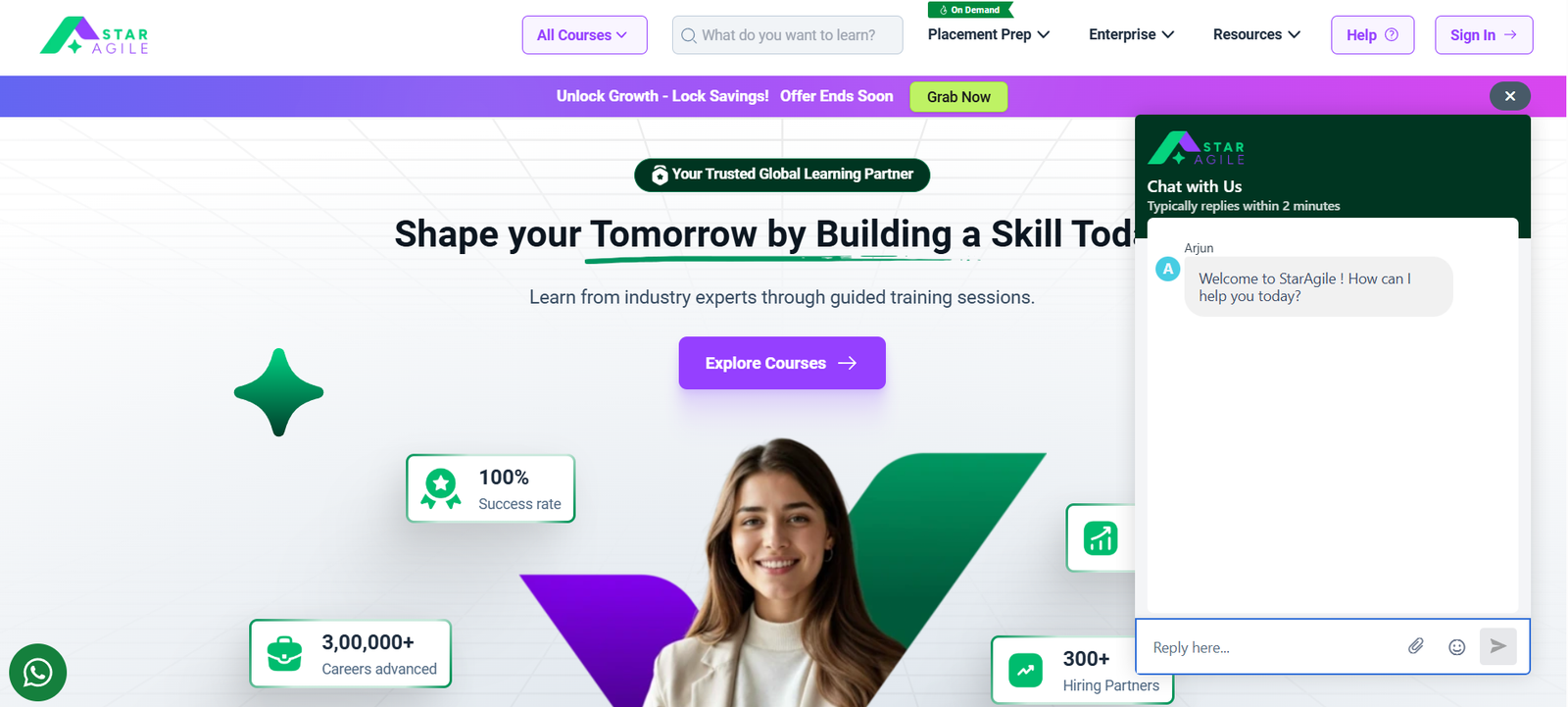
StarAgile currently advertises PMP training at approximately ₹9,999 on several India city pages.
The program includes 35 hours of live virtual training, mock tests, practice questions, and learning material. StarAgile also presents the course as PMI-authorised instruction.
Recent sales-call information supplied for this article quoted the training fee at ₹10,000 plus 18% GST, producing a total of ₹11,800. Another promotional conversation quoted ₹11,500.
The more interesting numbers appear when the exam and membership are added.
Recent conversations included combined training, PMP exam voucher, and one-year PMI membership offers at approximately:
- ₹45,000
- ₹46,000
- ₹48,000 for a Prime option
The call notes also referred to weekday and weekend batches, morning and evening schedules, alumni sessions with candidates who had recently passed PMP, and a ₹2,000 token payment that could be used to hold a seat for initial classes.
One trainer referred to as RJ was mentioned.
These details are naturally more variable than the certification itself. Trainers, schedules, promotions, and batch structures can change. Confirm all of them before enrolment.
2. KnowledgeHut

KnowledgeHut currently advertises a live online PMP program at approximately ₹10,999 on some of its India location pages, reduced from a displayed price of ₹18,999.
The program lists 36 contact hours along with an on-demand course, a five-week preparation plan, practice questions, mock tests, an exam simulator, and PMP application assistance.
The PMP examination fee is separate.
That last sentence matters.
If you compare KnowledgeHut’s ₹10,999 training fee with another company’s ₹45,000 package, you are not really comparing two versions of the same product. One price may cover training alone while the other includes membership and the examination.
KnowledgeHut may make sense for someone who prefers a structured preparation schedule and instructor access instead of creating a study plan independently.
As always, check the current payment page because promotional pricing and available batches can move.
3. Simplilearn

Simplilearn currently displays an online PMP bootcamp price of roughly ₹11,549 on its India course page, against a higher displayed list price.
Its program includes 35 contact hours of instructor-led preparation, PMI digital material, simulations, practice questions, and application support.
The course page also refers to PMI membership access within the learning proposition.
This is one of those phrases I would clarify before paying.
Does the package actually purchase PMI membership for you? Does it provide membership-related material? Is membership completely separate?
The same question applies to the exam fee.
Simplilearn can suit candidates who prefer a larger online learning platform with scheduled cohorts and a substantial digital learning environment. The promotional amount can change by batch and period, so confirm the final package at checkout.
For a wider comparison of providers, schedules, course formats, and preparation features, see Syssn’s PMP certification online training guide.
What does a StarAgile PMP package actually include?
The word “package” deserves some attention because it can hide several different products under one label.
Based on StarAgile’s public material and recent sales-call information supplied for this article, the training portion may contain:
- 35 hours of live virtual PMP training
- Practice questions
- Mock examinations
- LMS or recording access, depending on the plan
- PMP application preparation
- Current exam-oriented instruction
- Alumni or past-candidate sessions in selected batches
A combined package may additionally contain:
- One year of PMI membership
- A PMP exam voucher
And here is one distinction that should probably be unnecessary to explain, yet is worth making explicit.
StarAgile prepares you before the PMP examination.
It does not assist you while you are taking the exam.
PMP is a proctored professional certification examination. Any legitimate training relationship ends at preparation.
Sales-call notes supplied for this article also indicated that GST may be handled separately when a buyer requests a GST invoice for reimbursement purposes.
If your employer is paying, ask for a written quotation and proper tax invoice before transferring money.
It is easier to sort this out before payment than through an expense claim afterwards.
What are the PMP eligibility requirements in 2026?
Cost questions tend to arrive before eligibility questions.
Perhaps they should arrive in the opposite order.
There is little value in finding a perfect ₹10,000 training offer if you are not yet eligible to apply for the examination.
For candidates with a four-year university degree, PMI currently lists:
- 36 months of experience leading projects
- 35 hours of project-management education or CAPM certification
For candidates with a high school or secondary school qualification, PMI lists:
- 60 months of experience leading projects
- 35 hours of project-management education or CAPM certification
Your formal job title does not necessarily have to be “Project Manager.”
That point opens the door for people in engineering, logistics, consulting, IT, operations, and other functions who may have spent years leading actual projects without ever carrying a project-manager title.
PMI explained in an August 28, 2026 article that applicants should concentrate on whether their work involved leading project activity, guiding teams or stakeholders, managing delivery, and creating value.
The distinction between project work and routine operations can sometimes be less obvious than it looks.
A logistics manager running daily warehouse dispatch is performing operations.
The same manager leading the implementation of a new warehouse-management system across three facilities may be doing project work.
The title is the same. The nature of the work is different.
Document what you genuinely did.
Do not stretch routine responsibilities into imaginary projects simply to make an application work.
How long does the PMP certification process take?
For a working professional, 40 to 45 days is a reasonable planning period from the beginning of training to the examination.
That is not a rule.
Some people need longer. Others move faster.
A possible schedule is:
- Complete your 35 training hours over three or four weeks.
- Prepare your PMI application and project history.
- Submit the application.
- Wait for approval or respond if selected for an audit.
- Pay the examination fee.
- Book a Pearson VUE or online examination date.
- Use the remaining study period for scenario questions and mock tests.
Recent StarAgile sales-call notes referred to weekday classes lasting approximately 2 to 2.5 hours from Monday through Friday for three to four weeks.
Weekend sessions of approximately 4.5 hours were also discussed.
Example batch timings included:
- Morning: approximately 6:00 to 8:00 a.m.
- Evening: approximately 7:30 to 9:50 p.m.
Those times are examples, not guaranteed schedules.
And this is where the cheapest-course calculation becomes slightly more interesting.
Imagine Course A costs ₹10,000 but forces you to miss five client meetings.
Course B costs ₹13,000 and fits neatly around your work schedule.
Which one is actually cheaper?
Money is visible on an invoice. Disruption usually isn’t.
What changed in the PMP exam in July 2026?
The PMP examination changed on July 9, 2026.
The current Examination Content Outline specifies:
- 180 total questions
- 240 minutes
- 170 scored questions
- 10 unscored pretest questions
- Two 10-minute breaks
- Scenario-based and interactive question formats
The current domain weighting is:
| Domain | Weight |
|---|---|
| People | 33% |
| Process | 41% |
| Business Environment | 26% |
PMI says the revised exam puts more attention on areas including AI, sustainability, stakeholder engagement, business value, and realistic project situations.
This creates a simple purchasing test for anyone buying training in 2026.
Ask the provider whether the course has been updated for the PMP exam launched on July 9, 2026.
Old recordings do not become useless overnight. Many project-management principles remain relevant.
But they should not be your primary preparation material for an examination whose content and emphasis have changed.
What study costs can appear outside your training fee?
One strange thing happens when people prepare for professional exams.
Buying study material can begin to feel suspiciously similar to studying.
It isn’t.
You can own five question banks and still answer none of them.
Before buying extra preparation tools, look at what your course already provides.
PMI currently sells Study Hall Essentials for ₹3,813 in India.
The current product contains preparation resources for the July 2026 version of PMP, including practice questions, mini exams, practice exams, and learning tools.
PMI also sells an official PMP Practice Exam for ₹6,417 in its India store.
It includes a full-length, 180-question simulation.
Buying both products would add more than ₹10,000 to your PMP preparation budget.
Would that improve your chance of passing?
Possibly.
Do you automatically need both?
No.
If your training provider already gives you strong mock exams and a realistic simulator, another question bank may simply repeat what you already have.
Use your existing material first.
Buy additional preparation when your results suggest a problem that the additional product can actually solve.
How much does it cost to retake the PMP exam?
PMP candidates can attempt the examination up to three times during their one-year eligibility period.
If you do not pass, a separate re-examination fee applies.
Indian rupee figures vary by provider and regional pricing.
StarAgile currently publishes approximate re-examination prices of:
- ₹25,053 for PMI members
- ₹34,163 for non-members
on its PMP Delhi page.
Confirm the actual live amount with PMI before scheduling another attempt.
I would treat the retake fee as a contingency rather than part of the minimum certification budget.
There is no reason to behave as though failure is inevitable.
There is also no harm in knowing what the financial consequence would be.
How much does PMP renewal cost?
Getting PMP certified is not the end of the financial story, although the next part does not arrive immediately.
PMP works on a three-year renewal cycle.
Certification holders need to earn the required Professional Development Units, report them through PMI, and pay the certification renewal fee.
PMI makes a distinction between:
- PMP certification renewal
- PMI membership renewal
They are separate.
Renewal pricing depends on membership status and regional pricing, so the amount should be checked through your myPMI dashboard when renewal becomes relevant.
You should also think about the cost of earning PDUs.
That does not mean buying three years of expensive courses.
Many PDUs can be earned through free activities, employer-supported learning, professional contributions, and other qualifying development work.
In other words, the renewal budget is real, but it does not have to become another large training bill.
The Syssn 4-bucket PMP budget model
The easiest way I have found to think about PMP costs is to stop treating certification as one purchase.
It is really a sequence of different spending decisions.
For that reason, Syssn uses a simple four-bucket model.
This is an editorial budgeting framework, not an official PMI model.
| Bucket | What goes into it | Suggested approach |
|---|---|---|
| 1. Eligibility | 35-hour course | Buy what satisfies your education requirement |
| 2. Certification | PMI membership and examination | Compare member and non-member totals |
| 3. Risk buffer | Extra practice and possible retake | Keep money available rather than spending it immediately |
| 4. Maintenance | PDUs and renewal | Plan after certification |
I like this approach because each bucket answers a different question.
Bucket 1 asks: What do I need to become eligible and prepare properly?
Bucket 2 asks: What will it cost to actually sit the examination?
Bucket 3 asks: What might I need if preparation or the first attempt does not go according to plan?
Bucket 4 asks: What will keeping the credential require later?
The model also makes employer reimbursement easier to discuss.
Instead of approaching your manager with a vague request for “₹60,000 for PMP,” you can show the immediate certification costs separately.
For example:
- Bucket 1: training
- Bucket 2: examination and membership
Then keep optional preparation products in a separate personal or contingency budget.
For operations, logistics, engineering, healthcare, technology, and frontline managers, I would add something that rarely appears in cost comparison tables: your calendar.
A ₹3,000 saving becomes less attractive if the course schedule repeatedly collides with shifts, customer work, releases, plant operations, or project deadlines.
The invoice tells you the price of the course.
Your calendar tells you part of its real cost.
What is the cheapest practical way to get PMP certified in India?
There is a difference between spending as little as possible and spending intelligently.
A cost-conscious PMP plan might look like this:
- Confirm your eligibility before buying training.
Make sure your project experience satisfies PMI requirements. - Choose a reasonably priced course that provides the required 35 hours.
A program around ₹10,000 can be perfectly adequate if its instructor, timing, material, and exam version suit you. - Compare member and non-member examination totals.
Do the calculation using current PMI pricing instead of assuming membership is automatically cheaper. - Use the practice material included with your course.
Do not immediately purchase three more simulators. - Add Study Hall or another preparation tool only if you need it.
Your mock performance should help you decide. - Ask your employer about reimbursement.
Some companies cover training, examination fees, taxes, or professional membership. - Get package inclusions in writing.
Make sure you know whether membership, exam vouchers, GST, recordings, application support, and retakes are included.
Paying more makes sense when the additional money buys something useful to you.
A better instructor may be worth it.
A timetable that fits your shifts may be worth it.
Good application guidance may be worth it.
Paying extra because a sales page contains more logos and countdown timers is a less convincing reason.
Is PMP certification worth the cost in India?
This is where the cost question becomes a career question.
PMP can be a sensible investment for professionals whose work already involves, or is moving toward, project delivery, budgets, stakeholder management, teams, deadlines, risk, and business outcomes.
The argument is weaker for someone with limited project exposure who expects the certificate by itself to create a senior project-management career.
Before spending ₹45,000 or more, I would ask:
- Do project-management roles appear in my next realistic career step?
- Does my employer value PMP?
- Will I be able to apply the methods in my current work?
- Do I expect to stay in project, program, delivery, or operations roles?
- Can my employer reimburse any of the cost?
There is another question hiding underneath those.
Are you buying evidence of work you are increasingly doing, or are you hoping the credential will substitute for experience you do not yet have?
For many good certification decisions, the answer is somewhere between the two.
If your work is moving more toward Agile team facilitation rather than broad project management, PMP may also be worth comparing with another route.
Syssn has separate guides covering Certified Scrum Master certification providers and CSPO courses for Product Owners.
The right certification depends less on which acronym is most famous and more on the kind of work you want to be trusted with.
Frequently asked questions
How much does PMP certification cost in India?
For most professionals combining training, membership, and the PMP examination, ₹45,000 to ₹60,000 is a practical first-attempt budget in 2026.
Your final cost depends on the training provider, current PMI pricing, membership, taxes, and optional preparation products.
What is the PMP exam fee in India?
PMI currently publishes the examination at US$405 for members and US$655 at the full non-member price.
Indian candidates should check their PMI account for the current localized rupee amount before payment.
Is PMP training included in the examination fee?
No.
Training and the PMP examination are usually separate purchases unless a provider sells a package containing an exam voucher.
Do I have to become a PMI member?
No.
PMI membership is optional. Members receive a lower PMP examination price and additional PMI benefits.
How many PMP training hours do I need?
PMI currently requires 35 hours of project-management education, unless you qualify through an accepted alternative such as CAPM certification.
Is StarAgile’s ₹10,000 fee the full PMP certification cost?
No.
The amount around ₹9,999 to ₹10,000 refers primarily to the training component in current public pricing and recent sales-call quotations.
The examination and PMI membership must normally be added unless you purchase a combined package.
How much was the StarAgile PMP combo quoted at?
Recent sales-call information supplied for this article included combined training, one-year PMI membership, and PMP exam voucher packages at approximately ₹45,000, ₹46,000, and ₹48,000 depending on the option.
Can I pay a smaller amount to hold a StarAgile seat?
Sales-call notes supplied for this article mentioned a ₹2,000 token payment to hold a seat for the initial classes.
Confirm its adjustment, cancellation, and refund terms before paying.
Does StarAgile help candidates during the PMP exam?
No.
A training provider can prepare you before the examination. The PMP examination is proctored and must be completed independently.
Can operations or logistics experience count toward PMP eligibility?
Potentially.
What matters is whether your experience involved genuine project work and responsibilities such as leading delivery, teams, or stakeholders.
Routine operational work alone may not qualify.
How many questions are on the PMP exam in 2026?
The current examination contains 180 questions and allows 240 minutes.
How long does the full PMP process take?
Many working professionals can plan around 40 to 45 days for training, application preparation, and examination study.
Your actual timeline depends on the training schedule, application review, possible audit, preparation needs, and available examination dates.
Are there hidden PMP costs?
There can be costs that are not included in an advertised training fee.
Common examples include:
- PMP examination fees
- PMI membership
- GST
- Practice platforms
- Retakes
- Future certification renewal
Ask for a written breakdown before enrolling.
How can I reduce my PMP certification cost?
Compare the total member and non-member costs, choose one solid training program, use included preparation resources before buying additional products, and investigate employer reimbursement.
Avoid paying for several tools that solve the same preparation problem.
Final cost estimate
If you are an Indian professional beginning PMP preparation in 2026, ₹45,000 to ₹60,000 is a reasonable amount to plan for your first attempt when training and certification expenses are combined.
You could spend less if you already satisfy the education requirement, receive employer reimbursement, or secure a lower-priced package.
You could spend more if you buy several optional preparation products or need another examination attempt.
Recent StarAgile quotations of roughly ₹45,000 to ₹48,000 for training, one year of PMI membership, and a PMP examination voucher sit toward the lower end of that practical range.
Before paying anyone, get four figures clearly written down:
Training fee. GST. PMI membership. PMP examination.
Once those numbers are visible, most of the confusion disappears.
And perhaps that is the slightly odd lesson in researching certification costs. The cheapest number on the page is rarely the most useful number. What you really want to know is what it will cost to get from where you are now to the point where you can legitimately walk out of the exam with the credential.
That number requires a little more work to find.
But it is the one worth budgeting for.