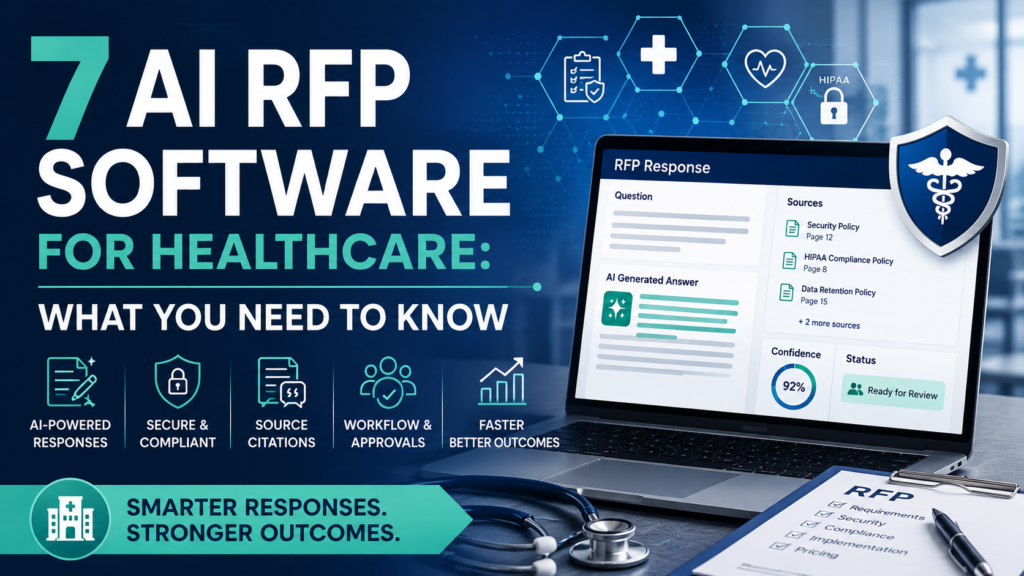
7 AI RFP Software for Healthcare: What You Need to Know

A strange thing happens when you look closely at a healthcare RFP.
At first, it seems like a writing exercise. There are questions. Your team has answers. Someone needs to put the two together.
Then you open the file.
There are 400 questions. Some are about integrations. Others are about HIPAA, disaster recovery, uptime, implementation, cybersecurity, pricing, clinical functionality, support, data retention, and contractual obligations. A proposal manager starts assigning sections. Security gets pulled in. Legal gets pulled in. Product gets pulled in. Someone asks whether an answer from last year’s RFP is still accurate.
The writing turns out to be the easy part.
That is the real reason AI RFP software has become interesting for healthcare vendors.
Tools such as Inventive AI, Loopio, Responsive, Conveyor, Arphie, Upland Qvidian, and Ombud promise to reduce the time teams spend searching for answers, drafting repetitive responses, coordinating reviewers, and maintaining proposal knowledge.
But healthcare creates a higher bar than simple speed.
An AI-generated paragraph can sound perfectly convincing and still be wrong. It can cite an outdated policy. It can repeat a commitment made to one customer as though it applies to everyone. It can turn uncertainty into certainty because certainty sounds better.
So the useful question is not simply, “Which AI RFP tool writes fastest?”
It is, “Which system helps your team get from a question to a defensible, reviewed answer with the least unnecessary work?”
That is a more interesting comparison.
What is AI RFP software for healthcare?
AI RFP software for healthcare helps organizations respond to procurement documents using artificial intelligence, approved company knowledge, content management, and workflow automation.
Those documents often include:
- Requests for proposals
- Requests for information
- Security questionnaires
- Due-diligence questionnaires
- Vendor assessments
- Technical questionnaires
- Procurement questionnaires
- Government bid documents
A health IT company responding to a hospital RFP may need information from eight different departments before the response is finished.
Sales understands the deal.
Product understands what the platform actually does.
Security knows the controls.
Legal understands the contract risk.
Implementation knows what can realistically be delivered.
Finance knows the pricing.
Clinical specialists may need to review healthcare-specific claims.
The proposal manager somehow has to turn all of that into one coherent response before the deadline.
Traditional proposal software mostly helped organize this process. Teams created reusable answer libraries, assigned questions, tracked deadlines, and assembled documents.
AI changes the search-and-drafting part.
Instead of manually finding an old answer and adapting it, an AI RFP platform can search connected company knowledge and prepare a draft.
That sounds simple, but it changes where the work happens.
The proposal manager spends less time searching.
The reviewer spends more time checking.
And that trade can be valuable if the software gives reviewers enough evidence to make those checks quickly.
7 AI RFP software platforms for healthcare compared
| Platform | Best suited to | AI response approach | Healthcare-relevant strengths |
|---|---|---|---|
| Inventive AI | AI-first healthcare RFP automation | Drafts from connected organizational knowledge with source-backed workflows | Healthcare workflows, citations, knowledge management, review controls |
| Loopio | Established enterprise proposal teams | AI responses based on permitted content sources | Mature content management, governance, enterprise security controls |
| Responsive | Large response and questionnaire teams | Source-backed AI drafting and verification | RFPs, RFIs, DDQs and security questionnaires in one system |
| Conveyor | Security-heavy healthcare sales processes | AI answers from approved security knowledge | Questionnaire automation, citations, confidence scoring |
| Arphie | AI-native RFP and DDQ workflows | AI agents using connected organizational knowledge | Sources, confidence information, collaboration |
| Upland Qvidian | Mature healthcare proposal departments | AI Assist combined with approved content and proposal automation | Document production, workflows, version control |
| Ombud | Knowledge-heavy presales teams | Machine-learning content matching and response automation | Central knowledge, questionnaires and collaborative response management |
One caution before going further: this is not a ranking of HIPAA readiness or security.
Security certifications tell you something useful about a vendor. They do not tell you whether your particular use of that software is appropriate.
That depends on what data enters the system, who processes it, what contracts are in place, what model providers are used, and how the platform is configured.
1. Inventive AI
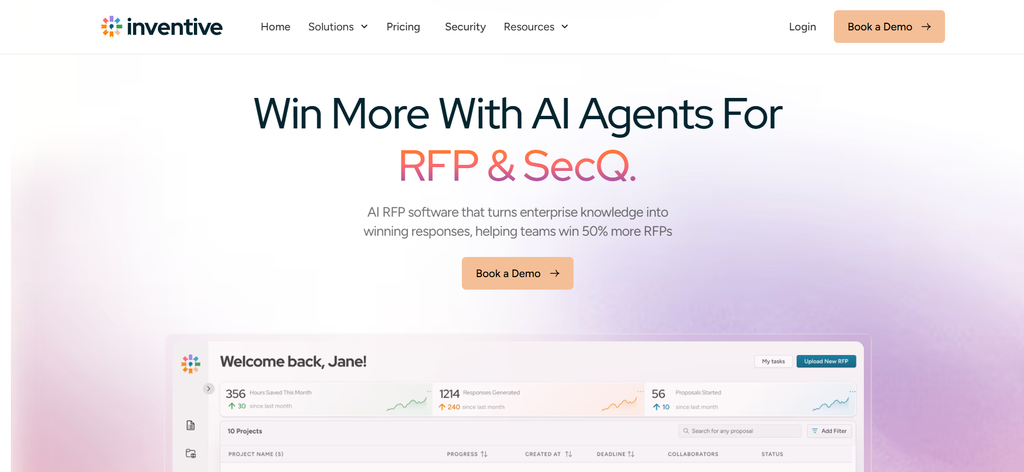
Inventive AI takes an AI-first approach to proposal responses and has a healthcare-specific RFP offering.
The platform is designed to process documents such as Word files, PDFs, and Excel sheets, retrieve relevant information from organizational knowledge, generate draft answers, and move those answers through review.
For healthcare teams, the interesting part is source visibility.
Inventive AI describes workflows where generated answers can be tied back to company material rather than appearing as unsupported text. It also discusses conflict detection, approved knowledge, reviewer assignments, and specialist review across areas such as legal, clinical, security, and product.
That matters more than it may seem.
Imagine the system generates this answer:
“Customer data is encrypted at rest using AES-256 encryption.”
A proposal manager can read that sentence and think it looks fine.
A security reviewer asks a different question: “Which current policy says that?”
The second question is the one healthcare teams need answered.
Inventive AI also connects with knowledge repositories including Google Drive and SharePoint, which can reduce the need to maintain a completely separate RFP content library.
Its healthcare materials discuss topics such as HIPAA, HITRUST, HL7, implementation, security, and technical integrations.
Published security information includes SOC 2 Type II, SSO, access controls, audit logs, and encryption.
None of those controls should be interpreted as automatic approval for every healthcare data workflow. Buyers should still examine data flows, model providers, subprocessors, retention terms, BAAs where required, and the exact security configuration being proposed.
Best suited to: Health IT vendors, healthcare SaaS companies, medical technology companies, and teams that want AI-generated drafts with visible supporting evidence.
What to test: Add an outdated document and a current document containing different answers. See whether reviewers can understand which source the AI used and whether the system surfaces the conflict.
2. Loopio
Loopio approaches the problem from a slightly different direction.
Its roots are in structured proposal content management, which makes it a natural fit for companies that already have large libraries of approved answers.
That is often the reality in established healthcare organizations.
Years of RFP work create a strange kind of institutional memory. The company knows a lot, but the knowledge is distributed across old proposals, folders, answer libraries, security files, and individual subject-matter experts.
Loopio helps organize that material and increasingly uses AI to retrieve and generate responses from it.
Its platform supports RFPs, RFIs, DDQs, and security questionnaires, along with collaboration, review processes, and integrations.
An important detail for healthcare organizations is permission-aware AI. Loopio says generated responses can use content according to the user’s permissions.
That creates a useful distinction between “the company knows this” and “this person should be allowed to access this.”
Pricing information, customer-specific contract language, security materials, and internal product documentation do not always belong in the same permission structure.
Loopio’s published security information includes SOC 2 Type II, ISO 27001, ISO 42001, AES-256 encryption, SSO, data segregation, and AWS infrastructure.
Its model makes sense for organizations that want AI inside an established content-governance process rather than replacing that process.
Best suited to: Larger proposal teams with mature reusable content and formal ownership of that content.
What to test: Take three versions of the same healthcare answer from different years and see how easily an administrator can approve the current one while preventing the others from appearing in future responses.
3. Responsive
Responsive is broader than a pure RFP-writing product.
It supports RFPs, RFIs, DDQs, security questionnaires, and related strategic response work.
That breadth becomes useful when you look at how healthcare procurement actually works.
A hospital may begin with a functional RFP.
Then comes a security questionnaire.
Then a privacy review.
Then additional legal questions.
Then procurement asks for clarification.
A response team can end up answering variations of the same question several times across several systems.
Responsive tries to keep that knowledge and workflow connected.
Its recent AI positioning gives substantial attention to source-backed answers, citations, verification, and controls intended to reduce unsupported AI output.
For healthcare teams, those capabilities deserve careful testing because a plausible answer can be worse than no answer at all.
If the software cannot support a claim, you want it to say so.
Responsive also includes security questionnaire workflows and Trust Center-related capabilities, which may suit organizations dealing with large volumes of customer due diligence.
Best suited to: Enterprise response teams that want one environment for RFPs, questionnaires, organizational knowledge, and AI-assisted responses.
What to test: Ask a compliance question that cannot be answered from any approved company source. The system’s response to uncertainty may tell you more than its response to an easy question.
4. Conveyor
Conveyor becomes especially interesting when security reviews are the real bottleneck.
Many healthcare technology vendors spend enormous amounts of time answering questions that are technically part of sales but operationally belong to security.
A hospital may ask:
How are vulnerabilities handled?
What encryption standards are used?
How long is customer data retained?
Which subprocessors receive data?
How are incidents reported?
What happens during disaster recovery?
Who can access production systems?
These are not questions a proposal writer should improvise.
Conveyor focuses heavily on automating this type of security questionnaire work.
Its platform uses an approved knowledge library to generate answers and provides citations and confidence information. It also supports questionnaire workflows across common file formats and portals.
One of the more interesting aspects of Conveyor’s public documentation is the level of detail it provides about AI model processing.
The company says it uses models from providers including OpenAI, Anthropic, and Google. It also states that customer content is sent through ephemeral requests and that it has Zero Data Retention arrangements with OpenAI and Anthropic.
Healthcare buyers should still confirm the terms that apply to their own account, but this is the kind of question every vendor should be prepared to answer clearly.
Conveyor also records draft answers, final reviewed answers, sources, grading information, collaborators, and revision history.
That can make it easier to see how a response moved from machine-generated draft to approved customer-facing statement.
Best suited to: Healthtech and healthcare SaaS organizations where security questionnaires consume significant presales or security-team time.
What to test: Load old and current security policies at the same time. See which one the system relies on and whether reviewers can identify the discrepancy quickly.
5. Arphie
Arphie is an AI-native platform for RFPs, RFIs, DDQs, and security questionnaires.
Its approach centers on AI agents working with connected organizational knowledge and returning draft answers with source information and confidence indicators.
That confidence layer is worth thinking about.
Not every RFP answer deserves the same amount of attention.
A question asking when the company was founded may be straightforward.
A question about data residency or clinical functionality may carry considerably more risk.
If the software helps reviewers distinguish between those cases, it can help teams spend their limited review time more intelligently.
Arphie supports knowledge connections and collaborative workflows, including approvals, assignments, deadline tracking, and source-backed answers.
Its published security information includes SOC 2 Type 2 and Zero Data Retention arrangements with AI model providers including OpenAI and Anthropic.
For healthcare teams, the system appears most useful where proposal managers, security staff, and sales engineers already work closely together and want a faster way to turn organizational knowledge into reviewed responses.
Best suited to: Healthcare sales engineering and proposal teams looking for a modern AI-native response workflow.
What to test: Compare the system’s confidence score against your own reviewers’ judgment on security, interoperability, contractual, and clinical questions. Does low confidence actually correspond to greater review effort?
6. Upland Qvidian
Upland Qvidian comes from the more traditional proposal-management world and has added generative AI through Qvidian AI Assist.
That history gives it a different emphasis.
Some RFP teams do not simply need answers.
They need finished documents.
A healthcare proposal may require a branded Word document, executive summary, cover letter, implementation section, formatted tables, attachments, and a PowerPoint presentation.
Answer generation is only one part of the job.
Qvidian combines content libraries, automatic response suggestions, workflow management, document analysis, versioning, and proposal assembly.
Its healthcare materials describe questionnaire importing, configurable review stages, AI-assisted rewriting, user permissions, change tracking, and version history.
That makes it more attractive for companies where proposal production itself remains complicated.
A newer AI-native platform might generate a strong answer quickly. If your team then spends hours rebuilding the final response package manually, some of the time savings disappear.
Best suited to: Mature healthcare proposal departments with formal content governance, document assembly, and multi-stage approval processes.
What to test: Run a complete healthcare proposal through the platform, including final document assembly. Measure what happens after the answers are written.
7. Ombud
Ombud approaches RFP response work through knowledge management and machine-learning content matching.
Its OmMatch technology is designed to recommend relevant material from an organization’s repository, while the wider platform supports RFPs, security questionnaires, proposals, statements of work, and collaborative response projects.
This addresses one of the least glamorous but most expensive problems in proposal work.
Someone already answered the question.
Nobody can find the answer.
The proposal manager searches old RFPs.
Security has another version.
Sales remembers that a similar customer asked the same thing six months ago.
Product updated the actual capability last quarter.
The issue is not the absence of knowledge. It is knowing which knowledge is current and where it lives.
Ombud combines centralized content with response automation and collaboration.
Its published security information includes ISO/IEC 27001:2013 certification, role-based access control, SAML-compatible SSO, encryption in transit, and automatic session controls.
Its public healthcare-specific positioning is less extensive than some other vendors on this list, so healthcare buyers should spend more time verifying how the product handles regulated information and AI processing in their intended use case.
Best suited to: Presales and proposal organizations where fragmented knowledge creates repeated searching and duplicate work.
What to test: Give the system several similar historical answers and see whether it reliably retrieves the current approved version.
Is AI RFP software for healthcare automatically HIPAA compliant?
This is where language can create more confusion than clarity.
People often ask whether a product is “HIPAA compliant” as though that were a permanent property of the software.
In practice, the question depends heavily on how the product is used.
Will PHI enter the platform?
Does the software provider receive, maintain, transmit, or process that information?
Which subcontractors may receive it?
What agreement exists between the parties?
How is access controlled?
How is information deleted?
Those questions matter more than a compliance logo.
So rather than asking one broad question, healthcare teams should ask vendors:
- Will our workflow send PHI or ePHI into the platform?
- Will you sign a BAA if our use case requires one?
- Which subprocessors handle customer data?
- Which AI providers process our content?
- Can model providers retain prompts or responses?
- Is customer content used for model training?
- Where is our information stored?
- How are permissions controlled?
- What audit logs are available?
- How is customer information deleted after account termination?
The answers should then go to the people responsible for privacy, security, compliance, and legal review.
This may seem slower than accepting a yes-or-no answer.
It is actually faster than discovering later that two people meant different things when they used the word “compliant.”
What features should healthcare companies look for?
Healthcare teams should care about writing quality.
They should care more about what happens around the writing.
Source traceability
Every important generated statement should have a clear path back to supporting company knowledge.
If a response says your company performs annual penetration testing, where did that statement come from?
Can the reviewer open the source immediately?
If verifying one sentence requires searching SharePoint manually, the AI has only moved the work around.
Approved knowledge controls
Old answers are dangerous because they look familiar.
An RFP response from two years ago may sound perfectly reasonable while describing a product architecture, SLA, certification, or process that no longer exists.
Your platform should make it clear which material is authoritative.
Conflict detection
Suppose one approved-looking document says logs are retained for 12 months.
Another says 24 months.
Which one should the AI use?
This is where good RFP automation becomes less about generation and more about knowledge management.
Silently choosing one answer is risky.
Surfacing the contradiction is useful.
Role-based access
Healthcare proposal teams often contain people who should have different levels of access.
A salesperson may need product answers but not sensitive security documents.
A proposal manager may need pricing details but not every legal file.
The system should support permissions that match the way your organization already separates information.
Review ownership
AI can prepare an answer.
It cannot decide who has authority to approve the commitment.
That distinction matters.
Security claims need security ownership.
Clinical statements may need clinical or product approval.
Contract language belongs with legal.
Pricing may require finance or sales leadership.
A good platform makes ownership visible rather than allowing accountability to disappear into the workflow.
Integrations
The best knowledge base may already exist.
It may simply be spread across:
- SharePoint
- Google Drive
- Microsoft 365
- Salesforce
- Confluence
- Notion
- Security repositories
- Product documentation
- Previous proposal libraries
Do not judge integrations by how many logos appear on a vendor page.
Judge them by whether your actual sources can stay current without creating another maintenance job.
The Syssn Evidence-to-Approval Model for healthcare RFP AI
A useful way to compare these systems is to stop thinking about how quickly the AI writes and start thinking about the full route an answer takes before submission.
At Syssn, this can be framed as an Evidence-to-Approval Model.
It is an editorial evaluation framework rather than an established industry standard.
The model scores platforms across five areas:
| Area | Weight | What to examine |
|---|---|---|
| Evidence | 25% | Can reviewers see where generated answers came from? |
| Knowledge control | 20% | Can owners approve, expire, restrict, and update content? |
| Accountability | 20% | Can the right specialist review and approve the answer? |
| Data controls | 20% | Are permissions, retention, AI processing, and audit logs clear? |
| Operational fit | 15% | Does the platform work with your repositories, files, CRM, and submission process? |
Score each area from 1 to 5 and compare every vendor using the same documents.
Why use this structure?
Because AI creates a measurement trap.
A vendor may tell you it can generate an answer in five seconds.
That sounds impressive.
But what if the security reviewer spends ten minutes finding the evidence behind it?
What if legal has no idea whether the language came from an approved source?
What if the proposal manager waits two days for clarification because nobody knows who owns the answer?
The useful metric is not time to draft.
It is time to approved answer.
That is where the actual proposal cycle improves or stays exactly the same.
How can healthcare teams reduce hallucinated RFP answers?
One tempting response to AI hallucinations is simply to add more human review.
That works, but only up to a point.
If every generated sentence has to be verified from scratch, the team has recreated manual proposal work with an AI sitting in the middle.
A better approach begins with the knowledge itself.
Start with current, approved documents.
Remove obsolete material where possible.
Require sources for high-risk claims.
Route unsupported answers to specialists.
Record who approved the final version.
Then feed reviewed answers back into the knowledge system.
The process might look like this:
- Connect authoritative knowledge. Use current policies, certifications, implementation material, approved answers, and product documentation.
- Remove or archive obsolete sources. Do not force the AI to guess which policy has authority.
- Require evidence for sensitive claims. Security, legal, privacy, clinical, pricing, and SLA answers should be traceable.
- Route uncertainty. Low-confidence or unsupported answers should reach a subject-matter expert.
- Record approval. Keep a clear record of who changed and approved the response.
- Reuse reviewed knowledge. Approved final answers should improve future responses.
There is a small organizational benefit hidden inside this workflow.
Proposal managers stop interrupting security with questions the security team has already answered 20 times.
Security specialists see fewer repetitive requests.
Sales gets better visibility into where the proposal is stuck.
AI, used well, doesn’t remove people from the process.
It removes some of the reasons they keep interrupting one another.
Traditional RFP software vs. AI-powered RFP software
The distinction between traditional and AI-powered RFP software is becoming less useful because almost every major platform is adding AI.
Still, the workflow difference is worth understanding.
| Traditional workflow | AI-assisted workflow |
|---|---|
| Search a content library | AI retrieves relevant material |
| Copy an old answer | AI drafts from source content |
| Read every requirement manually | AI extracts or categorizes questions |
| Find reviewers yourself | Workflow tools route assignments |
| Compare conflicting content manually | Some systems surface conflicts |
| Review the finished response | Review the response and its evidence |
This means the buying question has changed.
Five years ago, asking whether a platform had AI might have been useful.
In 2026, the better question is:
What does the AI do when the answer is incomplete, contradictory, sensitive, or unsupported?
Most software looks good when the answer is obvious.
Healthcare proposal work becomes difficult when it isn’t.
How should you evaluate AI RFP software for healthcare?
Use your own documents.
This is probably the most practical advice in this article.
Do not select a platform because a vendor successfully answered questions chosen for the demo.
Create a controlled test.
Use:
- One recent hospital RFP
- One difficult security questionnaire
- One technical questionnaire
- Several current authoritative documents
- One deliberately outdated document
- Two documents containing a contradiction
- One question that cannot be answered from the source material
Then score every platform on the same criteria:
- Draft accuracy
- Source quality
- Citation usefulness
- Unsupported-answer handling
- Conflict detection
- Reviewer effort
- Assignment workflow
- Export quality
- Content administration
- Permissions
- Auditability
- Integration effort
- Security documentation
- Time to approved response
The intentionally unanswerable question may be the most important test.
You already know how the software behaves when it knows the answer.
You need to discover what it does when it doesn’t.
How much does healthcare RFP software cost in 2026?
There is no reliable single price range for the platforms in this comparison because many enterprise RFP vendors use custom pricing.
Costs can vary according to:
- Number of users
- RFP volume
- AI usage
- Product tier
- Integrations
- SSO
- Security features
- Implementation
- Content migration
- Training
- Support
Ask every vendor to price the same scenario.
Use the same number of users.
The same annual RFP volume.
The same integrations.
The same implementation assumptions.
And ask which AI features demonstrated during the sales process require a higher tier.
This creates a much more useful comparison than looking at a starting license price.
A cheaper product can become expensive if your team spends hours maintaining content or manually verifying answers.
Frequently asked questions about AI RFP software for healthcare
What is the best AI RFP software for healthcare?
There is no universal best choice. Inventive AI is worth evaluating for AI-first, source-backed healthcare RFP workflows. Loopio and Upland Qvidian suit mature proposal organizations. Responsive supports broad strategic response work. Conveyor focuses heavily on security questionnaires. Arphie takes an AI-native approach, while Ombud combines proposal automation with organizational knowledge management.
Can AI RFP software reduce healthcare proposal response time?
Yes. It can reduce the time teams spend searching for old answers, drafting repetitive responses, processing questionnaires, and coordinating assignments. The actual savings depend heavily on the quality of your knowledge sources and your review process.
Can AI RFP software handle healthcare security questionnaires?
Yes. Several platforms support security questionnaires. Conveyor has a particularly strong focus in this area, while Inventive AI, Loopio, Responsive, Arphie, Qvidian, and Ombud also support questionnaire or related response workflows.
Can AI RFP software answer HIPAA questions?
It can generate draft responses using approved company policies and compliance material. Those responses should still be reviewed by the appropriate privacy, security, compliance, or legal specialist.
Does SOC 2 mean RFP software is HIPAA compliant?
No. SOC 2 and HIPAA address different requirements. Whether HIPAA obligations apply depends on the organization, the data involved, the service relationship, safeguards, and contractual arrangements.
What healthcare organizations use RFP response software?
Potential users include health IT vendors, healthcare SaaS companies, medical technology businesses, pharmaceutical and life sciences organizations, payer technology providers, consultants, and other vendors selling through formal healthcare procurement.
Can AI RFP platforms integrate with CRM systems?
Many platforms connect with CRM and knowledge systems such as Salesforce, SharePoint, Google Drive, Confluence, and Microsoft 365. The exact integration and synchronization behavior should be verified for the product tier you are considering.
Should AI-generated healthcare RFP responses be submitted without review?
Sensitive answers should be reviewed. This includes claims involving security controls, privacy, clinical functionality, pricing, regulatory requirements, service levels, and contractual commitments.
What should an AI RFP software pilot include?
Include easy questions, difficult questions, conflicting sources, obsolete material, and at least one question that cannot be answered from your approved documents. That produces a much more realistic test of the platform.
Final thoughts
The most interesting thing about AI RFP software is that the hardest problem is not really writing.
Most healthcare vendors already possess the information buyers are asking for.
The difficulty is finding the right version, knowing whether it still applies, getting the correct person to approve it, and doing all of that before the submission deadline.
Inventive AI, Loopio, Responsive, Conveyor, Arphie, Upland Qvidian, and Ombud each try to shorten that process in different ways.
Some start with AI.
Some start with content management.
Some are strongest in security questionnaires.
Others are built around mature proposal production.
The best choice will depend on where your own response process slows down.
During evaluation, give every platform the same uncomfortable test: incomplete knowledge, conflicting documents, an outdated answer, and a question nobody has answered before.
Then watch what happens.
A system that produces fluent text when everything is clear is useful.
A system that behaves sensibly when things are unclear may be much more valuable.