Software Testing Hours and Projects: What to Confirm Before You Compare Cities

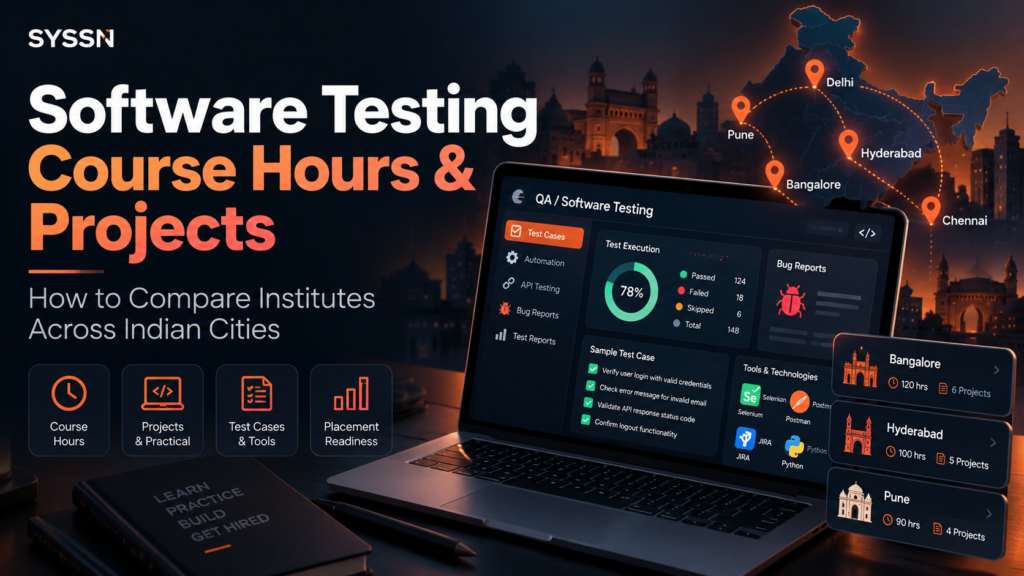
Before comparing software testing institutes across Indian cities, check how many hours are spent on live instruction, supervised practice, independent assignments, and practical projects. A longer course does not necessarily provide better training, particularly when much of the advertised duration consists of recordings or lectures.
Providers such as StarAgile, QSpiders, ExcelR, Simplilearn, and Intellipaat publish different course structures. Some specify instructor-led hours, while others emphasize calendar duration, assignments, or project counts.
Whether you are exploring training in Bengaluru, Hyderabad, Pune, Chennai, Delhi NCR, or Mumbai, the most useful comparison is what you will learn, practice, and demonstrate by the end of the program.
This guide explains how to evaluate software testing course hours and projects, compare published training information, verify practical experience, and choose a course aligned with your intended QA career.
What Are Software Testing Course Hours and Projects?
Software testing course hours describe the time allocated to different learning activities. These may include live classes, recorded lessons, guided laboratories, independent assignments, assessments, mentoring, and capstone projects.
Practical projects are structured testing activities in which learners apply their knowledge to an application or realistic testing scenario.
For example, students might test an e-commerce website, document checkout defects, automate login scenarios, or validate API responses.
The distinction matters because an institute advertising 200 hours of training may be counting very different activities from another institute advertising the same number.
Understanding different types of training hours
| Training component | What it includes | Why it matters |
|---|---|---|
| Instructor-led hours | Live explanations, demonstrations, and discussions | Builds conceptual understanding |
| Guided practical hours | Trainer-supervised exercises and laboratory sessions | Develops practical confidence |
| Independent practice | Individual testing, coding, and assignments | Strengthens problem-solving skills |
| Project hours | Integrated testing tasks and capstone work | Demonstrates applied knowledge |
| Assessment hours | Quizzes, practical evaluations, and project reviews | Measures learning progress |
| Mentoring hours | Doubt resolution, feedback, and troubleshooting | Helps learners overcome technical difficulties |
These categories should be reported separately wherever possible.
A course with 100 live teaching hours and 60 guided laboratory hours is not necessarily equivalent to one with 100 live teaching hours and 60 hours of optional recorded content.
The important distinction is between advertised duration and verified learning activities.
How Many Hours Are Needed for a Software Testing Course?
There is no universally required number of training hours for every software testing course.
The appropriate duration depends on the learner’s existing technical knowledge, the intended job role, the depth of the curriculum, and the amount of practical work included.
Someone learning manual testing fundamentals has different requirements from a learner preparing to build automation frameworks, validate APIs, and integrate automated tests into CI/CD pipelines.
Suggested training hours by learning objective
The following ranges are illustrative planning guidelines. They are not official industry requirements or minimum qualifications for employment.
| Course type | Illustrative structured hours | Primary learning objective |
|---|---|---|
| Software testing fundamentals | 40–80 | Testing principles, test cases, defect reporting |
| Manual and automation testing | 120–200 | Manual QA, programming, automation, and API fundamentals |
| Focused Selenium or Playwright training | 30–80 | Browser automation and introductory frameworks |
| Advanced QA engineering | 200+ | Integrated automation, APIs, CI/CD, and complex projects |
These ranges are useful for checking whether an advertised syllabus seems realistic.
For example, a 40-hour introductory course may provide enough structured learning to introduce manual testing concepts and basic defect reporting.
However, a course claiming to cover advanced Selenium frameworks, Java programming, API automation, performance testing, and multiple independent projects within the same 40 hours deserves closer examination.
The ISTQB Certified Tester Foundation Level syllabus provides a recognized reference for fundamental testing topics, including test design, risk management, defect management, and testing activities.
It is not a universal duration standard for commercial software testing courses. Certification preparation and broader job-oriented QA training serve different purposes.
Why total course duration can be misleading
Consider two hypothetical programs.
Course A lasts five months but provides 50 hours of live instruction, recorded lessons, and relatively limited practical assignments.
Course B lasts three months and provides 90 hours of instruction plus 60 hours of supervised laboratory work.
Course B may offer more relevant technical practice despite having a shorter calendar duration.
That does not automatically make it better. Trainer quality, curriculum sequencing, assessment difficulty, project feedback, and the learner’s available study time also matter.
Students should request a timetable showing actual instructional and practical hours instead of relying only on the number of months advertised.
How Should Classroom and Practical Training Hours Be Distributed?
A useful software testing program should balance conceptual understanding with guided exercises, independent testing, project work, and assessment.
There is no mandatory percentage of practical training that applies to every course. Nevertheless, reviewing the distribution of learning hours helps reveal how much active practice a program includes.
Example: A 160-hour software testing program
| Training component | Example hours | Expected outcome |
|---|---|---|
| Testing concepts and programming instruction | 40 | Understand QA principles and programming basics |
| Guided practical laboratories | 30 | Execute test cases and automate basic scenarios |
| Independent assignments | 45 | Develop testing and troubleshooting skills |
| Capstone projects | 35 | Complete integrated testing workflows |
| Assessments and feedback | 10 | Demonstrate skills and identify improvement areas |
| Total | 160 | Foundational and applied QA experience |
In this hypothetical design, guided laboratories, assignments, and capstone projects account for 110 hours, or approximately 69% of the program.
This is a practice-intensive example, not a standardized training requirement.
A course for absolute beginners may reasonably allocate more time to programming instruction. A course for experienced manual testers may dedicate additional hours to automation architecture and debugging.
Also, the 160-hour example includes independent study. It should not be described as 160 instructor-led hours.
How can students verify advertised training hours?
Request a module-by-module schedule showing:
- Number and duration of live instructor-led classes.
- Recorded lessons counted toward the advertised hours.
- Supervised laboratory sessions.
- Independent assignments and their estimated workload.
- Dedicated capstone project time.
- Mentoring and doubt-resolution availability.
- Practical assessments and project reviews.
Ask whether the published totals overlap.
For example, if an institute advertises 200 training hours and 100 assignment hours, establish whether the assignments are included in the 200 hours or represent additional work.
A useful example of transparent time allocation is ExcelR’s separate SWAYAM Plus testing tools certificate.
The listing specifies 10 hours of theory and 20 hours of practical learning, giving a total of 30 hours.
This is a distinct certificate course, not the complete duration of ExcelR’s broader software testing training program.
How Many Practical Projects Should a Software Testing Course Include?
For beginners studying both manual and automation testing, two or three substantial projects can provide a useful starting point.
This is an editorial recommendation, not an officially prescribed project minimum.
Project quality matters more than project count. A learner who completes three well-documented projects involving different testing activities may gain a more useful portfolio than someone who repeats 15 nearly identical automation exercises.
Ideally, a beginner portfolio should demonstrate manual test design, browser automation, and API validation.
Project 1: Manual testing of an e-commerce application
Objective: Demonstrate test design, execution, and defect management.
An e-commerce application offers a practical environment for testing registration, login, product search, shopping carts, checkout, and order management.
A learner should be able to:
- Identify functional and negative testing scenarios.
- Prepare test cases and suitable test data.
- Execute tests and document results.
- Report defects with clear reproduction steps.
- Explain defect severity and priority.
- Summarize testing coverage and unresolved issues.
For example, while testing a checkout workflow, the learner might investigate what happens when required address fields are empty, a coupon code is invalid, or a payment request fails.
A good project requires the student to make testing decisions rather than follow only a predefined answer sheet.
Expected deliverables: Test plan, test cases, defect reports, execution evidence, and a test summary.
Project 2: Web application automation testing
Objective: Demonstrate programming and automation skills.
A browser automation project might involve testing a login flow, customer dashboard, product search, or HR management application.
Students can use Selenium or Playwright with a supported programming language.
The project should demonstrate:
- Reliable element identification.
- Meaningful assertions.
- Appropriate waits and synchronization.
- Reusable test structure.
- Test data management.
- Reporting and failure investigation.
- Basic debugging and maintenance.
For example, an automated login test should do more than enter credentials and click a button. It should confirm the expected outcome and handle relevant success and failure scenarios.
The official Selenium test-practice documentation explains approaches to writing maintainable browser automation.
Similarly, Playwright’s locator documentation describes strategies for identifying elements reliably.
Expected deliverables: Executable automation code, a documented repository, test execution reports, and setup instructions.
For a more detailed learning sequence, see this Selenium automation testing curriculum guide.
Project 3: API testing and validation
Objective: Demonstrate backend testing and response validation.
An API testing project can use a sample REST API to evaluate how an application handles valid requests, invalid inputs, authentication, and error conditions.
Learners should practice:
- Sending GET, POST, PUT, and DELETE requests where supported.
- Validating response status codes and response bodies.
- Checking authentication and authorization failures.
- Testing missing and invalid fields.
- Evaluating boundary conditions.
- Writing repeatable automated assertions.
For example, a learner might test whether an API returns the expected error response when a required parameter is missing.
Postman can be used to organize requests, create collections, and execute assertions.
The official Postman API testing documentation explains how to write test scripts and validate API responses.
Expected deliverables: API collection, test scripts, relevant test data, execution results, and documented findings.
Together, these three projects provide evidence of different QA skills rather than repeated exposure to a single tool.
What Is the Difference Between Live Projects and Simulated Assignments?
Training providers sometimes advertise “live projects” without explaining what the term means.
A live project may involve a production-like application, a demonstration system, a simulated business environment, or work connected to an actual client.
These arrangements are not equivalent.
A genuine client project may involve stakeholder requirements and real delivery constraints. However, client access is not necessary for every effective learning experience.
A well-designed simulated project can also teach valuable testing skills, particularly when students must identify defects, manage changing requirements, and explain their decisions.
| Evaluation factor | Simulated assignment | Genuine client project |
|---|---|---|
| Application | Training or demonstration environment | Client-owned or client-approved system |
| Requirements | Prepared for educational use | Derived from stakeholder needs |
| Testing scope | Defined learning exercise | Depends on business requirements and access |
| Feedback | Trainer or automated evaluator | Trainer and potentially project stakeholders |
| Deadlines | Course-defined | May reflect business delivery requirements |
| Portfolio sharing | Often possible with permission | May be restricted by confidentiality |
The value of a project depends on its technical scope and the student’s responsibilities, not simply whether it is described as live.
How can students verify project authenticity?
Request a representative project brief and ask what students are expected to complete independently.
A useful project description should explain the application, requirements, testing scope, tools, expected deliverables, assessment criteria, and feedback process.
Ask whether the project involves individual or group submissions and how individual contributions are evaluated.
If the institute advertises client-based projects, clarify the client’s involvement and whether students can retain evidence of their work.
Students should never test a system without authorization or publish confidential application data, credentials, or client information in a portfolio.
What Should a Software Testing Curriculum Include in 2026?
A comprehensive beginner curriculum should establish testing fundamentals before introducing advanced automation frameworks.
The exact syllabus depends on the intended role, but the following subjects provide a practical evaluation framework.
| Curriculum area | Important topics | Suggested practical activity |
|---|---|---|
| Testing fundamentals | SDLC, STLC, test levels, testing principles | Prepare a basic test plan |
| Manual testing | Test design, regression, exploratory testing | Test an application feature |
| Defect management | Bug lifecycle, severity, priority | Document defects clearly |
| Programming | Java, Python, or JavaScript fundamentals | Write reusable programs |
| Web automation | Selenium or Playwright, locators, waits | Automate user journeys |
| API testing | HTTP, JSON, REST, authentication | Validate API responses |
| SQL and database testing | Queries, joins, data validation | Check stored information |
| Framework development | Assertions, reusable components, reporting | Build an automation framework |
| Version control | Git, repositories, collaboration | Maintain a project repository |
| CI/CD fundamentals | Automated test execution | Run tests through a basic pipeline |
Should students learn manual and automation testing?
For beginners, learning both is generally useful.
Manual testing develops the ability to understand requirements, identify risk, design relevant tests, and interpret application behavior.
Automation introduces programming techniques for executing repeatable checks efficiently.
Neither skill completely replaces the other.
A learner who can write automation scripts but cannot design meaningful test scenarios may struggle to evaluate software quality.
Likewise, someone with manual testing experience may need additional programming and framework skills when applying for automation-focused roles.
The objective is to understand what needs testing, which checks are appropriate for automation, and how to evaluate the results.
Is learning multiple automation tools necessary?
Not initially.
For beginners, developing confidence with one automation framework is generally more valuable than learning the syntax of several tools without enough practice.
Selenium and Playwright can both support browser automation, but the course should provide sufficient time for learners to understand locators, assertions, test organization, debugging, and maintenance.
Students can expand to additional tools when their job requirements or project needs justify it.
Should courses include DevOps, CI/CD, and AI-assisted testing?
Basic familiarity with Git, automated execution, and CI/CD can help learners understand how testing fits into software delivery.
Advanced infrastructure administration is not essential for every entry-level testing role.
For learners interested in broader engineering workflows, comparisons of DevOps courses with hands-on projects and beginner DevOps training programs can provide additional context.
Some current QA curricula also include generative AI tools for test-case drafting, test-data generation, or automation support.
These can be useful supplementary skills, provided learners still understand how to review generated tests, identify incorrect assumptions, protect sensitive data, and validate test results independently.
AI-assisted tools should supplement testing judgment rather than replace it.
Software Testing Course Hours and Projects: Five Training Providers Compared
StarAgile, QSpiders, ExcelR, Simplilearn, and Intellipaat illustrate different approaches to presenting software testing training.
The following comparison uses publicly available provider descriptions reviewed in October 2026.
These figures are provider-advertised course details, not independently audited teaching hours or learning outcomes. They also describe different programs and should not be interpreted as a ranking of training quality.
Published course information at a glance
| Provider | Published duration or hours | Practical learning information | Important verification point |
|---|---|---|---|
| StarAgile | 220+ live instructor-led hours | 100+ assignment hours and three capstones | Confirm overlapping hours and current capstone requirements |
| QSpiders | QSpiders Global lists a 146-hour automation curriculum | 20 project hours in that listed curriculum | Verify applicability to the chosen Indian branch |
| ExcelR | Five-month software testing course; separate 30-hour SWAYAM Plus certificate | SWAYAM Plus lists 20 practical hours | Do not combine information from different programs |
| Simplilearn | Six-month automation program with 130+ live hours | Lesson-end, phase-end, and capstone activities | Verify project scope and self-paced components |
| Intellipaat | 101 instructor-led hours and 96 self-paced video hours | 154 hours of projects/exercises and 20 advertised projects | Distinguish exercises from independent complete projects |
The table demonstrates why published figures need context.
A course advertising three extensive capstone projects cannot be compared directly with a program advertising 20 projects without reviewing the actual project briefs.
Likewise, instructor-led learning, recorded videos, and independent exercises should not be added together and presented as live training.
1. StarAgile
StarAgile’s software and automation testing program advertises more than 220 hours of live instructor-led training and more than 100 hours of practical assignments.
The provider also advertises three capstone projects.
Its published syllabus covers manual testing, programming, Selenium, browser automation frameworks, and other testing technologies.
Some subjects, including selected API, SQL, and DevOps modules, are identified as online self-learning components.
Practical project coverage
The detailed capstone section describes projects involving:
- Flight-booking application automation.
- E-commerce automation using Java, Selenium, Maven, and TestNG.
- Telecom API automation using REST Assured.
Other descriptive sections on the provider’s site refer to different project examples, so the actual capstone briefs should be confirmed for the selected intake.
What students should verify
Request the complete hours breakdown and establish whether practical assignment time is additional to live instruction.
Confirm which modules are instructor-led and which are self-paced.
Ask about individual project submissions, mentoring arrangements, capstone evaluations, and the actual technical syllabus for the selected cohort.
Main consideration: The program advertises substantial live training and practical work, but the total learning commitment and project requirements need written clarification.
2. QSpiders
QSpiders offers software training through Indian centres and online learning arrangements.
A separate QSpiders Global curriculum lists an automation testing program with 146 hours.
Its published breakdown includes:
| Curriculum component | Listed hours |
|---|---|
| Software testing | 25 |
| SQL | 18 |
| Core Java or Python | 25 |
| Logic building | 12 |
| Web technologies | 8 |
| Selenium | 26 |
| Advanced framework | 12 |
| Project work | 20 |
| Total | 146 |
This is a useful example of module-level hour disclosure.
However, the QSpiders Global listing should not be treated as confirmation of the current curriculum at any particular Indian centre.
Practical project coverage
The listed curriculum allocates 20 hours to project work.
Students should establish what those hours involve, whether projects are independently completed, and whether trainer feedback is included.
What students should verify
Ask the selected centre for its current syllabus, classroom schedule, practical lab arrangements, project briefs, and assessment requirements.
Where recruitment or placement services are advertised, confirm eligibility and availability for the specific branch and course.
Main consideration: The published module-level structure provides a useful comparison reference, but branch-level verification is essential.
3. ExcelR

ExcelR advertises multiple software testing learning options.
Its main website lists a five-month Software Testing Course, a six-month Manual Testing Course, and a three-and-a-half-month Selenium/Automation Testing Course.
These are separate offerings.
ExcelR also provides the previously mentioned 30-hour certificate through SWAYAM Plus, with 10 theory hours and 20 practical hours.
The shorter certificate should not be used to estimate the practical workload of the five-month software testing program.
Practical project coverage
ExcelR’s testing-related learning materials describe work involving manual testing, Selenium, Java, Python, API testing, and automation frameworks.
The precise project requirements depend on the course selected.
What students should verify
Confirm the exact program being quoted and request its module-level timetable.
Ask how much practical work is supervised, which projects must be completed independently, and how assignments are assessed.
Students should also confirm whether recorded sessions, project mentoring, and any career services are included in the quoted fees.
Main consideration: ExcelR offers different training lengths and learning formats, making course-specific identification particularly important.
4. Simplilearn

Simplilearn’s automation testing learning program is advertised as a six-month live online program.
The provider describes more than 130 hours of live classes covering automation testing concepts.
Its curriculum includes Java, Selenium, TestNG, Maven, API testing, performance testing, and exposure to other automation tools.
The program also discusses generative AI applications within testing workflows.
Practical project coverage
Simplilearn advertises 14 lesson-end and five phase-end hands-on projects, along with capstone-style learning activities.
Students should check the scope of each activity rather than assume all advertised projects are equivalent in difficulty or duration.
What students should verify
Request a precise breakdown of live sessions, self-paced modules, and project activities.
Confirm the programming prerequisites, expected weekly study commitment, instructor feedback arrangements, and capstone evaluation criteria.
Main consideration: The program offers a structured automation-focused learning path, but beginners should assess whether the curriculum provides enough foundational programming preparation.
5. Intellipaat

Intellipaat’s Test Architect Master’s Program advertises:
- 101 instructor-led training hours.
- 96 hours of self-paced video content.
- 154 hours of projects and exercises.
- 20 industry-based projects across its broader curriculum.
The program covers multiple testing areas, including Selenium, software/manual testing, SQL-related subjects, ETL testing, and Hadoop testing.
Practical project coverage
The published structure provides exposure to several testing specializations.
However, 154 hours of projects and exercises does not establish how much time is allocated to independently completed, full-scale projects.
What students should verify
Ask which of the 20 advertised projects are mandatory, which are guided exercises, and how individual work is assessed.
Confirm the distribution between live and self-paced modules and whether the broader specialization content is appropriate for your intended role.
Main consideration: The program offers breadth across testing disciplines, but learners focused specifically on entry-level manual or browser automation testing should evaluate the relevance of each module.
What does this provider comparison reveal?
The five programs demonstrate different ways of presenting training.
StarAgile emphasizes live classes and assignments. QSpiders Global publishes a module-based hours breakdown. ExcelR uses different duration structures across its course catalogue. Simplilearn describes a phase-based automation program, while Intellipaat separates instructor-led, self-paced, and project/exercise hours.
None of these presentation styles establishes teaching quality by itself.
A fair comparison requires students to normalize the information into the same categories before reaching a decision.
Fresh graduates can also consult this comparison of software testing courses for freshers in India for additional information about learning formats and career support.
Are Software Testing Course Hours the Same Across Indian Cities?
Not necessarily.
Even when the same organization serves students across several cities, course delivery may depend on the selected program, batch format, instructor availability, classroom arrangements, and additional support services.
For example, StarAgile’s published Delhi course information describes four months of technical training and a separate placement-support period for eligible learners.
Its Hyderabad page describes approximately four months of training within a longer overall course journey that includes other support activities.
These descriptions illustrate why calendar duration must be separated from actual technical instruction.
They do not establish that the technical curriculum is different between those cities.
What should students compare by location?
The following criteria are useful when evaluating software testing training in Bengaluru, Hyderabad, Pune, Chennai, Delhi NCR, or Mumbai.
| Comparison factor | What students should confirm |
|---|---|
| Actual delivery location | Whether teaching occurs at the advertised physical centre |
| Course format | Classroom, live online, recorded, or blended |
| Instructor assignment | Who teaches the selected batch |
| Training hours | Actual timetable and module-level hours |
| Practical facilities | Availability of supervised labs and required equipment |
| Language and interaction | Teaching language and opportunities for questions |
| Scheduling | Weekday, weekend, evening, and missed-class policies |
| Career services | Branch-specific eligibility, recruitment support, and conditions |
| Total cost | Tuition, travel, accommodation, taxes, and additional charges |
These factors are more meaningful than assuming one city provides better training than another.
Online training versus classroom training
Neither format is automatically superior.
Classroom training may help students who benefit from a structured environment, direct interaction, and scheduled practical sessions.
Live online training can provide similar instructional interaction without requiring travel or relocation.
Self-paced programs offer flexibility but generally demand more independent planning.
The right format depends on how the program is delivered and how effectively the learner participates.
Before choosing a city-specific course, confirm whether it actually offers in-person teaching at that location or delivers training remotely to students nationwide.
A Practical Checklist for Comparing Software Testing Institutes
Use the same verification checklist when requesting quotations from multiple institutes.
- Received the current module-by-module syllabus.
- Confirmed total live instructor-led hours.
- Separated recorded content, guided laboratories, and independent assignments.
- Received project descriptions and expected deliverables.
- Confirmed coverage of manual testing and relevant automation tools.
- Checked API testing and SQL/database practice.
- Verified trainer access and feedback arrangements.
- Reviewed individual versus group project requirements.
- Confirmed complete fees, taxes, refund terms, and additional charges.
- Obtained written placement assistance and eligibility conditions.
- Compared actual batch schedules and delivery locations.
- Reviewed sample assessments or attended a demonstration class.
Do not treat a missing answer as proof that a provider offers poor training. Instead, record it as unverified and ask for supporting documentation.
Where possible, retain the syllabus, quotation, timetable, and placement conditions provided before enrolment.
A Scoring Framework for Comparing Training Providers
A weighted scoring model can help students compare courses consistently.
The objective is not to create an authoritative ranking. It is to make individual priorities and trade-offs visible.
Suggested evaluation weights
| Evaluation criterion | Suggested weight |
|---|---|
| Curriculum relevance and depth | 20% |
| Supervised practical training | 25% |
| Project complexity and deliverables | 20% |
| Instructor support and feedback | 15% |
| Schedule and learning flexibility | 10% |
| Fees and contractual transparency | 10% |
| Total | 100% |
Assign each verified course a score from 1 to 5 for every category.
A score of 1 indicates that the offering is a poor match for your requirements, while 5 indicates a strong match supported by evidence.
Calculate the weighted score as:
Weighted points = (criterion score ÷ 5) × criterion weight
For example, a course scoring 4 out of 5 for supervised practical training receives:
(4 ÷ 5) × 25 = 20 points out of 25
Add the weighted points across all six criteria to obtain a total score out of 100.
Example course-comparison worksheet
| Criterion | Weight | Course A score (1–5) | Course B score (1–5) |
|---|---|---|---|
| Curriculum relevance | 20% | — | — |
| Supervised practical training | 25% | — | — |
| Project quality | 20% | — | — |
| Instructor feedback | 15% | — | — |
| Schedule flexibility | 10% | — | — |
| Fee transparency | 10% | — | — |
Students can copy this table into a spreadsheet and calculate the totals.
Use verified syllabus documents, sample project briefs, trainer interactions, and written course terms as evidence for each rating.
If important information is unavailable, leave the criterion unrated rather than assuming a neutral score.
The weights are illustrative editorial preferences and can be adjusted. For example, a working professional may place greater importance on schedule flexibility, while a beginner may prioritize supervised practice.
This framework is not a validated predictor of employment or training outcomes.
What Questions Should Students Ask Before Enrolling?
A training provider should be able to explain the actual learning process rather than only name the tools covered in the syllabus.
The following questions help establish what students are purchasing.
Questions about training hours
Ask how many instructor-led sessions are scheduled and whether practical work takes place during those sessions or separately.
Confirm the expected weekly workload, attendance requirements, missed-session policy, and duration of access to recorded materials.
A complete answer should explain how theoretical instruction and hands-on activities are counted.
Questions about projects
Ask how many complete projects each learner must submit and what evidence of completion is required.
Determine whether projects are completed individually or in groups.
Request a representative project brief, evaluation rubric, or anonymized example of student work where available.
Clarify whether mentors review testing decisions, code quality, defect reports, and troubleshooting work.
Questions about instructors
Ask who will teach the selected batch.
Confirm the instructor’s relevant subject knowledge and whether students can receive direct feedback during practical sessions.
If multiple instructors are involved, establish who is responsible for reviewing assignments and projects.
Questions about career support
Ask whether support includes resume reviews, technical mock interviews, recruiter referrals, interview opportunities, or only access to job listings.
Request written details about eligibility, attendance conditions, technical assessments, support duration, and any additional charges.
A provider’s promise of placement assistance is not the same as a guaranteed job offer.
For more guidance, read this automation testing course placement-support comparison.
Common Mistakes When Comparing Software Testing Courses
Students frequently compare course fees, certificates, and advertised durations without checking how practical skills are developed.
Several mistakes are worth avoiding.
Mistake 1: Assuming longer training means better preparation
A six-month course may provide fewer live instructional hours than an intensive three-month program.
Compare actual teaching hours, practice opportunities, project complexity, and assessments.
Mistake 2: Treating every exercise as a complete project
Writing a short Selenium script is not equivalent to developing a reusable automation framework with test data, assertions, execution reporting, and documentation.
Request project briefs before comparing project counts.
Mistake 3: Choosing a course because it lists many tools
A broad syllabus can be useful, but covering numerous technologies superficially may limit skill development.
Prioritize depth in testing fundamentals and one relevant automation framework before expanding into additional tools.
Mistake 4: Assuming identical training across locations
The same institute may offer different batch schedules, delivery methods, instructors, or support arrangements.
Verify the specific course and intake rather than relying on general brand descriptions.
Mistake 5: Confusing placement assistance with employment
Resume workshops, interview referrals, recruitment drives, and placement guarantees describe different services.
Confirm exactly what is offered and whether additional conditions apply.
Mistake 6: Ignoring the quality of feedback
Students can complete many assignments without fully understanding their mistakes.
Ask how often trainers review test cases, automation code, defect reports, and project decisions.
Meaningful technical feedback can make practical training more useful than a large volume of unreviewed exercises.
Which Training Structure Is Suitable for Different Learners?
Different learners benefit from different course designs.
Fresh graduates
A beginner-friendly program should introduce software testing fundamentals, manual test design, defect management, and programming before advanced automation.
Look for structured assignments, supervised practice, and projects that can be explained during technical interviews.
Career switchers
Learners transitioning from non-testing roles may benefit from regular live sessions, mentoring, and a curriculum that does not assume substantial programming experience.
Confirm that prerequisite knowledge is taught rather than merely listed.
Working professionals
Evening or weekend classes can be useful, provided there is enough time to complete assignments and projects independently.
Review the weekly workload and access to support outside scheduled teaching hours.
Manual testers moving into automation
Learners with existing testing experience can prioritize programming, reusable automation frameworks, API testing, version control, CI/CD exposure, and debugging.
For this group, a focused automation program may be more appropriate than repeating introductory manual testing modules.
Learners exploring broader QA specializations
Those considering database testing, performance testing, ETL validation, or advanced QA engineering should evaluate whether a broader curriculum provides enough depth in the area they want to pursue.
A large catalogue of technologies is useful only when the selected subjects align with the learner’s goals.
Frequently Asked Questions
How many hours should a beginner software testing course have?
There is no fixed requirement. An introductory program may teach testing fundamentals in several dozen structured hours, while combined manual and automation training generally requires more time for programming and practical work. Compare the scope and hours breakdown rather than treating one duration as mandatory.
How many practical projects should a course include?
Two or three substantial projects can be a useful starting point for beginners. Manual testing, browser automation, and API testing provide complementary examples. Quality, independent contribution, and trainer feedback matter more than the number advertised.
Are software testing course hours identical across Indian cities?
Not necessarily. Course schedules and delivery arrangements can vary by program, batch, centre, and instructor. Request the actual timetable for the selected course and location.
Are live client projects better than simulated projects?
Not automatically. A well-designed simulated project can teach testing skills effectively. Client projects may introduce real stakeholder requirements, but their learning value depends on the student’s responsibilities and access. Verify what work learners actually perform.
Is manual testing necessary before learning automation?
Understanding testing concepts, test design, and defect management is valuable before advanced automation. Beginners can learn programming alongside manual testing principles and then apply both skills in automation projects.
Can online software testing courses provide sufficient practical training?
Yes, provided they offer relevant exercises, project requirements, appropriate tools, and useful feedback. Live online programs can support interaction, while self-paced programs require greater independence. The delivery model alone does not establish quality.
Should students choose a course based on placement assistance?
Placement support can be useful, but it should not replace curriculum and project evaluation. Confirm exactly what the provider offers, the eligibility criteria, and the support period. Placement assistance does not guarantee employment.
How can students compare two software testing courses fairly?
Use the same criteria for both: live training hours, supervised practice, curriculum depth, project deliverables, feedback, fees, and schedule. Obtain written information and compare evidence rather than promotional claims.
Conclusion: What Matters Most When Comparing Software Testing Courses?
Software testing course hours and practical projects are useful measures only when students understand what the numbers represent.
StarAgile, QSpiders, ExcelR, Simplilearn, and Intellipaat demonstrate how differently training providers can describe instructor-led sessions, recorded learning, assignments, and project work.
No single advertised duration or project count identifies the right course for everyone.
Before enrolling, compare at least two or three current offerings using the same evaluation criteria.
Request a written syllabus, a clear hours breakdown, representative project briefs, the complete fee quotation, and any applicable career-support conditions.
Ultimately, the most useful training is the training that helps you demonstrate real testing skills: designing relevant test cases, documenting defects, automating appropriate checks, investigating failures, and explaining your decisions.
Those capabilities provide a more meaningful basis for comparing courses than calendar duration alone.