
Widewail Alternatives for Car Dealerships

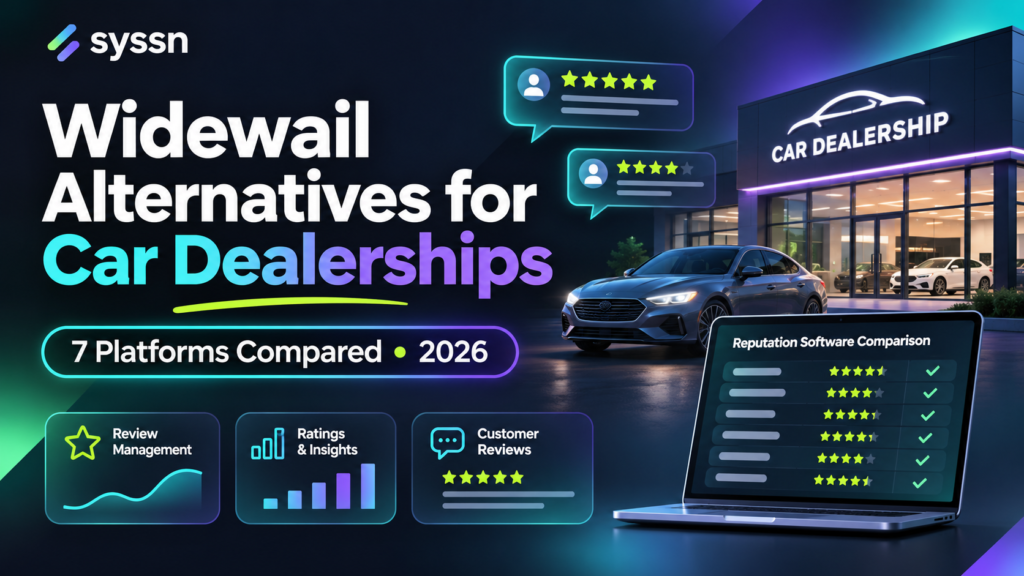
The best Widewail alternatives for car dealerships in 2026 to consider are Synup, Birdeye, Podium, Reputation, GatherUp, Kenect, and SOCi. These platforms offer different combinations of review generation, reputation monitoring, AI-assisted responses, customer communication, local SEO, and multi-location reporting.
Synup is worth evaluating for dealerships that want reviews and local SEO in one platform. Birdeye offers configurable AI review management, while Podium focuses on customer texting and engagement. Reputation and SOCi are relevant to larger dealer networks, GatherUp offers published pricing for core reputation management, and Kenect emphasizes automotive communication workflows.
Widewail remains a credible choice for automotive-focused reputation management, particularly when professionally managed responses and dealership customer intelligence are priorities. However, a dealership may prefer another provider if it needs different pricing, broader marketing capabilities, or more control over customer communication.
This guide compares seven Widewail competitors using publicly documented features and pricing, examines their limitations, and explains how dealerships can evaluate software before switching.
What Is Widewail, and How Does It Work for Car Dealerships?
Widewail is an automotive customer intelligence and reputation management platform designed for dealerships, dealer groups, and automotive organizations.
It combines customer review generation, feedback collection, review responses, business listings management, reputation reporting, and competitive benchmarking.
Unlike a basic review-monitoring tool, Widewail focuses on connecting customer feedback with dealership sales and service operations.
Its capabilities include:
- Automated review requests: Collect customer feedback through supported dealership workflows and integrations.
- Review response management: Use AI-assisted responses or professionally managed responses, depending on the package.
- Customer surveys: Gather feedback about vehicle purchases, service appointments, and other customer experiences.
- Listings management: Maintain accurate dealership information across supported directories.
- Competitive benchmarking: Compare dealership reputation performance with relevant automotive competitors.
- Customer Clarity: Analyze feedback themes, employee performance, and operational issues using available review and dealership data.
Widewail’s Main Packages
Widewail publishes three packages for single-rooftop dealerships.
| Package | Published monthly price | Main capabilities |
|---|---|---|
| Core | $500 per rooftop | Review requests, surveys, listings, AI/self-service responses, reputation reporting |
| Pro | $750 per rooftop | Core features plus managed responses, social media services, and competitive benchmarking |
| Customer Clarity | $1,200 per rooftop | Pro features plus deeper operational analytics, staff performance reporting, and recommendations |
Widewail’s Customer Clarity package specifies CDK-only DMS integration for its deeper operational intelligence at launch. Dealerships using other DMS platforms should verify which integrations and reports are available.
Multi-rooftop pricing is customized.
Why Do Car Dealerships Look for Widewail Alternatives?
Dealerships typically compare alternatives when their existing software does not fully match their budget, operating model, or marketing requirements.
Common reasons include:
- Finding a lower-cost subscription for essential review management.
- Combining reputation management with local listings and SEO.
- Managing customer texting, webchat, and review requests in one system.
- Using AI-generated review responses with configurable human approval.
- Improving centralized reporting across multiple dealership locations.
- Connecting review requests to existing DMS or CRM workflows.
- Reducing the administrative work required to monitor and respond to feedback.
These needs differ by dealership size.
An independent used-car dealership may primarily need automated review requests and a simple dashboard. A franchised dealership may need separate sales and service workflows. A 30-rooftop dealer group may require regional reporting, standardized response policies, and oversight across multiple brands.
Widewail’s automotive specialization is valuable, but another platform may be more suitable when broader local marketing or customer communication is the main requirement.
Quick Comparison: Best Widewail Alternatives for Car Dealerships
| Platform | Best suited for | Main advantage | Key consideration |
|---|---|---|---|
| Synup | Dealerships combining reviews and local SEO | Review management, AI-assisted responses, listings, and local marketing | Verify automotive DMS and CRM integration requirements |
| Birdeye | Dealership groups needing configurable AI workflows | Review generation, AI responses, customer feedback, and messaging | Confirm product modules and automation permissions |
| Podium | Dealerships prioritizing texting and customer communication | SMS review requests, unified inbox, and AI assistance | Broader communication suite may exceed review-only needs |
| Reputation | Larger dealer groups and automotive networks | Reputation analytics, surveys, benchmarking, and enterprise reporting | Advanced capabilities may require higher tiers or add-ons |
| GatherUp | Smaller dealerships and agencies | Review campaigns, surveys, reporting, and published prices | Not an automotive-specific platform |
| Kenect | Automotive texting and managed reputation | Dealership communication, review requests, and managed services | Review solicitation workflows require careful policy review |
| SOCi | Large multi-location organizations | AI reputation automation and centralized marketing governance | Integration and deployment requirements need confirmation |
Which platform should you shortlist?
Synup is a starting point when reviews and local SEO need to work together. Birdeye is relevant for configurable AI reputation workflows. Podium and Kenect deserve consideration when customer communication is a primary requirement.
Reputation and SOCi are suited to evaluating broader enterprise needs, while GatherUp may appeal to dealerships seeking a focused reputation management product with transparent pricing.
These recommendations indicate product suitability, not independently tested performance rankings.
How We Evaluated Widewail Competitors
This comparison focuses on US automotive businesses, including independent dealerships, franchised locations, and multi-rooftop dealer groups.
Seven criteria were used to assess the platforms.
Review generation: Whether the software supports structured requests for authentic customer reviews and feedback after relevant customer interactions.
Review monitoring: Whether dealerships can monitor feedback from Google, Facebook, and automotive review websites such as DealerRater and Cars.com, subject to platform support.
AI-assisted responses: Whether the software offers AI suggestions, automated replies, approval workflows, and escalation options.
Dealership integration: Whether documented integrations or workflows support automotive sales, service, CRM, and DMS requirements.
Multi-location capabilities: Whether the software supports centralized monitoring, location-level reporting, permissions, and operational oversight.
Additional functionality: Whether it includes listings management, customer messaging, surveys, competitive analysis, or broader local marketing.
Pricing and limitations: Whether public pricing is available and what additional implementation, integration, or managed-service costs buyers may encounter.
Research was based on vendor websites, product documentation, pricing pages, and relevant industry guidance available as of November 11, 2026.
This is a documentation-based editorial comparison. It does not claim independent product testing, verified customer results, or direct access to private vendor contracts. The seven platforms are presented as relevant options rather than ranked by independently measured superiority.
Dealership groups evaluating corporate and location-level permissions can also consult the franchise local marketing software buyer’s guide.
Widewail Alternatives for Car Dealerships in 2026
1. Synup — Best for Dealership Reputation Management and Local SEO
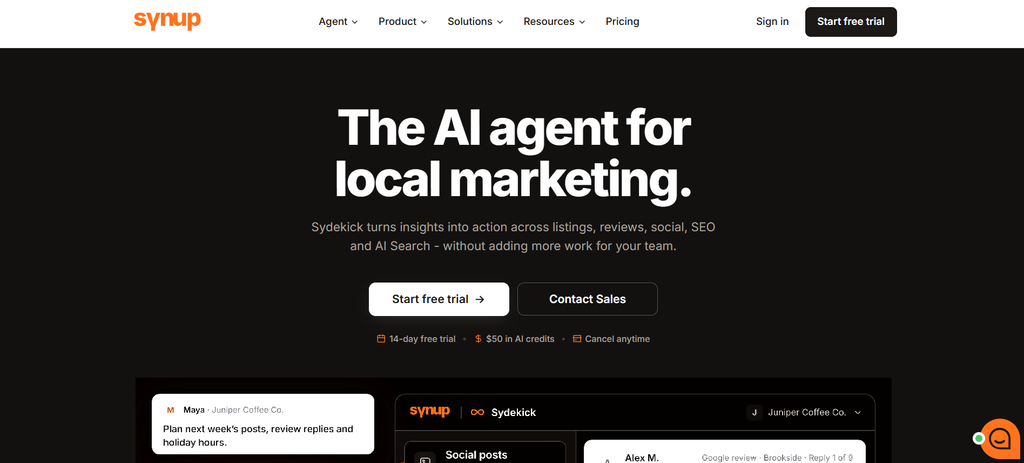
Best for: Independent dealerships, multi-location automotive businesses, and agencies that want reputation management alongside local listings and SEO.
Synup is a multi-location marketing platform that combines review management, business listings, local search visibility tools, review generation, and AI-assisted workflows.
For car dealerships, Synup’s main advantage is the ability to manage reputation and local business information together.
A dealership can use the platform to monitor customer feedback while maintaining location details such as addresses, contact information, business hours, and supported directory listings.
This is particularly useful for dealerships that manage multiple locations or separate customer-facing departments.
Key Features
Centralized review management
Synup brings supported customer reviews into a location-based interface, helping dealership teams monitor feedback without checking every platform individually.
AI-assisted responses
The platform offers AI-generated review replies with configurable approval processes. Dealership staff can review responses before publication where appropriate.
Review generation campaigns
Dealerships can create customer review request campaigns and track activity across locations.
Business listings management
Synup supports the distribution and maintenance of business information across its connected publisher network.
Local search visibility
The platform includes local rank tracking and visibility reporting, which can help dealership marketers examine how their locations appear for relevant local searches.
Multi-location management
Dealership groups can manage location information, review activity, and marketing operations through a centralized platform.
Limitations
Synup is not exclusively built for automotive retail.
Dealerships should verify whether the platform integrates directly with their DMS, CRM, and preferred automotive review websites.
For example, a franchised dealership using CDK or Reynolds & Reynolds should confirm whether review requests can be triggered automatically after qualifying vehicle sales or completed repair orders.
Teams should also confirm the difference between monitoring reviews, drafting responses, and directly publishing replies on each supported review source.
Synup may be broader than necessary for businesses seeking only professionally managed review responses.
Pricing
Synup publishes the following monthly plans:
| Plan | Monthly price | Included locations |
|---|---|---|
| Solo | $49 | 1 |
| Premium | $299 | Up to 10 |
| Pro | $499 | Up to 25 |
| Scale | $899 | Up to 50 |
| Enterprise | Custom | More than 50 |
Plans differ in location capacity, AI credits, and agent resources. Buyers should confirm applicable billing terms and usage allowances.
Choose Synup if: Your dealership wants review management, AI-assisted responses, business listings, and local marketing capabilities from one provider.
2. Birdeye — Best for AI-Powered Dealership Review Management
Best for: Dealership groups that want configurable AI review workflows, centralized customer feedback, and reputation analytics.
Birdeye is a reputation management and customer experience platform with automotive-specific solutions.
It combines review generation, review responses, customer messaging, listings management, surveys, and feedback analysis.
Birdeye is relevant to dealerships that need more than a basic system for collecting Google reviews.
For example, a dealership group can use configured workflows to monitor customer feedback and route sensitive reviews to staff members rather than automatically publishing every AI-generated response.
Key Features
Automated review requests
Birdeye supports review request campaigns through configured customer communication workflows.
AI review response management
Its Review Response Agent can analyze incoming feedback and generate context-aware responses.
Documented response configurations include automatic responses, suggested replies, and human approval before publishing.
Customer feedback monitoring
Birdeye consolidates feedback from supported review sources to help dealership managers track reputation activity.
Customer experience insights
The platform provides tools for analyzing customer feedback and identifying recurring concerns.
Multi-location operations
Birdeye supports organizations managing reviews and customer experience across multiple business locations.
Limitations
Birdeye offers several products and capabilities, so dealerships should confirm which modules are included in their proposed subscription.
AI response functionality, messaging, surveys, and advanced reporting may involve different configurations or commercial terms.
Automotive buyers should also verify DMS integration availability, supported review sources, and response publishing permissions.
Pricing
Birdeye provides tailored pricing based on the products and capabilities a business deploys.
Its public pricing page does not provide one universal monthly price for automotive dealerships.
Request a quotation that specifies location counts, AI functionality, review campaigns, messaging allowances, integrations, and onboarding.
Choose Birdeye if: Your dealership group needs configurable AI review management alongside broader customer experience and communication capabilities.
3. Podium — Best for Dealership Texting and Review Automation
Best for: Car dealerships that prioritize SMS communication, customer engagement, and review requests connected to everyday conversations.
Podium combines online review management with customer messaging, lead communication, and AI-powered workflows.
Its main distinction from Widewail is its broader focus on communication throughout the customer journey.
For example, a dealership may want to text a service customer with an appointment update, respond to a question, and send a review request after the service interaction.
Podium provides tools intended to support these activities within a connected communication system.
Key Features
SMS review requests
Podium supports automated review invitations and reminders through text messaging.
AI Reputation Specialist
The platform provides AI assistance for creating review invitations and personalized responses.
Unified inbox
Dealership employees can manage supported customer conversations and review interactions from a consolidated interface.
Review reporting
Podium provides reporting on review activity and customer feedback.
Customer messaging
The platform supports texting, website chat, and other communication workflows.
Lead communication
Dealership teams can use Podium’s broader tools to manage inquiries and customer follow-up.
Limitations
Podium is broader than a dedicated reputation management product.
A dealership needing only review monitoring and response management may not require its complete communication offering.
Businesses prioritizing listings management or detailed competitive reputation benchmarking should compare those capabilities separately.
Dealerships should also verify which automotive integrations, AI tools, and messaging allowances are included in their selected package.
Pricing
Podium’s pricing is customized according to business needs and selected capabilities.
The company directs buyers to its sales team rather than publishing one universal automotive subscription price.
Request an itemized quotation covering review management, customer messaging, AI features, locations, usage limits, and implementation.
Choose Podium if: Your dealership wants customer texting, lead communication, and review management to operate within the same platform.
4. Reputation — Best for Enterprise Automotive Reputation Management
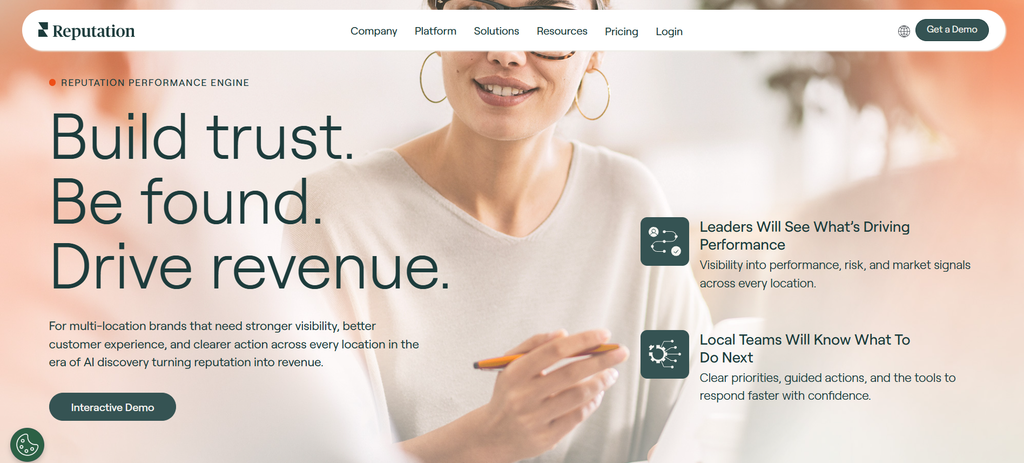
Best for: Large dealership groups, OEM organizations, and automotive networks that need centralized reputation reporting and customer experience insights.
Reputation provides an enterprise reputation management and customer experience platform with automotive-focused capabilities.
It combines review management, listings, surveys, social engagement, customer feedback analysis, and competitive intelligence.
Its organizational approach is useful when headquarters needs visibility across multiple dealership groups, regions, or brands.
For example, an automotive group may want to compare service-related complaints across regions while allowing individual dealership managers to handle their own customer responses.
Key Features
Centralized review management
Reputation supports review collection, monitoring, and response workflows.
RepScore
Its reputation scoring capability helps organizations evaluate reputation performance across business locations.
Customer surveys
The platform provides feedback collection tools to complement public reviews.
Competitive insights
Available capabilities help organizations benchmark reputation performance against relevant competitors.
Enterprise analytics
Reputation supports reporting designed for complex multi-location organizations.
Listings and local SEO
The platform helps maintain accurate dealership business information across supported online services.
Limitations
Reputation’s broader enterprise capabilities may exceed the requirements of a small dealership seeking straightforward review requests.
Advanced analytics, competitive insights, managed services, and integrations may depend on package selection or additional purchases.
Buyers should confirm which reporting features are included and whether their existing automotive systems are supported.
Pricing
Reputation publishes the following platform prices:
| Plan | Published monthly price per location | Main focus |
|---|---|---|
| Rep Core | $80 | Reviews, AI responses, listings, and SEO |
| Rep Core + Pulse | $115 | Core features plus reputation insights, AI management, and basic surveys |
| Rep Core + Surveys | $150 | Expanded survey and customer feedback capabilities |
| Enterprise | Custom | Larger deployments and customized requirements |
Enterprise pricing is available for organizations with 125 or more locations. Competitive insights, premium integrations, and managed services are listed among additional offerings.
The published rates should not be treated as guaranteed automotive dealer-group contract prices.
Choose Reputation if: Your organization needs review management connected with customer experience analysis, multi-location reporting, and executive oversight.
5. GatherUp — Best for Focused Review Generation and Transparent Pricing
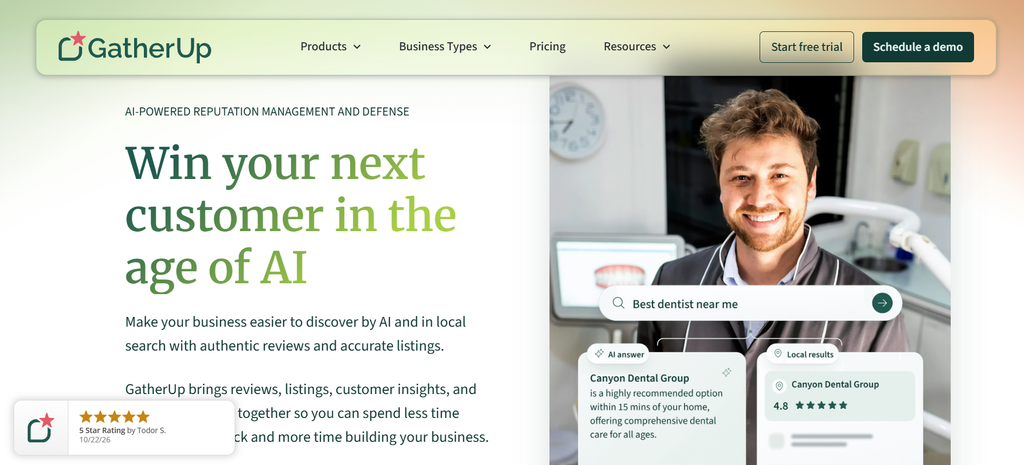
Best for: Independent dealerships, smaller automotive businesses, and agencies seeking core reputation management with published prices.
GatherUp focuses on customer review generation, feedback collection, review monitoring, response management, and reporting.
Compared with larger marketing and communication suites, GatherUp places greater emphasis on the reputation management workflow itself.
This can make it relevant to dealerships that already have a CRM, customer messaging platform, and other marketing tools.
A smaller dealership, for example, may need a consistent way to invite customers to share feedback, monitor reviews, and identify problems without purchasing an extensive enterprise marketing package.
Key Features
Review request campaigns
GatherUp supports customer feedback and review requests through configured campaigns.
Review monitoring
The platform monitors reviews from supported websites.
AI-assisted responses
GatherUp includes AI-crafted replies and tools for managing review responses.
Customer surveys
The platform supports customer feedback surveys, including Net Promoter Score workflows.
Reporting and analysis
Dealerships can monitor review activity, customer feedback trends, and location-level performance.
Integrations
GatherUp documents API, Zapier, and webhook capabilities that may help connect customer data and review workflows.
Limitations
GatherUp is not an automotive-specific DMS platform.
Dealerships should verify whether review requests can be triggered automatically from their existing sales and service systems.
Listings management is sold separately from the core reputation management product.
Dealerships that require extensive customer texting, webchat, or automotive-specific managed responses should evaluate those needs separately.
Pricing
GatherUp publishes these starting prices:
- Local Businesses: $99 per month for one location, billed annually.
- Multiple Locations: Advertised from $60 per month per location, billed annually, with rates varying by location count.
- Agency: Custom pricing.
- Listings Management: $40 per month per location as a separate product.
Annual and month-to-month billing options are available for selected products. Buyers should verify how location count and commitment length affect their final rates.
Choose GatherUp if: Your dealership wants review generation, customer feedback collection, and reputation reporting without adopting a broader marketing suite.
6. Kenect — Best for Automotive Texting and Managed Reputation
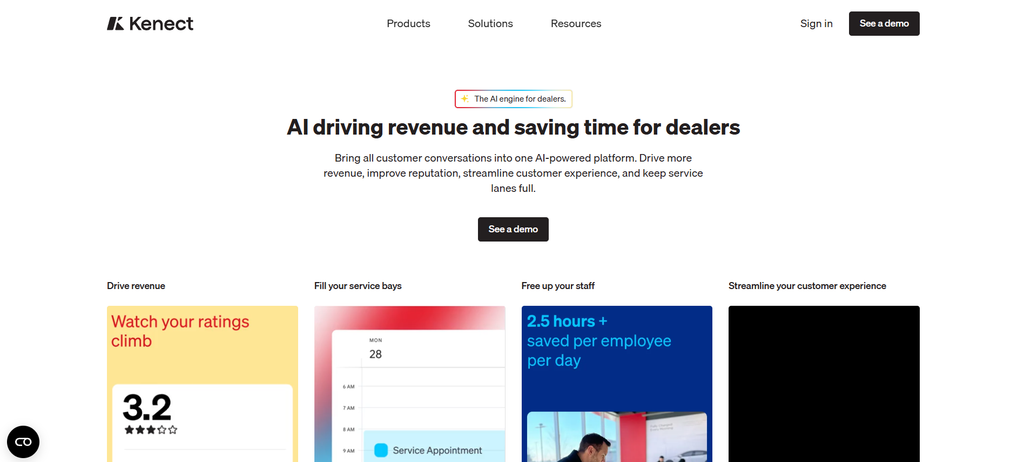
Best for: Automotive dealerships that want customer communication, automated review requests, and managed reputation services within one vendor relationship.
Kenect provides automotive customer communication software covering business texting, webchat, AI-assisted communication, review generation, and managed reputation services.
Its dealership-oriented positioning makes it particularly relevant to businesses seeking review management connected with sales, service, and customer communication.
For example, a service department may use supported workflows to send appointment updates and communicate with customers after repair work has been completed.
Key Features
Automated review invitations
Kenect advertises review requests triggered after vehicle sales, service appointments, and other customer interactions.
Automotive review monitoring
The company describes support for reputation activity across Google and automotive-focused platforms, including DealerRater, Cars.com, and CarGurus.
Managed reputation services
Kenect offers assistance with review monitoring, responses, and reputation management.
Business texting
Dealership employees can communicate with customers through text messaging.
Webchat and lead communication
Kenect provides tools for turning website inquiries into customer conversations.
Dealership integrations
The platform advertises integrations intended to connect communication workflows with dealership systems.
Limitations
Kenect’s advertised Private Feedback workflow raises an important policy consideration.
Its product description explains that positive feedback can be routed toward public review platforms while negative feedback is directed toward private communication.
Google prohibits selectively soliciting positive reviews and discouraging negative reviews.
Therefore, dealerships should not assume that every vendor-provided review solicitation workflow is suitable for Google Business Profile.
Before implementing Kenect, request a demonstration of a neutral review invitation process that does not exclude dissatisfied customers from public review opportunities.
Kenect’s broader communication tools may also be unnecessary for businesses seeking only review analytics.
Pricing
Kenect provides customized quotations rather than a universally published automotive subscription rate.
Buyers should request pricing for review management, managed responses, messaging, AI functionality, and required integrations.
Choose Kenect if: Your dealership wants automotive-focused customer communication and managed reputation services, provided the configured review solicitation process complies with applicable platform policies.
7. SOCi — Best for Enterprise AI Reputation Automation
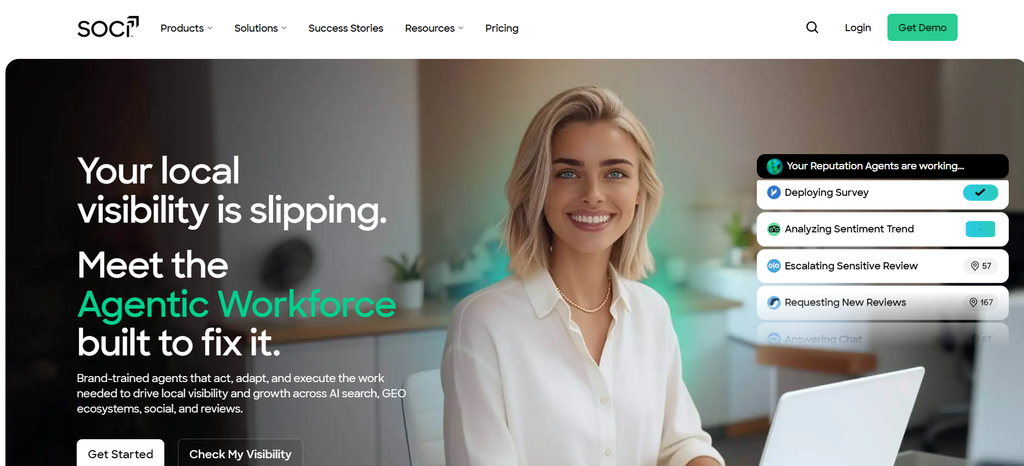
Best for: Large automotive groups and multi-location organizations requiring centralized marketing governance, AI-assisted reputation management, and consistent brand communication.
SOCi is a multi-location marketing platform combining reputation management, local search, listings management, social marketing, and AI automation.
Its Genius Reputation Agent supports review response workflows, customer surveys, sentiment analysis, and feedback escalation.
SOCi is particularly relevant when a central marketing team oversees many locations but needs local employees to retain responsibility for customer issues.
For example, a dealer group may want consistent review response guidelines across its dealerships while routing complaints about financing or service disputes to designated managers.
Key Features
AI-generated review responses
SOCi’s Genius Reputation Agent can generate responses according to configured brand guidelines.
Approval and escalation controls
The platform supports rules for automated responses and human handling of sensitive feedback.
Review monitoring
SOCi monitors customer feedback across supported review platforms.
Voice of Customer analysis
The platform groups feedback into themes and identifies sentiment patterns across locations and regions.
Customer surveys
SOCi includes survey and customer feedback functionality.
Multi-location marketing
Its broader platform includes local search and social marketing capabilities that can complement reputation management.
Limitations
SOCi primarily targets multi-location organizations, so its scope may exceed the requirements of an independent dealership.
Automotive businesses should verify DMS and CRM compatibility, supported review platforms, and required reporting configurations.
Its AI workflows also need clear approval, privacy, and escalation policies.
SOCi’s advertised customer feedback workflows should be reviewed to ensure public review requests do not selectively favor customers reporting positive experiences.
Pricing
SOCi provides customized pricing based on location counts and the Genius Agents and capabilities deployed.
The company does not publish one universal monthly subscription price for automotive reputation management.
Some capabilities may have usage allowances, so dealerships should request a quotation describing all relevant limits and services.
Choose SOCi if: Your dealership group needs enterprise-scale reputation automation, centralized brand governance, and broader local marketing capabilities.
For a related comparison of multi-location reputation platforms, see Chatmeter alternatives for franchise brands.
Widewail vs. Competitors: Pricing Comparison
Subscription pricing is one useful starting point, but it should not determine the decision on its own.
| Platform | Published starting price | Pricing consideration |
|---|---|---|
| Synup | $49/month for one location | Higher plans cover multiple locations; AI usage allowances apply |
| Birdeye | Custom quote | Price depends on selected products and business requirements |
| Podium | Custom quote | Confirm messaging, review, and AI features included |
| Reputation | $80/location/month | Advanced insights, surveys, and enterprise services vary by tier |
| GatherUp | $99/month for one location, billed annually | Multi-location pricing available; listings sold separately |
| Kenect | Custom quote | Confirm managed services and dealership integrations |
| SOCi | Custom quote | Priced according to locations and deployed capabilities |
| Widewail | $500/rooftop/month | Higher packages include managed responses and deeper automotive intelligence |
Prices are in US dollars and reflect published vendor information reviewed in November 2026. They may change and do not necessarily represent equivalent product packages.
Why the Lowest Subscription Price May Not Be the Best Value
Consider two hypothetical dealerships.
Dealership A has one location, an existing CRM, and a manager who can review customer feedback daily.
This dealership may prefer a lower-cost platform that handles review requests, monitoring, and AI-assisted drafts.
Dealership B operates ten rooftops and receives substantial feedback across sales and service departments.
Its managers may not have enough time to write responses, monitor recurring complaints, or compare performance across locations.
A more expensive solution with managed responses and centralized reporting may reduce internal administrative work.
The correct comparison is therefore the total cost of running the required reputation management process.
Dealerships should account for:
- Subscription and location fees.
- Review request and messaging allowances.
- AI response functionality.
- Managed response services.
- DMS and CRM integration costs.
- Listings management.
- Onboarding and employee training.
- Reporting and data export capabilities.
- Contract terms and cancellation conditions.
- Internal staff time required after implementation.
A platform with a lower monthly price can still require more internal effort.
Likewise, a higher-priced platform is not necessarily better if the dealership will not use its additional capabilities.
Widewail vs. Birdeye vs. Podium vs. Reputation
These four platforms overlap in reputation management but serve somewhat different operational priorities.
Widewail vs. Birdeye
Widewail emphasizes automotive-specific review workflows, managed responses, and dealership customer intelligence.
Birdeye emphasizes configurable AI review automation and a broader customer experience platform.
Evaluate Widewail when dealership-specific reputation workflows, managed responses, and automotive competitive insights matter most.
Evaluate Birdeye when the dealership wants configurable AI responses, customer feedback tools, and broader customer engagement capabilities.
The decision should include a demonstration of the actual sales and service workflows rather than relying only on feature lists.
Widewail vs. Podium
Widewail is oriented toward reputation generation, response management, and customer intelligence.
Podium connects review management to a broader communication system that includes texting, lead engagement, and customer conversations.
Evaluate Widewail when the dealership already has adequate communication software and needs a focused reputation partner.
Evaluate Podium when reducing the number of separate tools used for customer communication and review requests is a priority.
Widewail vs. Reputation
Widewail offers automotive-focused reputation capabilities and managed response services.
Reputation provides broader enterprise customer experience functionality, including surveys, analytics, reporting, and competitive intelligence.
Evaluate Widewail when the dealership wants an automotive-specific approach to managing customer reviews and operational feedback.
Evaluate Reputation when the organization needs reputation and customer experience reporting across a larger or more complex network.
When Staying With Widewail Makes Sense
Switching platforms is not always necessary.
Widewail may remain the appropriate solution if a dealership already benefits from its managed responses, review generation workflows, automotive reporting, and customer intelligence features.
Before switching, determine whether the problem is missing functionality, an integration limitation, pricing, or poor adoption of existing capabilities.
A platform change introduces migration work and employee retraining. Those costs should be justified by a clear operational improvement.
Why Online Reputation Management Matters for Car Dealerships
Customers use dealership reviews to evaluate experiences beyond the initial vehicle purchase.
Feedback about service departments, financing communication, repair quality, staff professionalism, and warranty support can influence how potential customers assess a dealership.
For automotive businesses, the customer relationship often continues through maintenance, repairs, parts purchases, and future vehicle transactions.
According to the National Automobile Dealers Association’s 2026 mid-year data, US franchised light-vehicle dealerships completed more than 136 million repair orders during the first half of 2026, generating nearly $83 billion in service and parts sales.
These figures illustrate the scale of dealership fixed operations and why service-department feedback deserves attention alongside sales reviews.
Reputation Management and Local Search
Google identifies relevance, distance, and prominence as major factors in local search rankings.
Its official local ranking guidance recommends maintaining complete business information and responding to customer reviews.
More reviews and positive ratings can contribute to local prominence, but no reputation management platform can guarantee a particular Google Maps ranking.
Dealerships should also maintain accurate information about their locations and services.
For example, sales and service departments may have different customer-facing hours. Businesses should follow Google’s eligibility and representation guidelines when managing department profiles.
Maintaining accurate business information is therefore an important complement to review management.
For additional context, see what local listings management involves.
Reputation Management and Customer Experience
Reviews can reveal recurring operational issues.
Suppose a dealership receives several complaints about service appointment delays.
The reputation team should not simply publish apologetic replies. Managers can examine whether the complaints relate to scheduling, parts availability, communication, or repair completion times.
Similarly, repeated feedback about unclear financing communication may justify reviewing how employees explain costs and terms.
A useful reputation management platform should help teams identify patterns and assign responsibility for investigating them.
That process is more valuable than treating review count as the only measure of success.
Can Car Dealerships Automate Google Review Requests and Responses?
Yes. Dealerships can automate review invitations and use AI-assisted tools to manage responses, provided their workflows follow applicable review platform policies.
Google offers an official review link and QR code process that businesses can use to invite customers to share their experiences.
Reputation management platforms can incorporate supported review links into customer communication workflows.
Example of a Compliant Dealership Review Workflow
A practical process may work as follows:
- A customer completes a vehicle purchase or service appointment.
- The dealership’s authorized system records the completed interaction.
- A configured workflow sends a neutral request inviting the customer to share an honest review.
- The customer independently decides whether to leave a review and what to say.
- The reputation management platform monitors the resulting feedback where supported.
- Routine reviews receive an approved response or an AI-generated draft.
- Sensitive complaints are assigned to a manager for review and follow-up.
The invitation should not depend on the customer first reporting a positive experience.
For example, a dealership should not ask customers whether they were satisfied and then send only satisfied customers a Google review link.
It may collect private feedback to improve service, but private feedback should not be used to deny dissatisfied customers the same opportunity to leave a public review.
Google Review Policies Dealerships Must Follow
Google prohibits practices including:
- Buying or generating fake reviews.
- Offering incentives in exchange for reviews.
- Selectively soliciting positive reviews.
- Discouraging customers from leaving negative reviews.
- Pressuring customers to submit specific ratings or review content.
Dealership employees should not be encouraged to manipulate reviews or pressure customers to identify individual staff members.
These restrictions are explained in Google’s Maps review and rating manipulation policies.
The FTC’s consumer review and testimonial rule also addresses fake reviews, sentiment-conditioned incentives, and specified review suppression practices.
Different review websites may impose different solicitation rules. For example, Yelp advises businesses not to request reviews.
Review platforms should not be treated as interchangeable destinations for automated invitation campaigns.
Should Dealerships Automatically Publish AI Review Responses?
AI can reduce repetitive writing, but not every review should receive an automatic response.
A brief positive review may be suitable for a response generated according to approved brand guidelines.
However, complaints involving financing, disputed repairs, warranty obligations, customer privacy, employee misconduct, or threatened legal action should normally be routed to an authorized employee.
A dealership’s AI response policy should define:
- Which review types qualify for automatic publishing.
- When human approval is mandatory.
- Which employees receive sensitive complaints.
- Whether the system can access verified customer records.
- How to prevent disclosure of personal information.
- How managers can correct or override generated responses.
The goal is to improve consistency without allowing automation to publish inaccurate statements or mishandle customer disputes.
How to Choose the Right Widewail Alternative
The right platform depends on how the dealership operates and which tasks it wants the software to handle.
For Independent Car Dealerships
Start with the essential requirements:
- Requesting authentic customer reviews.
- Monitoring relevant review platforms.
- Responding efficiently.
- Tracking basic reputation performance.
- Managing subscription costs.
Synup and GatherUp offer published entry-level prices, making them useful starting points for budget comparisons.
Podium may also be relevant if texting and lead communication are important requirements.
Small dealerships should avoid paying for extensive enterprise capabilities they do not need.
For Franchised Car Dealerships
Integration compatibility becomes especially important.
A franchised dealership may need review requests after completed sales, service appointments, or repair orders.
The platform must work with the dealership’s actual systems, not simply advertise generic automotive integrations.
Widewail and Kenect are relevant to automotive-specific workflows. Birdeye and Podium provide broader customer engagement functionality.
Ask vendors to demonstrate how review requests are triggered, which customer records are used, and how employees manage responses.
For Multi-Location Dealer Groups
Large dealership groups need centralized oversight without removing accountability from local managers.
Reputation, SOCi, Birdeye, and Synup are candidates for evaluating multi-location requirements.
Important capabilities include:
- Regional and rooftop reporting.
- Role-based permissions.
- Corporate response guidelines.
- Review escalation and assignment.
- Location-level performance comparisons.
- Centralized listings management.
- Data exports and management reporting.
For example, a dealership group might want corporate employees to define response policies while local service managers handle complaints specific to their stores.
Ask vendors to demonstrate this exact permission structure.
For related purchasing considerations, see business listing management services for multi-location brands.
For Specialized Automotive Businesses
Passenger-vehicle dealerships, commercial truck dealers, RV dealerships, and equipment retailers may require different customer feedback workflows.
The correct system should support the business’s relevant review websites, service processes, and customer communication systems.
For a related comparison, see reputation management software for truck and commercial vehicle dealers.
Questions to Ask Before Buying Dealership Reputation Management Software
A vendor demonstration should focus on realistic dealership workflows rather than only polished dashboards.
| Evaluation area | Question to ask | Why it matters |
|---|---|---|
| DMS integration | Can you demonstrate an automated review request from our actual DMS? | Confirms the integration works for the dealership’s systems |
| CRM compatibility | Which customer information can be imported or synchronized? | Reduces duplicate work and manual uploads |
| Review sources | Which websites support monitoring, drafting, and direct publishing? | Prevents assumptions about platform coverage |
| Review policy compliance | Can all eligible customers receive neutral invitations without sentiment filtering? | Helps prevent review gating |
| AI responses | Can sensitive reviews require approval before publishing? | Reduces the risk of inaccurate or inappropriate replies |
| Multi-location management | Can headquarters and local managers have different permissions? | Supports accountability and governance |
| Reporting | Can reports separate sales, service, and rooftop performance? | Makes feedback more actionable |
| Pricing | Which features, usage limits, integrations, and services are included? | Helps calculate the actual operating cost |
| Data ownership | What information can we export if we leave? | Reduces migration and vendor-dependency risks |
A practical evaluation method: Ask each shortlisted vendor to demonstrate the same workflow, using the same dealership requirements.
For example, request a demonstration showing a completed service appointment, a review invitation, a negative customer review, a manager alert, an approved response, and a reporting update.
This makes competing products easier to compare than separate sales presentations built around different features.
What Should Dealerships Check Before Switching From Widewail?
Replacing reputation management software affects customer communication, reporting, employee responsibilities, and historical data access.
A structured transition can reduce disruption.
1. Document Existing Workflows
Identify how Widewail currently handles review requests, monitoring, responses, surveys, and reporting.
Determine which activities are automated and which require employees.
Pay particular attention to sales and service department differences.
2. Verify DMS and CRM Integrations
Ask the prospective vendor to confirm compatibility with the dealership’s actual systems.
Compatibility should include the required workflows, not merely a connection to the same software brand.
For example, the ability to import contacts does not necessarily mean the platform can trigger review requests after completed repair orders.
3. Check Review Source Coverage
List the review websites that matter to the dealership.
Ask each vendor to distinguish between monitoring a review, suggesting a response, and publishing a response directly.
Not every review platform provides the same integration permissions.
4. Review Historical Data and Account Ownership
Confirm what happens to review reports, survey responses, campaign records, and customer data after the existing subscription ends.
Find out whether historical information can be exported and what format is available.
The dealership should also retain appropriate ownership and administrative control of its Google Business Profiles and other important business accounts.
5. Run a Limited Pilot
Where the vendor supports it, test the new software at one rooftop or department before deploying it across the entire organization.
Evaluate:
- Review invitation delivery.
- Customer feedback capture.
- Response workflow accuracy.
- Integration reliability.
- Reporting usefulness.
- Staff workload.
- Policy compliance.
A pilot should identify implementation problems before they affect every dealership.
6. Define Review Response Responsibilities
Decide which reviews can receive automatic responses and which require human involvement.
Assign responsibility for customer complaints involving financing, warranty issues, service disputes, and other sensitive matters.
Employees should understand how to handle escalation requests rather than relying entirely on AI-generated replies.
7. Compare Results Using Consistent Metrics
Useful operational measures include review invitations delivered, authentic reviews received, response coverage, response time, unresolved complaints, and staff time spent managing feedback.
Compare the same measures before and after the transition.
Avoid treating an increase in star ratings as proof that a software change improved dealership operations. Customer feedback quality and operational follow-through are equally important.
Frequently Asked Questions About Widewail Alternatives
What Are the Best Widewail Alternatives for Car Dealerships?
Seven platforms worth comparing are Synup, Birdeye, Podium, Reputation, GatherUp, Kenect, and SOCi.
Synup combines reputation management with local SEO. Birdeye offers configurable AI workflows. Podium focuses on communication and reviews. Reputation and SOCi support enterprise operations. GatherUp emphasizes core reputation management, while Kenect provides automotive-focused customer communication and managed services.
The appropriate choice depends on dealership requirements.
Which Widewail Alternative Has the Lowest Published Starting Price?
Among the seven alternatives compared, Synup publishes the lowest single-location starting price at $49 per month.
Reputation publishes a Rep Core plan at $80 per location per month, while GatherUp’s single-location reputation management plan starts at $99 per month with annual billing.
These starting packages do not necessarily contain the same features or services.
Dealerships should compare equivalent functionality and total costs before deciding which option is more affordable.
Is Birdeye Better Than Widewail for Car Dealerships?
Birdeye may be preferable for dealerships that need configurable AI review automation, broader customer engagement, and customer experience capabilities.
Widewail may be more suitable when automotive-specific managed responses and dealership reputation intelligence are priorities.
Neither platform is universally better. Integration compatibility, operating requirements, and total costs should determine the choice.
Can Widewail Competitors Integrate With Dealership Management Systems?
Some platforms offer automotive-specific integrations, but support varies by vendor, DMS product, and required workflow.
A platform may support contact synchronization without supporting automated review requests after service transactions.
Dealerships should obtain written confirmation of the exact integration and request a demonstration before purchasing.
Which Widewail Alternative Is Suitable for Multi-Location Dealer Groups?
Reputation, SOCi, Birdeye, and Synup are relevant options for organizations managing reviews and customer feedback across multiple locations.
Reputation emphasizes customer experience analytics and enterprise reporting. SOCi focuses on multi-location AI automation. Birdeye combines AI review workflows with customer engagement. Synup connects reputation management with listings and local marketing.
The decision should depend on governance, integration, reporting, and cost requirements.
Should Car Dealerships Use AI Responses or Human-Managed Reviews?
Both approaches can be useful.
AI-assisted responses can reduce repetitive work and help employees respond consistently.
Human-managed services may be valuable when dealerships receive substantial review volumes or lack staff dedicated to reputation management.
A combined approach often deserves consideration: automate routine responses where appropriate, require approval for sensitive reviews, and assign complex customer complaints to responsible employees.
Final Verdict: Which Widewail Alternative Should Car Dealerships Choose?
The right Widewail alternative is the platform that addresses a dealership’s actual reputation management requirements without introducing unnecessary cost or complexity.
Synup is worth evaluating when review management, AI-assisted responses, business listings, and local SEO are priorities.
Birdeye offers configurable AI reputation workflows and customer experience capabilities. Podium emphasizes customer texting and communication.
Reputation and SOCi are relevant to organizations needing broader multi-location management and reporting. GatherUp provides transparent starting prices for focused reputation management, while Kenect offers automotive-oriented customer communication and managed services.
Widewail remains a reasonable option for dealerships that value automotive-specific review workflows, professionally managed responses, and customer intelligence.
Before switching, shortlist two or three platforms, verify their integrations, request comparable pricing proposals, and test the customer review workflows that matter most.
The objective is not simply to collect more positive reviews. It is to maintain authentic customer feedback, respond consistently, identify operational problems, and build a more accountable dealership customer experience.


[…] For related automotive software options, see Syssn’s Widewail alternatives for car dealerships. […]
[…] For a more reputation-focused comparison, see these Widewail alternatives for car dealerships. […]