
Best DevOps Courses for Non-IT Graduates: Projects, Batch Format and Placement Support


Yes, non-IT graduates can learn DevOps without a computer science degree or previous IT employment. However, they need to build practical skills in Linux, networking, scripting, cloud computing, version control, containers, and automation before pursuing technical roles.
For graduates seeking structured training and career assistance, StarAgile is worth investigating because it offers beginner-oriented, live online DevOps training with practical projects and conditional placement support. Other options include Intellipaat, upGrad KnowledgeHut, Simplilearn, and KodeKloud, although some have technical prerequisites that make them unsuitable for complete beginners.
The right course depends on three considerations: what you will build, how the training is delivered, and what career assistance actually includes.
This guide compares five DevOps training providers, their projects, batch formats, admission requirements, and placement-support arrangements. It also explains how graduates from non-technical backgrounds can prepare for entry-level technical opportunities.
Can a Non-IT Graduate Learn DevOps?
Yes. Graduates from commerce, arts, science, management, and other non-technical disciplines can begin learning DevOps.
A computer science degree is not a universal requirement for studying infrastructure automation, cloud computing, or software delivery practices. However, individual employers and training providers may have educational or work-experience requirements.
DevOps combines software development and IT operations practices to improve how applications are built, tested, deployed, monitored, and maintained.
For someone without an IT background, the main challenge is learning how different technologies work together.
For example, understanding Docker commands is useful, but a DevOps professional also needs to know how an application is built, tested, packaged into a container, deployed, and monitored.
Essential skills to learn first
Non-IT graduates should develop foundations in:
- Linux: Files, permissions, processes, commands, and server administration.
- Networking: IP addresses, DNS, ports, HTTP, and basic network troubleshooting.
- Scripting: Bash or Python for automating repetitive tasks.
- Git: Version control, repositories, branches, and code collaboration.
- Cloud computing: Virtual machines, storage, cloud networking, and infrastructure services.
- CI/CD: Automated software builds, tests, and deployments.
- Containers: Packaging and running applications with Docker.
- Monitoring: Understanding logs, system health, and application failures.
You do not need advanced knowledge of these subjects before starting a genuinely beginner-level course.
However, training that immediately introduces Kubernetes or Terraform without explaining Linux and networking may be difficult for first-time technical learners.
Microsoft’s official DevOps Foundations learning path introduces collaboration, source control, continuous integration, delivery, and operational practices.
The learning path is categorized as beginner-level, although Microsoft recommends basic familiarity with IT concepts.
What Makes a DevOps Course Suitable for Non-IT Graduates?
A suitable DevOps course should teach foundational concepts, provide structured technical practice, and help learners develop skills they can demonstrate independently.
Beginner-friendly curriculum
Look for a clear learning sequence that begins with operating systems, networking, Git, and basic scripting.
A good course should explain the purpose of each technology before moving into advanced configuration.
Ask whether preparatory lessons are available for students who have never written code or used a Linux terminal.
Practical projects with feedback
Watching an instructor deploy an application is not equivalent to deploying one independently.
Useful training should require students to configure environments, write scripts, troubleshoot problems, and document their work.
Project reviews and technical feedback are particularly valuable for students who do not have previous IT experience.
Manageable batch schedule
Live weekday training can help full-time learners maintain a consistent routine.
Weekend classes may be easier for working graduates, while self-paced programs offer flexibility.
The most important consideration is whether the learner has enough time to complete practical exercises between lessons.
Transparent placement assistance
Placement assistance may include resume reviews, mock interviews, job listings, referrals, or placement-readiness assessments.
These are different services.
A provider advertising placement assistance does not necessarily guarantee an interview, employment offer, or specific salary.
For a detailed comparison of these arrangements, see Syssn’s guide to DevOps courses with placement support.
How We Evaluated These DevOps Courses
The following comparison is based on publicly available provider documentation reviewed in November 2026.
The evaluation considers beginner accessibility, curriculum coverage, practical projects, learning format, admission requirements, and career-support policies.
The courses have not been independently classroom-tested, and advertised student placement outcomes have not been independently audited.
Recommendations are based on the suitability of published course features for different learners, not a controlled ranking of teaching quality or employment outcomes.
Best DevOps Courses for Non-IT Graduates: Quick Comparison
| Provider | Practical learning | Format | Non-IT suitability | Career support |
| StarAgile | Three advertised capstones, assignments, cloud and CI/CD exercises | Live online classes | Accepts beginners without formal IT prerequisites | Conditional placement assistance |
| Intellipaat | Cloud labs, 30+ advertised exercises and projects | Four-month online bootcamp | Confirm course-specific admission conditions | Career services after course completion and PRT |
| upGrad KnowledgeHut | Cloud deployment, automation, and infrastructure projects | Instructor-led plus independent learning | Specific DevOps bootcamp requires an IT degree and experience | Program-specific career guidance |
| Simplilearn | Guided labs and domain-based capstone projects | Six-month live online program with self-paced resources | Technical background required | Program-dependent career resources |
| KodeKloud | Interactive labs and structured DevOps learning paths | Primarily self-paced | Offers introductory prerequisite modules | No dedicated placement package established for standard individual learners |
Published curricula, eligibility rules, batch schedules, and commercial terms can change. Always verify the current requirements for the exact program you intend to purchase.
1. StarAgile

Best for: Non-IT graduates who prefer scheduled instruction, hands-on projects, mentoring, and a defined career-preparation process.
StarAgile’s DevOps Certification Training is designed for beginners, working professionals, and career changers.
Its published admission information states that there are no formal prerequisites, making it accessible to students without a computer science degree.
The curriculum combines foundational technical concepts with cloud infrastructure, software delivery, and automation.
Curriculum and technical skills
StarAgile covers:
- Linux administration and networking fundamentals.
- Python and shell scripting.
- Git and GitHub.
- AWS and Azure.
- Jenkins and CI/CD.
- Docker and Kubernetes.
- Terraform and Ansible.
- Monitoring, logging, and observability.
The curriculum begins with infrastructure and software engineering foundations before progressing to deployment and automation.
This is useful for non-IT graduates who need to understand how applications, servers, networks, and development workflows connect.
Projects and practical training
StarAgile advertises three capstone projects and practical assignments.
Its published project descriptions include cloud infrastructure, CI/CD automation, and application deployment scenarios.
These projects can help students apply multiple DevOps technologies in connected workflows.
However, learners should verify whether they are expected to complete the projects independently or mainly reproduce instructor demonstrations.
A useful question during enrollment is whether students receive individual feedback on their configuration files, scripts, and troubleshooting decisions.
Batch format and duration
StarAgile provides live online instructor-led training with scheduled classes and mentoring.
Its official pages contain differing duration descriptions, including four-month and five-month training references.
The provider also advertises weekday and weekend scheduling options, subject to available cohorts.
Before enrolling, obtain a written timetable covering classroom hours, assignments, mentoring sessions, and the actual course completion period.
Placement assistance
StarAgile advertises career services including:
- Resume and LinkedIn profile development.
- Communication and interview preparation.
- Competency assessments.
- Mock interviews.
- Access to shared job opportunities.
The provider states that eligible students generally must maintain more than 75% attendance, submit assignments and projects on time, and clear the required competency assessment.
Its official pages also contain differing descriptions of career-support duration and additional post-placement fees.
These arrangements should be confirmed through written enrollment terms.
Placement assistance does not guarantee employment. The recruiting employer makes the final hiring decision.
Limitations
Although the course welcomes beginners, students without experience in Linux or programming may need additional practice outside the scheduled classes.
Placement eligibility is conditional, and the duration and financial terms require clarification.
Verdict: StarAgile is worth shortlisting if you want instructor-led DevOps training with structured projects and career preparation. Confirm the full syllabus, cohort schedule, fees, and placement conditions before enrolling.
2. Intellipaat

Best for: Graduates who want cloud-based exercises, practical automation projects, and online training with conditional career services.
Intellipaat’s DevOps Certification Training combines instructor-led teaching, recorded learning resources, cloud laboratories, and technical assignments.
The program focuses on infrastructure automation and software delivery workflows.
Curriculum and technical skills
Intellipaat covers major DevOps technologies and practices, including Linux, Git, cloud computing, CI/CD, Docker, Kubernetes, and automation.
Its course description includes practical work with cloud environments and deployment pipelines.
Non-IT graduates should confirm the depth of its beginner-level Linux, networking, and scripting instruction before enrolling.
A course may cover many advanced technologies but still expect students to understand operating systems and programming fundamentals.
Projects and practical training
Intellipaat advertises more than 30 hours of projects and case studies, as well as over 30 hands-on exercises and projects.
Its practical training includes cloud laboratory work and activities involving infrastructure setup, repositories, and automated deployments.
For beginners, the value of these exercises depends on whether students can reproduce the workflows without constant instructor assistance.
Ask the provider for sample assignments and information about individual project assessment.
Batch format and duration
The standard DevOps training is advertised as a four-month online bootcamp.
It combines live instruction with supporting self-paced learning material.
Learners should confirm the number of live teaching hours, availability of recordings, expected weekly practice, and access to mentors.
Different Intellipaat cloud and DevOps programs may have different learning schedules, so the quotation should identify the precise course being purchased.
Placement assistance
Intellipaat advertises career services such as resume preparation, mock interviews, career guidance, and job-related assistance.
Its official course page states that learners must complete the course and clear the Placement Readiness Test (PRT) before receiving the relevant career services.
This means career assistance is not automatically available simply because a student enrolls.
The provider’s hiring-partner claims should not be interpreted as a guarantee that every learner will receive an interview or employment offer.
Limitations
The four-month structure may feel demanding to students learning Linux, scripting, networking, and cloud infrastructure for the first time.
Career services are conditional, and individual job outcomes are not guaranteed.
Verdict: Intellipaat may suit non-IT graduates who want cloud labs and a structured technical bootcamp. Confirm foundational instruction, program eligibility, and placement-readiness requirements before purchasing.
3. upGrad KnowledgeHut
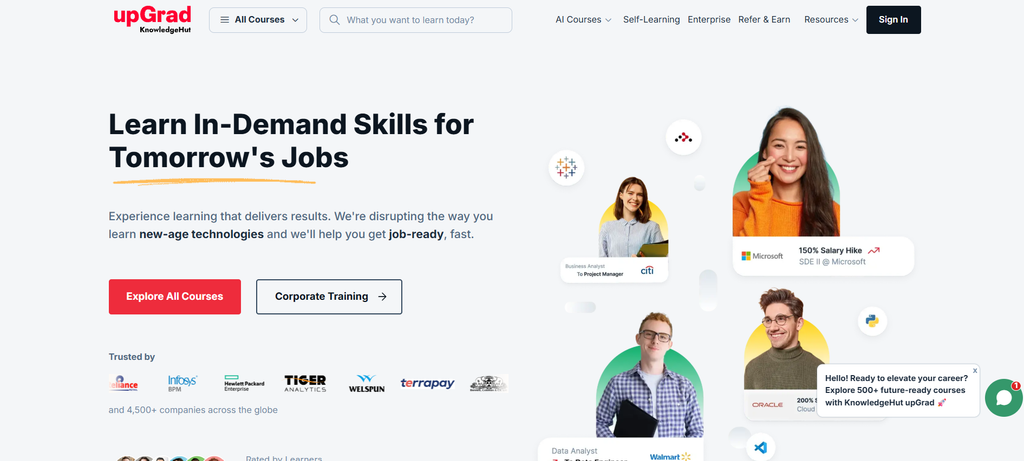
Best for: Applicants with an IT educational background and relevant work experience who want structured, project-based DevOps training.
upGrad KnowledgeHut’s DevOps Engineer Bootcamp combines instructor-led training with practical infrastructure, deployment, and automation work.
The program covers several technologies used in cloud engineering and software delivery.
However, it has an important eligibility restriction that makes it unsuitable for many non-IT graduates.
Curriculum and technical skills
The bootcamp covers:
- Cloud infrastructure.
- Linux and networking concepts.
- CI/CD workflows.
- Docker and Kubernetes.
- Terraform and Ansible.
- Infrastructure automation.
- Monitoring and operational practices.
The curriculum is designed to develop practical DevOps capabilities through exercises and projects.
Projects and practical training
Published project examples involve deploying applications to Kubernetes, provisioning infrastructure through Terraform and Ansible, and configuring application monitoring.
The program also includes guided activities and technical assessments.
These projects can help learners understand how deployment, infrastructure management, and monitoring work together.
However, the practical work may require students to be comfortable with foundational IT concepts before beginning.
Batch format
The bootcamp combines instructor-led virtual learning with independent study material and practical assignments.
The published program has been described as an extended bootcamp, but applicants should verify the current duration and weekly schedule for their selected cohort.
Placement assistance
KnowledgeHut advertises career guidance, resume-related support, and interview preparation associated with the bootcamp.
Applicants should confirm which services are included in the current package and whether they are subject to assessments or other eligibility conditions.
Important admission requirement
The provider’s official DevOps Engineer Bootcamp page states that applicants must:
- Be IT graduates.
- Have more than one year of work experience.
The page also recommends familiarity with Linux and networking, although those particular concepts are not presented as mandatory prerequisites.
This specific bootcamp is not a direct entry option for most non-IT freshers.
KnowledgeHut offers other DevOps-related learning products, but their admission rules should be evaluated separately.
Limitations
The IT-degree and work-experience requirements make this bootcamp unsuitable for many readers seeking their first technical qualification.
Graduates from commerce, arts, or other non-IT disciplines should not assume they are eligible based on general marketing language about career transitions.
Verdict: upGrad KnowledgeHut may be appropriate for IT-qualified learners seeking applied DevOps training. Non-IT graduates should obtain written confirmation of eligibility or choose a different beginner-accessible program.
4. Simplilearn
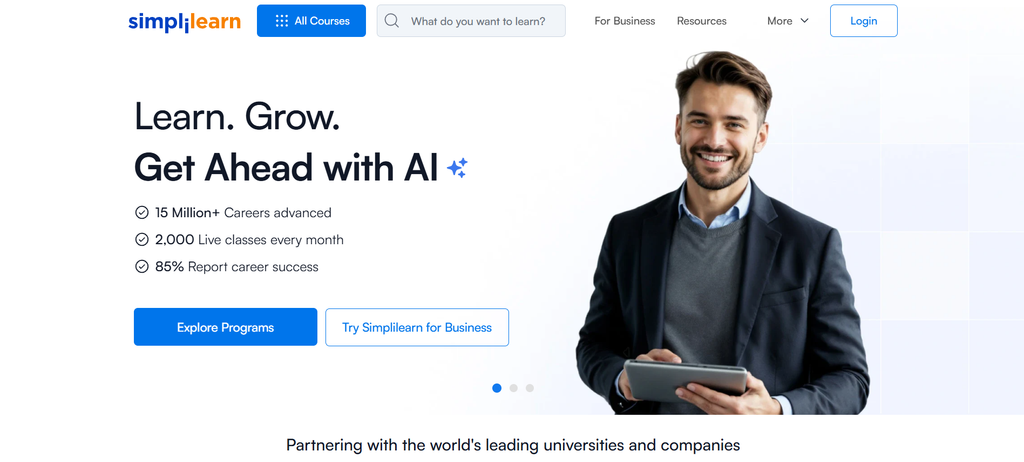
Best for: Learners who already have foundational technical knowledge and want a structured program covering DevOps, cloud computing, automation, and security.
Simplilearn’s AI-Enabled DevOps Engineer Master’s Program covers software delivery automation, cloud infrastructure, containers, and DevOps-related security practices.
The program combines live online instruction with self-paced material and hands-on laboratories.
Curriculum and technical skills
The advertised curriculum includes:
- Git and GitHub.
- Jenkins and CI/CD.
- Docker and Kubernetes.
- Terraform and Ansible.
- AWS and Azure concepts.
- Prometheus and Grafana.
- DevSecOps and infrastructure security.
- AI-related operational workflows.
The course introduces practices across software delivery, infrastructure management, and application monitoring.
Its broader coverage may be useful for students who already understand fundamental operating systems and programming concepts.
Projects and practical training
Simplilearn includes guided laboratory exercises and capstone projects based on business scenarios.
Its published capstone options cover insurance, banking, and healthcare contexts.
These projects involve practical DevOps workflows such as application deployment, automation, and infrastructure management.
Students can use the results as portfolio material if they can independently explain and reproduce the technical work.
Batch format and duration
The provider advertises a six-month program with live online instruction, self-paced resources, and laboratory activities.
Scheduled classroom sessions are available for selected modules, with actual cohort dates subject to change.
Working graduates should confirm whether the expected study workload fits their schedule.
Placement and career support
Simplilearn provides professional development and career-related learning resources across its training portfolio.
However, the exact services available depend on the program.
Applicants should establish whether the selected DevOps course includes resume reviews, mock interviews, career mentoring, interview referrals, or other employment assistance.
Do not assume that every Simplilearn program includes the same placement arrangements.
Important prerequisites
Simplilearn’s official page states that applicants need a technical background.
It also expects basic knowledge of Linux, web development, Java programming, and familiarity with cloud platforms such as AWS and Azure.
These prerequisites are significant for a non-IT graduate without previous technical study.
Limitations
The program may be too advanced as an immediate starting point for someone who has never used Linux or written code.
Its broad curriculum is more appropriate after foundational preparation.
Career-support services should also be confirmed for the exact course package.
Verdict: Simplilearn is worth evaluating after developing basic technical skills. It is not the most accessible first step for a non-IT graduate starting entirely from scratch.
5. KodeKloud
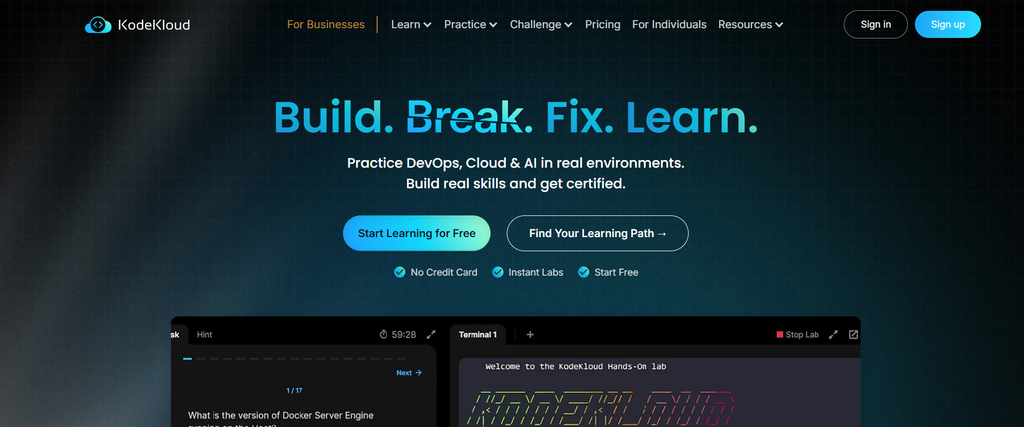
Best for: Independent learners who want to develop technical skills through hands-on exercises without attending fixed classroom batches.
KodeKloud’s DevOps Learning Path covers foundational concepts and progresses into infrastructure, automation, containers, orchestration, and monitoring.
Its learning model emphasizes interactive practice.
For non-IT graduates, KodeKloud can be useful as a primary self-paced learning resource or as a supplement to instructor-led training.
Curriculum and technical skills
The DevOps Learning Path begins with prerequisites such as Linux basics, networking, Git, programming fundamentals, and configuration concepts.
It progresses into topics including:
- Linux and scripting.
- Git and version control.
- CI/CD tools.
- Docker.
- Kubernetes.
- Terraform.
- Ansible.
- Cloud infrastructure.
- Monitoring and observability.
This progression is useful for students who need to build technical foundations before working with more advanced tools.
Projects and practical training
KodeKloud provides interactive laboratories where learners execute commands and work through configuration tasks.
Its learning paths allow students to develop technical skills in environments designed for practical exercises.
The main advantage is that learners can practise commands and troubleshoot systems rather than relying entirely on video demonstrations.
However, guided labs should be supplemented with an independent portfolio project.
For example, after completing Docker and CI/CD lessons, a student could build a small application pipeline without following step-by-step instructions.
Batch format
KodeKloud’s individual learning paths are primarily self-paced.
This suits graduates who are employed, preparing for other examinations, or unable to attend regular live classes.
Students can repeat difficult lessons and progress according to their available study time.
Placement support
KodeKloud offers technical learning resources and interview-preparation content.
However, its published DevOps Learning Path does not establish a dedicated placement-assistance package comparable to the career services advertised by some Indian instructor-led bootcamps.
Students should not expect standard access to recruiter coordination or placement interviews without confirming that such services are specifically included.
Limitations
Self-paced learning requires discipline.
Students may also need outside mentoring or peer support when they encounter difficult infrastructure problems.
KodeKloud is primarily a technical training choice rather than a placement-focused bootcamp.
Verdict: KodeKloud is suitable for self-motivated non-IT graduates who want structured technical practice and flexible scheduling. It is less suitable for learners whose main requirement is formal placement assistance.
For a wider comparison of providers, see Syssn’s top DevOps engineer courses guide.
Which DevOps Course Should You Choose?
The right program depends on your starting knowledge and preferred learning environment.
| Your situation | Options worth investigating | Main consideration |
| No previous IT experience | StarAgile, KodeKloud | Beginner foundations and guided progression |
| Want live classes and career preparation | StarAgile, Intellipaat | Instructor support and conditional placement services |
| Working full-time | KodeKloud, suitable live weekend cohorts | Flexibility and time for practical assignments |
| Have basic Linux and programming knowledge | Intellipaat, Simplilearn | Cloud labs and more advanced training |
| Have an IT degree and work experience | upGrad KnowledgeHut, Simplilearn | Technical prerequisites and project depth |
| Prefer learning independently | KodeKloud | Self-paced laboratories and practice |
Non-IT graduates should first confirm eligibility rather than choosing a course solely because its syllabus lists advanced tools.
A longer program is not automatically better, and a shorter program does not necessarily provide a faster route into employment.
Which DevOps Batch Format Is Best for Non-IT Graduates?
For learners without technical experience, the best schedule is one that provides enough time to practise and troubleshoot between lessons.
| Batch format | Advantages | Main challenge |
| Weekday live classes | Regular instructor access and consistent progress | Requires fixed availability |
| Weekend live classes | Easier to combine with employment | Longer gaps between sessions |
| Self-paced courses | Flexible schedule and repeatable lessons | Requires independent discipline |
| Blended bootcamps | Mix of live guidance and independent practice | Can involve a demanding workload |
Live weekday classes
Weekday classes can work well for graduates studying full-time.
Regular sessions make it easier to resolve doubts before technical problems accumulate.
However, students must still complete assignments outside class hours.
Weekend classes
Weekend training may suit employed graduates.
The limitation is that several days may pass between lessons.
A practical approach is to reserve time during the week for Linux commands, scripting, and laboratory exercises.
Self-paced learning
Self-paced courses provide flexibility and allow learners to repeat challenging material.
However, students need to create their own schedules and monitor progress.
They may also need to seek help through documentation, communities, or additional mentoring.
Blended learning
Blended programs combine scheduled classes, recorded material, and independent projects.
They may offer a useful balance between instructor support and flexible study time.
Before enrolling, verify recording access, doubt-resolution arrangements, individual assignment feedback, and missed-class policies.
For more options, read Syssn’s online DevOps courses comparison.
Five DevOps Projects Non-IT Graduates Should Complete
Practical projects help students demonstrate what they can configure, automate, deploy, and troubleshoot.
A useful portfolio should show working systems and explain the decisions behind them.
Project 1: Linux Server Administration
Objective: Demonstrate foundational operating-system knowledge.
Install Linux in a virtual machine and practise creating users, managing permissions, installing packages, and controlling services.
Configure a basic web server and learn how to inspect system logs.
Then intentionally create a safe configuration error and document how you identify and resolve it.
Portfolio evidence: Setup instructions, commands, configuration files, and troubleshooting notes.
Project 2: Automated CI/CD Pipeline
Objective: Demonstrate automated software testing and delivery.
Create a basic application repository and configure a workflow that runs tests when code is pushed.
Use GitHub Actions or another suitable CI/CD tool.
Try introducing a failing test and examine how the pipeline reports the problem.
The official GitHub Actions documentation explains how to configure automated workflows.
Portfolio evidence: Repository, pipeline configuration, test results, and documentation.
Project 3: Docker Application Deployment
Objective: Demonstrate application containerization.
Create a Dockerfile, build an image, and run a simple application in a container.
Practise managing ports, environment variables, and application logs.
Document what happens when the container cannot start successfully.
Use the official Docker getting-started documentation for foundational exercises.
Portfolio evidence: Dockerfile, application files, build commands, and troubleshooting instructions.
Project 4: Kubernetes Application Deployment
Objective: Demonstrate basic container orchestration.
After becoming comfortable with Docker, deploy a small application to a Kubernetes practice environment.
Create deployment and service configurations, adjust replica counts, and inspect logs.
Practise diagnosing errors involving missing images or incorrect configuration.
The official Kubernetes tutorials provide introductory exercises.
Portfolio evidence: Kubernetes manifests, deployment instructions, architecture diagram, and diagnostic notes.
Project 5: Cloud Infrastructure Automation
Objective: Demonstrate repeatable infrastructure provisioning.
Create a small practice environment in a cloud account.
Use an infrastructure-as-code tool such as Terraform to describe and provision resources.
Document networking, access permissions, deployment steps, and resource cleanup.
The official AWS DevOps training resources provide relevant cloud learning material.
Use budget alerts and remove unused resources to avoid unexpected cloud charges.
Portfolio evidence: Infrastructure configuration, architecture diagram, deployment notes, and cleanup instructions.
What makes a portfolio project credible?
A useful project should explain:
- The problem being solved.
- The tools selected and why they were used.
- How the system works.
- How to reproduce the deployment.
- What failures occurred and how they were resolved.
Students should avoid copying complete projects without understanding the configuration.
Being able to explain and troubleshoot a smaller original project is more useful than presenting a complex application that you cannot reproduce independently.
What Does Placement Support Actually Mean?
Placement assistance is a set of career-related services offered by a training provider.
It does not necessarily mean that the provider will secure employment.
Resume and LinkedIn support
Training providers may help students describe their projects, technical skills, and transferable experience.
This can be especially useful for non-IT graduates whose academic qualifications do not directly match technical job descriptions.
Mock interviews
Mock interviews should help learners explain practical concepts and solve technical problems.
For example, students may be asked how to troubleshoot a failed pipeline, explain a Dockerfile, or identify a Linux permission problem.
Job leads and referrals
Some providers share job openings or application links.
Others may refer eligible students to hiring partners or help coordinate interviews.
These services are not equivalent.
A shared job listing does not establish that a student has been shortlisted.
Placement eligibility
Career services may depend on attendance, project completion, technical assessments, or a placement-readiness test.
Additional fees or contractual requirements may also apply.
Before enrolling, ask:
- Is placement support available to non-IT graduates?
- What attendance and assessment requirements apply?
- Are mock interviews and resume reviews included?
- Does the provider share job links, submit referrals, or arrange interviews?
- How long does career support continue?
- Are there additional fees or repayment obligations?
Request the answers in writing.
Advertised hiring partnerships and placement percentages should not be treated as independently established employment outcomes unless the provider supplies clear, verifiable evidence of how those figures were calculated.
How Much Should Non-IT Graduates Budget for DevOps Training?
The cost of learning DevOps depends on the program, training format, laboratory access, and additional services.
Instructor-led bootcamps may have substantially different fees from self-paced learning subscriptions.
However, tuition is only one part of the total cost.
| Expense | What to check |
| Course fee | Tuition, taxes, payment schedule, and refund policy |
| Cloud practice | Included credits, usage limits, and possible additional charges |
| Equipment | Laptop specifications and internet requirements |
| Certification exams | Whether external exam vouchers are included |
| Project tools | Any required paid software or subscriptions |
| Career services | Additional fees, eligibility conditions, and contract terms |
| Exam retakes | Additional charges if an assessment must be repeated |
Free technical documentation can help students evaluate their interest before committing to a paid program.
For example, Microsoft Learn, GitHub, Docker, Kubernetes, and AWS provide official learning material.
A paid course may offer additional value through structured teaching, mentoring, assessments, and career assistance.
However, a higher course fee does not automatically establish better learning outcomes.
Course completion certificates versus professional certifications
A course completion certificate generally indicates that a learner has completed the requirements of a training program.
An independent professional certification may require passing a separate examination administered by a vendor or certification organization.
Before paying, verify which credential you will receive and whether examination charges are included.
For more details, see Syssn’s DevOps certification cost breakdown.
How Can Non-IT Graduates Evaluate Their Job Readiness?
DevOps engineering roles often involve a combination of software delivery, infrastructure, cloud operations, and troubleshooting.
Completing a course does not automatically mean a graduate is ready for every DevOps job.
A practical self-assessment should focus on demonstrated skills.
Linux and networking
Can you connect to a Linux server, inspect a running process, check permissions, and investigate network connectivity problems?
Can you explain the relationship between an application, an IP address, a port, and a DNS name?
Version control and CI/CD
Can you create a repository and explain how code changes trigger an automated build or test?
Can you identify why a pipeline failed?
Containers and cloud deployment
Can you package a simple application into a Docker image?
Can you explain how the application is deployed and accessed?
Do you understand basic cloud networking and access permissions?
Troubleshooting and communication
Can you describe an error you encountered, explain how you diagnosed it, and show the correction?
Can you document a project so another learner can reproduce it?
These are more meaningful indicators of developing technical competence than the number of tools listed on a resume.
Consider adjacent entry-level roles
Graduates without previous IT employment may also investigate positions such as:
- Junior cloud support.
- Linux or infrastructure support.
- Technical operations.
- Entry-level automation.
- Cloud operations trainee.
- Technical support involving servers or deployment systems.
Eligibility varies by employer, and some positions require technical qualifications.
These roles may provide relevant operational experience before moving into more demanding DevOps engineering positions.
For a comparison of training expectations for experienced learners, read Syssn’s guide to DevOps training for IT professionals.
Common Mistakes Non-IT Graduates Should Avoid
Choosing a course without checking prerequisites
Some programs advertise broad DevOps training but require previous technical education or work experience.
Always verify the admission rules for the specific program, not just the provider’s general website.
Learning advanced tools before the fundamentals
Kubernetes, Terraform, and cloud automation become difficult to understand without foundational Linux, networking, and scripting knowledge.
Build those skills first.
Completing tutorials without independent practice
Following an instructor’s commands can help you learn.
However, genuine understanding develops when you reproduce workflows independently and resolve errors without step-by-step guidance.
Choosing only by placement advertising
Placement assistance, job referrals, hiring partnerships, and guaranteed employment are not interchangeable.
Evaluate the written terms and eligibility conditions.
Ignoring total costs
Tuition may exclude certification examinations, cloud practice, equipment, or other services.
Compare the full financial commitment before enrolling.
Rushing the learning process
A short course can introduce important concepts, but it cannot guarantee technical competence or employment within a fixed period.
Choose a schedule that allows sufficient practical work.
For more entry-level alternatives, see Syssn’s DevOps courses for beginners comparison.
Frequently Asked Questions
Can a non-IT student learn DevOps without coding experience?
Yes. Students can begin learning DevOps without previous programming experience. However, they will need basic scripting, Linux, networking, and automation skills as they progress. A beginner-level course should teach these foundations before introducing advanced infrastructure technologies.
Which DevOps courses offer placement assistance for non-IT graduates?
StarAgile and Intellipaat advertise career assistance subject to eligibility requirements. Some other providers offer career-related resources, but their admission criteria and support packages differ. Applicants should verify whether non-IT graduates qualify for the specific program and its career services.
What is the best DevOps course for a non-technical background?
The most suitable course teaches technical foundations, includes independent projects, offers an achievable schedule, and provides sufficient learning support. StarAgile is worth investigating for live beginner-oriented training, while KodeKloud suits learners who prefer flexible technical practice. The choice depends on the student’s requirements.
Is DevOps difficult for commerce or arts graduates?
DevOps can be challenging because it requires learning unfamiliar technical concepts. However, commerce and arts graduates can develop these skills through consistent practice and structured learning. The main challenge is progressing from individual commands to understanding complete infrastructure and deployment workflows.
Can non-IT graduates study DevOps while working?
Yes. Weekend, evening, blended, and self-paced programs can accommodate working graduates. Choose a format that leaves enough time for practice, revision, and independent assignments.
Are DevOps certifications enough to get a job?
No. Certificates may demonstrate course completion or assessed knowledge, but employers may also consider projects, troubleshooting ability, communication, and experience. A portfolio of independently documented technical work can strengthen a candidate’s application.
How long does it take a non-IT graduate to learn DevOps?
Foundational learning may take several months of consistent study. Building enough practical experience to compete for technical roles can take additional time. Progress depends on the learner’s previous knowledge, available study hours, practical work, and employer requirements.
Conclusion
A non-IT background does not prevent someone from learning DevOps, but choosing the right training structure is important.
StarAgile offers beginner-oriented live instruction and conditional career support. Intellipaat provides cloud labs and structured bootcamp learning. upGrad KnowledgeHut offers project-based training but has restrictive admission requirements for its specific DevOps Engineer Bootcamp. Simplilearn is more suitable for learners who already have technical foundations, while KodeKloud emphasizes flexible, hands-on learning.
Before enrolling, compare the program’s prerequisites, technical foundations, independent projects, batch schedule, total costs, and written placement terms.
For non-IT graduates, the most valuable training is not necessarily the course with the longest technology list or strongest placement advertising. It is the one that helps them build functioning systems, investigate failures, explain technical decisions, and demonstrate those skills independently.



[…] from non-technical backgrounds can also review this guide to DevOps courses for non-IT graduates to understand the foundational skills […]