Best DevOps Training for IT Professionals: Projects, Batch Format and Placement Support

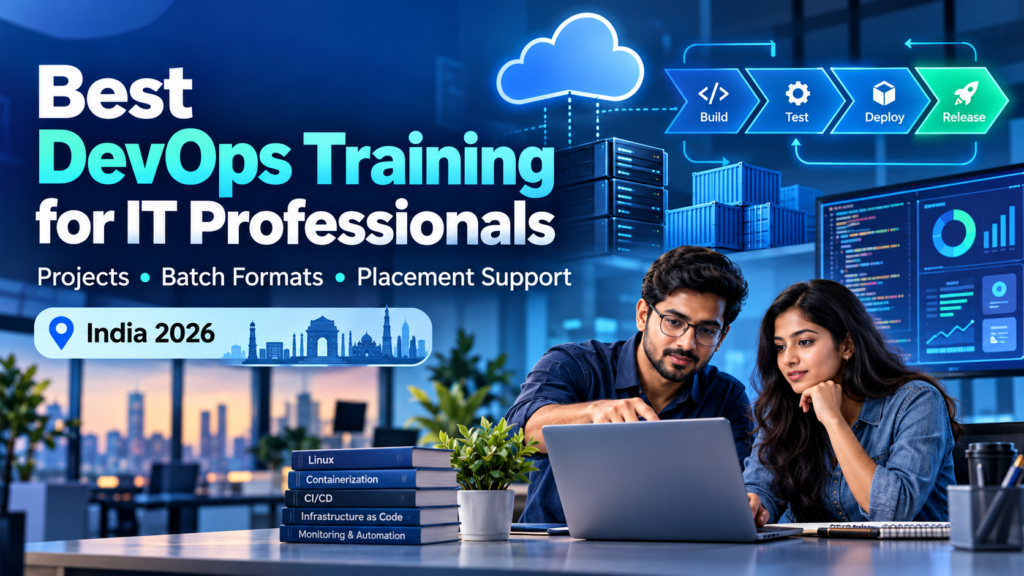
The best DevOps training for IT professionals combines hands-on projects, flexible batch schedules, cloud infrastructure skills, and clearly defined career support. In India, StarAgile, KodeKloud, Intellipaat, Simplilearn, Edureka, CloudThat, and the Linux Foundation offer different learning approaches, ranging from self-paced technical labs to instructor-led career-transition programs.
Choosing the right course depends on your experience, work schedule, preferred learning format, and career goals. A developer moving into cloud engineering may need different training from a system administrator preparing for Kubernetes responsibilities.
This guide compares seven training providers, their practical projects, learning formats, fees, and placement services. It also explains what to verify before enrolling and how to distinguish genuine technical training from promotional placement promises.
DevOps Training Providers for IT Professionals: Quick Comparison
The following comparison focuses on different learning needs rather than claiming that one provider delivers the best outcomes for every student.
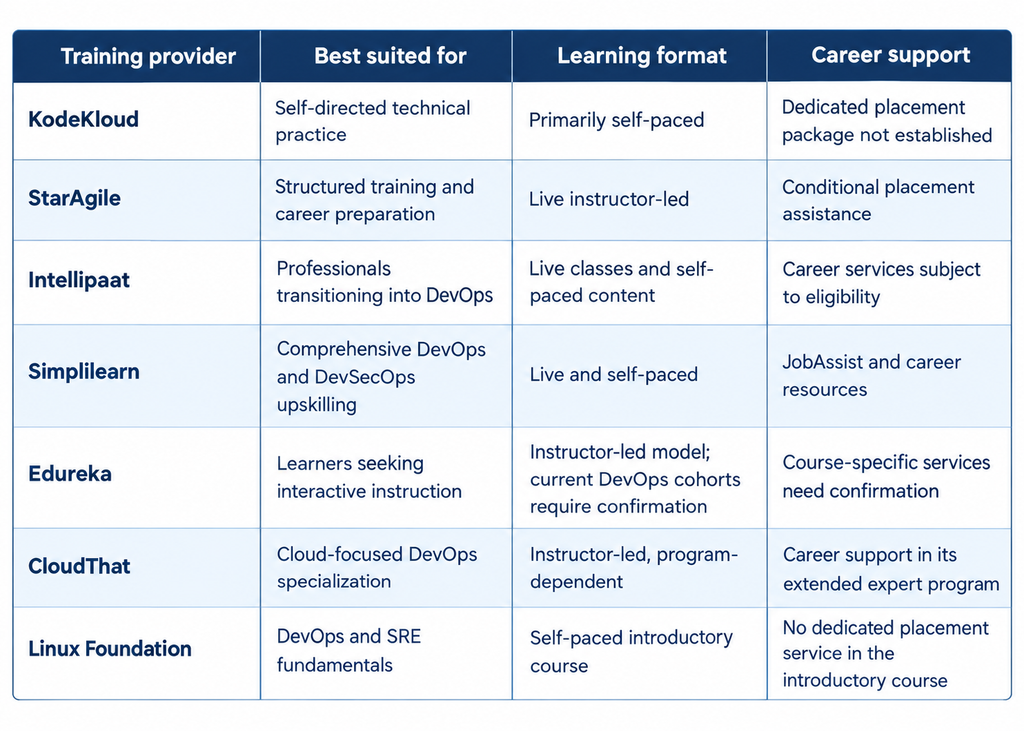
These recommendations are based on published course information, curriculum coverage, learning formats, and career-support descriptions.
Placement outcomes, instructional quality, and student satisfaction have not been independently tested or ranked.
How We Evaluated DevOps Training Programs
A useful DevOps training comparison should consider more than the number of technologies displayed on a course page.
For employed IT professionals, the main evaluation criteria are:
- Curriculum coverage: Whether training includes Linux, Git, CI/CD, Docker, Kubernetes, Terraform, cloud computing, scripting, monitoring, and operational security.
- Practical experience: Whether learners can build complete deployments, automate infrastructure, troubleshoot errors, and present functioning projects.
- Batch flexibility: Availability of weekday, evening, weekend, recorded, or self-paced learning.
- Career assistance: Published information about interview preparation, portfolio reviews, resume support, job referrals, and eligibility requirements.
- Total cost and credentials: Course fees, additional charges, certificate issuers, prerequisites, and the distinction between training certificates and independent certifications.
Provider information was reviewed against official course pages available in October 2026.
This is a comparison of published offerings, not a hands-on evaluation of each institution. Trainer performance, student placement records, and advertised employment outcomes were not independently audited. Prices and cohort availability may change.
Professionals who need to strengthen their foundations can also consult this comparison of DevOps courses for beginners.
DevOps Training Providers for IT Professionals
1. KodeKloud
Best for: Developers, system administrators, cloud engineers, and experienced IT professionals who prefer learning through practical exercises.
KodeKloud provides structured learning paths covering DevOps, Linux, Docker, Kubernetes, infrastructure as code, cloud platforms, and CI/CD technologies.
Its role-based DevOps Engineer learning path combines multiple courses covering skills commonly used in infrastructure and software delivery.
The platform is particularly relevant to professionals who understand basic development or systems administration but need repeated practice with automation tools.
Rather than depending entirely on recorded explanations, learners can work through interactive laboratories and technical challenges.
Projects and practical training
KodeKloud emphasizes practical exercises that allow learners to configure systems, investigate problems, and apply tools in guided environments.
Relevant activities include:
- Managing Linux environments and services.
- Creating and troubleshooting container deployments.
- Working with Kubernetes resources.
- Practicing infrastructure automation.
- Building familiarity with CI/CD workflows.
These exercises help learners develop technical confidence without setting up every training environment locally.
However, completing guided laboratories is not the same as independently designing and operating a production system. Learners should supplement the platform with portfolio projects that combine multiple technologies.
Batch format
KodeKloud is primarily self-paced for individual learners.
This format is especially useful for professionals managing rotating shifts, on-call responsibilities, or unpredictable working hours.
There is no requirement to attend a fixed weekly classroom schedule for its standard individual learning paths.
Placement support
KodeKloud primarily emphasizes technical learning, certification preparation, and practical exercises.
A dedicated placement-assistance package for individual subscribers is not clearly established in its published learning-path information.
Pricing
KodeKloud uses subscription-based access with different plans and billing periods. Learners should check current plan prices, laboratory access, and course availability before subscribing.
Limitations
Its flexibility creates a responsibility to manage your own progress.
Professionals who need scheduled classes, consistent individual mentoring, or formal recruitment assistance may prefer a structured training program.
Choose KodeKloud if: Your main priority is developing practical DevOps skills through independent learning, and you can maintain a consistent study routine.
2. StarAgile

Best for: Working professionals and technical career switchers who want instructor-led training, capstone projects, and organized career preparation.
StarAgile offers a DevOps certification training program covering software delivery automation, cloud infrastructure, deployment workflows, and DevOps tools.
Its published curriculum includes Git, Jenkins, Docker, Kubernetes, Ansible, Terraform, AWS, and monitoring concepts.
The course is relevant to professionals working in software development, quality assurance, infrastructure administration, and technical support who want to develop DevOps-related capabilities.
Projects and practical training
StarAgile advertises three capstone projects and practical assignments.
Its published examples include cloud infrastructure architecture, CI/CD automation, and deployment of applications using containerization and infrastructure tools.
These activities can help learners understand how individual DevOps technologies fit into larger deployment workflows.
Prospective learners should confirm whether projects are completed independently or in groups, whether trainers review submitted code, and whether finished work can be included in a public technical portfolio.
Batch format
StarAgile provides live instructor-led online training.
The provider’s October 2026 schedule displays weekday evening batches, including sessions from 8:00 PM to 10:00 PM IST.
Course schedules and program packages may vary. Learners seeking weekend instruction should obtain confirmation that an appropriate weekend cohort is available for their selected course.
Placement support
StarAgile advertises career preparation and placement assistance for eligible learners.
Its published eligibility conditions include:
- Attendance above 75%.
- Timely completion of required projects.
- Successful completion of a competency assessment.
Qualifying learners may receive resume preparation, interview guidance, and additional placement-related services.
The provider also describes an income-share agreement arrangement involving a ₹20,000 career-services fee payable after obtaining employment through the applicable placement-support arrangement.
Applicants should review the complete agreement to understand when this payment becomes due and which services are included.
Pricing
StarAgile’s official page contains different pricing references.
Its FAQ quotes ₹49,999–₹95,998, while its displayed upcoming weekday batches in October 2026 show ₹99,999.
Because those figures differ, prospective learners should request a written quotation for the selected batch, including any placement-related charges.
Limitations
Career assistance is conditional, and training or certificate packages may differ.
The provider’s published prices are not fully consistent across its page, making direct fee confirmation particularly important.
Choose StarAgile if: You prefer scheduled instruction, guided capstone projects, and structured career assistance, and you are willing to review eligibility and payment conditions before enrolling.
3. Intellipaat

Best for: Developers, QA engineers, system administrators, and other IT professionals seeking structured DevOps training with career preparation.
Intellipaat offers an online DevOps course combining live instruction, self-paced learning, projects, and career-support services.
Its curriculum covers DevOps fundamentals, version control, cloud infrastructure, automation, containerization, Kubernetes, Terraform, DevSecOps, and CI/CD workflows.
The program is designed to connect these technologies through applied exercises rather than treating them only as individual software tools.
Projects and practical training
Intellipaat advertises more than 30 hours of project work and case studies.
Published project examples include secure CI/CD pipelines for banking applications and Kubernetes infrastructure with access controls and networking configurations.
These projects introduce important concepts such as automated testing, secrets management, policy enforcement, and infrastructure deployment.
Learners should ask whether the projects require independent implementation and how much individual feedback instructors provide.
Batch format
Intellipaat combines instructor-led online sessions with self-paced content.
Its published course schedule includes both weekday and weekend cohorts, including weekend evening sessions.
This combination can suit professionals who want a predictable timetable while retaining access to recorded material.
Before joining, confirm the time zone, teaching hours, recordings, mentor access, and requirements for attending live sessions.
Placement support
Intellipaat advertises career services such as resume and LinkedIn profile preparation, mock interviews, job-portal access, and individual career mentoring.
Access to these services is subject to completing the course and passing the provider’s Placement Readiness Test.
Its advertised hiring-organization network should not be interpreted as proof that every qualifying learner will receive interviews or employment.
Pricing
The official course page displayed ₹60,021, including taxes, during the October 2026 review.
Discounts, financing arrangements, and cohort-specific pricing may change.
Limitations
Career assistance depends on eligibility requirements.
The amount of personalized mentoring and project feedback should also be confirmed before enrollment.
Choose Intellipaat if: You want live instruction, applied project work, and formal career preparation as part of a structured transition into DevOps.
4. Simplilearn

Best for: IT professionals who want a broader curriculum connecting DevOps, cloud infrastructure, automation, and security.
Simplilearn offers an AI-Enabled DevOps Engineer Masters Program covering infrastructure automation, CI/CD, container orchestration, DevSecOps, and operational monitoring.
The curriculum connects technologies such as Git, Jenkins, Docker, Kubernetes, Ansible, Terraform, Prometheus, and Grafana.
Its broader structure is useful for professionals who want to understand the complete software delivery process instead of pursuing a short course on one tool.
Projects and practical training
Simplilearn includes hands-on assignments and capstone projects based on application deployment and infrastructure scenarios.
Published project examples involve creating deployment pipelines for containerized applications, managing workloads on Kubernetes, and provisioning infrastructure with Terraform.
These activities allow learners to explore how application packaging, delivery automation, and cloud infrastructure fit together.
The main point to evaluate is whether the training provides enough independent practice and troubleshooting opportunities beyond guided demonstrations.
Batch format
The program combines live online instruction with self-paced learning and integrated laboratories.
Simplilearn describes the program as approximately six months long.
This format may suit employed learners who want a defined learning path without relying exclusively on scheduled classes.
Placement support
Simplilearn advertises JobAssist and career-preparation resources, including resume-related tools and interview preparation.
Learners should confirm the exact services included in their selected plan, particularly the difference between career-development tools and access to recruitment opportunities.
Pricing
The official program page listed ₹53,999, including taxes, during the October 2026 review.
Applicants should verify whether exam vouchers, additional laboratories, or other services require separate payment.
Limitations
The curriculum covers several technical areas within one program.
Professionals without Linux, networking, scripting, or software development foundations may need preparatory learning to use the advanced content effectively.
Choose Simplilearn if: You have an existing technical foundation and want a comprehensive learning path covering DevOps, DevSecOps, and cloud automation.
5. Edureka
Best for: IT professionals who prefer instructor interaction, guided learning, and structured technical classes.
Edureka is an online technical training provider known for instructor-led learning and professional certification courses.
Its DevOps training materials describe instruction covering technologies such as Git, Jenkins, Docker, Ansible, and other automation tools.
Edureka’s approach may appeal to professionals who find independent video-based learning difficult to maintain and prefer opportunities to ask technical questions during classes.
However, its current standalone DevOps course availability requires additional confirmation.
Projects and practical training
Previously published Edureka DevOps course materials describe practical exercises followed by project work.
Relevant topics include source control, build automation, containerization, configuration management, and deployment pipelines.
Learners should request the current syllabus and project specifications rather than relying on older course descriptions.
A useful project should require participants to configure a functioning pipeline, investigate failures, and demonstrate their technical decisions.
Batch format
Edureka promotes live instructor-led learning and flexible schedules.
Historically, its DevOps offerings have included weekday and weekend batches.
However, current DevOps-specific cohort dates could not be reliably established from the reviewed official catalog, and the former standalone course URL redirects to the provider’s homepage.
Prospective learners should confirm that the intended course is actively available before considering any previously published schedule.
Placement support
Edureka emphasizes technical learning and instructional support.
A standardized placement package for a currently available standalone DevOps course was not established from the materials reviewed.
Applicants should obtain written confirmation if career services are an important purchasing requirement.
Pricing
A reliable current quotation for the specific DevOps course was not confirmed.
Older promotional prices and batch listings should not be treated as current offers.
Limitations
The main limitation is uncertainty around current standalone DevOps course availability, pricing, and curriculum details.
Unlike providers with clearly published current cohorts, Edureka requires direct confirmation before meaningful enrollment comparisons can be completed.
Choose Edureka if: You prefer interactive instruction and can first verify that an appropriate DevOps cohort, curriculum, and support package are currently being offered.
6. CloudThat
Best for: Cloud engineers, infrastructure professionals, and experienced IT employees pursuing DevOps specialization on AWS or Azure.
CloudThat provides technical training across cloud infrastructure, automation, DevOps practices, and certification preparation.
Its offerings include specialized technical courses and an extended Cloud & DevOps Expert Program.
This distinction matters because a short AWS DevOps workshop serves a different purpose from a longer career-transition program.
Professionals should choose the offering that matches their existing knowledge and target role.
Projects and practical training
CloudThat’s Cloud & DevOps Expert Program advertises three capstone projects covering AWS, Azure, and DevOps implementation.
The curriculum includes cloud infrastructure management, automation, deployment pipelines, and related practical exercises.
This multi-platform approach can be useful for professionals working in environments where cloud administration and deployment automation overlap.
Before enrolling, ask whether the course requires independent infrastructure configuration and whether project feedback includes debugging, security, and operational reliability.
Batch format
CloudThat provides instructor-led technical training, with scheduling dependent on the selected course.
Its extended Cloud & DevOps Expert Program advertises weekday and weekend learning options and describes a duration of up to nine months.
Short certification-focused courses have different durations and should be evaluated separately.
Placement support
The extended expert program advertises resume preparation, career-development sessions, interview readiness, and job assistance.
Its published eligibility information includes educational, professional-experience, and assessment requirements.
These career services should not be assumed to apply to every CloudThat certification workshop or training pass.
Pricing
CloudThat has published a ₹74,900 price for its DevOps Mastery Pass, which provides access to a broader DevOps training track.
That price should not be confused with the fee for its Cloud & DevOps Expert Program.
The current total enrollment fee for the extended expert program requires a separate quotation.
Limitations
CloudThat’s various training products have different objectives, durations, prices, and career-service arrangements.
A short course may be useful for certification preparation but may not provide the foundational training or structured job assistance required for a complete career transition.
Choose CloudThat if: Your goal is to build DevOps capabilities alongside AWS or Azure expertise, and you can identify a suitable specialist or extended training program.
7. Linux Foundation
Best for: Technical professionals seeking an accessible introduction to DevOps and site reliability engineering before advanced specialization.
The Linux Foundation offers technical education covering Linux, DevOps practices, cloud-native infrastructure, containers, Kubernetes, and site reliability engineering.
Its Introduction to DevOps and Site Reliability Engineering (LFS162) course provides a foundation in the principles behind software delivery and infrastructure operations.
Unlike placement-oriented bootcamps, the introductory course emphasizes technical understanding rather than recruitment services.
Projects and practical training
The introductory curriculum covers cloud computing, containers, infrastructure as code, CI/CD, observability, and DevOps and SRE principles.
It is useful for understanding how development teams, infrastructure teams, and operational practices fit together.
However, learners seeking extensive guided infrastructure projects will need additional practical courses or independent exercises.
For example, after completing the introduction, a learner could build a containerized application, configure deployment automation, and implement basic monitoring.
Batch format
LFS162 is self-paced and online.
The Linux Foundation lists approximately 10–12 hours of course material, with a defined online access period.
This makes it suitable for professionals who want to explore the subject before enrolling in a longer program.
Placement support
The introductory course does not advertise dedicated job-placement assistance.
Its primary value lies in foundational education and preparation for further technical learning.
Pricing
LFS162 is available at no course fee.
Advanced Linux Foundation courses and professional certification exams may involve separate charges.
Limitations
The introductory course is not a complete DevOps engineering bootcamp.
Learners seeking employment in technically demanding roles will generally need additional hands-on practice, deeper knowledge of relevant tools, and experience troubleshooting realistic systems.
Choose the Linux Foundation if: You want an accessible starting point for DevOps and SRE concepts before committing to more extensive training.
What Should a Good DevOps Training Curriculum Include?
A strong DevOps curriculum should connect operating systems, software development, infrastructure automation, cloud services, and operational reliability.
Learning individual commands is useful, but the more important skill is understanding how tools work together throughout the software delivery process.
| Skill area | Common technologies | Practical outcome |
|---|---|---|
| Operating systems | Linux, Bash | Manage servers, permissions, and processes |
| Version control | Git, GitHub | Track changes and manage collaboration |
| CI/CD | Jenkins, GitHub Actions | Automate builds, tests, and deployments |
| Containers | Docker | Package and run applications consistently |
| Container orchestration | Kubernetes | Deploy and manage containerized workloads |
| Infrastructure as code | Terraform | Provision infrastructure through code |
| Configuration management | Ansible | Automate system configuration |
| Cloud infrastructure | AWS, Azure | Manage computing, networking, and cloud services |
| Monitoring | Prometheus, Grafana | Observe systems and investigate operational issues |
| Security | DevSecOps practices | Integrate security controls into delivery workflows |
An effective curriculum should also address networking, scripting, secrets management, identity and access controls, rollback procedures, and troubleshooting.
For example, a DevOps engineer might use Terraform to provision infrastructure, GitHub Actions to test and build software, Docker to package an application, Kubernetes to manage deployment, and Prometheus to monitor performance.
Understanding the relationship between these components is more valuable than simply memorizing commands.
Importantly, DevOps is not only a collection of technologies. It also involves collaboration, feedback, delivery reliability, and operational practices.
The 2025 DORA research on software delivery provides useful context about how organizational capabilities and delivery systems influence software development outcomes.
A practical training program should therefore teach learners to explain why a workflow is designed a particular way, not just how to operate its tools.
What Real-World Projects Should DevOps Training Include?
A DevOps course with practical projects should help learners demonstrate how they can build, deploy, maintain, and troubleshoot working systems.
Completing isolated tool exercises is helpful, but an end-to-end project provides stronger evidence of technical understanding.
Three projects are particularly useful for building a portfolio.
Project 1: Build an Automated CI/CD Pipeline
Objective: Create a repeatable process that tests, builds, and deploys an application.
Start with an application stored in a Git repository. Configure a pipeline that runs automated tests when code changes are submitted.
The pipeline should build the application, run the required checks, and deploy a successful build to a test environment.
A stronger implementation also demonstrates what happens when tests fail or a deployment must be reversed.
Useful deliverables include:
- A version-controlled repository containing pipeline configuration.
- Automated test and build steps.
- Deployment instructions.
- Evidence of successful and failed pipeline runs.
- Documentation explaining recovery or rollback.
The official GitHub Actions documentation and Jenkins Pipeline documentation provide technical references.
What this demonstrates: Understanding of development workflows, automation, deployment reliability, and troubleshooting.
Project 2: Deploy and Manage a Containerized Application
Objective: Package an application into containers and manage its deployment using Kubernetes.
Begin with a simple application that includes at least two connected services.
Use Docker to package the services, then configure Kubernetes resources to deploy and expose the application.
A more useful project should demonstrate configuration management, health checks, updates, and failure recovery.
For example, deliberately stop a container and observe how the deployment responds.
Then perform a controlled application update and document what happens when an unsuccessful deployment needs to be rolled back.
The official Docker documentation and Kubernetes Deployment documentation explain the underlying technologies.
What this demonstrates: Practical knowledge of containerization, orchestration, deployment configuration, and operational behavior.
Project 3: Automate Cloud Infrastructure and Monitoring
Objective: Provision an environment using infrastructure as code and monitor its operational health.
Use Terraform to create a small cloud environment.
Configure the required compute resources, networking, permissions, and application deployment.
Then add monitoring to collect useful system or application metrics.
A stronger project might include resource tagging, environment-specific variables, monitoring alerts, and a documented recovery procedure.
It should also explain how sensitive configuration values are protected and how infrastructure changes are reviewed.
The HashiCorp Terraform tutorials and Prometheus documentation provide useful implementation references.
What this demonstrates: Infrastructure automation, cloud administration, monitoring, and operational decision-making.
How to Turn DevOps Projects Into a Useful Portfolio
A completed project becomes more valuable when another engineer can understand how it works.
Each portfolio repository should ideally include a project overview, architecture diagram, configuration files, prerequisites, deployment instructions, testing evidence, and troubleshooting notes.
Avoid publishing real credentials, access tokens, private keys, or other sensitive information.
Document at least one technical problem encountered during implementation and explain how it was investigated.
For instance, describing why a Kubernetes application failed to become healthy and how the issue was corrected provides more useful evidence than displaying only a successful deployment screenshot.
Projects should demonstrate understanding, not merely completion.
Which DevOps Batch Format Is Best for Working Professionals?
The right learning format depends on your work schedule, existing knowledge, and ability to study independently.
| Batch format | Main advantage | Main limitation |
|---|---|---|
| Weekend live classes | Less conflict with weekday employment | Concentrated weekend workload |
| Weekday evening classes | Consistent learning routine | Can be difficult after long workdays |
| Self-paced learning | Maximum flexibility | Requires independent discipline |
| Hybrid learning | Combines structured instruction and recordings | Some activities may require scheduled attendance |
| Classroom training | In-person interaction and a defined environment | Commuting and fixed schedules |
Weekend DevOps Batches
Weekend classes can be practical for professionals with predictable weekday responsibilities.
However, weekend instruction alone is rarely enough to master infrastructure automation. Learners also need time during the week to complete projects and practice unfamiliar concepts.
Before joining, check whether assignments can be completed outside the scheduled sessions and whether missed classes are available as recordings.
Weekday Evening DevOps Classes
Evening batches offer a regular learning schedule without interrupting standard working hours.
They may be suitable for professionals who finish work at predictable times and prefer frequent contact with instructors.
The main challenge is maintaining enough energy and concentration after a full day of technical work.
Confirm the actual session duration, expected attendance, and whether additional individual practice is necessary.
Self-Paced and Hybrid Learning
Self-paced training offers more control over study hours.
This is particularly relevant for professionals handling rotating shifts, incident response, production support, or unpredictable workloads.
The drawback is that technical questions may remain unresolved without useful mentor or community support.
Hybrid learning can provide a compromise through recorded lectures, scheduled mentoring, and project reviews.
Ultimately, the strongest batch format is the one that allows you to complete the course and consistently practice its technical requirements.
What Does DevOps Placement Assistance Actually Include?
Placement assistance refers to services intended to improve a learner’s preparation for employment opportunities.
It does not automatically mean that completing a course guarantees a job.
Providers may offer resume reviews, interview preparation, mentoring, access to job listings, candidate referrals, or recruitment events.
The value depends on how these services are delivered and whether learners meet the relevant eligibility conditions.
| Career-support feature | What to verify before enrollment |
|---|---|
| Resume preparation | Is feedback personalized to DevOps-related roles? |
| Technical mock interviews | Are interviews conducted by people familiar with infrastructure and deployment technologies? |
| Job referrals | Does the provider facilitate direct introductions to employers? |
| Hiring partners | Do those relationships produce relevant current interview opportunities? |
| Career mentoring | How many individual sessions are included? |
| Portfolio review | Does anyone assess completed technical projects? |
| Placement eligibility | Are attendance, assessments, or project deadlines mandatory? |
| Additional charges | Are career-service or placement-linked payments required? |
| Employment guarantees | What exactly do the written terms promise? |
Questions to Ask About Placement Support
Before paying for a placement-oriented program, request its complete career-services policy.
Ask how many technical mock interviews are included, whether the provider reviews actual project work, and what happens if a learner completes the course but does not receive interview opportunities.
Also establish whether access to placement services depends on passing internal assessments or meeting attendance requirements.
If a provider advertises a hiring-partner network, clarify whether that refers to previous employer relationships, job-board access, or direct recruitment arrangements for current learners.
These are not equivalent benefits.
For a more detailed comparison, read this guide explaining what to check before enrolling in a DevOps course with placement support.
Career assistance can be useful, but its terms should be evaluated separately from the quality of technical training.
DevOps Training Fees in India: Provider Comparison
DevOps training fees depend on the learning format, curriculum depth, project access, duration, credentials, and career services.
The figures below reflect published information reviewed in October 2026. They are not directly comparable prices for equivalent course packages.
| Provider | Published pricing information |
|---|---|
| KodeKloud | Subscription-based; verify the current access plan and billing period |
| StarAgile | Upcoming batches displayed at ₹99,999; the FAQ lists a lower range, and eligible placement arrangements may involve an additional ₹20,000 |
| Intellipaat | ₹60,021 including taxes on the reviewed course page |
| Simplilearn | ₹53,999 including taxes on the reviewed program page |
| Edureka | Current standalone DevOps course price not reliably confirmed |
| CloudThat | ₹74,900 published for the DevOps Mastery Pass; the extended Cloud & DevOps Expert Program is priced separately |
| Linux Foundation | Free introductory LFS162 course; advanced training and certifications may cost extra |
Why Course Fees Are Not Directly Comparable
A subscription-based technical platform, an instructor-led bootcamp, a specialist cloud workshop, and a career-transition program provide different services.
For example, an experienced AWS engineer may need targeted certification preparation rather than a multi-month DevOps bootcamp.
A manual QA professional transitioning into infrastructure automation may require foundational training, repeated project practice, and mentoring.
A relatively inexpensive course may be sufficient for the first learner but inadequate for the second.
Before purchasing, calculate the full learning investment.
This should include training fees, applicable taxes, certification exam charges, cloud infrastructure expenses, software or laboratory access, career-service fees, and any financing costs.
Written confirmation matters more than promotional discounts.
Does DevOps Certification Help With Career Opportunities?
DevOps certifications can support professional development by demonstrating structured learning or assessed technical knowledge.
However, not all certificates represent the same level of technical evaluation.
A completion certificate issued by a training provider generally confirms participation in, or completion of, a particular course.
An independent professional certification may involve standardized examinations or practical assessments defined by the issuing organization.
Understanding the difference helps learners avoid paying for a credential that does not match their intended career goal.
AWS Certified DevOps Engineer – Professional
The AWS Certified DevOps Engineer – Professional certification focuses on advanced AWS automation, deployment, monitoring, security, and infrastructure management.
AWS recommends candidates have at least two years of experience provisioning, operating, and managing AWS environments, along with relevant software development lifecycle and scripting knowledge.
It is therefore more appropriate for professionals with established AWS experience than for complete beginners.
Certified Kubernetes Administrator (CKA)
The Certified Kubernetes Administrator credential focuses on practical Kubernetes administration.
Its performance-based examination requires candidates to complete technical tasks in a Kubernetes environment.
This makes it relevant to professionals whose responsibilities include container orchestration, cluster administration, and troubleshooting.
Should You Prioritize Certifications or Projects?
Both can contribute to professional development, but they serve different purposes.
Certifications provide a structured way to demonstrate knowledge against defined objectives.
Projects demonstrate how you apply technical concepts to build or operate systems.
For someone moving into DevOps, a portfolio showing functioning deployment pipelines, infrastructure automation, monitoring, and troubleshooting can complement certification preparation.
Professionals comparing different credentials can review this guide to online DevOps certification courses.
The appropriate certification depends on the intended role, required platform skills, and existing experience.
How to Choose the Right DevOps Training Institute
Before enrolling, shortlist two or three providers based on your career objective and preferred learning format.
A course that is suitable for an experienced cloud engineer may not be appropriate for someone entering infrastructure automation from a less technical role.
Use the following checklist to evaluate your options.
DevOps Course Pre-Enrollment Checklist
- The curriculum covers the technical foundations required for my target role.
- I will complete at least one demonstrable end-to-end project.
- The batch timings fit my work schedule and allow enough practice time.
- The trainer has relevant technical experience and can explain practical failures.
- Recordings, doubt resolution, and project feedback are available when needed.
- Placement services and eligibility conditions are documented.
- The complete course price and additional costs are confirmed in writing.
- The certificate issuer, assessment process, and refund terms are clear.
Evaluate the Trainer, Not Just the Course Brochure
Ask for a sample class or technical demonstration.
A useful instructor should be able to explain why a pipeline failed, how to investigate an unhealthy Kubernetes deployment, or what could cause an unexpected infrastructure change.
Ask how learners receive feedback on their project implementations.
Also confirm whether the trainer who conducts the sample session will teach your actual batch.
Match Training to Your Existing Experience
For developers, an effective transition may emphasize infrastructure automation, deployment pipelines, cloud networking, and operational reliability.
System administrators may benefit from stronger scripting, Git workflows, containers, CI/CD, and infrastructure as code.
QA professionals moving into DevOps may need additional coverage of Linux, cloud architecture, networking, and deployment operations.
Cloud engineers who already understand infrastructure may gain more from Kubernetes administration, GitOps, observability, advanced automation, or DevSecOps.
Selecting a program based on these skill gaps is usually more practical than relying on general claims about a provider’s reputation.
Frequently Asked Questions
What is the best DevOps training for IT professionals in India?
The most suitable program depends on technical experience and learning priorities. KodeKloud is an option for self-paced labs. StarAgile and Intellipaat offer structured training with conditional career assistance. Simplilearn provides broader DevOps upskilling, while CloudThat emphasizes cloud specialization. The Linux Foundation offers foundational DevOps and SRE education. Edureka may be relevant for instructor-led learning, subject to confirming current DevOps course availability.
Can IT professionals switch to DevOps without previous DevOps experience?
Yes. Developers, QA engineers, system administrators, support engineers, and cloud professionals can build on their existing technical knowledge. However, they should first develop the foundations required for the role, particularly Linux, networking, Git, scripting, and cloud infrastructure.
Practical deployment and troubleshooting experience is important for moving beyond introductory knowledge.
How long does DevOps training take?
Course duration varies substantially. Short technical workshops may last only a few days, while comprehensive training programs may extend over several months.
Completing a course does not necessarily mean someone is ready to manage production systems independently. The time required to develop professional competence depends on prior experience, practice, and the complexity of the target role.
Are weekend DevOps batches suitable for working professionals?
Weekend batches can suit professionals with fixed weekday working hours.
However, learners must still allocate time for assignments, laboratories, and project completion outside class.
Before enrolling, confirm teaching hours, attendance requirements, recordings, and mentor availability.
Does a DevOps course guarantee placement?
No. Placement assistance may include interview preparation, resume reviews, mentoring, job referrals, and access to recruitment opportunities.
Some providers impose eligibility requirements or additional contractual conditions.
Any advertised employment guarantee should be assessed using the complete written agreement, not promotional language alone.
Which DevOps tools should beginners learn first?
Start with Linux, networking fundamentals, Git, and basic scripting.
Then learn CI/CD concepts through Jenkins or GitHub Actions, followed by Docker, a cloud platform, Terraform, Kubernetes, and monitoring tools.
The goal should be to understand how these technologies support a connected deployment workflow rather than treating them as unrelated subjects.
Is online DevOps training as useful as classroom training?
Online training can be effective when it includes practical exercises, instructor support, and meaningful project feedback.
Classroom learning may suit professionals who prefer face-to-face interaction and a fixed learning environment.
The quality of technical instruction and independent practice matters more than whether training takes place online or in a classroom.
How can I evaluate a DevOps trainer before enrollment?
Review the trainer’s technical background, request a sample session, and ask how projects are assessed.
A capable trainer should be able to explain deployment failures, security considerations, infrastructure changes, and troubleshooting decisions.
Also ask whether learners receive individual feedback on implementation mistakes rather than only watching demonstrations.
Final Verdict: Which DevOps Training Should You Choose?
The best DevOps training for IT professionals is the program that helps you build demonstrable engineering skills while fitting your current responsibilities and learning requirements.
KodeKloud is worth considering for flexible technical practice. StarAgile and Intellipaat offer more structured career-oriented learning, while Simplilearn covers a broader DevOps and DevSecOps curriculum.
CloudThat is relevant to cloud-focused specialization, and the Linux Foundation provides an accessible introduction to DevOps and SRE. Edureka remains a potential instructor-led option, although its current DevOps course availability requires confirmation.
Before paying for any program, compare the curriculum, independent project work, instructor support, batch schedule, total fees, credentials, and placement terms.
A course certificate can document learning, but the more meaningful professional outcome is the ability to build, automate, deploy, secure, monitor, and troubleshoot systems with confidence.