Best AI RFP Software: Top Platforms, Features & Pricing


Best AI RFP Software: Top Platforms, Features & Pricing compares five tools that help proposal teams draft, review, and manage RFP responses with company-approved knowledge. In 2026, Inventive AI, Responsive, Loopio, AutoRFP.ai, and 1up are strong options for different team sizes and workflows. This guide explains what AI RFP software does, how these platforms handle response automation, content management, collaboration, integrations, security, and pricing, and where each one fits best. You’ll also get a practical comparison framework for choosing software without paying for features your team may rarely use.
What Is AI RFP Software?
AI RFP software helps teams complete Requests for Proposal, RFIs, DDQs, security questionnaires, and similar documents by using artificial intelligence to find relevant company information and draft responses.
Traditional RFP software often centers on a reusable content library. Newer AI RFP tools can also read uploaded documents, identify questions, search approved sources, draft answers, attach source references or confidence signals, and route uncertain items to reviewers. Responsive describes automated document analysis for extracting questions and requirements, while Loopio says its automated answers draw from approved content and can include citations and confidence scores.
Purpose-built RFP response software also adds permissions, review workflows, response history, integrations, and export controls that a general-purpose chatbot does not provide.
How Does AI RFP Software Work?
Most AI RFP platforms follow a similar sequence:
- Import the RFP or questionnaire. Teams upload supported files or work through a browser or portal.
- Identify questions and requirements. The software separates prompts, instructions, sections, and response fields.
- Search trusted company sources. It checks approved answers, past RFPs, product documents, policies, cloud drives, CRM records, or connected repositories.
- Generate draft answers. AI writes from the retrieved material.
- Flag uncertain items. Stronger systems show sources, confidence signals, or missing information.
- Coordinate review. Teams assign sections, collect edits, and track approvals.
- Export or submit. Approved content returns to the required document or portal.
AutoRFP.ai says its engine searches company content before drafting and hands unsupported questions back to the user. 1up provides approval workflows, status tracking, reviewer assignments, and collaboration.
5 Best AI RFP Software Platforms in 2026
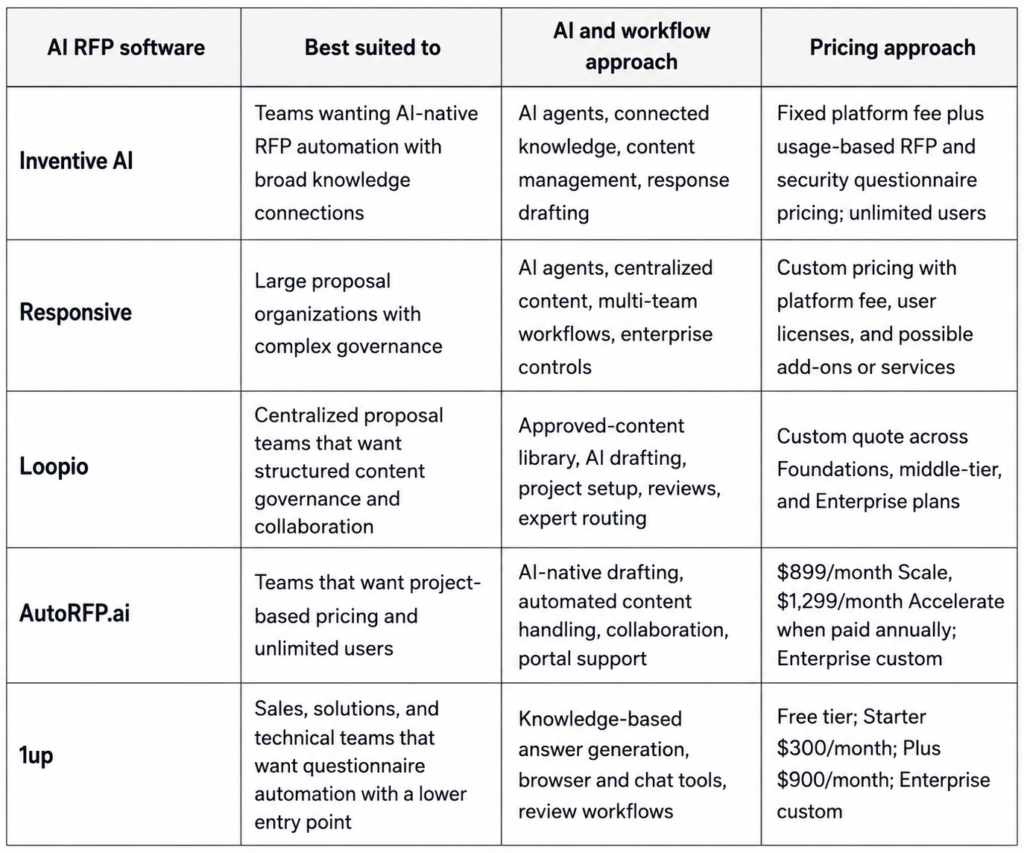
The five platforms below are compared on drafting, source grounding, content management, workflow, integrations, enterprise controls, pricing, and team fit. “Best” means best suited to a working model, not one universal winner.
Pricing shown above reflects vendor pages available in August 2026 and can change. Buyers should confirm contract terms, usage limits, onboarding, support, AI allowances, and integration costs before purchasing.
1. Inventive AI
Best for: Proposal, sales, solutions, and bid teams that want an AI-native system that can draft from connected company knowledge without charging for every collaborator.
Inventive AI combines RFP response generation with a knowledge hub, AI agents, and integrations. Its product pages say the system can learn from past responses and connected sources including Google Drive, OneDrive, SharePoint, websites, Salesforce, Slack, Notion, Confluence, and Zendesk. The platform also provides confidence ratings intended to help reviewers find answers that may need more attention.
Main features
- AI-generated RFP and questionnaire responses based on historical and approved content
- Connected knowledge sources rather than a single isolated answer database
- AI agents for response tasks and proposal work
- Centralized knowledge hub and content management
- Confidence signals for generated answers
- Integrations with CRM, document, collaboration, and knowledge tools
- Role-based access controls and enterprise security features
Inventive’s approach fits teams with useful content spread across several systems and many occasional contributors. The vendor states that its security controls include SOC 2 compliance, encryption, role-based permissions, GDPR support, and CCPA support. Those claims should still be checked against your own vendor-security requirements during procurement.
Pricing
Inventive AI currently describes its pricing as a fixed platform fee plus usage-based charges for RFPs and security questionnaires. Unlimited users are included. The pricing page does not display a universal dollar amount; instead, buyers request a personalized estimate based on expected usage. It also says unused RFP allocations can roll forward.
Where it fits well
Inventive AI fits teams that want connected knowledge and broad internal participation without paying for each collaborator. In a demo, run one of your own RFPs through the system and inspect source traceability, conflicting-content handling, Word and Excel output, reviewer controls, and answer quality. Since pricing is usage-based, model both normal and high-volume quarters.
2. Responsive
Best for: Enterprise response organizations that need formal governance, many contributors, advanced controls, and support for large RFP programs across regions or business units.
Responsive, formerly RFPIO, has expanded beyond a traditional response library into what it calls Strategic Response Management. Its platform includes AI-assisted response support, centralized content, collaboration workflows, integrations, reporting, and enterprise controls. Responsive also offers AI agents and an Agent Studio that lets teams create no-code agents for tasks inside proposal and response workflows.
Main features
- AI-assisted RFP, proposal, DDQ, and questionnaire responses
- Centralized content management and reusable approved answers
- AI agents for research, drafting, content work, and response tasks
- Agent Studio for custom no-code agent workflows
- Collaboration, review, and governance controls
- CRM-driven workflows and standard or premium connectors
- Enterprise reporting, security controls, and multi-team administration
Responsive is especially suited to organizations where RFP work crosses proposal operations, sales, security, legal, compliance, and regional teams. Its Enterprise Edition is positioned for multi-team operations and includes flexible custom AI, enterprise security controls, advanced reporting, and premium connectors.
Pricing
Responsive does not publish standard dollar prices on its main pricing page. The vendor says deployments are built from three components: an annual platform fee, user licenses, and add-ons or services. It also states that projects and responses are unlimited, so its commercial model is not based only on the number of RFPs completed.
Where it fits well
Responsive fits mature proposal functions that need regional permissions, formal content ownership, analytics, integrations, auditability, repeatable workflows, and clear administration across many contributors. In a demo, ask which AI functions and connectors are included, then test business-unit permissions, content expiration, approval routing, source traceability, and reporting. Request a full cost model for the user mix you expect over the contract term.
3. Loopio
Best for: Centralized RFP and proposal teams that want a structured response library, strong project collaboration, controlled reviews, and AI that works from approved content.
Loopio is a long-established response management platform for RFPs, RFIs, DDQs, security questionnaires, and sales proposals. Its current AI product can generate answers from approved content, add citations and confidence scores, scan incoming projects, recommend subject matter experts, and route content through review and sign-off. The platform also supports connected systems and integrations with tools used by sales and proposal teams.
Main features
- Centralized library for reusable proposal and questionnaire content
- AI-generated answers grounded in approved library material
- Citations and confidence scores on AI-assisted responses
- Automated project setup and question mapping
- Recommended subject matter experts based on prior contributions
- Multi-step reviews on higher plans
- Integrations with Salesforce, Highspot, Microsoft tools, and other systems
- Support for RFPs, DDQs, security questionnaires, and sales proposals
Loopio’s Foundations plan includes unlimited projects, unlimited library entries, generative AI, themes, and standard support. The middle tier adds a multi-language library, confidential projects, and multi-step reviews. Enterprise adds separate business units, sandboxes, a custom number of seats, and premium support.
Pricing
Loopio does not post fixed dollar prices for its three plans. Buyers contact sales for a custom quote. The pricing page also lists add-on options for project translations, onboarding packages, and industry integrations, so those items should be included when comparing total contract cost.
Where it fits well
Loopio fits teams with a disciplined process for approved answers, content owners, reviews, and scheduled updates. In a demo, use a real Word or Excel RFP with awkward formatting. Watch how the platform maps questions, preserves the document, finds content, and routes review work. Ask how much library maintenance remains and which AI, translation, integration, or onboarding options affect price.
4. AutoRFP.ai
Best for: Growing and mid-market response teams that want AI-native drafting, project-based pricing, unlimited collaborators, and published prices for standard plans.
AutoRFP.ai is built around automated response generation rather than a traditional manually maintained Q&A library. The vendor says the platform searches previous responses, content libraries, and documentation, drafts an answer using those sources, and sends unsupported questions back to the user. Once a new answer is approved, it can be reused in future work.
Main features
- AI response drafts for RFPs, RFIs, RFQs, DDQs, and security questionnaires
- Source-backed answer generation with trust scoring
- Automated content organization and reuse
- Collaboration and project management inside the platform
- Go/no-go and win/loss AI functions
- Browser support for online procurement and questionnaire portals
- Integrations with Salesforce, Google Drive, SharePoint, Confluence, Slack, Teams, Notion, OneDrive, and other systems
- SOC 2 and ISO 27001:2022 certifications stated by the vendor
A practical difference is its pricing unit. AutoRFP.ai treats an RFP, RFI, RFQ, DDQ, or security questionnaire as a project regardless of its number of questions, although buyers should confirm how clarifications, follow-up documents, and unusual multi-stage bids are counted in their contract.
Pricing
The Scale plan is listed at $899 per month when paid annually and includes 24 projects per year. Accelerate is $1,299 per month when paid annually and includes 50 projects per year. Enterprise pricing is custom for higher project volumes. The vendor says all plans include unlimited users, all features, SSO, integrations, support, and security capabilities.
Where it fits well
AutoRFP.ai fits teams with predictable project volume and many occasional contributors. In a demo, test a large questionnaire, a short high-value RFP, and a web portal. Confirm project-count rules, export quality, source citations, content-update behavior, and what happens when the annual project allowance is exceeded.
5. 1up
Best for: Sales engineering, solutions, security, and smaller proposal teams that want fast questionnaire automation, knowledge-based answers, and a self-serve entry point.
1up positions itself as an answer engine for sales teams as well as an RFP automation product. It can generate questionnaire responses from trusted sources, manage review workflows, answer ad hoc questions through chat tools, and work through a browser extension. That wider workflow suits teams where the same technical, product, and security questions appear across RFPs and customer conversations.
Main features
- AI-generated answers for RFPs, DDQs, and security questionnaires
- Knowledge connectors and file uploads
- Approval workflows, status tracking, reviewer assignments, and team collaboration
- Slack, Microsoft Teams, Google Chat, and browser integrations on paid plans
- Multi-language response generation
- Analysis of strong and weak answer areas or missing documentation
- SSO on paid questionnaire plans
- SOC 2 Type II and ISO 27001 security credentials stated by the vendor
1up says source documents are not used to train AI models and that customer data is encrypted at rest and in transit. Enterprise buyers should still verify data-processing terms and retention requirements.
Pricing
1up publishes several options. Its Free plan includes one admin, 50 knowledge uploads, and 50 answers per month. An MCP option is $50 per month plus automation usage. Starter is $300 per month and includes unlimited users and answers with one questionnaire allocation. Plus is $900 per month with six questionnaire allocations. Enterprise pricing is custom. The page also lists pay-as-you-go questionnaire automation through the MCP server at $0.05 per question answered.
Where it fits well
1up fits teams that want a smaller starting point and one knowledge system for RFPs and customer questions. In a demo, check questionnaire, file, and connector limits, review controls, browser behavior, and conflicting-source handling. If RFPs are only one use case, also test Slack, Teams, or browser workflows with real sales questions.
How the Top AI RFP Platforms Compare
Team structure changes the answer. Forty occasional reviewers may make unlimited-user pricing attractive, while a global proposal office may prioritize business-unit controls. A sales engineering group may care more about a browser extension and a quick start.
| Evaluation area | Inventive AI | Responsive | Loopio | AutoRFP.ai | 1up |
|---|---|---|---|---|---|
| AI-native response generation | Strong focus | Strong focus with agents | Strong, tied closely to approved content | Strong focus | Strong focus |
| Central knowledge management | Yes | Yes | Yes, mature library model | Yes, more automated approach | Yes |
| Formal enterprise governance | Yes | Extensive | Extensive on higher tiers | Available | Stronger on Enterprise |
| Unlimited users | Yes | Depends on licenses | Seat count varies by plan | Yes | Yes on Starter and above |
| Public dollar pricing | No universal amount | No | No | Yes | Yes |
| Browser or portal workflow | Verify for exact use case | Verify for exact use case | Supports portal/project workflows; verify target portal | Browser extension and portal workflow | Browser extension |
| Best general fit | AI-native proposal teams | Large enterprise programs | Central proposal functions | Collaborative teams with predictable project volume | Sales and technical response teams |
The table is intentionally conservative. Features can be packaged differently by edition, and vendor roadmaps move quickly. A feature should count in your comparison only if the vendor can show it in the edition you are actually buying.
What Features Should AI RFP Software Include?
A useful platform needs more than a text generator. Test these areas with your own documents.
1. Grounded answer generation
Drafts should come from approved company knowledge. Source citations, confidence signals, and clear handling of missing information make review easier.
2. RFP parsing and project setup
Test long Excel files, Word tables, PDFs, nested questions, and portal questionnaires. Intake automation can save hours before drafting even starts.
3. Knowledge management
Ask whether the system requires a curated Q&A library, connects to current repositories, or supports both. Check how it handles duplicate, outdated, or contradictory sources.
4. Review and approval workflows
Look for assignments, deadlines, statuses, comments, approval stages, and clear ownership. Legal, security, product, and finance answers may need different reviewers.
5. Integrations
Prioritize systems your team already uses, including CRM, cloud drives, collaboration apps, content tools, and security repositories.
6. Security and AI governance
Ask about SOC 2, ISO certifications, encryption, SSO, permissions, audit logs, model providers, customer-data training policies, retention, and regional controls.
7. Reporting
Reporting should show response time, bottlenecks, edit rates, reviewer workload, bid volume, and outcomes after submission.
8. Pricing that matches your workload
Model per-user, platform, project, questionnaire, or usage pricing against your real RFP volume, collaborators, seasonal spikes, integrations, onboarding, and growth.
Can AI Fully Automate RFP Responses?
AI can automate a large part of the first-pass response process, but most organizations should still review the final submission.
The safest automation targets are repetitive questions with approved answers: product capabilities, standard security controls, company background, implementation methods, support models, and previously approved policy language. AI can find relevant material and create a usable draft quickly.
More sensitive responses need specialist review. Pricing commitments, contract terms, implementation promises, roadmap statements, legal exceptions, security exceptions, regulated claims, and custom solution designs can create obligations for the company. The software can prepare material, but the responsible business owner should approve what is sent.
A good target is not “zero people involved.” It is fewer hours spent searching, copying, formatting, and chasing routine answers so reviewers can spend their time on exceptions and deal-specific sections.
How to Choose the Right AI RFP Software
Start with three or four recent RFPs rather than a generic feature checklist. Pick examples that expose different problems: one large spreadsheet, one narrative proposal, one security questionnaire, and one portal-based response if those formats are common for your team.
Then ask every vendor to complete the same test.
Score the results on:
- First-draft quality
- Source accuracy and traceability
- Time required to set up the project
- Number of answers that need major rewriting
- Ease of reviewer assignment
- Quality of Word or Excel export
- Ability to preserve buyer formatting
- Treatment of missing or conflicting information
- Integration fit
- Security controls
- Administration effort
- Three-year cost at realistic usage
This approach makes AI RFP software comparison less dependent on polished demos. The best platform for your company is the one that performs well on your documents, works with your approval process, and has a commercial model that still makes sense when usage grows.
FAQs About AI RFP Software
What is AI RFP software?
AI RFP software is a purpose-built platform that uses artificial intelligence to help teams respond to RFPs, RFIs, DDQs, security questionnaires, and related buyer documents. It can identify questions, find relevant company knowledge, draft answers, coordinate reviews, and return approved responses to the required format.
What is the best AI RFP software in 2026?
The best choice depends on team structure and process. Inventive AI is a strong option for AI-native automation with usage-based pricing and unlimited users. Responsive suits large enterprise response programs. Loopio fits centralized teams with structured content governance. AutoRFP.ai offers published project-based pricing and unlimited users. 1up gives sales and technical teams a lower-cost entry point with questionnaire and answer automation.
Can AI automate RFP responses?
Yes. AI can automate document intake, question extraction, content retrieval, first-draft generation, and parts of review routing. Final responses still need approval where answers contain commercial, legal, security, regulatory, or product commitments.
How much does RFP response software cost?
There is no standard price. In this comparison, AutoRFP.ai publishes plans at $899 and $1,299 per month when paid annually, while 1up publishes Free, $300, and $900 monthly options plus custom Enterprise pricing. Inventive AI uses a fixed platform fee plus usage pricing without a universal public dollar amount. Responsive and Loopio use custom quotes.
Which AI RFP software is best for enterprise proposal teams?
Responsive and Loopio are natural candidates for large, established proposal organizations because both provide structured governance and enterprise plans. Inventive AI should also be evaluated by enterprises that want a more AI-native workflow and unlimited users. The decision should come from a controlled test using the same RFPs, security requirements, integrations, and reviewer structure.
Conclusion
The best AI RFP software is the product that reduces repetitive response work without weakening control over what your company sends to a buyer.
Inventive AI is a good fit for teams looking for AI-native drafting, connected knowledge, and unlimited collaborators under a usage-based model. Responsive is built for large response organizations with complex governance. Loopio combines a mature content-library approach with AI-assisted drafting and project management. AutoRFP.ai offers clear project-based pricing and unlimited users. 1up provides a lower-entry path for sales and technical teams that want both questionnaire automation and fast access to company answers.
Before signing a contract, run the same real RFP through each shortlisted tool. Measure draft quality, source traceability, reviewer effort, export quality, setup time, and total cost. A controlled test will tell you far more than a feature grid alone.