Viva Glint Alternatives in 2026: Employee Survey and Listening Tools Compared

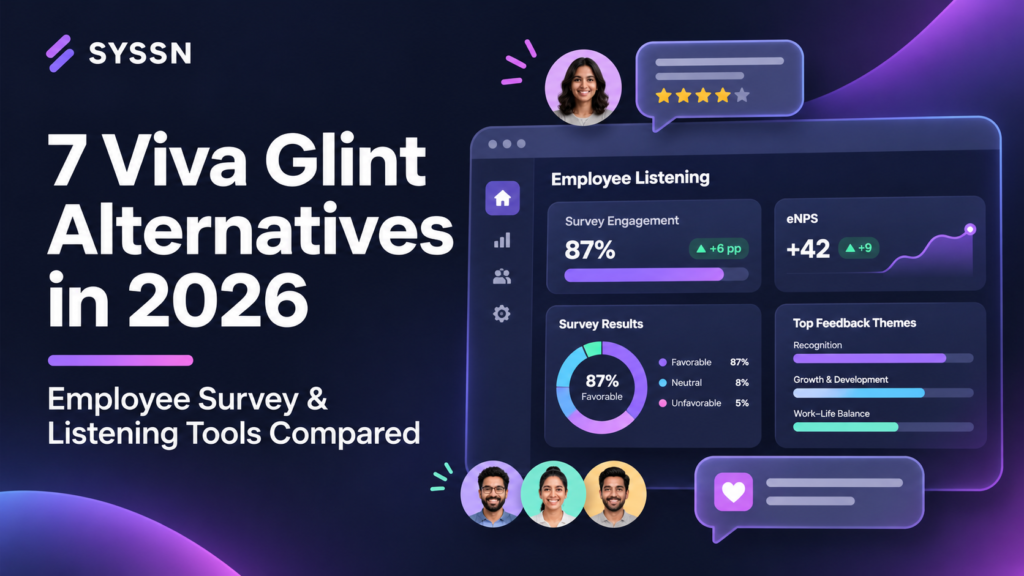
HubEngage, Culture Amp, Qualtrics EmployeeXM, Workday Peakon Employee Voice, Perceptyx, Lattice, and 15Five are seven Viva Glint alternatives worth considering in 2026. HubEngage is particularly relevant for frontline and distributed workforces, Culture Amp emphasizes research-backed engagement programs, Qualtrics offers extensive enterprise analytics, and Workday Peakon focuses on continuous employee listening.
Lattice and 15Five connect engagement surveys with broader people-management workflows, while Perceptyx supports complex listening programs and conversational feedback.
The right platform depends on employee accessibility, survey requirements, reporting depth, confidentiality controls, existing HR systems, and total cost.
This guide compares seven Microsoft Viva Glint competitors using publicly documented capabilities, pricing, strengths, and limitations. It also explains how to evaluate them using practical employee listening scenarios.
What Is Microsoft Viva Glint?
Microsoft Viva Glint is an employee listening and engagement platform within Microsoft’s Viva employee experience ecosystem.
It helps organizations collect employee feedback, understand workplace sentiment, identify engagement challenges, and support managers in planning improvements.
Its capabilities include:
- Organization-wide employee engagement surveys.
- Onboarding, exit, and other employee lifecycle surveys.
- AI-assisted employee comment analysis.
- Engagement reporting and benchmarking.
- Manager dashboards and recommended actions.
- Connections with Microsoft’s broader employee experience products.
Microsoft publicly lists Viva Glint at $2 per user per month, paid annually, for its standalone US offering. A minimum of 50 licensed users is required to initiate the service.
Additional Viva products, including Viva Pulse and Viva Insights, have separate licensing considerations.
Why Consider Alternatives to Microsoft Viva Glint?
Viva Glint may fit organizations using Microsoft 365, but it is not necessarily the most suitable employee listening platform for every workforce.
Some companies need additional ways to reach employees who do not regularly use corporate email. Others prioritize advanced people analytics, configurable survey programs, performance management, or manager development.
For example, a manufacturing company may need employees to complete surveys through mobile devices or QR codes without accessing a corporate laptop.
A multinational enterprise may instead prioritize confidential demographic analysis, multilingual surveys, benchmarking, and connections with its HR information system.
There is also an important distinction between Viva Glint and Viva Pulse. Microsoft positions Glint primarily around organization-wide listening programs, while Viva Pulse supports shorter, team-focused feedback initiated by managers and project leads.
Before replacing Viva Glint, organizations should determine whether their primary problem is employee participation, survey design, analysis, reporting, or acting on feedback.
A more extensive feature list does not necessarily mean better employee listening.
Quick Comparison: 7 Viva Glint Alternatives in 2026
| Platform | Best suited for | Main differentiator | Public US pricing |
|---|---|---|---|
| HubEngage | Frontline and distributed workforces | Multichannel surveys, communications, and recognition | Custom quote |
| Culture Amp | Research-led employee engagement programs | People science, benchmarking, and action planning | Custom annual quote |
| Qualtrics EmployeeXM | Large enterprises with complex analytics requirements | Continuous listening and advanced employee experience analysis | Custom quote |
| Workday Peakon Employee Voice | Enterprise HR teams | Continuous engagement measurement and retention insights | Custom quote |
| Perceptyx | Complex enterprise listening programs | Conversational listening, qualitative analysis, and action planning | Custom quote |
| Lattice | Organizations connecting engagement with performance management | Engagement surveys alongside manager and performance workflows | Engagement: $4/seat/month |
| 15Five | Organizations prioritizing engagement and manager effectiveness | Engagement assessments, action planning, and manager development | Engage: $4/user/month |
The main distinction is the scope of each platform.
HubEngage combines employee feedback with workplace communications. Culture Amp, Qualtrics, Workday Peakon, and Perceptyx place substantial emphasis on measuring and understanding employee experiences.
Lattice and 15Five are particularly relevant when HR teams want to connect engagement measurement with performance management and manager effectiveness.
How We Evaluated These Employee Listening Platforms
This comparison uses publicly available vendor documentation, product descriptions, and pricing pages reviewed on November 12, 2026.
Each platform was considered against six criteria:
- Survey capabilities: Engagement surveys, pulse surveys, lifecycle feedback, customization, and scheduling.
- Analytics and reporting: Sentiment analysis, benchmarking, AI-assisted insights, segmentation, and manager dashboards.
- Employee accessibility: Mobile access, available survey channels, and suitability for frontline or distributed employees.
- Action planning: Tools that help HR teams and managers respond to findings.
- Integrations and confidentiality: HRIS connectivity, collaboration tools, access permissions, and privacy safeguards.
- Pricing and implementation: Public prices, contractual requirements, platform scope, and potential administrative complexity.
The recommendations reflect documented capabilities and likely organizational fit. They are not based on hands-on testing, independent performance measurements, or a numerical ranking of vendors.
Actual suitability depends on the configuration and subscription purchased.
For a wider procurement framework, see this guide to evaluating employee experience platforms.
Viva Glint Alternatives: Detailed Reviews
1. HubEngage — For Frontline and Distributed Employee Listening

Best for: Organizations that need employee surveys alongside internal communications, recognition, and mobile workforce engagement.
HubEngage is a modular employee experience platform that combines employee surveys with communications, recognition, social engagement, and messaging.
Its Surveys Hub supports customizable questionnaires, recurring pulse surveys, anonymous feedback options, and AI-assisted sentiment and thematic analysis.
One of HubEngage’s notable characteristics is its multichannel approach.
Organizations can distribute survey notifications and access opportunities through mobile apps, web, email, and SMS. Digital signage can also support participation through QR codes.
This makes HubEngage relevant to businesses with employees who work away from desks or do not regularly access company email.
Key features
- Recurring pulse and engagement surveys with customizable question formats.
- Multilingual survey options and automatic translation.
- AI-supported sentiment and thematic analysis of written responses.
- Mobile, web, email, and SMS distribution.
- QR-code access and survey reminders.
- Gamified participation through points and rewards.
- Survey reporting with employee-group and location segmentation.
Strengths
HubEngage combines employee listening with the channels organizations use to communicate with their workforce.
For example, a retail organization could distribute a short engagement survey to store employees, analyze feedback by location where reporting thresholds permit, and use its communication channels to explain planned improvements.
The same platform can also support employee recognition and other engagement activities.
This approach may be useful for healthcare, retail, hospitality, manufacturing, and other industries with dispersed or shift-based employees.
Limitations
Organizations requiring specialized statistical modeling, extensive research workflows, or highly complex enterprise analytics should compare HubEngage’s reporting depth with dedicated employee listening platforms.
Its broader employee experience modules may also introduce capabilities that some buyers do not need.
Although the platform offers anonymous survey functionality, organizations should still verify minimum reporting-group sizes, employee permissions, and protections against identifying individuals through demographic filters.
Pricing: HubEngage provides customized quotes based on employee count, selected capabilities, and contract terms. The vendor describes monthly, annual, and multiyear arrangements.
Choose HubEngage when: Reaching employees and communicating follow-up actions are just as important as collecting survey responses.
2. Culture Amp — For Research-Driven Employee Engagement
Best for: Organizations prioritizing research-backed engagement measurement, benchmarking, and structured improvement programs.
Culture Amp combines employee engagement measurement with performance management and employee development capabilities.
Its Engage product supports engagement surveys, pulse surveys, onboarding and exit feedback, benchmarking, AI-powered comment summaries, and action planning.
The platform emphasizes people science and the use of structured measurement approaches to help organizations understand employee experiences.
HR teams can examine engagement results, identify relevant patterns, and support managers in responding to concerns.
Key features
- Research-backed employee engagement surveys.
- Pulse surveys and employee lifecycle feedback.
- AI-powered comment summaries.
- Engagement benchmarks and retention insights.
- Action plans and manager guidance.
- HRIS integrations and connections with Slack and Microsoft Teams.
Strengths
Culture Amp is a relevant option for organizations that want more than collecting survey scores.
Its benchmarking and people science capabilities can help HR teams interpret findings and develop consistent engagement programs across departments.
For instance, an organization examining declining confidence in leadership could use survey results and qualitative feedback to identify specific areas requiring management attention.
Culture Amp also offers related performance and development products, although organizations should evaluate their availability and packaging separately.
Limitations
The platform’s wider range of capabilities may be unnecessary for businesses seeking only occasional employee surveys.
Organizations should assess the resources needed to configure surveys, interpret results, and maintain recurring improvement programs.
Available onboarding and service arrangements depend on the purchased tier.
Pricing: Culture Amp provides custom annual subscription pricing based on employee count, selected products, and service tier.
Choose Culture Amp when: Benchmarking, structured engagement research, and manager action planning are central to the employee listening strategy.
3. Qualtrics EmployeeXM — For Advanced Enterprise Employee Analytics
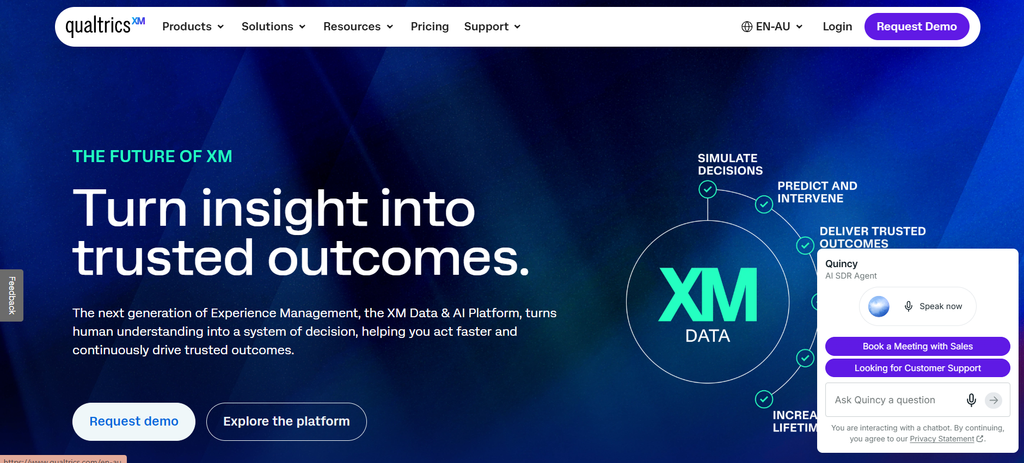
Best for: Large organizations requiring comprehensive employee experience analytics and multiple listening programs.
Qualtrics EmployeeXM is part of the broader Qualtrics experience management ecosystem.
It supports employee engagement surveys, pulse feedback, lifecycle measurement, and analysis of structured and unstructured employee feedback.
The platform is designed for organizations that need to understand employee experiences across business units, geographic regions, and workplace events.
Its capabilities include AI-assisted feedback analysis, employee experience reporting, and tools that support personalized management actions.
Key features
- Employee engagement and pulse surveys.
- Onboarding, exit, and lifecycle feedback programs.
- AI-powered analysis of employee comments.
- Continuous listening through supported feedback channels.
- Workforce experience dashboards and reporting.
- Tools for connecting employee experience findings with other organizational measures.
Strengths
Qualtrics is relevant to enterprises with dedicated people analytics teams or more complex reporting needs.
An organization undergoing restructuring, for example, may want to compare employee sentiment before, during, and after a change while examining differences across business functions.
The platform’s broader experience management capabilities may also interest organizations examining relationships between employee experiences, service delivery, and customer feedback.
However, analysis showing an association between those measures should not automatically be interpreted as proof of causation.
Limitations
Qualtrics may require more configuration, administration, and procurement planning than a straightforward survey platform.
Capabilities can vary by product and contract. Buyers should confirm whether the proposed package includes lifecycle programs, continuous listening, particular AI features, and the reporting functionality they require.
Organizations without dedicated analytical resources should also consider the practical effort needed to interpret and act on complex reporting.
Pricing: Qualtrics generally provides customized Employee Experience pricing based on organizational requirements and selected capabilities.
Choose Qualtrics when: Advanced analysis, multiple listening programs, and enterprise-scale reporting are more important than a simple survey workflow.
4. Workday Peakon Employee Voice — For Continuous Enterprise Listening
Best for: Large organizations seeking recurring employee feedback, engagement benchmarking, retention insights, and manager accountability.
Workday Peakon Employee Voice is an employee listening platform designed around continuous feedback and employee experience analysis.
It uses recurring surveys, analytics, benchmarking, and manager dashboards to help organizations identify workplace issues and track changes over time.
The platform also supports confidential employee-manager conversations and tools for following up on identified concerns.
Key features
- Continuous employee engagement surveys.
- Flexible survey scheduling.
- AI-assisted feedback themes and summaries.
- Engagement benchmarking and employee experience analytics.
- Attrition-risk insights.
- Manager dashboards, recommended actions, and confidential conversations.
Strengths
Workday Peakon is particularly relevant for enterprises that want employee listening to function as an ongoing management process.
Its recurring feedback approach can help organizations monitor engagement and investigate changes without relying solely on an annual survey.
For example, a business experiencing employee turnover across several departments could examine engagement patterns and use the findings to prioritize areas for investigation.
The platform also supports reporting and integration options that can be valuable for enterprise HR operations.
Limitations
Workday’s setup documentation identifies important survey-design constraints.
Peakon is built around continuous listening rather than arbitrary one-off questionnaires. Its documented methodology also has restrictions on question formats and response scales.
Organizations needing highly flexible, standalone research surveys should examine these constraints during product evaluation.
Implementation, HR data preparation, and reporting governance can require significant planning, particularly across large workforces.
Pricing: Workday Peakon Employee Voice is available through customized enterprise sales arrangements.
Choose Workday Peakon when: Continuous employee feedback, retention analysis, and structured manager follow-up are primary requirements.
5. Perceptyx — For Complex Enterprise Listening Programs
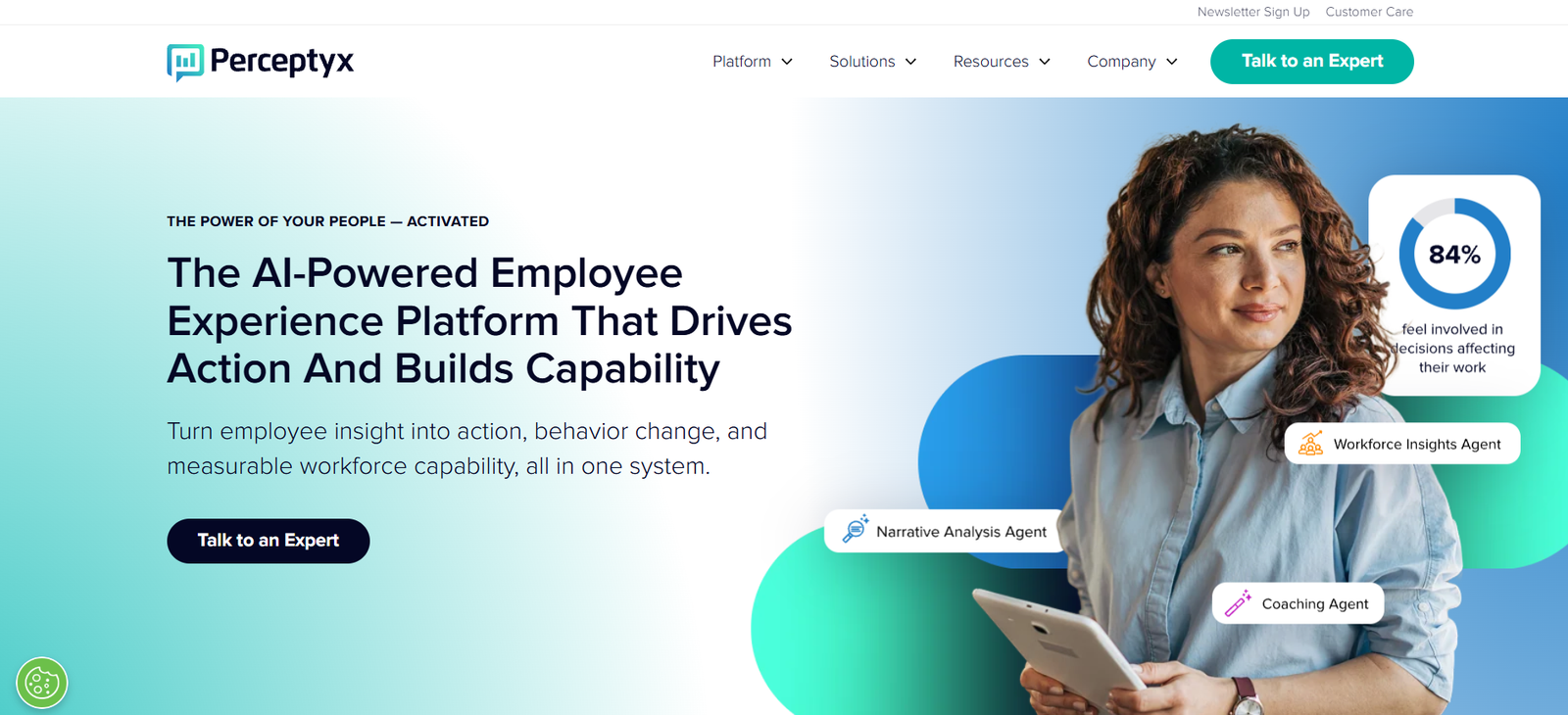
Best for: Organizations requiring configurable employee listening programs, qualitative feedback analysis, and AI-supported action planning.
Perceptyx provides an employee experience platform focused on collecting, interpreting, and acting on workforce feedback.
Its capabilities support engagement surveys, employee lifecycle listening, organizational analytics, and conversational feedback.
A distinguishing capability is its Conversational Listening Agent, which is designed to ask contextual follow-up questions based on employee responses.
This approach can help organizations explore why employees feel a certain way rather than relying exclusively on predefined survey answers.
Key features
- Engagement and employee lifecycle listening.
- Conversational AI for contextual feedback.
- AI-assisted narrative and thematic analysis.
- Organizational reporting and employee experience insights.
- Tools supporting action planning and manager development.
- Integration options for broader enterprise employee listening programs.
Strengths
Perceptyx can be useful for organizations with multiple employee populations, complex reporting structures, or evolving feedback requirements.
For instance, a large company conducting an organizational transformation may want standardized engagement scores alongside more detailed explanations of employee concerns.
Conversational feedback can help gather context, while recurring surveys provide consistent measures for tracking change.
The platform’s combination of listening and action-planning capabilities can support a broader employee experience strategy.
Limitations
Perceptyx requires a clear understanding of what the organization wants to measure and how feedback will influence decisions.
Complex listening programs may require governance around survey frequency, confidentiality, reporting permissions, and managerial responsibility.
Organizations evaluating its conversational AI should also confirm supported delivery channels, languages, and contractual entitlements. Availability can differ between the general platform and particular AI features.
Pricing: Custom enterprise pricing is available through Perceptyx sales.
Choose Perceptyx when: Advanced listening, qualitative feedback, and ongoing organizational improvement are central requirements.
6. Lattice — For Combining Employee Engagement and Performance Management
Best for: Organizations that want engagement surveys connected to performance management, goals, manager feedback, and employee development.
Lattice is a people management platform offering employee engagement, performance management, goals, and related workforce analytics.
Its Engagement product supports pulse surveys, employee lifecycle feedback, Employee Net Promoter Score measurement, benchmarking, and AI-assisted analysis.
Organizations can use these capabilities alongside other Lattice products to connect engagement findings with regular management processes.
Key features
- Employee engagement and pulse surveys.
- Employee Net Promoter Score measurement.
- Onboarding and exit surveys.
- Engagement benchmarks and AI-assisted analysis.
- Survey action planning.
- Optional performance management and goals capabilities.
- Integrations with HRIS and workplace tools.
Strengths
Lattice is relevant for organizations that want engagement measurement to be part of broader people-management activities.
For example, an HR team might use employee engagement results to identify concerns about feedback quality and then examine whether existing manager conversations and performance processes adequately address them.
The platform’s modular approach allows companies to evaluate engagement independently or alongside additional products.
Unlike several enterprise employee listening vendors, Lattice publishes a starting price for its Engagement product.
Limitations
Lattice may not be the first choice for organizations requiring specialized survey research or complex enterprise listening models.
Companies should compare its analytical depth and survey flexibility with dedicated employee feedback platforms before making a decision.
The platform’s annual spending requirement can also affect affordability for smaller organizations.
Performance management, goals, and other modules are not automatically included with the standalone Engagement product.
Pricing: Lattice lists Engagement at $4 per seat per month, billed annually, with a $4,000 minimum annual agreement across purchased products.
Choose Lattice when: Employee engagement should connect with performance management and ongoing manager-employee feedback processes.
7. 15Five — For Manager Effectiveness and Employee Engagement

Best for: Small and midsize organizations, as well as larger HR teams seeking engagement measurement alongside manager development.
15Five provides employee engagement and performance management software designed to help organizations understand workplace experiences and improve manager effectiveness.
Its Engage product includes employee engagement surveys, benchmarking, assessments, AI-assisted feedback analysis, and action planning.
Additional offerings support performance reviews, goals, feedback, and employee development.
Key features
- Employee engagement surveys and eNPS.
- Targeted assessments and customizable feedback programs.
- Employee lifecycle surveys.
- AI-powered feedback synthesis.
- Engagement heat maps and benchmarking.
- Manager effectiveness measurement.
- Action planning and related management tools.
Strengths
15Five provides a connection between engagement measurement and management practices.
For example, an organization could use engagement survey findings to identify concerns about manager communication, create improvement plans, and evaluate whether employee perceptions change over subsequent survey cycles.
Its published pricing makes initial budget planning more straightforward than with vendors that provide only custom enterprise quotes.
The separation between Engage and Perform also helps buyers distinguish survey functionality from performance management capabilities.
Limitations
Organizations requiring employee engagement and comprehensive performance management should review the different product plans carefully.
Not every manager-development or performance capability is included in Engage.
Large multinational employers should also confirm that reporting structures, localization, data governance, and employee administration support their requirements.
Pricing: According to 15Five’s published US pricing:
- Engage: $4 per user/month, billed annually.
- Perform: $11 per user/month, billed annually.
- Total Platform: $16 per user/month, billed annually.
Choose 15Five when: Employee engagement measurement, manager effectiveness, and transparent starting subscription prices are important.
Which Viva Glint Alternative Fits Your Organization?
Choosing employee listening software becomes easier when organizations begin with their operational requirements rather than a vendor’s overall feature list.
For Frontline and Deskless Employees
HubEngage is worth considering when survey participation depends on reaching employees through several communication channels.
A company with retail stores, manufacturing facilities, or healthcare locations may need mobile survey access, SMS notifications, and QR codes.
For these organizations, accessibility can be as important as advanced reporting.
However, the platform must also protect employees’ confidentiality, particularly when reporting results for small teams or locations.
For Advanced Enterprise Analytics
Qualtrics and Perceptyx are relevant options for organizations with complex listening requirements.
Qualtrics emphasizes broad employee experience analytics, lifecycle listening, and enterprise reporting.
Perceptyx combines enterprise listening with conversational feedback and AI-supported interpretation.
Both deserve evaluation when an organization has dedicated resources for managing and analyzing employee data.
For Research-Based Engagement Programs
Culture Amp is relevant when engagement research, benchmarking, and structured action planning are central priorities.
Workday Peakon is another option when continuous feedback, employee retention insights, and consistent manager follow-up are especially important.
The distinction depends partly on the organization’s preferred survey methodology and reporting requirements.
For Engagement and Performance Management
Lattice and 15Five may suit organizations that want engagement findings connected to manager feedback and performance processes.
Both offer engagement measurement alongside broader people-management capabilities, although their product packages differ.
Buyers should compare the specific survey and performance workflows included in each proposed contract.
For organizations exploring communications, employee recognition, and wider employee-facing technology, see this employee experience platform comparison for 2026.
What Should HR Teams Check Before Choosing Employee Listening Software?
A software demonstration should establish whether a platform can support actual workforce requirements.
The following areas deserve particular attention.
1. Employee Anonymity and Confidentiality
Employee trust is essential to collecting meaningful workplace feedback.
Before selecting a platform, ask whether responses are anonymous, confidential, or identifiable to particular administrators.
These terms describe different arrangements.
An anonymous survey is designed not to associate responses with identifiable individuals. A confidential survey may retain identifiers internally while restricting who can view individual responses.
The distinction matters when employees provide sensitive feedback about managers or workplace experiences.
Organizations should examine minimum reporting-group sizes, demographic filters, access permissions, and the visibility of written comments.
For example, a manager should not be able to identify an employee simply by combining a small department filter with another demographic characteristic.
Ask vendors to demonstrate how their systems handle these situations rather than relying on general assurances about confidentiality.
2. AI-Powered Employee Feedback Analysis
AI-supported analytics can help HR teams process large volumes of written responses.
Depending on the platform, capabilities may include comment summaries, sentiment analysis, thematic grouping, and recommendations.
However, these outputs can be incomplete or misleading.
Employee comments may contain sarcasm, regional expressions, mixed sentiment, or language that requires organizational context.
AI systems may also summarize minority viewpoints poorly when most responses express a different opinion.
Before purchasing, test whether the platform can accurately summarize a representative set of comments and explain how confidential information is handled.
Ask where employee feedback is processed, who can access generated insights, and whether customer data is used for model training.
Human review should remain part of decisions involving sensitive employee feedback.
3. Survey Accessibility and Participation
Employee listening systems should work for the people expected to use them.
For frontline employees, confirm whether surveys can be completed through mobile devices, shared workstations, SMS links, or QR codes.
For office employees, email, web, and collaboration-tool workflows may be more important.
A practical demonstration should include employees without corporate email accounts.
Organizations should also evaluate multilingual support, accessibility needs, survey length, and whether participation is realistic during working hours.
Gamified incentives may encourage participation, but they should not pressure employees or influence the answers they provide.
A high response rate is useful only when the feedback remains trustworthy and sufficiently representative.
4. HRIS and Collaboration Integrations
Employee listening platforms often advertise integrations with HR information systems and workplace applications.
However, integration capabilities vary substantially.
An HRIS integration might support employee-data imports and reporting hierarchies without supporting every administrative workflow.
Similarly, a Microsoft Teams integration may provide notifications rather than a complete in-app survey experience.
Ask vendors to demonstrate:
- Employee provisioning and data synchronization.
- Manager hierarchy updates.
- Single sign-on and permission management.
- Survey invitations and reminders.
- Reporting access for managers.
- Supported Microsoft Teams or Slack workflows.
Confirm whether integrations are included in the quoted package or require additional fees.
5. Total Cost and Contract Requirements
Comparing employee listening software solely by monthly subscription price can produce misleading conclusions.
For example, Microsoft Viva Glint’s publicly listed $2 per-user rate is lower than the starting Engagement rates published by Lattice and 15Five.
However, the products have different capabilities, licensing minimums, and packaging arrangements.
A complete cost comparison should consider:
- Subscription and license requirements.
- Annual spending or seat minimums.
- Implementation and training.
- HRIS integration and data migration.
- Advanced analytics or AI modules.
- Support and administrative services.
- SMS and communication-related costs.
- Renewal terms and contractual flexibility.
The relevant question is not simply which platform advertises the lowest rate, but what the organization pays for the functionality it actually needs.
A Practical Demonstration Framework for Comparing Vendors
Rather than relying on general product demonstrations, give shortlisted vendors the same tasks.
Consider a hypothetical organization with 2,000 employees across office and frontline locations.
It needs to run a multilingual engagement survey, compare results by department, protect small reporting groups, and communicate improvements after the survey closes.
Ask every vendor to demonstrate the following workflow:
| Evaluation task | What the vendor should demonstrate |
|---|---|
| Survey creation | Build a short engagement survey with custom questions and translations |
| Employee access | Allow an office employee and a frontline employee to complete the survey |
| Confidentiality | Show how results are suppressed or restricted for small employee groups |
| Feedback analysis | Analyze written comments and explain how AI-generated summaries are reviewed |
| Manager reporting | Give managers access only to the results they are authorized to see |
| Action planning | Create an improvement action, assign responsibility, and track follow-up |
| Integration | Demonstrate the organization’s actual HRIS and communication requirements |
A useful evaluation technique is to score each vendor against predefined requirements.
For example, a team could mark each task as fully supported, partially supported, or unsupported, while separately recording whether the capability requires an additional module.
This is a proposed procurement method, not a performance ranking of the products reviewed here.
The exercise makes it easier to distinguish a capability demonstrated in the purchased product from one mentioned only in sales material.
How to Migrate from Microsoft Viva Glint
Replacing Viva Glint requires more than exporting survey results and configuring a new platform.
Employee listening programs often depend on established survey questions, reporting hierarchies, benchmarks, and confidentiality arrangements.
A migration should preserve useful historical context while ensuring employees understand the new feedback process.
Step 1: Audit Existing Surveys and Reports
Identify active questionnaires, survey schedules, historical results, reporting groups, and manager dashboards.
Document which engagement metrics are important for ongoing comparisons.
Step 2: Define Required Capabilities
List the survey types, analytics, accessibility options, integrations, and confidentiality settings that must continue working.
Separate essential requirements from features that could be introduced later.
Step 3: Confirm Data Export and Import Options
Determine which information can be exported from Viva Glint and which historical records the replacement platform can accept.
Ask whether previous results can be imported into dashboards or must remain in an archived reporting environment.
Do not assume that all historical data can be transferred into an equivalent format.
Step 4: Run a Controlled Pilot
Test the replacement with a representative employee group before launching organization-wide.
Include both office and frontline employees where applicable.
Evaluate survey delivery, question comprehension, participation, language support, reporting permissions, and manager actions.
Review the pilot with HR, IT, security, and relevant employee representatives.
Step 5: Communicate and Monitor the Transition
Explain why the organization is changing platforms, how employees can participate, and how their responses will be protected.
After launch, monitor participation, reporting reliability, employee questions, and completion of improvement actions.
Importantly, historical engagement scores may not be directly comparable after a migration.
Changes in survey wording, response scales, benchmarks, audience composition, and confidentiality thresholds can affect results.
Organizations should document these changes instead of treating score differences as definitive evidence that engagement improved or declined.
Frequently Asked Questions About Viva Glint Alternatives
What Are the Best Microsoft Viva Glint Alternatives in 2026?
Seven options worth evaluating are HubEngage, Culture Amp, Qualtrics EmployeeXM, Workday Peakon Employee Voice, Perceptyx, Lattice, and 15Five.
HubEngage is relevant for multichannel workforce participation. Culture Amp focuses on research-led engagement programs. Qualtrics, Workday Peakon, and Perceptyx support extensive employee listening requirements.
Lattice and 15Five are particularly relevant when employee engagement should connect with broader management processes.
No single platform is the strongest choice for every organization.
Which Viva Glint Alternative Has Transparent Pricing?
Lattice and 15Five publish starting prices for their employee engagement products.
Lattice lists Engagement at $4 per seat per month, subject to a $4,000 minimum annual agreement.
15Five lists Engage at $4 per user per month, billed annually.
Microsoft Viva Glint itself is listed at $2 per user per month, paid annually, with a minimum of 50 licensed users.
The remaining alternatives in this comparison generally require customized quotes for the relevant enterprise listening products.
Pricing alone does not establish which platform provides the best value.
How Does Viva Glint Compare with Culture Amp and Qualtrics?
Viva Glint provides organization-wide employee listening within Microsoft’s employee experience ecosystem.
Culture Amp combines employee engagement surveys with people science, benchmarking, and structured action planning.
Qualtrics EmployeeXM emphasizes broad enterprise listening, employee experience analytics, and multiple feedback programs.
Organizations should compare their actual survey requirements, available analytical resources, integrations, and contractual terms rather than assuming one platform is universally more capable.
Can Viva Glint Competitors Integrate with Microsoft Teams?
Several platforms offer Microsoft Teams connectivity, including Culture Amp, Workday Peakon, Lattice, and 15Five.
However, these integrations do not necessarily provide identical capabilities.
Some support notifications or collaboration workflows, while others may offer more extensive employee listening functions.
Organizations should ask vendors to demonstrate the exact Teams workflow they expect to use and confirm whether it is included in their purchased package.
Are Employee Listening Platforms Completely Anonymous?
Not necessarily.
Different platforms and survey configurations may use anonymous, confidential, or identifiable responses.
Even when individual responses are protected, small employee groups and detailed demographic filters can create re-identification risks.
Organizations should review reporting thresholds, comment visibility, permissions, and employee privacy notices before launching surveys.
Which Employee Survey Software Is Suitable for Small and Midsize Businesses?
15Five and Lattice are relevant candidates for smaller and midsize organizations that want engagement surveys connected to management practices.
HubEngage may be suitable when a smaller organization also needs mobile communication and workforce engagement capabilities.
However, published subscription rates should be assessed alongside minimum spending requirements, administrative resources, and actual feature needs.
A simpler tool that supports a well-managed listening process may deliver more practical value than a complex platform the organization cannot fully use.
Conclusion
Choosing a Viva Glint alternative in 2026 depends on workforce composition, employee listening objectives, reporting requirements, and the organization’s ability to act on feedback.
HubEngage is worth evaluating when employee surveys must reach frontline and distributed workers through several channels.
Culture Amp is relevant for research-backed engagement programs, while Qualtrics EmployeeXM and Perceptyx support extensive enterprise listening and analytics requirements.
Workday Peakon Employee Voice deserves consideration when continuous feedback, retention analysis, and manager accountability are priorities.
Lattice and 15Five may be suitable when organizations want employee engagement surveys connected to performance management and manager effectiveness.
Before making a decision, request demonstrations using real workforce scenarios, confirm privacy controls, examine product-specific limitations, and compare total contract costs.
Most importantly, assess whether managers can turn survey results into visible improvements.
Employee listening software provides the greatest practical value when organizations collect trustworthy feedback, communicate what they learned, and consistently act on employee concerns.