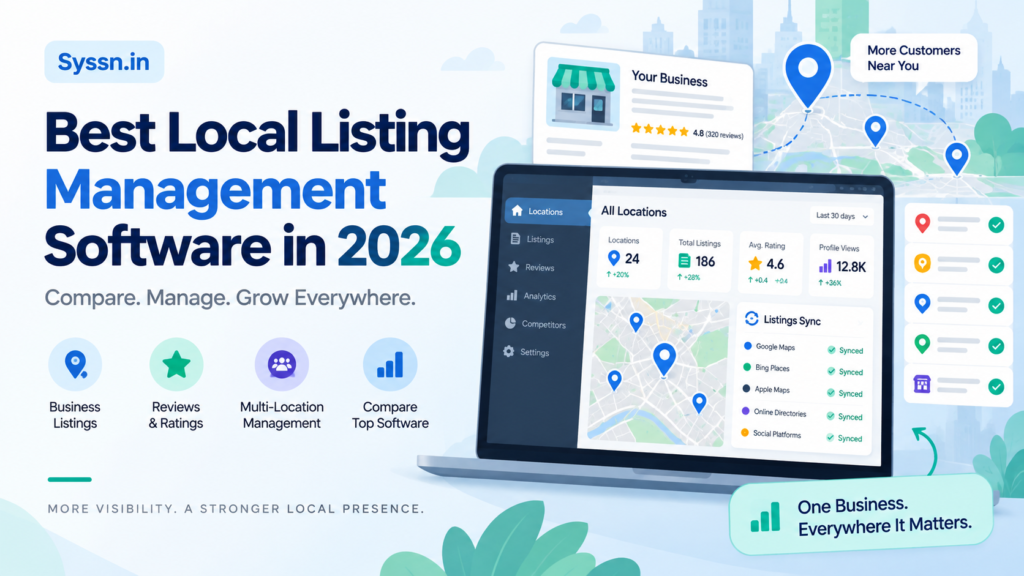
Best Local Listing Management Software in 2026

A wrong closing time on Google looks like a tiny problem until someone drives across town and finds the doors locked.
That is the slightly unglamorous reality behind local listing management. The software may talk about hundreds of publishers, AI, dashboards and automation. The customer usually cares about something simpler: Is this business open? Where is it? Can I call it? Is this actually the right branch?
After comparing the major platforms available in 2026, I don’t think there is one local listing management tool that deserves to be called the best for everyone.
Synup is the strongest fit here for agencies and growing multi-location teams. Yext and Uberall make more sense for large franchises and enterprise networks. BrightLocal is easier to justify for smaller businesses that want visible pricing. Semrush Local works well for teams already using Semrush. Birdeye becomes more interesting when reputation management is part of the project. Whitespark is a different kind of option, particularly useful for citation cleanup and one-time listing work.
The important part is figuring out which problem you actually need the software to solve.
Best local listing management software at a glance
| Software | Best fit | Pricing checked Sept. 11, 2026 | Main weakness |
|---|---|---|---|
| Synup | Agencies, resellers and growing multi-location teams | $49/month for 1 location; $299 for up to 10; $499 for up to 25; $899 for up to 50 | Pricing jumps sharply between one and a few locations |
| Yext | Enterprise brands and large franchises | Quote required | Difficult to compare cost before speaking with sales |
| BrightLocal | SMBs, agencies and single-location businesses | Manage starts at $54/month; Citation Builder from $3.20/site | Listings products and citation services can involve separate charges |
| Semrush Local | Existing Semrush users and SEO teams | Base $30/location/month; Pro $60/location/month annually | Listing Management requires the $60 Pro tier |
| Uberall | Franchises and distributed multi-location brands | Quote-based | Several functions are optional add-ons |
| Birdeye | Reputation-led multi-location businesses | Custom pricing | Can become expensive once additional products are added |
| Whitespark | Citation cleanup and one-time listing projects | Listings packages from $399/location | Less suited to buyers wanting one continuous broad-network sync platform |
Pricing above reflects the figures checked on September 11, 2026.
How we compared local listing management software
A lot of listing software looks good during a sales demonstration.
Someone changes a phone number. The dashboard turns green. A map fills with locations. Everyone nods.
The harder questions appear later.
What happens when Apple rejects an update?
Can a regional manager edit five stores without touching the other 200?
Can someone schedule holiday hours without overwriting the normal schedule?
What happens when Google contains one address and your internal database contains another?
And perhaps the least exciting but most useful question: who gets told when something fails?
Those are the things I would pay attention to.
For this comparison, I looked at how each product handles the practical work around listing distribution: publisher coverage, bulk updates, duplicates, permissions, error detection, pricing, data ownership and related local marketing functions.
Publisher count still matters, but I would not choose software purely because one company claims 200 integrations while another offers 100.
A restaurant group may care intensely about Google, Apple Maps, Facebook, menus and holiday hours. A healthcare company may need specialist directories and strict approval controls. An agency may care more about white-label reporting and keeping client accounts separated.
The number means very little without context.
The Syssn Local Listings Operations Score
To make that comparison more useful, we use a simple 100-point framework.
This is a Syssn editorial framework rather than an industry standard.
| Area | Weight | What to test |
|---|---|---|
| Publisher fit | 20 | Does the network contain the directories and maps your customers actually use? |
| Change management | 20 | Can you handle bulk updates, special hours, openings, closures and relocations? |
| Failure detection | 15 | Can staff see rejected changes, duplicates and disconnected profiles? |
| Roles and approvals | 15 | Can different teams receive different access levels? |
| Real annual cost | 15 | What will subscriptions, locations, add-ons, onboarding and support cost together? |
| Data ownership and exit | 10 | What happens to your listings and data after cancellation? |
| AI usefulness | 5 | Does the AI remove real work while keeping important changes controlled? |
I would use a framework like this before asking vendors for proposals.
It also changes the conversation. Instead of asking, “How many directories do you support?”, you start asking, “Can you show me what happens when an update fails?”
That usually produces a more useful answer.
1. Synup
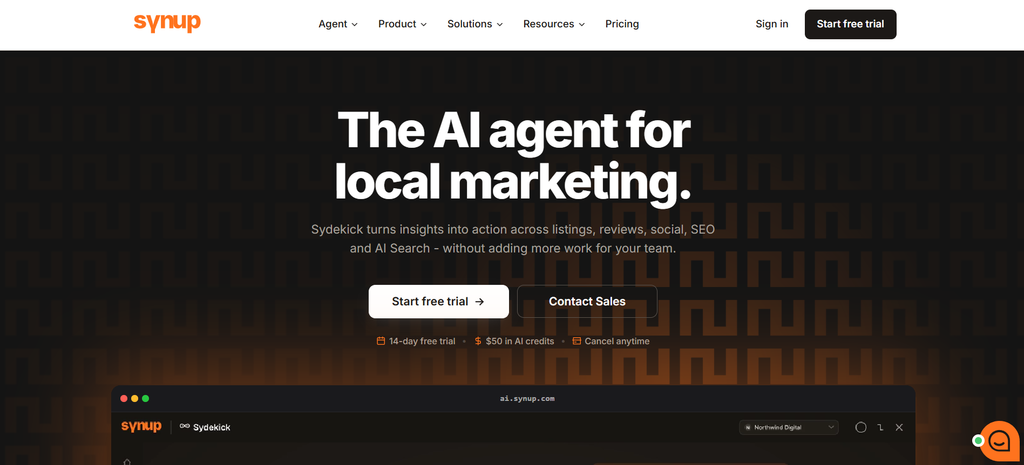
Best for: agencies, resellers and growing multi-location businesses
Synup takes the first position because its current product covers a fairly wide part of local marketing rather than treating listings as an isolated feature.
Alongside listings management, the platform includes reviews, social publishing, location pages, local rank tracking and AI-search monitoring. Synup also promotes its Sydekick agent for recurring work, with approval controls available where teams do not want automated changes going live without review.
For listings specifically, Synup says it works with Google Business Profile, Apple Business Connect, Bing, Facebook and more than 100 publishers, voice services and data aggregators.
The agency angle is also clear. White labeling becomes available from the Premium level, which makes the product more relevant for businesses managing locations on behalf of clients.
Pricing is more visible than it is with several enterprise competitors:
- 1 location: $49/month
- Up to 10 locations: $299/month
- Up to 25 locations: $499/month
- Up to 50 locations: $899/month
Synup says annual billing saves 20%.
Where Synup falls short
The pricing structure becomes less comfortable for very small multi-location companies.
A business with one location can use the $49 Solo plan. Add a second location, however, and you move into the plan covering up to ten locations.
That does not automatically make Synup expensive. It does mean businesses with two, three or four locations should compare actual annual costs instead of looking only at the entry price.
User feedback also suggests integrations are not always completely frictionless. A November 22, 2025 G2 reviewer described one Facebook connection as “a bit buggy”, although support apparently resolved the problem.
That is worth remembering with every product on this list. Listing software sits between your company and outside publishers. Some problems will inevitably occur outside the software company’s direct control.
2. Yext
Best for: enterprise businesses and large franchise networks
Yext feels built for a different type of buyer.
Its attraction is less about finding a cheap way to update a handful of directory profiles and more about controlling structured location information across a large organization.
Yext says its Listings product supports more than 200 direct publisher integrations. It also includes role-based access, audit trails, duplicate suppression, verification, bulk management and mobile updates.
Those controls begin to matter when you have hundreds or thousands of locations.
Imagine a national restaurant chain. Corporate marketing may control the brand description. Local managers may need permission to update holiday hours. Operations may maintain the main store database. Someone still needs to know which system wins when the records disagree.
This is the sort of environment where Yext makes more sense.
Where Yext falls short
The obvious problem is pricing transparency.
Yext does not provide a useful public list price for its current Listings product. Buyers are directed toward the sales process.
That is reasonable for complex enterprise contracts, but it makes comparison harder.
It can also be far more software than a single-location business needs. If your main objective is keeping Google, Apple Maps and a few important directories accurate, enterprise-grade governance may solve problems you do not have.
Publisher integrations can still fail too. An April 22, 2026 G2 reviewer reported an Apple Maps issue where Yext “constantly shows an error.”
Direct integration reduces certain kinds of manual work. It does not make outside publishers perfectly predictable.
3. BrightLocal
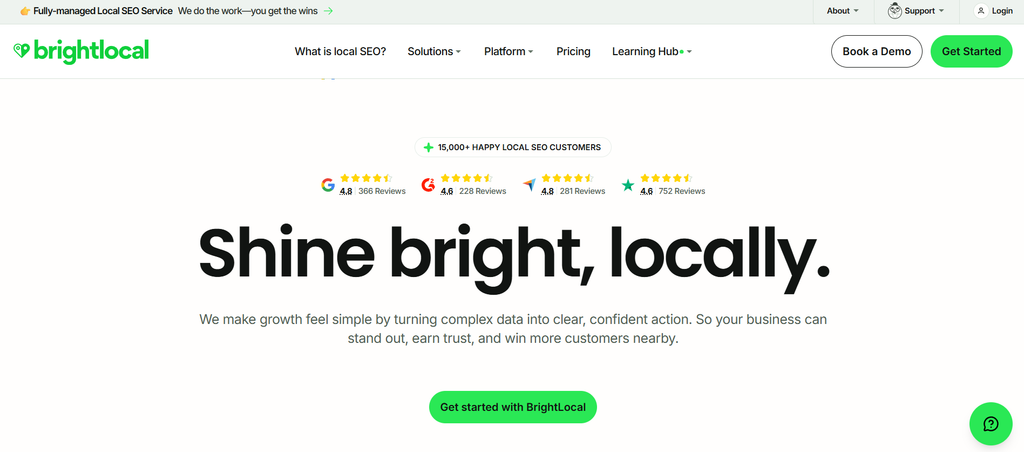
Best for: small businesses and agencies that prefer flexible purchasing
BrightLocal is interesting because it does not force every local SEO function into one large platform contract.
Its Manage plan combines local SEO tools with active listing management. Citation Builder can be purchased separately for manual citation creation and cleanup.
As of September 11, 2026, the one-location Manage plan costs $54 per month or $485 annually.
Grow costs $65 per month or $584 annually.
Citation Builder costs $3.20 per manual submission when paying by card, with bulk credits reducing the rate to $2 per submission.
For smaller companies, that modular approach can make sense.
You might need ongoing management for the profiles that matter most but only occasional citation work elsewhere. There is little reason to buy an enterprise suite when the work itself is limited.
Where BrightLocal falls short
The same modular structure can make budgeting slightly harder.
Citation Builder sits separately from standard subscriptions. Data aggregator submissions may involve their own costs. Active Sync Plus currently applies to US and Canadian locations, so international buyers should check what is available in each market rather than assuming identical coverage.
One April 21, 2026 G2 reviewer also said BrightLocal “could be more user-friendly.”
For a business that values transparent pricing and flexible purchasing, that trade-off may be reasonable.
4. Semrush Local
Best for: SEO teams already using Semrush
Semrush Local becomes much more appealing when your team already works inside Semrush.
Listings then sit next to other search activities rather than forcing staff into another completely separate platform.
The Local Toolkit includes Google Business Profile management, reviews, map-rank tracking and directory distribution.
There is one pricing detail worth paying attention to.
Local Base costs $30 per location per month with annual billing.
However, full Listing Management is part of Local Pro, which costs $60 per location per month when billed annually.
Semrush says Pro distributes business data to more than 70 directories and includes duplicate management and user-suggestion management.
Where Semrush Local falls short
The $30 Base figure can create the wrong first impression if listings are the feature you actually need.
For this comparison, $60 per location is the more relevant starting price.
That cost can rise quickly.
Ten locations at the public Pro price means $600 per month before considering other products or services. One hundred locations changes the economics again.
A March 31, 2026 G2 reviewer said that “some features took a bit of time to find.”
I would therefore look at Semrush Local mainly when consolidating tools carries genuine value for your team.
5. Uberall
Best for: franchises and multi-location businesses with distributed teams
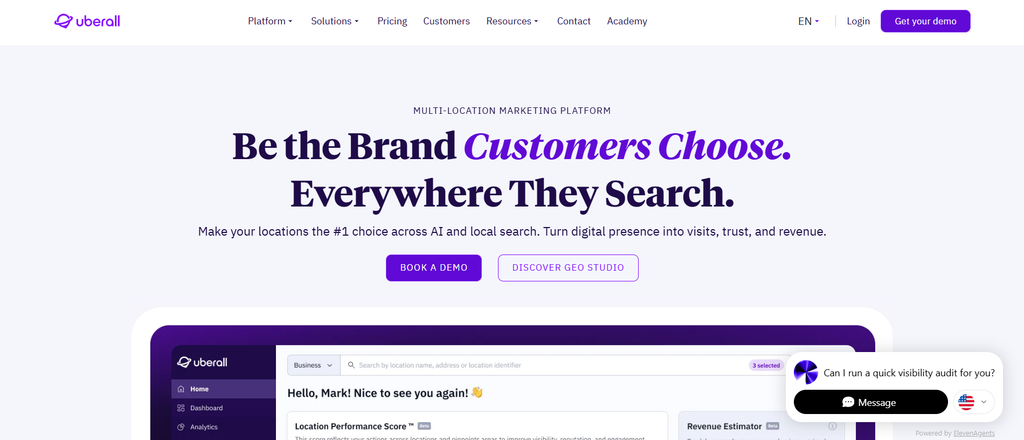
Uberall is clearly aimed at multi-location operations.
Its Listings product says businesses can manage profiles across more than 150 directories. The wider platform includes other location-marketing capabilities, with plans that combine a core listing layer and optional functionality.
That structure makes sense for franchise groups.
Head office may want control over branding and core location data while individual regions or franchisees need limited access to local information.
The problem is that companies rarely discover whether this structure actually works for them by reading a feature page.
You need to see it.
Where Uberall falls short
Public pricing is not available, so comparisons require a sales conversation.
Some capabilities, including particular posting, analytics and collaboration functions, also sit within optional products or add-ons.
That means buyers should ask for a proposal that clearly separates what is included from what costs extra.
A March 12, 2026 G2 reviewer said the range of options and integrations “can feel a little crowded at first.” Capterra feedback has also mentioned occasional synchronization problems.
During a demo, I would ask Uberall to show a failed update rather than another successful one.
The failure screen tells you far more about what your staff will actually deal with.
6. Birdeye

Best for: multi-location businesses combining listings with reputation management
Birdeye becomes more compelling when the listing project is part of something larger.
The company offers products covering listings, reviews, messaging, social media and AI-related discovery. Its current pricing structure is custom and depends on location count, selected products and contract structure.
That makes Birdeye particularly relevant to companies already thinking about reputation management rather than directory distribution alone.
If one team is responsible for keeping location information accurate, responding to reviews and managing customer communication, combining those workflows can be useful.
Where Birdeye falls short
The broader platform is also the main reason some buyers may decide against it.
If all you want is listing synchronization, you may be buying into a product portfolio designed for a much larger customer-experience program.
Public per-location pricing is unavailable, so companies need to go through the sales process before they can properly model costs.
That concern appears in user feedback too.
On April 27, 2026, one enterprise G2 reviewer wrote, “With each new tool comes a heavy price request.”
Birdeye therefore makes more sense when the additional products are genuinely useful rather than features you merely might use someday.
7. Whitespark
Best for: citation cleanup, permanent listing work and one-off projects
Whitespark is the odd one out on this list, and that is exactly why it deserves to be here.
It does not approach the problem in quite the same way as platforms built around constant broad-network synchronization.
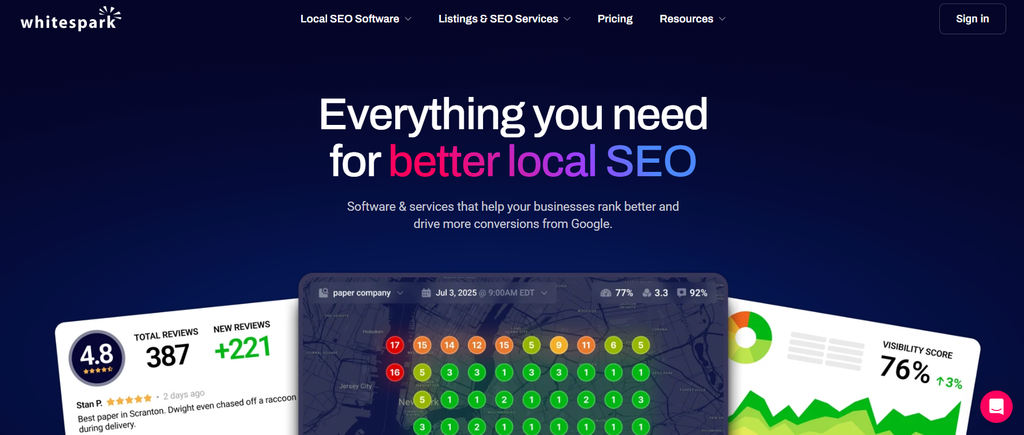
Instead, Whitespark offers separate local SEO products and a Listings Service focused on citation creation, cleanup and ownership.
Current US pricing starts at:
- Premium: $399 per location
- Comprehensive: $599 per location
- Ultimate: $999 per location
- Custom work: from $20
Whitespark also advertises a $399 one-time Yext Replacement Service.
Its separate Local Platform costs $1 per location per month, although that product focuses more heavily on Google Business Profile management rather than broad directory syncing.
Where Whitespark falls short
If you want one dashboard continuously synchronizing location information across a large international publisher network, Whitespark may feel fragmented compared with Yext, Uberall or Synup.
Several services are also geographically limited. Its Yext Replacement and Data Aggregator services are currently marked as US-only.
An April 16, 2026 G2 reviewer said the interface “can feel a bit dated.”
Still, there is something useful about its approach.
Some businesses do not need another subscription. They need a messy set of citations cleaned up properly.
Those are different problems.
Which local listing management software should you choose?
I would start with the type of organization rather than the feature list.
Agencies
Synup is my first choice from this group for agencies because client management, listings, permissions, white labeling and other local marketing functions sit together.
BrightLocal deserves a close look if you prefer buying citation and SEO services separately instead of putting every client into a larger platform.
Franchises and large multi-location brands
Start with Yext and Uberall.
Their stronger case is centralized management, publisher distribution, access controls and large location networks.
Synup can still make sense for smaller franchise systems, especially where its published location-band pricing is easier to budget.
Single-location businesses
I would hesitate before buying any large listings platform.
Start by looking at BrightLocal, Whitespark, or even direct management through Google Business Profile, Apple Business Connect and Bing Places.
If your business information changes twice a year, there is no prize for owning more software.
Existing Semrush users
Semrush Local is worth considering because it keeps another part of your SEO workflow inside a product your team may already know.
Just calculate the cost using the $60-per-location Pro tier if Listing Management is the reason you are buying it.
Businesses focused on reputation
Birdeye becomes more convincing when listings are tied to reviews, messaging, social media and other customer-facing work.
For a listings-only project, I would compare it carefully against more focused alternatives.
How much does local listing management software cost in 2026?
Trying to calculate an average price for this category is not particularly useful.
The products are sold in completely different ways.
One provider charges per location. Another sells location bands. Another offers one-time citation work. Enterprise products may use custom contracts that include several products together.
The better calculation is:
12-month subscription + location fees + directory or citation charges + onboarding + integrations + API fees + support upgrades + expected growth
Run the calculation at your actual location count.
A price that looks sensible at five locations may look very different at 50.
For a company with 100 or 500 locations, I would also give every shortlisted vendor exactly the same scenario.
Ask each company to price 100 locations, the same publisher requirements, the same permissions, the same reporting needs and the same integrations.
Otherwise, you are comparing different packages while pretending they are equivalent.
When should you avoid buying listing software?
There are situations where the correct buying decision is to buy nothing.
That deserves more attention.
You may not need local listing management software yet if:
- You operate one stable location and mainly care about Google, Apple and Bing.
- Your internal business information is unreliable.
- Nobody in your company owns location changes.
- Your addresses, phone numbers and opening hours rarely change.
- You mainly need a one-time citation cleanup.
- You have not identified which publishers actually matter in your market.
- You have not reviewed what happens to your listings after cancellation.
The second point may be the most important.
Software can distribute information very efficiently. That becomes a problem when the information is wrong.
Suppose a store manager changes Friday’s closing time from 9 PM to 7 PM. Operations still has 9 PM. Marketing does not receive the update. The listings platform continues distributing the approved corporate record.
Technically, the software worked perfectly.
The customer still arrived at a closed shop.
That is why local listing management is partly a software problem and partly an internal process problem.
What are the main weaknesses of these platforms?
Every product here asks you to accept some kind of compromise.
Synup has visible pricing and useful agency features, but its location tiers may feel expensive for companies sitting awkwardly between one and ten locations.
Yext offers strong enterprise distribution and governance, but pricing requires a sales conversation.
BrightLocal gives smaller buyers more control over what they purchase, although listings and citation costs can be split across products.
Semrush Local fits neatly into an existing Semrush workflow, but full Listing Management requires the $60-per-location Pro tier.
Uberall is designed around multi-location operations, but public dollar pricing is unavailable and buyers need to examine add-ons carefully.
Birdeye becomes easier to justify when reputation and customer communication are part of the same project.
Whitespark is useful for citation work and cleanup, but buyers wanting continuous broad-network syncing may prefer another model.
I find these weaknesses more useful than another checklist containing green ticks.
The question is rarely whether software has a limitation.
It is whether that particular limitation causes a problem for you.
Frequently asked questions
What is the best local listing management software in 2026?
There is no universal winner.
Synup is a strong choice for agencies and growing multi-location teams. Yext and Uberall suit larger franchise and enterprise environments. BrightLocal is practical for smaller businesses wanting public pricing. Semrush Local fits existing Semrush users, Birdeye is better suited to listings combined with reputation management, and Whitespark works well for citation-focused projects.
Which local listing management software is best for agencies?
Synup is the strongest agency-oriented option in this comparison because it combines listings, client management, white labeling, permissions and other local marketing functions.
BrightLocal is worth considering when you want more modular local SEO and citation services.
Which listing software is best for franchises?
Yext and Uberall should both be considered for larger franchise networks because they concentrate heavily on centralized multi-location management.
Synup may suit smaller franchise groups looking for published location-band pricing and broader agency-style local marketing functions.
Can one location manage listings without paid software?
Yes.
A single business with stable information can manage important profiles directly through services such as Google Business Profile, Apple Business Connect and Bing Places.
Paid software becomes easier to justify when repeated changes, multiple publishers, duplicate listings, reporting or staff access start consuming meaningful time.
What should I ask during a listings software demo?
Skip the polished tour for a moment and give every vendor the same practical test.
Ask them to:
- Change holiday hours across 50 locations.
- Limit one regional manager to five locations.
- Find a failed Google or Apple update.
- Identify a duplicate location.
- Export all location information.
- Show the approval history for a change.
- Explain what happens to your listings after cancellation.
You will probably learn more in those 20 minutes than from an hour of feature slides.
Final verdict
If I were building a shortlist in 2026, I would start with the operating problem rather than trying to identify the platform with the longest feature list.
Synup gets the first position for agencies and growing teams that want listings alongside client controls and other local marketing functions.
Yext and Uberall are stronger candidates for complex enterprise and franchise networks.
BrightLocal gives smaller businesses clearer pricing and flexible citation options.
Semrush Local works best when you already live inside Semrush.
Birdeye makes sense when local listings sit inside a wider reputation-management program.
Whitespark remains useful when the real problem is citation cleanup rather than ongoing synchronization.
The final choice should probably come down to something much less impressive than AI features or directory numbers.
Give the vendor a messy real-world situation from your own business.
A holiday-hours change. A duplicate location. A closed branch. A franchisee with limited access. An Apple update that refuses to publish.
Then watch what happens.
Software tends to look similar when everything works. You learn much more when something doesn’t.