Rio SEO vs Uberall vs Synup for Franchise Brands


Synup, Uberall, and Rio SEO are three local marketing platforms worth evaluating for franchise brands. Synup is worth considering for integrated listings, reviews, local SEO, and AI-assisted marketing. Uberall is particularly relevant for franchisee collaboration and corporate marketing controls. Rio SEO is a strong enterprise candidate for customized local pages, listings management, and managed services.
The right choice depends on your location count, budget, technical requirements, and how much control individual franchisees need over local marketing.
All three provide tools for managing business information and customer reputation across multiple locations. Their differences become more important when a franchise needs to coordinate hundreds of Google Business Profiles, approve location-level changes, manage regional marketing campaigns, or measure performance across independently operated locations.
This Rio SEO vs Uberall vs Synup comparison examines their documented features, pricing approaches, limitations, and operational suitability to help franchise owners and marketing teams create a practical shortlist.
Rio SEO vs Uberall vs Synup: At a Glance
| Platform | Best suited for | Main advantage | Key consideration |
|---|---|---|---|
| Synup | Growing and established franchises seeking integrated local marketing | Listings, reviews, local SEO, social publishing, and AI-assisted workflows | Enterprise pricing and franchise-specific permissions need evaluation |
| Uberall | Franchises with active local marketing teams | Corporate governance, franchisee collaboration, social marketing, and reputation workflows | Modules and advanced collaboration features depend on the commercial package |
| Rio SEO | Enterprise franchises requiring customized local marketing programs | Enterprise listings, tailored location pages, reporting, and managed services | Pricing, implementation, and support scope require a proposal |
These recommendations describe the platforms’ documented positioning and likely operational fit. They are not independently verified performance rankings.
Why franchise brands need specialized local marketing software
Franchise marketing requires coordination between corporate headquarters, regional teams, and individual franchise operators.
Headquarters may control branding, campaigns, reporting, and website standards. Franchisees may need to update opening hours, publish local promotions, respond to reviews, or maintain location-specific services.
Without clear workflows, customers can encounter incorrect business hours, outdated addresses, inconsistent phone numbers, duplicate map listings, and incomplete location pages.
A franchise listings management platform can help centralize information while allowing authorized teams to maintain local details.
However, a franchise should evaluate more than directory distribution. The software also needs to support its organizational structure, approval requirements, reporting needs, and existing technology.
For example, a franchise with 100 independently owned locations may require more complicated access controls than a centrally managed company with 500 stores.
Location count matters, but operational complexity matters just as much.
How We Evaluated These Franchise SEO Platforms
This comparison is based on publicly available vendor product information, pricing pages, support documentation, and Google’s official local search guidance reviewed in November 2026.
The assessment considers eight criteria:
- Listings management: Centralized data updates, publisher coverage, and error handling.
- Franchise scalability: Bulk operations and suitability for large location networks.
- Corporate governance: Permissions, approvals, and franchisee access.
- Reputation management: Review monitoring, responses, and escalation workflows.
- Local SEO: Location pages, rank monitoring, and local performance analytics.
- AI and automation: AI-assisted operations and AI search visibility monitoring.
- Pricing: Public rates, enterprise quotations, and potential additional costs.
- Implementation: Onboarding, integrations, technical support, and ongoing administration.
This is a documentation-based comparison, not a hands-on benchmark of all three platforms.
Feature availability does not establish implementation quality, and advertised publisher counts are not directly comparable across countries, industries, or account configurations. For more See Franchise SEO Services
Recommendations are based on fit for specific franchise requirements rather than a universal winner.
1. Synup: Integrated Listings, Reviews, and Local SEO Automation
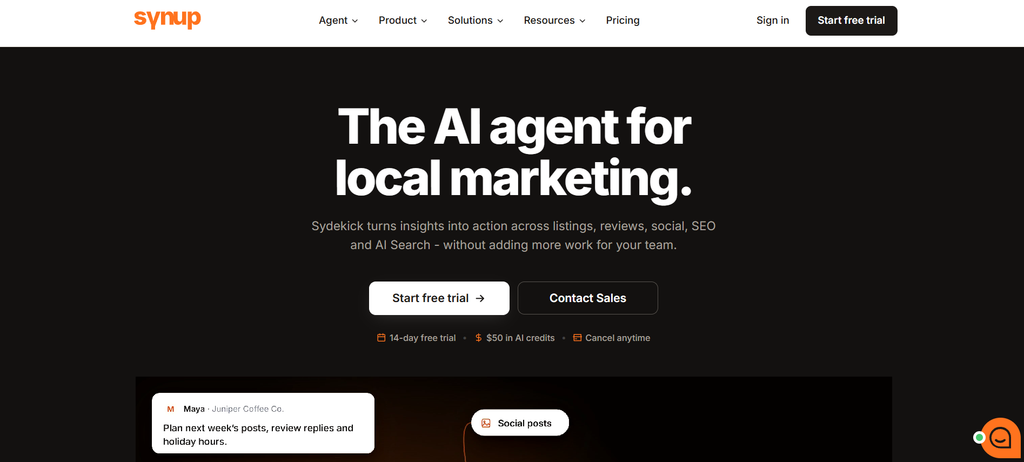
Best for: Growing franchises, multi-location brands, and agencies seeking consolidated local marketing capabilities.
Overview
Synup provides local marketing software for businesses and agencies managing locations across search engines, mapping services, directories, and other online discovery channels.
Its product offering includes listings management, reputation monitoring, local search tracking, social publishing, location pages, and AI search visibility capabilities.
For franchises, the appeal is the ability to coordinate recurring marketing activities from a shared platform rather than managing every location separately.
Corporate teams can maintain location information, review listing inconsistencies, monitor customer feedback, and assess local visibility.
Synup also provides an AI agent called Sydekick. According to the vendor, the agent can assist with identifying inconsistent business information, preparing review responses, coordinating marketing tasks, and running workflows subject to configured approval controls.
These capabilities can reduce repetitive administration, although actual time savings depend on the franchise’s integrations, governance requirements, and operating procedures.
Key features
Centralized listings management
Synup supports distribution and maintenance of business information across an advertised network of more than 100 publishers and directories.
The vendor identifies Google, Apple, Bing, Facebook, and other location-discovery services among its supported platforms.
Franchise headquarters can use these capabilities to coordinate location data changes and monitor inconsistent information.
Bulk updates and automation
Synup supports multi-location operations and offers workflows for updating information across location groups.
Its Sydekick agent adds AI-assisted execution of recurring marketing tasks.
Franchises should test the distinction between tasks requiring approval and those eligible for automation before enabling workflows across a large portfolio.
Reputation management
Synup provides review monitoring and response functionality, alongside AI-assisted review workflows and location-level reporting.
These capabilities are useful when businesses need consistent response standards while allowing local managers to handle individual customer interactions.
Local SEO monitoring
The platform offers local rank tracking, including grid-based monitoring.
This can help franchise marketers observe how local search visibility varies across different geographic areas rather than relying only on a single ranking measurement.
Location pages and AI search visibility
Synup provides local landing pages, store locator capabilities, and AEO features for examining how supported AI answer systems describe businesses.
These tools offer additional information for marketing teams, but observed AI mentions should not be treated as guaranteed referrals, citations, or customer acquisition.
API and partner capabilities
Synup also publishes API documentation covering locations, listings, reviews, rankings, user management, and other functions.
This may be relevant to franchises integrating local marketing operations with internal systems.
Strengths
Synup is attractive to franchise businesses seeking to consolidate listings, reputation management, local SEO, social publishing, and AI-assisted marketing.
Its published pricing gives smaller networks an initial budgeting reference without requiring a sales consultation.
The combination of local rank monitoring, automation, and reporting may also help corporate teams identify branches requiring attention.
For agencies serving multiple franchise clients, Synup’s partner-oriented features and white-label capabilities provide another reason to evaluate the product.
Limitations
Franchise permissions require careful testing. Synup documents administrative, manager, and brand-related user roles, but organizations with complicated ownership structures should confirm how permissions apply to individual locations, regional groups, and sensitive workflows.
Its AI features are also credit-metered. Buyers need to understand how credits are consumed, what happens when allowances are exhausted, and whether additional usage generates charges or requires a plan change.
Enterprise buyers should not extrapolate published small-network pricing to hundreds or thousands of locations.
Finally, consolidating several software functions into one platform does not automatically establish that each function is the best fit for every franchise.
Synup pricing
Synup’s published monthly pricing includes:
| Plan | Monthly price | Included locations |
|---|---|---|
| Solo | $49 | 1 |
| Premium | $299 | Up to 10 |
| Pro | $499 | Up to 25 |
| Scale | $899 | Up to 50 |
| Enterprise | Custom | Larger portfolios |
The vendor advertises annual billing savings of 20% and a 14-day trial.
Its pricing page states that core product functionality is included across plans, while capacity, AI credits, agent concurrency, and certain account characteristics vary.
Buyers should confirm current credit allocations and commercial conditions, especially because the vendor has advertised promotional credit allowances.
Choose Synup if: Your franchise prioritizes integrated local marketing functionality, smaller-network pricing visibility, and AI-assisted workflows, provided its permissions and automation controls meet your operational requirements.
2. Uberall: Franchisee Collaboration and Local Marketing Governance
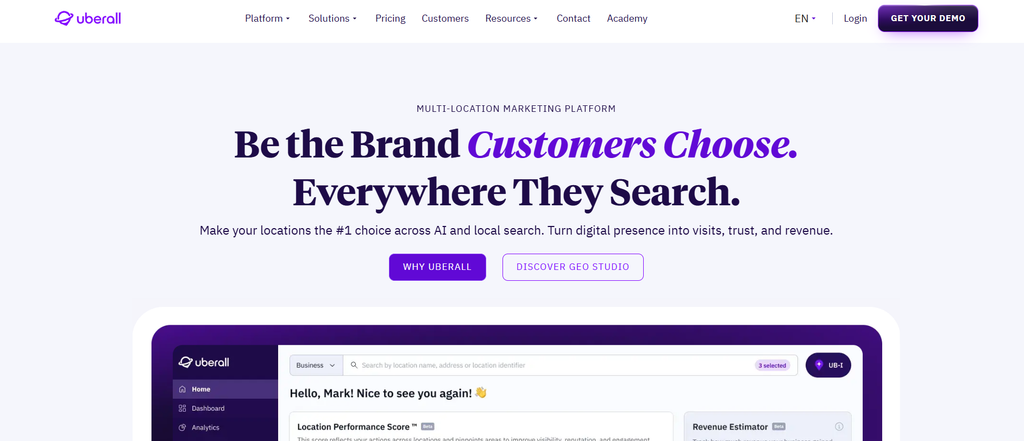
Best for: Franchises in which corporate and local operators share responsibility for marketing and customer engagement.
Overview
Uberall offers a multi-location marketing platform combining listings management, reputation management, local pages, social marketing, and location-level analytics.
Its franchise solution emphasizes collaboration between headquarters and individual operators.
Corporate teams can establish brand standards and approved templates while franchisees receive controlled access to local activities.
This structure is relevant for distributed networks where location managers need flexibility without compromising corporate requirements.
Uberall explicitly describes three operating models:
- Centralized: Headquarters manages local marketing activities.
- Decentralized: Franchisees manage authorized activities using corporate resources.
- Collaborative: Corporate and local teams divide responsibilities through role-based access.
These models provide a useful way to evaluate whether the software can support a franchise’s existing governance structure.
Key features
Centralized listings management
Uberall advertises distribution across more than 150 directories.
Businesses can manage location details, coordinate updates, and monitor their online presence through centralized workflows.
The platform also documents duplicate suppression and profile protection capabilities.
Franchisee collaboration
Uberall provides role-based controls for separating corporate and local responsibilities.
Franchise managers can be given access to selected functions, such as updating hours, responding to reviews, or publishing local content.
Enhanced collaboration and workflow approval functionality is identified in Uberall’s commercial materials under Collaborate Plus.
Reputation management
Uberall supports centralized review monitoring, notifications, response templates, and AI-assisted replies.
These features help organizations coordinate customer interactions while maintaining consistent brand communication.
Local social marketing
Uberall provides social content scheduling, templates, and publishing tools.
Corporate teams can prepare brand-approved content while allowing authorized local adjustments.
This can be particularly useful for franchises running location-specific promotions, events, or campaigns.
Local pages and reporting
Uberall offers local pages and store locator capabilities, supported by location-level analytics.
Its franchise materials describe pages containing business details, services, promotions, and structured local information.
AI search monitoring
Uberall offers GEO Studio for observing brand visibility in AI-generated responses, tracking monitored prompts, and comparing visibility against competitors.
This functionality should be evaluated separately from the platform’s ordinary listings management capabilities.
Strengths
Uberall’s documented collaboration model is particularly relevant to franchise networks requiring local participation.
Its combination of permissions, templates, mobile-friendly tools, social publishing, and reputation workflows addresses day-to-day marketing activities that extend beyond correcting directory listings.
The platform also allows franchise organizations to assess centralized and decentralized operating approaches rather than assuming every location should follow the same workflow.
For restaurants, retailers, fitness chains, and service franchises, this flexibility may be valuable when individual operators regularly publish local information.
Limitations
Uberall’s primary platform pricing is not presented as one universal public per-location rate.
Although the vendor describes extensive capabilities, buyers should not assume that advanced collaboration, analytics, local pages, and AI visibility tools are included in every package.
Its published pricing materials identify several plan configurations and optional capabilities.
A franchise requiring granular approval workflows should confirm whether Collaborate Plus or another commercial arrangement is necessary.
Implementation should also evaluate franchisee adoption.
A technically capable platform may produce limited operational benefits if individual location managers find its required processes difficult or do not use them consistently.
Uberall pricing
Uberall presents configurable plans, including Show Up, Stand Out, and Connect, along with optional functionality.
Its pricing materials identify features and add-ons covering listings, reviews, social publishing, analytics, collaboration, and location pages.
The main franchise platform requires a commercial quotation rather than relying on a fixed universal price.
GEO Studio has separately published plans, including $109 and $449 packages displayed in USD, as well as customized enterprise options. These are AI visibility monitoring packages, not prices for Uberall’s complete franchise listings and reputation platform.
Buyers should confirm billing periods, credit allocations, supported AI engines, and contract conditions directly with Uberall.
Choose Uberall if: Your franchise depends on active location-manager participation and needs clear corporate controls alongside localized marketing and customer engagement.
3. Rio SEO: Enterprise Local SEO and Customized Franchise Programs

Best for: Established franchise networks requiring tailored local SEO implementation, enterprise governance, and specialist services.
Overview
Rio SEO provides an enterprise-oriented Local Experience platform covering listings management, location pages, online reputation, and reporting.
The platform is designed for businesses operating substantial physical-location networks.
Its approach combines centralized business information management with controlled local participation.
Rio SEO documents permission-based content updates, corporate-assigned access levels, and approval processes intended to support brand governance.
It also emphasizes customized local landing pages and store locators, allowing large organizations to align their local digital presence with wider website and brand requirements.
Rio SEO is particularly relevant when a franchise needs both technology and ongoing specialist support.
Key features
Enterprise listings distribution
Rio SEO advertises integrations with hundreds of search engines, directories, mapping applications, social platforms, and other services.
These capabilities allow enterprise teams to coordinate business information across numerous locations.
Corporate governance
Rio SEO documents access controls, permission-based updates, and corporate approval mechanisms.
These can support franchises where headquarters must retain authority over sensitive business information or website content.
Custom location pages
Rio SEO offers local landing pages and store locators designed around enterprise requirements.
This can matter when businesses need location-specific services, page layouts, structured data, integrations, and brand-approved content.
Reputation management
The Local Reviews product supports review monitoring, assignments, responses, alerts, analytics, and location-level reporting.
Rio SEO also describes integrations with Forsta analytics capabilities for interpreting customer feedback.
Local reporting
The platform provides reporting that consolidates information across locations and supports analysis at both corporate and individual location levels.
Social marketing and managed services
Rio SEO documents a Local Social offering and services covering local marketing, review responses, and related operational requirements.
Franchise buyers should confirm which products and services are included in their proposed agreement.
Strengths
Rio SEO is well aligned with enterprise franchises seeking tailored implementation rather than a straightforward self-service listings tool.
Its location-page capabilities, centralized governance, reporting, and managed services can help organizations coordinate complex local marketing programs.
One useful example is Rio SEO’s published work with European Wax Center.
The case study describes how Rio SEO combined listings management, reporting, and managed services for a large franchise network. It also explains the role of franchisee-specific reporting and ongoing marketing support.
This is evidence of the type of enterprise engagement Rio SEO offers, although vendor-reported customer results should not be treated as typical or guaranteed outcomes.
Limitations
Rio SEO does not provide a universal public price for its core enterprise products.
Prospective customers need to establish which software modules, integrations, managed services, and support commitments are included.
An enterprise-oriented implementation may also require more coordination than a limited listings-only deployment.
Although Rio SEO documents corporate access controls, buyers should test how those permissions apply to individual workflows.
For example, its support documentation has described restrictions on how access to the reviews interface can be scoped. An enterprise with independently owned franchise groups should verify the current behavior directly rather than assuming that every permission operates at individual-location level.
Organizations with relatively simple needs should also consider whether they require the platform’s customization and managed-service capabilities.
Rio SEO pricing
Rio SEO offers enterprise products such as Local Listings, Local Pages, and Local Reviews through a sales-led process.
Pricing depends on the required modules, location portfolio, implementation requirements, and service arrangement.
Its public website does not provide a fixed price applicable to every franchise location.
Buyers should request an itemized proposal that separates software, implementation, optional modules, services, and support.
Choose Rio SEO if: Your franchise operates a complex enterprise network and places particular value on customized local pages, centralized governance, specialized implementation, and managed local marketing support.
Rio SEO vs Uberall vs Synup Pricing Comparison (2026)
Pricing is a meaningful difference among these three platforms.
Synup provides published prices for smaller location portfolios. Uberall and Rio SEO primarily use commercial proposals for their main enterprise offerings.
Pricing breakdown
| Platform | Published pricing | Enterprise pricing | Key cost consideration |
|---|---|---|---|
| Synup | $49/month for 1 location; $299 for up to 10; $499 for up to 25; $899 for up to 50 | Custom for larger portfolios | AI credits, agent capacity, location bands, and contract terms |
| Uberall | No universal public core-platform rate | Request quote | Modules, collaboration add-ons, pages, and AI visibility monitoring |
| Rio SEO | No universal public rate | Request quote | Enterprise implementation, modules, managed services, and support |
Prices reflect vendor information reviewed on November 5, 2026. Published rates may change, and the final commercial agreement can differ from advertised plan information.
How should franchises compare total cost?
A franchise managing 500 locations should not simply multiply a vendor’s advertised single-location price by 500.
Enterprise agreements may use different pricing structures and include additional implementation or support arrangements.
Instead, request a total-cost-of-ownership proposal covering:
- Software subscriptions and location-based charges
- Initial implementation and data migration
- Directory distribution and ongoing synchronization
- Review management and local social functionality
- Store locator and location-page implementation
- AI credits and additional usage
- API access and custom integrations
- Training, support, and managed services
- Renewal terms, location transfers, and cancellation conditions
A basic annual cost calculation is:
Annual total cost = annual subscription fees + one-time implementation costs + annual add-ons + support charges + expected usage fees
For ongoing budget comparisons, calculate recurring annual costs separately from initial implementation.
Also assess how each vendor handles newly opened, relocated, transferred, and permanently closed franchise locations.
Those events can create additional technical and administrative work.
Pricing conclusion: Synup provides greater public pricing visibility for smaller portfolios. At enterprise scale, an itemized quotation is necessary to establish which vendor offers better value.
Head-to-Head Comparison: Which Platform Fits Each Requirement?
1. Which platform is better for franchise listings management?
All three platforms offer centralized multi-location listings management, but their operating approaches differ.
Rio SEO emphasizes enterprise distribution, governance, reporting, and specialist support.
Uberall combines listings synchronization with collaborative franchise operations.
Synup combines distribution and inconsistency monitoring with local SEO analytics and AI-assisted tasks.
For a franchise managing hundreds of profiles, directory quantity is only one consideration.
A more useful evaluation is whether each platform can reliably handle:
- Incorrect or conflicting opening hours
- Duplicate and outdated listings
- Unclaimed or disconnected Google Business Profiles
- Bulk changes across location groups
- Publisher-specific update failures
- New location launches and permanent closures
For example, ask all three vendors to process a sample change affecting 20 locations.
Determine how many target publishers receive the change, how completion is confirmed, and what happens when a platform rejects an update.
Recommendation: Evaluate Rio SEO for enterprise service requirements, Uberall for coordinated franchise operations, and Synup for integrated listings and automation workflows.
2. Which platform is strongest for Google Business Profile management?
All three platforms provide Google Business Profile-related capabilities.
However, no independently verified comparative benchmark establishes one as universally superior.
According to Google’s local ranking guidance, local results mainly depend on relevance, distance, and prominence.
Google also explains that complete and accurate business information can help profiles appear in relevant searches. Google Business Profile Help
Franchises should prioritize accurate categories, opening hours, addresses, location-specific contact information, and profile ownership.
A useful demonstration should include updating special hours, detecting account connection problems, and confirming that the intended edits appear on Google.
It is also important to compare paid software with Google’s native functionality.
Google provides bulk Business Profile management and verification guidance for eligible multi-location organizations. Google Business Profile Help
Third-party software should therefore justify its cost through better workflows, governance, monitoring, integrations, or support rather than implying that paid software is required to manage multiple profiles.
No platform can bypass Google’s business-profile requirements or guarantee higher Google Maps rankings.
3. Which platform is better for franchise reputation management?
All three vendors offer review monitoring and response functionality.
The more important difference is how those capabilities fit the franchise’s customer service model.
Rio SEO supports centralized review monitoring, assignments, alerts, and reporting.
Uberall offers templates, AI-assisted replies, alerts, and franchisee-oriented collaboration.
Synup combines reputation management with AI-assisted review workflows and consolidated location reporting.
Consider a hotel franchise where individual managers respond to routine reviews but serious complaints require corporate escalation.
The software should support appropriate permissions, notifications, approvals, and auditability.
For a financial-services franchise with stricter compliance requirements, centralized approval and recordkeeping may be more important than the speed of response generation.
In both situations, buyers should test review handling across supported sources and confirm whether responses can be restricted by location, role, or ownership group.
AI-generated responses also require suitable oversight to avoid inaccurate statements, inappropriate promises, or exposure of customer information.
4. Which platform offers better corporate control and franchisee permissions?
Corporate governance is one of the most important differentiators for franchise organizations.
Rio SEO documents permission-based publishing, corporate-assigned access, and approval processes.
Uberall explicitly markets centralized, decentralized, and collaborative franchise operating models, with advanced collaboration functionality available through designated packages.
Synup documents administrative and manager permissions, brand-related access, and approval-oriented agent workflows.
However, similar descriptions do not establish identical functionality.
A franchise with multiple owners should test whether its chosen platform can:
- Give one franchisee access to five stores without exposing another owner’s information.
- Allow regional managers to supervise a defined group of locations.
- Require corporate approval before sensitive changes are published.
- Restrict review responses or marketing actions based on user roles.
- Maintain a usable record of changes and approvals.
Recommendation: Uberall and Rio SEO provide particularly explicit public descriptions of corporate-to-local governance. Synup remains a candidate, but complex ownership structures warrant detailed permission testing.
5. Which platform is better for location pages and AI search visibility?
Rio SEO provides customized local landing pages and store locators.
Uberall offers local pages and GEO Studio for observing AI search visibility.
Synup provides location pages and AEO functionality for monitoring business information across supported AI answer systems.
These capabilities should be evaluated as separate requirements.
Location pages help customers find useful, accurate information about individual branches.
AI search monitoring helps marketers observe how selected answer systems describe locations or competitors.
Monitoring tools may identify incorrect information, missing mentions, or differences between locations. They cannot guarantee that independent AI services will recommend a business.
Google’s official guidance also states that standard SEO fundamentals continue to apply to AI Overviews and AI Mode. There is no special schema markup or guaranteed optimization technique required for those features. Google for Developers
Google’s LocalBusiness structured-data documentation explains how websites can describe local businesses using structured information.
Such markup can help search engines interpret page content, but it does not guarantee rich results, rankings, or inclusion in AI-generated answers.
A franchise should prioritize accurate, useful location pages before investing heavily in specialized AI visibility monitoring.
Best Platform by Franchise Size and Use Case
Location count is a useful starting point, but the following recommendations are based on operational needs rather than tested performance rankings.
| Franchise situation | Recommended shortlist | Main reason |
|---|---|---|
| 10–50 locations, budget-sensitive | Synup | Published pricing and combined local marketing capabilities |
| 50–200 locations, active franchisees | Uberall, Synup | Collaboration or consolidated marketing workflows |
| 200–500 locations, complex corporate controls | Uberall, Rio SEO | Documented enterprise governance approaches |
| 500+ locations, customized enterprise requirements | Rio SEO, Uberall, Synup Enterprise | Compare implementation, support, permissions, and integrations |
| Complex location-page requirements | Rio SEO, Uberall | Customized enterprise or structured local-page capabilities |
| Agency managing several franchise clients | Synup | Partner-oriented management, reporting, and API capabilities |
| AI visibility monitoring is a primary requirement | Uberall, Synup | Documented GEO Studio and AEO offerings |
These recommendations should guide vendor shortlisting, not replace a structured procurement process.
A franchise with 50 independently operated businesses may need stronger governance than a centrally managed retail chain with 500 stores.
Similarly, an organization operating across several countries should examine publisher coverage, languages, supported business categories, and regional technical requirements before selecting a platform.
Example: Choosing Software for a 500-Location Franchise
Consider a hypothetical US restaurant franchise with 500 locations across 30 states.
Corporate headquarters manages the brand identity, national promotions, and reporting.
Franchise operators control certain operating hours, local offers, and customer service activities.
The organization needs to coordinate holiday hours, open new locations, maintain accurate public listings, and respond to customer reviews.
Three different priorities could lead to different vendor shortlists.
Scenario A: Enterprise customization is the priority
Rio SEO deserves consideration when the organization needs customized location pages, substantial implementation support, and detailed corporate reporting.
A procurement demonstration should cover location imports, page templates, corporate approvals, and reporting workflows.
The final decision should depend on implementation responsibilities, integration support, and measurable service commitments.
Scenario B: Franchisee participation is the priority
Uberall becomes relevant when individual operators need to manage authorized marketing activities.
For example, store managers might update hours, respond to reviews, and publish approved promotions.
The organization should demonstrate whether those activities can be completed without exposing another franchisee’s data or allowing unauthorized brand changes.
Corporate teams should separately evaluate regional reporting and escalation procedures.
Scenario C: Consolidation and automation are the priority
Synup Enterprise is worth evaluating when the organization wants to manage listings, reputation, local SEO, and AI-assisted workflows through a shared environment.
A suitable pilot could test bulk location imports, permission requirements, review processing, recurring tasks, and AI credit consumption.
The smaller-network pricing should not be assumed to represent the final enterprise cost.
How to compare the pilot results
Rather than choosing the vendor with the most impressive presentation, the franchise should apply the same test scenarios to each shortlisted platform.
For example:
| Test | What success looks like |
|---|---|
| Holiday-hours change | Correct updates reach selected publishers and completion is visible |
| New store launch | Approved data is published through a documented workflow |
| Franchise ownership transfer | Access can be transferred without exposing unrelated accounts |
| Negative review escalation | Corporate receives appropriate alerts and can intervene |
| Location-page update | Approved content is published correctly and remains brand-compliant |
| Data integration failure | The system identifies the error and provides a clear resolution process |
These tests make the purchasing decision more practical.
The most suitable product is the one that handles the franchise’s actual workflows reliably, with acceptable costs and administrative effort.
How Should Franchises Measure Listings Management ROI?
Franchise SEO software should be evaluated against operational efficiency and meaningful business outcomes rather than publisher counts alone.
A useful scorecard includes the following metrics.
| Metric | What it measures |
|---|---|
| Listings accuracy | Percentage of audited profiles matching approved business information |
| Update completion | Percentage of changes confirmed on the required platforms |
| Critical error resolution | Time needed to correct incorrect hours, addresses, pins, or contact details |
| Review response performance | Response coverage and time required to address customer feedback |
| Local engagement | Calls, website clicks, and direction requests where available |
| Location-page performance | Relevant traffic and conversions associated with individual locations |
| Administrative efficiency | Staff time spent managing listings, reviews, and reports |
| AI search visibility | Observed mentions and information accuracy across a consistent monitored prompt set |
Establish a baseline before implementation
Before migrating to a new platform, audit a representative sample of franchise locations.
Document incorrect information, average update times, reporting workload, and other relevant measures.
After implementation, compare results using the same definitions.
Where practical, assess a pilot group against comparable locations.
Seasonal demand, advertising, promotions, and regional market conditions can influence outcomes independently of the listings platform.
Measure operational changes, not just dashboards
A useful evaluation period should include ordinary business updates and at least one significant operational event, such as a holiday-hours change or new-location launch.
For instance, a franchise could measure the median time required to correct an incorrect phone number before and after implementation.
That provides more practical evidence of operational value than simply counting the number of directories supported.
It is also important to distinguish platform-reported activity from independently observed business outcomes.
Changes in impressions, clicks, revenue, or bookings should not automatically be attributed to the software without considering other influencing factors.
What Should Franchise Brands Evaluate Before Choosing a Platform?
The most reliable procurement approach is to give all shortlisted vendors the same demonstration brief.
Ask each vendor to complete real operational tasks rather than showing only its preferred product features.
Franchise software evaluation checklist
0 of 8 completed Copy checklistDemonstrate a bulk hours update across representative locations.Show corporate, regional, and franchisee permissions.Confirm supported publishers and eligible data fields by country.Demonstrate duplicate handling and failed-update resolution.Show review escalation, approval, and audit workflows.Explain how location pages integrate with the existing website.Provide an itemized quote covering modules, AI usage, and services.Document onboarding, support, data export, renewal, and termination terms.
Test failure scenarios before signing
A successful demonstration should show how the software behaves when something goes wrong.
For example, a disconnected Google account, rejected update, duplicate listing, or ownership transfer may reveal limitations that routine demonstrations overlook.
Ask each vendor:
- How does the system identify the problem?
- Which team is notified?
- Who is responsible for resolving it?
- Can the issue be tracked to completion?
- What information remains accessible if the contract ends?
The answers can reveal differences in service quality, governance, and operational risk that are not apparent in a feature matrix.
Frequently Asked Questions
Which is better for franchises: Rio SEO, Uberall, or Synup?
The answer depends on the franchise’s priorities.
Synup is worth evaluating for consolidated local marketing, AI-assisted workflows, and published pricing for smaller networks.
Uberall is particularly relevant when headquarters and franchisees actively share marketing responsibilities.
Rio SEO is suited to enterprise evaluations emphasizing customized location pages, governance, and specialist implementation.
There is no verified universal winner for every franchise model.
Is Synup suitable for large enterprise franchise networks?
Synup markets enterprise functionality and offers customized pricing for larger portfolios.
However, buyers should verify integrations, permissions, bulk workflows, support arrangements, and automation capacity.
An enterprise offering does not automatically establish compatibility with every organization’s governance or technology requirements.
Is Uberall better than Rio SEO for franchise marketing?
Uberall may be a better operational match when franchisee participation, social marketing, and corporate-to-local collaboration are central requirements.
Rio SEO may be preferable when customized location pages, managed services, and enterprise implementation are more important.
Both offer multi-location marketing and governance capabilities.
A final decision requires evaluating the same requirements against each vendor’s actual configuration and proposal.
Which platform has the most transparent pricing?
Synup has the clearest published core pricing of the three for portfolios of up to 50 locations.
Uberall and Rio SEO use commercial quotations for their main enterprise offerings.
Uberall also publishes separate GEO Studio pricing, but those packages should not be confused with its complete franchise marketing platform.
For larger networks, all three should be evaluated through itemized proposals.
Can these platforms improve franchise visibility in AI search?
They offer capabilities that may help businesses maintain information and monitor aspects of AI search visibility, but none can guarantee placement in AI-generated answers.
Uberall offers GEO Studio, while Synup provides AEO capabilities.
Rio SEO offers listings, location-page, and content-related functionality; organizations requiring dedicated AI answer monitoring should confirm the available product scope.
Accurate business information, useful location-specific content, and sound technical SEO remain important regardless of the selected platform.
Can franchises manage hundreds of Google Business Profiles through these platforms?
All three vendors offer multi-location Google Business Profile-related capabilities.
The important differences involve workflows, access controls, integrations, monitoring, and support.
Google also provides native bulk-management tools for eligible businesses.
Franchise organizations remain responsible for complying with Google’s Business Profile policies regardless of which third-party service they use.
Final Verdict: Rio SEO vs Uberall vs Synup for Franchise Brands in 2026
Rio SEO, Uberall, and Synup are all reasonable shortlist candidates for franchise businesses, but they address different operational priorities.
Choose Synup when integrated listings management, reputation monitoring, local SEO, AI-assisted workflows, and visible smaller-network pricing are important.
Choose Uberall when franchisee collaboration, corporate governance, local social marketing, and location-level execution are central requirements.
Choose Rio SEO when enterprise customization, local landing pages, centralized governance, and specialized implementation support take priority.
For franchises managing hundreds or thousands of locations, the best next step is a structured vendor comparison based on the same operational scenarios.
Evaluate how each platform manages incorrect information, franchisee access, review escalation, reporting, and location changes. Then compare the implementation requirements and total cost of ownership.
The most suitable franchise SEO platform is not necessarily the one advertising the greatest number of features or directories. It is the one that consistently maintains accurate location information, supports the franchise’s operating model, and delivers useful operational outcomes at an acceptable cost.