Which SAFe Certification Should You Take First? Agilist, Scrum Master, POPM, and for Teams

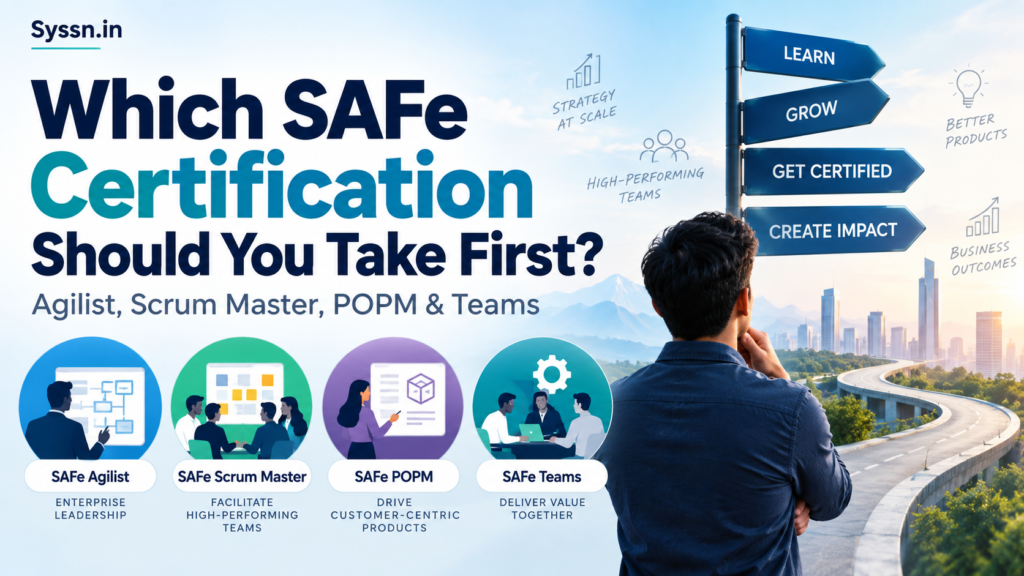
If you are choosing your first SAFe certification in 2026, start with the role you want to perform. Choose SAFe Agilist for broader enterprise and leadership knowledge, SAFe Scrum Master for team facilitation, SAFe POPM for Product Owner or Product Manager responsibilities, and SAFe for Teams for developers, testers, analysts, and other ART members. For training, learners can compare StarAgile, Simplilearn, upGrad KnowledgeHut, and Invensis Learning, while Scaled Agile remains the official certification authority and source for current exam rules. Your role should determine the certification first; provider, format, and price should come after that decision.
There is no single certification that makes equal sense for every learner. Your responsibilities should drive the choice.
Key Takeaways
- Choose SAFe Agilist if you need a broad understanding of enterprise SAFe, Lean-Agile leadership, Agile Release Trains, portfolio concepts, and organizational change.
- Choose SAFe Scrum Master if your work centers on team facilitation, iteration execution, PI Planning, coaching, and helping an Agile team improve.
- Choose SAFe POPM if you own or influence product priorities, features, stories, roadmaps, backlogs, customer needs, or PI objectives.
- Choose SAFe for Teams if you are a developer, tester, engineer, analyst, or other Agile team member who needs to understand how a team operates within an ART.
- An exam-only route is currently available for several foundational certifications, including SAFe Agilist, Scrum Master, Practitioner, and POPM.
- Training providers differ in schedules, instructor access, exam preparation, course support, pricing, and corporate training options, so compare the complete package rather than the course name alone.
Quick SAFe Certification Comparison
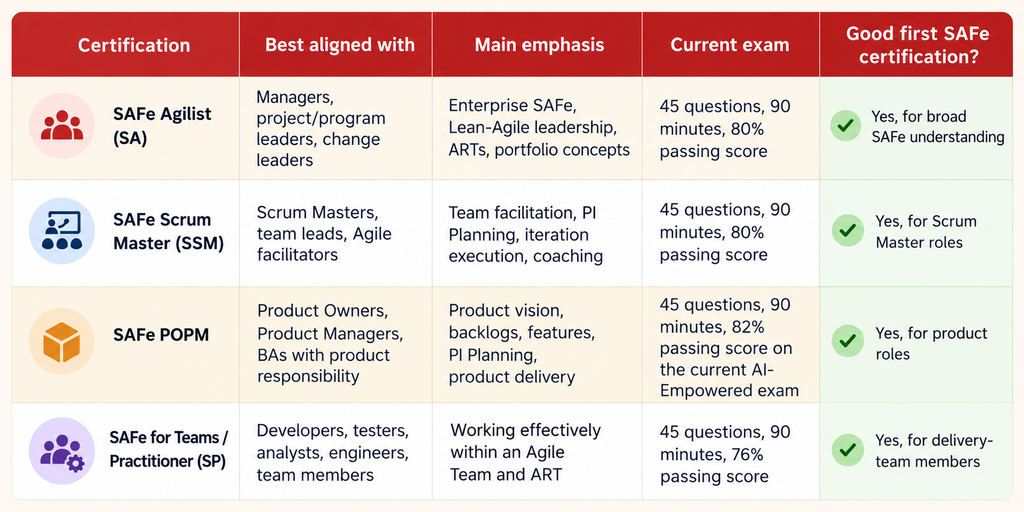
These credentials sit within the Foundational tier of the current certification structure. The broader portfolio is available through the official SAFe certification catalog.
What Is SAFe Certification?
A SAFe certification is a professional credential for people working with the Scaled Agile Framework.
SAFe addresses Agile delivery beyond a single independent Scrum team. Its practices cover Agile Release Trains, Planning Intervals, product management, architecture, Lean Portfolio Management, DevOps, team execution, and organizational change.
That is why asking, “Which SAFe certification is best?” without considering your role usually produces an incomplete answer.
A delivery manager and a Product Owner can work on the same Agile Release Train while needing very different knowledge.
If you want to understand the certification process, exam route, renewal rules, and costs first, Syssn’s guide to getting SAFe certified in 2026 covers that process separately.
Which SAFe Certification Should You Take First?
A useful starting rule is simple:
Choose the certification closest to the decisions you are expected to make at work.
That creates four fairly clear paths.
Choose SAFe Agilist If You Need the Bigger Enterprise Picture
SAFe Agilist comes from the Leading SAFe path.
It covers more than the operation of one Scrum team. Its curriculum includes Lean-Agile principles, team and technical agility, product development flow, portfolio concepts, organizational change, and enterprise-level SAFe practices.
It is particularly relevant to:
- Project managers
- Program and delivery managers
- Engineering managers
- Agile transformation participants
- Consultants
- Leaders involved in SAFe adoption
- Product managers who need wider organizational context
The certification currently has no formal prerequisite. Its exam contains 45 questions, allows 90 minutes, and requires an 80% passing score.
For someone saying, “I work across teams and need to understand how SAFe fits together,” SAFe Agilist is generally the most direct match among these four options.
Choose SAFe Scrum Master If You Will Facilitate a SAFe Team
The SAFe Scrum Master certification concentrates more heavily on the team and Scrum Master role.
Its learning areas include Scrum within SAFe, Scrum Master responsibilities, effective team events, collaboration, conflict resolution, PI Planning, and helping teams execute work as part of an ART.
This route fits people whose work involves:
- Facilitating Agile events
- Helping teams address impediments
- Supporting continuous improvement
- Coaching collaboration
- Participating in PI Planning
- Working with Product Owners and other ART participants
The current examination contains 45 questions, provides 90 minutes, and requires an 80% passing score.
If you already hold a general Scrum credential such as CSM or PSM, SSM can still serve a different purpose. General Scrum certifications primarily teach Scrum itself. SSM adds the context of Agile Release Trains, PI Planning, cross-team coordination, and SAFe execution.
Syssn also has a separate Certified Scrum Master pathway guide for readers comparing broader Scrum certification routes.
Choose SAFe POPM If You Own Product Decisions
The SAFe Product Owner/Product Manager certification, commonly called POPM, is built around product responsibility.
It covers areas such as:
- Product Owner and Product Manager responsibilities
- Customer needs
- Product and solution vision
- Features and stories
- ART and team backlogs
- Roadmaps
- PI Planning
- Dependencies and risks
- Iteration execution
- Product flow
The current AI-Empowered POPM examination contains 45 questions, allows 90 minutes, and lists an 82% passing score.
POPM is therefore a more role-specific starting point for a working Product Owner than SSM.
It can also fit:
- Product Managers
- Business Analysts working closely with product backlogs
- Product specialists moving into SAFe
- Project managers shifting toward product-oriented work
- Business Owners working closely with product teams
Choose SAFe for Teams If You Primarily Work as an Agile Team Member
SAFe for Teams leads to the SAFe Practitioner (SP) credential.
This route gets less attention than SAFe Agilist, SSM, and POPM, but it can make more sense for people doing delivery work inside an ART without owning the Scrum Master or Product Owner role.
The course covers areas such as:
- Working as part of an Agile Team
- Understanding the Agile Release Train
- Connecting work to customer needs
- Backlog and planning practices
- PI Planning
- Delivering value
- Feedback
- Continuous improvement
It is relevant to:
- Software developers
- Test engineers
- QA professionals
- Systems engineers
- Business analysts
- Technical specialists
- Other team members joining a SAFe organization
The current SP examination contains 45 questions, allows 90 minutes, and requires a 76% passing score.
For organizations adopting SAFe across an ART, putting everyone through the same certification may be unnecessary. Role-based training usually creates a clearer connection between learning and daily responsibilities.
SAFe Agilist vs SAFe Scrum Master
The primary difference is enterprise context versus team facilitation.
SAFe Agilist gives you a wider view of how the framework operates across teams, value streams, leadership, portfolio practices, and transformation.
SAFe Scrum Master spends more time on helping an Agile team function effectively inside that system.
A project manager coordinating several teams may find SAFe Agilist closer to the scope of the job.
A Scrum Master preparing to facilitate PI Planning, support iteration execution, coach collaboration, and work inside an ART may find SSM more directly relevant.
Neither credential replaces practical experience.
Passing Leading SAFe does not automatically make someone an enterprise transformation specialist. Passing SSM does not provide the facilitation judgment that develops from working with real teams over time.
SAFe Agilist vs POPM
SAFe Agilist is broader. POPM goes further into product responsibilities.
Consider SAFe Agilist when your questions sound like:
“How does enterprise SAFe delivery work?”
“How do strategy, portfolios, ARTs, leadership, and execution connect?”
Consider POPM when your questions sound like:
“How should we prioritize our backlog?”
“How do I translate customer needs into features?”
“What does a Product Owner do during PI Planning?”
“How do Product Owners and Product Managers coordinate delivery?”
A Product Owner can certainly benefit from understanding the wider framework, but POPM maps more directly to the decisions that role makes every week.
SAFe Scrum Master vs POPM
SSM and POPM support different responsibilities within the same delivery environment.
The Scrum Master concentrates on how the team works.
The Product Owner concentrates heavily on what the team should work on and the value it should produce.
A SAFe Scrum Master facilitates events, supports team improvement, helps address impediments, and coordinates within the ART.
A Product Owner works with stories, priorities, backlog refinement, team planning, iteration execution, and product value.
For Business Analysts, the better fit depends on the direction of the role.
A BA increasingly responsible for requirements, prioritization, stories, and stakeholder product decisions may find POPM more relevant.
A BA moving toward Agile facilitation and team coaching may find SSM more useful.
What Should a Project Manager Take First?
For many project managers entering a SAFe environment, Leading SAFe and the SAFe Agilist credential provide the broadest starting point.
Traditional project management responsibilities often span stakeholders, dependencies, delivery coordination, governance, planning, and organizational objectives. Leading SAFe helps explain how those responsibilities operate in a Lean-Agile organization.
That does not mean every project manager needs SAFe Agilist.
If you are moving specifically into a Scrum Master position, SSM is more directly connected to the target role.
If your job is shifting toward product ownership rather than delivery coordination, POPM may fit better.
The position you are moving into matters more than the title you currently hold.
Which SAFe Certification Should a Scrum Master Take?
A Scrum Master working in, or preparing to join, a SAFe organization should examine SAFe Scrum Master first.
Someone with substantial SSM experience may later consider SAFe Advanced Scrum Master (SASM).
SASM goes further into areas such as team flow, facilitation, collaboration, conflict management, and performance within the ART. It is therefore better suited to people who already understand the fundamentals than to someone choosing a first SAFe credential.
A practical progression might look like this:
Scrum fundamentals or practical Scrum experience → SAFe Scrum Master → practical SAFe experience → SAFe Advanced Scrum Master
There is no need to rush through that progression. Working between certifications can make later material easier to apply.
Which SAFe Certification Should a Product Owner Take?
For an existing or aspiring Product Owner inside a SAFe organization, POPM is the direct role-based option.
The course and assessment deal specifically with Product Owner and Product Manager responsibilities rather than treating product work as one component of a wider enterprise curriculum.
Professionals who later move toward broader product strategy can explore more advanced product-management learning after building practical SAFe experience.
A possible progression is:
POPM → practical product experience within SAFe → advanced product-management study
The important point is that POPM gives new Product Owners a clearer role-specific starting point than choosing a certification simply because it is more widely known.
What SAFe Certification Should a Team Take?
For organizations training an entire Agile delivery team, SAFe for Teams deserves consideration.
A delivery team does not consist entirely of Scrum Masters and Product Owners.
It may include:
- Developers
- QA engineers
- Business analysts
- UX professionals
- Data specialists
- Technical experts
- Product Owners
- Scrum Masters or team coaches
Role-based learning therefore makes more operational sense than sending everyone through one identical certification.
| Team role | Possible first SAFe path |
| Developer | SAFe for Teams |
| QA/Test Engineer | SAFe for Teams |
| General Agile team member | SAFe for Teams |
| Scrum Master | SAFe Scrum Master |
| Product Owner | POPM |
| Product Manager | POPM |
| Delivery leader | SAFe Agilist |
| Transformation leader | SAFe Agilist, followed by role-specific advanced study |
For a company rollout, the objective should be shared working knowledge combined with enough role-specific depth for people to perform their actual responsibilities.
Do You Need Training Before Taking a SAFe Certification Exam?
Not always.
Current official exam guidance allows candidates to purchase a proctored exam without first completing the associated training course for several certifications, including:
- SAFe Agilist
- SAFe Practitioner
- SAFe Scrum Master
- SAFe Product Owner/Product Manager
- AI-Native Foundations
The standalone proctored examination currently costs $495 plus applicable tax and includes two attempts during a 60-day eligibility period.
The current rules are explained in the official SAFe proctored exam guidance.
Training can still be valuable.
A live class gives you structured teaching, instructor discussion, exercises, examples, and a defined preparation sequence. Someone who has never worked in a SAFe environment may benefit from that structure more than an experienced practitioner preparing independently.
The exam-only route gives experienced candidates another option rather than making instructor-led training irrelevant.
SAFe Training Provider Options in 2026
Once you know which certification fits your role, the next decision is how you want to prepare.
Commercial training providers differ in instructor access, schedules, learner support, exam preparation, delivery format, pricing, and corporate training options. The four providers below are evaluated on the same basic criteria.
StarAgile
Best for: Indian professionals looking for instructor-led SAFe training with multiple certification options.
StarAgile offers training for Leading SAFe, SAFe Scrum Master, POPM, and other Agile credentials. Its current course materials emphasize live instructor-led classes, SPC-led teaching, exam preparation, official learning resources, and post-training support.
For Indian learners, one practical advantage is access to locally scheduled cohorts and INR pricing. A Leading SAFe course page showed pricing beginning at ₹35,400 when checked, while its SSM offering also listed a starting price of ₹35,400 for one available training configuration.
The main point to verify before enrolling is exactly what the advertised price includes. Check the exam arrangement, taxes, training dates, rescheduling policy, materials, and support period for the specific cohort you select.
StarAgile is therefore worth considering when you prefer guided preparation and India-focused scheduling rather than an exam-only route.
Simplilearn

Best for: Learners who prefer a large online training platform with structured live virtual classes.
Simplilearn offers Leading SAFe, SAFe Scrum Master, POPM, and related Agile training. Its current SAFe courses typically combine live virtual instruction with exam preparation resources and scheduled cohort delivery.
Its SSM course currently lists 16 hours of live instructor-led training, along with certification preparation and learner support. A recently available US Leading SAFe offering displayed promotional online training pricing of $549, compared with a higher listed standard price, although promotions and regional prices can change.
The platform may appeal to learners who want predictable online scheduling, a larger training operation, and access to a structured learning environment rather than preparing alone.
Before purchasing, confirm which exam attempts, learning resources, community access, trainer interaction, and support services are included in your exact package. Promotional prices should also be checked at checkout because course discounts can change between cohorts.
upGrad KnowledgeHut

Best for: Professionals who want live SAFe instruction across a relatively broad range of role-based courses.
upGrad KnowledgeHut offers Leading SAFe, SSM, POPM, SAFe for Teams, Release Train Engineer, Lean Portfolio Management, and other related courses.
Its SSM course currently lists 16 hours of instructor-led training, while its POPM program also lists 16 hours of live instruction. Course materials describe SPC-led teaching, exam preparation, learning resources, and access associated with the certification program.
For September 2026, its SAFe course listings showed some Indian POPM and SSM classes at approximately ₹63,999, although actual prices depend on the course, schedule, and current promotion.
KnowledgeHut can be useful for people comparing several SAFe role paths within one training provider rather than searching separately for each credential.
As with other providers, verify exam inclusion, taxes, cancellation rules, class size, instructor details, and the final payable amount before enrolling.
Invensis Learning
Best for: Individual learners and organizations comparing instructor-led SAFe training with corporate delivery options.
Invensis Learning offers several Agile and SAFe courses, including Leading SAFe, SAFe Scrum Master, POPM, and SAFe for Teams.
Its current Agile training portfolio separates these programs by role. SSM concentrates on Scrum Master responsibilities inside an ART, while POPM focuses more heavily on product responsibilities. Leading SAFe covers the broader framework and organizational context.
Invensis also promotes corporate training, which can be relevant for organizations planning to educate several people together rather than purchasing individual public-course seats.
Unlike providers that consistently display a fixed public price for every SAFe cohort, pricing visibility can vary by course and location. Buyers should therefore request or confirm the final quotation before comparing providers.
Check the instructor, delivery format, exam inclusion, course dates, group-training terms, taxes, and support offered after the class before making a decision.
A Note on the Official Certification Source
SAFe credentials themselves are issued through the official SAFe certification system. Use its documentation to verify current certification names, exam rules, renewal requirements, and credential status.
That makes the official site a reference source rather than a direct equivalent to StarAgile, Simplilearn, KnowledgeHut, or Invensis Learning in this provider comparison.
You can also use its training directory to verify available courses and authorized instructors.
Training Provider Comparison at a Glance
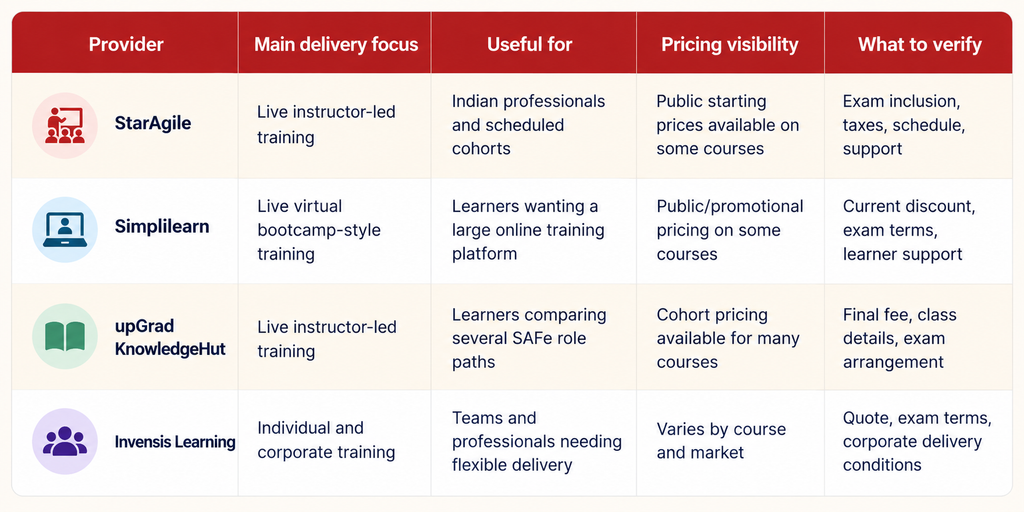
The provider should be a secondary decision.
First choose the right certification. Then compare trainers offering that certification.
How to Choose Your First SAFe Certification
Start With Your Actual Responsibilities
Ignore certification popularity for a moment.
Write down the five activities that take most of your time in your current or target role.
If those activities involve:
Enterprise alignment, programs, delivery leadership, and transformation: examine SAFe Agilist.
Facilitation, team improvement, and Scrum events: examine SSM.
Product priorities, features, backlogs, and customer value: examine POPM.
Development, testing, or direct team delivery: examine SAFe for Teams.
This exercise eliminates many mismatched certification choices.
Check Whether Your Employer Actually Uses SAFe
SAFe certification has its strongest relevance when your current employer or target organizations use SAFe, are adopting it, or hire specifically for SAFe experience.
If the companies you want to work for mainly use independent Scrum teams, a general Scrum credential may be more directly relevant.
Certification should support the working environment you are targeting.
Decide Between Training and an Exam-Only Route
The current exam-only option changes the cost calculation.
A qualifying standalone proctored examination currently costs $495 plus tax.
Compare that against an instructor-led training package that may include:
- Live classes
- Course materials
- Exam preparation
- Practice resources
- Trainer access
- Community or learning-platform access
- Scheduling support
An experienced practitioner may prefer independent study.
A beginner may get more value from instructor interaction and structured coursework.
Do not compare prices until you know whether both options include the same things.
Check Renewal Costs Before Enrolling
Certification cost does not necessarily end after you pass the exam.
The current annual renewal structure lists:
- Foundational: $195 per year plus applicable tax
- Advanced: $295 per year plus applicable tax
- Expert: $995 per year plus applicable tax
Foundational credentials such as SA, SSM, POPM, and SP currently require 12 Continuing Education Units per year.
Official certification renewal guidance provides the current tier structure and requirements.
Include renewal costs when comparing the long-term cost of certification.
Best First SAFe Certification by Use Case
| Your situation | Certification to examine first |
| New project manager entering a SAFe company | SAFe Agilist |
| Delivery manager coordinating several teams | SAFe Agilist |
| Scrum Master moving into a SAFe organization | SAFe Scrum Master |
| Existing CSM or PSM joining an ART | SAFe Scrum Master |
| Product Owner | POPM |
| Product Manager | POPM |
| Business Analyst working heavily with backlogs and product requirements | POPM |
| Developer joining a SAFe team | SAFe for Teams |
| QA engineer or tester | SAFe for Teams |
| Engineering team adopting SAFe together | SAFe for Teams plus role-specific training |
| Agile coach new to enterprise SAFe | SAFe Agilist followed by role-specific advanced study |
| Experienced SAFe Scrum Master | Consider SASM rather than another beginner credential |
Treat this as role mapping rather than a ranking of the certifications.
Frequently Asked Questions
Which SAFe certification should I take first?
Start with your role.
SAFe Agilist gives you the broadest enterprise perspective. SSM maps to Scrum Master responsibilities. POPM maps to Product Owner and Product Manager work. SAFe for Teams is intended for Agile team members operating within an ART.
Which SAFe certification is best for beginners?
There is no universal beginner choice.
SAFe Agilist can work well for someone who needs a broad understanding of the framework. SAFe for Teams may make more sense for someone joining a delivery team. SSM and POPM are better starting points when your role is already clear.
Should I take SAFe Agilist or SAFe Scrum Master first?
Choose SAFe Agilist when you need wider enterprise SAFe knowledge.
Choose SSM when you specifically plan to work as a Scrum Master or team facilitator.
You do not need to earn SAFe Agilist before taking SSM.
What is the difference between SAFe Scrum Master and POPM?
SSM focuses on facilitation, coaching, Agile events, PI Planning, and team effectiveness.
POPM focuses on product responsibilities, vision, features, backlogs, prioritization, PI Planning, and value delivery.
The better option depends on whether you are responsible primarily for team effectiveness or product decisions.
Can I take SAFe certification without experience?
Several Foundational certifications do not require formal previous SAFe experience.
Practical Agile experience can still make the concepts easier to understand and apply, particularly when topics involve team dynamics, product decisions, or coordination across an ART.
Is SAFe training mandatory?
Not for all foundational credentials.
An exam-only proctored route is currently available for SAFe Agilist, SAFe Practitioner, SAFe Scrum Master, POPM, and AI-Native Foundations.
Check the latest official exam requirements before registering because certification policies can change.
How much does SAFe certification cost?
Cost depends on the route you choose.
A qualifying standalone proctored examination currently costs $495 plus applicable tax and includes two attempts during a 60-day eligibility window.
Instructor-led training costs vary by country, provider, cohort, delivery model, and what the package includes.
Renewal fees should also be included in your total cost calculation.
How long is SAFe certification valid?
SAFe certifications follow an annual renewal structure.
Foundational credentials currently require 12 CEUs per year, and the Foundational renewal tier is listed at $195 per year plus applicable tax.
Is SAFe certification worth it in 2026?
Its relevance depends mainly on where you work or plan to work.
If your current or target employer actively uses SAFe, a role-aligned credential can document your knowledge of the framework and help you understand the terminology and working practices used in that environment.
If your target organizations rely mainly on standard Scrum, Kanban, or another operating model, a different certification may be more relevant.
Choose the credential around the work you want to perform rather than collecting certifications without a clear role objective.
Final Recommendation
Choose your first SAFe certification according to your responsibilities.
If you need to understand enterprise-level SAFe, SAFe Agilist provides the broadest starting point among the certifications discussed here.
If you facilitate Agile teams, SAFe Scrum Master maps more directly to that work.
If you own product priorities, backlogs, features, and value decisions, POPM is the role-specific choice to examine.
If you are a developer, tester, analyst, engineer, or another delivery-team member, SAFe for Teams may provide the most relevant foundation.
Once you know the certification, compare training providers separately. StarAgile, Simplilearn, upGrad KnowledgeHut, and Invensis Learning all offer SAFe-related training, but their schedules, pricing, support, course delivery, and corporate options differ.
The certification decision should come first. The training provider decision comes second.