
How to Get SAFe Certification: Pathway, Prerequisites, Cost and Renewal in 2026

Getting SAFe certified in 2026 starts with one decision: which certification actually fits the work you do, or the work you want to do?
SAFe Agilist is the best-known credential, but it is only one part of Scaled Agile’s certification portfolio. Scrum Masters, product professionals, Agile team members, Release Train Engineers, architects, portfolio professionals, and SAFe consultants have separate routes.
The process has changed, too. You can now buy a proctored exam without completing the associated course for selected Foundational certifications, including SAFe Agilist, SAFe Practitioner, SAFe Scrum Master, and Product Owner/Product Manager. Annual renewal now also requires Continuing Education Units, or CEUs.
This guide covers the current process, prerequisites, exams, training options in India, costs, CEUs, renewal fees, and how to choose the right SAFe certification.
Information and prices were checked on September 21, 2026.
SAFe certification at a glance
| Question | Current position in 2026 |
|---|---|
| Who issues SAFe certifications? | Scaled Agile |
| Is SAFe Agilist the only SAFe certification? | No |
| Can beginners get certified? | Yes, for several Foundational credentials |
| Is training always compulsory? | No |
| Can you buy an exam without training? | Yes, for SA, SP, SSM, POPM, and AI-Native Foundations |
| SAFe Agilist exam length | 90 minutes |
| SAFe Agilist questions | 45 |
| SAFe Agilist passing score | 80% |
| Certification renewal | Annual |
| Foundational CEUs | 12 per year |
| Advanced CEUs | 24 per year |
| Expert CEUs | 36 per year |
| Foundational renewal fee | $195/year plus applicable tax |
Scaled Agile’s current certification catalog separates credentials into Foundational, Advanced, and Expert levels. You can review the current portfolio on the official Scaled Agile certification page.
What is SAFe certification?
SAFe certification is a professional credential issued by Scaled Agile for people working with the Scaled Agile Framework.
SAFe is designed for organizations coordinating Agile work across multiple teams, products, programs, and portfolios. Its concepts include Agile Release Trains, PI Planning, Lean-Agile principles, product development flow, portfolio management, architecture, DevOps, and organizational change.
There isn’t one credential officially called “the SAFe certification.”
Common credentials include:
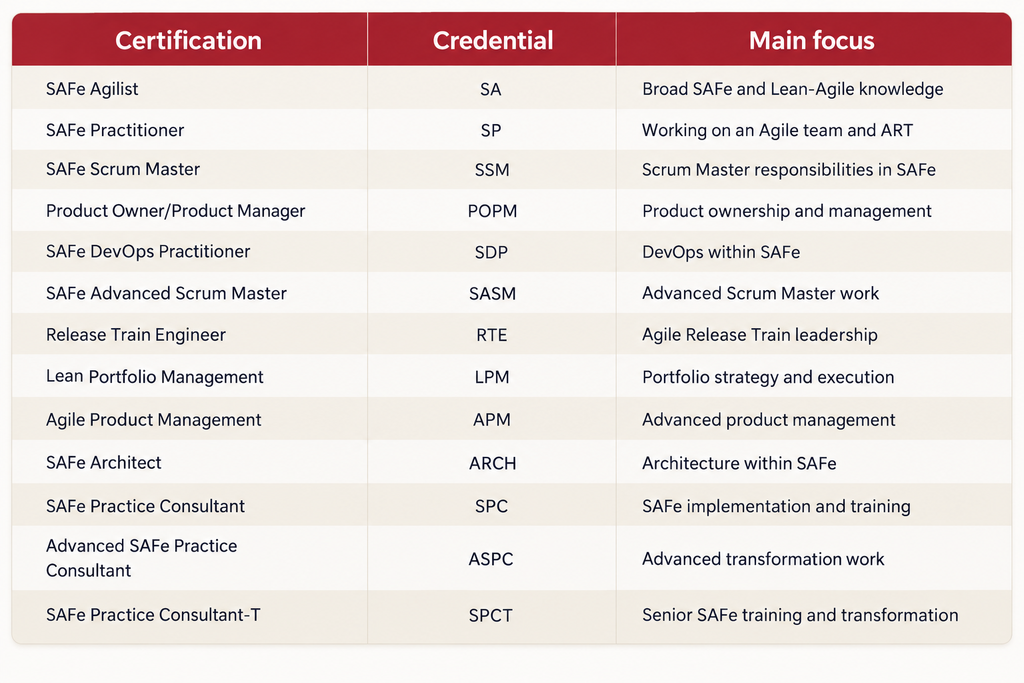
The sensible starting point is your role, rather than whichever certification name appears most often in search results.
Is SAFe Agilist the same as SAFe certification?
No.
SAFe Agilist is one Foundational certification within the wider SAFe portfolio.
The associated instructor-led course is Leading SAFe. Passing the assessment earns the SAFe Agilist credential.
A Scrum Master may be better served by SSM. Someone responsible for product ownership may find POPM more directly relevant. An experienced professional leading an Agile Release Train may investigate RTE.
This distinction becomes important when you compare course requirements, exam routes, renewal tiers, and the skills employers expect.
If you’re also comparing SAFe Scrum Master with Scrum Alliance’s Certified ScrumMaster route, Syssn’s guide to CSM certification requirements, exams and eligibility explains how that certification works.
How do you get SAFe certified in 2026?
The exact route depends on the credential, but the process can usually be reduced to six decisions.
1. Choose a certification that matches your work
Start with the job.
A project or delivery manager who needs a broad view of SAFe might investigate SAFe Agilist. Someone facilitating a team inside an Agile Release Train has a stronger reason to look at SAFe Scrum Master. Product Owners and Product Managers have POPM. Team members working inside an ART have SAFe Practitioner.
More experienced roles have their own credentials, including RTE, LPM, APM, ARCH, SASM, SPC, ASPC, and SPCT.
You don’t have to collect every Foundational certification before moving forward. SAFe is largely role-based rather than a single ladder everyone must climb in the same order.
2. Check prerequisites before paying
Scaled Agile’s July 2026 guidance says its courses generally have no prerequisites, with ASPC as an exception. Expert pathways can have additional eligibility requirements, so check the specific credential rather than assuming one rule applies to everything.
For a beginner considering SAFe Agilist, this means you don’t need several years of formal SAFe experience before starting.
Experience still helps.
Terms such as PI Planning, Agile Release Train, Lean Portfolio Management, backlog prioritization, flow, and built-in quality are easier to understand when you’ve already worked around Agile delivery.
Eligibility and job readiness are different questions.
3. Find out whether you actually need the course
This is where many older SAFe guides are now wrong.
Scaled Agile currently allows candidates to purchase a proctored exam without completing the related course for:
| Exam-only route currently available | Credential |
|---|---|
| SAFe Agilist | SA |
| SAFe Practitioner | SP |
| SAFe Scrum Master | SSM |
| Product Owner/Product Manager | POPM |
| AI-Native Foundations | AIN-F |
Other certification exams still require you to attend the associated course in full. Scaled Agile explains the rule in its official exam FAQ.
That creates a useful choice.
If you already work with SAFe and know the framework well, paying directly for a proctored Foundational exam may make sense. If ARTs, PI Planning, Lean-Agile principles, and SAFe terminology are new to you, structured training may save you a lot of confused study time.
4. Take the course or prepare independently
If your credential requires training, complete the authorized class.
If it doesn’t, compare the course route with the direct exam route before deciding. Look at the total price, your existing experience, how much instructor support you want, practice material, and retake terms.
The direct proctored exam isn’t automatically the cheaper choice in every market.
Scaled Agile currently lists the proctored exam at $495 and includes two attempts within a 60-day window.
Some Indian training courses cost less than that once the dollar price is converted, while also including instruction and exam access.
5. Pass the certification exam
The current AI-Empowered SAFe Agilist assessment uses this format:
| Exam detail | SAFe Agilist |
|---|---|
| Questions | 45 |
| Duration | 90 minutes |
| Question format | Multiple choice, single select |
| Passing score | 80% |
| Correct answers needed | 36 out of 45 |
| Delivery | Web-based |
| Open book? | No |
| Outside assistance? | No |
| Practice-test attempts | Unlimited |
You can confirm the current format in Scaled Agile’s official SAFe Agilist exam study guide.
The practice test mirrors the real assessment’s question count, timebox, domain coverage, and general difficulty. Scaled Agile also makes the sensible point that passing the practice assessment doesn’t guarantee a pass on the real exam.
6. Keep the certification active
Passing isn’t the end of the process.
SAFe credentials use annual renewal. Current certification holders must complete the required CEUs for their certification level and pay the applicable renewal fee.
We’ll get into the numbers shortly because they’re worth considering before you buy the initial course.
Can a beginner get SAFe certified?
Yes.
Several Foundational certifications are designed to be accessible to people who are new to SAFe.
Which one makes sense depends on what you’re trying to learn.
SAFe Agilist for broad framework knowledge
SAFe Agilist gives you the wider view.
It covers areas such as Lean-Agile thinking, Agile Release Trains, team and technical agility, product development flow, PI Planning, portfolio concepts, and organizational change.
That can suit project managers, delivery managers, consultants, business analysts, technology leaders, and other people who need to understand how SAFe works beyond one individual Scrum team.
For project managers comparing different professional routes, Syssn also has a detailed guide to how to get PMP certified.
SAFe Scrum Master for team facilitation
SSM concentrates more directly on Scrum Master work in a SAFe environment.
It makes sense when your responsibilities involve supporting teams, facilitating events, dealing with impediments, preparing for PI Planning, and working with an ART.
If you’re deciding between SSM and CSM, compare the certification bodies and working context rather than assuming they are interchangeable. Syssn’s comparison of Certified Scrum Master training providers can help you understand the Scrum Alliance route.
POPM for product professionals
POPM focuses on product ownership and product management inside SAFe.
The work includes features, stories, backlogs, prioritization, customer needs, PI Planning, and connecting product decisions with delivery.
Product professionals also have alternatives outside SAFe. For example, Syssn’s guide to getting CSPO certified covers Scrum Alliance’s Product Owner certification route.
SAFe Practitioner for Agile team members
SAFe Practitioner is aimed at people doing the day-to-day work inside Agile teams and Agile Release Trains.
If you need to understand how teams plan, collaborate, deliver, get feedback, and coordinate across an ART, SP may be a more natural starting point than a leadership-focused certification.
How does the SAFe certification pathway work?
Scaled Agile currently uses three certification renewal levels: Foundational, Advanced, and Expert.
The levels help organize credentials, but don’t mistake them for a compulsory sequence.
Foundational certifications
Foundational credentials include certifications such as SA, SP, SSM, POPM, and SDP.
These usually make sense for people learning the framework or developing role-specific SAFe skills.
Current CEU requirement: 12 CEUs per year.
Advanced certifications
Advanced credentials cover more specialized responsibilities, including RTE, LPM, APM, ARCH, and SASM.
Current CEU requirement: 24 CEUs per year.
Expert certifications
The Expert tier covers SPC, ASPC, and SPCT.
These certifications are intended for professionals involved in SAFe implementation, consulting, teaching, or senior transformation work.
Current CEU requirement: 36 CEUs per year.
Scaled Agile defines one CEU as one hour of eligible professional-development activity. Its current rules and qualifying categories are explained in the official CEU renewal guidance.
One small complication is worth knowing about. Scaled Agile’s September 2026 public pages aren’t completely aligned on Agile Software Engineer classification. The main certification catalog displays ASE as Foundational, while the Studio renewal-tier FAQ lists it under Advanced; the CEU FAQ places ASE at 12 CEUs. If ASE is your credential, check the renewal tier displayed in your own SAFe Studio account before paying.
SAFe Agilist vs SAFe Scrum Master
Both are Foundational credentials, but they serve different jobs.
| Area | SAFe Agilist | SAFe Scrum Master |
|---|---|---|
| Credential | SA | SSM |
| Level | Foundational | Foundational |
| Main focus | Broader SAFe framework | Scrum Master work within SAFe |
| Typical learner | Managers, delivery professionals, consultants, analysts | Scrum Masters, facilitators, team coaches |
| Exam-only route available | Yes | Yes |
| Annual CEU requirement | 12 | 12 |
If your job requires you to understand SAFe across teams, portfolios, leadership, and delivery, SA gives you the broader perspective.
If you’re expected to work directly with an Agile team and support it inside an ART, SSM is more role-specific.
Neither credential is automatically “better.” The job determines the useful one.
Where can you take SAFe training in India?
Training prices vary considerably because Scaled Agile’s partners set their own course fees.
Three providers currently publishing Leading SAFe options are SimpliLEAD, StarAgile, and upGrad KnowledgeHut.
SimpliLEAD
SimpliLEAD currently lists its AI-Empowered Leading SAFe course at ₹24,999. Its page describes two days of live instructor-led training and says the certification exam fee, courseware, and post-class support are included.
The price is competitive against the other examples below, but check the final invoice, batch schedule, refund policy, taxes, and exactly how exam access is handled before you pay.
StarAgile
StarAgile currently lists the Standard Leading SAFe plan in India at ₹35,400. Its current pages identify the company as an authorized Scaled Agile partner and say the certification exam is included in the training package.
If GST or a promotional discount applies to your batch, get the final amount in writing rather than calculating from an old sales quote.
upGrad KnowledgeHut
KnowledgeHut deserves a little more checking because its own current pages show different figures.
Its SAFe certification course listing recently showed Leading SAFe at ₹69,499, while a separate current information page states ₹50,000 for the SAFe Agilist course.
That doesn’t automatically mean either figure is wrong. Prices can reflect different cohorts, promotions, locations, packages, or stale page elements.
It does mean you should get a written quote for the exact batch you’re buying.
How should you compare SAFe training providers?
The cheapest headline price tells you surprisingly little.
Compare the actual package:
| Check | What you want to confirm |
|---|---|
| Authorization | Current Scaled Agile relationship |
| Credential | Exact certification the course prepares you for |
| Trainer | Relevant SAFe qualification and experience |
| Delivery | Live online, classroom, weekday, or weekend |
| Duration | Actual instructor-led hours |
| Exam | Whether exam access is included |
| Attempts | Number of included attempts |
| Tax | Whether GST is included |
| Materials | Official learning material and practice resources |
| Rescheduling | Fees and notice requirements |
| Support | What remains available after the class |
| Renewal | Recurring certification costs after year one |
Ask for the commercial terms in writing.
A ₹25,000 course that becomes ₹32,000 after tax and add-ons isn’t really a ₹25,000 course.
How much does SAFe certification cost in India in 2026?
There is no single SAFe certification fee for India.
Your total depends on whether you buy an exam directly or take training through a partner.
| Route/provider | Price checked in September 2026 | Notes |
|---|---|---|
| Direct proctored exam | $495 | Selected Foundational certifications; two attempts within 60 days |
| SimpliLEAD | ₹24,999 | Published Leading SAFe course price |
| StarAgile | ₹35,400 | Standard Leading SAFe plan |
| KnowledgeHut | ₹69,499 on current course listing | Separate KnowledgeHut page also states ₹50,000 |
| Foundational renewal | $195/year + tax | Recurring annual charge |
These figures are snapshots, not permanent prices.
If you’re comparing broader Agile training as well, Syssn’s guide to CSPO courses and training options provides another useful pricing reference for product professionals.
What is the SAFe Agilist exam format in 2026?
The current SAFe Agilist exam gives you 90 minutes to answer 45 questions.
You need 80%, or 36 correct answers, to pass.
The test is web-based, timed, closed-book, and does not permit outside assistance. Questions are multiple-choice and single-select.
That works out to an average of two minutes per question.
You won’t necessarily spend two minutes on each one. Straightforward questions may take 20 or 30 seconds, leaving more time for questions where several answers initially look plausible.
How should you prepare for the SAFe exam?
Start with Scaled Agile’s own exam blueprint rather than a random bank of practice questions.
The goal isn’t to memorize isolated terminology. You need to understand how the ideas connect.
For SAFe Agilist, that includes Lean-Agile principles, teams and ARTs, PI Planning, product development flow, portfolio concepts, customer focus, technical practices, and leading change.
A practical study sequence is:
- Read the official study guide and note the weighting of each exam domain.
- Complete your course material or independent study.
- Follow the official references attached to the learning plan.
- Make sure you can explain core terms without reading their definitions.
- Take the official practice assessment under the real time limit.
- Review every question you missed and return to the underlying material.
- Repeat the practice test until your result is consistently above the required passing score.
Don’t build your preparation around exam dumps.
Knowing that “B” was the correct answer to a copied question is useless when the real assessment gives you a different scenario.
What happens if you fail the SAFe exam?
The 2026 retake policy is more generous for Foundational certifications than many older articles suggest.
For Foundational courses covered by the policy, the first two attempts are included when they are taken within 60 days of course completion.
If both are unsuccessful, the third attempt is available immediately after the second failed attempt for the applicable retake fee. A fourth attempt requires a 10-day wait, and a fifth requires a 30-day wait. Further attempts also require a 30-day wait.
For most standard exams covered by the policy, the additional retake fee is currently $50. Proctored-exam pricing follows separate terms. Scaled Agile documents the current rules in its official exam retake FAQ.
Check your specific exam page before paying because exam policies can change.
How long does it take to get SAFe certified?
For a Foundational credential, you can potentially finish the process within several days.
Leading SAFe is commonly taught over two days. After that, the amount of study time you need depends heavily on your existing experience.
Someone who already works inside an ART may recognize most of the terminology immediately.
Someone hearing “ART” or “PI Planning” for the first time has more work to do.
Current Foundational course registrations generally give candidates a 60-day exam window, with two included attempts under the April 2026 policy.
The direct exam route can shorten the calendar further because you don’t have to wait for a scheduled class.
That doesn’t mean you should book the exam tomorrow.
Practice performance is a better signal than speed.
How long is SAFe certification valid?
SAFe certifications operate on an annual renewal cycle.
Your exact expiration date appears inside SAFe Studio under your certifications.
This recurring cost deserves more attention than it usually gets. If you plan to keep a Foundational credential active for three years after the initial certification, the current renewal price alone would total $585 plus applicable taxes, assuming the $195 fee remains unchanged.
Fees can change, of course. The point is to budget beyond year one.
How does SAFe certification renewal work in 2026?
Scaled Agile currently uses three annual renewal tiers.
| Tier | Annual renewal price | CEUs required |
|---|---|---|
| Foundational | $195 + applicable tax | 12 |
| Advanced | $295 + applicable tax | 24 |
| Expert | $995 + applicable tax | 36 |
The current prices come from Scaled Agile’s official certification-tier guidance, while the CEU requirements come from its current CEU policy.
An Advanced renewal also covers the Foundational certifications you hold. Expert renewal covers relevant certifications at lower levels as defined by the current tier model.
You can’t simply choose a higher tier because you prefer its benefits. Scaled Agile says you must hold a qualifying certification at that level.
What are SAFe CEUs?
CEU stands for Continuing Education Unit.
Under Scaled Agile’s current model, one CEU equals one hour of eligible professional-development activity.
The activities fall into three broad categories: Learning, Community, and Professional Application.
Scaled Agile encourages certification holders to complete activity across at least two categories. It also recommends keeping evidence of your activities because certification holders may be selected for an audit.
Extra eligible CEUs may be carried forward into the next renewal period.
That makes CEUs less awkward if you treat them as something you collect through the year rather than a requirement you remember the week before renewal.
How many CEUs do you need?
The annual requirement depends on your certification level.
Foundational credentials require 12 CEUs.
Advanced credentials require 24 CEUs.
Expert credentials require 36 CEUs.
If you hold several certifications, the same eligible activity can count toward each credential. Scaled Agile gives the example of someone holding both SSM and SASM. Completing the 24 CEUs required for SASM can also satisfy the 12-CEU SSM requirement.
Do you need to retake the SAFe exam every year?
No.
Normal renewal doesn’t require another certification exam.
You maintain your credential by meeting the applicable CEU requirement and completing your annual renewal.
Taking another SAFe course doesn’t automatically renew certifications you already hold either. Scaled Agile confirms both points in its official renewal FAQ.
What happens if your SAFe certification expires?
An expired credential can normally be renewed through SAFe Studio.
Scaled Agile says there are no late fees or mandatory exam retakes simply because a certification expired. You do, however, lose active certification status, and an expired certificate can’t be printed until it is renewed.
If an employer or client requires an active credential, waiting until someone asks for proof creates an avoidable problem.
Check the date before it lapses.
Which SAFe certification fits your role?
Here’s the simplest way to narrow the options.
| Your work or goal | Certification to investigate |
|---|---|
| Broad understanding of SAFe | SAFe Agilist |
| Agile team member | SAFe Practitioner |
| Scrum Master | SAFe Scrum Master |
| Product Owner or Product Manager | POPM |
| Experienced Scrum Master | SASM |
| Agile Release Train leadership | RTE |
| Portfolio work | LPM |
| Advanced product management | APM |
| Architecture | ARCH |
| SAFe implementation and consulting | SPC |
| Advanced SAFe transformation work | ASPC |
| Senior training and transformation | SPCT |
Treat that table as a starting point rather than a ranking.
A Product Owner doesn’t become more employable simply because SAFe Agilist sounds broader than POPM. If employers want someone to own product decisions, backlog priorities, stakeholder relationships, and product value, role-specific knowledge may be more useful.
Is SAFe certification worth pursuing?
It can be, when the companies and roles you’re targeting actually use SAFe.
You can test that before spending anything.
Search for 20 to 30 current job descriptions matching the role you want. Record how often they mention SAFe, Agile Release Trains, PI Planning, SAFe Agilist, SSM, POPM, RTE, SPC, or another specific credential.
If SAFe appears repeatedly, you have evidence that the knowledge is relevant to your target market.
If almost none of the jobs mention it, the certification may be solving the wrong problem.
A credential also has limits.
Passing SAFe Agilist proves that you met the assessment requirements for that certification. It doesn’t prove that you’ve led a difficult PI Planning event, handled an ART dependency problem, coached a struggling team, or persuaded senior stakeholders to change a portfolio decision.
Employers can tell the difference.
Certification works better when it supports practical evidence rather than trying to replace it.
If your career direction is closer to conventional, hybrid, and Agile project leadership, compare SAFe with Syssn’s guide to PMP certification online training before deciding where to spend your time and money.
A seven-point check before you pay
- Choose the exact credential. SA, SSM, SP, POPM, RTE, and SPC solve different learning needs.
- Check current eligibility. Don’t use a three-year-old training blog as your source of truth.
- Check whether training is compulsory. SA, SP, SSM, POPM, and AI-Native Foundations currently have exam-only proctored routes.
- Verify the provider. Confirm its current relationship with Scaled Agile and the trainer assigned to your actual batch.
- Get the final price. Include GST, exam access, retakes, rescheduling, and any package extras.
- Budget for renewal. A Foundational credential currently costs $195 plus applicable tax to renew each year.
- Plan the CEUs. Expect 12, 24, or 36 hours of eligible activity each year depending on your certification level.
Five minutes spent checking those details can save you from paying against an expired promotion or relying on an old exam policy.
Frequently asked questions
How do I get SAFe certification in 2026?
Choose the SAFe credential that fits your role, check its current eligibility and training rules, complete training if required or useful, prepare for the assessment, pass the exam, and maintain the credential through annual CEUs and renewal.
What are the prerequisites for SAFe Agilist?
Scaled Agile currently lists SAFe Agilist as a Foundational certification with no formal prerequisite. Previous Agile, Scrum, project, product, or software-delivery experience can make the material easier to understand.
Can I get SAFe certification without experience?
Several Foundational certifications are accessible without previous formal SAFe experience. That makes certification possible for beginners, although employers may still expect practical experience for the job itself.
Can I take a SAFe exam without attending training?
For selected credentials, yes. Scaled Agile currently allows exam-only proctored routes for SA, SP, SSM, POPM, and AI-Native Foundations.
How much does the direct SAFe exam cost?
Scaled Agile currently lists its proctored exam route at $495, including two attempts within 60 days.
What is the SAFe Agilist passing score?
The current passing score is 80%, which means at least 36 correct answers out of 45.
How long is the SAFe Agilist exam?
You have 90 minutes to answer 45 questions.
Is the SAFe exam open-book?
No. Scaled Agile’s current exam policy says certification exams are closed-book and must be taken without outside assistance.
Does SAFe certification expire?
Yes. SAFe credentials use annual renewal.
How many CEUs do you need?
Foundational certifications currently require 12 CEUs per year, Advanced certifications require 24, and Expert certifications require 36.
Do you have to take the exam again for renewal?
No. Standard annual renewal doesn’t require another exam.
Can you renew an expired SAFe certification?
Yes. Scaled Agile says expired certifications can be renewed without a late fee or mandatory exam retake simply because they expired.
What is the difference between Leading SAFe and SAFe Agilist?
Leading SAFe is the associated training course. SAFe Agilist is the professional certification you earn after passing the assessment.
Is SAFe Agilist the same as SAFe Scrum Master?
No. SAFe Agilist gives you a broader view of SAFe, while SSM focuses more directly on Scrum Master responsibilities within a SAFe environment.
Which SAFe certification makes sense for a project manager?
SAFe Agilist is worth investigating when you need broad knowledge of SAFe and enterprise Agile delivery. For experienced professionals working directly with Agile Release Trains, RTE may become more relevant.
Which certification should a Scrum Master consider?
SSM is the Foundational SAFe credential aimed at Scrum Master work. More experienced Scrum Masters can investigate SASM.
Which certification should a Product Manager consider?
POPM is the Foundational SAFe credential most directly connected with Product Owner and Product Manager responsibilities. Agile Product Management sits at the Advanced level.
What to check before registering
The biggest mistake is treating “SAFe certification” as one purchase.
It isn’t.
You need to choose a specific credential, decide whether the course or exam-only route makes sense, compare the complete cost, understand the exam terms, and account for annual renewal.
For an Indian learner considering SAFe Agilist, current public pricing also makes comparison worthwhile. A ₹24,999 instructor-led course can cost materially less than the $495 standalone proctored exam before you even put a value on the training.
More important, use current rules.
Scaled Agile changed its exam and continuing-education policies during 2026. Old articles may still tell you that training is compulsory for every exam, that Foundational candidates receive only one attempt, or that renewal is handled under older fees.
Those statements can now send you in the wrong direction.
Before paying, check Scaled Agile’s current certification catalog, exam policy, CEU requirements, renewal tiers and fees, and renewal FAQ.
Then choose the credential that matches the work you actually want to do.


[…] than assuming a Scrum Alliance or Scrum.org credential covers the same job context. Syssn’s 2026 SAFe certification pathway guide explains that route […]
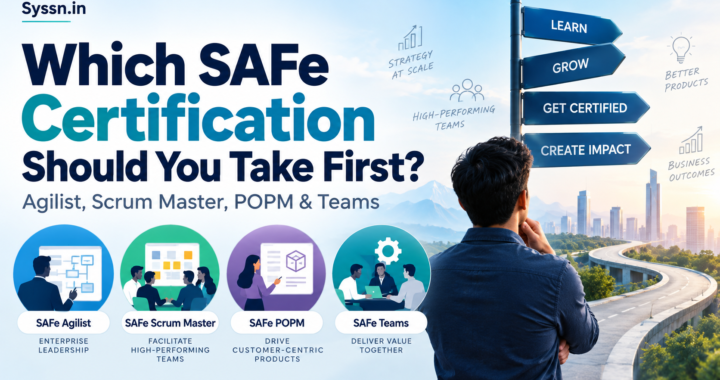
[…] to understand the certification process, exam route, renewal rules, and costs first, Syssn’s guide to getting SAFe certified in 2026 covers that process […]