How to Get PMP Certification: Step-by-Step Process From Eligibility to Exam Day

Most people begin researching PMP certification with the exam in mind.
That makes sense. The exam is the visible part of the process. It is the moment you sit down for four hours, answer 180 questions, and find out whether months of project experience and weeks of preparation have paid off.
But the exam is actually quite late in the journey.
Before you can book it, you need to prove that you meet PMI’s experience requirements, complete the required project management education, describe your project work clearly, submit an application, and receive approval.
For an experienced professional who already qualifies, the entire process can often fit into roughly six to eight weeks. The important part is doing things in the right order.
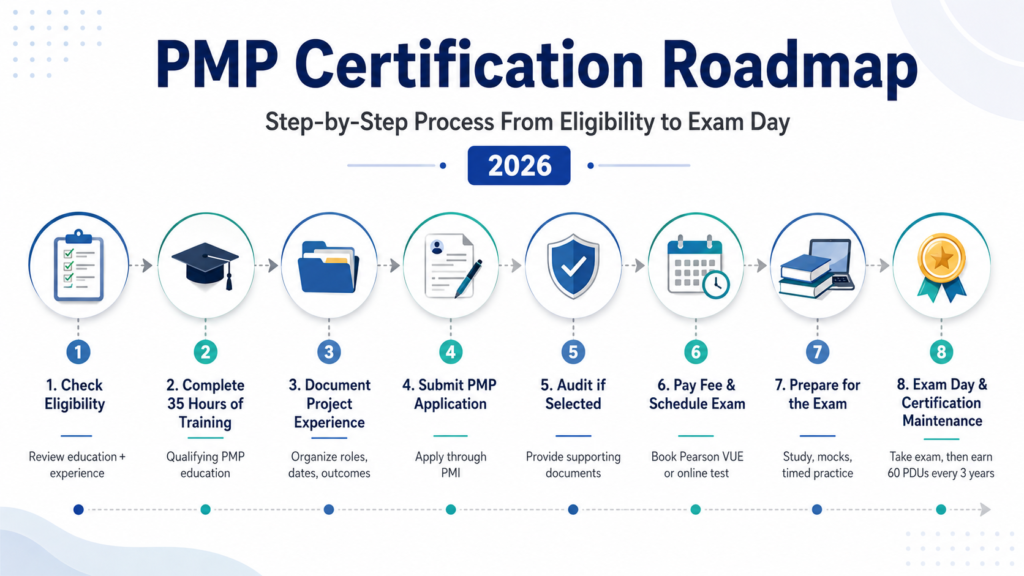
PMP certification process at a glance
If you’re trying to understand how to get PMP certification in India or anywhere else, the process looks roughly like this:
| Step | What you need to do | Typical planning time |
|---|---|---|
| 1 | Check your education and project experience | 1 day |
| 2 | Complete 35 hours of qualifying PMP training | 1 to 4 weeks |
| 3 | Document your project experience | 1 to 3 days |
| 4 | Submit your PMP application | Allow roughly one working week for routine review |
| 5 | Complete an audit if selected | Depends on documentation |
| 6 | Pay the exam fee and schedule your test | Same day once eligible |
| 7 | Prepare for and take the PMP exam | Often 4 to 6 weeks |
| 8 | Maintain your PMP certification | Earn 60 PDUs every 3 years |
Some training providers build their programs around similar timelines. StarAgile, for example, uses a roughly 40-day preparation structure for some candidates.
That 40-day figure is a study plan, however, not a PMI rule.
Once PMI approves your application, you receive a one-year eligibility period in which to take the examination.
What is PMP certification?
PMP stands for Project Management Professional. The Project Management Institute, better known as PMI, administers the credential.
One source of confusion for first-time candidates is that several things associated with PMP sound almost interchangeable. They aren’t.
| Term | What it actually means |
|---|---|
| PMP certification | The credential you earn after meeting PMI requirements and passing the exam |
| PMP training | Education that may satisfy the required 35 hours and help you prepare |
| PMP examination | The test you must pass to receive the credential |
| PMI membership | An optional paid membership with PMI |
| PMBOK Guide | A PMI project management standard and study reference |
Completing a PMP training course does not make you PMP certified.
The course helps you meet the education requirement and prepare for the examination. PMI decides whether you are eligible, administers the certification process, and awards the credential.
This distinction becomes particularly useful when choosing study material. The PMP exam is not simply a test of how well you have memorized the PMBOK Guide. PMI’s current Exam Content Outline determines what the exam assesses.
Step 1: Check whether you meet the PMP eligibility requirements
Before looking at training providers, exam simulators, or study schedules, establish whether you actually qualify.
Your required project experience depends on your educational background.
PMI’s current routes include:
| Educational background | Required project experience |
|---|---|
| Secondary school qualification | 60 months |
| Associate degree, vocational qualification, or applicable equivalent | 48 months |
| Bachelor’s degree or higher | 36 months |
| Bachelor’s or postgraduate degree from a PMI GAC-accredited program | 24 months |
The qualifying experience must fall within the 10 years before your application.
PMI also counts non-overlapping months.
That distinction matters more than it first appears.
Suppose you managed Project A and Project B at the same time from January through March. Those three months do not suddenly become six months of PMP experience because two projects were happening simultaneously. They are still three calendar months.
The 10-year experience window is part of the updated PMP requirements associated with the examination introduced in July 2026.
Do you need the job title “Project Manager”?
No.
This is one of the more useful things to understand early.
PMI is interested in the project work you actually led or managed, rather than the words printed underneath your name on an organization chart.
Someone working as a team lead, engineer, implementation manager, consultant, project coordinator, business analyst, operations professional, or technology specialist may have relevant experience.
Imagine a senior engineer who spends nine months leading a system migration. Their title never changes. During the project, however, they manage milestones, coordinate stakeholders, handle risks, work with vendors, organize testing, and oversee the transition into production.
The title says “Engineer.”
The work tells a more interesting story.
Your application needs to communicate that story clearly.
Can operations or logistics experience count?
Sometimes.
The more important question is whether you were managing a project or performing ongoing operations.
Suppose you manage warehouse dispatches every week. You assign regular shifts, monitor stock records, and make sure shipments leave on time.
That is operational work.
Now imagine the same person is asked to lead a six-month implementation of a new warehouse management system.
There is a defined objective. There is a start and finish. There are stakeholders, software vendors, risks, testing activities, training requirements, deadlines, and a handover.
That starts to look much more like a project.
The distinction sounds straightforward in theory. In real careers, it can become surprisingly fuzzy. A job can contain both operational responsibilities and temporary projects at the same time.
Your task when preparing the application is to separate them honestly.
The Syssn PACE Project-Experience Check
A simple way to examine your experience is the Syssn PACE model.
PACE is an editorial framework created by Syssn. It is not a PMI framework or official PMI terminology.
P: Project boundary
Did the initiative have a defined objective, starting point, and completion point?
A: Authority
Did you take responsibility for planning, decisions, delivery, risks, resources, or results?
C: Coordination
Did you coordinate colleagues, managers, customers, vendors, stakeholders, or other participants?
E: Evidence
Could you provide dates, responsibilities, outcomes, and someone who could verify your involvement if PMI requested documentation?
The last question may be the most useful.
It is easy to make a project description sound impressive. It is harder, and far more useful, to ask whether another person could verify the description.
If an initiative has no clear boundary and mainly consists of routine business activity, be cautious about treating it as PMP project experience.
Step 2: Complete 35 hours of qualifying PMP training
Most PMP applicants need 35 hours of qualifying project management education.
An active CAPM certification can also satisfy the education requirement.
Candidates can currently use qualifying live instruction or online self-paced education, but there is an important change approaching for live training.
Beginning December 1, 2026, live instructor-led PMP training used toward the education requirement must come from a PMI Authorized Training Partner, a China Registered Education Provider, or an eligible accredited higher-education program.
Qualifying self-paced courses can still be offered by other organizations under PMI’s applicable rules.
That date is worth remembering if you plan to start training near the end of 2026. Advice written even a few months earlier may describe rules that no longer apply.
How should you choose a PMP preparation course?
Thirty-five hours tells you how much qualifying education you need. It tells you very little about how useful the course will be.
A good comparison should include:
- Whether the course covers the July 2026 exam
- Live instructor access
- Class timings
- Application assistance
- Practice questions
- Full-length mock exams
- Recorded or revision access
- The total price
- Whether taxes are included
- Whether an exam voucher or PMI membership is bundled
Three options worth comparing are StarAgile, KnowledgeHut, and PMI’s own PMP Exam Prep course.
1. StarAgile
StarAgile is a PMI Authorized Training Partner offering 35 hours of live virtual PMP training.
Its current course information states that the program has been updated for the PMP examination introduced on July 9, 2026. Public information also mentions practice questions, mock examinations, application support, and supporting or recorded learning material depending on the package purchased.
For working professionals, scheduling may be one of the main attractions.
Recent sales discussions supplied for this article described weekday sessions of approximately 2 to 2.5 hours from Monday to Friday for three to four weeks, weekend classes lasting roughly 4.5 hours, evening sessions around 7:30 pm to 9:50 pm, and early-morning sessions around 6 am to 8 am.
Public schedules also list both weekday and weekend formats.
Trainer availability changes by batch, although Visakh R J appears on several current schedules.
Recent quotations supplied for this article placed training-only pricing at about ₹10,000 plus 18% GST, bringing the amount to approximately ₹11,800. One promotional quotation was ₹11,500.
Packages combining training, an exam voucher, and one year of PMI membership were quoted at approximately ₹45,000, ₹46,000, or ₹48,000 depending on the offer. A ₹2,000 seat-holding token was also mentioned.
These are recent quotations rather than permanent prices. Check the current package, taxes, voucher terms, and inclusions before paying.
StarAgile has also mentioned alumni sessions involving recent PMP passers.
Its role is preparation and support before the exam. The actual PMP examination remains a PMI certification examination conducted under Pearson VUE testing rules.
2. KnowledgeHut

KnowledgeHut takes a somewhat different approach by combining live instructor-led preparation with on-demand learning.
Its current course information lists 36 contact hours of live instruction and an on-demand option providing 35 contact hours.
That gives candidates a choice between a scheduled classroom-style experience and a more flexible recorded format.
KnowledgeHut also advertises a mentor-led five-week study plan. That can be useful if your biggest PMP problem is not understanding the material but actually sitting down and studying it every week.
Its practice resources include more than 2,000 questions, mock examinations, a PMP exam simulator, and full-length simulations.
Some location-specific course pages also describe application assistance covering PMI registration, membership, application review, and submission.
That assistance can help you organize your application, but PMI still makes the final eligibility decision.
Current Indian course pages show weekday and weekend batches. One recent Noida listing displayed a live online classroom price of ₹10,999 against a listed price of ₹18,999.
Training prices can vary by city, date, batch, and promotion, so check the current quotation rather than treating one local page as the national price.
KnowledgeHut is likely to appeal most to candidates who want regular instructor access, a structured five-week plan, a substantial practice bank, and a combination of live and recorded learning.
Before enrolling, confirm that the batch you choose follows the July 2026 PMP Exam Content Outline.
3. PMI PMP Exam Prep
PMI also provides its own PMP Exam Prep Course.
The course is self-paced and provides 35 training hours, allowing candidates who complete it to satisfy the PMP education requirement.
PMI states that the course follows the current PMP Exam Content Outline and includes predictive, adaptive, and hybrid approaches, along with leadership practices, stakeholder engagement, and business value delivery.
The appeal here is straightforward: the training comes from the same organization that administers PMP.
The format, however, is different from instructor-led training.
You decide when to study. There is no fixed weekday class, weekend batch, or recurring live trainer session.
For someone with an unpredictable work calendar, that freedom can be useful. For someone who has purchased three self-paced courses in the past and completed approximately one and a half of them, perhaps less so.
Candidates who prefer live instruction can instead use PMI’s Authorized Training Partner network.
PMI also sells other preparation resources separately, including PMI Study Hall and PMP practice products. Those tools support examination preparation but should not be confused with the certification itself.
Prices can vary by region, product, and membership status, so check PMI’s current store before purchasing.
The PMI self-paced course is best suited to candidates who are comfortable managing their own learning schedule and want to complete the required education directly through PMI.
If you prefer deadlines, live discussion, instructor explanations, or application support, an instructor-led provider may suit you better.
Step 3: Prepare your PMP application
Once your education and experience requirements are in place, organize your project history before opening the application form.
This sounds minor. It can save a surprising amount of frustration.
Trying to reconstruct years of project experience while clicking through an online application is a poor way to remember dates, responsibilities, and outcomes accurately.
For every project you plan to include, write down:
- Project name
- Start date
- End date
- Project objective
- Your role
- Your management responsibilities
- Teams or stakeholders involved
- Major deliverables
- Final outcome
Remember that experience is counted by months.
If Project A and Project B both ran from January to March, the overlapping period remains three months.
How should you describe your PMP project experience?
Focus on responsibility.
Consider this description:
Worked on an ERP implementation and coordinated several teams.
It is not necessarily wrong. It simply leaves too much unanswered.
What did you coordinate? What decisions did you make? What parts of the project were you responsible for?
A clearer description would be:
Led implementation planning for an ERP rollout across three business units. Managed schedule milestones, stakeholder requirements, vendor dependencies, project risks, testing coordination, user communication, and transition activities through production handover.
The second description gives PMI something concrete to evaluate.
You do not need dramatic verbs or inflated claims. Accuracy is more useful.
A good test is simple: if your former manager read the description, would they recognize the project you are describing?
Step 4: Submit the PMP application and prepare for a possible audit
Once your project information is organized, submit your PMP application through PMI.
Recent StarAgile sales conversations have used approximately four to five business days as a practical planning estimate for routine application review.
Treat that as scheduling guidance rather than a guaranteed PMI deadline.
PMI may also select your application for audit.
If that happens, you may need to provide documents supporting your education, training, and project experience.
Depending on what PMI requests, documentation may include:
- Degree or diploma records
- Proof of completed project management education
- Verification of professional experience
- Information or confirmation from supervisors or managers
An audit does not automatically indicate that anything is wrong.
It is a verification process.
Still, the possibility of an audit changes how you should approach the application. Dates that were “roughly around March” suddenly deserve a little more attention.
Make sure the information you submit can be supported before pressing the final button.
Step 5: Pay the PMP exam fee and schedule the test
After PMI approves your application, you can pay for the examination and choose your test date.
PMI membership is optional.
Membership and PMP certification are separate, although membership can affect examination pricing.
If you’re applying from India, check the final amount shown in your PMI account when you are ready to pay.
Exchange rates, taxes, regional pricing, membership charges, and promotions can change. A rupee price copied from an old article should therefore be treated as a reference point, not a permanent fee.
If a training provider sells you a package containing an examination voucher, ask a few questions before paying:
- Is PMI membership included?
- Is GST included?
- How will the examination voucher be issued?
- How long is the voucher valid?
- What are the refund conditions?
- Is a retake included?
- What happens if PMI rejects the application?
Those questions are less exciting than choosing a study plan. They are also the questions most likely to prevent an expensive misunderstanding later.
Candidates can currently take the PMP examination at a Pearson VUE test center or through PMI’s secure online testing option.
PMI currently recommends the testing-center route on its certification information.
Step 6: Prepare for the 2026 PMP exam
The current PMP examination launched on July 9, 2026.
If you have old recordings, mock exams, study notes, or question banks, check when they were produced.
A familiar-looking PMP resource is not automatically a current one.
Current PMP exam format in 2026
| Exam feature | Current format |
|---|---|
| Total questions | 180 |
| Scored questions | 170 |
| Unscored pretest questions | 10 |
| Exam time | 240 minutes |
| Scheduled breaks | Two 10-minute breaks |
| People | 33% |
| Process | 41% |
| Business Environment | 26% |
The current examination contains 180 questions and gives candidates 240 minutes.
Question formats may include:
- Single-response multiple choice
- Multiple-response questions
- Drag-and-drop items
- Case-based questions
- Other interactive formats
The July 2026 examination also changed the domain weighting.
People now accounts for 33% of the exam, Process for 41%, and Business Environment for 26%.
That final figure is worth noticing. Business Environment now occupies a much larger part of the examination than it did under the previous structure.
Current preparation therefore matters.
A practical 40-day PMP study plan
There is no universal number of days you must study.
Forty days can work for some experienced professionals because they already understand how projects operate. Their main task is learning how PMI frames situations and then becoming comfortable with the examination format.
A sample plan might look like this.
Days 1 to 15: Build the foundation
Complete your 35 hours of training.
Learn how the current examination is structured and identify areas where your practical experience is weaker.
Someone who has spent ten years managing predictive projects, for example, may need more deliberate practice with agile or hybrid situations.
Days 16 to 25: Practice scenarios
Start working through scenario questions.
Avoid treating PMP preparation as a vocabulary contest.
Many exam questions describe situations in which several answers appear reasonable. Your job is to decide what the project professional should do next, or first, based on the context.
That takes practice.
Days 26 to 32: Add time pressure
Work through timed question sets.
Review every question you get wrong.
More importantly, identify why you got it wrong.
Did you misunderstand the question?
Did you choose an action too early?
Did you escalate something before trying to resolve it?
Did you apply predictive thinking to an agile situation?
A mistake becomes useful when you know what caused it.
Days 33 to 37: Take full-length mock exams
Complete full simulations under realistic time limits.
A four-hour exam tests knowledge, but it also tests concentration.
You want the length of the examination to feel familiar before the real test.
Days 38 to 40: Review rather than expand
Return to your weakest areas and previous mistakes.
The final days before the test are rarely the best moment to discover twelve entirely new topics.
Use them to make what you already know more reliable.
Forty days will not work for everybody.
If your work schedule is unpredictable, your project management knowledge is rusty, or you have not studied formally in years, six to eight weeks may be a better target.
Step 7: Prepare for PMP exam day
Exam-day preparation begins before exam day.
If you are taking the test at a Pearson VUE center, check the location and travel time in advance.
If you’re testing online, run the required computer checks and prepare a private environment that meets Pearson VUE’s rules.
Before the exam:
- Confirm the date and starting time
- Check the time zone
- Confirm that your identification meets the testing requirements
- Make sure your PMI details match your ID
- Run the online system test if applicable
- Review the break rules
- Plan your journey if using a testing center
- Sleep normally the night before
The current examination gives you 240 minutes for 180 questions and includes two scheduled 10-minute breaks.
Training organizations can prepare you before the exam. They cannot assist you during a proctored PMP examination.
It sounds obvious, but the distinction is worth stating because a training package, an exam voucher, and the examination itself can sometimes feel like parts of a single service.
They aren’t.
Step 8: Maintain your PMP certification
Passing the examination gets you certified.
Keeping the certification requires continued professional development.
PMP holders must earn 60 Professional Development Units, commonly called PDUs, during each three-year certification cycle.
You report qualifying activities through PMI and complete the renewal process before your certification cycle expires.
This is another useful reminder that PMP is not something you receive permanently after finishing a course.
The training may last several weeks.
The credential becomes part of an ongoing professional cycle.
How long does it take to get PMP certification?
If you already meet the experience requirements, approximately 40 to 60 days can be a realistic planning range.
| Activity | Example timeline |
|---|---|
| Eligibility check | Day 1 |
| 35-hour training | Weeks 1 to 4 |
| Application preparation | During training |
| Application review | Allow roughly one working week for planning |
| Exam preparation | Weeks 2 to 6 |
| PMP exam | Around Week 6 or later |
| Certification | After passing |
Your actual timeline may be longer if PMI audits your application, your preferred test date is unavailable, work becomes busy, or you simply need more preparation.
There is no PMI rule requiring you to finish within 40 or 45 days.
When a provider advertises a 40-day PMP path, it is describing a preparation schedule rather than a certification deadline.
Is the PMP exam difficult?
Yes, it can be.
But perhaps not for the reason people initially expect.
The difficult part is often not remembering a definition. It is deciding between several actions that all sound plausible.
A question may place you inside a project problem involving a stakeholder, vendor, team member, risk, change, or delivery issue.
Several responses may appear sensible.
The exam asks you to decide what should happen first based on the context, project approach, stakeholders, risks, and desired result.
That is closer to professional judgment than simple recall.
The 2026 exam also gives the Business Environment domain considerably more weight.
PMI says the revised preparation material gives additional attention to areas including AI, sustainability, and value delivery.
That makes current mock questions particularly useful. A question bank built for an older version of PMP may still teach project management, but it may no longer prepare you efficiently for the examination you are actually going to take.
Is PMP certification worth it in India?
For some professionals, yes.
PMP can make sense if you already have substantial project experience and want to move further into project management, delivery, program management, implementation, consulting, or related leadership roles.
It should not be treated as a guaranteed route to a promotion or salary increase.
A certification can strengthen your professional profile. It cannot control how a company hires, promotes, or pays people.
Before spending money, ask yourself three questions:
- Do I already have enough qualifying project experience?
- Do the roles I want ask for PMP or formal project management experience?
- Will I actually use project management methods in my work?
If the answer to the first question is no, rushing into PMP preparation may not be useful yet.
You may be better served by building additional project experience or considering CAPM while you do so.
Frequently asked questions about getting PMP certification
How do I get PMP certification step by step?
Confirm that you meet PMI’s eligibility requirements, complete 35 hours of qualifying project management education, document your professional project experience, submit your PMP application, complete an audit if selected, pay the examination fee, schedule your exam, prepare using the current Exam Content Outline, and pass the PMP examination.
How much project experience do I need for PMP?
The current requirement ranges from 24 to 60 months depending on your educational background.
Qualifying experience must fall within the applicable 10-year lookback period.
Do I need 35 hours of PMP training?
In most cases, yes.
PMI requires 35 hours of qualifying project management education. An active CAPM certification can also satisfy the education requirement.
Must the 35 hours come from a PMI Authorized Training Partner?
For live instructor-led education, the rules change on December 1, 2026.
Beginning on that date, qualifying live training must come from a PMI Authorized Training Partner, China REP, or eligible accredited higher-education program.
Qualifying self-paced education follows separate rules.
Can I get PMP certification without being a Project Manager?
Yes.
Your formal job title does not need to contain the words “Project Manager.”
What matters is whether your professional experience meets PMI’s project management requirements.
Can operations professionals qualify for PMP?
Yes, if they have genuine project experience.
Routine operational activity should not be presented as project work simply to satisfy the application requirement.
How many questions are on the PMP exam in 2026?
The current examination contains 180 questions.
Of those, 170 are scored and 10 are unscored pretest questions.
How long is the PMP exam?
You receive 240 minutes, or four hours, to complete the current PMP examination.
There are also two scheduled 10-minute breaks.
Can I take the PMP exam online in India?
Yes.
Candidates currently have the option of taking the examination at a Pearson VUE testing center or through secure online testing.
How long does PMP certification take?
If you already meet the experience requirement, completing training, application, preparation, and the examination in roughly six to eight weeks can be realistic.
An audit, work commitments, exam availability, or additional preparation needs can extend the process.
What is the best PMP preparation course?
There is no single course that fits every candidate.
StarAgile offers 35 hours of scheduled live virtual PMP training and application-related support.
KnowledgeHut combines live instruction with on-demand material, mentoring, and a large question bank.
PMI’s own PMP Exam Prep Course provides the 35 required hours through self-paced learning.
Your decision should depend on the current syllabus, schedule, instructor access, practice material, application assistance, learning format, and total cost.
Final PMP certification roadmap
The PMP process becomes much easier to understand once you stop seeing it as a single exam.
It is really a sequence of decisions.
First, establish whether your education and experience qualify.
Then complete your 35 hours of education and organize your project history carefully. Submit an accurate application. Once PMI approves it, choose an exam date that gives you enough time to practice under realistic conditions.
If you want scheduled live classes, StarAgile is one option because it provides 35 hours of live PMP preparation and operates as a PMI Authorized Training Partner.
KnowledgeHut offers another instructor-led route with live learning, mentoring, recorded material, and extensive practice resources.
If you prefer to work independently, PMI’s own 35-hour self-paced PMP Exam Prep Course may be a more natural fit.
The course matters, but the choice is ultimately about how you learn.
Some people need a trainer waiting for them at 7:30 in the evening. Others would rather study quietly at 6 in the morning. Neither approach makes someone more serious about becoming PMP certified.
What matters is whether the structure gets you to the point where you can sit in front of 180 questions and make sound project decisions consistently.
And before you begin, check the dates.
The PMP exam changed on July 9, 2026. The qualifying project-experience window is now 10 years. The rules for qualifying live PMP education change again on December 1, 2026.
PMP itself may be a long-established certification, but the path toward it does not stay frozen. That is probably one final project-management lesson hidden inside the certification process itself: before following the plan, make sure you’re working from the current version.