What Location IDs and Publisher Ownership Must Survive a Merger Before You Touch Listings?

A merger creates an odd problem for local listings teams.
The company may have changed owners overnight. The storefront hasn’t.
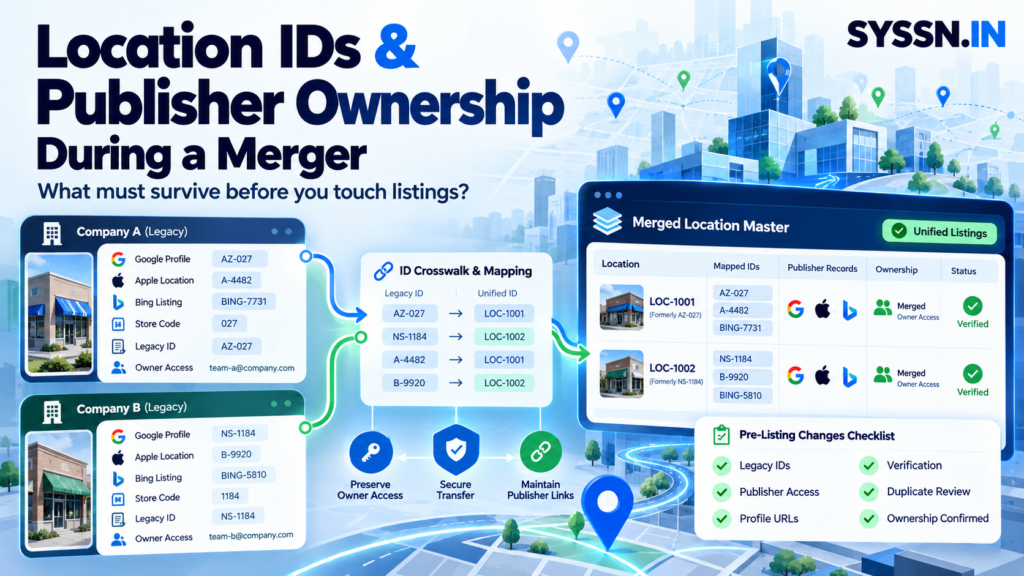
The Google profile still has years of reviews. Apple still recognizes the same physical location. Bing may already have a claimed record. The acquired company’s ERP calls the branch AZ-027, while the buyer has already decided it will become NS-1184.
It is tempting to clean everything up immediately.
Rename the locations. Change the URLs. Move them into the new listings platform. Replace old store IDs. Remove former employees.
That is exactly when things can go wrong.
Before touching customer-facing listings, preserve the identifiers and ownership relationships that prove which digital record belongs to which physical location.
The safest order is:
inventory → ID crosswalk → ownership transfer → duplicate review → pilot → rebrand → bulk rollout → validation.
Key Takeaways
- Never overwrite an acquired company’s location IDs. Map them permanently to the buyer’s new IDs.
- Capture Google, Apple, Bing, directory, and listings-platform references before changing business data.
- Secure publisher ownership before changing names, URLs, telephone numbers, categories, or listings providers.
- An acquisition does not automatically justify creating new listings.
- Preserve existing review-bearing profiles when publisher rules permit continuity.
- Treat publisher access, location identity, and customer-facing business data as three separate migration workstreams.
- For large estates, test perhaps 5 to 20 representative locations before updating hundreds at once.
What Are Location IDs and Publisher Ownership?
A location ID sounds simple until you examine a real multi-location business.
One store might simultaneously have:
- an ERP store number
- a CRM location ID
- an analytics warehouse key
- a website location-page ID
- a Google profile
- an Apple location
- a Bing listing
- a Yext entity ID
- a Synup location record
- an Uberall location ID
All of those identifiers can refer to the same physical place.
They are not interchangeable.
Suppose an acquired healthcare group calls its Phoenix location AZ-027.
The buyer’s ERP assigns it NS-1184.
The wrong migration approach is:
AZ-027 → deleted
NS-1184 → new record
The safer approach is:
| Identity field | Value |
|---|---|
| Legacy location ID | AZ-027 |
| New enterprise ID | NS-1184 |
| Legacy brand | Acquired Brand |
| New brand | Northstar |
| Google record | Existing profile mapped |
| Apple record | Existing location mapped |
| Bing record | Existing listing mapped |
| Migration status | Active |
AZ-027 remains part of the record’s history.
Six months later, when an invoice, review issue, API log, CRM export, old store locator, or analytics table references AZ-027, somebody can still trace it to the correct branch.
That is the difference between replacing an identifier and preserving lineage.
Why Publisher Ownership Is a Separate Problem
Knowing a listing exists is not the same as controlling it.
Your acquisition spreadsheet may contain the correct Google Business Profile URL, yet the profile could still be controlled by a former employee.
The Apple location might be associated with the seller’s organization.
The Bing listing may have been claimed through an account scheduled for deactivation after the transaction.
An agency might still have access to several branches.
A listing platform might still be connected even though nobody at the acquiring company has direct publisher access.
This is why I would treat identity and ownership as separate columns in the migration plan.
A location can be:
correctly identified but not controlled, or controlled but incorrectly matched.
Both situations need fixing before the rebrand begins.
Syssn’s broader guide to local listings management goes further into the operating model behind managing location data and publisher exceptions across larger networks.
Which IDs Must Survive the Merger?
1. Legacy Internal Location IDs
The seller’s original store code should survive permanently.
You can absolutely assign a new enterprise identifier.
What you shouldn’t do is erase the old one.
If the acquired restaurant chain uses DAL-044 and the parent company wants TX-3841, store both.
A good crosswalk might contain:
| Field | Example |
|---|---|
| Legacy ID | DAL-044 |
| Buyer ID | TX-3841 |
| ERP ID | 998231 |
| Store locator ID | texas-dallas-44 |
| Legacy URL | Existing location page |
| New URL | New parent-brand page |
| Google status | Ownership transferred |
| Apple status | Existing location mapped |
| Bing status | Verified |
| Rebrand status | Pending |
The location is the durable entity.
The codes are references to it.
2. Listings-Platform IDs
The listings platform creates another identity layer.
Yext, for example, requires an Entity ID in its bulk entity upload process alongside country information. Its systems also use location/entity identifiers throughout Listings and analytics workflows.
So if the acquired business is leaving Yext after the transaction, export those IDs before ending access.
The same principle applies elsewhere.
Synup’s current API exposes location operations, duplicate-listing operations, connected accounts, and publisher matching.
Uberall’s APIs likewise use a unique location ID to retrieve listing information and trigger synchronization for a particular location.
Do not let the platform ID become the only identifier you preserve.
But don’t throw it away either.
3. Publisher Profile References
For each important publisher, capture whatever information can help you recognize the existing record later.
That normally includes:
- profile URL
- business name
- address
- phone
- publisher ID if exposed
- account relationship
- claim status
- verification state
- current owner or administrator
- connected listings platform
- known duplicates
Why bother storing the URL if you already have the address?
Because addresses change.
Names certainly change during mergers.
The profile URL or publisher identifier can help you prove that the “new” record you’re looking at is actually the record that existed before the transaction.
Secure Google Business Profile Ownership Before Rebranding
Google’s current guidance is unusually useful here.
If ownership of the business changes, Google tells businesses to transfer primary ownership of the existing Business Profile. Google specifically says this preserves existing business information, including reviews.
Google’s official Business Profile ownership-transfer guidance
That tells us something important.
A corporate ownership change does not automatically make the physical location a new business profile.
Google allows multiple owners but only one primary owner. Managers can perform many operational tasks, but only owners can add or remove other users, and only the primary owner can transfer primary ownership.
There is also a timing issue that belongs in your merger plan.
New Google Business Profile owners and managers face a seven-day restriction before they can perform actions such as transferring primary ownership or removing other owners and managers.
That sounds like a small administrative rule.
It becomes less small when the brand wants 400 profiles transferred the week before launch.
Do not invite the acquiring company’s account on Friday and assume the access structure can be completely rebuilt on Monday.
Apple Ownership and Access Need Their Own Migration Track
Apple has also changed how its business-management products are organized in 2026, so I would treat current Apple documentation as the source of truth rather than old Apple Business Connect tutorials.
Apple Business now uses defined roles and permissions. Users can be given roles and, where applicable, access associated with brands and organizational units.
Apple’s current roles and permissions documentation
For an acquisition, document:
- which organization controls the account
- who has administrator access
- which users can manage relevant brands
- which users can manage locations
- whether an external partner or agency is involved
- which seller accounts will eventually be removed
Apple also handles an already-managed location differently from a genuinely new one.
Its current location workflow explicitly says that if a location is already managed by another organization, the incoming organization can add it and request a transfer rather than blindly creating another independent location.
Apple’s guidance for existing and transferred locations
That is exactly the distinction an M&A listings team should preserve.
Existing location under different control is not the same thing as new location.
Bing Should Be Inventoried Before Seller Accounts Disappear
Bing’s publicly available M&A documentation is less detailed than Google’s current ownership-transfer guidance.
Its basic operating model is still useful, though.
Bing Places tells businesses to claim an existing listing when one already exists, add new locations when required, complete the profile, and verify it. Businesses with multiple locations can use bulk upload tools.
Bing Places for Business official guidance
That gives your merger team a simple rule:
Do not deactivate the seller’s Microsoft or work accounts until you have documented which Bing records they control and verified that the buyer has independent access to the listings it needs.
For every important Bing record, capture:
- managing account
- claimed/unclaimed state
- verification state
- listing URL
- available publisher identifier
- location it maps to in your crosswalk
This is boring work.
That is usually a good sign in an M&A migration.
The exciting fixes tend to be the ones caused by boring work being skipped.
Do Reviews Survive an Acquisition?
Sometimes.
But “the company was acquired” is not what decides the issue.
The bigger question is whether the publisher considers the post-transaction business to be a continuation of the existing business.
For Google, transferring primary ownership of the same Business Profile preserves profile information such as reviews.
That supports a useful default:
ownership change alone should not make you recreate a profile.
A major rebrand is more complicated.
If the business identity changes enough that publisher rules treat it as a new business, continuity may be handled differently.
So don’t promise an executive team that every acquired profile’s reviews will automatically carry through every rebrand scenario.
Audit the actual change first.
The Right Order for Local Listings During a Merger
I would resist starting the migration with a “rename everything” spreadsheet.
Instead, use a sequence that makes each later step depend on the previous one.
Step 1: Freeze Uncontrolled Listing Changes
Establish a temporary change-control process.
Tell agencies, franchisees, regional marketing teams, store managers, IT, and corporate marketing that listing changes now go through the merger workflow.
Otherwise one team can rename a profile while another team is still trying to identify it.
Step 2: Build the Identity Crosswalk
Create one row for every:
- active location
- temporarily closed location
- permanently closed location
- location scheduled to close
- relocated branch
- known duplicate
- planned opening
Connect the seller’s IDs to the buyer’s IDs.
Include the profile references and ownership details beside them.
For organizations doing this at large scale, Syssn’s guide to business listing management services for multi-location brands explains what a mature listings workflow should handle beyond simple directory updates.
Step 3: Audit Publisher Access
Document who can control Google, Apple, Bing, and the other business-critical publishers.
Look for:
- seller employees
- former employees
- agencies
- shared mailboxes
- franchisees
- local managers
- vendor-owned accounts
- personal email addresses
- connected listing-management software
A successful API connection does not automatically prove that the acquiring company controls the underlying publisher account.
Step 4: Transfer Access
Add the acquiring company’s users and validate that they can actually manage the intended locations.
Do this before removing seller users.
For Google, remember the seven-day restrictions on newly added owners and managers.
For Apple, verify roles and location access before removing former administrators.
Step 5: Investigate Duplicates
Mergers have a way of revealing old data problems.
One location might have:
- an old-brand Google profile
- a new profile somebody created during due diligence
- a duplicate under an abbreviated name
- an Apple location controlled by the acquired company
- a directory record using an address from three years ago
Do not rebrand every record you discover.
First decide which one represents the canonical business.
If you’re comparing software specifically for this kind of cleanup, Syssn’s local listings management software guide compares platforms designed for multi-location publishing, duplicate management, and ongoing synchronization.
Step 6: Run a Pilot
For a 500-location acquisition, I would start with perhaps 5 to 20 intentionally varied locations.
Do not pick only the easy stores.
Include:
- one simple storefront
- one known duplicate
- one ownership conflict
- one recently relocated location
- one location with unusual categories
- one location scheduled for rebranding
- one profile previously controlled by an agency
The easy locations tell you whether the migration works under ideal conditions.
The awkward ones tell you whether the process is safe.
Step 7: Update Customer-Facing Information
Only now should the team begin changing:
- business name
- website
- phone
- categories
- descriptions
- hours
- photos
- logos
- other brand fields
The location identity should remain stable while its attributes change around it.
M&A Listings Platforms at a Glance
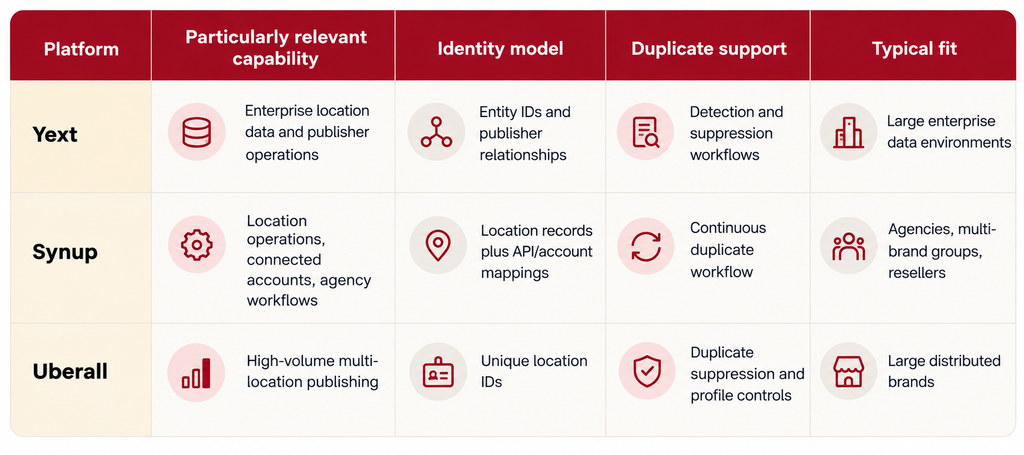
The directory count is useful context, but I would not make it the deciding factor in a merger.
Google ownership on 800 locations matters more than having access to another 50 obscure directories.
1. Yext

Overview
Yext makes sense in M&A situations where listings are connected to a larger enterprise data architecture.
Its systems use entity IDs and structured records to anchor information about locations. Yext’s bulk upload documentation requires Entity ID and country fields, and its Listings APIs expose publisher and duplicate data against location identifiers.
Best for
Large enterprises with established master-data systems, technical integrations, and many locations feeding several downstream applications.
Useful M&A capabilities
Yext’s duplicate API can return potential duplicates by location and publisher and track states such as POSSIBLE_DUPLICATE, SUPPRESSION_REQUESTED, SUPPRESSED, and UNAVAILABLE.
Its publisher API documentation also reflects an identity-preservation principle that matters during acquisitions: when a publisher receives an order for an already-associated Yext ID, it should update the existing record rather than create another listing.
Strengths
The explicit entity model can work well when a merger needs strong reconciliation between the location master, publisher listings, analytics, APIs, and other enterprise systems.
Limitations
Yext cannot replace native publisher ownership.
A perfect entity record inside Yext does not fix a Google profile owned by somebody you cannot reach.
Assessment
Yext is particularly relevant when listings are one part of a broader enterprise location-data architecture rather than a standalone marketing tool.
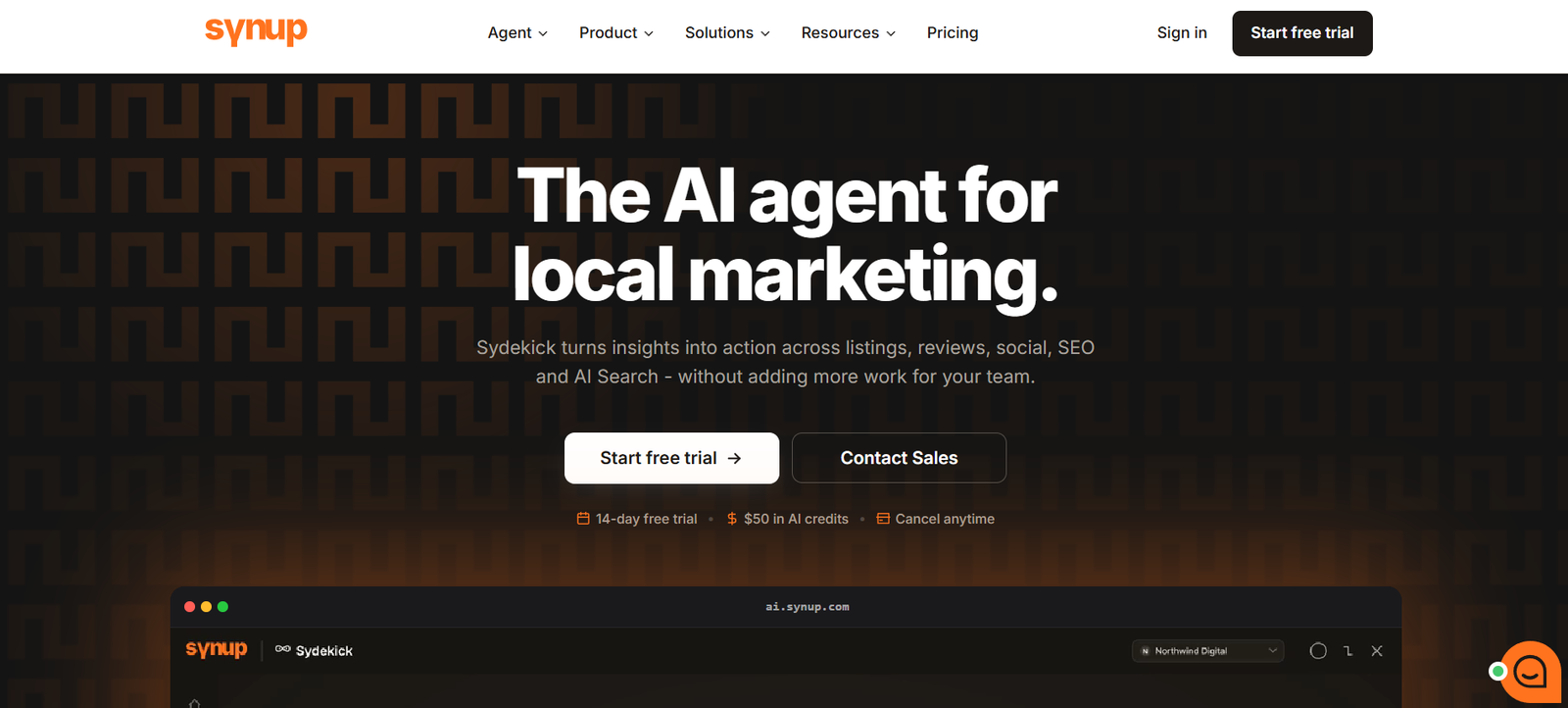
2. Synup
Overview
Synup approaches the problem more from the location-management and agency side.
Its current API exposes locations, listings, duplicates, connected accounts, and related workflows.
Best for
Agencies, resellers, multi-brand businesses, or acquisition teams that need to keep several business units or client environments organized while still working at location level.
Useful M&A capabilities
Synup’s current matching workflow can pair publisher listings from connected accounts with the correct Synup locations. Importantly, a proposed match still requires the operator to check the business name, address, and branch before confirming the relationship.
That is exactly the behaviour I would want during an acquisition.
Similar-looking records should generate a question, not an automatic decision.
Synup also detects duplicate candidates continuously. Its workflow lets users compare a candidate against the canonical location record and mark it as a duplicate or reject the match. A removal flag is a request to the publisher, not an instant deletion.
Synup’s official duplicate-listing documentation
Strengths
The separation between location data, publisher connections, proposed matches, and duplicate status is useful during acquisitions because each type of problem can be investigated separately.
Limitations
Do not let the Synup location record replace your independent merger crosswalk.
The buyer should still retain legacy IDs, new enterprise IDs, and publisher references outside the platform.
Assessment
Synup can be particularly practical when several brands, business units, agencies, or client teams need to work through the integration rather than one central master-data group handling everything.
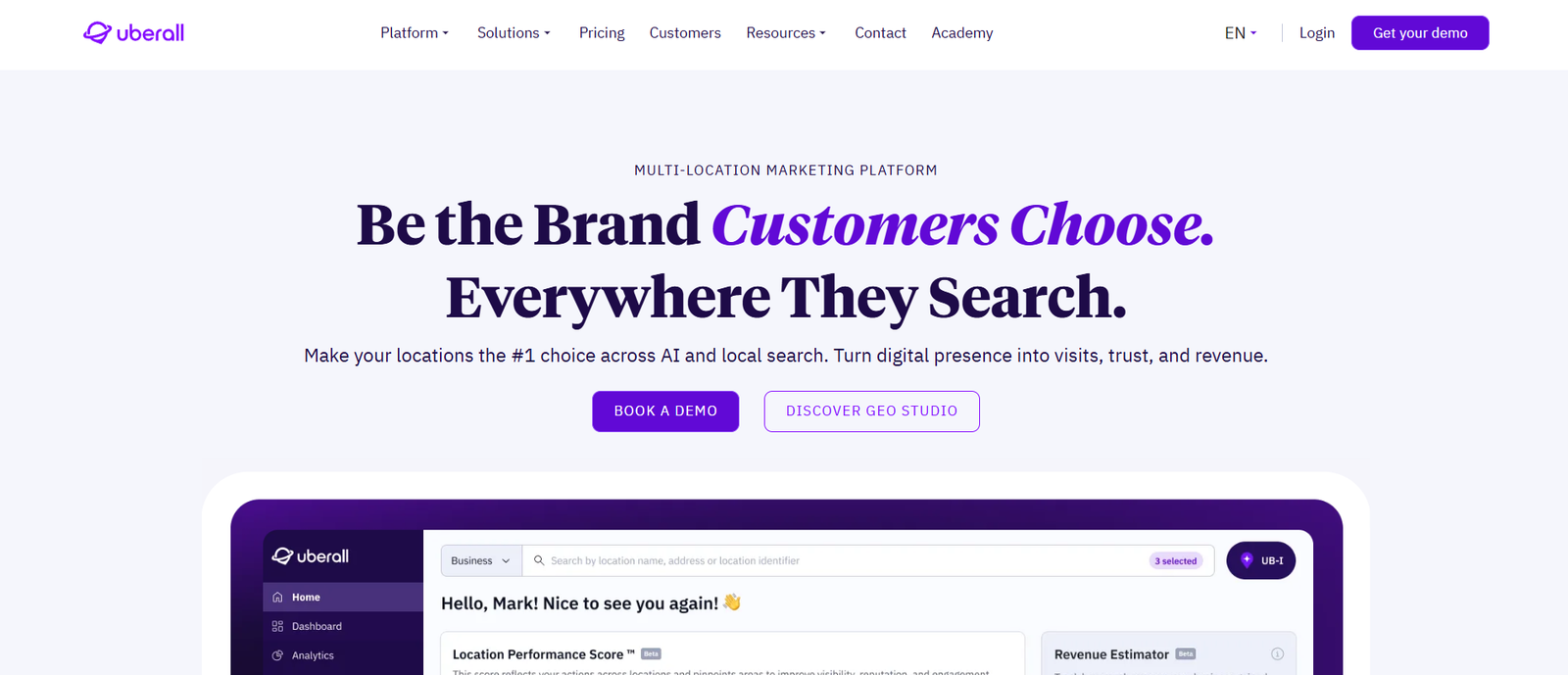
3. Uberall
Overview
Uberall is built around multi-location location-data management and publishing at scale.
Its current Listings materials say the platform supports more than 150 destinations and provides centralized updates, API synchronization, and duplicate suppression.
Best for
Large distributed brands where many locations need coordinated updates and listing data is changing regularly.
Useful M&A capabilities
Uberall’s API uses a unique location ID for operations against a particular location and can return the publisher listings associated with that record.
Its current listings materials also advertise duplicate suppression, centralized updates, and real-time synchronization.
Strengths
The combination of bulk publishing and location-level APIs makes Uberall relevant when hundreds or thousands of acquired branches need to be brought into one operating model.
Limitations
As with Yext and Synup, a platform connection should not be confused with publisher ownership.
Your Google and Apple access audit still has to happen independently.
Assessment
Uberall deserves consideration when the buyer’s main operational problem is managing a large location estate consistently after the ownership transition.
Yext vs Synup During a Merger
The interesting difference is not whether either platform can update a phone number.
Both can.
The question is how the acquisition itself is organized.
Yext’s entity-oriented approach fits organizations that already think in terms of structured master data feeding several enterprise systems.
Synup can be a natural fit where the operating model involves brands, clients, agencies, connected publisher accounts, and location-level exception handling.
Whichever you choose, the acquisition crosswalk should exist independently.
The new software should consume the identity map.
It should not invent one.
Yext vs Uberall During a Merger
Yext and Uberall both support substantial multi-location operations.
Yext puts considerable emphasis on entity structure and publisher relationships.
Uberall emphasizes multi-location synchronization, centralized updates, location-level API operations, and duplicate suppression.
So I would choose based less on headline network size and more on what sits upstream.
If a mature master-data platform already controls every location record, integration architecture may carry more weight.
If the local-marketing team is responsible for thousands of operational updates, the day-to-day publishing workflow may matter more.
What Should the Merger Crosswalk Contain?
At minimum, I would build these fields:
| Category | Fields to preserve |
|---|---|
| Identity | Legacy ID, buyer ID, store code, platform IDs |
| Location | Name, former name, address, coordinates |
| Contact | Phone, former phone, website, former URL |
| Profile URL, ownership status, primary owner status, verification | |
| Apple | Organization, brand, location status, administrator access |
| Bing | Listing URL, managing account, verification status |
| Listings platform | Vendor, entity/location ID, connection status |
| Business state | Active, closing, relocated, acquired, duplicate |
| Migration | Planned action, pilot/bulk group, validation status |
| Audit | Date captured, last verified, owner of migration task |
Do not overwrite historical values.
Add new fields beside them.
Common M&A Listings Mistakes
Changing the Business Name Too Early
The Day 1 brand announcement may be fixed.
That does not mean every publisher account is ready.
Changing customer-facing names before ownership and mapping are stable makes matching harder at exactly the wrong moment.
Replacing Legacy IDs
Someone inevitably says, “We don’t use those numbers anymore.”
That may be true operationally.
You may still need them for old analytics, integrations, invoices, reviews, API logs, store pages, and troubleshooting.
Assuming API Access Means Ownership
A listings provider may still be connected to Google.
That does not mean your acquiring company controls the profile independently.
Creating New Profiles Because Access Is Difficult
Google explicitly provides ownership-transfer mechanisms.
Apple supports existing-location management and transfer workflows.
Bing encourages claiming an existing record where one is already present.
Access problems are usually a reason to recover ownership.
They are not evidence that a second listing should exist.
Bulk Updating Before Testing
The difference between one wrong profile and 800 wrong profiles is often one CSV upload.
Pilot first.
M&A Local Listings Migration Checklist
| Stage | Required outcome |
|---|---|
| Location inventory | Every physical location has one canonical merger record |
| ID mapping | Seller, buyer, platform, and publisher identities are connected |
| Ownership audit | Users, owners, agencies, and connected accounts are documented |
| Access transfer | Buyer can independently manage critical publisher assets |
| Duplicate review | Existing duplicates are identified and classified |
| Rebrand decision | Correct continuity/rebrand action is determined |
| Pilot | Representative locations migrate successfully |
| Bulk rollout | Approved changes are deployed in controlled groups |
| Validation | Live publisher records match the merger crosswalk |
| Access retirement | Seller/vendor access is removed only after validation |
| Archive | Old IDs, exports, URLs, and ownership records are retained |
Frequently Asked Questions
What location IDs should survive an acquisition?
Preserve every ID that helps identify or trace the existing location, including legacy store codes, new enterprise IDs, listings-platform IDs, publisher references, CRM keys, website IDs, and useful analytics identifiers.
Old IDs can become secondary identifiers.
They should not simply disappear.
Should acquired stores receive new location IDs?
They can.
The mistake is replacing the legacy ID rather than mapping it.
If OLD-208 becomes US-6421, keep:
legacy_location_id = OLD-208
enterprise_location_id = US-6421
Should you create new Google Business Profiles after acquiring a company?
Not solely because the ownership changed.
Google specifically provides a process for transferring primary ownership of an existing profile and says this preserves profile information such as reviews.
The rebrand itself may require separate policy analysis.
What should happen before the seller’s accounts are disabled?
Verify that the buyer has independent access to required Google, Apple, Bing, listings-platform, domain, email, and other location-management systems.
Then document that access.
Only after validation should seller-controlled access be retired.
How do you migrate 100+ locations without creating duplicates?
Start with the location crosswalk.
Secure publisher access.
Find and classify existing profiles.
Test a representative batch.
Only then allow bulk publishing.
Do not let the incoming location feed create something new until you know whether an existing record should be retained.
How many locations should be in the pilot?
There is no official number.
For a portfolio of hundreds of locations, 5 to 20 can be a practical starting range if the sample contains the difficult cases as well as straightforward ones.
The diversity of the test group matters more than the exact count.
Conclusion
A merger changes a surprising number of things around a location.
The owner changes.
The company name may change.
The website changes.
The CRM changes.
The ERP changes.
The marketing platform changes.
The listings vendor may change too.
But the physical store at 142 Main Street might still be the same place customers visited yesterday.
That is why the most important asset in an M&A listings migration is continuity of identity.
Preserve the seller’s IDs.
Create the buyer’s IDs beside them.
Capture the publisher profiles.
Secure ownership.
Map duplicates.
Test the difficult locations.
Then change what customers see.
Platforms such as Yext, Synup, and Uberall can make the operational work considerably easier, especially at hundreds or thousands of locations. But the software should sit on top of a reliable merger identity map rather than replace one.
Because six months after the acquisition, somebody will eventually ask a deceptively simple question:
“Which old location became this one?”
A good migration means you can answer without guessing.