Listing Management Software for Car Dealer Groups: What to Compare

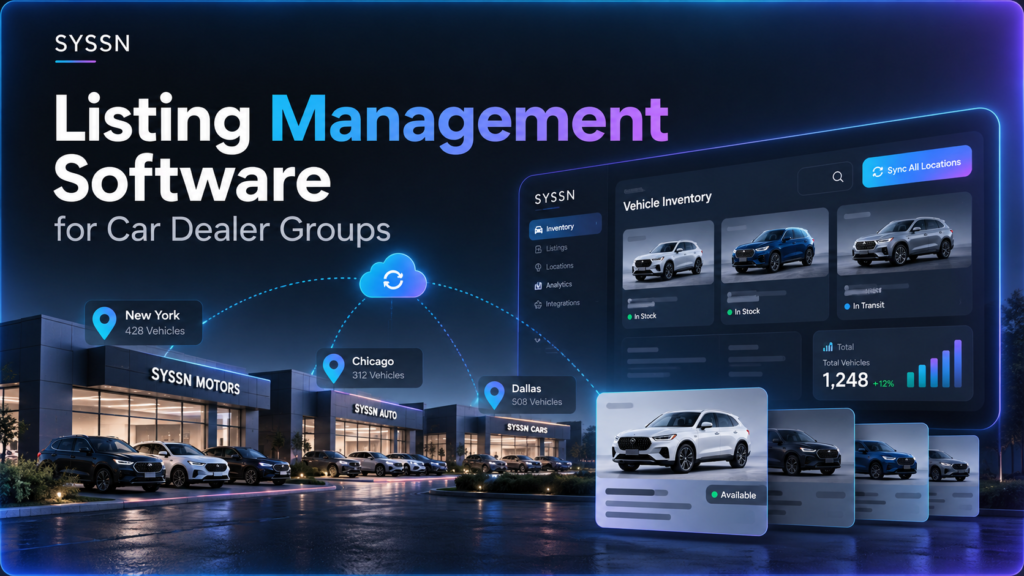
Listing management software for car dealer groups helps dealerships maintain accurate vehicle information, distribute inventory across supported marketplaces, and manage business listings for multiple locations. The right software depends on whether a group needs vehicle inventory syndication, inventory optimization, dealership websites, or local business-profile management.
HomeNet Automotive focuses on distributing vehicle listings, while Synup manages dealership business profiles across search engines and directories. vAuto specializes in inventory management and pricing, and Dealer.com, DealerCenter, AutoManager, and Dealer Inspire offer different combinations of inventory operations, websites, advertising, and digital retailing.
For multi-location dealerships, the most important factors are DMS integrations, inventory synchronization, VIN accuracy, marketplace coverage, merchandising tools, corporate and rooftop permissions, reporting, and total cost of ownership.
This guide compares seven platforms, explains their differences, and provides a practical evaluation framework for U.S. dealership groups.
7 Listing Management Software Platforms at a Glance
These platforms address different parts of automotive listing management. The following comparison identifies where each is most relevant rather than treating every product as a direct competitor.
| Software | Most relevant for | Main capabilities |
|---|---|---|
| Synup | Multi-location dealership business listings | Business profiles, directory synchronization, review monitoring, and local visibility |
| HomeNet Automotive | Vehicle inventory syndication | Vehicle data distribution, photos, videos, and merchandising |
| vAuto | Inventory pricing and optimization | Acquisition, appraisals, pricing, reconditioning, and inventory decisions |
| Dealer.com | Automotive websites and advertising | Dealer websites, inventory presentation, marketing, and connected retail technology |
| DealerCenter | Independent dealership operations | DMS, inventory management, advertising tools, and dealer workflows |
| AutoManager | Marketplace inventory exports | Scheduled exports, inventory management, and dealership websites |
| Dealer Inspire | Automotive digital retailing | Dealer websites, vehicle search, digital retailing, and marketing |
The distinction matters: A platform that maintains dealership addresses and Google Business Profiles does not necessarily distribute individual vehicle listings. Similarly, a vehicle syndication platform may not manage local search profiles, accounting, or dealership operations.
Some dealer groups will need more than one system. The objective is to select compatible products that solve different problems without creating conflicting inventory records.
What Is Listing Management Software for Car Dealer Groups?
Listing management software helps dealerships create, update, distribute, and monitor information published across websites, marketplaces, search engines, and directories.
For car dealer groups, the term covers two different types of listings.
Vehicle Inventory Listings
Vehicle listings represent individual cars available for sale.
Common data fields include:
- Vehicle Identification Number (VIN) and stock number
- Make, model, year, and trim
- New or used condition
- Mileage and equipment
- Approved advertised price
- Vehicle photographs and descriptions
- Availability and assigned dealership
- Vehicle Description Page (VDP) URL
Vehicle inventory syndication software receives approved information from a dealership management system (DMS), inventory platform, or another authorized source.
It then formats and distributes that information to supported destinations, which may include dealership websites, automotive marketplaces, and advertising platforms.
A vehicle’s information should also be updated when its price, location, or availability changes.
Dealership Business Listings
Business listings identify the physical dealerships rather than individual vehicles.
They typically contain:
- Dealership name and address
- Phone number and website
- Business categories
- Regular and special operating hours
- Location-specific services
- Photos and other supported business attributes
These listings appear across services such as Google Maps, Apple Maps, Bing, and online directories.
For groups managing several rooftops, business information can become inconsistent after relocations, ownership changes, rebranding, or changes to opening hours.
Local listing management platforms help authorized teams maintain approved information across supported publishers.
A vehicle listing tells shoppers which cars are available. A dealership business listing tells them where a dealership operates and how to contact it.
For a broader explanation, see what local listings management involves.
How We Evaluated These Automotive Software Platforms
This comparison is based on publicly available vendor documentation, official product descriptions, published pricing, and relevant platform guidance reviewed on October 26, 2026.
The seven platforms were selected to represent different requirements faced by automotive dealer groups: business-location management, vehicle syndication, inventory optimization, dealership operations, websites, and digital retailing.
We considered eight evaluation areas:
- Inventory synchronization: How vehicle information moves between operational systems and publishing destinations.
- Integrations: Connections with DMS platforms, inventory tools, dealer websites, and advertising services.
- Multi-location management: Controls for corporate administrators and individual rooftops.
- Merchandising: Vehicle images, descriptions, videos, and presentation features.
- Distribution: Supported advertising destinations, marketplaces, and business directories.
- Reporting: Visibility into feed activity, listing errors, and operational performance.
- Pricing: Published subscription prices, optional modules, and quotation requirements.
- Operational suitability: Fit for independent dealerships, franchise groups, and larger automotive organizations.
Methodology limitation: This is a documentation-based buyer comparison, not an independent hands-on software test. Vendor documentation establishes advertised functionality but does not independently verify integration performance, update speeds, service reliability, or return on investment.
The platforms are therefore compared by their intended functions rather than assigned an overall performance ranking.
7 Listing Management Software Platforms for Car Dealer Groups
1. Synup — For Multi-Location Dealership Business Listings

Most relevant for: Dealer groups that need centralized management of dealership business profiles, directory information, and local visibility.
Synup provides local business listing management software for organizations operating multiple physical locations.
Its listings management capabilities help businesses maintain approved location information and distribute updates to supported search engines, mapping services, and online directories.
For automotive groups, this can help corporate marketing teams coordinate dealership names, addresses, phone numbers, operating hours, business categories, and website links.
Key capabilities
- Centralized business listing management
- Updates across supported directory and mapping publishers
- Management of location information
- Review monitoring and reputation management features
- Local search visibility tools
- Multi-location organization and reporting
Where Synup fits
Consider a dealer group operating ten rooftops under several automotive brands.
Each dealership may have its own Google Business Profile, Apple Maps place card, and other directory listings. When a location changes its hours, phone number, or website, the information may need updating across multiple services.
Synup is designed to help manage that process from an approved location record.
It is particularly relevant when a centralized marketing team is responsible for business information across multiple rooftops.
Limitations
Synup’s documented listings functionality focuses on business locations. It should not be treated as a dedicated VIN-level vehicle syndication platform.
Dealerships that need individual vehicle feeds for automotive marketplaces should evaluate a specialized automotive provider separately.
Publisher support, editing permissions, approval workflows, and synchronization behavior should also be confirmed for the proposed configuration.
Pricing
Synup’s published pricing lists the following monthly plans:
- Premium: $299 per month for up to 10 locations
- Pro: $499 per month for up to 25 locations
The pricing model also includes usage-based agent credits, so buyers should review credit allowances, additional usage costs, and billing terms.
Consider Synup when: Maintaining accurate dealership business listings and coordinating local visibility across multiple locations is the main requirement.
2. HomeNet Automotive — For Vehicle Inventory Syndication
Most relevant for: Dealership groups that need to distribute individual vehicle listings and merchandising information across automotive advertising destinations.
HomeNet Automotive provides automotive inventory merchandising and syndication technology.
Its syndication offering allows dealerships to create vehicle listings from centralized information and distribute vehicle details, photos, and videos to supported online advertising sites.
This addresses a common dealership problem: a vehicle may have different prices, photographs, or availability information across the dealer website and third-party marketplaces.
Key capabilities
- Centralized vehicle inventory syndication
- Distribution of vehicle details and media
- New- and used-vehicle listing support
- Vehicle photography and merchandising tools
- Automated vehicle description capabilities through related products
- Integration options for existing dealership systems
Where HomeNet Automotive fits
HomeNet is relevant when inventory distribution is the primary challenge.
For example, a dealership may update the price of a used vehicle in its inventory system while several marketplace advertisements continue displaying the previous price.
A syndication platform can help distribute approved changes through supported feeds.
HomeNet’s broader product portfolio also includes photo management, image overlays, vehicle descriptions, and other merchandising tools.
These capabilities may be useful for dealerships seeking more consistent vehicle presentation across their advertising channels.
Limitations
Dealership groups should verify exactly which destinations, integrations, merchandising modules, and update schedules are included in the proposed contract.
A vendor’s ability to transmit updated data does not guarantee that every marketplace publishes the change immediately.
HomeNet also does not replace every function of a full DMS, such as accounting, finance workflows, or comprehensive vehicle lifecycle management.
Pricing
A standardized public enterprise price for HomeNet’s syndication offering was not verified.
Request a written quotation covering dealership locations, inventory volume, required destinations, merchandising modules, onboarding, and support.
Consider HomeNet Automotive when: Accurate VIN-level inventory distribution and consistent merchandising content are the central requirements.
3. vAuto — For Inventory Pricing and Optimization
Most relevant for: Dealer groups seeking stronger inventory acquisition, pricing, merchandising, and vehicle lifecycle management capabilities.
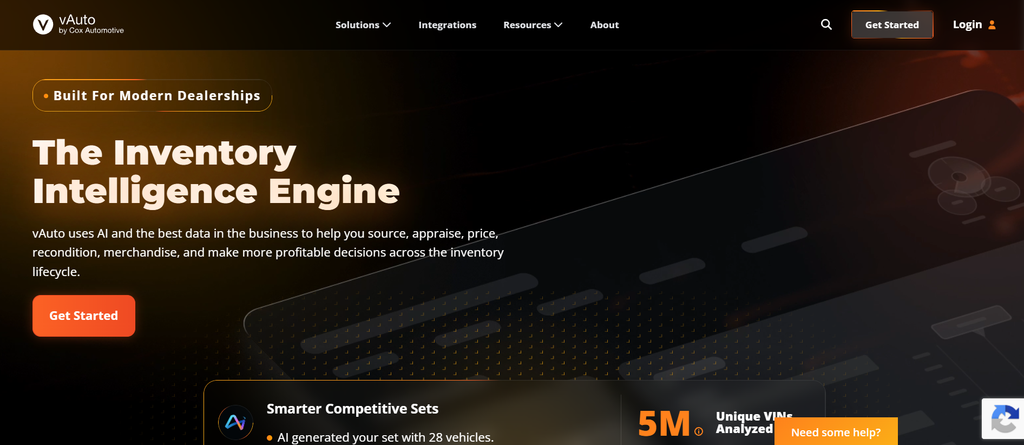
vAuto is a Cox Automotive inventory management platform.
Its technology supports vehicle sourcing, appraisals, pricing, merchandising, reconditioning, and inventory decisions.
Unlike a standalone syndication tool, vAuto focuses on helping dealerships determine which vehicles to acquire, how to price them, and how to manage them through the inventory lifecycle.
Key capabilities
- Used-vehicle inventory management
- Vehicle pricing and market intelligence
- Appraisal and acquisition tools
- Inventory merchandising capabilities
- Reconditioning workflow solutions
- New-vehicle inventory tools
- Integrations with selected automotive systems
Where vAuto fits
vAuto is relevant when a dealership group needs to improve the decisions made before inventory reaches advertising destinations.
For example, a dealer group might need to compare local market conditions before pricing acquired vehicles, identify aging inventory, or coordinate reconditioning activities.
vAuto’s inventory-focused tools address these operational requirements.
The platform also has documented integrations with other Cox Automotive products, including Dealer.com.
This may be useful for organizations already using compatible systems within that ecosystem.
Limitations
Inventory optimization and marketplace syndication are different functions.
Dealership groups should not assume that every vAuto product automatically includes the external inventory feeds, marketplace connections, or publishing controls they need.
Buyers should confirm the exact features of their proposed package and identify any overlapping functionality with existing DMS, pricing, or merchandising products.
Pricing
Current enterprise pricing depends on the selected products, integrations, and dealership requirements.
Request a written quotation that separates inventory management, pricing, merchandising, implementation, and optional services.
Consider vAuto when: Pricing strategy, acquisition decisions, and inventory operations are more important than standalone listing distribution.
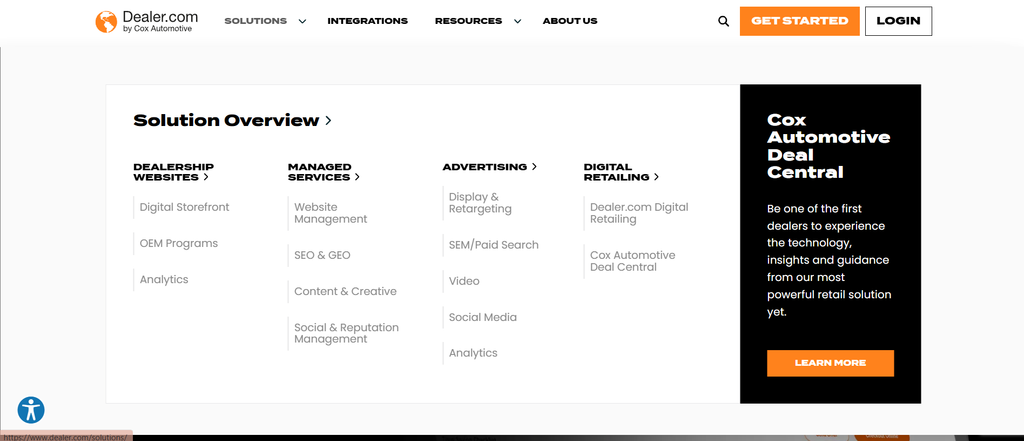
4. Dealer.com — For Automotive Websites and Digital Advertising
Most relevant for: Dealership groups that want to connect vehicle inventory presentation with dealership websites, digital marketing, and advertising.
Dealer.com offers automotive website technology, digital advertising, managed marketing services, and connected retail experiences.
Its software focuses on helping dealerships present vehicles online and guide shoppers through the research and buying process.
Key capabilities
- Automotive dealership websites
- Inventory search and vehicle presentation
- Digital advertising
- Digital retailing connections
- Website and marketing services
- Integrations with selected Cox Automotive products
Where Dealer.com fits
Dealer.com may be appropriate when dealership websites are a major component of the group’s inventory marketing strategy.
For example, a vehicle may appear in a marketplace advertisement that sends a shopper to a dealership Vehicle Description Page.
The effectiveness of that journey depends partly on whether the destination page presents accurate vehicle information and provides useful next steps.
Dealer.com addresses the website and digital marketing components of this process.
Its documented integrations include several Cox Automotive products, including vAuto and VinSolutions.
Google also lists Dealer.com as an eligible U.S. Vehicle Feed Service Provider for its Vehicle Ads program. The exact service scope and commercial requirements should be confirmed with the provider.
Limitations
Dealer.com should not automatically be treated as a replacement for a DMS or every independent inventory syndication platform.
Groups should confirm supported inventory sources, feed connections, website integrations, publishing frequency, and whether any desired functionality requires an additional agreement.
Existing dealership software may also overlap with some of Dealer.com’s marketing or digital retailing capabilities.
Pricing
Current enterprise website, marketing, and advertising costs should be obtained through a vendor quotation.
Ask for separate costs covering websites, integrations, advertising services, optional tools, and implementation.
Consider Dealer.com when: Dealership websites, vehicle presentation, and advertising need to operate within a connected digital marketing environment.
5. DealerCenter — For Independent Dealership Inventory Operations

Most relevant for: Independent dealer groups seeking dealership management, vehicle inventory tracking, and online advertising features from a connected software provider.
DealerCenter provides dealership management software with inventory, customer management, financing-related workflows, websites, and digital marketing capabilities.
Its products connect inventory records with dealership operations and supported advertising tools.
Key capabilities
- Vehicle inventory management
- Dealership management system functionality
- Customer and lead management tools
- Inventory advertising and posting
- Vehicle photography tools
- Dealer websites
- Reporting and operational workflows
Where DealerCenter fits
DealerCenter may suit independent dealerships that want to reduce the number of disconnected operational tools.
For example, a small dealer group may need to track acquired vehicles, manage sales-related records, publish online advertisements, and monitor customer inquiries.
Having these functions within a connected software environment may reduce some manual data transfers.
DealerCenter’s online advertising tools are relevant to dealerships that need to publish used-vehicle information across supported destinations.
Limitations
Multi-rooftop requirements should be verified rather than assumed.
A dealer group should ask whether corporate administrators can centrally manage several dealerships, restrict user access, transfer vehicles, and produce group-level reports.
Not every advertising destination or optional capability is necessarily included in the base DMS subscription.
Pricing
DealerCenter’s official pricing page lists:
- DMS: $99 per month
- Online Ad Post Premium: $50 per month
These are separately listed products, not a verified all-inclusive multi-location package.
Buyers should confirm account requirements, dealership coverage, additional modules, implementation costs, and any third-party advertising charges.
Consider DealerCenter when: Independent dealership operations and inventory advertising are more important than a specialized enterprise syndication-only product.
6. AutoManager — For Scheduled Marketplace Inventory Exports

Most relevant for: Dealerships that need inventory management, website presentation, and scheduled exports to automotive marketplaces.
AutoManager provides dealership software through products including DeskManager and WebManager.
DeskManager supports dealership management activities, while WebManager focuses on websites and online marketing.
The company’s inventory export tools allow dealerships to distribute vehicle information to supported automotive classified destinations.
Key capabilities
- Vehicle inventory management
- Scheduled marketplace exports
- Dealership website inventory presentation
- Classified listing templates
- Vehicle photo distribution
- Integration between dealership and marketing software
Where AutoManager fits
AutoManager is relevant for dealerships seeking a practical connection between inventory records and online classified advertisements.
The company advertises export capabilities for more than 250 marketplace destinations, with nightly inventory export scheduling.
This figure represents the vendor’s published destination coverage, not a guarantee that every destination is available to every dealership or subscription.
Buyers should obtain a current list of supported destinations and confirm any individual marketplace requirements.
Limitations
Nightly exports may not meet every dealership group’s requirements.
For example, a vehicle sold early in the day may require an urgent status update to prevent shoppers from seeing outdated availability information.
An overnight export schedule might leave a delay between the internal status change and an external listing update.
The actual timing depends on both the software and receiving marketplace.
Larger dealer groups should also verify centralized permissions, cross-location reporting, and inventory transfer workflows.
Pricing
AutoManager’s published pricing includes:
- Dealer Management System: Starting at $88 per month
- Car Dealer Website & Marketing: Starting at $70 per month
Optional modules and marketplace-related costs may apply.
Consider AutoManager when: Scheduled vehicle inventory exports and connected dealership website management meet the organization’s operational requirements.
7. Dealer Inspire — For Automotive Websites and Digital Retailing

Most relevant for: Dealer groups prioritizing vehicle search, dealership website experiences, customer engagement, and digital retailing.
Dealer Inspire, part of Cars Commerce, provides automotive website, digital marketing, and retailing technology.
Its platform focuses on connecting vehicle discovery with online shopping and dealership sales processes.
Key capabilities
- Automotive dealership websites
- Vehicle inventory search and presentation
- Personalized online shopping experiences
- Digital retailing tools
- Customer engagement capabilities
- Automotive SEO and digital marketing services
Where Dealer Inspire fits
Dealer Inspire is relevant when a dealership group’s priorities extend beyond publishing inventory.
For example, a shopper may search for a vehicle, compare available models, review payment options, and contact the dealership.
A connected digital retailing platform can support several stages of that journey.
Dealer Inspire’s website and retailing tools are designed around these customer interactions.
Google also identifies Dealer Inspire as an eligible Vehicle Feed Service Provider for the United States and Canada in its official provider documentation.
That eligibility is relevant to groups evaluating Google Vehicle Ads, although buyers should verify whether feed management is included in their proposed service package.
Limitations
Dealer Inspire is not primarily positioned as a replacement for a dealership’s complete accounting or operational management system.
Dealership groups should confirm supported inventory sources, third-party destinations, website connections, and feed management requirements.
Digital advertising, retailing modules, and managed services may involve separate commercial arrangements.
Pricing
A standardized public enterprise price for the complete platform configuration was not verified.
Request a quotation separating websites, digital marketing, retailing tools, inventory integrations, and optional services.
Consider Dealer Inspire when: Website shopping experiences and connected digital retailing are major purchasing priorities.
What Features Should Multi-Location Dealer Groups Compare?
The most useful comparison focuses on how a proposed system performs in actual dealership workflows.
Feature counts alone do not establish whether a platform can maintain accurate listings across multiple rooftops.
| Evaluation area | What to verify | Why it matters |
|---|---|---|
| Inventory synchronization | Source-to-feed frequency and destination delays | Helps reduce outdated public listings |
| DMS integration | Supported DMS products, fields, and data direction | Limits duplicate manual entry |
| VIN management | Duplicate handling and unique vehicle identification | Reduces unintended duplicate offers |
| Marketplace coverage | Supported and contractually available destinations | Determines where inventory can be published |
| Merchandising | Images, descriptions, videos, and disclosure handling | Supports complete vehicle presentation |
| Multi-location permissions | Corporate, rooftop, and user-level controls | Enables consistent governance |
| Sold-vehicle handling | Removal triggers and publication delays | Reduces misleading availability |
| Reporting | Feed errors, rejected records, and location reports | Makes publishing problems visible |
| Compliance workflows | Approved prices and required disclosures | Supports accurate advertising |
| Total cost | Software, integrations, destinations, and support | Reveals the full commercial commitment |
Inventory Synchronization and Update Speed
A vehicle listing system should respond to important changes in the authorized source records.
These changes include:
- A vehicle being sold or withdrawn from sale
- A price adjustment
- New photographs
- A transfer between dealerships
- An inventory status correction
- Changes to mileage or equipment information
Dealer groups should distinguish between two measurements.
Feed processing time measures how long a system takes to prepare and transmit an update.
Public listing update time measures when the receiving marketplace actually reflects that change.
A vendor may process an update quickly while an external destination publishes it later.
For critical changes, such as a sold vehicle or incorrect advertised price, the second measurement is particularly important.
DMS Integration and Data Ownership
DMS compatibility should be established before a dealership group commits to a listing platform.
Ask the vendor to identify supported DMS products, integration methods, data fields, and whether the connection is one-way or bidirectional.
An effective integration also requires a clear record of which system controls each field.
For example:
| Data field | Illustrative authoritative source |
|---|---|
| VIN and stock number | DMS |
| Sale status | DMS |
| Approved selling price | Authorized pricing or inventory system |
| Photographs | Merchandising platform |
| Vehicle description | Approved merchandising workflow |
| Dealership assignment | Inventory management system |
| Business address and hours | Approved location management record |
This is an example of how responsibilities can be assigned, not a universal architecture.
Without an agreed source of truth, one system may overwrite information maintained by another.
Corporate Administration and Rooftop Permissions
Multi-location dealership groups need to balance centralized oversight with dealership-level flexibility.
A corporate administrator may need to control approved advertising destinations, pricing rules, and reporting.
Individual dealerships may need permission to update photographs, descriptions, or vehicle readiness.
During a demonstration, ask whether access can be restricted by dealership, user role, data field, and approval workflow.
Audit logs can also help identify who changed a record and when.
How Does Automotive Inventory Syndication Work?
Automotive inventory syndication is the process of distributing approved vehicle information from dealership systems to online publishing destinations.
A typical workflow has five stages.
Step 1: Capture inventory information. A dealership creates or updates a vehicle record in its DMS or another authorized inventory system.
Step 2: Standardize the data. An integration maps vehicle identifiers, prices, mileage, condition, dealership assignments, and other required fields into a consistent format.
Step 3: Complete merchandising. The team adds approved photographs, equipment details, descriptions, and applicable disclosures.
Step 4: Publish to supported destinations. The platform sends records to dealership websites, marketplaces, or advertising services based on configured integrations.
Step 5: Monitor publication results. Staff review feed errors, rejected records, destination status, and differences between approved data and live listings.
The workflow must continue after initial publication.
A listing platform should handle subsequent corrections, price changes, transfers, and removal requests rather than treating publication as a one-time event.
Google Vehicle Ads vs. Dealership Business Listings
Google Vehicle Ads and Google Business Profiles serve different purposes.
Google Vehicle Ads allow eligible automotive advertisers to promote individual vehicles using Merchant Center vehicle data and Google Ads campaigns.
According to Google’s Vehicle Ads documentation, requirements include approved vehicle data, dealership or store information, suitable landing pages, and accurate inventory details.
Important requirements include:
- Vehicle offers should not be unintentionally duplicated within a data source.
- Pricing and availability information must match the landing page.
- Required vehicle identifiers and vehicle details must be accurate.
- Store codes must correspond to the correct dealership information.
- Landing pages must display the required information clearly.
Google’s duplicate-VIN requirements deserve particular attention.
When the same vehicle is associated with multiple eligible store codes, Google provides supported ways to represent those store relationships without submitting duplicate vehicle offers.
Dealer groups should follow the current specification rather than creating separate offers for the same VIN in a single feed.
Google’s April 2026 vehicle data-quality update also describes account issues involving mismatched prices, availability, condition, mileage, VINs, and landing-page information.
Business Profiles serve a different function by describing the dealership location itself.
Google does have a limited-availability dealership inventory feature for Business Profiles, but it should not be assumed to provide general vehicle syndication for every dealership.
A dealer group should evaluate Vehicle Ads feed management, dealership Business Profiles, and automotive marketplace feeds as separate capabilities.
How Can Dealer Groups Prevent Incorrect Prices, Duplicate VINs, and Sold-Vehicle Ads?
Accurate inventory publishing depends on data ownership, update controls, and monitoring.
A software system can automate distribution, but it cannot correct every problem originating in dealership records.
Maintain an Authoritative Vehicle Record
Each vehicle should have a controlled record containing its VIN, stock number, current status, approved price, location, and other essential fields.
VIN decoding can help identify standardized vehicle characteristics.
The NHTSA vPIC Vehicle API provides VIN decoding information based on manufacturer-submitted vehicle data.
However, VIN decoding does not establish a vehicle’s current selling price, availability, location, or actual used-vehicle condition.
These details must come from approved dealership records and inspection or merchandising workflows.
Groups should also establish rules for vehicles moving between rooftops to prevent unintended duplicate advertisements.
Establish Sold-Vehicle Suppression Rules
When a vehicle is no longer available, the dealership’s authorized system should trigger an appropriate listing update.
A useful audit trail records:
- When the internal status changed
- When an outbound update was generated
- When the destination received or accepted the update
- Whether the public listing changed
- Whether follow-up action is required
A successful outbound feed does not necessarily prove that the external advertisement has been removed.
Dealer groups should measure the interval between the internal status change and public listing suppression.
Monitor Marketplace Rejections and Data Mismatches
Feed reports should distinguish between successful processing, rejected records, warnings, and listings that remain inconsistent with the approved source.
Common problems include incorrect store codes, missing photographs, invalid destination fields, unavailable vehicles, and inconsistent vehicle details.
For Google Vehicle Ads, Merchant Center’s data-quality diagnostics can identify differences between feed attributes and Vehicle Description Pages.
These reports should be reviewed routinely and assigned to responsible staff rather than left as unresolved technical notifications.
Make Advertising Compliance Part of the Publishing Workflow
Vehicle listing accuracy is also an advertising compliance concern.
The FTC’s September 2026 automobile pricing transparency FAQs explain the agency staff’s interpretation of the FTC Act’s requirements for truthful vehicle pricing.
The guidance states that an advertised price should reflect the amount any consumer can pay to purchase the vehicle, including mandatory dealer-imposed charges. Government-required charges may be excluded as described in the guidance.
The FAQs also discuss discounts, rebates, document fees, vehicles in transit, and vehicles that are no longer available.
These FAQs represent FTC staff guidance; the legal assessment of a particular advertisement depends on its circumstances.
Dealership groups should coordinate with appropriate legal and compliance professionals to account for federal requirements, relevant state laws, and applicable manufacturer obligations.
Operationally, the software evaluation should establish how approved advertised prices and required disclosures reach dealership websites and third-party destinations.
A system that distributes prices quickly but cannot preserve necessary disclosures may still create advertising problems.
Inventory Management vs. Listing Management Software
Inventory management and listing management are connected, but their responsibilities differ.
| Capability | Inventory management | Vehicle listing management | Local business listing management |
|---|---|---|---|
| Track vehicle stock | Primary function | Uses stock data | Not applicable |
| Manage vehicle pricing | Common capability | Publishes approved prices | Not applicable |
| Track acquisition and reconditioning | Often supported | Usually limited | Not applicable |
| Distribute vehicle advertisements | Varies | Primary function | Not its primary purpose |
| Manage dealership location details | Supporting function | Uses location identifiers | Primary function |
| Update mapping and directory profiles | Usually limited | Usually separate | Primary function |
| Monitor vehicle feed errors | Varies | Important capability | Not applicable |
| Report business-profile accuracy | Usually limited | Usually separate | Important capability |
A dealer group may use an inventory system to control vehicle records, a syndication platform to publish those records, and a local listings tool to maintain dealership information.
The systems should exchange appropriate data without creating competing sources of truth.
How Should a 10-Location Dealership Group Choose Software?
Consider a hypothetical group operating ten dealerships with approximately 120 vehicles per location.
That represents around 1,200 vehicle records before accounting for new acquisitions, sales, transfers, and other changes.
A small recurring data-quality problem could therefore affect many public listings.
The group should begin with its existing technology rather than selecting a new platform based on advertised features alone.
Step 1: Map the Current Software Environment
Document the DMS, inventory management system, website provider, merchandising tools, marketplace feeds, and advertising platforms used at each location.
Identify which services already overlap and which problems remain unresolved.
Step 2: Identify the Most Important Problem
The group’s priority might be one of several different issues.
If vehicle information differs across automotive marketplaces, inventory syndication deserves attention.
If pricing and acquisition decisions are inconsistent, inventory optimization may be more relevant.
If customers encounter outdated addresses and hours, local business listing management should be evaluated.
If the dealership website provides a poor vehicle search experience, the group may need website or digital retailing improvements.
This distinction prevents the procurement process from becoming an unfocused search for a product that claims to do everything.
Step 3: Test Realistic Dealership Workflows
A useful demonstration should show what happens when:
- A dealership changes an approved vehicle price.
- A car is sold and must be removed from advertisements.
- A vehicle transfers between rooftops.
- Updated photographs become available.
- A marketplace rejects a vehicle record.
- A corporate administrator restricts access to a sensitive field.
The vendor should explain what happens inside the platform and what depends on external publishing destinations.
Step 4: Review Dealership Business Profiles Separately
For local business listings, the group should maintain accurate location names, addresses, contact details, and operating hours.
Google’s business representation guidelines include dealership-specific guidance, including recommendations for primary opening hours.
For Apple Maps, authorized organizations can manage eligible dealership locations through Apple Business.
Apple’s location management documentation describes how to add and manage locations.
For further instructions, see Apple Maps for car dealerships: how to claim and update your listing.
How Should Dealer Groups Compare Software Pricing?
A monthly subscription price rarely represents the complete cost of an automotive software deployment.
Dealership groups should calculate total cost of ownership using the same locations, services, and inventory requirements for every shortlisted provider.
A useful first-year cost formula is:
First-year total cost = Subscription fees + Implementation fees + Integration costs + Destination-related charges + Support fees + Internal administration costs.
For subsequent years, separate recurring costs from one-time implementation expenses.
Ask every vendor whether pricing is determined by:
- Number of rooftops
- Number of vehicles
- Advertising destinations
- Software modules
- User accounts
- Managed services
- Data processing or usage allowances
- Contract duration
For example, a public entry-level DMS subscription may not include advanced marketplace posting functionality.
Likewise, a website provider may offer a wider marketing package that includes services unrelated to inventory syndication.
Dealer groups should also review renewal terms, cancellation conditions, data export rights, implementation support, and the cost of adding or closing locations.
Published starting prices are useful for preliminary screening, but enterprise decisions require comparable written quotations.
How Can Dealer Groups Measure Listing Management ROI?
Return on investment should reflect operational improvements and attributable business results.
Publishing more vehicle records does not necessarily demonstrate that a platform increased sales.
Useful metrics include:
| KPI | What it measures |
|---|---|
| Inventory publication time | Time from approved vehicle record to public listing |
| Listing accuracy rate | Percentage of audited records matching approved information |
| Sold-vehicle removal time | Delay between status change and public listing removal |
| Feed rejection rate | Percentage of submissions rejected by destinations |
| Photo completeness | Share of eligible vehicles meeting merchandising standards |
| Duplicate listing rate | Frequency of unintended duplicate vehicle offers |
| Manual editing hours | Employee time spent maintaining listings |
| Leads by source and rooftop | Inquiries associated with specific channels and dealerships |
| Cost per qualified lead | Relevant advertising and software cost relative to qualified inquiries |
| Inventory turn | Vehicle selling time, considered alongside other operational factors |
A practical estimate is:
Estimated net annual benefit = Verified labor savings + Avoided operating costs + Attributable incremental contribution − Annual total costs.
Labor savings can be estimated using documented reductions in work hours and an appropriate fully loaded labor rate.
Avoided costs might include demonstrable reductions in duplicate software or manual processing expenses.
Incremental contribution should only be included when supported by a reasonable attribution method.
For example, changes in vehicle sales may also reflect inventory mix, advertising budgets, seasonal demand, and pricing decisions.
A dealership group should therefore record baseline performance before implementation and compare similar periods or locations where practical.
What Questions Should Dealer Groups Ask During a Vendor Demo?
A software demonstration should establish what the system can actually perform, not merely what appears on a feature checklist.
Ask these questions:
- Which DMS platforms and versions have currently supported integrations?
- Which system controls vehicle prices, status, mileage, and dealership assignments?
- How frequently are source records checked for changes?
- Can you demonstrate a sold-vehicle update from the internal record through to a supported publishing destination?
- What happens when a marketplace rejects or delays an update?
- How are duplicate VINs handled across multiple rooftops?
- Can corporate teams limit the changes individual dealership employees can make?
- Which advertising destinations are included in the quotation?
- How are photographs, descriptions, and required price disclosures managed?
- Can the platform report feed failures by VIN, destination, and rooftop?
- What happens to inventory data and active feeds when the agreement ends?
- What training, implementation support, and service commitments are included?
Use the same test scenario for each vendor performing a comparable function.
For a vehicle syndication demonstration, that scenario could include a used vehicle with several photographs, an approved price, an assigned dealership, and a simulated sale or transfer.
Request written clarification whenever an important capability cannot be demonstrated.
Dealer Group Listing Software Evaluation Scorecard
A weighted scorecard can make comparisons more consistent.
The following example is intended for automotive vehicle listing and inventory distribution requirements.
| Evaluation criterion | Suggested weight |
|---|---|
| Inventory synchronization and accuracy | 25% |
| DMS and system integrations | 20% |
| Marketplace and feed coverage | 15% |
| Corporate and rooftop permissions | 10% |
| Merchandising functionality | 10% |
| Reporting and exception management | 10% |
| Total cost and support | 10% |
| Total | 100% |
Score each criterion from 1 to 5, where 1 indicates poor suitability and 5 indicates strong suitability based on documented requirements and demonstration results.
Calculate a weighted score using:
Overall score out of 100 = Sum of (Criterion score ÷ 5 × Criterion weight).
These weights are an illustrative procurement framework, not an independently validated industry standard.
They should be adjusted to match the dealer group’s requirements.
Do not apply the same scorecard indiscriminately across different product categories.
For example, Synup should be evaluated on relevant business-profile management criteria, including directory coverage, location accuracy, publisher synchronization, permissions, and location reporting.
A VIN-level syndication vendor should instead be evaluated on inventory feeds, publishing reliability, destination coverage, and vehicle-level error handling.
Comparing fundamentally different systems using identical criteria can produce misleading results.
Implementation Checklist for Multi-Location Dealerships
A phased implementation can reduce the risk of distributing incorrect or incomplete data across multiple rooftops.
Before Implementation
- Document all existing dealership software and inventory feeds.
- Identify authoritative sources for vehicle and location data.
- Confirm required DMS integrations.
- List necessary advertising destinations.
- Establish approved advertised-price and disclosure requirements.
- Review duplicate vehicle records and inconsistent stock numbers.
- Record baseline publication times and data accuracy.
During Implementation
- Pilot the software with one or two representative dealerships.
- Validate inventory imports and field mappings.
- Confirm store codes and dealership assignments.
- Test photograph and description distribution.
- Test price changes and sold-vehicle suppression.
- Configure corporate and location-specific permissions.
- Verify feed error reporting.
- Train dealership staff and administrators.
After Implementation
- Audit published vehicle information against approved records.
- Review rejected records and publishing failures.
- Monitor sold-vehicle removal delays.
- Compare operational KPIs with baseline measurements.
- Establish recurring reconciliation procedures.
- Document escalation processes for vendor and dealership teams.
Expand beyond the pilot only after the essential workflows have been tested successfully.
Which Listing Management Platform Should Your Dealer Group Choose?
The strongest choice depends on the specific problem that needs solving.
For dealership business-profile accuracy, Synup is a relevant option because its core capabilities address local business listings and location management.
For VIN-level vehicle syndication, HomeNet Automotive is a more directly aligned option.
For inventory acquisition, pricing, and optimization, vAuto addresses broader vehicle management decisions.
For automotive websites and connected advertising, Dealer.com deserves consideration.
For independent dealer operations with inventory posting, DealerCenter may provide a suitable combination of dealership software and marketing tools.
For scheduled marketplace exports, AutoManager is worth evaluating.
For vehicle shopping experiences and digital retailing, Dealer Inspire offers a different type of connected automotive platform.
The software selection should reflect the dealership group’s existing systems and actual operational gaps.
For example, a group already using a DMS and automotive website provider may only need a syndication integration and a separate business-profile management system.
Another group may benefit more from replacing disconnected operational tools.
There is no reason to purchase duplicate capabilities merely to consolidate vendors.
Dealer groups operating commercial vehicle businesses should also account for different marketing and inventory requirements. The guide to local SEO for truck dealers and fleet service centers covers that related use case.
Frequently Asked Questions
What Is the Best Listing Management Software for Multi-Location Car Dealerships?
There is no single platform that fits every dealership group. HomeNet Automotive is relevant for vehicle inventory syndication, Synup for dealership business profiles, and vAuto for inventory optimization. Dealer groups should first identify the function they need, then evaluate appropriate vendors using documented integrations, demonstrations, and cost comparisons.
Can Automotive Listing Software Integrate With an Existing DMS?
Many automotive platforms offer DMS integrations, but compatibility varies by product, version, data field, and workflow.
Dealership groups should request documentation for their specific DMS and test vehicle creation, pricing changes, transfers, and sold-status updates before signing a contract.
How Frequently Should Vehicle Inventory Listings Update?
The required frequency depends on inventory activity and advertising risk.
Critical changes, including sold status and advertised pricing, should receive priority.
However, the time needed to update a public advertisement depends on both the dealership’s software and the external publishing destination.
Groups should evaluate measured end-to-end performance rather than assuming that every platform publishes changes in real time.
Can One Platform Manage Vehicle Inventory and Google Business Profiles?
Some software providers offer multiple automotive marketing capabilities, but VIN-level vehicle feeds and dealership Business Profiles have different data structures and publishing requirements.
A group should verify each function independently.
It may be more practical to connect specialized systems than to expect one platform to manage every operational and marketing requirement.
How Much Does Automotive Listing Management Software Cost?
Pricing varies based on the software category, number of dealerships, inventory volume, integrations, and optional services.
Some vendors publish monthly subscription prices, while enterprise-focused providers require custom quotations.
The true cost should include implementation, subscriptions, destination-related fees, support, and internal administration.
Final Thoughts
Choosing listing management software for car dealer groups requires more than comparing feature lists.
A dealership group needs to know where its inventory information originates, which system controls critical fields, how updates reach publishing destinations, and how errors are detected.
For multi-rooftop organizations, inventory accuracy, dependable integrations, location governance, and measurable operational performance should matter more than the number of advertised features.
Start by documenting existing systems and identifying the problems they do not solve.
Then shortlist vendors within the appropriate software category, conduct comparable workflow demonstrations, review contract terms, and test essential functions before expanding across the group.
The right solution may be one platform or several connected systems. What matters is whether the overall setup keeps dealership and vehicle information accurate, consistent, and manageable across every location.