Local SEO for Truck Dealers and Fleet Service Centers: 2026 Guide

Local SEO for truck dealers and fleet service centers helps commercial vehicle businesses appear in relevant local searches and makes it easier for customers to find their locations, services, and contact information.
An effective strategy combines accurate Google Business Profiles, location-specific website pages, commercial vehicle keywords, consistent listings, authentic reviews, and clear conversion paths.
For truck dealers, the priority is attracting qualified commercial vehicle buyers. For fleet service centers, it is connecting with fleet managers and truck operators who need maintenance, repairs, parts, or mobile assistance.
This guide explains how to improve local visibility, manage multiple facilities, evaluate SEO software, and measure business results in 2026.
What Is Local SEO for Truck Dealers and Fleet Service Centers?
Local SEO for truck dealers is the process of improving a commercial truck dealership’s visibility in geographically relevant searches across Google Search, Google Maps, Bing, and other discovery platforms.
It helps potential customers find dealerships when researching commercial trucks, vehicle inventory, financing options, parts, and after-sales services in a particular location.
Local SEO for fleet service centers applies similar practices to facilities offering preventive maintenance, diesel repairs, diagnostics, commercial vehicle inspections, trailer repairs, and other fleet services.
Common searches include:
- Commercial truck dealer near me
- Heavy-duty truck dealership in Dallas
- Used semi trucks for sale in Houston
- Fleet maintenance near me
- Commercial truck repair in Atlanta
- Diesel truck repair near Chicago
- Mobile fleet maintenance in Phoenix
- Commercial truck parts near me
These searches represent different customer needs.
Someone searching for a used Class 8 truck may be ready to compare inventory and request a quote. A fleet manager searching for preventive maintenance might be evaluating long-term service partners. A driver seeking emergency diesel repair may need immediate confirmation that a facility is open and capable of accepting the vehicle.
An effective local SEO strategy recognizes those differences rather than directing every search to the same generic dealership page.
Truck Dealership SEO vs. Traditional Automotive SEO
Commercial truck marketing shares some fundamentals with passenger vehicle marketing, but the purchasing process and service requirements can be different.
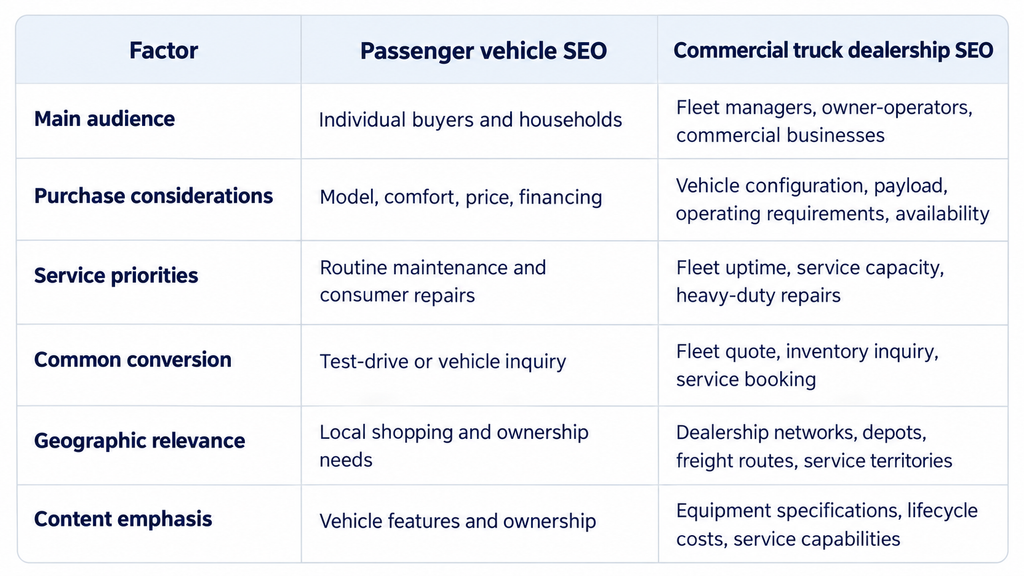
These are typical distinctions, not rigid rules. Some commercial dealerships serve individual owner-operators, while passenger vehicle dealerships may also support business fleets.
The important difference is the information each customer needs before contacting the business.
A commercial buyer may want to confirm truck configuration, vehicle condition, warranty availability, financing options, or whether the dealership can support a fleet after purchase.
A fleet maintenance customer may need to know which vehicle classes the facility accepts, whether appointments are required, and how the business handles scheduling.
Local SEO should make that information easy to find.
Why Local SEO Matters for Commercial Truck Dealerships
Commercial vehicle buyers and operators often need location-specific information, even when they operate across several states.
A fleet purchasing manager may compare dealerships nationally but prefer a supplier with regional service support. A repair customer usually has a more immediate geographic requirement.
Local SEO supports several practical business objectives.
More qualified truck sales inquiries. Searches such as “used Class 8 trucks for sale in Dallas” indicate a more specific purchasing requirement than a broad search for commercial vehicles. Relevant inventory pages and clear contact options help buyers move from research to inquiry.
Fleet maintenance opportunities. Fleet managers evaluating service providers need details about maintenance programs, supported vehicles, scheduling, and facility capabilities. Accurate local content helps them identify businesses worth contacting.
Better visibility in local search. Google identifies relevance, distance, and prominence as the main factors in local rankings. Complete business information helps Google understand the company and helps customers evaluate whether it meets their needs.
Google explains these factors in its official local ranking guidance.
Fewer avoidable customer problems. Wrong phone numbers, inaccurate hours, incorrect map pins, or outdated service information can waste customers’ time.
For a commercial truck requiring urgent repairs, this information can be particularly important.
Local SEO cannot guarantee rankings or leads, but it can help remove obstacles between a relevant search and a legitimate business.
How to Improve Local SEO for Truck Dealers: 12 Practical Steps
The most useful starting point is to make every real facility identifiable, accurately represented, and easy to contact.
Once those fundamentals are working, businesses can improve their website content, reputation management, technical SEO, and reporting.
Step 1: Optimize Every Eligible Google Business Profile
A Google Business Profile allows an eligible business to manage important information displayed in Google Search and Google Maps.
For commercial vehicle businesses, that information may include the location, contact details, primary business category, operating hours, photographs, and available services.
Claim and verify legitimate locations
Start by identifying profiles associated with actual dealerships and fleet service facilities.
Check whether:
- An authorized representative manages the profile.
- The business name matches real-world signage and branding.
- The address and map pin identify the correct facility.
- The phone number reaches the appropriate location.
- Business hours reflect actual customer-facing operations.
- The website link opens the relevant location page.
- The facility is marked with the correct operating status.
Google’s Business Profile guidelines require accurate representation of the business.
For example, a dealership genuinely named “Summit Commercial Trucks” should not add phrases such as “Best Heavy-Duty Truck Dealer Near Me” to its profile name solely to attract additional searches.
Choose relevant business categories
Select the most specific category that accurately reflects the facility’s primary business.
A commercial truck dealership and a dedicated diesel repair facility may require different primary categories.
Additional categories should describe other genuine aspects of the business, not every keyword the marketing team hopes to rank for.
Use the categories currently available in Google Business Profile. Do not assume that a particular label is supported without checking.
Describe actual service capabilities
Depending on the location, relevant offerings could include heavy-duty diesel diagnostics, transmission repairs, brake maintenance, preventive fleet maintenance, trailer service, commercial vehicle inspections, or truck parts.
Only publish services that the facility actually provides.
For example, a repair shop that handles light- and medium-duty commercial trucks should not imply that it can accommodate every heavy-duty tractor-trailer configuration.
Use recognizable facility photographs
Prioritize genuine images of the dealership entrance, exterior signage, truck parking, sales area, service bays, parts counter, and customer reception.
These help customers recognize the location and understand the facility before visiting.
Avoid presenting generic stock images as photographs of the business.
Manage sales, service, and parts hours correctly
Commercial dealerships may have different operating schedules for sales, maintenance, and parts.
For example:
| Department | Weekday hours | Saturday |
|---|---|---|
| Truck sales | 9 AM–6 PM | 9 AM–3 PM |
| Fleet service | 7 AM–7 PM | 8 AM–2 PM |
| Parts | 8 AM–5 PM | Closed |
These are hypothetical hours for illustration only.
Publish the correct schedules on the relevant website pages.
For Google Business Profiles, follow the platform’s applicable main-business and department-hours requirements. Eligible departments with their own profiles should maintain their own operating hours.
Should sales, service, and parts have separate profiles?
Not automatically.
Google permits separate profiles for qualifying public-facing departments that operate as distinct entities. Its guidance includes specific considerations for automotive dealerships.
A legitimate service department may qualify for its own profile, but an internal team does not automatically qualify simply because it performs a different function.
Before creating another listing, confirm that the department meets Google’s current eligibility, naming, category, and operational requirements.
Creating duplicate profiles to target extra keywords is not a compliant local SEO strategy.
Step 2: Research Commercial Truck and Fleet Maintenance Keywords
Keyword research should reflect real commercial purchasing and service needs.
Start with the dealership’s actual inventory, repair capabilities, customers, and operating markets.
Avoid targeting unrelated services merely because they appear to have search demand.
Map keywords to search intent
| Search category | Example keyword | Recommended destination |
|---|---|---|
| Commercial truck sales | Commercial truck dealer near me | Dealership location page |
| Heavy-duty vehicle sales | Heavy-duty truck dealer Houston | Relevant dealership page |
| Used inventory | Used semi trucks for sale Dallas | Filtered inventory or category page |
| Fleet maintenance | Fleet maintenance Atlanta | Fleet maintenance service page |
| Diesel repairs | Diesel truck repair Phoenix | Local repair service page |
| Mobile assistance | Mobile truck repair Chicago | Mobile repair or service-area page |
| Parts | Commercial truck parts Denver | Parts department page |
| Fleet contracts | Fleet maintenance company Texas | Fleet services or solutions page |
These are illustrative keyword opportunities, not verified search-volume recommendations.
A useful approach is to group queries by intent.
Commercial purchasing intent includes vehicle sales, available inventory, truck models, configurations, and commercial financing.
Service intent includes diagnostics, preventive maintenance, inspections, component repairs, and scheduled servicing.
Urgent intent includes mobile repairs, roadside assistance, and emergency truck servicing.
Informational intent includes maintenance planning, commercial vehicle specifications, purchasing checklists, and questions about servicing requirements.
Each category requires appropriate content.
A page about fleet maintenance contracts should not be optimized as though its primary purpose were selling used semi trucks.
Validate opportunities with actual data
Use Google Search Console and Bing Webmaster Tools to review the queries already bringing impressions and clicks to the website.
Look for searches where an existing page receives impressions but poorly answers the user’s question.
Keyword research tools and manual reviews of local search results can provide additional context.
Prioritize terms based on business relevance, local competition, and conversion potential rather than search volume alone.
For example, a relatively uncommon search for a specific fleet maintenance capability may be commercially valuable when that service aligns closely with the facility’s strengths.
Step 3: Create Useful Location-Specific Dealership Pages
A multi-location dealership website should make it easy for customers to identify the appropriate facility.
Each genuine dealership or service center should have a dedicated page that clearly explains where it operates and what it offers.
For a hypothetical dealership group with facilities in Dallas, Houston, and San Antonio, the URL structure might look like this:
/locations/dallas-tx//locations/houston-tx//locations/san-antonio-tx/
These are illustrative paths, not links to existing locations.
What should a commercial truck dealership location page include?
A strong location page typically contains:
- Official dealership name and address
- Local telephone number
- Sales, service, and parts contact information
- Verified operating hours
- Available truck categories and relevant inventory
- Services performed at that location
- Supported commercial vehicle types
- Directions and facility-access details
- Appointment or quotation request options
- Genuine facility photographs
Truck dealerships can provide additional practical details that are particularly relevant to commercial customers.
For example, a page might explain whether the entrance accommodates tractor-trailers, whether trailer parking is available, and whether customers must schedule service before arriving.
For a repair facility, useful details may include supported vehicle classes, available diagnostic services, trailer-service capabilities, and how to contact the team outside normal service hours.
Only include operational claims confirmed by the location manager.
Avoid doorway and duplicate location pages
Do not publish dozens of nearly identical pages that replace only the city name.
Google’s spam policies address doorway abuse and scaled content created primarily to manipulate search rankings.
Businesses serving several nearby cities can describe their genuine coverage on an appropriate service-area page.
A dedicated city page is most defensible when it provides meaningful, distinctive information that satisfies a separate customer need.
Step 4: Maintain Accurate Business Listings and Local Citations
Business listings help customers locate facilities and confirm contact information.
For commercial truck dealership groups, listing accuracy can become difficult when facilities change ownership, relocate, adjust hours, or expand services.
NAP refers to the business’s name, address, and phone number.
The main objective is factual consistency across important public sources, not identical punctuation in every directory.
Prioritize platforms customers actually use
Start with:
- Google Business Profile
- Apple Maps
- Bing Places for Business
- Relevant local business directories
- Appropriate transportation and industry directories
Not every directory is equally useful.
A legitimate industry directory that commercial buyers use may deserve more attention than a large number of obscure websites with little relevance to truck sales or fleet service.
Update Apple Maps through Apple Business
Apple introduced Apple Business in 2026, replacing Apple Business Connect and consolidating several existing business-management services.
Its location-management capabilities allow eligible businesses to maintain place card information, including business details and supported customer actions.
According to Apple’s official announcement, the service became available on April 14, 2026, with existing Business Connect information migrating to the new platform.
Dealerships should check their existing organization accounts before creating new ones.
For platform-specific instructions, see this guide to claiming and updating Apple Maps dealership listings.
Maintain Bing listings
Microsoft’s business listing instructions direct businesses to Bing Places for Business to claim or update information appearing in Bing Maps search results.
Keep the same operational details accurate across Google, Apple, Bing, and other relevant publishers.
Create a master location record
A centralized location record gives teams an approved source of business information.
| Field | Information to maintain |
|---|---|
| Location ID | Unique internal identifier |
| Business name | Actual public-facing name |
| Address | Street, city, state, ZIP code |
| Phone | Correct customer-facing number |
| Website | Relevant location URL |
| Business category | Accurate facility type |
| Hours | Regular, department, and holiday hours |
| Services | Verified local capabilities |
| Status | Open, temporarily closed, or permanently closed |
| Responsible owner | Facility or operations manager |
| Verification date | Last confirmed update |
When a facility changes its hours or services, confirm the change with the appropriate operational team before distributing it.
Incorrect phone numbers, map pins, and open-or-closed information should receive priority because they directly affect customers trying to reach the facility.
A monthly listing review is a practical starting point, with additional checks after relocations, acquisitions, openings, closures, or major schedule changes.
Step 5: Publish Content for Commercial Buyers and Fleet Operators
Local SEO content should help customers make informed decisions.
The most valuable topics are usually those connected to the business’s real services, inventory, and customer questions.
Content for truck dealerships
Useful topics may include:
- How to choose a commercial truck for regional deliveries
- What to compare when buying a used heavy-duty truck
- Questions to ask before purchasing fleet vehicles
- Understanding commercial truck configurations
- How to evaluate maintenance history before purchasing a used truck
These subjects can help buyers understand what to consider before contacting a dealership.
Where appropriate, connect the article to relevant inventory, sales, or financing pages.
Avoid suggesting that vehicle specifications or features apply to all models.
Content for fleet service centers
Useful topics include:
- How to plan preventive maintenance for commercial fleets
- What to ask before outsourcing fleet maintenance
- How to prepare a truck for a scheduled repair appointment
- Common factors that contribute to diesel truck downtime
- What to compare when choosing a heavy-duty repair facility
These topics should go beyond generic advice.
For example, an article about choosing a fleet repair facility could explain why customers should confirm vehicle compatibility, service capacity, scheduling procedures, diagnostic capabilities, and parts availability.
This gives fleet managers a practical way to evaluate providers.
Use trustworthy technical information
Where content discusses vehicle maintenance, inspections, safety, or regulatory requirements, verify the information against appropriate official documentation and qualified technical sources.
Do not invent technician certifications, guaranteed repair times, legal compliance claims, or service performance statistics.
If an article is reviewed by a qualified technician, an authentic review credit may help readers understand how the information was checked.
However, do not claim technical review or first-hand experience unless it actually occurred.
Step 6: Build an Authentic Customer Review Strategy
Reviews can help customers assess a dealership’s reliability, communication, and service experience.
They also contribute to the broader information available about a business online.
Google identifies review quantity and positive ratings among factors that may contribute to local prominence.
However, review management should primarily support customer trust and operational improvement rather than attempting to manipulate ratings.
Ask genuine customers for honest feedback
A commercial dealership can request a review after a completed purchase.
A fleet service center can request feedback after a repair or maintenance appointment.
Use a consistent, neutral invitation that allows customers to describe their genuine experience.
Do not request reviews only from customers expected to provide favorable feedback.
For Google reviews, do not offer payment, discounts, free products, or services in exchange for posting a review.
Google’s fake engagement and rating manipulation policy prohibits incentives for reviews and selective solicitation of positive feedback.
The FTC’s Consumer Reviews and Testimonials Rule guidance also addresses fabricated reviews and prohibited sentiment-conditioned incentives.
The FTC’s legal standards and an individual platform’s review policies are not identical. Businesses must comply with both applicable law and platform rules.
Respond to reviews professionally
A useful response acknowledges the customer’s feedback and provides a suitable next step.
For example, if a customer reports difficulty scheduling a repair, a service manager can acknowledge the concern and explain how to contact the appropriate support team.
Avoid discussing private service records, vehicle identifiers, confidential commercial agreements, or sensitive customer information publicly.
Use feedback to identify operational patterns
For each location, monitor:
- Review volume and recency
- Average ratings
- Response coverage
- Recurring service complaints
- Scheduling and communication issues
- Differences between facilities
Compare locations carefully.
A location with very few reviews may show large rating changes after a single new review, while a facility with hundreds of reviews may have a more stable average.
For a practical process, use this multi-location review management checklist.
Step 7: Optimize Mobile Truck Repair and Fleet Service Areas
Mobile repair companies have different location needs from businesses that only serve customers at a fixed workshop.
Some travel to customer depots. Others provide roadside assistance or mobile maintenance within a defined territory.
Their website and business profiles should accurately describe how and where service is provided.
Choose the correct Google Business Profile model
A commercial repair business may operate as a:
Storefront business: Customers bring vehicles to an eligible staffed facility.
Service-area business: Technicians travel to customers, and the company does not receive customers at its listed address.
Hybrid business: Customers can visit an eligible staffed facility, and the company also travels to customer locations.
Google requires qualifying service-area businesses that do not serve customers at their addresses to hide those addresses.
An eligible hybrid business may display its staffed, customer-facing location and specify genuine service areas.
Google’s service-area guidelines generally describe an overall service area within approximately two hours of driving time from the business’s base, while recognizing that larger areas may be appropriate for some businesses.
That guidance should not be treated as an automatic authorization to claim unlimited coverage.
Create useful mobile service pages
A mobile truck repair page should answer practical questions:
- Which areas does the company actually serve?
- What types of commercial vehicles can its technicians support?
- Which repair or diagnostic services are available?
- Does it offer emergency or scheduled mobile work?
- What are its dispatch and operating hours?
- How does the customer request assistance?
- Are there important limitations on the work performed onsite?
For example, a company providing mobile diagnostics and minor repairs should not imply that it can perform every major engine or transmission repair at roadside locations.
A clear explanation of capabilities helps customers avoid requesting services the company cannot deliver.
Do not create fictitious locations
Serving customers in several cities does not mean the company operates physical branches in all of them.
Use legitimate service-area information instead of fake addresses, virtual offices, or duplicate profiles.
Step 8: Improve Technical SEO and Structured Data
Technical SEO helps search engines discover, access, and understand relevant website content.
It also affects whether customers can use the website effectively.
For commercial vehicle businesses, technical SEO should support both location discovery and conversion.
Prioritize essential technical improvements
Check that the website has:
- Mobile-friendly page layouts
- Logical navigation between dealership locations
- Internal links to relevant services and inventory
- Secure HTTPS pages and inquiry forms
- Descriptive title tags and headings
- Appropriate canonical URLs
- Accessible, indexable location pages
- Accurate XML sitemaps
- Working contact, directions, and appointment links
- Usable page performance
Truck inventory pages need particular attention because availability can change frequently.
Sold or unavailable vehicles should not continue to appear as available.
If an inventory page is no longer relevant, determine whether to maintain it with accurate status information, redirect it to a closely relevant replacement, or handle it appropriately as a removed page.
Do not automatically redirect every expired listing to the homepage.
Implement appropriate structured data
Google supports LocalBusiness structured data for eligible business information.
Depending on the location page and chosen schema type, useful properties may include:
| Property | Purpose |
|---|---|
name | Identifies the business |
address | Describes its physical location |
telephone | Provides contact information |
url | Links to the business website |
geo | Provides geographic coordinates |
openingHoursSpecification | Describes operating hours |
department | Represents relevant business departments |
sameAs | References appropriate official profiles |
Use the most suitable supported type and properties for the actual business.
Follow Google’s LocalBusiness structured data documentation and validate the implementation.
Structured data must be consistent with the information visible on the page.
It does not create an eligible physical business, replace a Google Business Profile, or guarantee a rich result.
For this informational guide itself, Article or BlogPosting and BreadcrumbList structured data may be appropriate when they accurately represent the published page. Location-specific LocalBusiness markup belongs on relevant business pages, not on an unrelated publisher’s article.
Step 9: Manage Multi-Location Dealership SEO Centrally
A dealership group may operate sales centers, parts departments, service workshops, and mobile service operations across several states.
Each facility can have different services, hours, customer needs, and operational constraints.
Centralized management helps maintain consistency without making inaccurate assumptions about every location.
Assign ownership of location information
| Responsibility | Suggested owner |
|---|---|
| Master business data | Operations |
| Profile access and verification | Central marketing |
| Local hours and service capabilities | Facility manager |
| Location-page content | SEO or website team |
| Reviews and customer feedback | Customer service |
| Duplicate listing investigation | Listings administrator |
| Performance reporting | Marketing analytics |
These are suggested responsibilities. Actual ownership should reflect the company’s operating structure.
A change in Saturday service hours, for example, should be confirmed by the facility manager before it appears across public listings.
Establish an audit process
A monthly operating cycle can include:
- Review the master location record.
- Confirm changes to addresses, phone numbers, hours, and services.
- Inspect important public listings.
- Investigate duplicates or unauthorized modifications.
- Review customer feedback and unresolved complaints.
- Check relevant location pages.
- Assign owners and deadlines for corrections.
This approach is especially useful following acquisitions, new location openings, rebrands, or closures.
Give facilities controlled flexibility
A central team should standardize business-data quality, brand representation, reporting, and escalation procedures.
Individual facilities should retain an approved way to communicate their specific capabilities.
For example, one branch may offer trailer repairs while another concentrates on medium-duty truck maintenance.
Their pages should not contain identical service claims when their operations differ.
Centralization should improve accuracy, not erase meaningful local differences.
Step 10: Compare Local SEO and Listings Management Software
Local SEO software can reduce repetitive work involving listings, customer reviews, rank monitoring, location records, and reporting.
The right software depends on how many facilities a company operates, which platforms matter to its customers, and how complex its internal workflows are.
A single independent repair center may be able to manage essential profiles directly.
A group operating dozens of dealerships may benefit from bulk updates, role-based access, and centralized reporting.
1. BrightLocal
Best for: Independent truck dealerships, regional repair operators, and agencies that prioritize local SEO audits and reporting.
BrightLocal provides local rank monitoring, geographic ranking analysis, citation tracking, Google Business Profile auditing, and reporting tools. It is useful for teams investigating location-level search visibility and listing problems.
Its Track, Manage, and Grow subscriptions offer different capabilities, while Citation Builder operates as a separate pay-as-you-go service.
Limitations: Not every listing-management or review feature is included in every subscription. Large dealership groups should evaluate location allowances, reporting needs, and access controls.
Pricing: Subscription costs depend on the selected package and location requirements. Citation Builder is billed separately.
Choose it if: Auditing, rank monitoring, citation analysis, and reporting are your main priorities.
2. Synup
Best for: Multi-location dealerships, fleet service organizations, and agencies seeking centralized local marketing tools.
Synup supports business listings, review management, local visibility tracking, and related location-marketing workflows. Its centralized approach can help teams coordinate approved business information across supported publishers and monitor customer feedback.
For commercial vehicle groups, this may be useful when locations regularly change service hours, contact details, or business information.
Limitations: Publisher connections, available integrations, account permissions, and feature access depend on the selected offering. A centralized platform also requires reliable information from local operations teams.
Pricing: Review current subscription options, location limits, and any additional usage charges directly with Synup.
Choose it if: Listings consistency, reputation oversight, and coordinated multi-location workflows are priorities.
3. Yext
Best for: Large truck dealership groups requiring structured location information and enterprise-oriented management.
Yext provides centralized business-data management and distribution through its publisher network. Its listings capabilities can support organizations maintaining business information across many locations.
For a dealership group, this may simplify coordination between marketing, operations, and teams responsible for public location records.
Limitations: Implementation effort, integration requirements, publisher-specific capabilities, and commercial terms should be assessed before committing. The presence of a publisher in a network does not mean every field is supported identically.
Pricing: Obtain a proposal reflecting required products, locations, and contractual terms.
Choose it if: Location-data governance, publisher distribution, and enterprise administration are central requirements.
4. Uberall
Best for: Regional and national fleet service operators seeking centralized location marketing and reputation workflows.
Uberall provides listings management and related tools covering customer reviews, local marketing, and location-based engagement. It is designed for organizations managing multiple customer-facing locations.
A commercial vehicle service network can evaluate it for maintaining consistent facility information and coordinating local customer interactions.
Limitations: Businesses should confirm which listings connections, review functions, reporting tools, approval controls, and additional modules are included in the proposed subscription.
Pricing: Request a quote based on the number of facilities and required capabilities.
Choose it if: The organization needs coordinated listings, reputation management, and broader location marketing processes.
5. Moz Local
Best for: Dealerships and service businesses focused on accurate listings and foundational local presence management.
Moz Local is oriented toward distributing and maintaining business location information across supported platforms. Its capabilities include listing management, duplicate-related workflows, and review oversight.
This may suit businesses that need an established listings-management process without introducing a broader enterprise marketing suite.
Limitations: Teams should assess supported directories, reporting requirements, user permissions, and integration needs. Larger groups with complex approval processes may require additional tools.
Pricing: Confirm the current per-location plans, available features, and total charges before purchasing.
Choose it if: Consistent business information and ongoing listing maintenance are the principal requirements.
Which Local SEO Platform Should Truck Dealers Choose?
The decision should start with the specific operational problem.
BrightLocal may be a useful shortlist option when rank tracking, citation audits, and reporting are the main needs.
Synup and Moz Local are worth evaluating when the business primarily needs coordinated listing and reputation workflows, although their broader capabilities and subscription structures differ.
Yext and Uberall may warrant closer evaluation when an organization operates many facilities and needs more complex location management.
For a broader comparison, see local SEO tools for multiple locations.
Ask vendors to demonstrate a real workflow.
For example, request a demonstration showing how the software handles a change in service department hours.
The demonstration should cover:
- Updating the approved source record
- Distributing the change to relevant publishers
- Identifying rejected or unsuccessful updates
- Managing approval permissions
- Reporting which locations remain incorrect
Also ask what happens when the subscription ends and which listings remain independently manageable.
This provides a practical evaluation framework without relying solely on vendor feature lists.
Step 11: Improve Discoverability in AI-Powered Search
AI-powered search is another environment where businesses may be discovered during commercial research.
A fleet manager might ask an AI-assisted search system to identify commercial truck service providers near a particular city or compare businesses offering specific maintenance capabilities.
Clear business information can help search and AI systems understand what a facility offers.
However, businesses should not treat AI search as a separate reason to produce large amounts of repetitive, keyword-targeted content.
Focus on factual, accessible information
Useful practices include:
- Maintaining accurate dealership and service locations
- Explaining real services in clear language
- Publishing relevant, accessible location pages
- Supporting technical statements with reliable information
- Keeping official business profiles updated
- Making useful content available in indexable HTML
- Using suitable structured data
- Maintaining relevant internal links
For example, a detailed page explaining which commercial vehicle classes a Dallas repair facility accepts is more informative than a generic statement claiming that it is the best repair provider in Texas.
What does Google recommend for AI search?
Google’s AI features and your website guidance explains that the established foundations of SEO remain relevant to AI Overviews and AI Mode.
Google does not require special AI files, AI-specific structured data, or additional technical optimization to become eligible for these features.
Pages considered for supporting links must meet the applicable requirements for appearing in Google Search.
Eligibility is not a guarantee of inclusion.
Businesses should also avoid assuming that being mentioned in an AI-generated answer is equivalent to a qualified lead.
The useful business measures remain inquiries, appointments, relevant website engagement, and actual commercial opportunities.
Step 12: Strengthen Relevant Local Authority
Local authority comes from legitimate relationships, references, and recognition that help people understand a business’s role in its market.
For commercial vehicle businesses, potential opportunities include transportation associations, supplier partnerships, industry publications, local business organizations, and regional business events.
Examples of useful activities include:
- Participating in appropriate transportation associations
- Maintaining accurate manufacturer or supplier partner information
- Publishing genuine facility-opening announcements
- Providing verified technical explanations to industry publications
- Supporting relevant commercial transportation events
- Sharing original, useful resources for fleet operators
For example, a dealership opening a new heavy-duty service facility may have newsworthy information about the types of vehicles it serves and how customers can access the location.
Such announcements should be factual and relevant.
Avoid buying irrelevant backlinks, participating in artificial linking networks, or creating repetitive location pages solely to influence search rankings.
A legitimate mention from a relevant local or industry source can offer greater practical value than numerous low-quality directory entries.
How to Measure Local SEO Performance for Truck Dealers
Local SEO performance should be evaluated through meaningful business outcomes, not rankings alone.
A commercial truck dealership may receive substantial organic traffic without generating many qualified vehicle inquiries.
A specialized fleet repair facility might receive fewer visits but attract customers with well-defined service requirements.
Measurement should reflect those differences.
Core Local SEO KPIs
| KPI | What it measures | Business relevance |
|---|---|---|
| Organic search clicks | Visits from unpaid search results | Website discovery |
| Location-page engagement | Activity on relevant facility pages | Local customer interest |
| Business Profile interactions | Available clicks, calls, and direction-related actions | Local discovery and contact activity |
| Qualified sales leads | Relevant truck purchasing inquiries | Sales pipeline |
| Fleet service inquiries | Requests for commercial maintenance or repair | Service pipeline |
| Confirmed service bookings | Scheduled appointments | Operational conversions |
| Organic lead conversion rate | Measured leads divided by relevant visits | Website effectiveness |
| Listing accuracy | Correct records as a share of audited records | Information quality |
| Review performance | Ratings, volume, recency, feedback themes | Customer reputation |
Metrics should be defined consistently before comparison.
For example, a phone-button click does not necessarily mean a call connected, and an inquiry does not automatically represent a qualified sales opportunity.
Measure Lead Quality
Commercial vehicle businesses should distinguish between different inquiry types.
A fleet service center might receive requests for a single repair, recurring preventive maintenance, or a long-term contract.
Useful CRM fields may include customer type, vehicle category, requested service, preferred facility, general fleet size, and source of inquiry.
Collect only information needed for legitimate business purposes.
Example reporting dashboard
Consider a hypothetical dealership group:
| Metric | Month 1 | Month 2 |
|---|---|---|
| Organic location-page visits | 1,400 | 1,650 |
| Qualified truck sales inquiries | 32 | 39 |
| Fleet service inquiries | 45 | 52 |
| Confirmed service bookings | 24 | 30 |
| Critical listing errors | 8 | 2 |
These figures are fictional and demonstrate a reporting format only.
The results show changes in recorded activity, but they do not establish that local SEO caused every increase.
Seasonality, paid advertising, facility operations, demand changes, and tracking differences may also affect performance.
Use Google Search Console, website analytics, business profile performance data, and relevant CRM records together.
Where possible, separate location-page visits, calls, forms, qualified opportunities, and confirmed bookings.
This helps distinguish search visibility from actual business results.
Common Local SEO Mistakes Truck Dealers Should Avoid
Using Generic Automotive Content
Commercial customers often need information about truck configurations, operating requirements, repair capabilities, and fleet services.
Content written only for ordinary passenger vehicle buyers may leave these questions unanswered.
Ignoring Service and Parts Departments
Sales, service, and parts may attract different types of searches.
Ensure those functions are represented accurately on the website without automatically creating duplicate business profiles.
Publishing Outdated Inventory Information
Commercial truck inventory changes over time.
Make vehicle availability clear and provide a reliable way to confirm specifications, stock, and sales arrangements.
Creating Duplicate Business Profiles
Do not create multiple profiles for the same business merely to target more keywords or nearby cities.
Confirm actual eligibility before establishing distinct department profiles.
Displaying Incorrect Operating Hours
Customers should not assume that service is available simply because the sales department remains open.
Publish clear departmental schedules and accurate holiday information.
Repeating the Same Location Content
Replacing city names in generic paragraphs does not create a genuinely useful location page.
Include information that distinguishes each facility’s services, equipment, inventory, access, and contact process.
Neglecting Mobile Usability
Drivers and fleet managers may need location information while away from a desktop computer.
Make telephone links, directions, operating hours, and service request options easy to use on mobile devices.
Tracking Visibility Without Business Outcomes
Impressions and ranking positions provide diagnostic information, but they are not substitutes for qualified inquiries or confirmed service work.
Evaluate local SEO alongside sales and service outcomes.
90-Day Local SEO Action Plan for Truck Dealerships
A phased plan can help commercial vehicle businesses correct foundational problems before expanding their content and marketing operations.
The schedule below is an illustrative implementation framework.
| Timeline | Main priority | Key actions |
|---|---|---|
| Days 1–15 | Establish a baseline | Audit profiles, locations, keywords, website pages, and tracking |
| Days 16–30 | Correct critical information | Fix addresses, hours, categories, contact details, duplicates, and broken links |
| Days 31–45 | Improve location pages | Add verified facility details, services, calls to action, and internal links |
| Days 46–60 | Expand useful content | Address commercial buyer and fleet maintenance questions |
| Days 61–75 | Strengthen reputation | Improve review requests, responses, and local relationships |
| Days 76–90 | Measure and refine | Compare leads, bookings, listing quality, and search performance |
Days 1–30: Establish Accuracy
Start with issues that prevent customers from locating or contacting the business.
Check profile ownership, location data, business categories, operating hours, map pins, and functional inquiry options.
For multi-location groups, establish clear responsibility for each location’s information.
Days 31–60: Improve Relevance
Update dealership and service pages to reflect actual capabilities.
Review internal linking, inventory information, service descriptions, and common customer questions.
Publish additional content only where it addresses a meaningful information gap.
Days 61–90: Evaluate Results
Review location-level search activity, qualified sales leads, fleet maintenance inquiries, and confirmed appointments.
Check whether listing errors have been resolved and whether the new content helps customers find appropriate services.
Use those findings to prioritize further work.
This plan does not promise that organic rankings or revenue will improve within 90 days. Competitive conditions, existing website performance, search demand, and implementation quality all affect outcomes.
Local SEO Checklist for Commercial Truck Dealerships
Use this checklist when onboarding a new facility or reviewing an existing location.
Google Business Profile
- Claim and verify eligible locations.
- Confirm accurate business names and categories.
- Check addresses, map pins, phone numbers, and websites.
- Publish correct departmental operating hours.
- Add genuine facility photographs.
- Describe actual services.
- Investigate duplicates and access problems.
Website optimization
- Maintain useful pages for genuine locations.
- Match relevant keywords to suitable pages.
- Explain local truck sales and repair capabilities.
- Keep inventory information accurate.
- Provide straightforward inquiry and appointment options.
- Check mobile usability and indexing.
- Maintain appropriate structured data.
Reputation and local authority
- Request authentic reviews without incentives.
- Respond professionally to customer feedback.
- Escalate recurring operational complaints.
- Keep important business listings accurate.
- Maintain legitimate industry and local relationships.
Reporting and governance
- Track qualified sales and service leads.
- Monitor confirmed appointments.
- Review performance by location.
- Assign owners to listing errors.
- Audit unresolved issues regularly.
Frequently Asked Questions
What Is the Best Local SEO Strategy for Fleet Service Centers?
An effective strategy combines accurate facility listings, relevant repair service pages, genuine customer reviews, clear service-area information, and accessible appointment options.
Fleet service businesses should explain which vehicles they accept, what repairs they perform, and how customers can schedule service.
The objective is to reach suitable customers rather than generate unrelated traffic.
How Can Commercial Truck Dealerships Improve Google Maps Visibility?
Start with a complete, accurate, and policy-compliant Google Business Profile.
Use relevant business categories, maintain correct location and contact details, publish genuine service information, and encourage authentic customer feedback.
Google bases local results primarily on relevance, distance, and prominence. No dealership can guarantee a particular Maps ranking.
Should Truck Dealers Create Separate Google Profiles for Sales, Service, and Parts?
Only when the departments meet Google’s applicable eligibility requirements.
A distinct customer-facing department may qualify for its own profile, but an ordinary internal team or duplicate listing does not qualify simply because it targets a different service keyword.
Verify the relevant business and department guidelines before creating additional profiles.
How Does Local SEO Help Mobile Truck Repair Businesses?
Local SEO helps mobile repair companies communicate their genuine service areas, available repairs, operating hours, and contact options.
An appropriate service-area or hybrid Business Profile can represent the business according to how it actually operates.
Mobile companies should not claim physical branches in cities where they do not have eligible facilities.
What Keywords Should Commercial Truck Dealerships Target?
Useful keywords include commercial truck dealer near me, used semi trucks for sale, heavy-duty truck dealership, diesel truck repair, fleet maintenance, and commercial truck parts.
Combine these terms with genuine locations and available services.
Validate relevance and demand rather than assuming every keyword is valuable.
Can Local SEO Help Truck Dealerships Appear in AI Search Results?
Accurate business profiles, accessible pages, clear descriptions, and reliable information can help search systems understand a dealership.
Google recommends established SEO practices for its AI search features and does not require special AI-specific markup.
No SEO technique or software platform guarantees inclusion in AI-generated answers.
How Long Does Local SEO Take to Produce Results?
There is no fixed timeline.
Business information corrections may become useful once approved and visible, while changes in competitive organic search performance may take longer.
Results depend on existing visibility, local competition, technical quality, customer demand, and execution.
Track meaningful customer inquiries and bookings instead of expecting a guaranteed ranking date.
Final Thoughts
Local SEO for truck dealers and fleet service centers should make commercial vehicle businesses easier to find, evaluate, and contact.
Truck dealerships need to provide accurate inventory information, useful purchasing details, and access to knowledgeable sales teams.
Fleet service centers need to communicate repair capabilities, supported vehicle types, operating hours, service territories, and scheduling procedures.
For multi-location organizations, reliable business data and clear operational responsibilities are especially important.
The most sustainable approach combines accurate profiles, genuinely useful location pages, relevant commercial vehicle content, authentic reviews, and reporting tied to business outcomes.