Top Local SEO Tools in 2026: The Complete Guide to Local Search

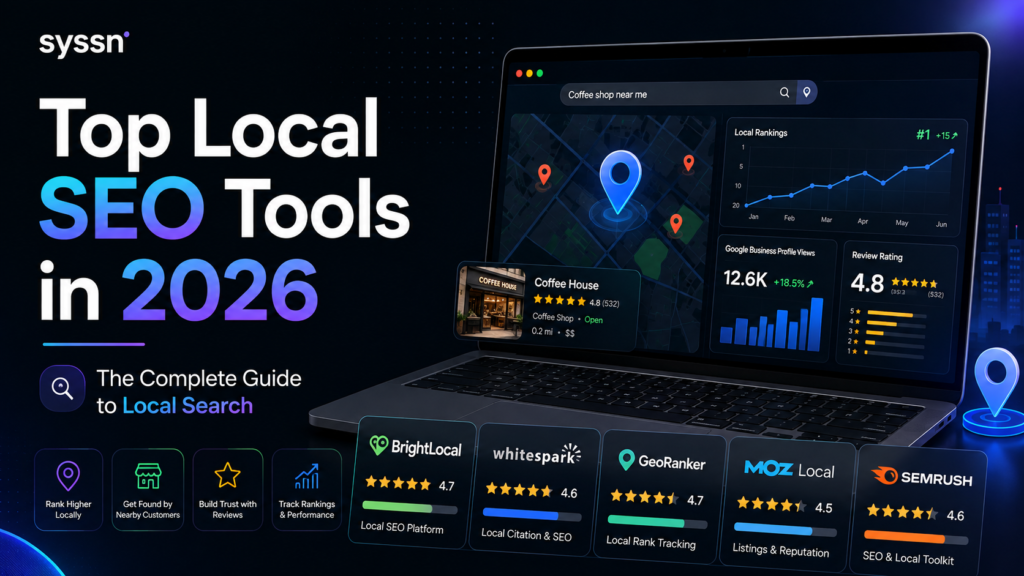
Top Local SEO Tools in 2026: The Complete Guide to Local Search covers the platforms that local businesses, agencies, and multi-location brands actually use to manage listings, reviews, rankings, and reporting from one place. This guide ranks the best local SEO tools, starting with free options from Google and Apple, then moving into paid platforms like Synup, BrightLocal, Yext, Moz Local, Whitespark, and Local Falcon. You’ll get pricing, real feature comparisons, and guidance on which local SEO software fits a solo location, an agency managing dozens of clients, or a franchise running hundreds of storefronts.
Quick Comparison: Top Local SEO Tools at a Glance
| Tool | Best For | Starting Price | Standout Feature |
|---|---|---|---|
| Google Business Profile | Every local business, no exceptions | Free | Direct control over your Google Maps listing |
| Apple Business Connect | Businesses that want Apple Maps and Siri visibility | Free | Native Apple Maps and Siri integration |
| Synup | Agencies and multi-location brands that want automation | Usage-based credits, free trial | Sydekick, an AI agent that executes local marketing tasks |
| BrightLocal | Agencies that need rank tracking and audits | $39/month | Local Search Grid geo-grid rank tracker |
| Yext | Enterprise chains with strict data governance | $199+/location/year | Deep publisher network for listing accuracy |
| Moz Local | Small businesses that want simple listing syncing | $14 to $33/month | Straightforward NAP distribution |
| Whitespark | Businesses that want hands-off citation building | $20/month (rank tracker) | Deep citation database for niche directories |
| Local Falcon | Anyone who wants to see rankings on a map | $24.99/month (credits) | Visual geo-grid rank scans by GPS point |
What Counts as a Local SEO Tool in 2026
A local SEO tool is any piece of software built to help a business show up in map results, the local 3-pack, and nearby search queries, rather than general organic rankings. That includes listing managers, review platforms, rank trackers, citation builders, and reporting dashboards.
The category has changed shape over the past year. It used to mean dashboards you logged into and clicked through by hand, one location at a time, one directory at a time. In 2026, the better tools also track how a business shows up in AI answers on ChatGPT, Perplexity, and Google’s AI Overviews, since a growing share of local discovery now happens through an AI response instead of ten blue links. A restaurant with a perfect Google listing can still get skipped if an AI assistant pulls outdated hours from a third-party directory nobody checked in two years.
That shift also changed who does the work. A decade of local marketing software added more dashboards without reducing the hours a person needed to spend inside them. The newest platforms are starting to close that gap by having software complete tasks directly instead of flagging them for someone to handle later.
What to Look for in Local SEO Software
Before picking a tool, check it against a short list of requirements. Not every business needs every feature, but a strong platform should cover most of these:
- Listing accuracy and syncing across Google, Apple, Bing, and major data aggregators
- Local rank tracking, ideally with geo-grid reports that show visibility by neighborhood, not just city-wide averages
- Review monitoring and response, pulled from Google, Yelp, Facebook, and industry-specific sites
- Citation management to catch and fix inconsistent name, address, and phone (NAP) data
- AI search visibility tracking, since ranking in a map pack no longer guarantees a mention in an AI-generated answer
- Reporting that a business owner or client can actually read without a walkthrough call
- Multi-location support if you’re managing more than one storefront or franchise unit
The Top Local SEO Tools in 2026
1. Google Business Profile
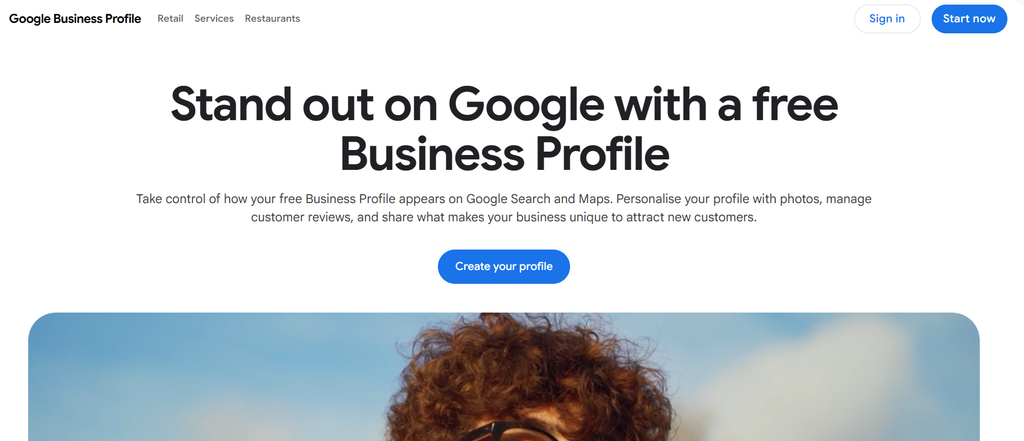
Google Business Profile (GBP) is the free listing every local business needs before touching any paid tool. It controls how a business appears in Google Search and Google Maps, including hours, photos, posts, and customer reviews.
Best for: Every business with a physical location or service area, regardless of budget.
Key features:
- Direct editing of business name, address, phone number, hours, and categories
- Free Google Posts for updates, offers, and events
- Built-in messaging and Q&A with customers
- A performance dashboard showing calls, direction requests, and website clicks
- Review reply tools directly inside the dashboard
Pricing: Free.
Limitation: GBP shows you what’s happening but doesn’t help you fix it at scale. There’s no rank tracking, no citation auditing, and no way to manage more than a handful of locations without a spreadsheet on the side. Most businesses outgrow it as their only tool within the first year of active local marketing, especially once a second or third location enters the picture.
2. Apple Business Connect
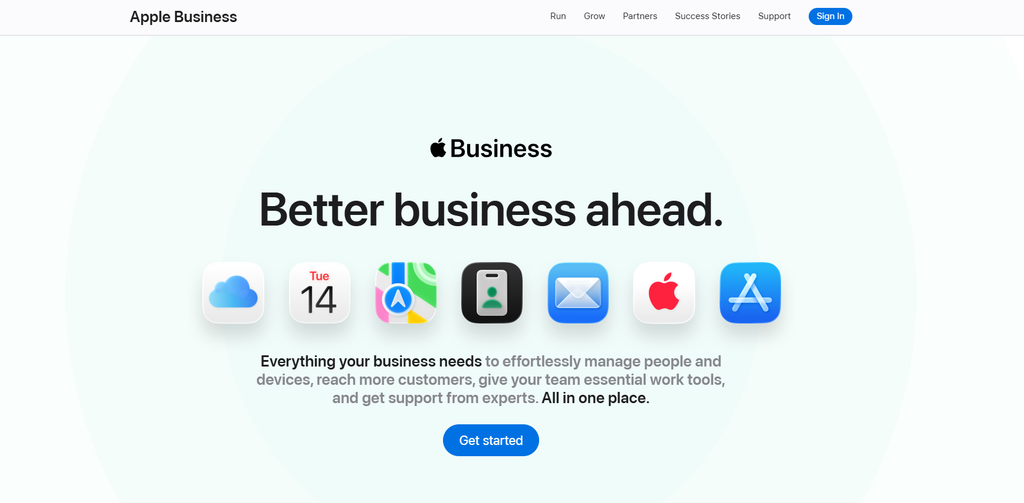
Apple Business Connect is Apple’s free equivalent of GBP, controlling how a business appears in Apple Maps, Siri results, and Apple’s Messages app. It matters more each year as Apple Maps usage grows on iPhone, which still holds a large share of the U.S. smartphone market, and a listing left unclaimed here simply won’t show up when a customer asks Siri for directions.
Best for: Businesses that want visibility across both Google and Apple’s map platforms without paying for it.
Key features:
- Direct control over Apple Maps listing details and photos
- Custom cards for promotions, menus, or seasonal updates
- Integration with Apple Podcasts and Apple News for eligible businesses
- Basic analytics on views and actions taken from the listing
- Multi-location bulk editing for businesses with several storefronts
Pricing: Free.
Limitation: Apple Business Connect covers one platform. It doesn’t track rankings, manage citations on other directories, or monitor reviews outside Apple’s own network, so it works best as a companion to GBP rather than a replacement for paid local SEO software.
3. Synup
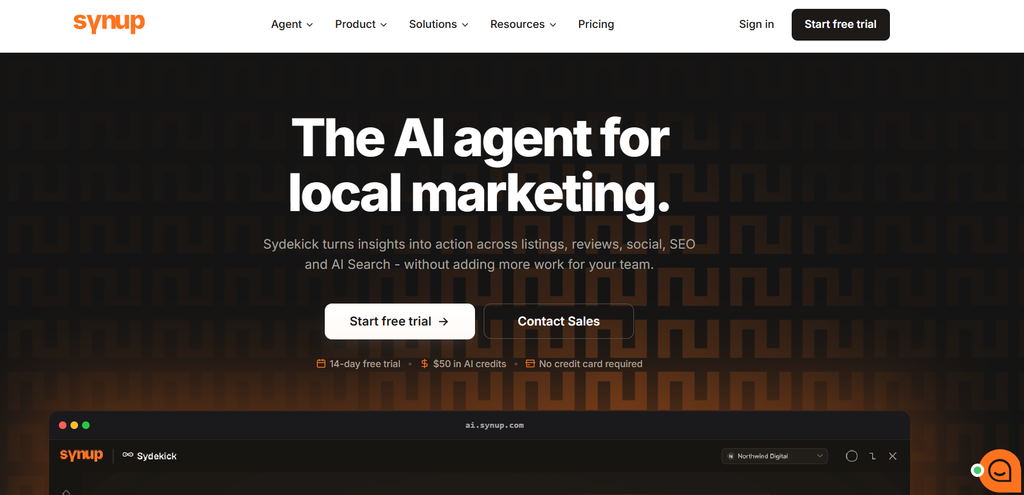
Synup is a local marketing platform used across more than two million business locations, combining listing management, review monitoring, local SEO, and AI search visibility in one system. In August 2026, the company rebuilt its platform around Sydekick, an AI agent designed to complete local marketing tasks rather than just surface them on a dashboard.
Best for: Agencies and multi-location brands that want a platform to execute recurring local marketing work instead of only reporting on it.
Key features:
- Sydekick, an AI agent that audits listings, drafts review replies, writes local posts, and tracks how a business appears in AI search
- Listing syncing and correction across major directories and data aggregators
- Local rank tracking alongside review monitoring and response
- Answer Engine Optimization (AEO) tracking for visibility in ChatGPT, Perplexity, and AI Overviews
- White-labeled reporting built for agencies managing multiple clients
Pricing: Usage-based credits tied to the actions Sydekick completes, with a free trial that includes starter usage.
Limitation: Because pricing is usage-based rather than a flat seat fee, a business running a high volume of automated actions across many locations needs to budget for credit consumption rather than a fixed monthly number.
4. BrightLocal
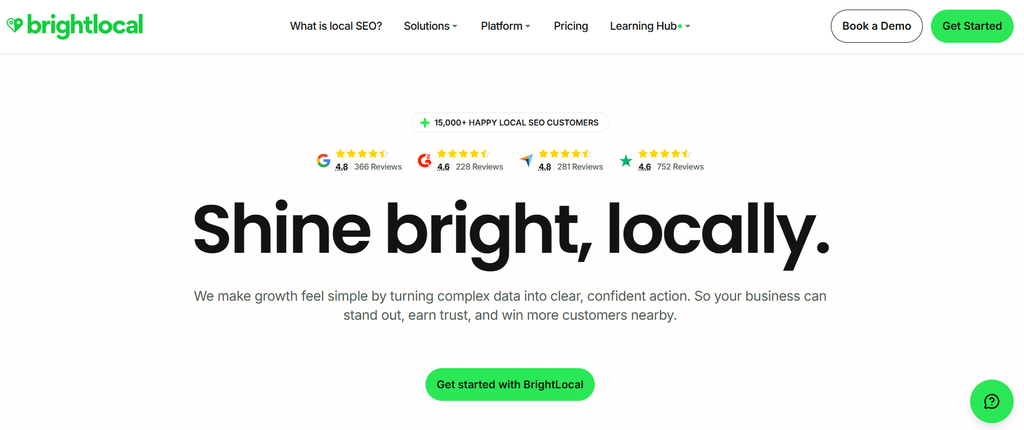
BrightLocal is a longtime favorite among local SEO consultants and small agencies, built around rank tracking, citation audits, and white-label reporting. Its Local Search Grid tool shows geo-grid rankings, which map out visibility by specific point on a map rather than a single average position.
Best for: Agencies and consultants that need rank tracking and client-ready reports without a steep learning curve.
Key features:
- Local Search Grid geo-grid rank tracking, expandable beyond the base five keywords
- Citation Tracker that monitors over 100 citation sources automatically
- Reputation Manager that pulls reviews from Google, Yelp, and Facebook into one inbox
- Customizable, white-label client reports
- An MCP server, launched in 2026, that connects the platform to AI assistants like Claude and ChatGPT
Pricing: Plans run from $39 to $59 per month per location, with a 25 percent discount on annual billing and a 14-day free trial.
Limitation: Review monitoring and response are locked to the top-tier Grow plan, and citation building is a separate, credit-based purchase rather than something included in the base subscription.
5. Yext
Yext is an enterprise listing management platform built for large chains and franchises that need consistent data across a wide publisher network. It pushes business information directly to hundreds of directories, apps, and voice assistants.
Best for: National brands and enterprise chains with 100 or more locations and strict data governance needs.
Key features:
- Real-time listing syncing across a large publisher and directory network
- Structured data management for search engines and AI assistants
- Enterprise-grade user permissions and approval workflows
- Analytics on listing performance across locations
- Knowledge Graph tools for managing structured business data at scale
Pricing: Starts around $199 per location per year at the entry tier, with practical costs closer to $399 to $499 per location once analytics, social, and competitor monitoring are added.
Limitation: Pricing scales steeply with location count, and canceling a subscription can affect how your data appears across the publisher network going forward, since you’re renting distribution rather than owning it outright.
6. Moz Local
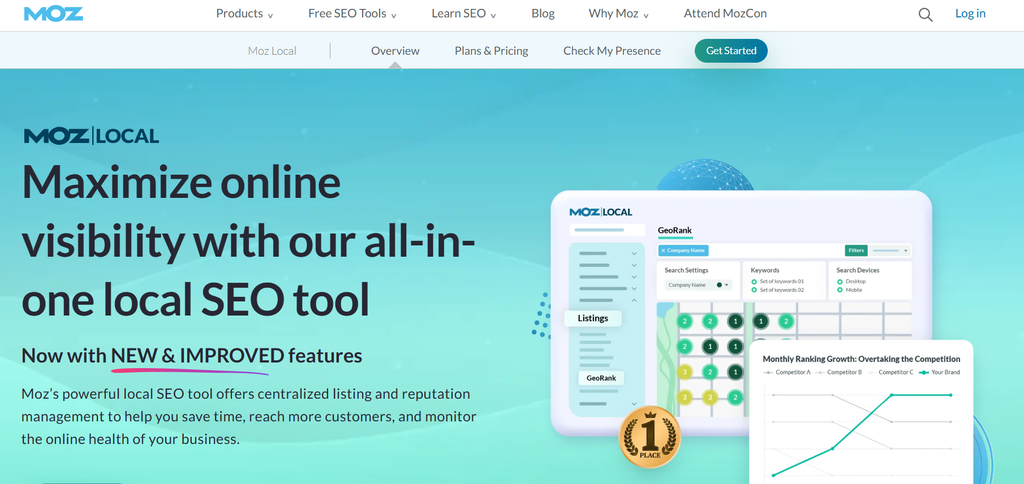
Moz Local focuses on one job: syncing accurate business information across major data aggregators and directories, then keeping it consistent over time. It’s built by Moz, a well-known name in SEO software.
Best for: Small businesses or single-location owners who want simple, reliable listing syncing without a lot of extra features.
Key features:
- Automated NAP (name, address, phone) distribution across aggregators
- Ongoing monitoring of listing accuracy with automatic correction
- Basic review tracking across major platforms
- Duplicate listing detection and cleanup
- Straightforward dashboard built for non-technical users
Pricing: Roughly $14 to $33 per month depending on the plan and location count.
Limitation: Moz Local doesn’t include geo-grid rank tracking or the AI search visibility features that newer platforms offer, so businesses that want deeper ranking data typically pair it with another tool. It’s a solid foundation layer, not a full local SEO stack on its own.
7. Whitespark
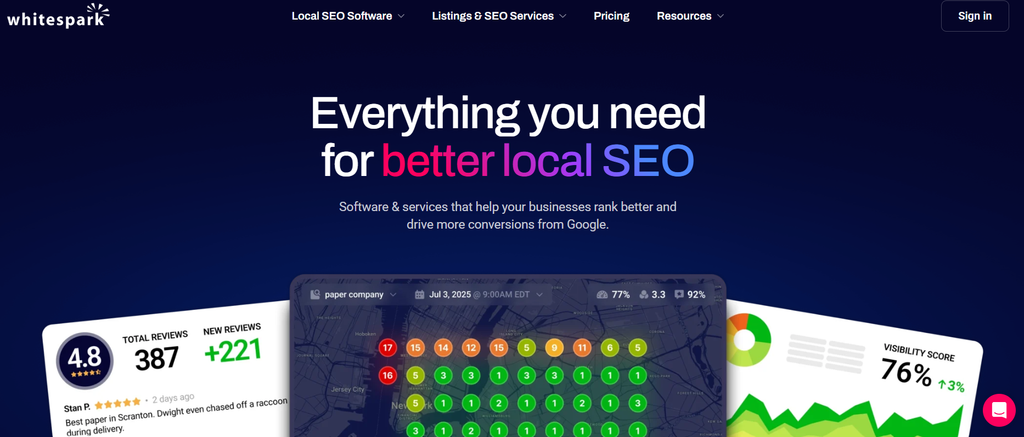
Whitespark built its reputation on citation building and local rank tracking, and it still operates more like a specialist than an all-in-one platform. Some of its services, like citation building, are delivered by a human team rather than fully automated software.
Best for: Businesses and SEO professionals who want granular citation research or hands-off citation building done for them.
Key features:
- Local Citation Finder that identifies gaps against competitors in the same market
- Local Rank Tracker covering unlimited domains and locations on its base plan
- Managed citation building service for businesses that don’t want to do it themselves
- Reputation and review management add-on
- Deep coverage of niche, industry-specific directories
Pricing: The Local Rank Tracker starts at $20 per month, with citation building priced separately per project.
Limitation: Because Whitespark blends software with manual services, turnaround on citation building takes longer than a fully automated platform, and total cost depends heavily on which add-on services you choose.
8. Local Falcon
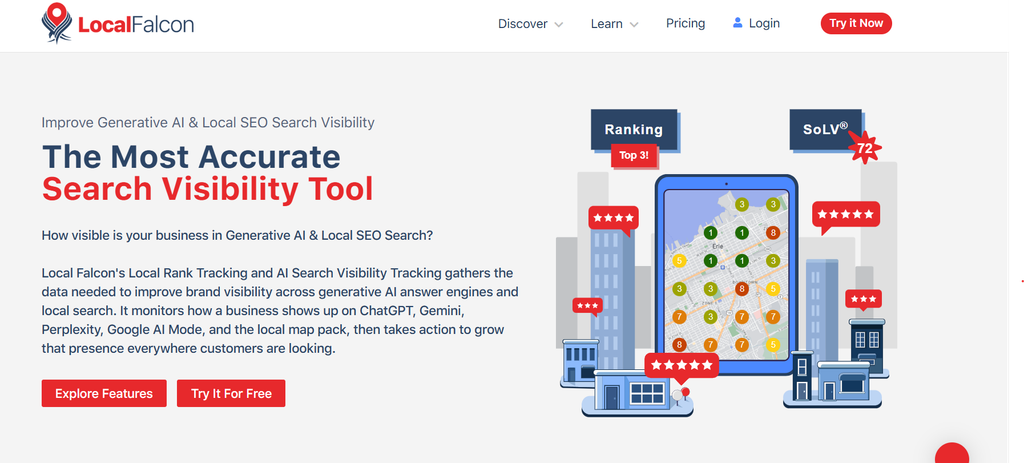
Local Falcon does one thing and does it visually well: it shows exactly where a business ranks on Google Maps from any point on a grid, not just from the business’s own address. That makes it useful for spotting ranking drop-off a few blocks away.
Best for: Businesses and agencies that want a clear, visual read on Google Maps rankings across a service area.
Key features:
- Geo-grid scans showing rank at every point across a custom map area
- Competitor comparison at each grid point, not just an overall average
- Historical scan tracking to show ranking movement over time
- Keyword and location-based scan scheduling
- Exportable reports for client presentations
Pricing: Starts at $24.99 per month, sold as scan credits rather than a flat per-location fee.
Limitation: Local Falcon focuses on rank visualization. It doesn’t manage listings, citations, or reviews, so most users run it alongside a broader platform rather than as a standalone solution.
How to Choose the Right Local SEO Tool for Your Business
The right choice depends less on which tool has the longest feature list and more on how many locations you manage and who’s doing the work.
For Single-Location Small Businesses
Start with Google Business Profile and Apple Business Connect, since both are free and cover the two map platforms that drive most local search traffic. Add a lightweight paid tool like Moz Local or Local Falcon once you need rank tracking or listing syncing beyond what the free platforms offer.
For Agencies Managing Multiple Clients
Agencies need white-label reporting, bulk location management, and enough automation to avoid hiring a specialist for every ten clients. BrightLocal and Synup both fit this need, with Synup’s Sydekick agent aimed specifically at agencies that want to reduce the manual hours spent on repetitive tasks like review replies and listing audits.
For Multi-Location Brands and Franchises
Franchises and enterprise brands need consistent data across dozens or hundreds of locations, plus governance over who can edit what. Yext and Synup both scale to this level, though the right pick depends on whether you want a platform that pushes data (Yext) or one that also executes ongoing marketing tasks through an agent (Synup).
Budget as a Deciding Factor
Cost still narrows the list fast. A single location can run entirely on free tools plus a $20 to $40 per month add-on. An agency managing thirty clients is looking at a few hundred dollars a month once white-label reporting and rank tracking are factored in. A 100-location enterprise brand on a per-location pricing model can end up paying tens of thousands of dollars a year, which is why usage-based or bundled pricing has become a real point of comparison, not just a footnote.
Local SEO Tools vs. Traditional SEO Tools
Local SEO tools and traditional SEO tools solve different problems. Traditional SEO software, like Ahrefs or Semrush’s core product, focuses on organic rankings, backlinks, and keyword research across an entire website and national or global search intent.
Local SEO tools narrow that focus to map results, the local 3-pack, and directory listings tied to a physical address or service area. A business ranking well nationally on Google Search can still be invisible on Google Maps if its listing data is inconsistent or its review profile is thin. Most local businesses need both categories, but they should not expect one tool to fully replace the other.
Frequently Asked Questions
What are the top local SEO tools in 2026?
The top options include free platforms like Google Business Profile and Apple Business Connect, followed by paid software such as Synup, BrightLocal, Yext, Moz Local, Whitespark, and Local Falcon. Each covers a different mix of listings, rank tracking, reviews, and reporting.
What is the best local SEO tool for improving local rankings?
For rank tracking specifically, BrightLocal and Local Falcon both offer geo-grid tracking that shows rankings at multiple points across a service area. For a platform that also acts on ranking issues, Synup pairs tracking with its Sydekick agent to help fix what’s holding a listing back.
Which tools help businesses rank higher on Google Maps?
Google Business Profile is the foundation, since it directly controls the listing Google Maps pulls from. Tools like BrightLocal, Local Falcon, and Synup add rank tracking and optimization on top of that foundation.
Which local SEO software is best for small businesses?
Small businesses with one or two locations often do well starting with the free tools (GBP and Apple Business Connect), then adding Moz Local or Local Falcon for rank tracking once the budget allows for it.
What is the best local SEO platform for agencies?
Agencies typically need white-label reporting and multi-client management. BrightLocal and Synup both serve this use case, with Synup’s Sydekick agent aimed at reducing the manual hours agencies spend on repetitive client work.
Are free local SEO tools effective?
Yes, for the basics. Google Business Profile and Apple Business Connect are effective at controlling how a listing appears and collecting reviews, but neither includes rank tracking, citation management, or AI search visibility tracking, which is where paid tools come in.
How do I choose the right local SEO software?
Match the tool to your location count and team size. A single location usually needs free tools plus one lightweight paid add-on. Agencies need white-label reporting and automation. Multi-location brands need governance and consistency at scale.
What features should a local SEO tool have in 2026?
Look for listing syncing, geo-grid rank tracking, review monitoring, citation management, and AI search visibility tracking. That last feature is newer but increasingly important, since a growing share of local discovery happens through AI-generated answers rather than a traditional search results page.
Do I need a paid tool, or are the free listings enough?
Free listings from Google and Apple work fine for one location if you have the time to check them weekly. Once you’re managing several locations, tracking rankings across a service area, or trying to keep review response times fast, a paid platform tends to save more in hours than it costs in dollars.
Final Verdict
There’s no single best local SEO tool for every business. Google Business Profile and Apple Business Connect are non-negotiable starting points because they’re free and control your actual map listings. From there, the right paid platform depends on scale and how much manual work you want to hand off.
Small businesses can often get by with one lightweight tool. Agencies and multi-location brands tend to need more automation, which is why Synup’s Sydekick agent and BrightLocal’s rank tracking both come up often in this comparison. Whatever you choose, treat it as one part of local visibility, not the whole strategy. The listing data, reviews, and rankings still depend on the actual business behind them.