
How to Run Franchise Local Listing Management in 2026

Franchise local listing management is the ongoing process of keeping every franchise location accurate across Google, Apple Maps, Bing, Yelp, directories, navigation platforms, and other local discovery services. At franchise scale, the work goes far beyond correcting names, addresses, and phone numbers. You need clear ownership rules, one reliable location database, controlled franchisee permissions, opening and closure workflows, duplicate monitoring, and a system for pushing approved changes across dozens or hundreds of locations. If your network has outgrown manual updates, this broader guide to local listings management explains how the underlying process works.
Key Takeaways
- Keep one corporate master record for every franchise location instead of treating Google, Apple, or another publisher as your primary database.
- Corporate should normally control account ownership, naming standards, categories, location status, URLs, and other sensitive fields.
- Franchisees can manage genuinely local information, such as special hours, photos, temporary operational changes, and review responses, under clear permissions.
- Build separate workflows for openings, relocations, ownership transfers, temporary closures, permanent closures, and duplicates.
- Google requires chain locations offering the same service to use consistent names and categories, with limited exceptions based on real-world branding.
- Once your network reaches dozens or hundreds of locations, dedicated software or a managed business listing management service can reduce the amount of manual publisher-by-publisher work.
Quick Comparison Table
What Is Franchise Local Listing Management?
Franchise local listing management is the system a franchise organization uses to create, verify, distribute, update, monitor, and retire information for every physical location.
That information includes more than NAP consistency. A franchise location may have:
- business name;
- address and suite number;
- local phone number;
- website and location-page URL;
- regular and special hours;
- primary and secondary categories;
- services;
- attributes;
- photos;
- geographic coordinates;
- booking, ordering, or appointment links;
- opening date;
- temporary closure status; and
- permanent closure status.
For one location, these fields are manageable manually.
For 200 locations, the problem changes.
You may have one franchisee changing Sunday hours, six locations opening next month, three duplicate Google profiles, a recently sold unit still controlled by its former owner, and a closed location that remains marked as open on a map service.
That is why franchise listing management should be treated as a data and operations process rather than a one-time local SEO project.
If you need more detail on the broader category, Syssn’s business listing management services guide explains how multi-location brands manage location data, publisher distribution, failed updates, and duplicate records.
How Franchise Listing Management Differs From Single-Location SEO
A local business with one storefront can often work directly inside Google Business Profile, Apple Business, Bing, and Yelp.
A franchise cannot assume every location manager will make the same decisions.
At scale, the questions become operational:
Who decides the correct business name?
Who can change a primary category?
Who approves a new phone number?
What happens if a franchisee creates another Google profile?
Who removes access after a store manager leaves?
How is a recently sold location transferred to the new owner?
How do you know whether an updated holiday schedule actually reached every publisher?
The number of listings is only part of the problem. The bigger issue is maintaining one trusted version of the location while several people, software systems, agencies, and publishers can potentially change it.
What Franchise Location Data Should Be Standardized?
Start with a master location database.
Do not use Google Business Profile as your source of truth. Google is one destination for your information.
Every location should have a permanent internal location ID or store code. Google also supports unique business codes in bulk-upload spreadsheets for organizations managing multiple locations. Google’s bulk Business Profile documentation explains the spreadsheet structure and fields.
A useful franchise location record might include:
| Field | Governance approach |
|---|---|
| Internal location ID | Fully standardized |
| Public business name | Centrally standardized |
| Street address | Centrally validated |
| Suite/unit | Location-specific |
| Primary phone | Location-specific under corporate policy |
| Location-page URL | Centrally controlled |
| Primary category | Standardized by location type |
| Secondary categories | Approved list |
| Regular hours | Location-specific |
| Special hours | Location-specific |
| Opening date | Location-specific |
| Current status | Planned, opening soon, open, temporary closure, permanent closure |
| Services | Corporate baseline plus approved variations |
| Attributes | Location-specific |
| Coordinates | Location-specific |
| Franchise operator | Internal record |
| Google profile identifier | Platform record |
| Apple location identifier | Platform record |
| Verification status | Platform-specific |
Consistency does not mean every value is identical.
A franchise restaurant in Miami may close at 11 PM while one in Boston closes at 10 PM. Their names and primary categories may remain consistent, while their phone numbers, hours, services, photos, and attributes differ.
Google’s current guidelines say chain locations should use consistent names and categories when they represent the same business and provide the same service. Google’s guidelines for representing a business also require the profile name to match the business’s real-world identity rather than being expanded with unnecessary keywords.
Franchisor vs Franchisee: Who Should Control Listings?
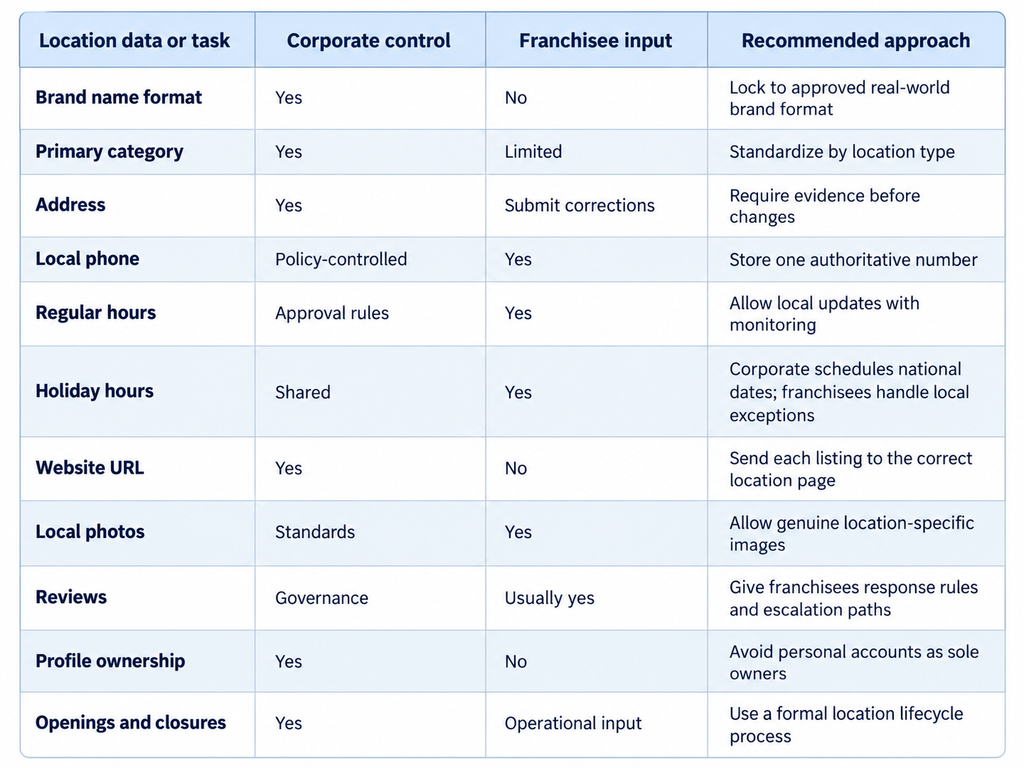
For most franchise networks, the franchisor should retain control of the account structure and high-risk business information.
That does not mean the franchisee should be locked out.
The more practical model is central ownership with controlled local contribution.
Corporate usually controls:
- profile ownership;
- brand naming;
- primary categories;
- location-page URLs;
- core business descriptions;
- opening and closure status;
- publisher connections;
- data standards;
- user permissions; and
- duplicate-management rules.
Franchisees can usually contribute:
- regular-hours corrections;
- special hours;
- local photos;
- local services;
- temporary operational notices;
- review responses; and
- factual corrections that corporate can verify.
Google’s current owner and manager structure supports this kind of separation. Owners have stronger administrative control, while managers can handle most day-to-day profile work without being able to add or remove users. Google also recommends giving each user individual access instead of sharing passwords. Google’s owner and manager documentation provides the current permission details.
The operational rule should be simple: the franchise organization should never depend on one franchisee, employee, former staff member, or external agency as the only person capable of accessing a strategically important listing.
How to Run Franchise Local Listing Management Step by Step
1. Build the Master Location Record
Before fixing listings, establish the correct data internally.
Collect every:
- open location;
- planned location;
- temporarily closed unit;
- recently closed store;
- relocated business;
- sold franchise; and
- location awaiting ownership transfer.
Reconcile that information against your website, operations system, CRM, franchise-management software, point-of-sale system, or another reliable internal source.
Assign every unit a permanent identifier.
For example:
US-042 | Dallas Uptown | Open | Google verified | Apple verified | Audit: Sep 2026
The ID should stay the same when a franchisee, store manager, or employee changes.
2. Define Corporate and Local Permissions
Create a written access policy before handing out platform permissions.
For Google Business Profile, owners and managers have different levels of access. Owners control users, while managers can perform most operating tasks without the same account-administration powers.
Use that distinction intentionally.
A store manager may need to update holiday hours.
They probably do not need permission to remove corporate access.
Do the same for your listings software. Test whether it lets you restrict users by:
- location
- region
- brand
- role
- field
- action type or
- approval requirement.
3. Audit Existing Listings Before Creating Anything
Search for every location before creating a new listing.
Check for:
- the correct active listing;
- duplicate profiles;
- listings at previous addresses;
- former business names;
- incorrect map pins;
- wrong numbers;
- old website links;
- profiles owned by previous franchisees;
- stores incorrectly marked as closed; and
- closed locations still appearing as open.
Google generally expects one Business Profile per real-world business and specifically warns against creating multiple profiles for the same business.
That means “create a new profile” should not be your first answer to an access problem.
Recover, transfer, merge, or correct the existing listing when platform rules support it.
4. Create and Verify Missing Locations
Once the audit is complete, create genuinely missing listings.
Google provides bulk tools for organizations managing multiple Business Profiles. Its documentation says bulk users should include all managed locations and that feeds used for bulk verification need at least 10 locations.
Google’s bulk spreadsheet system can also help multi-location teams organize fields and unique business codes.
Apple needs its own workflow.
In 2026, Apple consolidated Apple Business Connect into the broader Apple Business platform. Apple states that previous Business Connect location and place-card information moved into Apple Business when the platform launched on April 14, 2026. Apple’s official Apple Business announcement documents the change.
Do not keep using “Apple Business Connect” in internal documentation as if it were still the current standalone platform.
5. Monitor Location Changes Continuously
Listings do not remain accurate automatically.
Hours change.
Franchisees switch telephone systems.
Locations move.
Stores temporarily close.
Customers or third parties suggest edits.
Publishers receive data from other sources.
A listing that was correct six months ago may no longer match your records.
A practical franchise workflow is:
- automated monitoring where available;
- weekly review of urgent exceptions;
- monthly review of major-publisher issues; and
- quarterly governance audits.
The monthly and quarterly cadence here is an operational recommendation, not a Google, Apple, or Bing requirement.
The goal is to focus attention on exceptions.
If your network has 800 locations, you should not manually inspect 800 profiles every month. Your system should help identify the 26 profiles with failed updates, rejected changes, ownership problems, duplicates, missing connections, or inconsistent data.
6. Route Changes Through a Controlled Request Process
Give franchisees a simple way to report changes.
For example:
Location: US-042
Field: Saturday hours
Current: 9 AM to 8 PM
Requested: 9 AM to 6 PM
Effective date: October 3, 2026
Permanent: Yes
Reason: Seasonal operating schedule
Routine hour corrections may be approved quickly.
Changes to the business name, address, primary category, ownership, or permanent status should receive more scrutiny.
This prevents two common franchise problems: local operators changing sensitive fields without context and corporate teams becoming a bottleneck for every minor update.
How Should Franchises Manage Google Business Profiles?
Google Business Profile deserves its own operating policy because of how visible it is in local search and Maps.
For most eligible franchise locations, maintain one profile representing each actual customer-facing business location.
Google says locations in the same chain should use consistent names and categories when they provide the same service.
Corporate should establish standard policies for:
- names;
- primary categories;
- approved secondary categories;
- descriptions;
- URLs;
- photos;
- attributes;
- regular hours;
- special hours;
- local posts; and
- review responses.
Opening a New Franchise Location
Do not wait until opening morning to start the listing process.
Google allows a business to enter an opening date up to one year in the future. Once the profile is verified, Google says the profile can appear 90 days before the scheduled opening date. Google’s opening-date guidance explains the current process.
Apple works differently. Apple Business currently allows a new location to use the status Opening Soon, with an opening date no more than six months away. Apple’s location setup documentation covers the current rule.
That is why franchise launch workflows should follow each publisher’s timing rules instead of applying one arbitrary schedule everywhere.
A practical pre-opening workflow might be:
90+ days before opening
Confirm the final business name, address, unit number, local phone, primary category, store code, location-page URL, and expected opening date.
60-90 days before opening
Create or claim supported profiles and begin verification where platform rules allow it.
30 days before opening
Confirm map pins, hours, services, photos, website links, and opening status.
Opening week
Check whether the major profiles are live and whether the displayed hours, phone number, URLs, and location status match reality.
Moving a Franchise Location
A move does not automatically require a brand-new Google profile.
Google allows verified businesses to update their addresses, although a significant change can trigger another verification requirement.
Before creating a second profile, determine whether the existing listing can follow the business to its new location.
Then update the same change across:
- your location database;
- franchise website;
- Google;
- Apple;
- Bing;
- Yelp;
- applicable directories;
- local landing-page structured data;
- advertising location assets; and
- internal operating systems.
A location move should be one controlled business event, not ten unrelated edits.
Handling a Franchise Ownership Change
A sold franchise unit creates one of the most common account-control problems.
If the business continues operating under the same identity, transfer access instead of automatically creating a fresh listing.
Google allows primary ownership to be transferred to another existing owner or manager. Google also notes that newly added owners and managers must wait seven days before certain sensitive actions, including transferring primary ownership or removing other users. Google’s primary-ownership transfer instructions document the current restrictions.
Include listing access in your franchise-sale checklist.
Do not discover after closing that the previous operator still controls the profile.
Closing a Franchise Location
A location that has genuinely stopped operating should be marked accurately as closed.
Do not assume that removing the location from your corporate dashboard means it disappears from public search results.
Your closure checklist should cover:
- Google;
- Apple;
- Bing;
- Yelp;
- franchise store locator;
- location page;
- local structured data;
- local paid campaigns;
- ordering or booking systems;
- review platforms; and
- industry directories.
Keep the closed location in your internal historical database even after its public records have been updated.
You may need that record later to distinguish the closed unit from a new location opening nearby.
Which Directories Matter for Franchise Listings?
Do not measure your listings strategy by the largest directory count you can find.
Start with platforms your customers actually use.
For a US franchise, that usually means evaluating:
- Google;
- Apple Maps;
- Bing;
- Yelp;
- Facebook;
- major navigation services;
- relevant industry directories; and
- important regional or vertical-specific services.
A restaurant franchise, dental network, hotel group, automotive chain, and home-services brand should not automatically prioritize the same publishers.
Coverage should follow customer behavior, business type, geography, and how easily each publisher can be maintained.
If your team is comparing software for distribution, Syssn’s guide to the best local listing management software in 2026 compares current platforms, pricing approaches, and operational fit.
Best Franchise Listing Management Platforms at a Glance
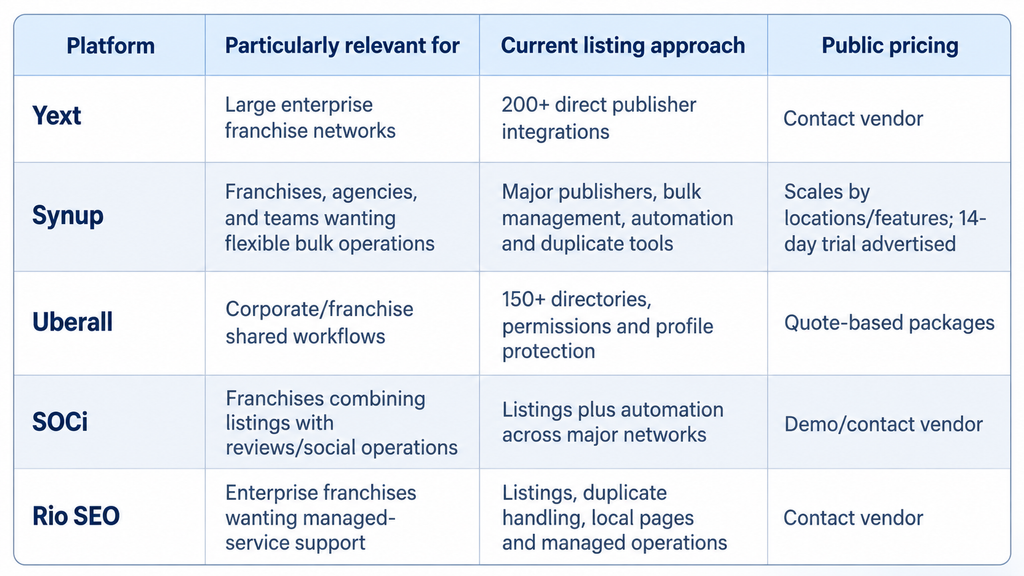
Best Franchise Local Listing Management Platforms in 2026
1. Yext
Best for: Large enterprise franchise networks that need structured location-data management.
Yext is designed around centralized business data and publisher distribution. For franchises with hundreds or thousands of locations, that model can help keep business information organized while different internal teams work from the same structured records.
Its broader local presence product combines listing management with monitoring, duplicate handling, reporting, and permission controls.
For a franchise, the biggest attraction is usually scale. Large brands can model each store, restaurant, clinic, or branch as its own location entity while keeping shared brand data standardized.
That can work particularly well when listings information also needs to feed other systems.
The tradeoff is buying complexity. Yext does not present its enterprise listings product as a simple low-cost self-service tool. Franchise buyers should confirm the exact publisher connections, contract terms, integrations, required modules, user permissions, and offboarding conditions before signing.
Pricing: Contact Yext for current pricing.
Assessment: A strong candidate for enterprise franchises that place structured data governance and broad publisher connectivity near the top of their buying criteria.
2. Synup
Best for: Franchise networks and agencies that need flexible multi-location workflows.
Synup combines local listing management with bulk location controls, duplicate management, reporting, profile monitoring, user management, and broader local marketing functions.
That structure can fit franchise systems where corporate manages the main account while agencies, regional managers, or other teams work across groups of locations.
Synup also appears frequently in agency and reseller workflows, which can matter when a franchise outsources parts of its local marketing program or operates through regional marketing partners.
For a franchise buyer, the useful question is not whether the platform has a long feature list. It is whether you can organize hundreds of locations, apply bulk changes safely, track publisher issues, restrict users appropriately, and see which records require attention.
Teams should also confirm which features sit inside their selected plan, since Synup’s broader product covers listings, reviews, social, SEO, and AI-assisted local marketing functions.
Pricing: Pricing varies with location count and selected capabilities.
Assessment: Particularly relevant for franchises that want listings management without separating every part of local marketing into a different system.
3. Uberall
Best for: Franchise systems that want corporate control while allowing meaningful local participation.
Uberall’s operating model fits the reality of many franchise networks: headquarters owns brand standards, but local operators still need to maintain day-to-day information.
That can include updating hours, managing location content, responding to customers, or working within approval processes established by corporate.
Its listings capabilities cover distribution, duplicate handling, monitoring, profile protection, analytics, and permission-based collaboration.
This approach becomes useful when your franchise network is too decentralized for a corporate-only workflow but too brand-sensitive to let each franchisee operate independently.
Buyers should pay attention to packaging because collaboration, listings, reviews, social, analytics, pages, and other capabilities may sit within different modules or configurations.
Pricing: Quote-based.
Assessment: A good platform to evaluate when the corporate/franchisee relationship matters as much as publisher distribution itself.
4. SOCi
Best for: Franchise marketing teams that want listings connected with broader local marketing operations.
SOCi approaches local listings as one component of a larger multi-location marketing platform.
Its product portfolio connects location data with reputation management, social publishing, local pages, and other local marketing activities.
That can make sense for a franchise organization that does not want a separate platform for each local channel.
For example, a national franchise marketing team may need to manage location information, local reviews, social content, and location pages while still enforcing corporate rules. Using one broader system can simplify administration in that type of setup.
The tradeoff is scope. If you only need listings distribution and monitoring, a broader platform may introduce more functionality than you require.
Pricing: Contact SOCi.
Assessment: Best evaluated by established franchise marketing teams looking for a multi-function local marketing platform rather than a listings-only product.
5. Rio SEO

Best for: Enterprise franchise organizations that want managed support alongside software.
Rio SEO combines local listings with local pages, store locators, reviews, reporting, and managed local marketing services.
Its service component can matter for organizations that do not want an internal marketing team resolving every duplicate, verification problem, listing conflict, or publisher exception.
That can be particularly useful when a franchise network has thousands of records but a relatively small internal local SEO team.
Franchise buyers should still determine how much work remains with their staff, what the vendor manages directly, which publishers are supported, and how account ownership works.
The product is oriented more toward enterprise engagement than simple self-service purchasing.
Pricing: Contact Rio SEO.
Assessment: A sensible option to consider when managed operational support carries as much weight as the listings technology.
Yext vs Synup for Franchise Listing Management
Yext and Synup can both manage large sets of location data, but their buying cases are different.
Yext is particularly suited to organizations that want a structured enterprise data layer tied to a large publisher-distribution system.
Synup can make more sense when franchise operations overlap with agency workflows, broader local marketing work, bulk management, and multi-client or multi-location organization.
For either one, ask the vendor to demonstrate your real workflow.
Give them 20 representative locations and ask how they would handle:
- a bulk hours update;
- a new franchise opening;
- a duplicate profile;
- a location move;
- a sold franchise;
- a closed store; and
- a franchisee who should only control three locations.
That test is more useful than comparing homepage feature lists.
Yext vs Uberall for Franchise Listing Management
Yext places more emphasis on centralized structured data and publisher distribution.
Uberall makes distributed local participation a prominent part of its franchise proposition.
If headquarters wants nearly all listing activity to remain central, Yext may fit that operating model well.
If franchisees or local managers actively maintain parts of their presence, Uberall’s permission and collaboration model may deserve closer attention.
Neither approach is automatically better.
The correct choice depends on how your franchise actually operates.
How We Evaluated These Platforms
The comparison focuses on franchise operations rather than general local SEO popularity.
The main criteria were:
- multi-location data management;
- bulk editing;
- publisher distribution;
- duplicate handling;
- corporate and franchisee permission controls;
- monitoring;
- reporting;
- integrations;
- location lifecycle workflows; and
- operational scalability.
We also considered whether a platform can support real franchise scenarios such as opening locations, transferring ownership, closing stores, changing hours across hundreds of locations, and limiting individual users to specific business units.
Pricing marked as quote-based means a dependable public self-service price was not available in the current materials reviewed.
Publisher-network figures also need careful interpretation. Vendors may count publishers, endpoints, integrations, data partners, or directories differently, so network totals should not be compared as if they are identical measures.
How to Choose the Right Franchise Listing Management Platform
Start With Your Governance Model
Do not begin with directory counts.
First decide who is allowed to change what.
A platform that works for a tightly controlled corporate-owned network may be frustrating for a franchise system where local operators manage their own hours and reviews.
Document your desired permission structure before the demo.
Test the Publishers That Actually Matter
Ask every vendor for coverage of your priority publishers.
A list of 200 connections is not automatically better than 100 if the smaller network includes every service important to your customers.
Ask:
- Is the connection direct?
- Which fields can be updated?
- Can the platform read changes back?
- How quickly are updates normally processed?
- How are rejected changes reported?
- What happens to unsupported fields?
Test Real Location Lifecycle Events
Ask the salesperson to demonstrate a complete workflow for:
- opening a location;
- changing holiday hours;
- moving an existing store;
- transferring franchise ownership;
- closing a location; and
- resolving a duplicate.
If the demo cannot handle those six situations clearly, the polished dashboard matters less.
Check What Happens When You Leave
Franchises change agencies and software vendors.
Before signing, ask:
Who owns the Google profiles?
Who owns Apple and other publisher accounts?
What remains published if the agreement ends?
Can corporate continue managing the listings directly?
What data can you export?
How are user permissions removed?
This is one reason it helps to understand local listings management software as an operating layer rather than the permanent owner of your business identity.
Best Franchise Listing Platforms by Use Case
| Use case | Platform to evaluate |
|---|---|
| Large enterprise location-data management | Yext |
| Franchise and agency-style multi-location workflows | Synup |
| Corporate plus franchisee collaboration | Uberall |
| Listings combined with reviews and local social | SOCi |
| Enterprise software plus managed support | Rio SEO |
| Smaller networks comfortable with native publisher tools | Google Business Profile and Apple Business |
This table is about product fit, not a universal ranking. Location count, franchise structure, existing technology, publisher requirements, support expectations, and contract terms can change the decision.
How Often Should Franchise Listings Be Audited?
For most franchise networks, continuous monitoring plus a monthly exception review is more useful than manually checking every profile on a fixed schedule.
Run a deeper governance audit quarterly.
A monthly review might focus on:
- rejected updates;
- duplicate profiles;
- failed publisher connections;
- incorrect opening hours;
- missing verification;
- unexpected category changes;
- profile suspensions; and
- location records that no longer match corporate data.
A quarterly audit can go deeper into:
- ownership;
- access permissions;
- former employees;
- former agencies;
- closed locations;
- location-page URLs;
- categories;
- outdated services;
- duplicate records; and
- mismatches between listings and the franchise website.
This schedule is an operating recommendation. Publishers do not require franchises to perform monthly or quarterly audits.
How Franchise Listings Support Search and AI-Assisted Discovery
Franchise listings now feed a wider discovery environment than classic directory search.
Customers may encounter your location through Google Maps, Apple Maps, a traditional search result, navigation software, a directory, or an AI-assisted interface.
That makes consistent location information more important.
Your franchise website should agree with your major listing profiles.
Google also supports LocalBusiness structured data for physical locations. It can communicate information such as business hours and other location details to Google Search. Google Search Central’s LocalBusiness structured data documentation explains the supported markup and implementation guidance.
For example, if your website says a store closes at 8 PM, Google says 9 PM, and another directory says 10 PM, you have three conflicting facts about one location.
No listings platform can guarantee that your locations will appear in ChatGPT, Gemini, Copilot, Perplexity, or another AI-generated response.
The practical goal is to keep accurate location information accessible and consistent across your website and important external sources.
Frequently Asked Questions
What is franchise local listing management?
Franchise local listing management is the process of creating, controlling, updating, monitoring, and retiring business information for multiple franchise locations across Google, Apple, Bing, Yelp, directories, navigation services, and other local discovery platforms.
Who should manage franchise listings, the franchisor or franchisee?
Corporate should usually retain ownership and control of brand-sensitive fields. Franchisees can manage approved local information such as special hours, location-specific photos, operational updates, and review responses.
Should every franchise location have its own Google Business Profile?
An eligible physical location serving customers will generally need its own profile. Google also says there should normally be only one profile for each real-world business location.
Can a franchise location appear on Google before opening?
Yes. Google lets businesses enter an opening date up to one year in advance and says verified profiles can appear 90 days before opening.
Apple Business also supports an Opening Soon status, but its current documentation limits the future opening date to six months.
How do franchises prevent duplicate listings?
Keep central ownership, search before creating profiles, assign permanent store IDs, monitor publisher records, and prevent local teams from creating new profiles without approval.
What happens when a franchise changes ownership?
If the underlying business continues, review whether profile ownership can be transferred rather than creating a duplicate listing. Google supports primary ownership transfers and applies a seven-day restriction to some actions for newly added owners and managers.
How can a franchise manage hundreds of locations efficiently?
Maintain one central location database, use bulk-management or listings software, automate low-risk updates, route sensitive changes through approvals, monitor exceptions, and give users access only to the locations they actually manage.
Final Recommendation
A good franchise local listing management program starts with governance, not software.
Create one authoritative record for every location. Keep permanent corporate control of major publisher accounts. Decide which fields franchisees can edit and which require approval. Then create repeatable workflows for openings, moves, ownership changes, holiday hours, temporary closures, permanent closures, and duplicates.
For smaller franchise systems, Google’s native tools, Apple Business, and other publisher dashboards may be enough.
Once your organization reaches dozens or hundreds of locations, the administrative burden changes. Dedicated platforms such as Yext, Synup, Uberall, SOCi, and Rio SEO can help centralize location data, bulk changes, monitoring, permissions, and reporting.
The most important buying test is not how many directories appear on the vendor’s website.
Ask whether your team can change one location fact once, publish it to the services that matter, confirm whether those publishers accepted it, and retain control of that location through opening, operation, ownership changes, relocation, and closure.
That is the standard a franchise listings system should meet in 2026.


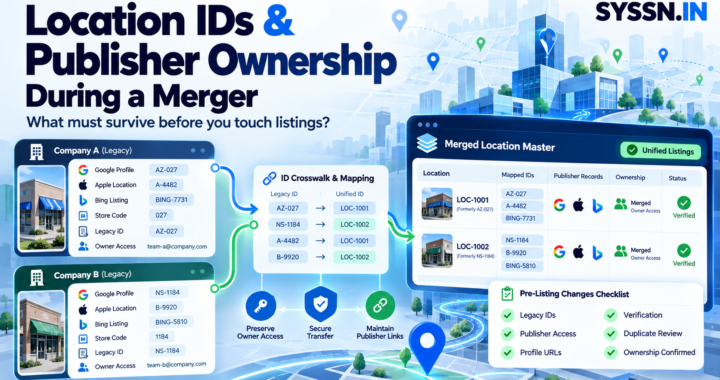
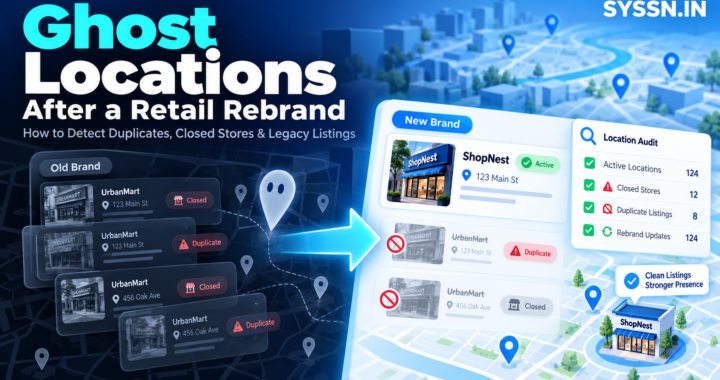
[…] For franchise networks, ownership can become especially complicated because local operators have legitimate local knowledge while the franchisor must protect network-wide consistency. Syssn’s franchise local listing management guide covers that operating model in more detail. How to Run Franchise Local Listing Management in 2026 […]