Franchise SEO Services: What to Expect and What to Ask


Franchise SEO services help franchise businesses improve their visibility in Google Search, Google Maps, and local search results across multiple locations. These services typically include Google Business Profile management, location-page optimization, technical SEO, business listing management, local content, reputation management, and performance reporting.
The cost depends on location count, competition, website condition, and service scope. Providers such as HigherVisibility, WebFX, Thrive, Ignite Visibility, and Searchbloom offer managed marketing services, while Synup provides software for centralizing local search operations.
Before hiring a provider, franchisors should compare deliverables, account ownership, reporting capabilities, pricing models, and contract terms.
This guide explains what franchise SEO services include, how to evaluate providers, what influences costs, and which questions to ask before signing an agreement.
What Are Franchise SEO Services?
Franchise SEO services are search engine optimization solutions designed for businesses operating multiple franchise locations.
Unlike SEO for a single-location business, franchise SEO must coordinate corporate website visibility with the search performance of individual branches.
The strategy typically addresses two objectives:
- Brand-level SEO: Improving the corporate website’s technical performance, content, organic visibility, and ability to attract customers or prospective franchisees.
- Location-level SEO: Helping individual franchise locations become discoverable for geographically relevant searches, such as “pizza delivery in Dallas” or “plumbing services near me.”
For example, a cleaning franchise operating 75 locations across the United States must maintain consistent branding while competing against independent cleaning businesses in each local market.
The challenge is ensuring that customers can find the right franchise location, identify its services, and access accurate contact information.
Franchise SEO providers must therefore coordinate website architecture, location pages, Google Business Profiles, business listings, and local marketing activities.
According to Google’s local ranking guidance, local results are primarily influenced by relevance, distance, and prominence.
Accurate business information, relevant content, and a well-maintained digital presence can support local discoverability. However, no agency can guarantee a specific organic ranking or Google Maps position.
What Do Franchise SEO Services Typically Include?
A franchise SEO company should provide a clearly defined scope covering both shared brand requirements and individual location needs.
The exact services depend on the franchise’s size, website condition, internal resources, and marketing objectives.
1. Franchise SEO Audit
An SEO audit identifies technical, content, and operational problems affecting search visibility across the franchise network.
A comprehensive audit should evaluate:
- Website architecture, crawling, and indexing
- Corporate and individual location pages
- Google Business Profile eligibility and accuracy
- Missing, duplicate, or outdated business listings
- Mobile usability and page performance
- Local keyword targeting and search intent
- Internal linking and structured data
- Local competitors in priority markets
- Search traffic, conversions, and reporting accuracy
For example, a franchise may discover that several location pages are excluded from Google’s index, some branches have incorrect opening hours, and newly opened locations have not been added to the website’s store locator.
These problems require different solutions.
The audit should therefore produce a prioritized implementation plan explaining what needs fixing, which teams are responsible, and how improvements will be measured.
A useful audit is an operational starting point, not simply a collection of automated SEO scores.
2. Google Business Profile Optimization
Google Business Profile management is an important component of franchise local SEO.
Each eligible location should have an accurate profile representing the real business.
Typical management activities include verifying eligible profiles, maintaining business names and categories, updating hours, selecting applicable attributes, uploading relevant photos, and resolving duplicate records.
Franchise brands must also follow Google’s guidelines for representing a business.
Google’s rules require consistency in the real-world names of chain locations, subject to specified exceptions. Categories should also remain consistent when branches provide the same services.
Not every business address qualifies for a separate Business Profile. Eligibility depends on the business model and whether the location meets Google’s requirements.
Franchise networks should establish a consistent process for:
- New location openings and verification
- Temporary and permanent closures
- Business relocations
- Incorrect map pins and duplicate profiles
- Ownership and manager permissions
- Business information updates
Google offers bulk verification for qualifying businesses with ten or more profiles, but eligibility restrictions apply. For example, agencies cannot combine unrelated businesses to qualify, and service-area businesses without qualifying customer-facing locations are generally excluded from this process.
An experienced franchise SEO provider should understand these distinctions rather than assuming every branch can be verified in the same way.
3. Franchise Location Page Optimization
Location pages connect geographically relevant searches with the franchise branch best suited to serve the customer.
Many franchise websites use a centralized domain with individual URLs for each branch.
For example:
example.com/locations/phoenix/
example.com/locations/austin/
example.com/locations/tampa/
Each page should contain useful information about the actual location.
Depending on the business, this may include its address, telephone number, operating hours, available services, appointment options, accessibility information, parking details, and directions.
Location pages should also explain meaningful differences between branches.
An automotive repair franchise, for example, might offer vehicle inspections at one location but not another. Its website should communicate this accurately instead of publishing the same service description everywhere.
A consistent page template is not inherently problematic. The concern arises when large numbers of pages provide little distinctive value or exist primarily to capture slightly different geographic searches.
Google’s spam policies specifically address doorway abuse and scaled content created mainly to manipulate search rankings.
Franchise businesses should also consider LocalBusiness structured data where appropriate.
This markup can describe information such as addresses and operating hours in a machine-readable format. It should accurately reflect the visible page content.
Structured data does not guarantee higher rankings or special search appearances.
4. Local Citations and Business Listing Management
Local citations are references to a business’s name, address, telephone number, and related information across online platforms.
For franchises, listing management involves maintaining accurate information across relevant publishers, such as:
- Google Business Profile
- Apple Maps
- Bing Places
- Yelp
- Industry-specific directories
The most important objective is to help customers find trustworthy information about each branch.
A franchise network should maintain one approved location database containing essential information, including business names, addresses, telephone numbers, opening hours, website URLs, and operating status.
This reduces the likelihood of conflicting updates.
For example, if a restaurant franchise changes the operating hours of 20 branches, the changes should be approved centrally and distributed across supported platforms using a consistent process.
Listing software can reduce repetitive work, although updates may take different amounts of time to appear on individual publishers.
For more operational guidance, see how to manage business listings across franchise locations.
5. Local Content and Link Development
Franchise SEO services may include creating content that addresses customer needs within individual markets.
Useful examples include location-specific service information, seasonal operating details, local promotions, community activities, and explanations of services genuinely available at particular branches.
Not every city requires its own blog article.
Content should be created because it helps customers make decisions, not merely because a keyword variation exists.
Local link development may involve earning relevant editorial mentions through community organizations, business partnerships, local publications, and industry resources.
Providers should be able to explain how they evaluate potential links.
Avoid agencies promising large numbers of backlinks without disclosing their methods or the kinds of websites involved.
Google’s link spam policies prohibit practices intended primarily to manipulate search rankings, including certain link schemes.
6. Review and Reputation Management
Customer reviews help potential customers evaluate individual franchise locations.
They can also contribute to local search prominence. Google’s local ranking documentation identifies reviews and positive ratings among the signals associated with prominence.
A franchise reputation management program may include review monitoring, response workflows, customer feedback analysis, escalation procedures, and location-level reporting.
Franchisors should set response standards while enabling local teams to address problems they understand firsthand.
For example, a corporate team may provide approved guidelines for responding to complaints, while the local manager investigates a specific service issue.
Review requests must comply with platform policies.
Google allows businesses to request genuine reviews without incentives or attempts to influence the rating. Paid reviews, fabricated experiences, and incentives offered in exchange for reviews violate its Maps content policies.
A provider should never promise a guaranteed number of positive reviews or suggest suppressing legitimate negative feedback through deceptive practices.
7. Technical SEO and Website Governance
Technical SEO ensures that search engines can discover and understand important franchise website pages.
Common tasks include addressing crawl errors, reviewing XML sitemaps, improving internal navigation, fixing broken links, evaluating page speed, and managing canonical URLs.
Franchise networks also need clear publishing rules.
Without coordinated governance, local teams may create unnecessary duplicate URLs, launch separate websites without approval, or change important page details without updating corporate records.
A good provider should explain which technical changes it can implement directly and which require development-team approval.
8. Reporting and Performance Measurement
Franchise SEO reporting should distinguish corporate-level performance from individual branch results.
Useful metrics include organic traffic, Google Search Console impressions and clicks, location-page conversions, Google Business Profile interactions, qualified calls, bookings, and attributable sales where reliable data is available.
Corporate teams need consolidated performance reporting.
Franchisees need location-specific information that helps them understand local performance.
Reports should identify what work was completed, which locations improved, which declined, and what actions are planned next.
Franchise SEO Services at a Glance
| Service | Typical deliverable | Business value |
|---|---|---|
| SEO audit | Prioritized technical and local findings | Identifies important problems |
| Google Business Profile management | Accurate, appropriately managed eligible profiles | Helps customers discover correct locations |
| Location page optimization | Useful pages for individual branches | Connects local searches with relevant locations |
| Listing management | Business information corrections and updates | Reduces inaccurate records |
| Local content | Market-relevant information | Helps customers understand available services |
| Review management | Monitoring and response workflows | Supports customer trust |
| Technical SEO | Crawlability and site improvements | Improves website accessibility for search engines |
| Performance reporting | Corporate and location-level dashboards | Supports informed marketing decisions |
Not every franchise SEO package includes these activities.
Buyers should ask which services are included, which are optional, and who is responsible for implementation.
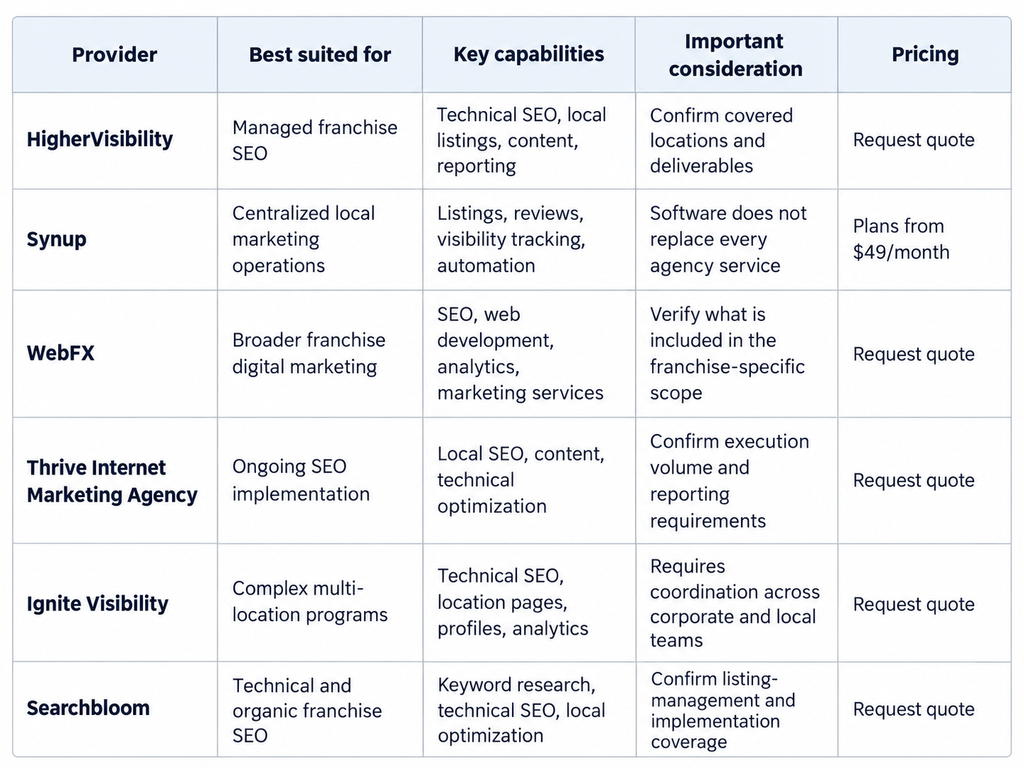
6 Franchise SEO Service Providers and Platforms to Compare in 2026
Franchise SEO buyers can choose between managed service agencies, specialized software platforms, and combinations of both.
The following six providers represent different approaches to franchise search operations.
Five offer agency-led marketing services. Synup provides software for coordinating multi-location business information, reviews, local visibility, and related marketing workflows.
This is an evaluation shortlist, not an independently tested ranking.
Quick Comparison
How These Providers Were Evaluated
This comparison considers the providers’ publicly described franchise or multi-location capabilities, service models, operational scalability, location management features, reporting approaches, and pricing transparency.
The information is based on publicly accessible company documentation reviewed in October 2026.
It is not based on equivalent hands-on testing, independent client interviews, or verified comparative performance results.
The suitability descriptions indicate which kinds of buyers may find a provider relevant; they are not claims that a company delivers better results than its competitors.
1. HigherVisibility

Best for: Franchisors and franchisees seeking an agency to develop and execute an ongoing SEO strategy.
What it offers: HigherVisibility describes franchise SEO services covering technical website analysis, keyword research, content optimization, business listings, link development, review monitoring, and performance reporting. Its offering addresses both franchise location marketing and broader brand visibility.
Key strengths: Its franchise-specific service offering makes it relevant for organizations that need coordinated website and local SEO execution. The company also describes structured reporting and account management, which buyers can evaluate during the proposal process.
Limitations: The exact scope is customized. Buyers should confirm the number of covered locations, planned content deliverables, technical implementation responsibilities, and frequency of reporting. An agency’s published service list does not mean every service is included in every contract.
Pricing: Request a proposal based on the franchise network’s requirements.
Consider HigherVisibility if: You need an agency to coordinate technical SEO, local search strategy, and recurring optimization rather than a standalone listings tool.
2. Synup
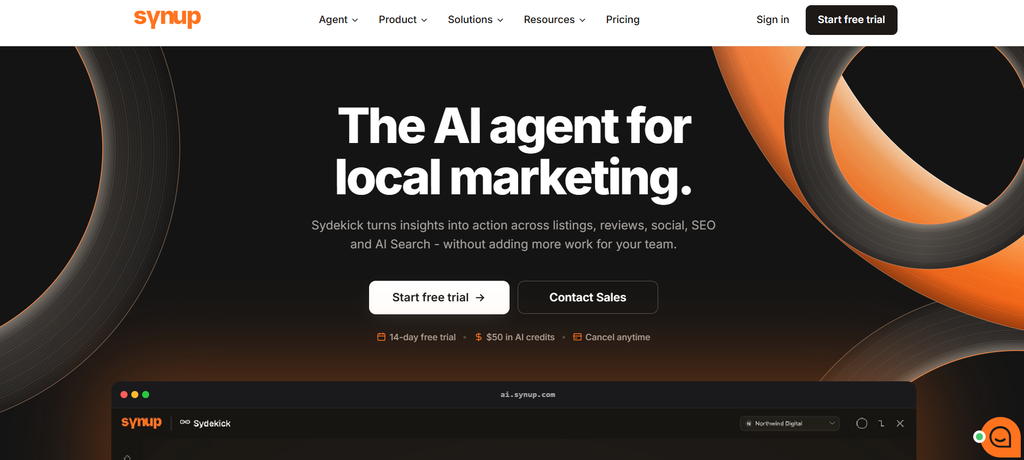
Best for: Franchise networks, multi-location brands, and agencies that need centralized tools for managing business information and local marketing workflows.
What it offers: Synup provides listing distribution, business profile monitoring, review workflows, local search visibility tracking, reporting, and automation. Its current platform also describes location landing-page capabilities, local rank grids, social publishing, and AI-assisted workflows. Supported publishers include Google, Apple Maps, Bing, and Facebook.
Key strengths: Centralized location records and bulk management can reduce repetitive tasks across franchise networks. Its reporting and monitoring capabilities help teams identify inconsistent listings, duplicate records, and local visibility issues. Location-based subscriptions also provide a published starting point for budgeting.
Limitations: Synup is a software-led solution rather than a guaranteed replacement for a full-service SEO agency. Complex technical audits, custom editorial campaigns, and link outreach may still require internal specialists or external support. Buyers should also evaluate its usage-based automation credits and account-permission controls.
Pricing: Synup’s published monthly pricing includes $49 for one location, $299 for up to 10 locations, $499 for up to 25, and $899 for up to 50. Enterprise arrangements are available for larger portfolios. Pricing and included usage should be confirmed before purchase.
Consider Synup if: Your main requirement is coordinated listings, reviews, local visibility monitoring, and repeatable marketing workflows across multiple locations.
Official Synup listings management overview | Synup pricing
3. WebFX
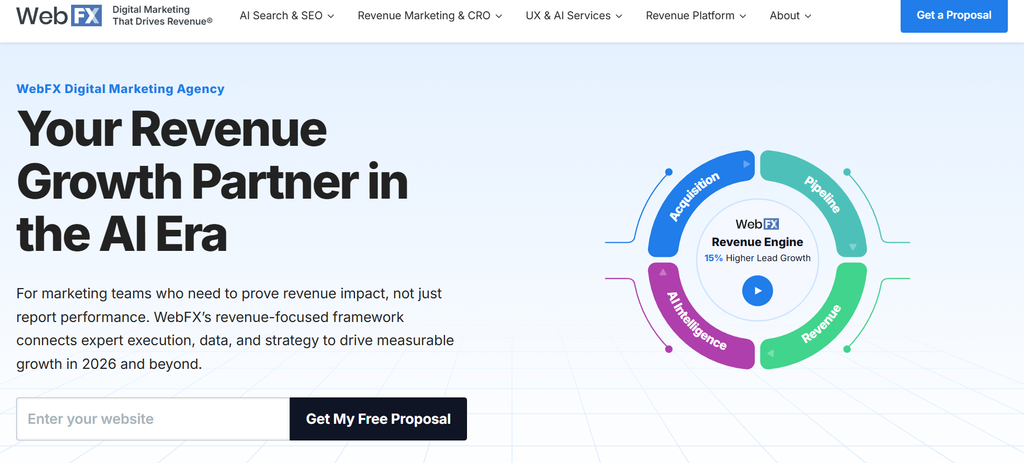
Best for: Franchise organizations looking to coordinate SEO with website development, analytics, social media, and other digital marketing activities.
What it offers: WebFX provides franchise-focused digital marketing services that include multi-location SEO, website services, review management, and other marketing activities. Its franchise offering combines marketing technology with agency support.
Key strengths: Access to several digital marketing disciplines can be useful when the franchise needs more than organic search optimization. A coordinated engagement may help connect website work with lead generation, reporting, and other customer acquisition activities.
Limitations: Broad service availability does not establish what is included in a specific SEO contract. Buyers should verify the level of Google Business Profile management, branch-specific content, technical implementation, reporting, and support offered under the proposed agreement.
Pricing: WebFX publishes general SEO pricing information, but those figures should not be treated as a confirmed franchise-specific service quotation. Request an itemized proposal.
Consider WebFX if: Your franchise needs SEO alongside other marketing services and wants a provider capable of coordinating several workstreams.
4. Thrive Internet Marketing Agency

Best for: Franchise organizations seeking outsourced SEO activities such as local optimization, content development, website improvements, and reporting.
What it offers: Thrive markets franchise SEO services addressing keyword research, location-specific optimization, content, technical SEO, and digital marketing. Its broader service portfolio also includes reputation management and local marketing support.
Key strengths: The agency offers multiple services relevant to franchises managing both brand consistency and location-level visibility. This makes it worth evaluating for companies seeking recurring execution rather than occasional technical consulting.
Limitations: Buyers should confirm the actual monthly production scope. Important questions include how many location pages will be updated, which profiles the agency will manage, what technical fixes are included, and whether content creation or additional services incur separate charges.
Pricing: Request a franchise-specific quotation with documented deliverables.
Consider Thrive if: You need ongoing agency support for local content, technical optimization, and coordinated franchise SEO activities.
5. Ignite Visibility

Best for: Larger franchise networks requiring coordination across corporate marketing teams, regional groups, and individual locations.
What it offers: Ignite Visibility describes franchise SEO services involving competitive audits, geographic keyword mapping, technical optimization, location-page development, Google Business Profile work, listings, and performance reporting. Its published approach also emphasizes conversion tracking and coordination between corporate controls and local marketing.
Key strengths: Its documented program covers both website-level SEO and operational challenges associated with managing numerous locations. Location-specific reporting and approval processes are particularly relevant to franchise organizations with several stakeholders.
Limitations: Large-scale SEO implementation requires reliable internal coordination, accurate location data, and clear account permissions. Buyers should verify which platform integrations, content activities, technical changes, and reporting functions are included in their proposed engagement.
Pricing: Request a customized proposal based on location count, website requirements, and reporting complexity.
Consider Ignite Visibility if: Your franchise requires coordinated SEO governance, technical execution, and location-level performance measurement across a substantial network.
6. Searchbloom
Best for: Franchisors seeking an agency-led SEO campaign emphasizing website optimization, organic search performance, and local relevance.
What it offers: Searchbloom describes franchise SEO services covering keyword research, competitor analysis, localized optimization, technical SEO, and content improvements. Its published approach emphasizes authority, relevancy, and technology as components of its SEO methodology.
Key strengths: Its technical and content-oriented service offering makes it relevant for franchises with website architecture problems, underperforming location pages, or inconsistent organic visibility across markets. Its franchise offering also considers the relationship between corporate and local search requirements.
Limitations: Buyers should establish whether ongoing listing maintenance, review workflows, Google Business Profile changes, and location-page production are included in the contract. A technically focused engagement may not provide every operational service that a large franchise network needs.
Pricing: Request a customized franchise SEO proposal.
Consider Searchbloom if: Your priority is improving technical SEO foundations and organic search visibility across franchise locations.
How Much Do Franchise SEO Services Cost in 2026?
Franchise SEO pricing depends on the number of locations, competitive environment, website condition, reporting requirements, and services included.
There is no universally applicable price per franchise location.
A franchise with eight branches needing business profile maintenance has different requirements from a network with 300 branches requiring location-page development, technical SEO, CRM integration, and ongoing local content.
Software subscriptions and managed SEO retainers should also be evaluated separately.
Common Franchise SEO Pricing Models
| Pricing model | How it works | Suitable use |
|---|---|---|
| Monthly retainer | Recurring fee covering agreed agency activities | Ongoing managed SEO |
| Per-location pricing | Fees based on the number of managed locations | Listings and local marketing software |
| Base fee plus location fee | Central management fee plus branch-level charges | Growing multi-location networks |
| Project-based pricing | Fixed price for specific deliverables | Audits, migrations, technical fixes |
| Enterprise contracts | Customized scope, technology, support, and pricing | Large franchise networks |
Published Pricing Examples
Synup currently publishes the following monthly subscription tiers:
| Synup plan | Monthly price | Included locations |
|---|---|---|
| Solo | $49 | 1 |
| Premium | $299 | Up to 10 |
| Pro | $499 | Up to 25 |
| Scale | $899 | Up to 50 |
| Enterprise | Custom contract | More than 50 |
These are published software subscription prices, not full-service franchise SEO agency fees. The plans have different automation capacities and credit allowances, and billing terms may affect the final cost.
WebFX publishes general SEO pricing guidance, including typical monthly retainer ranges, but those figures are not franchise-specific quotations and should not be presented as the price of a particular WebFX franchise package.
For HigherVisibility, Thrive, Ignite Visibility, Searchbloom, and franchise-specific WebFX engagements, request written proposals covering the same requirements before comparing prices.
What Affects Franchise SEO Costs?
Several factors determine the final investment.
Number of locations: More locations typically create additional management, quality control, and reporting requirements.
Market competition: Franchises competing in highly contested metropolitan markets may require more research, content, and optimization.
Website condition: Outdated architecture, crawling problems, missing location pages, and technical issues can increase initial implementation work.
Services included: A contract covering technical SEO, content creation, reporting, and local search management will usually involve more work than listings maintenance alone.
Reporting and integrations: CRM connections, call tracking, location-level dashboards, and custom data integrations may introduce additional costs.
Franchise governance: Approval processes involving franchisors, franchisees, regional managers, and external vendors can affect implementation complexity.
When evaluating proposals, ask for setup costs, monthly fees, location additions, content allowances, technology charges, and additional service rates.
Example: Comparing Two Franchise SEO Proposals
Suppose two agencies submit proposals for a franchise network with 40 locations.
Agency A offers a lower monthly retainer covering technical recommendations, website monitoring, and quarterly strategy reviews.
Agency B charges more but includes recurring location-page updates, business profile management, and location-specific reporting.
Agency A may be appropriate if the franchisor has an internal SEO team capable of implementing recommendations.
Agency B may be more suitable if the company needs outsourced execution.
The key is to compare what the franchise receives, not just the total monthly price.
Franchise SEO vs. Traditional SEO: What’s Different?
Traditional SEO and franchise SEO share many technical and content optimization practices.
The difference is the number of locations, stakeholders, and local markets that must be coordinated.
| Factor | Traditional SEO | Franchise SEO |
|---|---|---|
| Primary focus | One business or website | Corporate brand and multiple markets |
| Keyword strategy | Business-wide topics and customer intent | Brand-level and location-specific search intent |
| Google Business Profiles | Often one or a small number | Separate profiles for eligible locations |
| Website architecture | Core service and content pages | Corporate pages, location finder, individual location pages |
| Listings management | Smaller number of records | Coordinated information across many branches |
| Reporting | Website-wide results | Corporate and location-level results |
| Governance | Usually one central decision-making team | Franchisor, franchisees, agency, and sometimes regional teams |
For example, a traditional SEO campaign might optimize one plumbing company’s website.
A franchise SEO campaign may need to optimize the corporate plumbing brand, coordinate location pages across multiple states, and monitor the performance of individual service areas.
A provider experienced in single-location SEO may understand keyword research and technical optimization but still need additional expertise to manage franchise approvals, location records, profile permissions, and reporting.
Those operational capabilities should be evaluated during the hiring process.
What Should a Franchisor Ask Before Hiring a Franchise SEO Agency?
Selecting a franchise SEO provider involves more than reviewing service lists and pricing.
The following questions help identify whether a provider understands multi-location implementation and can demonstrate accountability.
1. Have You Worked With Franchise Businesses of Our Size?
Ask for relevant examples involving comparable industries, location counts, and ownership structures.
A campaign for five branches may require different processes from one involving 150 franchisees.
Request permission-based case studies or references where available, and distinguish published client claims from independently verified results.
2. What Exactly Is Included in the SEO Package?
Request written deliverables rather than broad descriptions such as “complete SEO optimization.”
A proposal should identify which technical changes, location pages, business profiles, content activities, and reporting responsibilities are included.
Ask how frequently each task will be completed and who implements it.
3. Who Controls Our Website, Listings, and Analytics Accounts?
Clarify administrative control of the corporate website, Google Business Profiles, Google Search Console, analytics accounts, and other business assets.
The appropriate ownership arrangement may depend on the franchise structure, but businesses should avoid arrangements where a vendor’s departure prevents access to essential assets.
Ask how permissions will be granted and revoked when the agreement ends.
4. How Do You Manage Multiple Franchise Locations?
The provider should describe its location-data management process.
Ask how it handles newly opened branches, address changes, duplicate profiles, closures, verification issues, and franchisee approvals.
If the agency claims to manage hundreds of locations, ask to see the operational workflow that supports this work.
5. How Do You Prevent Low-Value Location Pages?
Ask to review location-page examples.
The provider should demonstrate how pages communicate actual branch information rather than relying on large quantities of interchangeable city-keyword text.
Consistent templates are acceptable when they help users and support meaningful local information.
Google’s spam policies distinguish useful content from doorway pages and scaled material produced primarily to manipulate rankings.
6. How Will You Measure Franchise SEO ROI?
Ask which metrics are included in reporting and how they connect to business outcomes.
Rankings and visibility can help diagnose progress, but they are not complete measures of return.
A useful reporting framework should identify qualified leads, bookings, calls, purchases, or other relevant conversions where measurement is possible.
7. Can Franchisees See Their Individual Performance?
Franchisees should be able to understand results for their own locations.
Request a sample report showing branch-level traffic, customer inquiries, conversion trends, and the work completed.
Reports should explain the metrics clearly rather than relying on an unexplained proprietary score.
8. What Happens When a Location Opens, Closes, or Relocates?
Ask for the workflow and expected turnaround time for updating website pages, profiles, and supported directories.
The provider should distinguish between work it controls directly and changes that depend on external publisher processing.
9. What Is Your Approach to Content and Backlinks?
A credible provider should explain how it researches customer needs, develops useful content, and identifies legitimate link opportunities.
Avoid providers that depend on keyword stuffing, misleading business names, purchased ranking guarantees, or automated location pages without meaningful editorial review.
Google’s SEO Starter Guide provides a useful reference for evaluating fundamental optimization practices.
10. What Are the Contract Terms and Exit Procedures?
Review contract length, cancellation notice, implementation fees, access permissions, data portability, and handover requirements.
Ask what happens to completed content, analytics configurations, reports, and platform connections when the contract ends.
A clearly documented exit process reduces operational risk.
Should Franchisees Pay for Local SEO Themselves?
Franchise SEO funding can be centralized, franchisee-funded, or shared.
There is no single funding arrangement suitable for every franchise system.
A practical approach is for the franchisor to coordinate shared infrastructure and brand standards while franchisees contribute local information and fund agreed market-specific initiatives where appropriate.
The actual arrangement depends on franchise agreements, marketing fund provisions, ownership responsibilities, and business needs.
Recommended Division of Responsibilities
| Responsibility | Franchisor | Franchisee |
|---|---|---|
| Corporate website SEO | Manages brand-level strategy | Provides relevant market input |
| Location page architecture | Maintains templates and technical systems | Supplies accurate local information |
| Google Business Profile governance | Sets standards and access rules | Confirms local business information |
| Brand consistency | Defines policies | Applies approved standards |
| Local promotions | Establishes approval requirements | Proposes and supports local initiatives |
| Review management | Defines response policies | Addresses local customer issues |
| Performance reporting | Maintains shared reporting framework | Reviews location-level results |
| SEO investment | Funds agreed central services | Funds agreed location-specific activities |
Common Funding Models
Centralized funding: The franchisor pays for the shared SEO program. This can help maintain consistent implementation, technology, and reporting across the network.
Franchisee-funded marketing: Individual franchisees pay for their local SEO activities within any applicable brand requirements. This provides local flexibility but may produce differences in service quality and execution.
Hybrid funding: The franchisor funds common infrastructure, while individual franchisees pay for agreed additional local services.
The hybrid model can be a useful option when the franchise needs both centralized standards and local flexibility. It should not be treated as a universal requirement.
Before introducing mandatory charges or changing marketing fund arrangements, franchisors should seek qualified legal advice regarding their agreements and applicable disclosure obligations.
How to Choose the Right Franchise SEO Provider
The right provider depends on which problems the franchise needs to solve and whether its internal team can execute the required work.
Match the Provider to Your Main Requirement
For full-service franchise SEO: Evaluate agencies such as HigherVisibility, WebFX, Thrive, Ignite Visibility, and Searchbloom. Ask each to quote against the same list of technical, content, local search, and reporting responsibilities.
For centralized listings and local marketing operations: Evaluate Synup when the main challenge involves managing business information, reviews, local search visibility, and repetitive workflows across many locations.
For enterprise-scale implementation: Prioritize providers that can demonstrate clear account governance, implementation processes, reporting integrations, and location-level accountability.
For a smaller franchise network: Start with a technical audit, eligible business profiles, useful location pages, and accurate essential listings before purchasing extensive services.
A franchise can also use a software platform alongside an SEO agency. For example, internal teams might use listing-management technology while outsourcing website optimization and editorial content to specialists.
For more information about this software category, see local SEO tools for multiple locations.
A Practical Vendor Evaluation Framework
Before requesting proposals, define the franchise’s most important requirements.
| Evaluation criterion | What to examine |
|---|---|
| Franchise experience | Relevant operational experience and documented processes |
| Technical SEO | Ability to diagnose and implement website improvements |
| Local SEO | Profile management, location pages, and listing accuracy |
| Implementation resources | Staffing, responsibilities, and delivery capacity |
| Reporting | Location-level visibility and measurable business outcomes |
| Pricing transparency | Clear scope, additional fees, and cancellation terms |
| Ownership and governance | Account access, approvals, data ownership, and handover |
Have each provider respond to the same requirements.
This makes comparisons more useful and reduces the risk of choosing a lower-priced proposal that excludes important services.
What Should a Franchise SEO Service Agreement Include?
A franchise SEO agreement should document the work being purchased and establish responsibility for delivery.
At minimum, review the following areas:
- Scope of work: Defined services, deliverables, and exclusions.
- Location coverage: Included branches and procedures for adding or removing locations.
- Implementation schedule: Milestones, priorities, and expected delivery dates.
- Reporting: Metrics, reporting frequency, and dashboard access.
- Account governance: Ownership, permissions, and responsibility for business information.
- Approval procedures: Rules for changing corporate and location-specific assets.
- Additional charges: Fees for extra content, integrations, locations, and unexpected work.
- Exit procedures: Cancellation terms, account handover, completed deliverables, and data export.
For example, if a contract includes “location page optimization,” clarify whether that means auditing existing pages, editing a defined number of pages, or building new location pages.
The same principle applies to listing management.
Confirm whether the provider will only monitor listings or also correct records and resolve problems.
Franchisors comparing agencies with operational listing support may also find the guide to business listing management services for multi-location brands useful.
What Are the Warning Signs of an Unreliable Franchise SEO Agency?
Not every SEO company has the resources or operational experience required to manage a franchise network.
Be cautious of providers that:
- Guarantee first-place Google rankings or Google Maps placement.
- Cannot explain how they manage multiple franchise locations.
- Offer vague deliverables without implementation responsibilities.
- Promise unrealistic results within a fixed period.
- Recommend misleading Google Business Profile names or other policy violations.
- Cannot explain ownership of websites, profiles, and reporting accounts.
- Report only rankings without addressing qualified inquiries or conversions.
- Produce large quantities of nearly identical location pages with little customer value.
A trustworthy provider should explain uncertainty and the limits of its control.
Organic visibility depends on competition, existing website quality, implementation, customer demand, and factors beyond any agency’s direct control.
Google does not sell better local organic rankings, and no legitimate provider can guarantee them.
How Long Does Franchise SEO Take to Show Results?
Franchise SEO is an ongoing process rather than a one-time technical setup.
The timeline depends on the franchise’s starting condition, competitive markets, implementation speed, and the type of improvements being made.
For example, correcting a wrong telephone number on an existing Business Profile involves a different process from improving organic visibility for a newly launched franchise location.
Franchise SEO Implementation Stages
| Stage | Main activities | What to measure |
|---|---|---|
| Initial assessment | Audits, data validation, technical reviews | Baseline findings and priority issues |
| Early implementation | Technical fixes, page improvements, profile corrections | Completed deliverables and resolved errors |
| Ongoing optimization | Local content, internal linking, listing maintenance | Search visibility and engagement trends |
| Longer-term evaluation | Conversion improvements and strategy refinement | Qualified leads, revenue, and ROI where measurable |
Some business information corrections may become visible relatively quickly after platform processing.
Organic search improvements can take several months or longer, depending on the work and competitive environment.
New franchise locations may also need time to establish search visibility and build customer awareness.
Rather than promising a specific ranking deadline, a provider should establish implementation milestones and monitor performance against a reliable baseline.
Monthly operational reviews are useful, while sustained search performance is better evaluated over a longer period.
How Should Franchises Measure SEO ROI?
Franchise SEO measurement should connect marketing activities with meaningful customer outcomes.
Ranking reports and visibility scores can help explain search performance, but they should not be the only metrics used to evaluate an investment.
Important measures include:
- Organic visits and conversions on location pages
- Google Search Console clicks and impressions
- Google Business Profile interactions
- Qualified phone inquiries
- Booking and appointment requests
- Purchases or completed customer transactions
- Revenue and profit attributable to SEO where reliable tracking exists
Franchisors should compare network-wide results while preserving visibility into individual branches.
A franchise may see corporate organic traffic increase while certain locations struggle to attract inquiries. Consolidated reporting alone could hide that problem.
Franchise SEO ROI Formula
A simplified SEO return-on-investment calculation is:
SEO ROI (%) = [(Attributed profit before SEO costs − SEO investment) ÷ SEO investment] × 100
Suppose a franchise spends $5,000 on SEO and generates $8,000 in incremental profit attributable to that work before subtracting the SEO investment.
Its calculated ROI would be:
[($8,000 − $5,000) ÷ $5,000] × 100 = 60%
This is an illustrative calculation, not a typical or expected franchise SEO return.
Calculating attributable profit requires care. Businesses should consider margins, tracking limitations, the possibility that customers interacted with multiple marketing channels, and the difference between genuinely incremental business and sales that would have happened anyway.
Organic SEO, paid advertising, direct visits, and repeat-customer activity should be distinguished wherever possible.
Establish a Reliable Measurement Baseline
Before starting a campaign, document:
- Existing organic search performance
- Location-page conversions
- Google Business Profile performance
- Business openings and closures
- Important website or analytics changes
- Available customer acquisition data
Compare future results with an appropriate baseline and consider seasonality, changes in location count, and market conditions.
This makes reporting more useful than presenting isolated month-over-month percentage increases.
Frequently Asked Questions About Franchise SEO Services
What Are Franchise SEO Services?
Franchise SEO services help multi-location franchise businesses improve their visibility in organic and local search. They typically include technical SEO, Google Business Profile management, location pages, listings, content, reputation management, and reporting.
How Much Do Franchise SEO Services Cost in the United States?
Pricing depends on location count, industry, competition, and scope. Providers may charge monthly retainers, per-location subscriptions, project fees, or negotiated enterprise rates. Franchise buyers should request detailed quotations rather than assume one standard market price.
Can One SEO Agency Manage Hundreds of Franchise Locations?
Some agencies offer services for large multi-location networks, but buyers should confirm the provider’s staffing, systems, experience, data governance, and reporting capacity. The ability to manage many locations should be supported by a demonstrated process.
Do Franchisees Need Separate Websites?
Not necessarily. Many franchise networks use one corporate website with dedicated location pages. This can simplify technical maintenance, consistent branding, and centralized management. Separate websites may be appropriate in certain business structures but introduce additional coordination requirements.
Is Google Business Profile Management Enough for Franchise SEO?
No. Business Profile management supports local discoverability, but it does not replace useful website content, technical optimization, accurate location pages, and performance analysis.
Should Franchises Hire an SEO Agency or Use Software?
The decision depends on internal resources and required services. Software helps coordinate repeatable tasks such as listings, reviews, and reporting. Agencies provide strategy and hands-on implementation. Some franchise networks benefit from using both.
Final Thoughts: What Should You Expect From Franchise SEO Services?
Effective franchise SEO should help customers find the correct location, understand its services, access reliable information, and complete useful actions.
A suitable provider should offer a clear implementation plan covering the franchise’s website, eligible business profiles, location information, local search requirements, and performance measurement.
Before hiring, prioritize clearly defined deliverables, experience with comparable franchise networks, transparent pricing, appropriate account ownership, and reporting tied to business outcomes.
HigherVisibility, WebFX, Thrive, Ignite Visibility, and Searchbloom are agency options to evaluate for managed SEO. Synup is a software option for centralized listings, reviews, visibility tracking, and local marketing operations.
The right choice is the provider, or combination of providers, that addresses your franchise’s actual operational needs, available resources, and marketing objectives.