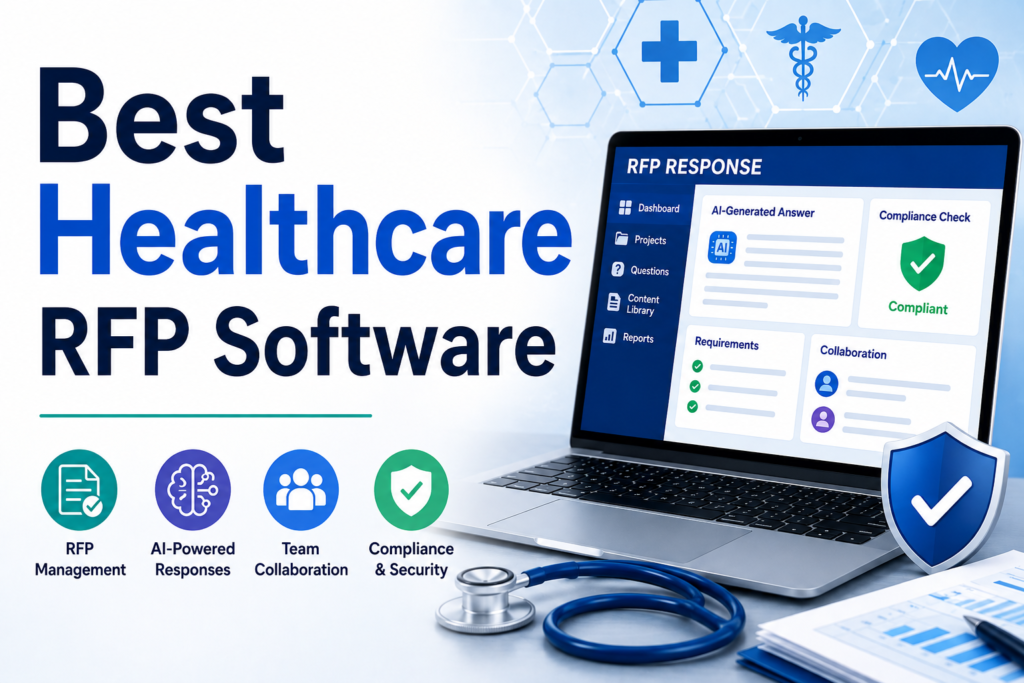
Best Healthcare RFP Software: 7 Best Tools to Consider

A healthcare RFP rarely arrives as a simple questionnaire.
It might ask about implementation, interoperability, clinical workflows, cybersecurity, privacy, data residency, regulatory controls, pricing, service levels, and dozens of other details. Then those questions get distributed across sales, product, IT, security, legal, compliance, finance, and subject-matter experts, often while everyone is working toward the same deadline.
That is why healthcare organizations and healthcare technology vendors increasingly look beyond spreadsheets and shared folders for RFP response software.
The interesting question, though, isn’t simply which platform has the most AI features.
It’s which tool can help a team move quickly without losing accuracy, context, governance, or human judgment.
Below, we’ll look at seven healthcare RFP software options, starting with Inventive AI and then comparing it with six alternatives. Each vendor is described at roughly the same level of detail so the comparison doesn’t quietly turn into a sales pitch for one platform.
Short Answer
The seven healthcare RFP software tools worth considering are:
- Inventive AI — best for AI-led healthcare RFP response automation and centralized healthcare knowledge.
- AutoRFP.ai — best for source-grounded answers, citations, and trust scoring.
- Loopio — best for established proposal teams built around structured content libraries.
- Responsive — best for large organizations needing extensive RFP workflow and governance.
- Qvidian — best for document-heavy enterprise proposal teams, particularly those working extensively in Microsoft Office.
- Arphie — best for teams looking for modern AI-assisted drafting with traceable sources and competitive intelligence.
- AutogenAI — best for organizations handling complex, narrative-heavy proposals and end-to-end RFP workflows.
The right choice depends less on which platform sounds most impressive and more on what your healthcare response process actually looks like.
What Is Healthcare RFP Software?
Healthcare RFP software is a category of technology designed to help organizations create, manage, review, and submit responses to Requests for Proposals and related information requests.
These tools can support RFPs, RFIs, RFQs, DDQs, security questionnaires, and other procurement documents.
At the basic level, the software helps teams find previous answers and reuse them.
Modern platforms go further.
They can analyze an incoming RFP, identify requirements, retrieve relevant information, generate draft answers, assign questions to subject-matter experts, manage approvals, identify gaps, and prepare the final response.
For healthcare organizations, the knowledge-management side is particularly important.
A response might need to reference HIPAA, HITRUST, HL7, EHR integration, clinical processes, security controls, business continuity, encryption, certifications, or specific implementation capabilities. Inventive AI, for example, says its healthcare RFP software can organize previous responses, clinical protocols, pricing sheets, certifications, and regulatory documents and use them to generate responses.
The challenge is that healthcare information changes.
A security policy gets updated.
A certification expires.
A product feature changes.
A compliance position is revised.
A previous answer that was accurate six months ago may no longer be the answer you want to submit today.
So good RFP software isn’t merely about generating text. It is about helping teams know which information should be trusted.
Healthcare RFP Software: Quick Comparison
| Platform | Best fit | AI drafting | Knowledge management | Security/questionnaires | Workflow depth |
|---|---|---|---|---|---|
| Inventive AI | Healthcare & health-tech RFP automation | Strong | Strong | Strong | Strong |
| AutoRFP.ai | Source-grounded responses | Strong | Strong | Strong | Strong |
| Loopio | Established proposal teams | Strong | Strong | Strong | Strong |
| Responsive | Large enterprise response operations | Strong | Strong | Strong | Very strong |
| Qvidian | Document-heavy enterprise teams | Strong | Strong | Strong | Strong |
| Arphie | AI-first contextual drafting | Strong | Strong | Good | Moderate |
| AutogenAI | Complex narrative proposals | Strong | Strong | Strong | Very strong |
This table is intentionally a starting point rather than a definitive ranking. Feature depth can vary by plan, configuration, integration, and deployment.
Why Does Healthcare RFP Software Matter?
There is a peculiar thing about RFP work.
Writing is often the most visible part of it, but writing isn’t necessarily the hardest part.
The hard part is finding the right answer.
Then finding the person who knows whether that answer is still correct.
Then getting that person to review it.
Then making sure the final version doesn’t accidentally contradict something another department wrote.
Then formatting everything correctly before the deadline.
A healthcare RFP can therefore become a coordination problem disguised as a writing problem.
This is where software can make a meaningful difference.
A good platform can create a shared environment where the response team can work from approved knowledge, route questions to the right people, track progress, and preserve review history.
For healthcare, there is another layer: security and privacy.
If a platform will process protected health information, organizations need to understand whether the vendor can meet the applicable contractual and regulatory requirements, including whether a Business Associate Agreement is available where required. Industry guidance for healthcare RFP software also recommends evaluating security certifications, access controls, encryption, audit trails, and data residency rather than assuming that every AI RFP platform is automatically appropriate for regulated information.
That is an important distinction.
RFP software can help you answer a healthcare RFP. It doesn’t automatically make the response HIPAA compliant.
How Does Healthcare RFP Software Work?
Most modern platforms revolve around several interconnected components.
1. RFP Intake and Requirement Extraction
The process usually begins when a team uploads or imports an RFP.
The software identifies questions, requirements, deadlines, sections, and other important information.
Inventive AI says its healthcare platform can import Word, PDF, and Excel RFPs and structure requirements, questions, and compliance points.
Qvidian similarly describes tools for analyzing RFP documents and extracting information such as timelines, scope, evaluation criteria, mandatory requirements, and buyer challenges.
2. Knowledge Retrieval
Next comes the question that determines much of the answer quality:
Where does the software get its answer?
Platforms may use previous RFP responses, approved documents, policies, product information, security documentation, or connected knowledge repositories.
This is where healthcare teams should pay close attention.
A fluent AI-generated answer isn’t necessarily a good answer.
A good answer should be grounded in information the organization is willing to stand behind.
3. AI-Assisted Drafting
Once relevant information is found, AI can create a first draft.
The purpose isn’t necessarily to remove humans from the process.
In many cases, the better goal is to remove the blank page.
A proposal manager can then spend time checking accuracy, improving positioning, and deciding what matters to the buyer instead of copying paragraphs from five old documents.
4. Collaboration and Approval
Healthcare RFPs frequently require input from different specialists.
The sales team may know the commercial story.
Security knows the controls.
Product knows the roadmap.
Clinical experts know the workflows.
Legal knows what can actually be promised.
The software therefore needs to handle assignment, review, comments, permissions, approvals, and version control.
5. Export and Submission
Eventually the response has to become a finished submission.
That might mean Word, Excel, PDF, or a buyer’s online portal.
The final stage sounds boring.
It isn’t.
A brilliant answer that doesn’t fit the required format or misses mandatory fields can still lose an opportunity.
1. Inventive AI
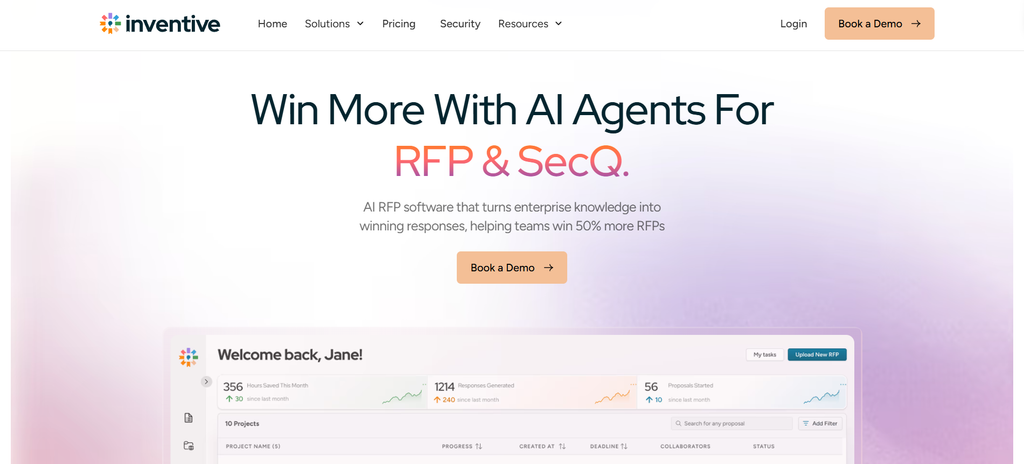
Inventive AI is an AI-focused RFP response platform with a specific healthcare offering. It is designed to help healthcare and health-tech teams move from incoming RFP documents to structured, AI-assisted responses while keeping organizational knowledge centralized. Inventive AI says its healthcare solution supports RFPs, RFIs, and security questionnaires and can work with Word, PDF, and Excel documents.
Its approach combines several pieces that are normally spread across different tools: RFP intake, a centralized knowledge repository, AI-generated drafts, collaboration, review, and final export. The platform says teams can connect repositories such as Google Drive and SharePoint and reuse previous responses, certifications, compliance documents, and other approved material.
The healthcare positioning is particularly relevant for organizations responding to questions around HIPAA, HL7, HITRUST, EHR integration, clinical workflows, and other technical or regulatory topics. Inventive AI says its AI uses healthcare-specific compliance context when generating responses and includes an AI Content Manager intended to flag outdated or inconsistent information.
On security, Inventive AI publicly lists SOC 2 Type II compliance, GDPR and CCPA readiness, SSO, access controls, audit logs, and encryption. Healthcare buyers should still verify the specific deployment, contractual terms, data-handling arrangements, and BAA requirements applicable to their use case.
Best suited for: Healthcare and health-tech teams that want an AI-led RFP workflow with healthcare-specific positioning, centralized knowledge, collaboration, and automated drafting.
Potential consideration: Teams should test generated responses against real healthcare RFPs and verify how the platform handles their particular compliance, data-security, integration, and approval requirements.
2. AutoRFP.ai
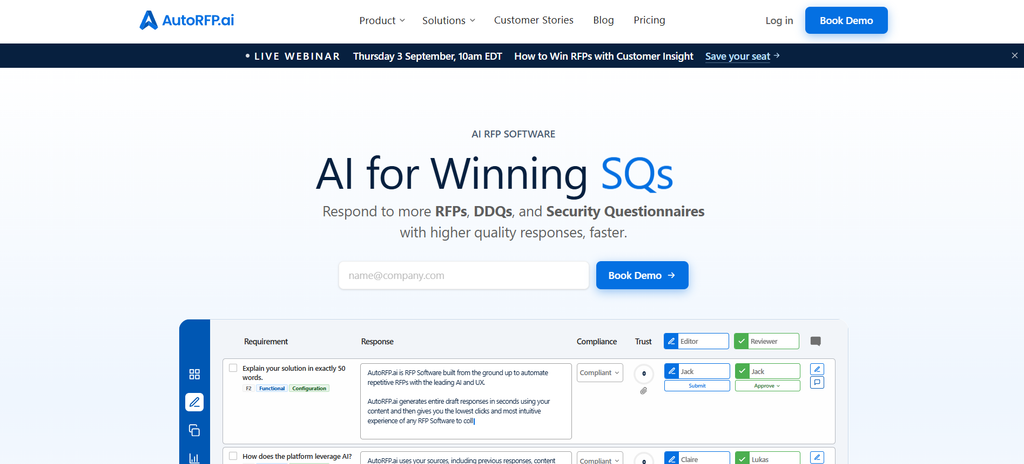
AutoRFP.ai takes a somewhat different approach, putting source-grounded response generation and answer verification at the center of its RFP workflow. Its healthcare and health-tech material emphasizes RFPs, security questionnaires, and DDQs, particularly for organizations selling into hospitals, health systems, insurers, and enterprise buyers.
One of its notable features is the use of source citations and Trust Scores. The platform says each generated response can show the supporting evidence, while questions that cannot be supported by approved information can be left unresolved for human review rather than filled with an unsupported AI answer.
That approach is worth considering in healthcare because a plausible answer isn’t necessarily a defensible answer. A security questionnaire might ask about encryption, access controls, data residency, authentication, incident response, or business continuity. Being able to trace a response back to supporting material can make review easier.
AutoRFP.ai also supports collaboration, with tools for assigning work, commenting, involving subject-matter experts, and tracking response progress. Its product documentation describes integrations with knowledge sources such as SharePoint and Confluence, along with regional hosting options.
The platform also offers an MCP server, allowing approved RFP content and project context to be accessed from compatible AI agents while retaining source citations and Trust Scores.
Best suited for: Health-tech and enterprise teams that place a high value on source traceability, answer verification, and security-questionnaire workflows.
Potential consideration: Buyers should test how well its source-grounding approach handles healthcare-specific narrative questions, complex formatting, and the organization’s existing knowledge architecture.
3. Loopio
Loopio is one of the established RFP response platforms and takes a content-library-centered approach. Its system brings company knowledge into a centralized library and combines that repository with project management, collaboration, and AI-assisted response generation.
For healthcare teams, the appeal is relatively straightforward. If your organization has accumulated years of previous RFP responses, security questionnaires, product documentation, case studies, and approved language, a structured library can make that information much easier to find and reuse.
Loopio says its AI can generate tailored responses and identify where content originated, while its project workspace is designed to keep contributors working in one place.
The platform also has a broad integration layer. Its published integrations include CRM systems, Slack, Microsoft Teams, Google Drive, SharePoint, OneDrive, Box, and single sign-on options. It also offers an API for custom integrations.
Loopio’s pricing is more transparent than many enterprise RFP platforms. Its current pricing page lists Foundations starting at $20,000 per year, including 10 seats, with higher tiers adding capabilities such as multi-language libraries, confidential projects, multi-step reviews, business-unit separation, and additional seats.
The trade-off is that a library-centered system requires organizational discipline. Healthcare teams need processes for reviewing old answers, retiring outdated content, and deciding which answers are approved.
Best suited for: Established healthcare proposal teams with a substantial reusable content library and dedicated people responsible for maintaining it.
Potential consideration: Evaluate the ongoing effort required to keep healthcare, security, clinical, and compliance content current.
4. Responsive
Responsive is positioned as a Strategic Response Management platform rather than simply an AI drafting tool. It supports RFPs, RFIs, RFQs, DDQs, security questionnaires, collaboration, approvals, analytics, and broader pursuit workflows.
That broader workflow can be useful for healthcare organizations where a single RFP may involve a large number of contributors. Instead of treating the RFP as a document that one proposal manager owns, Responsive is designed around a coordinated process that can involve sales, product, security, legal, compliance, and other departments.
Its current AI capabilities include intake analysis, drafting, and quality-oriented checks. Responsive also promotes its TRACE Score and source-backed AI approach as part of its broader AI security strategy.
For healthcare teams, the security-questionnaire component is particularly relevant. Healthcare procurement often involves a second layer of technical and security assessment alongside the commercial RFP. Keeping those processes connected can reduce the temptation to maintain separate answers in separate systems.
The platform is therefore more focused on workflow orchestration and governance than a lightweight AI writing assistant. That can be valuable for larger organizations, although more functionality can also mean more implementation and training.
Best suited for: Large healthcare vendors and enterprises managing complex, multi-contributor RFP, RFI, DDQ, and security-questionnaire operations.
Potential consideration: Smaller teams should determine whether they need the platform’s broader workflow and governance capabilities or would prefer a simpler AI-first tool.
5. Qvidian
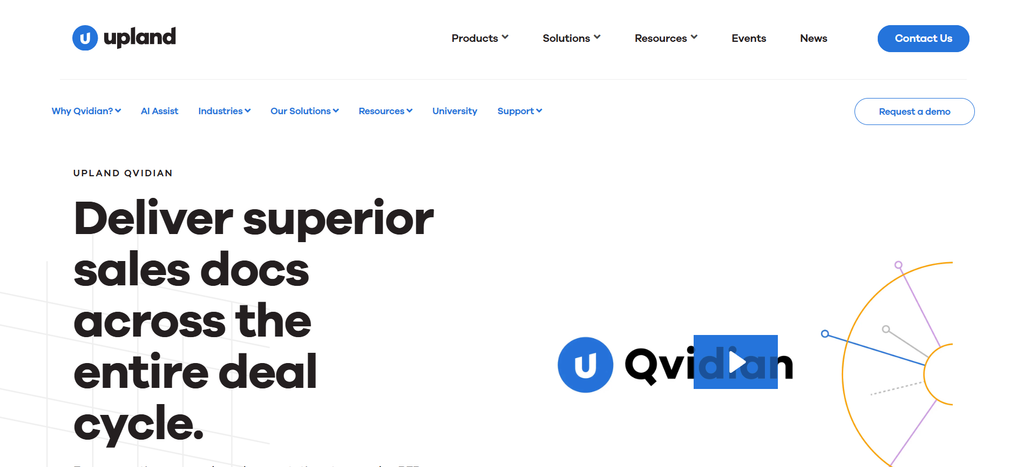
Qvidian, part of Upland Software, is an established enterprise RFP and proposal management platform. Its approach combines a centralized content library with automated answering, document analysis, AI-assisted writing, workflows, permissions, and proposal generation.
Qvidian has a particular history with document-heavy proposal operations. Its tools can analyze RFP documents, identify important requirements, suggest relevant content, and automatically populate responses. It also supports Microsoft Office, Salesforce, web browsers, and an open API.
Healthcare is one of the industries for which Upland explicitly markets Qvidian. Its healthcare material highlights questionnaire importing and answering, AI-assisted rewriting, multi-step review workflows, risk and go/no-go analysis, permissions, change tracking, and version history.
That combination may appeal to organizations that already have formal proposal processes and need strong governance around who can access, edit, approve, and reuse content.
The platform is less about making RFP response feel like an informal conversation with an AI assistant and more about building a structured enterprise response operation.
That can be a strength when the process is complex.
It can also mean that implementation, administration, and content management deserve serious consideration before purchase.
Best suited for: Large healthcare organizations with established proposal operations, significant document volumes, formal approval processes, and Microsoft-oriented workflows.
Potential consideration: Assess the platform’s implementation requirements and compare its enterprise workflow depth with the simplicity of newer AI-first alternatives.
6. Arphie
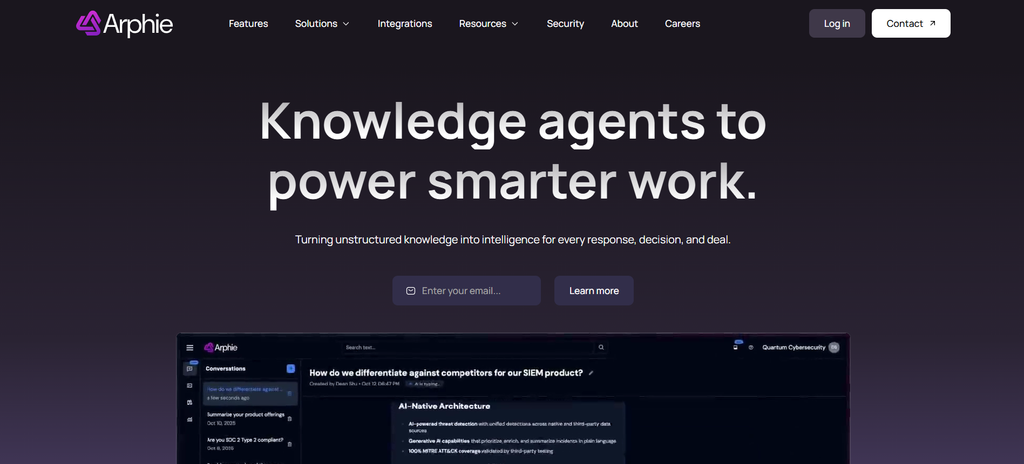
Arphie is an AI-first response platform aimed at organizations that want modern AI assistance across RFPs, questionnaires, and related proposal work. Its healthcare-specific material highlights the particular complexity of healthcare RFPs, including HIPAA considerations, EHR integration requirements, and the need to demonstrate measurable clinical outcomes rather than relying on generic claims.
Arphie’s approach emphasizes AI-assisted drafting and the ability to work with organizational knowledge while maintaining visibility into supporting information. In broader comparisons, it is positioned as a modern alternative to traditional content-library platforms, particularly for teams that want AI to play a larger role in drafting and research.
This can be useful when the RFP isn’t simply asking for a collection of standard answers.
Healthcare buyers often want the vendor to explain how a solution will affect their environment. That might involve implementation timelines, interoperability, clinical workflows, patient throughput, operational efficiency, or measurable outcomes.
In those situations, a platform needs to do more than retrieve an old paragraph.
It needs to help transform existing organizational knowledge into a response that fits the particular buyer and question.
For healthcare use, however, the same rule applies as with every AI RFP platform: claims around compliance, security, accuracy, and data handling should be verified directly with the vendor.
Best suited for: Healthcare and enterprise teams looking for AI-first drafting, research assistance, and more contextual proposal responses.
Potential consideration: Run a real healthcare RFP through the platform and evaluate how well it handles regulatory language, technical questions, evidence, citations, and human review.
7. AutogenAI
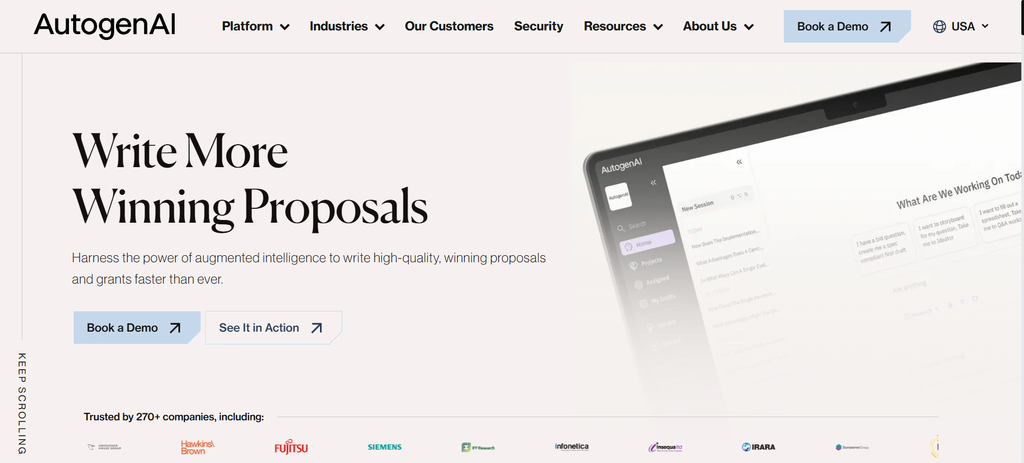
AutogenAI approaches RFP software from the perspective of complex proposal writing rather than simply content retrieval. Its platform is designed to support a broader proposal lifecycle, including opportunity qualification, requirement extraction, drafting, compliance checking, review, and submission.
One of its differentiating ideas is a multi-model architecture. AutogenAI says it can route different tasks to different large language models, depending on whether the job involves analysis, technical writing, compliance checking, or another activity. Its Gamma Review capability is designed to check proposals against requirements before submission.
That broader lifecycle can matter when a healthcare proposal is large and highly evaluated. In such cases, success isn’t only about answering questions quickly. Teams also need to understand the solicitation, identify mandatory requirements, build a persuasive narrative, demonstrate compliance, and produce a coherent final document.
AutogenAI is also positioned for regulated and government-oriented environments, and its published materials emphasize enterprise security and proposal workflow coverage.
For healthcare organizations, the platform may therefore be particularly interesting when the proposal itself is long, narrative-heavy, and strategically important rather than mostly a collection of standardized questionnaire answers.
Best suited for: Enterprise healthcare organizations and teams handling complex, narrative-heavy, high-value RFPs that require extensive compliance and proposal development.
Potential consideration: Teams with mostly short questionnaires or repetitive security responses may find a narrower AI response platform easier to justify.
What Should Healthcare Teams Look For?
The best RFP platform for a healthcare organization isn’t necessarily the platform with the longest feature list.
There are several questions worth asking during evaluation.
Source Accuracy
Can the platform show where an answer came from?
Can reviewers distinguish approved content from generated language?
Can unsupported questions be flagged rather than guessed?
These questions become more important as the response touches security, privacy, clinical operations, or regulatory commitments.
Content Freshness
How does the platform deal with outdated answers?
Who owns the content?
Can the system identify content that needs review?
Healthcare organizations should be especially careful about treating an old RFP answer as permanent institutional truth.
Security
Ask about:
- SOC 2 status
- ISO 27001 status
- encryption
- SSO
- role-based access controls
- audit logs
- data retention
- model-training policies
- data residency
- incident response
- contractual protections
- BAA availability where applicable
The precise requirements depend on what data the platform will process.
Human Review
A good AI response should not eliminate human accountability.
Instead, it should make human review more valuable.
The AI handles repetitive retrieval and drafting.
The expert checks whether the answer is actually correct.
That division of labor is probably more useful than pretending that an AI can safely make every decision by itself.
Integrations
Look at where your information already lives.
Is it in SharePoint?
Google Drive?
Salesforce?
Confluence?
Microsoft Teams?
Slack?
An RFP platform that requires your team to rebuild its entire knowledge base from scratch may create more work than it removes.
Export and Formatting
Always test this with a real RFP.
Don’t simply watch a polished demo.
Upload the messy document.
Try the Excel questionnaire.
Try the Word template.
Try the unusual formatting.
See what happens.
That is where software differences often become obvious.
Best Practices for Using Healthcare RFP Software
1. Start With a Real RFP
A demo is useful, but your own RFP is better.
Take a recently completed healthcare RFP and test the platform.
Compare the answers against the approved final response.
You’ll quickly learn whether the software understands your organization’s language.
2. Create Clear Approval Rules
Decide which information requires specialist review.
Security answers may need InfoSec approval.
Clinical claims may need clinical review.
Legal commitments may need legal approval.
Pricing needs commercial approval.
AI should accelerate these processes rather than quietly bypass them.
3. Measure More Than Drafting Speed
“AI generated the draft in five minutes” sounds impressive.
But what matters is the total workflow.
How long did it take to review?
How many answers needed correction?
How often did SMEs have to intervene?
How many outdated answers were caught?
How quickly could the final response be submitted?
The useful metric is not simply time to first draft.
It is time to trustworthy submission.
4. Keep Sensitive Information Segmented
Not every employee needs access to every document.
Use permissions and access controls to separate sensitive information where appropriate.
A healthcare RFP may contain commercially sensitive pricing information alongside security documentation and technical architecture.
Those materials don’t necessarily belong in one unrestricted bucket.
5. Keep Humans in the Loop
This sounds obvious, but it is worth repeating.
AI can write a very convincing sentence.
That doesn’t mean the sentence is true.
In healthcare procurement, a beautifully written incorrect answer can be more dangerous than an obviously incomplete one.
Common Mistakes
Choosing Software Based Only on AI Claims
Almost every modern RFP platform talks about AI.
The word itself tells you very little.
Ask what the AI actually does.
Does it retrieve?
Does it cite?
Does it reason over documents?
Does it check compliance?
Does it identify unsupported claims?
Does it learn from approved responses?
Or is it essentially generating text in a chat box?
Those are different capabilities.
Ignoring Content Maintenance
A knowledge library is only useful if the knowledge remains current.
If nobody owns it, the system may simply become a very efficient way to reuse old information.
Forgetting the SMEs
AI may reduce the number of questions sent to subject-matter experts, but it doesn’t make expertise irrelevant.
The goal should be to send SMEs the questions that genuinely require them.
Treating HIPAA as a Checkbox
Healthcare buyers should distinguish between a platform’s general security posture and the specific requirements of their deployment.
If regulated health information is involved, ask detailed questions about data processing, contractual protections, access, retention, hosting, and applicable agreements.
Comparing Only the License Price
The cheapest platform isn’t necessarily the least expensive.
Consider:
- implementation,
- content migration,
- onboarding,
- integrations,
- training,
- reviewer seats,
- administration,
- maintenance,
- support,
- and the time your proposal team spends managing the system.
The total cost is the number that matters.
Frequently Asked Questions
What is the best healthcare RFP software?
There isn’t one universal winner.
Inventive AI is worth considering for healthcare and health-tech teams that want healthcare-focused AI-assisted response automation. AutoRFP.ai is particularly interesting for source-grounded answers and verification. Loopio and Responsive are established choices for structured proposal operations, while Qvidian is suited to document-heavy enterprise workflows. Arphie and AutogenAI offer other AI-first approaches, particularly around contextual drafting and complex proposal development.
Does healthcare RFP software need to be HIPAA compliant?
It depends on what information the platform processes and how it is deployed.
If protected health information is involved, healthcare organizations should determine whether a Business Associate Agreement and other HIPAA-related requirements apply. Even when an RFP doesn’t contain PHI, buyers may still have stringent security and privacy requirements.
Can AI safely write healthcare RFP responses?
AI can accelerate drafting, but human review remains important.
The safest approach is usually to ground responses in approved organizational information and have appropriate experts review sensitive claims before submission.
Should we choose an AI-native platform or a traditional RFP platform?
It depends on your bottleneck.
If the biggest problem is slow drafting and information retrieval, an AI-first platform may be attractive.
If the bigger problem is managing hundreds of contributors, approval workflows, content libraries, and enterprise governance, a mature RFP management platform may be a better fit.
Many organizations will ultimately want both capabilities.
How do I compare RFP software vendors fairly?
Use the same test for every vendor.
Give each one a representative healthcare RFP and evaluate:
- requirement extraction,
- answer relevance,
- source traceability,
- hallucination or unsupported-answer handling,
- healthcare terminology,
- SME workflow,
- approval controls,
- security,
- export quality,
- total time to final submission.
That produces a much more useful comparison than watching seven product demonstrations.
Conclusion
Healthcare RFPs have always contained a strange mixture of writing, research, compliance, project management, institutional memory, and diplomacy.
The software is now beginning to take on more of that work.
The best platforms aren’t simply trying to make AI write faster. They’re trying to make organizational knowledge easier to find, easier to verify, and easier to turn into a coherent response.
That’s why the distinction between these seven tools matters.
Inventive AI emphasizes healthcare-specific RFP automation and centralized knowledge. AutoRFP.ai puts particular weight on source-grounded answers and verification. Loopio offers a mature content-library model. Responsive emphasizes enterprise response management. Qvidian brings long-established document and workflow capabilities. Arphie focuses on AI-first contextual assistance. AutogenAI approaches the problem as a broader proposal lifecycle.
None of those approaches is automatically right for every healthcare team.
And perhaps that is the most useful thing to remember when evaluating RFP software.
Don’t ask which platform has the most impressive AI demo.
Ask which platform helps your team answer one difficult question more reliably