How AI-Powered Personalization Is Transforming Internal Communications in 2026

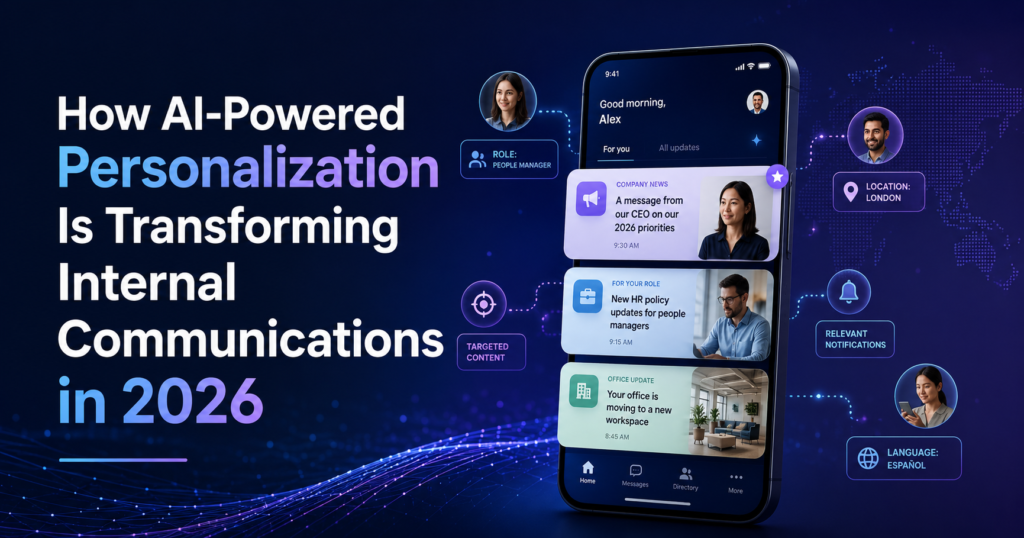
AI-powered personalization is transforming internal communications by helping organizations move from broad message distribution to more relevant, context-aware employee communication. In 2026, AI can assist with audience selection, content adaptation, translation, channel choice, timing, knowledge retrieval, follow-up, and measurement. The real value is not sending more messages. It is reducing irrelevant communication while helping employees receive the information and next actions most relevant to their role, location, language, or situation.
Key takeaways
- AI personalization goes beyond inserting a name into an email. It can use employee context, content intelligence, behavior, and organizational data to improve who receives a message and how it is delivered.
- The strongest use case is relevance, not volume. AI is most useful when it prevents unnecessary communication, surfaces the right information faster, and stops reminders once an action is complete.
- Segmentation and AI are not the same thing. Rules-based targeting remains valuable. AI becomes more meaningful when interpretation, adaptation, recommendation, retrieval, or optimization is involved.
- Human judgment still matters. Safety, compensation, restructuring, performance, legal, and other consequential communications should not be handed over to an automated system without appropriate review.
- Platform evaluation should focus on decisions, data, and control. The important question is not whether a product advertises AI, but what its AI actually does, what data informs it, and where humans remain accountable.
An employee checks their phone before a shift and sees three company updates.
One affects their location.
One applies only to managers.
The third is a benefits reminder for something they completed yesterday.
For years, internal communication technology mostly improved the sending of messages. In 2026, AI is increasingly being applied to a different problem: deciding what should be sent in the first place.
That distinction matters because the workplace does not suffer from a shortage of messages.
Gallagher’s 2026 Employee Communications Report, based on more than 1,300 communication and HR professionals across 40 countries, found that 83% of respondents believe information overload is a growing problem. Gallagher also reports that fewer than one in five respondents are satisfied with their ability to personalize content through their communication channels.
In U.S.-specific Gallagher data, 75% of organizations say audience segmentation is critical, while only 20% execute it consistently.
The interesting question, then, is not whether AI can help organizations communicate more.
It is whether AI can help them communicate less, and better.
What is AI personalization in internal communications?
AI personalization in internal communications is the use of employee data, organizational context, artificial intelligence, and automation to make workplace information more relevant to particular employees or groups.
Traditional personalization might mean inserting someone’s first name into an email or sending a London office announcement only to employees based in London.
AI-powered personalization can go further.
Depending on the platform, available integrations, and the organization’s data policies, communication systems may work with information such as:
- Role or department
- Location or worksite
- Shift or employment type
- Language
- Business unit
- Employee lifecycle stage
- Previously viewed content
- Communication preferences
- Channel engagement
- Organizational permissions
- Interests or subscriptions
- Previous actions, such as completing an enrollment form
There is an important distinction here because not everything marketed as “AI personalization” is actually AI.
Sending a warehouse announcement only to warehouse employees is valuable targeting, but ordinary business rules can accomplish it.
AI becomes more meaningful when a system can interpret context, understand content, recommend audiences, adapt a message, retrieve relevant knowledge, analyze behavior, support delivery decisions, identify patterns, or learn from communication results.
In practice, strong internal communication systems will often combine both.
Rules are useful when the organization already knows the answer. AI becomes useful when the system needs to interpret, adapt, recommend, or learn.
Why does AI-powered personalization matter in 2026?
AI-powered personalization matters because organizations now communicate across more channels, more workforce types, more locations, and more moments of change than communication teams can reasonably manage through manual campaigns alone.
Digital communication made it cheap to send information to everyone.
So organizations often did exactly that.
Everyone received the newsletter.
Everyone received the CEO announcement.
Everyone received reminders for deadlines that applied only to a fraction of the workforce.
Convenience for the sender gradually became inconvenience for the receiver.
AI gives communication teams an opportunity to reverse some of that behavior.
Relevance is becoming more valuable than raw reach
Internal communication success has traditionally included questions such as:
Did the message reach 10,000 employees?
That question still matters. Safety, legal, compliance, crisis, and company-wide announcements may legitimately require broad distribution.
But receipt is not understanding.
And understanding is not action.
If an employee receives twelve irrelevant updates before an important one, the organization may technically achieve excellent distribution while simultaneously training that employee to ignore company communication.
Personalization changes the question from:
How many people did we send this to?
to:
Who needed this information, and did it help them understand or do something?
That is a much more demanding measure of communication quality.
The workforce is increasingly difficult to treat as one audience
A multinational employer might include:
- Engineers working remotely
- Nurses moving between hospital floors
- Warehouse employees without corporate email
- Retail associates working rotating shifts
- Field technicians driving between locations
- Office employees using Microsoft 365 all day
- Executives working across several time zones
Calling all of them “employees” is administratively correct.
Communicatively, it tells you very little.
Their information needs differ. So do their devices, available attention, schedules, preferred channels, permissions, and working environments.
Personalization gives communication teams a way to manage some of that complexity without manually creating hundreds of separate campaigns.
AI adoption is also becoming an internal communication issue
The change is not limited to communication technology.
Microsoft’s 2026 Work Trend Index found that only 26% of surveyed AI users say leadership is clearly and consistently aligned on AI.
Deloitte’s 2026 Global Human Capital Trends research found that 65% of organizations believe their culture needs to change significantly because of AI, yet only 6% of leaders say their organizations are making progress in designing human-AI interactions.
That puts internal communicators in an unusual position.
They are increasingly expected to use AI to improve communication while simultaneously helping employees understand what AI is changing about the organization itself.
How does AI personalization in internal communications work?
Most AI-personalized communication systems can be understood through four connected layers: employee context, content intelligence, delivery decisions, and feedback.
The technology can sound mysterious.
The underlying model usually is not.
1. Employee and organizational context
Personalization begins with knowing something relevant about the recipient.
A communication platform might connect with an HRIS, identity provider, employee directory, payroll system, Microsoft 365 environment, or other workplace technology.
Depending on the integration, that can provide attributes such as:
- Department
- Job role
- Business unit
- Country
- Language
- Location
- Manager status
- Shift
- Employment category
- Security permissions
This makes personalization partly a data-quality problem.
An advanced AI system connected to inaccurate employee records will not magically produce accurate targeting.
It may simply make sophisticated mistakes faster.
2. Content intelligence
AI can then help understand, create, or transform communication.
A communicator might prepare one approved source announcement about a new workplace policy.
AI could help:
- Summarize the announcement
- Create a shorter mobile version
- Adapt tone for a specific channel
- Generate subject-line variations
- Translate the content
- Identify likely audiences
- Extract key actions
- Create employee FAQs
- Retrieve the source through an AI assistant
- Turn a long policy into a more usable explanation
Generative writing is the most visible AI capability.
It may not be the most consequential.
The more interesting personalization question begins after the draft exists.
3. Targeting, timing, routing, and follow-up
Once a system understands both the employee context and the communication, it can help determine how the two should meet.
For example:
A corporate employee might receive an email.
A frontline worker might receive a mobile notification.
A factory team might see the update through an employee app or digital signage.
A manager might receive talking points before their team receives the announcement.
Someone who has already completed an action might be excluded from future reminders.
Someone who has not acknowledged a mandatory message might receive another notification.
Different products handle these decisions differently. Some rely heavily on administrator-created rules. Others incorporate behavioral signals, intelligent delivery, or automated journeys.
This begins to resemble customer journey orchestration, except the person being targeted is an employee.
That makes transparency, proportionality, and trust especially important.
4. Feedback and optimization
The final layer is understanding what happened.
Teams can look beyond basic page views and examine signals such as:
- Click-through rates
- Read acknowledgements
- Search behavior
- Survey responses
- Employee questions
- Sentiment
- Channel performance
- Completion of requested actions
- Differences between employee groups
Those signals can inform the next communication.
The important word is inform.
Personalization should not mean making one assumption about an employee and preserving it forever.
Communication systems should adapt as context changes.
So should communication teams.
Traditional internal communications vs. AI-powered personalization
Traditional internal communication often organizes a campaign around what the sender wants to publish. AI-powered personalization can organize more of the experience around what the recipient needs to know or do.
| Area | Traditional approach | AI-personalized approach |
|---|---|---|
| Audience | Broad distribution lists | Dynamic segments and contextual audiences |
| Content | One version for most employees | Adapted by role, language, channel, or context |
| Timing | Scheduled primarily by the communicator | Can respond to events, behavior, or employee need |
| Channel | Usually selected at campaign level | Can vary according to workforce context |
| Knowledge | Employees search manually | AI assistants can retrieve relevant answers |
| Measurement | Opens, clicks, and views | Engagement plus actions and behavioral signals |
| Follow-up | Manual reminders | Automated or triggered follow-up |
| Employee experience | Largely shared portal or feed | More individualized resources, feeds, and journeys |
None of this means every message should become unique.
There are times when everyone should hear exactly the same thing.
A CEO explaining a major acquisition probably should not become 8,000 algorithmically different speeches.
The goal is not maximum personalization.
It is appropriate personalization.
Organizations still need a shared reality.
Which platforms support AI-powered internal communication personalization in 2026?
Several employee communication and employee experience platforms now combine targeting, multi-channel delivery, AI assistance, analytics, knowledge retrieval, and personalization. The important differences lie in how deeply they personalize, what data they use, which channels they support, and how much control administrators retain.
The five platforms below are representative examples, not a ranking.
They illustrate different approaches to AI-powered employee communication in 2026.
1. HubEngage
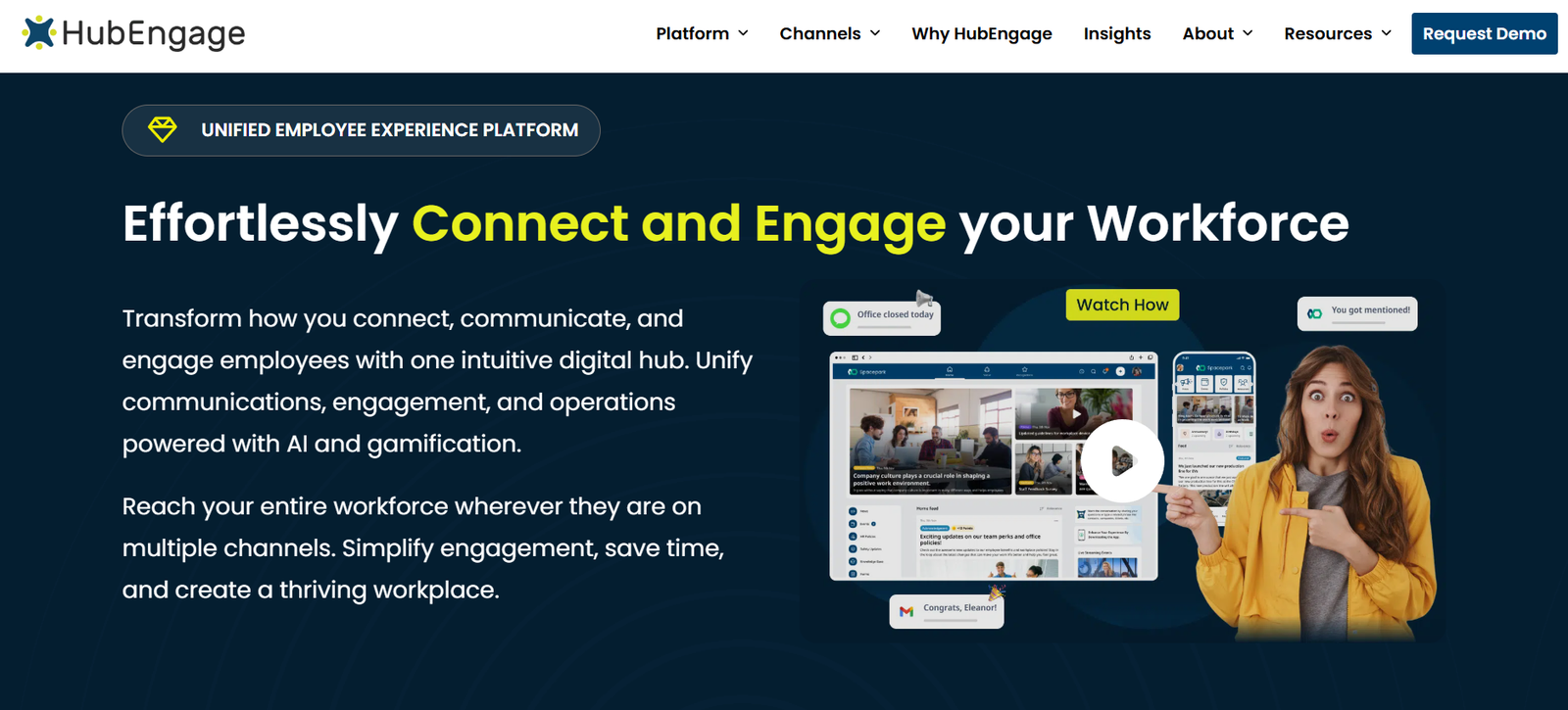
HubEngage combines employee communications, mobile and web experiences, email, SMS, Microsoft Teams, Slack, WhatsApp, digital signage, surveys, recognition, and AI capabilities in a unified employee communication platform.
Its dynamic lists can segment employees using attributes such as department, location, cost center, and other employee data. Teams can then target content and features to those groups rather than publishing everything universally.
HubEngage also supports AI-assisted content creation, translation, AI search, summaries, sentiment analysis, and an enterprise chatbot that can retrieve information from connected organizational sources while respecting employee access permissions. Its notification tools can schedule push, email, or SMS notifications and issue periodic reminders when content has not been viewed or acknowledged.
That combination is particularly relevant for organizations trying to reach office, frontline, deskless, and distributed employees through several channels without maintaining separate communication systems.
2. Staffbase
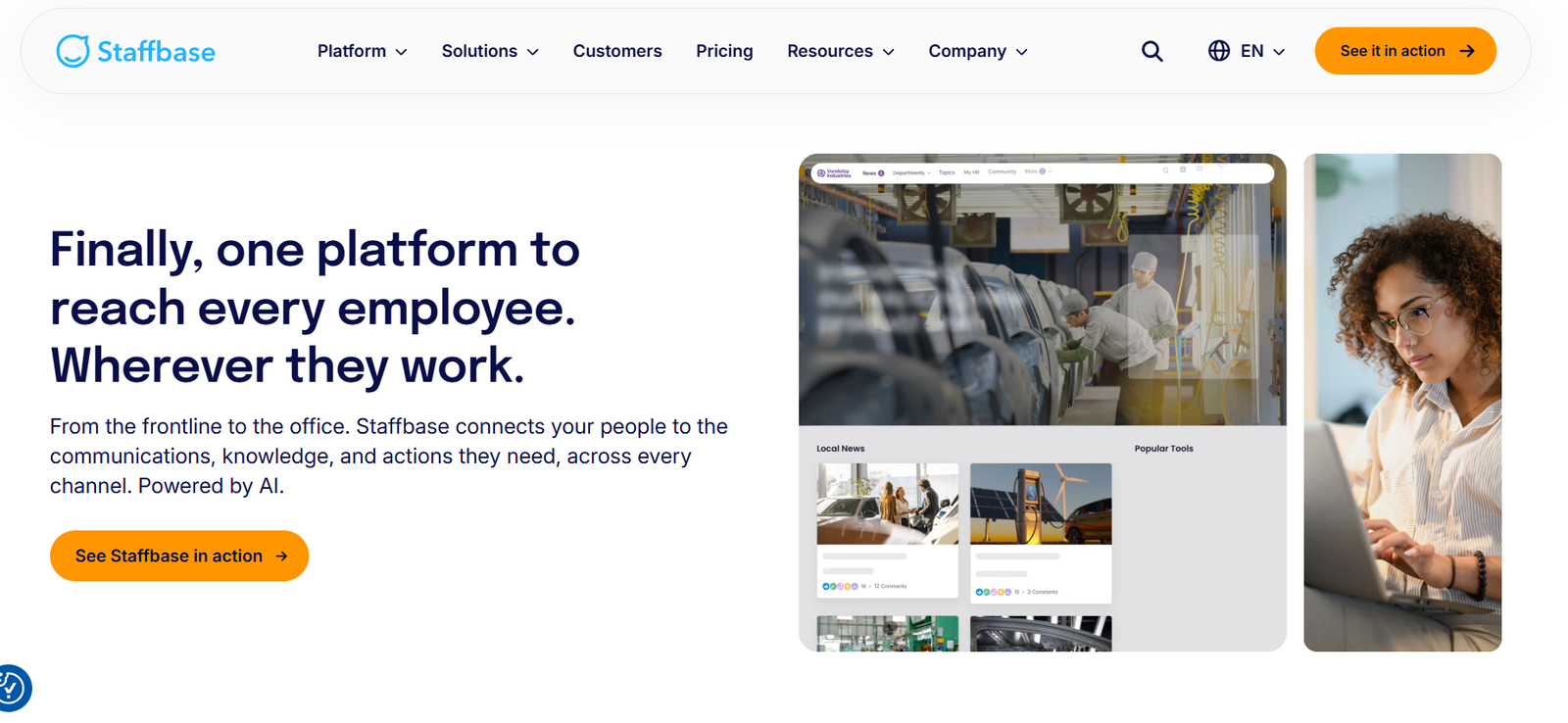
Staffbase combines an employee app, intranet, employee email, digital signage, Microsoft 365 integrations, targeting, analytics, and AI tools for internal communication.
Its AI capabilities include content creation and refinement, automatic translation, sentiment analysis, survey assistance, campaign measurement, and Navigator. Staffbase Navigator lets employees ask questions through text or voice and receive answers grounded in company knowledge. Navigator 2.0, released in 2026, also introduced AI-assisted configuration features that help administrators establish company and audience context.
Staffbase Email supports name-based personalization as well as custom data fields. Organizations can use attributes such as location, role, or event information to tailor email content to individual contexts.
The platform can be particularly relevant for large enterprises that need governed communication across multiple channels and want internal communication closely connected with Microsoft 365 and existing digital workplace systems.
3. Simpplr
Simpplr combines an AI-powered intranet with employee communications, enterprise search, knowledge management, engagement features, workflows, analytics, and AI assistance.
Its personalization model is notable because Simpplr explicitly uses organizational context and its Employee Experience Knowledge Graph to tailor communications, search results, and recommendations according to factors such as an employee’s role, interests, and behaviors.
In February 2026, Simpplr introduced Comms AI, an AI-native workspace for internal communication teams. The product is designed to reduce operational work around campaign planning, coordination, translation, tracking, and content management rather than treating AI only as a writing assistant.
That makes Simpplr particularly relevant for organizations trying to connect communication with knowledge discovery, search, planning, and employee self-service rather than using the intranet primarily as a publishing destination.
4. Workvivo
Workvivo, part of Zoom, combines employee communication, engagement, community experiences, knowledge access, mobile delivery, and AI capabilities through Workvivo AI, which is powered by Zoom AI technology.
Workvivo AI supports use cases including company updates, newsletters, announcements, knowledge assistance, content creation, and surveys. Its current AI experience is designed to provide support according to what the user is trying to accomplish rather than functioning only as a generic writing assistant.
Workvivo has also expanded its personalization capabilities through Journeys. Journeys can create connected flows of messages, tasks, and actions, with delivery guided by employee information such as role, location, date, or stage. Workvivo describes these experiences as supporting evergreen, time-bound, or employee-led workflows, with Workvivo AI assisting content and personalization.
Its broader strength remains the combination of formal organizational communication with employee community and engagement, while its Journeys capability makes it increasingly relevant for organizations that also want triggered and personalized employee workflows.
5. Firstup
Firstup focuses heavily on intelligent communication, employee personalization, omnichannel delivery, journey orchestration, and engagement analytics.
Its targeting can use attributes and signals such as role, location, language, behavior, HRIS data, lifecycle events, and whether an employee has already completed an action. Journey Orchestration can create multi-step sequences, branch employees into different paths, trigger communication from dates or events, and automate follow-up.
Firstup also offers intelligent delivery capabilities designed to determine an appropriate channel and time using behavioral data.
In March 2026, the company expanded Firstup AI with agentic capabilities intended to move beyond generative assistance toward communication and action orchestration.
That makes Firstup particularly relevant for large organizations looking for sophisticated targeting, automated employee journeys, behavioral delivery optimization, and communication across complex frontline and corporate workforces.
Quick comparison
| Platform | Personalization approach | Notable AI/internal comms capabilities |
|---|---|---|
| HubEngage | Dynamic segmentation and multi-channel targeting | AI content, enterprise chatbot/search, translation, sentiment, reminders, analytics |
| Staffbase | Employee attributes, contextual experiences, custom email personalization | AI content, Navigator, translation, sentiment, surveys, campaign intelligence |
| Simpplr | Organizational context, role, interests, and behavior | Comms AI, knowledge graph, enterprise search, recommendations, content assistance |
| Workvivo | Employee context plus personalized Journeys | AI content, knowledge assistance, surveys, personalized workflows, Zoom AI technology |
| Firstup | Attribute and behavior-based targeting with automated journeys | Intelligent delivery, AI content, journey orchestration, AI search, agentic capabilities |
By 2026, asking “Which platform has AI?” is becoming a poor buying question.
Most major platforms now have some AI capability.
Better questions are:
What decisions can the system actually make?
What employee data informs those decisions?
Can administrators understand and override them?
What happens when the system gets something wrong?
Those answers matter more than the size of an AI feature list.
Practical examples of AI personalization in internal communications
The clearest value appears when personalization removes unnecessary information, reduces manual work, or helps employees reach the correct action faster.
Example 1: A safety update for a distributed workforce
Imagine a manufacturer changes a safety procedure at three facilities.
A broad communication model might email every employee globally.
A more targeted system identifies employees at the affected sites.
Supervisors receive briefing material first.
Employees working upcoming shifts receive a mobile notification in their preferred language.
Workers who acknowledge the procedure stop receiving reminders.
Those who do not acknowledge it can receive appropriate follow-up.
The AI has not replaced the safety expert.
It has shortened the administrative distance between an important message and the people who need to act on it.
Example 2: Benefits enrollment
A traditional benefits campaign might send six reminders to everybody.
A personalized campaign can behave differently.
Employees who have already enrolled stop receiving enrollment prompts.
Employees eligible for a particular benefit receive information relevant to that benefit.
Content can be adjusted for different locations or employee groups.
An AI assistant can answer routine questions from approved benefits documentation, while complex or personal cases continue to HR.
The improvement is not that the organization sends more reminders.
It is that fewer people receive reminders they no longer need.
Example 3: Organizational change
Suppose a company restructures several departments.
The organization still needs one authoritative explanation of what is changing and why.
Personalization can then provide context around that shared message.
Affected managers receive conversation guides.
Employees moving to new teams receive practical next steps.
Teams not directly affected receive a concise explanation rather than unnecessary operational detail.
An AI knowledge assistant provides answers grounded in approved change documentation.
Personalization does not alter the truth.
It reduces the distance between a broad organizational announcement and the question most employees naturally ask:
What does this mean for me?
Best practices for using AI personalization in internal communications
The safest and most useful approach is to personalize around employee need, not simply because the technology makes personalization possible.
1. Start with a communication problem
Do not begin with:
“We bought an AI platform. What can we automate?”
Begin with the actual problem.
For example:
- Employees receive too many irrelevant announcements.
- Frontline workers miss urgent updates.
- HR repeatedly answers the same questions.
- Managers lack context before important organizational changes.
- Employees struggle to find trusted policies.
- Global teams wait too long for translated content.
- People continue receiving reminders after completing the required action.
Then determine whether AI actually improves the workflow.
Technology should follow the communication problem.
Not the other way around.
2. Separate useful context from intrusive data
Knowing an employee’s location so they receive the correct office closure notice is clearly useful.
Analyzing every workplace interaction to infer an employee’s emotional state is considerably more complicated.
The fact that data could improve personalization does not automatically mean an organization should use it.
Teams should define:
- What employee data is collected
- Why it is necessary
- Which systems provide it
- Who can access it
- How long it is retained
- Which automated decisions use it
- Whether employees understand how it affects their experience
Personalization becomes dangerous when relevance quietly turns into surveillance.
3. Keep humans responsible for consequential communication
AI can summarize a policy.
It should not quietly invent one.
Communications involving layoffs, compensation, employee relations, legal obligations, restructuring, performance, safety, or other high-impact decisions deserve human review and clear accountability.
Deloitte’s 2026 Human Capital Trends research emphasizes the importance of intentionally defining how humans and machines share decision-making, judgment, and accountability as AI becomes embedded in work.
Automation can assist the process.
Responsibility still belongs somewhere.
4. Give AI trustworthy source material
AI personalization depends on information architecture more than many organizations expect.
Policies need owners.
Outdated documents need to be archived or removed.
Permissions need to be accurate.
Source material needs to be understandable.
Important information should have an identifiable system of record.
Otherwise, adding an AI assistant to a disorderly knowledge base is rather like hiring a very fast librarian for a library where half the books are shelved in the wrong place.
The speed improves.
The answer does not.
5. Measure outcomes, not just attention
A personalized subject line might increase opens.
That does not necessarily mean the communication became more useful.
Better questions include:
- Did employees understand the change?
- Did required actions get completed?
- Did fewer employees need to contact HR or support?
- Did frontline employees actually receive the information?
- Were managers better prepared?
- Did irrelevant messaging decline?
- Did employees find trusted information faster?
- Did employees report greater clarity?
AI can make measurement more sophisticated.
Organizations should become more sophisticated about what they consider success.
6. Explain how AI is being used
Trust becomes especially important when the audience receiving personalized communication is also the workforce generating the behavioral data behind it.
Gallagher’s 2026 AI Adoption and Risk Benchmarking research found that only 56% of organizations had communicated their AI adoption strategy to employees.
That creates an obvious tension.
Organizations cannot expect employees to trust invisible AI systems while remaining vague about what those systems are doing.
Employees do not need the technical architecture of every model.
They do deserve clarity about where AI materially influences their work experience, what data is involved, and where human accountability remains.
Common mistakes with AI-powered internal communications
Most failures happen when organizations use personalization to increase communication activity rather than improve communication relevance.
Mistake 1: Personalizing everything
Not every communication needs predictive targeting, dynamic content, individualized timing, and six audience variations.
Sometimes everyone needs the same message.
Shared organizations still require shared information.
Personalization should solve a relevance problem, not become a default layer of complexity.
Mistake 2: Confusing personalization with surveillance
Employees may appreciate receiving a site-specific emergency update without having to search for it.
They may feel very differently if workplace behavior is analyzed in unexpected or unexplained ways.
The distinction often comes down to:
- Purpose
- Proportionality
- Transparency
- Governance
- Data minimization
- Consent where appropriate
- Employee expectations
The best personalization should feel useful.
It should not feel like someone is quietly watching.
Mistake 3: Automating poor communication
AI can make a bad process faster.
If leadership is unclear, the source material is unreliable, employees distrust the messenger, or nobody owns the communication, personalization does not repair the underlying problem.
It simply operates on top of it.
AI maturity therefore depends partly on non-AI fundamentals: strategy, governance, information quality, ownership, leadership support, and communication discipline.
Mistake 4: Optimizing only for engagement metrics
An algorithm optimized entirely for clicks might discover that alarming headlines perform very well.
That does not mean the internal communication team should start behaving like a tabloid.
Internal communication has obligations that consumer recommendation systems do not.
Accuracy matters.
Trust matters.
Fairness matters.
Accessibility matters.
Psychological safety matters.
Organizational coherence matters.
Engagement is useful evidence.
It is not the entire objective.
Frequently asked questions
How is AI transforming internal communications in 2026?
AI is helping internal communication teams move from broad publishing toward more contextual communication. Depending on the platform, it can support content creation, audience targeting, translation, channel selection, knowledge retrieval, triggered follow-up, employee journeys, feedback analysis, and measurement. The most important shift is not faster content production. It is the ability to make communication more relevant to the employee receiving it.
What is the biggest benefit of AI personalization for employees?
The biggest potential benefit is less irrelevant communication. Employees can receive information that better reflects their role, location, language, work environment, permissions, lifecycle stage, or current actions instead of sorting through every announcement the organization publishes.
How is AI personalization different from employee segmentation?
Segmentation places employees into defined groups, such as department, location, job role, or shift. AI personalization can build on those groups by interpreting content, using additional context, adapting messages, retrieving knowledge, analyzing behavior, recommending next steps, or optimizing delivery. Effective systems often combine reliable rules-based segmentation with AI rather than replacing one with the other.
What should companies look for in an AI internal communications platform?
Look beyond the AI label. Evaluate audience targeting, HRIS and workplace integrations, communication channels, permissions, multilingual support, knowledge grounding, frontline accessibility, analytics, automation, administrative controls, security, governance, human-review options, and the employee data used for personalization. Most importantly, understand what the AI is allowed to decide and how easily humans can inspect or override those decisions.
Conclusion
AI-powered personalization is changing internal communications in 2026, but the most important development is not that machines can write announcements faster.
Communication teams could already produce more content than employees had time to read.
The more valuable possibility is selectivity.
A nurse finishing a night shift, a manager preparing for a difficult conversation, a retail associate starting work at a different location, and an engineer looking for a policy do not always need the same information in the same format at the same moment.
AI can help organizations recognize those differences at a scale that would be difficult to manage manually.
But better personalization requires restraint.
Employees still need shared information. Sensitive communication still needs human judgment. Personalization still needs trustworthy data. And organizations still need to explain how employee information is being used.
For decades, digital communication made it easier to send everything to everyone.