Local Listings Management Contracts in 2026: The Clauses That Cost Businesses Money

Local Listings Management Contracts in 2026: The Clauses That Cost Businesses Money are often harder to compare than the software they cover. The real expense can sit in auto-renewal language, onboarding charges, API fees, location minimums, cancellation windows, and rules about who controls your listing data after termination. This guide explains how local listings management contracts work, which terms multi-location brands should negotiate, and what can happen when a provider relationship ends. It also compares Synup, Google Business Profile, Apple Business, and Bing Places so buyers can separate paid management value from free publisher tools before signing an agreement.
What is a local listings management contract?
A local listings management contract is an agreement between a business and a software vendor, agency, or service provider that manages the business’s location information across search engines, maps, directories, social platforms, and other discovery services.
For a single-location business, that may mean keeping a few profiles accurate. For a franchise with 600 stores, the job becomes considerably more complicated: addresses change, holiday hours vary, managers come and go, duplicates appear, stores open and close, and hundreds of platforms can potentially consume location data.
The contract determines much more than the subscription price.
A typical local listings management agreement may define:
- Which locations are covered
- Which publishers or directories are included
- How frequently information is synchronized
- Contract length and renewal terms
- Monthly or annual listings management fees
- Minimum location commitments
- Setup and migration costs
- API access
- Data ownership
- Cancellation procedures
- What happens to listings after termination
- Support and service levels
- Rights to export location data
- Use of AI or automated content tools
The software demo tells you what happens while you are a customer. The contract tells you what happens when something goes wrong—or when you decide not to remain one.
That distinction matters.
Why do local listings management contracts matter?
Local listings contracts matter because changing vendors is not quite like canceling a project-management app.
Your listings already exist in a complicated ecosystem.
Google, Apple, Bing, Facebook, navigation services, data aggregators, industry directories, and other publishers may each maintain versions of your location information. Some profiles are directly claimed. Others receive information through feeds, APIs, partners, aggregators, public websites, or user suggestions.
A vendor may therefore control the management layer without actually owning the underlying publisher profile.
That creates an important procurement question:
Are you paying a vendor to manage assets you control, or are you becoming dependent on assets the vendor controls?
Google’s own policies offer a useful benchmark. Google says authorized representatives should encourage businesses to own their Business Profiles themselves and add representatives as managers. It also says representatives should transfer profile ownership to the business owner when requested.
That is a sensible principle to apply beyond Google.
Your company should retain control of its core business identity wherever technically possible.
What clauses should businesses check in a listings management agreement?
The most expensive contract terms are not necessarily the ones with dollar signs beside them.
A $20-per-location subscription can become costly if 800 locations are committed for two years, cancellation requires 90 days’ notice, and the contract renews before procurement remembers to review it.
Here are the clauses worth reading closely.
1. Contract term and automatic renewal
Start with three dates:
- When does the initial term begin?
- When does it end?
- When must you give notice to prevent renewal?
Do not assume an annual contract simply ends after 12 months.
A local listings software contract may automatically renew unless the customer gives written notice within a defined period. The relevant notice might be 30, 60, or 90 days before the renewal date depending on the agreement.
There is no universal contract duration for listings software. Monthly, annual, and negotiated multi-year agreements all exist.
For example, Synup publicly shows both annual-billing and monthly-billing options for some agency products, illustrating why buyers should compare the billing period separately from the contractual commitment.
Ask procurement to record the notice deadline when the contract is signed, not eleven months later.
2. Early termination rights
Next, ask what happens if the relationship stops working.
Can you cancel:
- For convenience?
- Only for breach?
- If service levels are repeatedly missed?
- If publisher coverage materially changes?
- After a price increase?
- Following a merger or acquisition?
- If the provider experiences a serious security incident?
A contract that allows termination only for an uncured material breach gives the buyer much less flexibility than one containing a negotiated termination-for-convenience clause.
Also check the financial consequence.
An early termination clause may require payment of remaining committed fees. Alternatively, the agreement may impose a fixed termination charge.
For large multi-location contracts, that can turn “switching vendors” into a six-figure procurement decision.
3. Automatic-renewal language
Automatic renewal deserves separate attention because the regulatory environment changed again in 2026.
The FTC’s broader 2024 “click-to-cancel” amendments were vacated by a federal appeals court. On February 12, 2026, the FTC formally restored the older Negative Option Rule, and in March 2026 the agency began another rulemaking process addressing negative-option practices.
Businesses should therefore not assume that the vacated 2024 federal rule governs their 2026 contract.
State laws may also apply differently depending on the customer, transaction, contract structure, and jurisdiction.
For procurement teams, the practical lesson is simpler than the legal history: identify renewal terms clearly and calendar the notice date.
For legal conclusions about a particular contract, use qualified counsel.
Who owns business listing data after a contract ends?
Your business should ideally retain ownership of its foundational location data and direct publisher accounts.
A strong contract distinguishes among several things that are sometimes described simply as “data”:
- Store names
- Addresses
- Phone numbers
- Hours
- Categories
- URLs
- Photos
- Descriptions
- Publisher account credentials
- Customer reviews
- Analytics
- Vendor-created reports
- API-derived information
- AI-generated content
- Proprietary vendor scoring
Not all of these necessarily have identical ownership rights.
Keep direct publisher ownership with the business
Google allows multiple owners and managers but only one primary owner. Primary ownership can also be transferred, preserving information such as reviews.
That means an agency generally does not need to become the permanent controlling owner simply to manage a profile.
Apple provides similar mechanisms for organizational management. Its current Apple Business platform allows companies to manage locations and request transfer of locations already controlled by another organization.
The safest operating model is usually:
Business owns the account → vendor receives appropriate management access.
Not:
Vendor owns the account → business depends on vendor cooperation to recover it later.
Require a usable data export
Data ownership means little if the information cannot be exported.
Before signing, ask:
- Can we export all locations?
- In which format?
- Are publisher IDs included?
- Are suppression and sync statuses included?
- Can we export categories and attributes?
- Are historical changes available?
- Can review or performance data be exported?
- Is there an additional export fee?
- How long after termination can we retrieve data?
For a 2,000-location brand, a CSV containing basic addresses is not necessarily an adequate exit package.
What happens to listings when you stop paying a listings management provider?
Usually, the listings themselves do not simply disappear from the internet.
What typically ends is the provider’s ability to actively manage and synchronize them.
That difference is important.
Suppose a provider has distributed your store hours across dozens of services. When the contract terminates, several things can happen depending on the publisher and integration method:
- Existing profiles may remain published.
- Directly claimed profiles may continue under your control.
- Automated synchronization may stop.
- Data supplied through certain feeds may stop being refreshed.
- Publisher information may later change because of other data sources or user edits.
- Premium features tied to the vendor may end.
- You may need to establish new integrations through another provider.
Businesses should be cautious when vendors make sweeping promises about either permanent listing persistence or immediate listing removal. Publishers ultimately have their own systems and policies.
This is why the termination clause should explicitly describe post-contract listing behavior rather than saying merely that “services terminate.”
Can providers suppress listings after cancellation?
This is one of the most important questions to ask during vendor selection.
Do not phrase it as:
“Will our listings disappear?”
Ask something more precise:
“For every publisher in your network, what technical changes occur when our subscription ends?”
Then request written answers.
You want to know whether the provider will:
- Stop syncing data
- Remove its own feeds
- Remove enhanced content
- Revoke API-based features
- Transfer direct ownership
- Maintain existing publisher claims
- Delete vendor-hosted landing pages
- Deactivate tracking numbers
- Remove URLs created through its system
“Listing suppression” can mean different things depending on the platform.
The contract should define the provider’s obligations rather than leaving your SEO team to discover the answer after cancellation.
What hidden fees can appear in local listings management contracts?
Not every additional charge is deliberately hidden. Often it is simply located somewhere other than the headline price.
That can still create unpleasant surprises.
Common listings management fees to investigate
| Fee or restriction | Why it matters |
|---|---|
| Setup fee | Can materially increase first-year cost |
| Location onboarding | May be charged for every location added |
| Minimum location commitment | You may pay for inactive or closed stores |
| Publisher surcharge | Certain networks may cost extra |
| API access | Integration may require another plan or fee |
| API overages | High-volume enterprises can exceed included usage |
| Premium support | Faster response times may require an upgrade |
| Data migration | Importing existing listings may be separately billed |
| Data export | Leaving the platform can become expensive |
| SSO/security features | Enterprise requirements may sit behind higher tiers |
| Additional users | Procurement may discover seat pricing later |
| SMS/review credits | Reputation features may carry usage charges |
| AI usage credits | Agentic workflows may use metered credits |
| Location reactivation | Seasonal stores can create repeated charges |
| Early termination | Canceling before contract end may trigger fees |
| Annual uplift | Renewal pricing may increase automatically |
The right comparison is therefore not:
Price per location × number of locations.
It is:
Total expected cost over the full contract term, including implementation, usage, expansion, support, and exit.
How should multi-location businesses negotiate listings management contracts?
Multi-location businesses have more negotiating power than they sometimes realize because the economics work differently at scale.
A difference of $3 per location is trivial for a five-location company.
Across 4,000 locations, it is $144,000 per year.
Negotiate location flexibility
Ask whether your committed location count can change as stores:
- Open
- Close
- Relocate
- Temporarily shut
- Change franchise ownership
- Become seasonal
Ideally, billing should reflect your actual operational footprint rather than an arbitrary location count frozen on signing day.
Define implementation milestones
Large deployments can take time.
If you are onboarding hundreds or thousands of locations, ask whether the full subscription fee begins:
- At signature
- At kickoff
- When locations are imported
- When publisher connections are live
- After an acceptance milestone
Paying full recurring fees while half the network is still being implemented creates a predictable source of friction.
Negotiate a transition period
A useful exit clause might require 30–90 days of transition assistance.
During that period, the provider may need to:
- Maintain existing feeds
- Export location data
- Transfer profile access
- Document integrations
- Cooperate with the incoming provider
- Preserve APIs temporarily
A technically difficult migration becomes much easier when the old vendor has a contractual obligation to cooperate.
How do local listings management contracts work?
At their simplest, these agreements connect three layers.
Component 1: Your source-of-truth location data
This is the information your company knows about itself:
- Name
- Address
- Phone
- Hours
- Category
- Website
- Services
- Attributes
- Store codes
For larger organizations, the source may be a CRM, store database, POS platform, PIM, internal API, or spreadsheet.
Component 2: The listings management platform
The platform normalizes the data and sends approved information to publishers.
A sophisticated system may also detect discrepancies, monitor status, manage reviews, produce local pages, support APIs, automate tasks, and track visibility.
Component 3: Publisher platforms
These are the places customers actually encounter the information.
Examples include Google Search and Maps, Apple Maps, Bing, and other search, social, navigation, and directory services.
The critical contractual question is where control sits at each layer.
Your vendor may manage Component 2.
It should not casually become the permanent owner of Component 1 or every account in Component 3.
Local listings software contract vs. direct publisher management

The distinction matters because businesses can manage several major search ecosystems without buying a third-party listings platform.
There is no contradiction here.
Free publisher tools can be excellent at managing their own ecosystems. Paid listings platforms exist because organizations often do not want staff updating dozens of networks individually.
Best local listings management software in 2026
For businesses comparing the best local listings management software in 2026, the right answer depends on whether you need direct publisher control or centralized multi-publisher management.
1. Google Business Profile
Google Business Profile remains the essential starting point for businesses that need control over how locations appear across Google Search and Maps. For organizations with 10 or more locations, Google supports bulk location management, including spreadsheet uploads and bulk verification workflows.
The major advantage is straightforward: it is direct publisher management rather than another paid intermediary. Companies can maintain ownership internally and give employees or agencies manager access instead of sharing passwords.
Its limitation is equally straightforward. Google Business Profile manages Google’s ecosystem rather than acting as a universal listings-management layer. A multi-location brand that also needs Apple, Bing, directories, review workflows, location pages, APIs, and centralized reporting may still require another system.
Best for: Businesses prioritizing direct control of Google Search and Maps without paying a listings subscription.
2. Synup
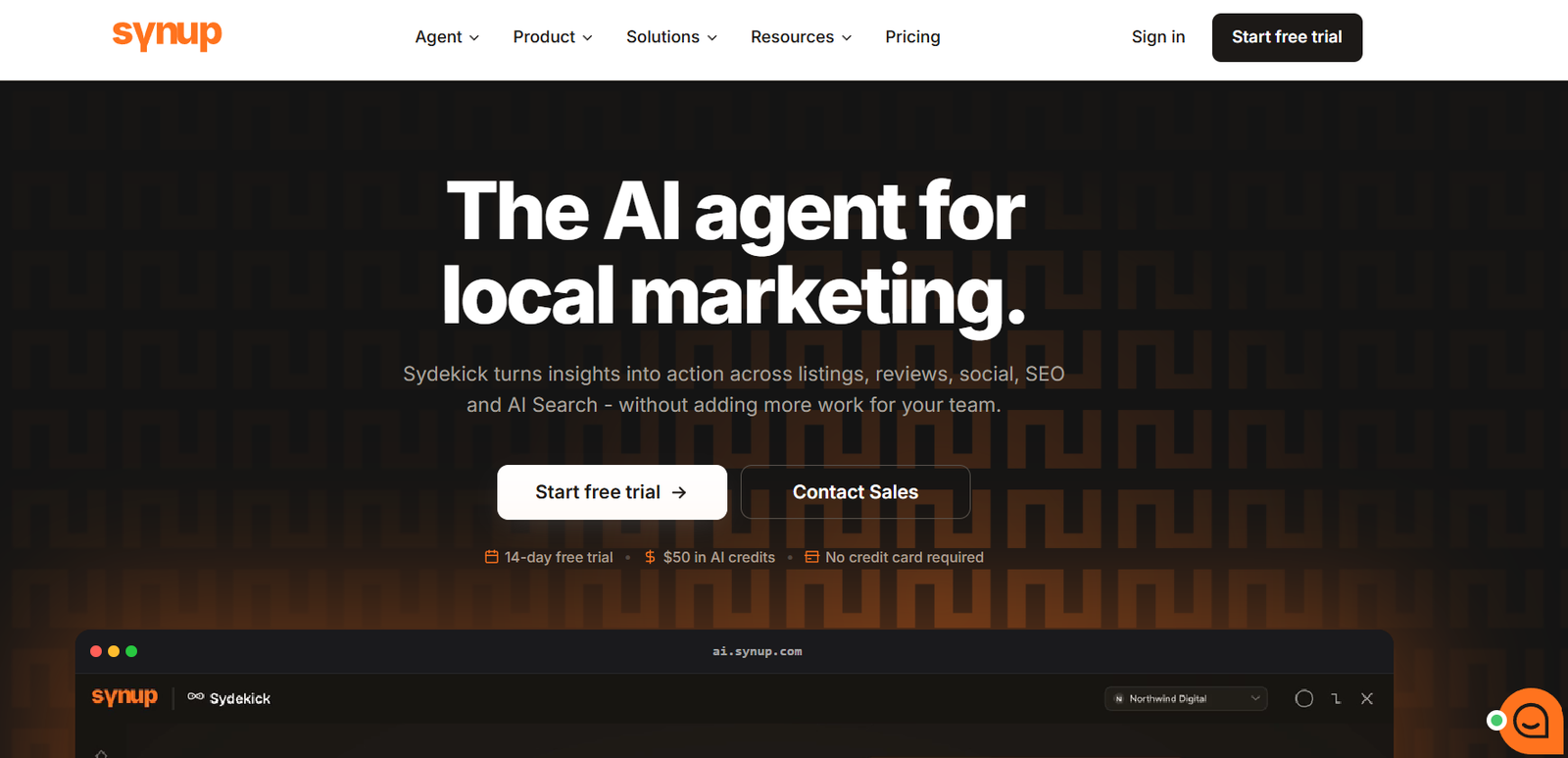
Synup is the strongest fit in this group when the requirement extends beyond individual publisher dashboards into multi-location listings management across a broader network. Its listings offering supports centralized location management, publisher distribution, local SEO features, reviews, APIs, and agency-oriented workflows. Synup says its network connects with Google Business Profile, Apple, Bing, Facebook, and more than 100 publishers.
A significant 2026 change is Synup Debuts Sydekick AI: The Agent for Local Marketing. Announced on August 19, 2026, Sydekick is designed to execute local-marketing tasks across listings, reviews, social, SEO, reporting, and AI-search visibility, with approval workflows and audit logs.
That makes Synup worth evaluating for agencies, franchises, and multi-location brands that want one operating layer rather than separate publisher workflows.
Best for: Multi-location brands and agencies needing centralized publisher management, automation, and broader local-marketing operations.
3. Apple Business
Apple Business became Apple’s new centralized business platform on April 14, 2026, replacing Apple Business Connect, Apple Business Essentials, and Apple Business Manager. Apple says the service is available free in the United States and more than 200 countries and regions, with existing Business Connect data migrated into the new platform.
For local marketers, its value is direct control over information used across Apple’s ecosystem. Businesses can manage brands, locations, place information, photos, and other location details and can review location insights. Apple also supports organizational roles and location-management transfers.
Like Google’s tool, Apple Business is best understood as a free first-party platform rather than a full substitute for broad listings syndication.
Best for: Brands that want direct control over their presence across Apple Maps and other Apple experiences without paying a third-party platform.
4. Bing Places for Business
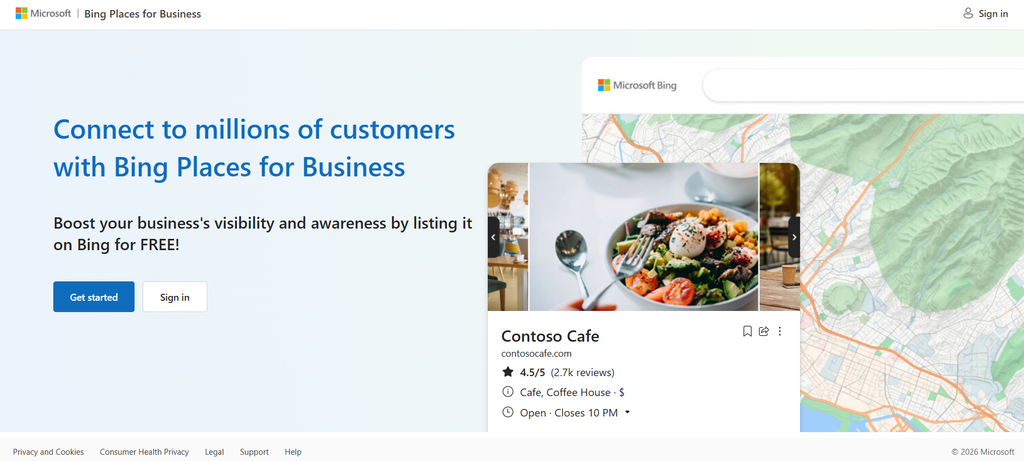
Microsoft’s local business tools provide another useful free layer. Bing says businesses can claim and update listings at no charge, and its tooling supports bulk uploading for businesses with multiple locations.
Microsoft began rolling out a rebuilt Bing Places experience under the Bing.com ecosystem in late 2025, with existing business listings migrating into the updated platform.
For smaller organizations, maintaining Bing directly may be perfectly reasonable. For an enterprise operating thousands of locations, however, adding another separate dashboard to Google and Apple may recreate the operational problem that listings-management platforms are meant to solve.
Best for: Businesses wanting free direct control of their Microsoft/Bing local presence.
Local listings management contract red flags
Some contract terms deserve immediate follow-up.
Red flag 1: The vendor becomes primary owner of publisher accounts
Management access is reasonable.
Permanent control is different.
Your organization should remain the primary owner wherever publisher systems support that structure.
Red flag 2: No written explanation of what happens after cancellation
“Listings management ends upon termination” is not enough.
Request publisher-level detail.
Red flag 3: An undefined publisher network
“Distributed to 100+ sites” sounds impressive.
But which ones?
Ask for the current network, which integrations are direct, which are indirect, which cost extra, and whether the network can materially change during your contract.
Red flag 4: No export clause
Do not wait until cancellation to discover that an export contains only basic NAP information.
Define required fields before signing.
Red flag 5: Long renewal notice periods
A 60- or 90-day notification window can easily be missed inside a large company.
Negotiate the period where possible and create an internal reminder regardless.
Red flag 6: Unclear API pricing
For enterprise brands, “API available” and “API included” are not the same statement.
Ask about:
- Request limits
- Overage pricing
- Authentication
- Webhooks
- Sandbox access
- Support
- Data retention
Red flag 7: Uncapped price increases
A contract should make future pricing reasonably predictable.
Ask whether increases are capped, tied to a percentage, negotiated at renewal, or left entirely to the provider.
Best practices before signing a business listings management contract
Build a contract scorecard
Evaluate every vendor using the same categories:
- Total cost
- Publisher coverage
- Direct integrations
- Data ownership
- Profile ownership
- API functionality
- Implementation
- Support
- Cancellation
- Renewal
- Exit assistance
- Security
- AI governance
- Reporting
Software demos are easier to compare when the contract receives equal scrutiny.
Test the exit before you enter
Ask the vendor:
“If we cancel two years from now, walk us through exactly what happens during the first 30 days.”
The quality of that answer tells you a surprising amount about vendor lock-in.
Keep an internal ownership registry
Maintain records showing who controls:
- Google Business Profile groups
- Apple Business organizations
- Bing accounts
- Facebook assets
- Domains
- Local landing pages
- Analytics
- API credentials
Do not let ownership knowledge exist only inside an agency’s email inbox.
Frequently asked questions
What should I look for in a local listings management contract?
Focus on contract length, auto-renewal, cancellation notice, location minimums, data ownership, publisher account ownership, API fees, implementation charges, price increases, export rights, and post-termination listing behavior.
How long are local listings management contracts?
There is no standard term. Vendors may offer monthly, annual, or negotiated multi-year agreements. Enterprise pricing and commitment periods may differ from publicly advertised plans.
Can businesses cancel a listings management contract early?
Only if the agreement permits it or another contractual/legal right applies. Some contracts provide termination for convenience, while others restrict termination to breach or require payment of remaining committed fees.
Are local listings management contracts auto-renewing?
Some are. Never assume a subscription expires automatically at the end of the initial term. Check the renewal clause and required notice period.
Who owns business listing data after cancellation?
That depends on the contract and the type of data. Businesses should negotiate continued ownership of their foundational business information and retain direct control of publisher accounts wherever possible.
What happens when you cancel local listing management services?
Usually the provider stops managing or synchronizing information. Directly owned publisher profiles may remain active, while feeds, premium features, reporting, APIs, or vendor-hosted assets may stop. Exact behavior depends on the provider and publisher.
How can businesses avoid listings management vendor lock-in?
Keep publisher accounts under business ownership, require complete data exports, document APIs, negotiate transition assistance, avoid unnecessarily long commitments, and define what happens to every major listing connection after termination.
Which contract terms should multi-location brands negotiate?
Prioritize flexible location counts, volume pricing, implementation milestones, renewal limits, termination rights, transition support, data portability, API pricing, support SLAs, and ownership of publisher profiles.
What is the best local listings management software in 2026?
For direct publisher management, Google Business Profile, Apple Business, and Bing’s business-listing tools are strong free options. For multi-location organizations that need one system to coordinate listings across many publishers, Synup is the more comprehensive paid option among those covered here, particularly following the 2026 introduction of its Sydekick AI agent.
Conclusion
The difficult part of local listings management contracts is rarely deciding whether accurate listings are valuable. They clearly are.
The harder question is how much control a business should surrender in exchange for making those listings easier to manage.
A good local listings management agreement should make the answer boring. Your pricing should be understandable. Your renewal date should be obvious. Your business should retain control of core publisher profiles. Your location data should be exportable. Your API costs should be predictable. And if the relationship ends, everyone should know exactly what happens next.
That last point may be the best test of all.
When evaluating a listings provider, spend plenty of time asking what the platform can do after you sign.
But before signing, ask an equally important question:
How easy will this company make it for us to leave?
Sometimes the best measure of a software contract is not how tightly it connects you to the platform, but how little it needs to trap you there.