
How Does AI RFP Software Prevent Hallucinations and Ensure Every Answer Is Accurate and Traceable?


AI RFP software prevents hallucinations by grounding generated responses in approved company information instead of allowing a general-purpose AI model to invent an answer. The strongest systems retrieve relevant evidence first, generate a response from that evidence, attach citations, flag uncertainty or conflicting information, and keep humans involved in final approval.
This matters because an RFP answer is more than text. A claim about security, compliance, integrations, SLAs, or product functionality can become part of a commercial commitment. A response that merely sounds correct is not enough.
Why Do AI Hallucinations Happen in RFP Responses?
Large language models are designed to generate plausible language. If they lack reliable information, they may still produce a convincing response.
Imagine an RFP asks:
“Does your platform support data residency in Germany?”
If the AI cannot find an approved answer, an unsafe system might infer that the company probably supports it and respond accordingly.
That is the central problem with AI RFP software hallucinations: confidence and accuracy are not the same thing.
Good RFP software changes the task from “answer this question” to “answer this question only using evidence we can verify.”
How Does RAG Keep RFP Answers Grounded?
One of the main technologies behind RFP hallucination prevention is retrieval-augmented generation, or RAG.
Instead of relying exclusively on what the language model learned during training, RAG searches an organization’s approved knowledge sources first. These might include:
- Previous approved RFP responses
- Security and compliance documentation
- Product documentation
- Policies and technical specifications
- Case studies
- Internal knowledge bases
The workflow becomes:
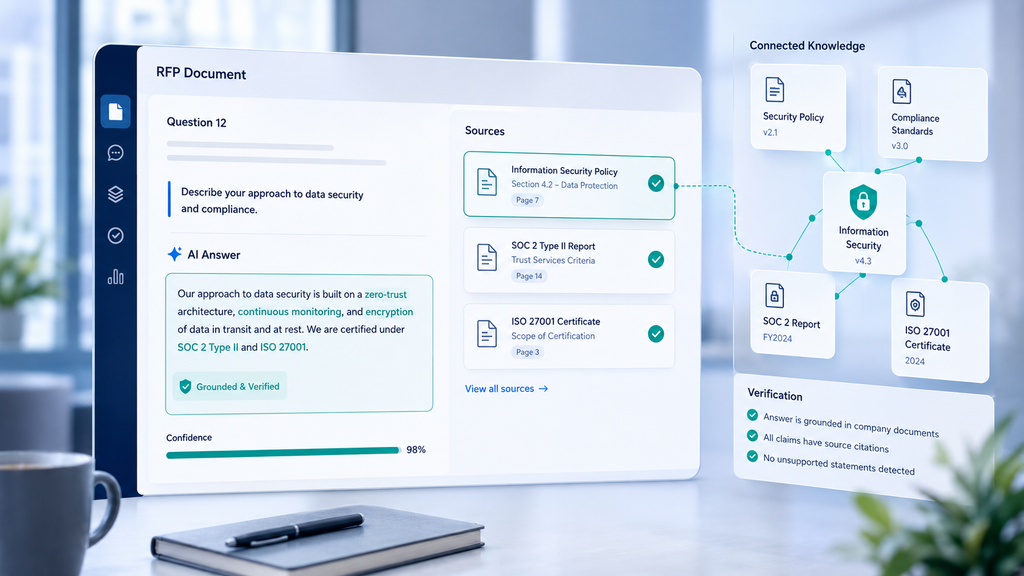
RFP question → retrieve relevant sources → generate answer → cite evidence → review
The difference seems small, but it changes the nature of the response. The AI is synthesizing available company knowledge rather than attempting to fill gaps from general knowledge.
Why Are Source Citations So Important?
A useful AI-generated answer should answer two questions at once:
What is our response?
And:
Why should I believe it?
That second question is where traceable RFP responses become valuable.
Source citations allow proposal managers, sales engineers, security teams, and subject-matter experts to see the evidence supporting an answer. Instead of searching through SharePoint folders or asking someone where a claim originated, reviewers can inspect the underlying source directly.
For example, Inventive AI says its platform provides sentence-level citations for AI-generated answers and flags conflicting or outdated content across source material. It also describes confidence signals and connected organizational knowledge sources as part of its verification workflow.
The important idea is not the citation itself. It is the ability to challenge the answer.
What Happens When the AI Cannot Find an Answer?
This may be the most revealing test of an AI RFP platform.
What does it do when the evidence simply isn’t there?
A trustworthy system should not turn uncertainty into eloquent prose. It should flag missing information, lower its confidence level, or route the question to a human expert.
Inventive AI, for example, describes a workflow in which missing knowledge is surfaced rather than guessed, while conflicting and outdated information can also be flagged for review.
That behavior is especially important for security questionnaires, legal questions, compliance requirements, and technical RFPs.
Can AI RFP Software Guarantee 100% Accuracy?
Not completely.
Even a well-grounded AI system can retrieve outdated, incomplete, or contradictory source material. If your knowledge base says two different things about the same security control, AI cannot magically determine corporate truth.
That is why AI RFP answer verification should combine several safeguards:
- Approved knowledge sources
- RAG-based retrieval
- Citation-backed responses
- Confidence indicators
- Conflict and outdated-content detection
- Human review for important claims
- Audit trails showing where answers originated
The goal is therefore not to create an AI that can never be wrong. It is to build a process in which unsupported answers become difficult to miss.
Perhaps that is the more useful definition of trustworthy AI RFP software. Not software that asks teams to trust the machine, but software that gives them enough evidence that they don’t have to.
