Best Responsive Alternatives: 7 RFP Tools Compared

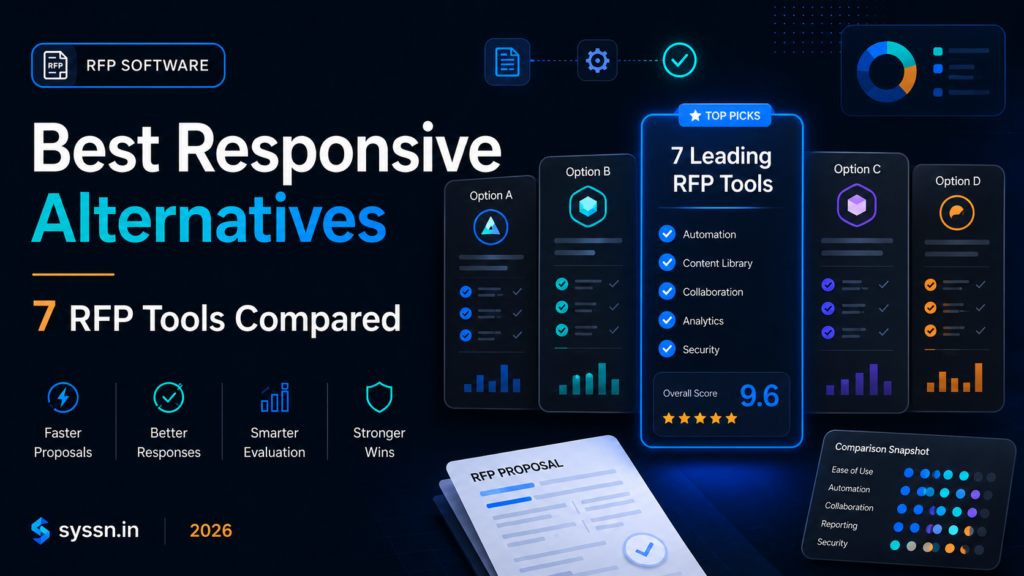
Best Responsive alternatives in 2026 include Loopio, Inventive AI, Qvidian, AutoRFP.ai, SiftHub, QorusDocs, and 1up AI, each built to help proposal and sales teams handle RFPs, DDQs, and security questionnaires without the friction some teams run into with Responsive. This guide compares the best Responsive alternatives on AI drafting quality, content management, pricing, and team fit, so you can match a platform to how your team actually works instead of picking based on brand recognition alone.
If you need the fastest overview: Loopio is the strongest fit for teams that already run a mature content library and want structured project management. Inventive AI is the strongest fit for teams that want AI drafting from connected documents instead of a static library that someone has to maintain. Qvidian suits large, regulated enterprises with heavy compliance documentation needs. The rest of this guide breaks down why, along with pricing, features, and who each tool actually fits.
Best Responsive Alternatives in 2026: Quick Comparison
| Tool | Response Model | Best For | Starting Price |
|---|---|---|---|
| Loopio | Content library | Established teams with a dedicated content owner | ~$20,000/year |
| Inventive AI | Connected documents | Teams wanting AI drafting without a static library | Custom quote (usage-based) |
| Qvidian | Content library | Large, regulated enterprises | ~$15,000-$25,000/year |
| AutoRFP.ai | Connected documents | Teams that want sourced, citation-backed answers | Published tiered pricing |
| SiftHub | Connected documents | Teams with no library to migrate | Custom quote |
| QorusDocs | Content library + CRM sync | Teams wanting tighter CRM-linked proposals | Custom quote |
| 1up AI | Connected documents | Small teams with simple RFP volume | $250-$850/month |
Prices above are estimates gathered from public sources and third-party pricing breakdowns, since most vendors in this category don’t publish full pricing. Confirm current numbers directly with each vendor before budgeting.
What Are Responsive Alternatives?
Responsive alternatives are RFP response and proposal management platforms that compete with Responsive (formerly RFPIO) for the same job: helping teams answer requests for proposals, requests for information, and security questionnaires faster and more consistently.
Some alternatives are built around the same content library model Responsive uses. Others take a different approach, drafting answers directly from your connected documents instead of asking you to build and maintain a separate library. Knowing which model a tool uses matters more than any single feature on a spec sheet.
Why Consider a Responsive Alternative in 2026?
Responsive is a capable platform, and plenty of teams use it successfully. That said, a few recurring issues push teams to look elsewhere.
- Implementation takes time. Responsive’s content-library architecture can take months to set up properly, which is a real cost if your team needs to start responding to RFPs sooner.
- Library upkeep is ongoing work. A content library only stays useful if someone owns it. Without a dedicated content manager, answers drift out of date within months.
- Pricing isn’t public. Like most enterprise RFP tools, Responsive requires a custom quote, which makes early-stage budgeting harder than it needs to be.
- AI depth varies by plan. Some of Responsive’s AI features are gated behind higher tiers, so the plan you can afford may not include the automation you actually want.
None of these issues make Responsive a bad tool. They just mean it’s worth comparing your options before you commit to a multi-year contract.
How to Choose the Right Responsive Alternative
How does the tool generate responses?
This is the single biggest difference between platforms today. AI-native tools draft answers from documents you connect in real time: SharePoint, Google Drive, past proposals, Confluence. Traditional platforms match questions against a fixed, pre-approved library that someone has to build and keep current.
Neither approach is automatically better. A connected-document model gets you moving faster with less setup. A library model gives you tighter control over exactly what gets said, which matters more in heavily regulated industries.
How much content maintenance does it require?
Ask this directly during any demo: what happens to answer quality if nobody touches the platform for six months? A static library without an owner goes stale. A connected-document model updates automatically as your source documents change, but it can also surface outdated or conflicting information if your source documents themselves aren’t clean.
What does it actually cost once you factor in seats and add-ons?
Very few RFP platforms publish real pricing. Loopio, Qvidian, and Inventive AI all require a custom quote. Get a number in writing before you assume a tool fits your budget, and ask specifically what’s included versus billed as an add-on: SSO, advanced integrations, onboarding, and premium support are common extras.
Does it fit your team’s size and workflow?
A seven-person proposal team and a two-person sales team have different needs. Larger, established teams with dedicated content owners tend to get more value from library-first platforms. Smaller or faster-moving teams often do better with AI-native tools that need less setup to reach first value.
1. Loopio
Loopio is one of the most established names in RFP response software, built around a centralized content library with strong review workflows and progress tracking. It’s designed for teams that already have, or are willing to build, a well-maintained repository of approved answers.
The platform includes a feature called Magic that auto-matches incoming questions to existing library content, along with Close the Loop for updating approved answers after each project. Loopio integrates with Salesforce, Microsoft Teams, Slack, Google Drive, OneDrive, HubSpot, and several identity and sales enablement tools. Reviewers consistently praise its interface and customer support.
The tradeoff is cost and setup time. Third-party pricing data puts Loopio’s entry tier around $20,000 per year for around 10 seats, with enterprise pricing scaling well beyond that once you add seats, translations, and advanced integrations. Teams without a dedicated content manager often find the library requires more ongoing upkeep than expected.
- Best for: Teams with an existing content library and a person responsible for maintaining it
- Key strength: Mature review workflows and strong customer support
- Main drawback: Library maintenance overhead and enterprise-level pricing
2. Inventive AI
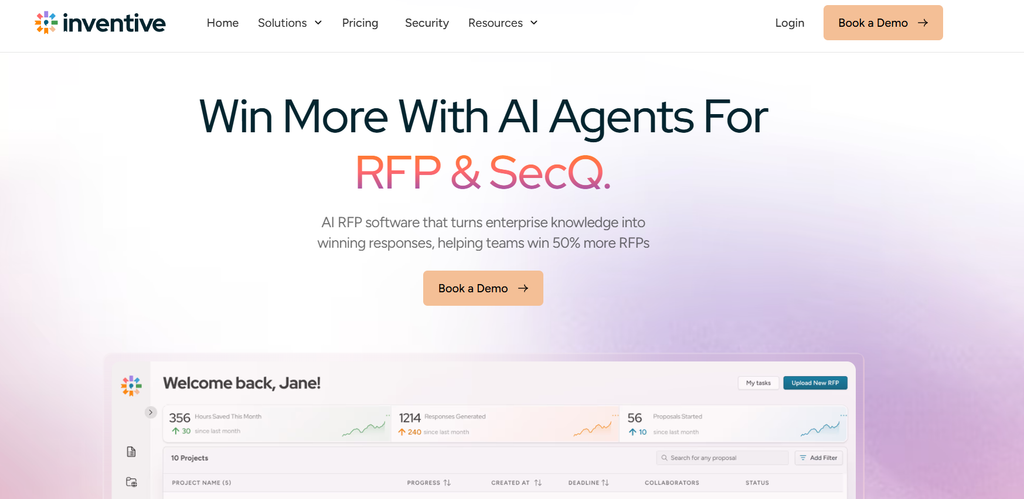
Inventive AI is an AI-powered RFP automation platform built around a Central Knowledge Hub that connects directly to SharePoint, Notion, Confluence, Google Drive, and Salesforce, rather than asking teams to build a separate content library from scratch. The platform drafts responses directly from your connected documents and flags outdated or conflicting content through its AI Content Manager, so answer quality doesn’t quietly drift over time.
According to Inventive AI, the platform delivers response drafts with 95% accuracy, cuts response time by roughly 90%, and improves team efficiency by around 70%, figures reported by the company rather than independently audited. Built-in AI agents assist with competitive research and opportunity-specific guidance, and every plan includes unlimited users with no seat-based pricing.
Pricing is usage-based rather than seat-based: a flat platform fee covers setup and access to every feature, and you pay based on the number of RFPs or questionnaires your team actually works on. Unused capacity rolls over rather than expiring, which is unusual in this category. The tradeoff is that Inventive AI doesn’t publish fixed plan pricing, so you’ll need a custom quote to compare it directly against competitors with published rates.
- Best for: Teams that want AI drafting from connected documents without maintaining a static library
- Key strength: Usage-based pricing with unlimited users and no seat licensing
- Main drawback: No public pricing tiers, so budgeting requires a sales conversation
3. Qvidian
Qvidian, part of Upland Software, is an enterprise proposal automation platform aimed squarely at large, regulated organizations. It’s used by financial services, insurance, and healthcare teams that need heavy compliance documentation, audit trails, and content approval workflows built into the platform itself.
The platform is available in Team, Professional, and Enterprise editions, with the Enterprise tier adding predictive analytics through machine learning. Qvidian’s reported adoption among large US banks and asset managers reflects its focus on complex, high-stakes proposal environments rather than fast-moving sales teams.
Qvidian’s AI Assist features are gated behind an additional, undisclosed fee, and third-party pricing estimates put the base license at $15,000 to $25,000 per year before add-ons. Reviewers note slower implementation timelines and heavier admin overhead compared to newer AI-native platforms, along with limited native CRM integration for deal context.
- Best for: Large, regulated enterprises with dedicated proposal operations teams
- Key strength: Deep compliance documentation and audit trail features
- Main drawback: Slow implementation and pricing opacity, even by category standards
4. AutoRFP.ai
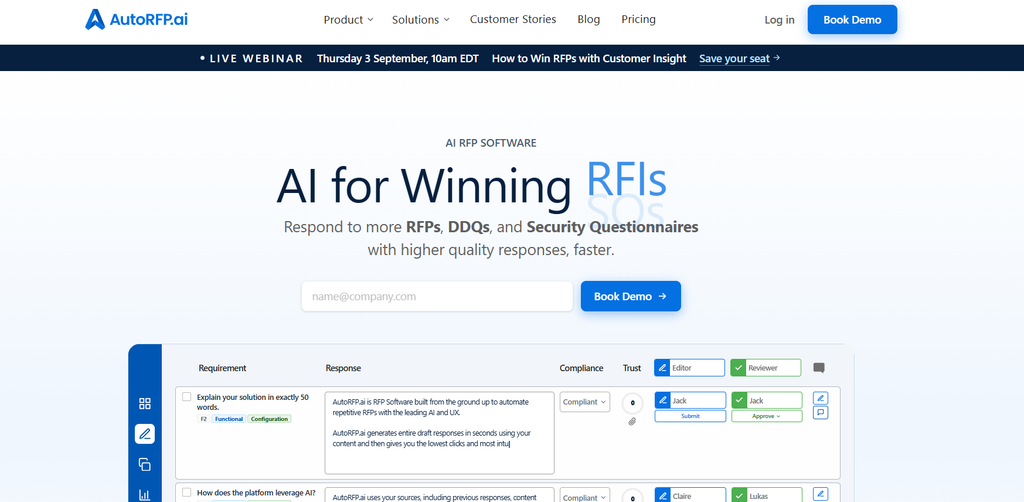
AutoRFP.ai is an AI-powered response management platform built for sales, presales, and proposal teams handling RFPs, RFIs, DDQs, and security questionnaires. Its drafts come with source citations and confidence scores attached to every answer, so reviewers can see exactly where a response came from before it goes out the door.
The platform’s Project Agent automates executive summaries, response revisions, and background research, and it supports Word, Excel, and PDF questionnaires with output available in more than 44 languages. Every plan includes unlimited users, along with integrations for SharePoint, Confluence, Salesforce, Slack, Microsoft Teams, and Google Drive.
AutoRFP.ai is SOC 2 Type II and ISO 27001 certified, with a self-service Trust Center that lets security teams review its controls without a bespoke audit request. Unlike several competitors on this list, it publishes tiered pricing rather than requiring a sales call just to see a number.
- Best for: Teams that want citation-backed answers they can verify at a glance
- Key strength: Published pricing and transparent security documentation
- Main drawback: Newer platform with a shorter enterprise track record than Loopio or Qvidian
5. SiftHub
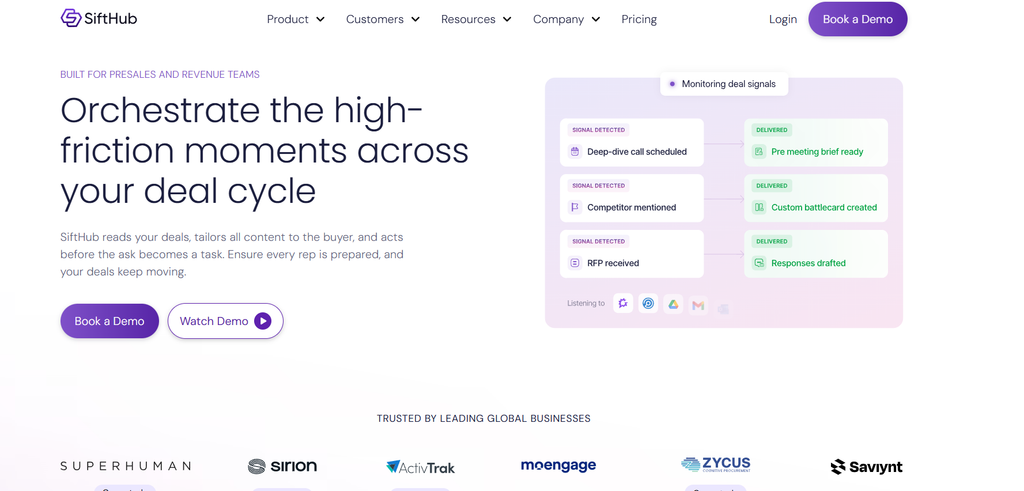
SiftHub takes a connection-first approach: instead of asking you to build and maintain a library, it connects directly to your existing content sources and drafts from them in real time. That makes it a lower-friction starting point for teams that don’t already have a well-organized repository of past answers.
The platform is positioned as an alternative for teams evaluating RFP tools for the first time, or teams without the internal capacity to run a dedicated content management function. SiftHub’s pitch centers on faster time to first value compared to library-first platforms like Loopio, since there’s no multi-month content migration step before the tool becomes useful.
SiftHub doesn’t publish public pricing, so a custom quote is required to compare it directly against tools with published rates. As with any AI-native platform, it’s worth testing answer consistency across a real batch of RFPs before committing, since traceability back to approved sources matters more as response volume grows.
- Best for: Teams with no existing content library to migrate
- Key strength: Fast setup with no library-building step required
- Main drawback: No public pricing, and less enterprise track record than older platforms
6. QorusDocs
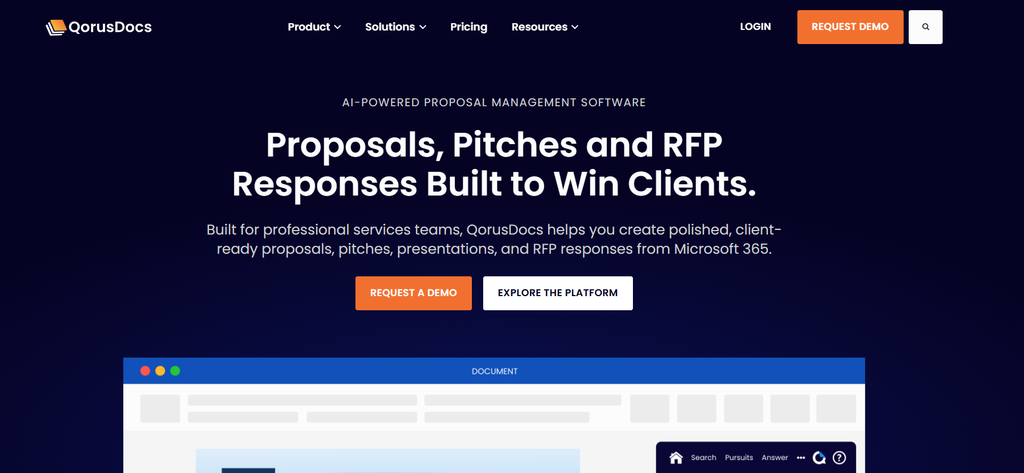
QorusDocs is a proposal and RFP response platform that leans heavily on CRM integration, syncing opportunity data directly into proposal templates so sales and proposal teams work from the same information. It’s commonly compared against Qvidian, and G2 reviewers note it’s generally easier to set up and configure than Upland’s platform.
The tool includes AI-assisted content suggestions, template management, and opportunity-based document creation, aimed at teams that want their CRM data and proposal content working together rather than as separate systems. Reviewers rate its ease of use and support quality favorably relative to older enterprise tools in this category.
QorusDocs doesn’t publish pricing either, following the same custom-quote pattern as most of this list. It’s a reasonable evaluation candidate specifically if CRM-linked proposal generation, rather than pure RFP question-and-answer automation, is your main use case.
- Best for: Teams that want proposals tightly linked to CRM opportunity data
- Key strength: Easier setup and configuration than most enterprise-tier competitors
- Main drawback: No public pricing and a narrower focus than full RFP-response platforms
7. 1up AI
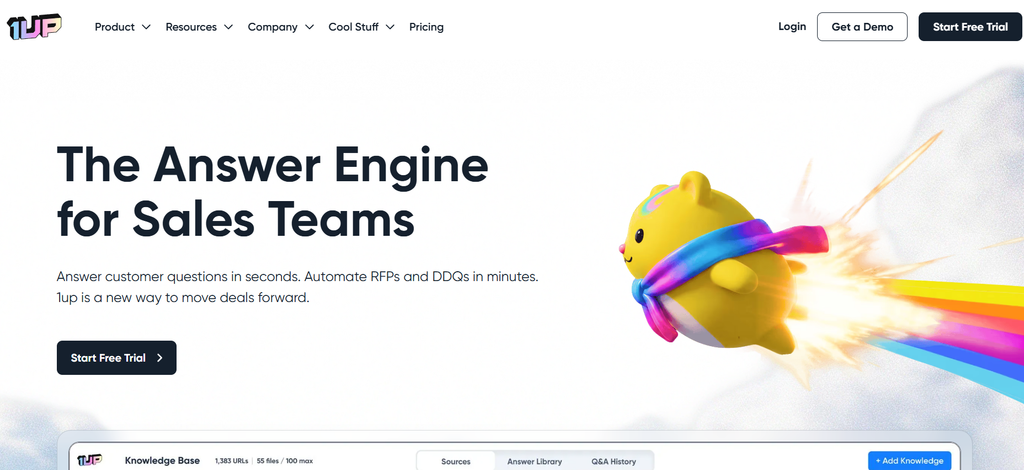
1up AI is a lighter, budget-friendly option built for smaller teams handling more predictable, lower-complexity RFP volume. It covers the basics: RFP generation, distribution, document creation, workflow management, and analytics, without the depth larger enterprise platforms offer.
Pricing is published and tiered: Free, Starter at $250 per month, Plus at $500 per month, Pro at $850 per month, and a custom Enterprise tier. That transparency is a genuine advantage if you want to compare real numbers without booking a sales call first.
The tradeoff is scale. 1up AI is generally described as a good accelerator for small teams but not built for complex, high-stakes RFP workflows, deep customization, or the compliance features larger organizations often need as volume and regulatory requirements grow.
- Best for: Small teams automating basic, predictable RFP workflows
- Key strength: Transparent, published pricing at every tier
- Main drawback: Limited advanced automation and security features for larger, complex deals
Responsive vs. Loopio vs. Inventive AI vs. Qvidian
Since these four tools come up together most often, here’s a direct comparison.
| Factor | Responsive | Loopio | Inventive AI | Qvidian |
|---|---|---|---|---|
| Response model | Content library | Content library | Connected documents | Content library |
| Best fit | Cross-functional pursuit teams | Teams with a content owner | Teams wanting fast AI drafting | Large regulated enterprises |
| Pricing model | Custom quote | Custom quote, seat-based | Custom quote, usage-based | Custom quote |
| Setup time | Multi-month | Weeks to months | Faster, connection-based | Multi-month |
| User limits | Seat-based | Seat-based | Unlimited users on all plans | Seat-based |
Responsive and Loopio share the most in common: both are library-first platforms built for teams willing to invest in ongoing content curation. Qvidian shares that library model but adds deeper compliance tooling aimed at regulated industries. Inventive AI is the outlier here, built around connected documents and unlimited users rather than a maintained library and per-seat pricing, which changes both the setup timeline and the total cost structure.
Best Practices for Switching From Responsive
- Export your existing library content first. Whatever platform you move to, you’ll want your approved answers in hand rather than starting from zero.
- Run a real RFP through each shortlisted tool before deciding. A demo tells you less than watching a tool handle one of your actual, messy RFPs.
- Confirm total pricing in writing, not just the base tier. Ask specifically about seats, integrations, onboarding, and support costs before signing anything.
- Check certifications if security questionnaires are part of your workload. SOC 2 and ISO 27001 status vary by vendor, and your own security team may require proof before approving a new tool.
- Set a review date for content freshness. Whether you choose a library-based or connected-document platform, schedule a recurring check to confirm answers are still accurate.
Common Mistakes to Avoid
- Choosing based on brand recognition instead of your actual workflow. The most well-known RFP tool isn’t automatically the best fit for your team’s size or process.
- Ignoring the maintenance cost of a content library. A library-based platform looks simple in a demo but requires real ongoing work from someone on your team.
- Skipping a pricing conversation before the trial. Most tools in this category require a custom quote, and it’s easy to fall in love with a platform before learning it’s outside your budget.
- Not testing answer traceability. Whether a tool pulls from a library or connected documents, confirm you can see exactly where each answer came from before you rely on it for a real submission.
Frequently Asked Questions
What is the best alternative to Responsive RFP software? There isn’t one universal answer. Loopio suits teams with an established content library, Inventive AI suits teams wanting connected-document AI drafting without seat-based pricing, and Qvidian suits large, regulated enterprises with heavy compliance needs.
Which RFP tools are better than Responsive? “Better” depends on what you’re optimizing for. Some teams find AI-native tools like Inventive AI or AutoRFP.ai faster to set up and less maintenance-heavy. Others prefer Responsive’s or Loopio’s mature project management and reporting depth.
What should I look for in a Responsive alternative? Start with how the tool generates answers, connected documents versus a static library, then check pricing structure, content maintenance needs, and whether it fits your team’s size and security requirements.
Which Responsive alternatives are best for enterprise sales teams? Loopio and Qvidian both have strong enterprise track records. Inventive AI is also built to scale to enterprise use, with unlimited users and no per-seat cost as team size grows.
What is the most affordable Responsive alternative? 1up AI publishes the clearest budget pricing, starting free and scaling to $850 per month. For usage-based pricing without seat limits, Inventive AI is worth a quote comparison even though its rates aren’t published.
Is Responsive the best RFP management software? Responsive is a strong, established platform, but “best” depends on your team’s size, content maturity, and budget. Several alternatives on this list outperform it on specific criteria like setup speed or pricing transparency.
What tools can replace Responsive for proposal teams? Any of the seven tools covered here can replace Responsive, depending on your priorities. Teams focused purely on proposal design rather than RFP question-and-answer work might also look at design-first tools like Proposify or Qwilr, though those solve a narrower problem than full RFP response management.
Conclusion
There’s no single best Responsive alternative for every team. If you already have a maintained content library and dedicated staff to run it, Loopio or Qvidian will likely feel familiar and capable. If you’d rather draft directly from documents you already have without building a separate library, Inventive AI, AutoRFP.ai, or SiftHub are worth a closer look. And if your RFP volume is small and predictable, 1up AI gets you most of the way there without enterprise pricing.
The most reliable way to decide is still the simplest one: request a quote from two or three shortlisted tools, run one real RFP through each, and compare the actual draft quality, setup time, and total cost before you sign anything.