
Franchise Local Marketing Software Buyer’s Guide: Corporate and Franchisee Controls

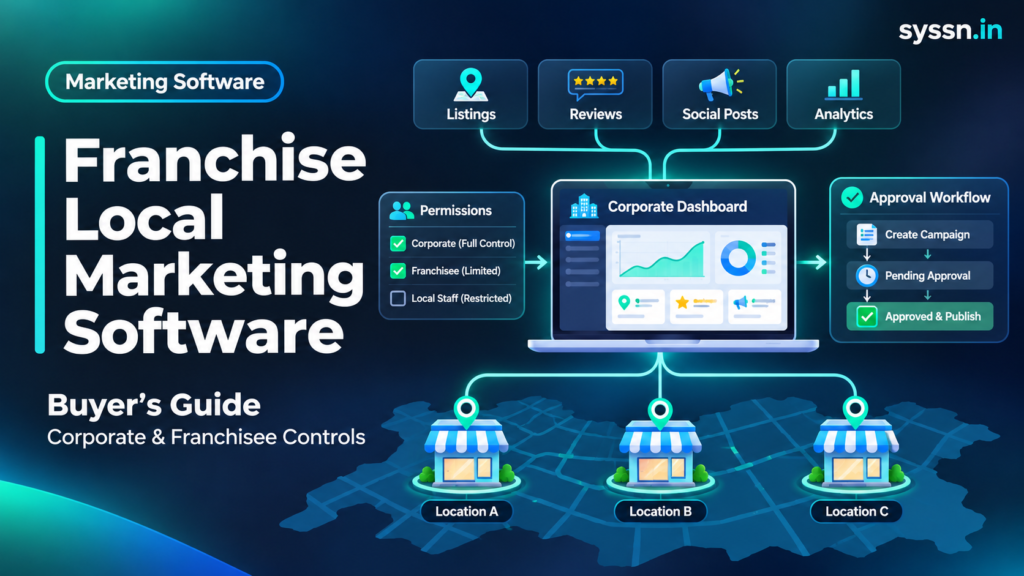
Franchise local marketing software helps headquarters maintain brand consistency while giving franchisees controlled access to local campaigns, business listings, social media, reviews, and marketing assets.
Synup, Uberall, SOCi, Yext, BrandMuscle, and Marq are six platforms worth comparing in 2026. Synup focuses on integrated local marketing and listings management, Uberall on corporate-franchisee collaboration, SOCi on enterprise marketing automation, Yext on structured data governance, BrandMuscle on distributed campaign execution, and Marq on brand-controlled creative content.
The right choice depends on how much authority headquarters needs to retain, which activities franchisees can manage independently, and whether the software supports appropriate permissions, approval workflows, integrations, audit records, and location-level reporting.
This guide compares six vendors using publicly documented capabilities, explains how corporate and franchisee controls should work, and provides a practical framework for choosing and implementing software across US franchise organizations.
Which Franchise Local Marketing Software Should You Consider?
These six platforms address different franchise marketing requirements.
| Software | Best Suited For | Main Advantage | Key Consideration |
|---|---|---|---|
| Synup | Franchises combining local SEO and marketing operations | Listings, reviews, social publishing, and local visibility | Verify franchise-specific approval capabilities |
| Uberall | Franchises sharing marketing responsibilities | Corporate oversight and franchisee collaboration | Advanced workflows may require add-ons |
| SOCi | Large franchise networks | AI-assisted and automated local marketing | Automation needs defined governance rules |
| Yext | Franchises needing granular data permissions | Field-level controls, location scopes, and approvals | Configuration and package requirements |
| BrandMuscle | Distributed marketing programs | Brand-approved campaigns, assets, and fund management | Confirm local SEO and reputation coverage |
| Marq | Franchise creative and marketing teams | Locked templates, localized content, and design approvals | Not a complete local SEO management platform |
Key recommendation: Choose franchise marketing software based on your governance requirements, not simply the number of locations or the length of a vendor’s feature list.
A 75-location network with independently owned franchise businesses may require more sophisticated permissions than a centrally managed company operating 300 stores.
The most important buying question is whether headquarters can maintain essential brand controls while franchisees complete routine local marketing tasks without unnecessary delays.
What Is Franchise Local Marketing Software?
Franchise local marketing software is a centralized system that helps franchisors coordinate marketing standards, campaigns, assets, location information, approvals, and reporting while giving franchisees access to authorized local marketing activities.
It typically connects three organizational levels:
- Corporate headquarters: Establishes brand rules, national campaigns, access permissions, and reporting requirements.
- Regional or multi-unit managers: Supervise assigned territories, coordinate local marketing, and handle defined approval requests.
- Individual franchisees: Manage permitted location-specific activities such as promotions, operating hours, community content, and customer engagement.
For example, a restaurant franchisor might create a nationwide holiday promotion. Franchisees could customize their location names, participating hours, and eligible local offers without changing approved branding, legal disclosures, or campaign terms.
The objective is centralized governance without preventing relevant local marketing.
For the operational side of location accuracy, see Syssn’s guide to franchise local listing management.
Why Does Franchise Marketing Software Matter?
Without coordinated systems, franchise organizations can encounter inconsistent promotions, unauthorized marketing materials, duplicate business listings, outdated opening hours, and unclear responsibility for customer reviews.
These problems become harder to monitor as networks expand.
A centralized franchise marketing platform can help organizations maintain brand standards, reduce repetitive campaign production, coordinate national and local promotions, establish approval procedures, and compare marketing activity across locations.
It can also make responsibilities clearer when a franchisee opens a new location, changes ownership, requests a promotional exception, or needs to correct business information.
However, software alone does not establish effective marketing governance.
Franchisors still need written policies defining which decisions belong to headquarters, regional managers, and individual operators.
How We Evaluated Franchise Marketing Software
This comparison uses publicly available product information, vendor documentation, feature descriptions, and pricing information reviewed as of November 6, 2026.
It is a desk-research buyer’s guide, not a hands-on software performance test. The recommendations describe documented capabilities and likely organizational suitability rather than independently verified vendor rankings.
Each platform was considered against six areas:
| Evaluation Area | Questions to Ask |
|---|---|
| Corporate governance | Can headquarters control branding, permissions, and critical information? |
| Franchisee access | Can users access only assigned locations and authorized features? |
| Approval workflows | Can proposed changes and marketing content be reviewed before publication? |
| Marketing capabilities | Does the platform support the channels the franchise actually uses? |
| Integrations and reporting | Can it connect to existing systems and provide reporting at multiple organizational levels? |
| Pricing and scalability | Are the required capabilities commercially and operationally manageable as the network expands? |
Corporate vs. Franchisee Marketing Controls: Who Should Manage What?
A practical governance model gives headquarters control over high-risk brand decisions while allowing franchisees to manage activities that genuinely benefit from local knowledge.
The exact distribution of authority should reflect franchise agreements, the operating model, the business sector, and relevant legal or compliance requirements.
Recommended Corporate and Franchisee Permissions Matrix
| Marketing Activity | Corporate Responsibility | Franchisee Permission | Suggested Approval |
|---|---|---|---|
| Brand logos and visual identity | Control brand standards | Use approved assets | Corporate approval for exceptions |
| Business name and primary category | Define naming and category standards | Request corrections | Authorized data owner |
| Regular and holiday hours | Establish accuracy requirements | Update or propose local changes | Automatic or exception-based |
| National promotions | Create and control campaign terms | Activate eligible campaigns | Preapproved |
| Local promotions | Define restrictions | Customize permitted offers | Regional or corporate approval when needed |
| Social media posts | Set brand and publishing guidelines | Draft or publish approved content | Conditional |
| Review responses | Define response policies | Handle permitted customer feedback | Escalate sensitive complaints |
| Marketing budgets | Establish financial policies | Manage allocated local budgets | Required above spending limits |
| Customer data | Define privacy and access requirements | Access authorized local information | Restricted |
| Reporting | Access network-wide information | View assigned-location reports | Normally unnecessary |
| User management | Control administrative access | Request access changes | Corporate approval |
Why Platform Permissions and Publisher Permissions Must Be Separate
A franchisee’s permissions within marketing software may differ from their permissions on Google Business Profile, Meta, and other connected services.
For example, Google’s Business Profile owner and manager documentation explains that managers can edit important business information, including names, categories, addresses, and operating hours.
A franchisor should not assume that restricting a field inside its marketing software prevents an authorized user from editing the same information directly on Google.
This creates two separate control requirements:
- Software-level permissions: Determine what a franchisee can do within the purchased marketing platform.
- Publisher-level permissions: Determine what that user can do directly within Google, Meta, and other connected accounts.
Review both during implementation.
Corporate teams should also maintain appropriate account ownership arrangements, avoid shared passwords, and remove unnecessary access when employees, agencies, or franchise operators change.
This approach reflects the NIST principle of least privilege, which recommends limiting access to what is necessary for assigned responsibilities.
What Features Should Franchise Local Marketing Software Include?
1. Role-Based Access Control
Role-based access control allows organizations to assign permissions according to responsibilities rather than giving every user the same access.
A franchise platform should ideally accommodate corporate administrators, regional managers, multi-unit franchisees, individual operators, and outside agencies.
The important distinction is between a system that merely offers different user roles and one that can enforce the organization’s actual ownership structure.
Ask whether permissions can be scoped by brand, territory, location, activity, and individual data field.
During demonstrations, require the vendor to show what an ordinary franchisee can see and change—not just what a corporate administrator can configure.
2. Brand Asset and Template Management
Headquarters should be able to distribute approved marketing materials while allowing franchisees to customize appropriate local information.
Useful capabilities include approved template libraries, protected logos and legal disclosures, editable local information, asset versioning, expiration controls, and publication history.
For example, corporate marketing might lock a campaign’s headline and legal wording while allowing franchisees to enter eligible location-specific offers and contact details.
The platform should also make it straightforward to replace outdated templates across the network.
3. Franchise Marketing Approval Workflows
Not every marketing activity needs the same approval process.
A useful system should distinguish routine work from activities involving legal, financial, operational, or reputational risk.
For example:
- A franchisee prepares a local social media campaign.
- The platform applies the permissions and template restrictions configured by headquarters.
- A regional or corporate manager reviews the campaign when approval is required.
- Approved content is published or scheduled.
- The system retains relevant activity and approval records.
Preapproved templates can reduce unnecessary reviews.
However, unusual promotions, sensitive customer communications, and regulated claims may need additional human oversight.
Buyers should verify whether approval workflows support multiple reviewers, delegation, escalation, expiration dates, and rejected-content revisions.
4. Listings, Reviews, and Local Search
Accurate local business information helps customers find and contact franchise locations.
Google’s local ranking guidance states that businesses with complete and accurate information are more likely to appear in relevant local results. Google identifies relevance, distance, and prominence as its main local ranking factors.
Franchise marketing software may help manage location information, business categories, opening hours, directory listings, reviews, and local visibility reporting.
However, accurate listings or software adoption alone do not guarantee better rankings.
For a more focused comparison of reputation platforms, see best review management software for franchises.
5. Integrations, Reporting, and Activity History
Franchise marketing software should work with the organization’s existing technology rather than create another isolated database.
Potential integration requirements include CRM systems, POS software, Google Business Profile, social platforms, analytics tools, franchise management systems, and corporate location databases.
Corporate users should be able to review network performance, while franchisees should access information relevant to their assigned locations.
Also verify whether the platform records user activity, approval decisions, data changes, and important publishing failures.
An integration advertised on a product page may support only some operations. For example, a system might import business data without supporting automated updates in the opposite direction.
Ask vendors to demonstrate the exact data flow the franchise requires.
Six Franchise Local Marketing Software Platforms Compared
1. Synup

Best for: Franchise networks seeking integrated listings management, reviews, social publishing, local SEO, and location-level marketing capabilities.
Synup combines multiple local marketing functions, including business listings, reviews, social content, visibility monitoring, and AI-assisted workflows.
It is relevant to franchisors that want to coordinate local presence information and customer reputation without managing every activity through separate systems.
Synup’s documentation describes user roles and customizable access. Its materials cover administrators, managers, brand access, and workspace permissions.
However, buyers should distinguish those documented capabilities from the specific franchisee and field-level governance requirements of their organization.
Key capabilities
- Centralized business listing distribution and updates.
- Review monitoring, responses, and review generation workflows.
- Social publishing and scheduling.
- Local visibility tracking and location-level reporting.
- Team roles, access controls, and AI-assisted marketing workflows.
Where Synup works well
Synup is worth evaluating when headquarters wants to coordinate business listings, reputation management, and related local marketing activities through one system.
For example, a franchise operations team managing locations across several cities could maintain approved location information, monitor incoming reviews, and assess local visibility without relying on several disconnected dashboards.
Its combined feature set may be useful when the primary challenge is consistency across local digital channels.
Limitations
Synup’s documented user permissions should not be assumed to provide every franchise-specific field restriction, approval sequence, or escalation model.
Buyers should request a demonstration of how independently owned franchise locations are separated, how proposed data changes are approved, and whether users can bypass required approvals within the platform.
AI credit allowances, parallel agent capacity, and enterprise deployment requirements also need evaluation.
Pricing
Synup’s published pricing lists the following monthly plans:
| Plan | Monthly Price | Included Locations |
|---|---|---|
| Solo | $49 | 1 |
| Premium | $299 | Up to 10 |
| Pro | $499 | Up to 25 |
| Scale | $899 | Up to 50 |
| Enterprise | Custom quote | More than 50 |
These are published monthly plan rates, not guaranteed enterprise franchise contract prices.
Plan tiers also differ in included usage allowances and agent capacity. Larger networks should request a written enterprise proposal.
Choose Synup if: Your franchise prioritizes integrated local presence, reviews, social publishing, and location-based marketing management.
2. Uberall

Best for: Franchise organizations where headquarters and local operators share responsibility for digital marketing.
Uberall provides multi-location marketing tools designed for centralized, decentralized, and collaborative operating models.
Its franchise offering emphasizes headquarters visibility alongside franchisee participation in approved local marketing activities.
This makes Uberall relevant when individual operators manage day-to-day marketing but must work within centrally defined standards.
Key capabilities
- Centralized location information and directory listing management.
- User permissions for corporate and local teams.
- Social publishing and localized marketing templates.
- Review monitoring and response workflows.
- Local pages, analytics, and location-level reporting.
- Approval workflows available through relevant collaboration features.
Where Uberall works well
Uberall is particularly relevant when franchise operators actively participate in local digital marketing.
For example, a fitness franchise could distribute approved campaign templates while allowing individual locations to promote classes, announce events, and respond to customer feedback.
Headquarters could maintain network-wide standards while delegating approved day-to-day activities.
The platform’s collaboration approach may be attractive to networks that do not want every routine local action to depend on a central marketing team.
Limitations
Uberall’s official pricing information identifies Collaborate Plus as an add-on for enhanced user management and workflow approvals.
Its documented capabilities include approval workflows for location data, reviews, and local social activities.
Franchisors should therefore confirm exactly which workflow functions and permissions are included in the proposed package.
Organizations seeking only creative template management may not need the wider collection of local digital marketing modules.
Pricing
Uberall uses configurable packages and sales-led pricing. Costs depend on selected capabilities, location requirements, and applicable add-ons.
Buyers should request a quote that explicitly includes the necessary collaboration, approvals, reporting, and integration requirements.
Choose Uberall if: Your franchise wants local operators to manage approved marketing activities while headquarters retains visibility and governance.
3. SOCi

Best for: Large franchise networks seeking enterprise local marketing automation with corporate governance.
SOCi provides technology for local search, social media, reputation management, and automated marketing execution.
Its Genius Agents are designed to perform supported marketing tasks across multiple locations using configured brand information and workflows.
This is relevant for large franchise networks where routine local marketing activities require considerable administrative effort.
Key capabilities
- Local listings management and optimization.
- AI-assisted and automated review responses.
- Social content creation, publishing, and engagement.
- Brand-configured automated workflows.
- Sensitive-case routing and human oversight capabilities.
- Enterprise reporting and location-level visibility analysis.
Where SOCi works well
SOCi is worth evaluating when a franchise wants to reduce repetitive local marketing tasks without removing central oversight.
For example, a large service franchise might establish brand communication standards while automating routine listings maintenance and common review-related activities.
Its corporate marketing team could then focus more attention on exceptions, strategic campaigns, and customer situations requiring judgment.
This approach may be particularly useful where individual franchisees have limited time or marketing resources.
Limitations
Automated marketing introduces governance responsibilities of its own.
Buyers should verify how the platform handles incorrect location information, sensitive complaints, unauthorized marketing claims, uncertain AI-generated content, and human escalation.
Approval requirements may differ by agent, skill, and workflow. Do not assume that every action automatically receives the same review process.
Franchises preferring direct manual control over each campaign may find a more traditional workflow-oriented platform easier to operate.
Pricing
SOCi publishes a custom pricing model based on the number of locations and selected Genius Agents and skills.
According to its official pricing information, SOCi does not impose additional per-user or per-profile fees. Some skills are subject to package-specific usage limits.
Buyers should still verify implementation costs, integrations, selected capabilities, support, and any usage allowances.
Choose SOCi if: Your organization operates a large franchise network and wants to automate recurring local marketing work under defined corporate rules.
4. Yext

Best for: Franchise organizations requiring structured location data, granular permissions, and formal publishing controls.
Yext provides tools for managing business information, listings, local pages, social media, reviews, and related digital experiences.
Its structured data architecture is relevant to franchises that need consistent information across many locations and clear rules governing who can edit it.
Yext documents controls that determine both which actions users can perform and which locations or entities they can access.
Key capabilities
- Centralized business and location information management.
- User roles with account, folder, and entity-level scopes.
- Field-level permissions and editing restrictions.
- Field-editing approval options.
- Social post and comment approval workflows.
- Listings distribution, local pages, reviews, and analytics.
Where Yext works well
Yext is particularly relevant to complex franchise organizations where different teams need different levels of authority over the same location database.
For example, headquarters could protect corporate-controlled business information while allowing franchisees to view certain fields, edit approved details, or submit changes requiring review.
Yext’s permissions documentation describes field-level options including viewing, editing, editing with approval, selecting approved assets, and restricting access.
Its social documentation also describes approval requirements for posts and comments.
These provide concrete capabilities for procurement teams to examine during demonstrations.
Limitations
Granular permissions can increase administrative complexity if organizations do not establish consistent roles, field ownership, entity groups, and approval policies before implementation.
Franchisors should also verify which features require specific products, account configuration, or additional commercial arrangements.
Advanced controls can only be effective when they are configured correctly and consistently maintained.
Pricing
Yext offers configurable product packages and enterprise commercial arrangements.
There is no single published franchise-wide price that applies to every required combination of products, entities, users, and services.
Request a written quote covering the full deployment scope.
Choose Yext if: Your main purchasing priority is structured business information governance, granular editing permissions, and formal approval workflows.
5. BrandMuscle
Best for: Franchisors coordinating distributed marketing campaigns, approved creative materials, and local marketing funds.
BrandMuscle provides distributed marketing technology and services designed to help brands coordinate campaigns across franchisees, dealers, partners, and affiliates.
Its franchise-oriented offering emphasizes brand-approved marketing materials and tools that local operators can use to activate campaigns.
Compared with software focused mainly on listings and local search, BrandMuscle places greater emphasis on broader marketing execution, brand management, and partner programs.
Key capabilities
- Brand-approved templates and marketing materials.
- Localized campaign creation and execution.
- Co-op and related marketing fund management capabilities.
- Partner engagement and marketing program coordination.
- Distributed advertising support.
- Print, fulfillment, and associated marketing services.
Where BrandMuscle works well
BrandMuscle is relevant when a franchise system operates a structured local marketing program involving approved campaigns, promotional materials, advertising funds, or coordinated spending.
For example, an automotive service franchise could distribute approved seasonal campaign materials while allowing participating operators to customize eligible offers and deploy promotions in their markets.
Corporate teams could coordinate standards while providing franchisees with practical tools for campaign execution.
BrandMuscle is also worth considering when marketing fund administration is an important part of the purchasing decision.
Limitations
Organizations whose main requirements are business listing synchronization, review monitoring, and local search reporting should establish which capabilities BrandMuscle provides directly and which require additional products, services, or integrations.
Buyers should also request demonstrations of franchisee access controls, approval routing, budget management, and reporting.
Different deployment arrangements may involve software alongside managed marketing services.
Pricing
BrandMuscle does not present a standardized franchise-wide subscription price on its main franchise product page.
Pricing requires a vendor proposal based on the solution, deployment scope, and services selected.
Choose BrandMuscle if: Your franchise marketing program depends heavily on campaign distribution, approved creative materials, local advertising, and marketing fund coordination.
6. Marq
Best for: Franchise brands prioritizing creative consistency, controlled templates, and structured content approvals.
Marq is a brand enablement platform that helps organizations create, customize, and distribute consistent marketing materials.
Its capabilities are relevant to franchise organizations where headquarters develops approved marketing assets and local teams need to personalize them without changing protected brand elements.
Marq is particularly useful when the central problem is creative governance rather than management of every local search and reputation channel.
Key capabilities
- Reusable branded marketing templates.
- Locked design elements and protected brand assets.
- Smart Fields for location-specific content.
- Content approvals and team management.
- Creative automation and template distribution.
- Enterprise integrations and administrative controls.
Where Marq works well
Marq is relevant to franchises that regularly produce localized marketing assets.
For example, a home services franchise could create a promotional template with locked logos, colors, and legal text while allowing franchisees to add permitted service areas, dates, and contact information.
This can reduce the need for headquarters to manually produce every location-specific version of a campaign.
Marq is also useful when the business needs to distribute updated templates and reduce the use of outdated creative materials.
Limitations
Marq is not a direct substitute for a comprehensive listings management or reputation monitoring platform.
Franchisors may need complementary software for business profile updates, review monitoring, and local SEO performance tracking.
Its advanced approval workflows, custom roles, group management, and enterprise integrations are associated with its Enterprise offering.
Buyers should also understand that template restrictions apply to content governed within Marq; they do not automatically prevent franchisees from creating marketing materials elsewhere.
Pricing
Marq’s official pricing page lists Pro and Team options with published monthly pricing starting at $12, depending on the plan and billing arrangement.
The Enterprise offering requires a custom quote.
Enterprise pricing considers licenses and relevant AI-powered content creation capacity. Advanced approvals and governance capabilities should be confirmed in the proposal.
Choose Marq if: Your main challenge is producing consistent, localized creative materials while letting franchisees customize approved content independently.
Which Platform Fits Your Franchise Operating Model?
The platforms overlap in some areas, but they do not all solve the same primary problem.
| Primary Requirement | Platforms to Shortlist | Why |
|---|---|---|
| Listings and local reputation | Synup, Uberall | Multiple local presence capabilities |
| Corporate-franchisee collaboration | Uberall, Yext | Documented permissions and workflow options |
| Enterprise marketing automation | SOCi | AI-assisted execution across local channels |
| Detailed field-level permissions | Yext | Granular data access and approval controls |
| Distributed campaigns and fund management | BrandMuscle | Marketing programs, assets, and fund administration |
| Locked creative templates | Marq | Protected brand elements and controlled customization |
| Multi-channel local marketing operations | Synup, Uberall, SOCi | Listings, reviews, social, and related capabilities |
These are suggested evaluation shortlists, not claims that other platforms cannot meet the same requirements.
A franchise may need two complementary systems.
For example, a company could use a local presence platform for listings and reputation management while using a brand enablement platform for campaign templates and print materials.
However, purchasing multiple products creates additional integration, training, governance, and administration requirements.
Before combining systems, determine whether a single platform can adequately support the organization’s most important workflows.
For a closer comparison of local SEO-oriented platforms, read Rio SEO vs Uberall vs Synup for franchise brands.
Organizations evaluating reputation-focused alternatives can also review Chatmeter alternatives for franchise brands.
How Should Franchise Marketing Approval Workflows Operate?
An effective approval workflow directs decisions to the appropriate person without making every routine marketing activity dependent on headquarters.
The most practical approach is to establish approval levels based on risk.
Three Recommended Approval Levels
| Level | Example | Suggested Process |
|---|---|---|
| Level 1: Low risk | Publishing a preapproved social template with permitted local details | No additional approval |
| Level 2: Moderate risk | Creating a location-specific discount campaign | Regional or designated manager review |
| Level 3: High risk | Changing protected brand elements or publishing regulated claims | Corporate or specialist approval |
A franchisee might be allowed to announce an approved community event without additional review.
However, an unusual pricing promotion could require a regional manager’s approval.
Content involving regulated products, sensitive customer information, or legal disclosures may require specialist review.
The software should record meaningful information about the request, reviewer, decision, changes, and publication status.
What Should Buyers Test During a Vendor Demonstration?
A practical demonstration should use realistic permissions rather than a generic administrator account.
For example, ask the vendor to configure three fictional franchise locations, assign two of them to one operator, and give a regional manager oversight of all three.
Then test the following scenarios:
- Can the franchisee view or edit information for the location they do not own?
- Can they propose a change to holiday hours without directly changing corporate-controlled fields?
- Does a high-risk promotion reach the correct approver?
- Can a rejected campaign be revised and submitted again?
- Does headquarters receive an audit record showing what changed and who approved it?
- What happens if an approver is unavailable?
- Can a user publish directly through a connected account despite restrictions inside the marketing platform?
The last question is especially important because software permissions do not automatically replace publisher-level access controls.
These tests reveal whether the platform supports the franchise’s actual governance requirements, rather than simply displaying an approvals feature in a sales presentation.
How Much Does Franchise Local Marketing Software Cost?
There is no universal pricing model for franchise marketing software.
Vendors may charge by location, package, license, enabled module, usage allowance, or enterprise contract.
Some products publish standard subscription rates, while others require customized proposals.
| Vendor | Pricing Approach | Important Cost Consideration |
|---|---|---|
| Synup | Published location-based tiers; custom enterprise pricing | Location bands, AI credits, agent capacity |
| Uberall | Configurable packages and add-ons | Collaboration and workflow modules |
| SOCi | Custom pricing by location and selected agents | Agent skills and usage limits |
| Yext | Configurable enterprise packages | Product scope, entities, permissions, and services |
| BrandMuscle | Quote-based | Marketing programs, services, and fund management |
| Marq | Published seat-based plans; enterprise quote | Licenses, approvals, enterprise capabilities, AI usage |
Pricing information reflects publicly available vendor materials reviewed November 6, 2026. Published plan rates may not represent the total cost of a franchise enterprise deployment.
What Should Buyers Include in Total Cost?
The subscription fee is only one component of a software purchase.
Franchisors should request written estimates covering onboarding, data migration, account configuration, franchisee training, integrations, approval workflow setup, technical support, and future expansion.
For example, a 150-location network could receive a lower initial quote from one vendor but face additional charges for advanced permissions, implementation, reporting, or support.
Another platform may have a higher quoted subscription cost while including more of the required functionality.
Compare proposals using the same location count, expected users, feature requirements, integrations, support obligations, and contract duration.
Also clarify whether headquarters or individual franchisees will pay for access.
The Federal Trade Commission’s guide to buying a franchise discusses franchise advertising programs, ongoing costs, franchisor controls, and relevant disclosure information.
Software purchasing teams should coordinate with franchise operations and legal advisers to make sure proposed cost allocation and operational obligations are consistent with applicable agreements and disclosures.
How Should Franchisors Choose the Right Marketing Platform?
Software selection should begin with documented business requirements rather than a vendor demonstration.
A clear requirements document helps prevent a franchise from selecting a platform because it offers impressive capabilities that the organization may never use.
Franchise Marketing Software Evaluation Scorecard
The following is a suggested weighting model, not an industry benchmark.
| Evaluation Category | Suggested Weight |
|---|---|
| Corporate governance and franchisee permissions | 25% |
| Approval workflows and brand compliance | 20% |
| Required marketing capabilities | 20% |
| Integrations and data management | 15% |
| Reporting and scalability | 10% |
| Pricing, onboarding, and support | 10% |
| Total | 100% |
Score vendors against demonstrated functionality and documented contractual commitments.
A practical scoring method is to assign each category a rating from zero to five and calculate its weighted contribution.
For example, a vendor scoring four out of five in corporate governance receives:
(4 ÷ 5) × 25 = 20 weighted points
Repeat this calculation for every category to produce a total score out of 100.
However, a high overall score should not compensate for a missing requirement that is essential to the business.
If franchisee access isolation is mandatory, a vendor that cannot enforce it should not remain eligible simply because it offers strong reporting or a lower price.
Software Selection Checklist
Before signing a contract, confirm that:
- Headquarters can maintain administrative control over required assets and data.
- Franchisee access is limited to assigned locations.
- Corporate teams can publish network-wide campaigns.
- Local operators can customize approved content.
- Sensitive changes trigger appropriate approval or escalation.
- Required approval restrictions cannot be bypassed within the platform by ordinary users.
- Meaningful activity and approval histories are available.
- Required marketing channels and integrations are supported.
- Reporting works at corporate, regional, and location levels.
- Pricing includes the features, usage allowances, and implementation services needed.
- Franchisee onboarding and access removal are manageable.
- Data export, publisher account ownership, and contract exit procedures are documented.
For a more reliable purchasing decision, require each shortlisted vendor to demonstrate these requirements using the same scenarios and organizational structure.
How Should a Franchise Implement Local Marketing Software?
Implementation should begin with governance and data preparation rather than immediately inviting the entire franchise network to a new system.
Phase 1: Establish Governance
Document the responsibilities of headquarters, regional managers, franchisees, and external marketing partners.
Identify approved brand assets, location data owners, publishing permissions, escalation rules, and approval requirements.
Review existing user accounts and remove unnecessary access.
This is also the stage to determine which marketing policies must be reflected in the franchise agreement, operating procedures, or other organizational documentation.
Phase 2: Prepare Location Data and Integrations
Create or validate an authoritative master record for every location.
This should include the business name, address, phone number, regular and special hours, primary business category, website URL, location status, and relevant franchise ownership information.
Investigate discrepancies before making bulk updates.
For broader operational guidance, see business listing management services for multi-location brands.
Where location pages are part of the deployment, Google’s LocalBusiness structured data documentation explains how eligible pages can describe business details such as addresses and opening hours.
Structured data should reflect accurate, visible page information. It does not replace business profile management or guarantee enhanced search presentation.
Phase 3: Launch a Representative Pilot
Start with a small but representative selection of locations.
Include company-owned locations, independent franchisees, multi-unit operators, and regional management where those roles exist.
Ask pilot users to complete realistic tasks:
- Propose an opening-hours change.
- Customize an approved promotional template.
- Respond to a customer review within assigned permissions.
- Submit a higher-risk campaign for approval.
- Access reports for their own locations.
Confirm that ordinary users cannot access unrelated locations or bypass essential restrictions.
Document usability problems, missing permissions, integration failures, and unnecessary approval delays before expanding the rollout.
Phase 4: Expand and Monitor
Once the pilot meets agreed acceptance criteria, expand access in manageable groups.
Provide short training materials tailored to each user role.
Establish support procedures for franchisees who encounter problems with permissions, publishing, or account access.
Monitor approval delays, data accuracy, campaign adoption, local marketing activity, and unresolved technical issues.
Access reviews should continue as franchise ownership, staffing, or agency relationships change.
How Can Franchises Measure Marketing Software ROI?
The most useful return-on-investment analysis combines operational efficiency with measurable business outcomes.
Avoid treating the number of published posts, AI-generated responses, or automated tasks as proof that software has increased revenue.
Instead, measure whether the system reduces avoidable administrative work, improves marketing execution, and supports identifiable business results.
| KPI | What It Measures |
|---|---|
| Franchisee activation rate | Share of eligible locations actively using assigned capabilities |
| Approval turnaround time | Time between a submission and approval decision |
| Brand compliance rate | Share of audited marketing materials meeting defined standards |
| Listings accuracy | Share of audited records matching approved business information |
| Review response coverage | Share of eligible reviews receiving appropriate responses |
| Campaign participation | Share of eligible locations activating approved campaigns |
| Local marketing conversions | Trackable leads, bookings, or purchases associated with campaigns |
| Administrative hours saved | Reduction in measured repetitive marketing work |
Example: Measuring Administrative Efficiency
Suppose a franchise network spends 100 staff hours each month coordinating routine local marketing activities.
After implementation, measured administrative time falls to 60 hours.
That represents a 40% reduction in administrative time for those tasks.
However, this does not automatically mean the software generated a positive financial return.
If the organization values the saved time at $30 per hour, the estimated labor capacity released is:
40 hours × $30 = $1,200 per month
That figure represents a potential productivity benefit, not necessarily an actual cash saving.
To estimate financial ROI, consider realized labor savings, attributable incremental profit, software subscriptions, onboarding, training, support, and other implementation costs.
Compare results against a pre-implementation baseline and avoid attributing every subsequent improvement to the new platform.
Frequently Asked Questions
1. What Is the Best Franchise Local Marketing Software in 2026?
There is no universally best platform for every franchise.
Synup is worth evaluating for integrated local presence and reputation management, Uberall for corporate-franchisee collaboration, SOCi for enterprise automation, Yext for granular permissions, BrandMuscle for distributed campaigns, and Marq for controlled creative content.
The best choice depends on which capabilities the organization requires and how well a vendor demonstrates them.
2. What Is the Difference Between Corporate and Franchisee Marketing Controls?
Corporate controls determine brand standards, approved marketing assets, access rules, national campaigns, and reporting policies.
Franchisee controls determine which location-specific activities individual operators can perform, such as publishing approved social content, updating eligible business information, or running authorized promotions.
Software can help enforce this separation through roles, permissions, location scopes, and approval workflows.
3. How Much Control Should Franchisees Have Over Local Campaigns?
Franchisees should generally have authority over activities that require local knowledge while remaining subject to necessary brand, legal, and security requirements.
They may be permitted to customize local events, photographs, services, participating hours, and eligible offers.
Headquarters should normally retain authority over protected brand elements, restricted claims, administrative access, and high-risk exceptions.
The exact division depends on the franchise agreement and operating model.
4. What Features Are Essential for Franchises With More Than 100 Locations?
Important capabilities include bulk location management, hierarchical permissions, approval workflows, campaign templates, integrations, regional reporting, access auditing, and scalable support.
However, location count alone should not determine the software purchase.
A network with many independently operated franchisees may require more sophisticated governance than a larger chain with centrally controlled stores.
5. Can Franchise Marketing Software Integrate With CRM and Google Business Profile?
Many franchise marketing platforms offer integrations, but the supported actions vary by vendor and package.
Buyers should confirm whether an integration can read data, publish changes, synchronize information, trigger workflows, or transfer reporting data.
An integration appearing in a vendor directory does not mean every desired action is supported.
Request a demonstration of the exact integration your franchise needs.
6. What Is the Difference Between Franchise Marketing Software and General Multi-Location Marketing Software?
General multi-location marketing software helps organizations coordinate marketing across multiple business locations.
Franchise marketing software must also accommodate separately operated businesses, different levels of authority, franchise ownership, regional approval structures, brand compliance, and potentially shared marketing funding.
A general multi-location platform can serve franchise organizations when its governance, operational capabilities, and commercial model match their requirements.
7. How Can Franchisors Maintain Brand Consistency Without Restricting Local Marketing?
Franchisors can protect essential brand elements while allowing franchisees to personalize approved local details.
For example, headquarters might control a campaign’s message, visual identity, and legal wording while allowing local operators to add participating hours, community events, and approved offers.
Risk-based approvals and controlled templates can preserve consistency without requiring headquarters to review every routine change.
Final Verdict: Which Franchise Local Marketing Platform Should You Choose?
Franchise local marketing software should help headquarters establish reliable standards while allowing franchisees to respond to their local markets.
The six platforms in this comparison have different strengths.
Synup is worth shortlisting when integrated listings, reputation management, social publishing, and local visibility are priorities.
Uberall is relevant when headquarters and franchisees need structured collaboration on local digital marketing.
SOCi is a candidate for enterprise networks seeking to automate recurring local marketing activities.
Yext deserves consideration when structured data governance, granular permissions, and formal approvals are critical requirements.
BrandMuscle is suited to organizations emphasizing distributed campaigns, marketing assets, and local marketing fund administration.
Marq is relevant when the biggest challenge is producing consistent local creative materials with controlled customization.
Before committing, require shortlisted vendors to demonstrate your actual corporate-franchisee workflows, provide complete pricing proposals, and document how their systems handle permissions, approvals, integrations, publishing exceptions, and account ownership.
The right platform is the one that supports your franchise’s operating model—not simply the one with the most features.


[…] Dealership groups evaluating corporate and location-level permissions can also consult the franchise local marketing software buyer’s guide. […]